

B2B Email Marketing in 2026: Stop Optimizing Emails, Start Optimizing Your List
Email marketing returns $36-$42 for every $1 spent. That's the stat everyone cites. What they don't mention is that most B2B email marketing teams are quietly sabotaging that ROI by sending well-crafted emails to garbage lists. The market's grown from $7.14B to a projected $16-18B by 2030 at a 16.5% CAGR, and the teams capturing that growth aren't writing better subject lines - they're fixing everything upstream of the send button.
The Short Version
- Micro-segment ruthlessly. Send to 20-50 person cohorts with tailored messaging. Three sends to 50 people beats one blast to 5,000.
- Fix your infrastructure first. SPF, DKIM, DMARC, and list verification aren't optional. Google and Yahoo enforce this now. Get it right before you touch your copy.
- Stop measuring open rates. Apple Mail Privacy Protection makes them unreliable. Track clicks, replies, and revenue instead.
What B2B Email Marketing Actually Means
Business-to-business email marketing is using email to reach people who buy on behalf of their company, not for themselves. That distinction changes everything about how you write, who you target, and what success looks like.
The biggest difference from B2C? You're not selling to one person. You're selling to a buying committee. Zapier's framework breaks this into six roles: initiators, users, buyers, deciders, gatekeepers, and influencers. Each role cares about different things - the VP of Engineering wants technical depth, the CFO wants ROI math, and the end user wants to know it won't make their life harder.
This means longer sales cycles, multiple touchpoints, and content that educates rather than promotes. A B2C brand can get away with a flash sale email. A B2B team sending "20% off this quarter!" to a CTO is wasting everyone's time.
The 2026 Strategy Playbook
Micro-Segment Ruthlessly
The era of blasting your full database is over. One practitioner on r/b2bmarketing put it bluntly: they sent over 17 million emails in 2024, and the top performers were "sniper approach, not shotgun." Their sweet spot? Campaigns targeting 20-50 people with highly specific messaging, sent three times with tailored variations.
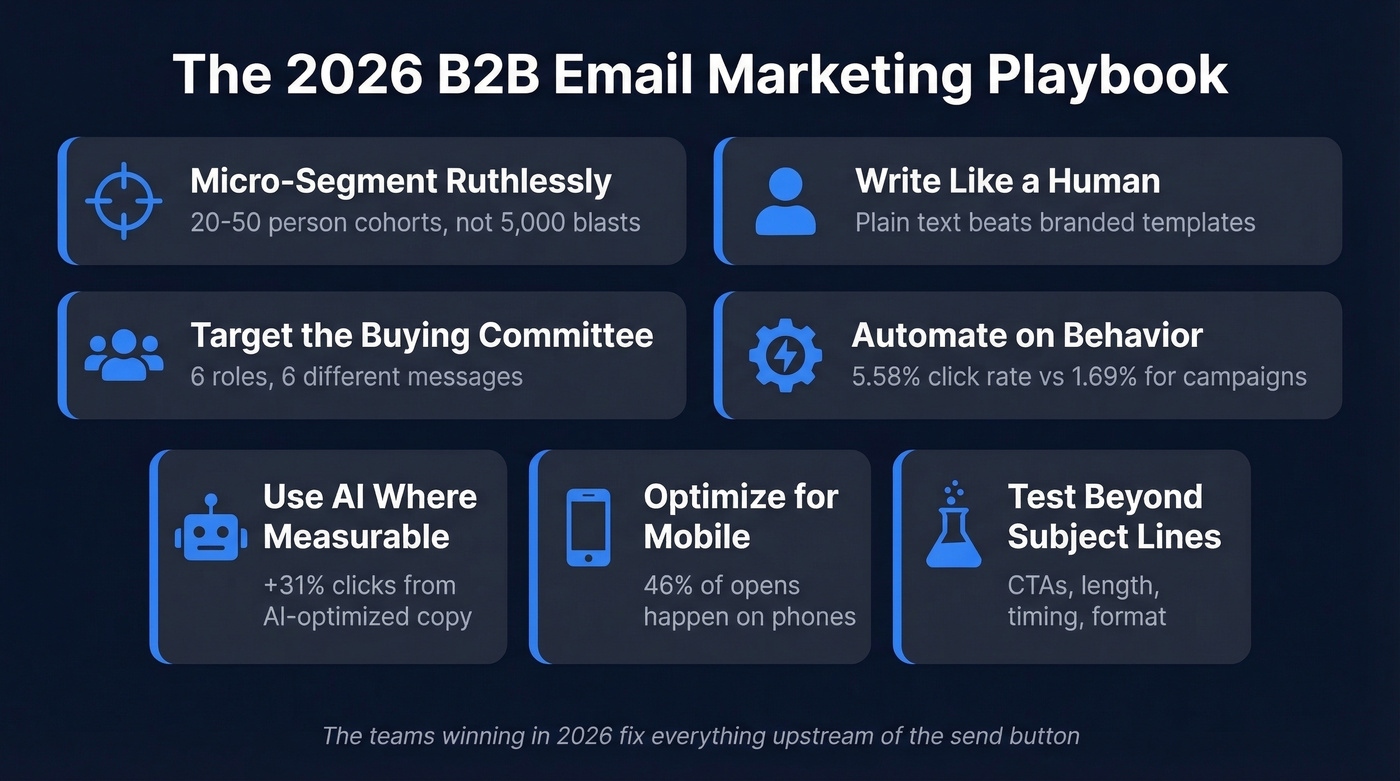
We've run campaigns at both extremes - the micro-segmented cohorts win every time. Smaller cohorts mean higher relevance, fewer spam complaints, and better reply rates. It's the only approach that scales without destroying your sender reputation.
Write Like a Human
No fancy templates. No hero images. Short, sharp, plain-text emails that look like they came from a colleague, not a marketing department. The consensus on Reddit is clear: branded newsletters get archived. Emails that read like a real person wrote them get read.
Target the Buying Committee
Don't send one email to "the company." Send different emails to different stakeholders. The initiator who flagged the problem needs a different message than the CFO who signs the check. Map your content to the six buying center roles and you'll cover more ground with fewer sends.
Here's the thing - this is one of the most overlooked B2B email marketing strategies, and one of the highest-leverage. Most teams default to one message per campaign because it's easier. The teams winning in 2026 accept the extra work.
Automate Based on Behavior
Behavioral triggers crush time-based drips. Klaviyo's data across 183,000+ brands shows automated flows generate a 5.58% click rate versus 1.69% for standard campaigns - 3.3x the engagement. In our testing, automated flows consistently outperform scheduled sends by at least that margin because the email arrives when the prospect actually does something, not when your calendar says it's Tuesday.
Use AI Where It's Measurable
64% of marketers now use AI in email. eBay's work with Phrasee produced +15.8% opens and +31% clicks through AI-optimized subject lines and copy. The key word is "measurable." Use AI for subject line testing, send-time optimization, and personalization at scale. Don't use it to generate entire campaigns you never review.
Optimize for Mobile
This one still trips up experienced teams. Around 46% of emails are opened on mobile devices, yet broken rendering remains one of the most common complaints in practitioner communities. Single-column layouts, 14px+ body text, and tappable CTAs aren't nice-to-haves. Preview every email on a phone before you hit send.
Test Beyond Subject Lines
Most teams A/B test subject lines and stop there. Test send times, CTA placement, email length, plain text vs. HTML, and the number of links. The teams that test beyond the obvious find 10-20% performance gains that compound over months - and those gains are what separate good B2B email marketing from great. (If you need a deeper testing workflow, start with a clean click rate formula and iterate from there.)
Why Your Open Rates Are Lying
Apple Mail Privacy Protection, rolled out in 2021, preloads tracking pixels via proxy servers before anyone reads your email. Every email sent to an Apple Mail user registers as "opened" whether the recipient glanced at it or not. And this isn't limited to iCloud addresses - anyone using the Apple Mail app on iPhone or Mac triggers it, regardless of their email provider.
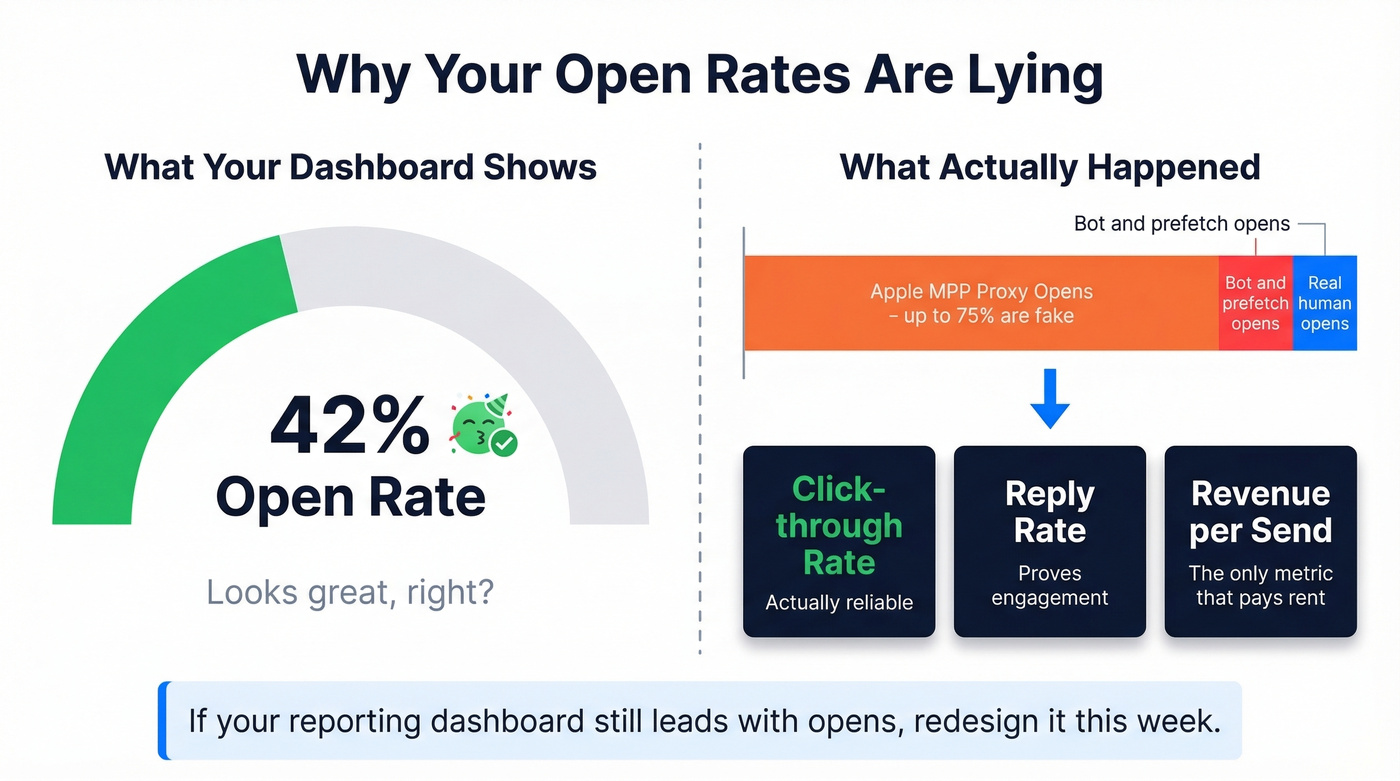
The distortion is massive. Up to 75% of reported opens in some segments are artificial. That "42% open rate" your team celebrated last month? Most of it is Apple's servers, not human eyeballs.
Here's the paradox practitioners are reporting in 2026: opens are improving with better targeting, but clicks are declining - likely due to tighter budgets reducing willingness to act. This makes open rates doubly misleading. They're inflated by MPP and disconnected from the metric that actually matters: did someone click?
Replace open rate with click-through rate, reply rate, conversion rate, and retention. If your reporting dashboard still leads with opens, redesign it this week.

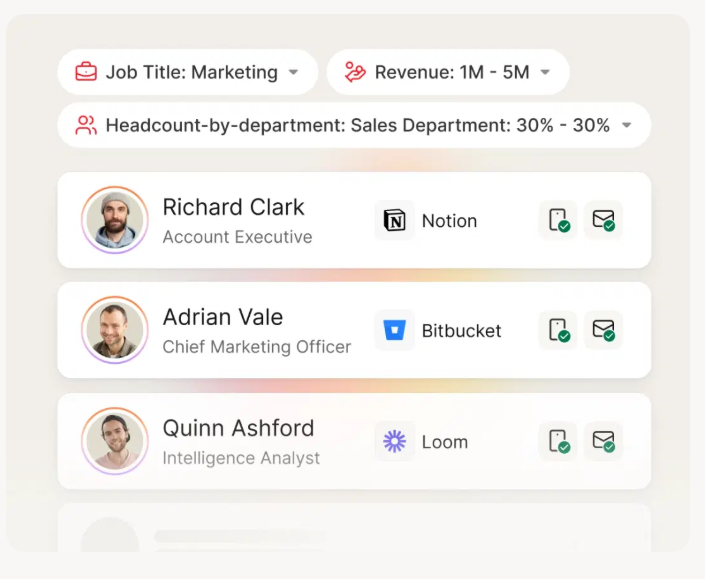
Micro-segmenting to 20-50 person cohorts only works if every email in that cohort is real. Prospeo's 5-step verification delivers 98% email accuracy - so your sniper campaigns actually land. 30+ filters let you build hyper-targeted lists by intent, technographics, job change, and more.
Stop crafting perfect emails for addresses that bounce.
B2B Email Benchmarks (2026)
Benchmarks are guardrails, not gospel. Here's what the data shows, with the MPP caveat firmly in mind.
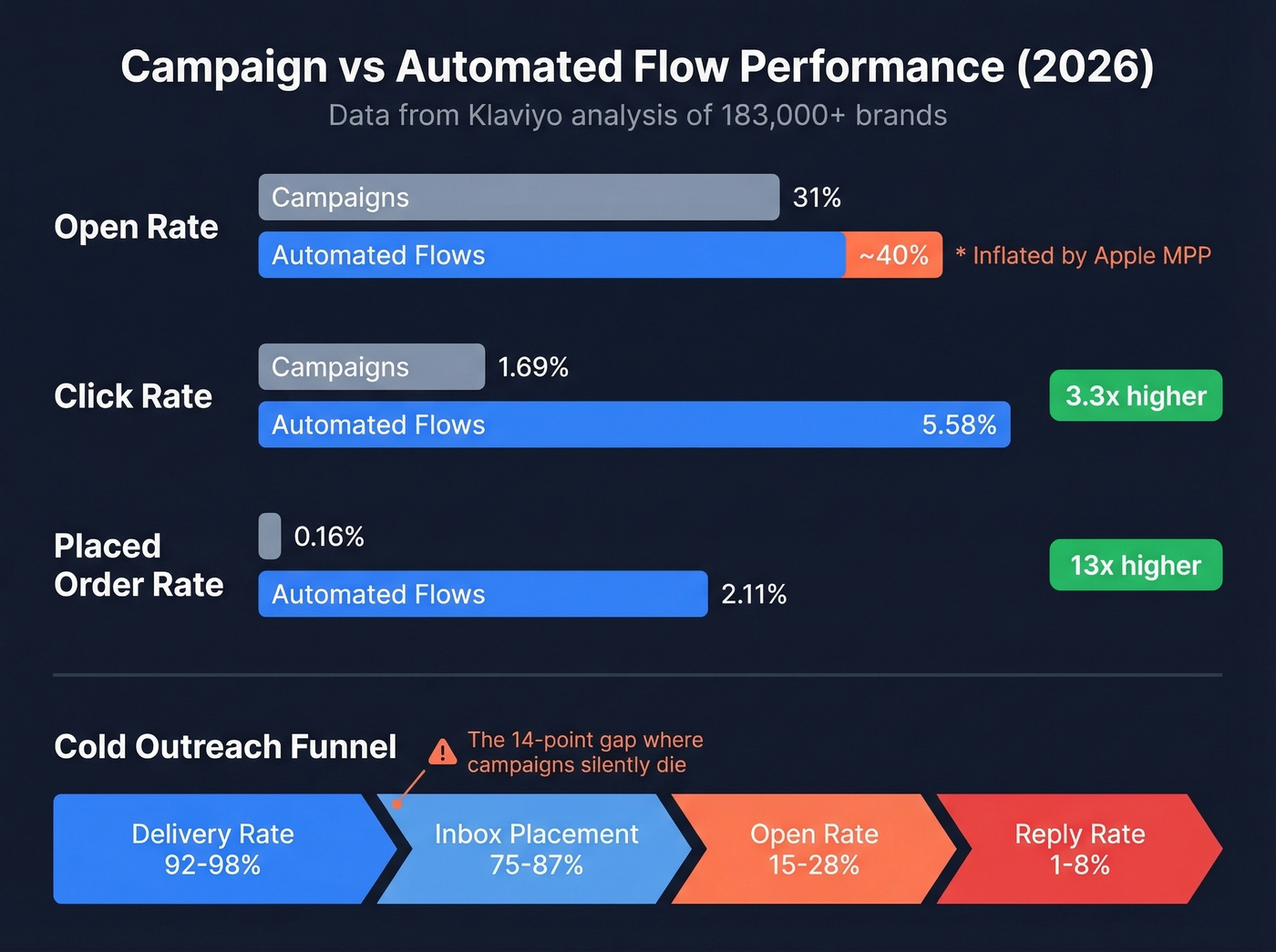
Campaign vs. Automated Flow Performance
| Metric | Campaign Avg | Automated Flow Avg | Top 10% |
|---|---|---|---|
| Open rate | 31% | ~40%* | 45.1% |
| Click rate | 1.69% | 5.58% | 3.38% / 10.48% |
| Placed order rate | 0.16% | 2.11% | 0.36% / 4.3% |
*Automated flow open rates vary by flow type. Data from Klaviyo's analysis of 183,000+ brands. Mailchimp's benchmarks run slightly higher at 35.63% open and 2.62% click across all users, but both datasets are skewed by MPP inflation on the open rate side.
Cold Outreach Funnel
| Stage | Typical Range |
|---|---|
| Delivery rate | 92-98% |
| Inbox placement | 75-87% |
| Open rate | 15-28% |
| Reply rate | 1-8% |
Cold reply rates have declined from 6.8% in 2023 to 5.8% based on the latest available data. The critical distinction most teams miss: delivery rate (~98%) and inbox placement (~84%) aren't the same thing. Your ESP says "delivered" when the server accepts the email. That doesn't mean it hit the inbox - it might be sitting in spam. The ~14-point gap between delivery and inbox placement is where campaigns silently die.
Let's be honest: if your average deal size is under $15K, you probably don't need a $50K/year data platform or a 12-tool martech stack. A verified list, plain-text emails, and behavioral triggers will outperform most enterprise setups at a fraction of the cost.
The Deliverability Playbook
Every deliverability problem traces back to infrastructure. No amount of copywriting skill compensates for emails landing in spam. (For a deeper walkthrough, see our email deliverability guide.)
Authentication: SPF, DKIM, DMARC
These three DNS records prove you're a legitimate sender. Setup takes about 30 minutes per domain, but mistakes can tank your reputation.
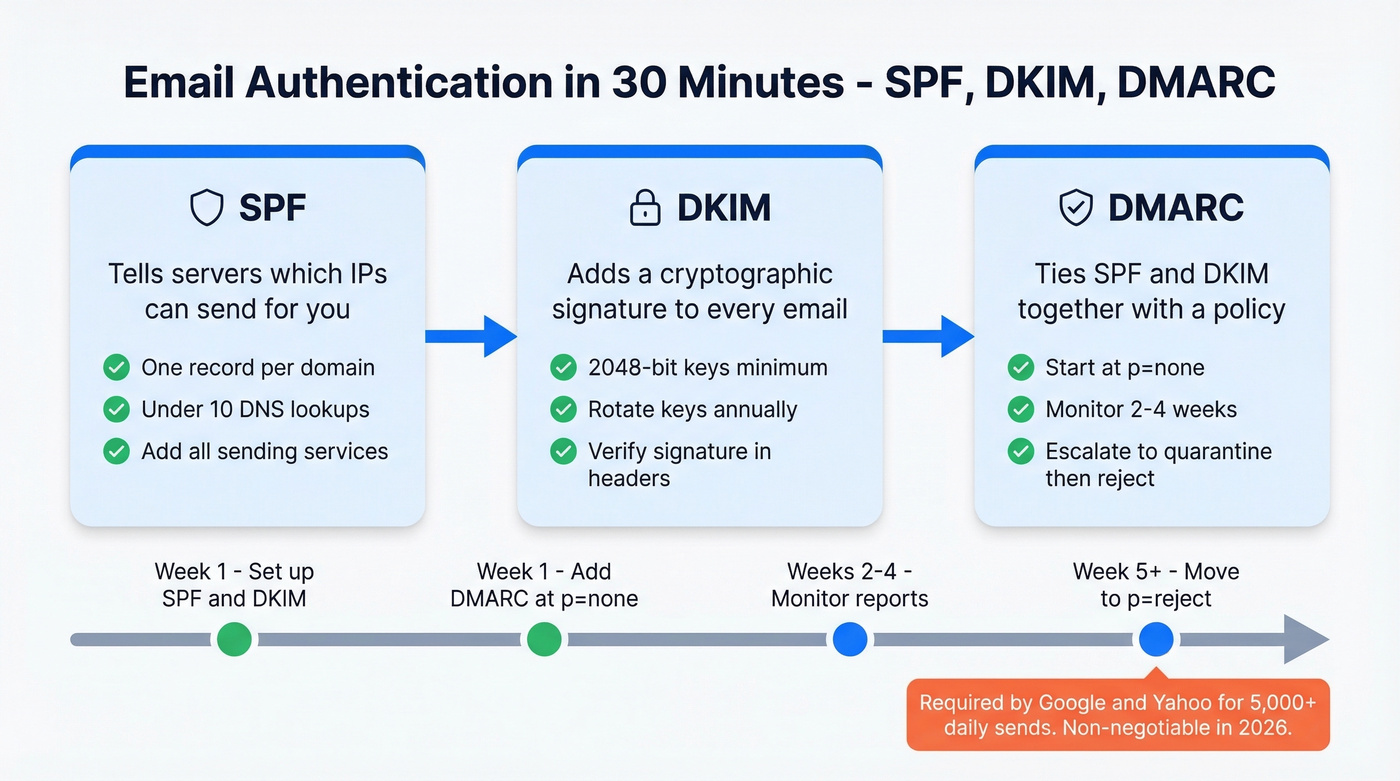
SPF tells receiving servers which IPs can send on your behalf - one record per domain, under 10 DNS lookups. DKIM adds a cryptographic signature to every email; use 2048-bit keys minimum and rotate annually. DMARC ties them together with a policy: start at p=none, monitor for 2-4 weeks, then escalate to quarantine and eventually reject. (If you're troubleshooting policy failures, start with DMARC alignment.)
Bulk Sender Rules (Google & Yahoo)
If you send more than 5,000 emails per day, Google and Yahoo now require SPF + DKIM authentication, DMARC at minimum p=none, one-click unsubscribe per RFC 8058, TLS encryption, valid forward/reverse DNS, and a spam complaint rate below 0.3%. That threshold is non-negotiable. Exceed it and your deliverability craters. Also ensure CAN-SPAM compliance and GDPR consent for EU contacts.
Warming and Sending Limits
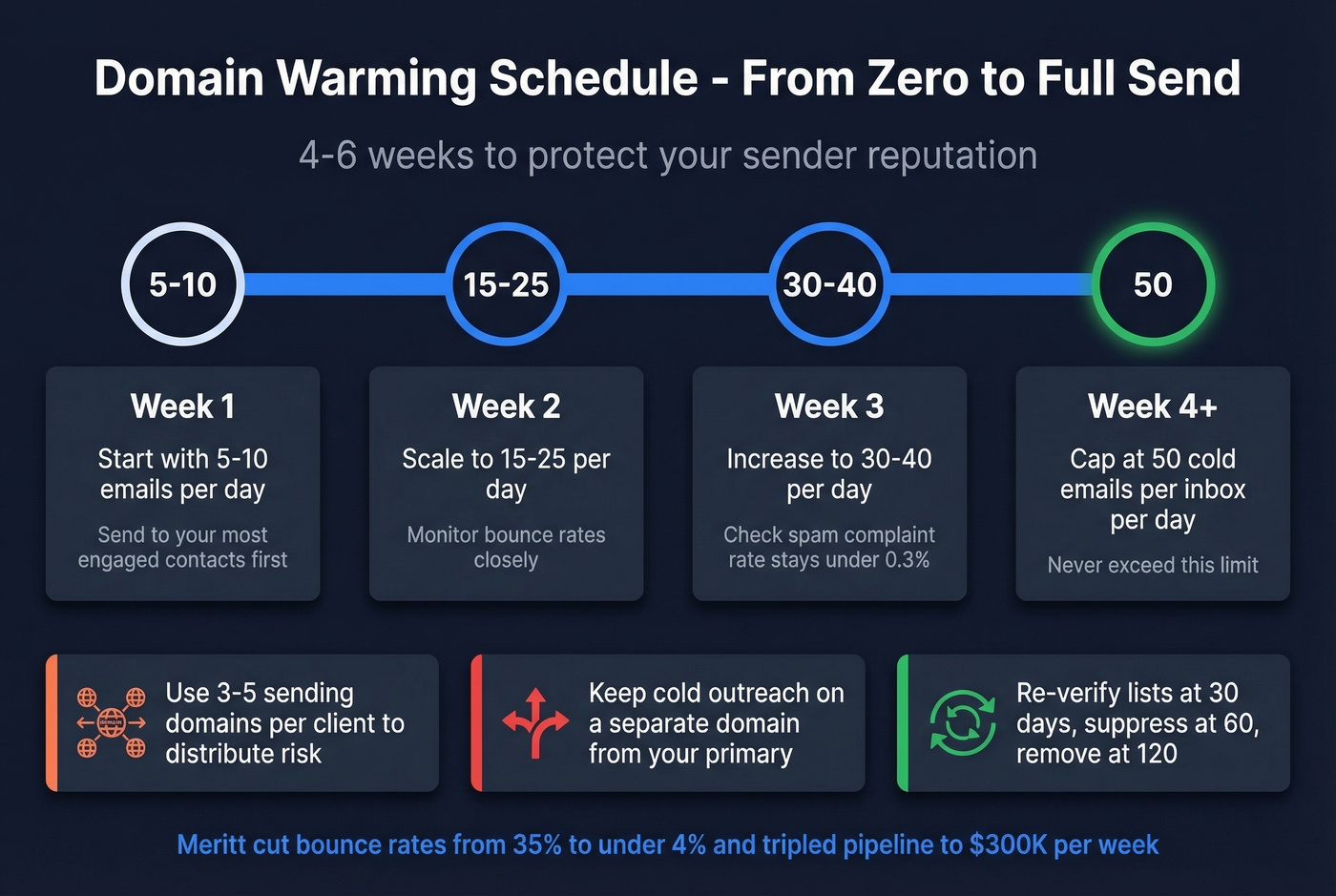
New domains need a 4-6 week warming period. Start with 5-10 emails per day in week one, scaling to 50 by week four. Never exceed 50 cold emails per inbox per day, and use 3-5 sending domains per client to distribute risk. Keep cold outreach on a separate domain to protect your primary domain's reputation. (If you want a stricter framework, follow an email velocity cap by inbox and by domain.)
List Hygiene and Data Quality
Bad emails bounce. Bounces damage your sender reputation. Reputation damage sends future emails to spam - even the ones going to valid addresses. It's a cascade, and the only way to stop it is upstream.

Prospeo handles this with real-time email verification at 98% accuracy, catching spam traps, catch-all domains, and honeypots before they hit your sending infrastructure. The 7-day data refresh cycle means you're not sending to addresses that went stale weeks or months ago. Meritt saw their bounce rate drop from 35% to under 4% after switching - and their pipeline tripled from $100K to $300K per week.
Run your list through a step-down hygiene cadence: re-verify at 30 days, suppress non-engagers at 60, and remove at 120. Your ESP won't do this for you. (If you're diagnosing issues, start with email bounce rate benchmarks and codes.)
Bad data is the fastest way to tank your sender reputation and kill deliverability. Prospeo refreshes every record on a 7-day cycle - 6x faster than the industry average - so your B2B email campaigns hit real inboxes, not spam folders. Teams using Prospeo cut bounce rates from 35%+ to under 4%.
Fix your list before you fix your copy. Start with 75 free verified emails.
5 Mistakes Killing Your Results
Automation without personalization. Triggered emails only work if the content matches the behavior. "You viewed our pricing page" followed by a generic product overview isn't personalization - it's a missed opportunity.
Frequency creep. Teams send more because they can, not because they should. The result is fatigue, unsubscribes, and spam complaints. Anything above a 0.3% spam complaint rate means you're over-sending.
Ignoring mobile rendering. Broken layouts on phones kill engagement instantly. Test every email on mobile before sending - this is the mistake practitioners complain about most, and it's the easiest to fix.
Ignoring deliverability infrastructure. We've seen teams spend months perfecting email copy while sending from an unauthenticated domain with no DMARC record. Fix the plumbing before you paint the walls.
Measuring opens instead of revenue. Open rates feel good and mean nothing. Track clicks, replies, pipeline generated, and revenue influenced. Those are the numbers your CFO cares about.
Best Tools for B2B Email Campaigns
These ESPs handle the sending. But they can't fix what you're sending to - the best automation in the world won't save a campaign built on unverified, stale contact data.
| Tool | Best For | Starting Price | Key Strength | Key Weakness |
|---|---|---|---|---|
| Prospeo | List building + verification | ~$0.01/email | 98% email accuracy | Not an ESP |
| ActiveCampaign | Mid-market B2B | $19/mo | Deep automation | Steep learning curve |
| HubSpot | HubSpot CRM users | $20/mo | CRM integration | Expensive at scale |
| Brevo | Startups | $9/mo | Free tier (300/day) | Basic editor |
| Mailchimp | Simple campaigns | $13/mo | Easy editor | Weak B2B CRM |
| GetResponse | Mid-range all-in-one | $19/mo | Landing pages incl. | Less B2B-focused |
Prospeo
Your ESP sends the emails. Prospeo builds the list worth sending to. With 300M+ professional profiles and 30+ search filters - buyer intent, technographics, job change, headcount growth - you can build micro-segmented cohorts of verified contacts before they ever touch your ESP. The free tier includes 75 verified emails per month plus 100 Chrome extension credits, and paid plans run roughly $0.01 per email. It's the cheapest insurance against the bounce-reputation-spam cascade that kills campaigns.
ActiveCampaign
The obvious pick for mid-market B2B teams that need complex automation tied to a CRM. Behavioral targeting is genuinely deep - trigger sequences based on site visits, email engagement, deal stage changes, and custom events. The built-in CRM isn't Salesforce, but it's more than enough for teams under 50 reps. The tradeoff is a brutal learning curve; expect a solid month of setup before things click. Budget $29-50/mo for a real B2B use case. SaaS teams in particular benefit from ActiveCampaign's ability to trigger flows based on product usage events, which makes it a strong backbone for behavior-driven B2B email marketing strategies.
HubSpot
HubSpot's email marketing is strong if you're already living in HubSpot CRM. The workflow builder is intuitive and reporting ties email performance directly to pipeline. The catch? It gets expensive quickly, and feature gates push you toward higher tiers. Skip this if you're not already on HubSpot CRM - don't adopt HubSpot email just for the email.
Brevo
Use this if you're a startup that needs to send emails without spending money. The free tier gives you 300 emails per day. Paid plans start at $9/mo. Skip this if you need sophisticated automation or a polished drag-and-drop editor.
Mailchimp
Easy editor, solid templates, and a brand everyone recognizes. But Mailchimp isn't built for B2B - the CRM is basic, lead scoring is limited, and it charges you for unsubscribed contacts sitting in your list. From $13/mo.
GetResponse
Solid mid-range option that bundles landing pages, webinars, and automation. Less B2B-specific than ActiveCampaign but good value for teams that want an all-in-one without HubSpot pricing. From $19/mo. Zoho Campaigns ($20/mo) is worth a look if you're already in the Zoho ecosystem, and MailerLite ($25/mo) stays clean and cheap for simple campaigns.
FAQ
What's a good open rate in 2026?
Reported averages range from 31-42%, but Apple MPP inflates these numbers significantly. Focus on click-through rate instead - 2-4% is solid for campaigns, and automated flows should target 5%+. Reply rate matters more than opens for any outbound motion.
How often should I email my B2B list?
One to two times per week works for newsletters. Behavior-triggered emails fire when the prospect takes action, not on a fixed schedule. Watch your spam complaint rate - above 0.3% means you're over-sending and risking your sender reputation.
Is cold email still effective for B2B?
Yes, but reply rates have declined to 5.8%. Success requires micro-segmentation, verified contact data, proper domain authentication, and plain-text messaging that reads like a real person wrote it.
How do I keep emails out of spam?
Authenticate your domain with SPF, DKIM, and DMARC. Warm new domains gradually over 4-6 weeks. Keep your spam complaint rate below 0.3%. Verify every email address before sending to catch spam traps, catch-all domains, and honeypots before they damage your reputation.
What's the difference between delivery rate and inbox placement?
Delivery rate (~98%) means the receiving server accepted your email. Inbox placement (~84%) means it actually landed in the primary inbox, not spam or promotions. The ~14-point gap is where most B2B email marketing campaigns silently fail - and it's the metric your ESP dashboard probably isn't showing you.