

B2B Lead Identification: What Actually Works in 2026
92% of B2B buyers already have at least one vendor in mind before formal evaluation begins. If you're not identifying those buyers early - before they fill out a form - you're showing up to a race that's already halfway over.
B2B lead identification is the discipline that closes that gap. Here's how the identification layer works, which methods deliver, and where most teams stall out.
The Short Version
What Lead Identification Actually Means
Lead identification is the process of discovering who your potential buyers are - by company, name, and contact info - before they self-identify through a form fill or demo request. It's not lead generation, which attracts buyers through content, ads, or events. It's not lead nurturing, which warms them after contact. It's the proactive, outbound-adjacent motion: you're finding the people, not waiting for them to find you.
Why It Matters Now
Up to 98% of B2B website visitors leave without filling out a form. That's not a leak. It's a flood.
The average B2B buying cycle runs 10.1 months, with roughly 5% of accounts actively in-market at any given time. Worse, the pre-contact favorite wins roughly 80% of deals. If you're relying on inbound forms to surface demand, you're seeing a fraction of the picture. Identification is how you illuminate the rest.
Three Methods That Work
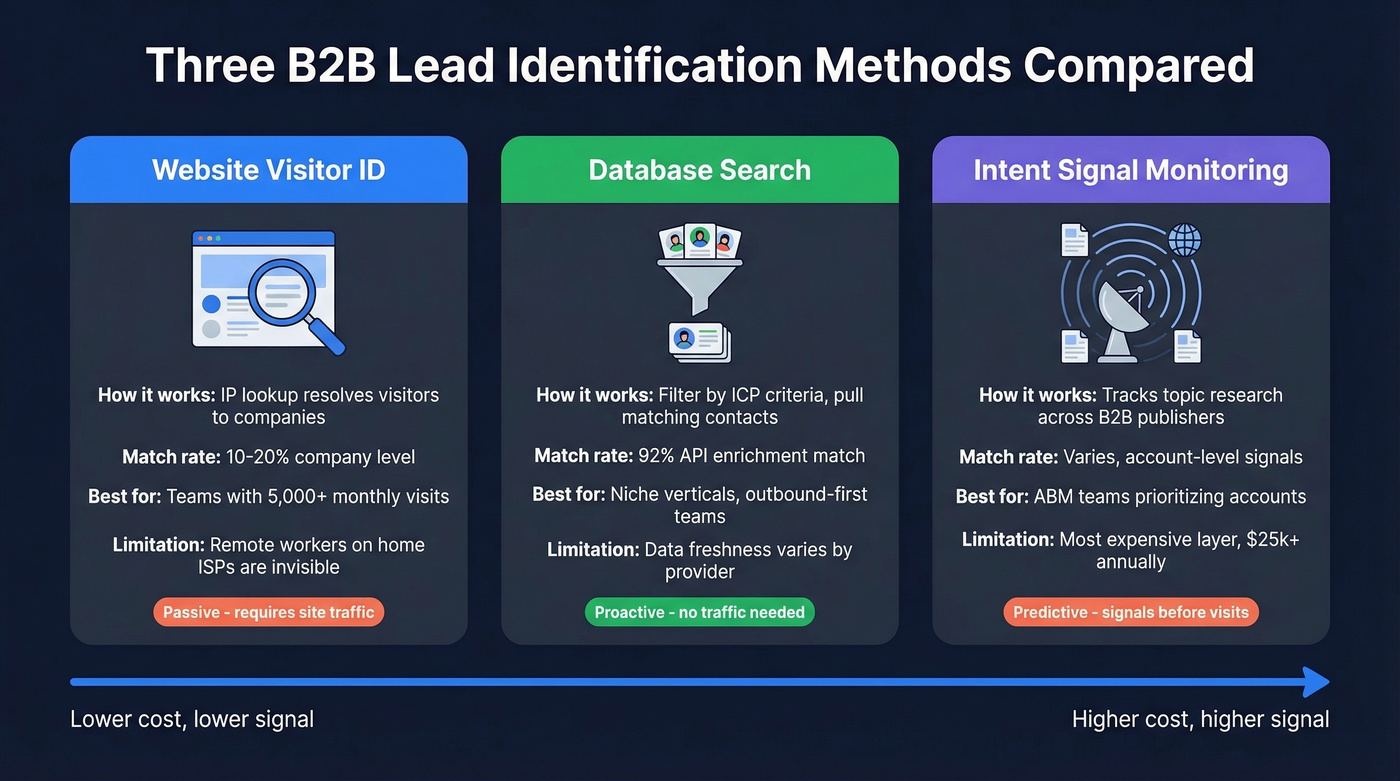
Website Visitor ID
A script on your site captures visitor IP addresses and resolves them to company names using reverse-IP databases. Tools like Leadfeeder and Clearbit Reveal handle this automatically. The catch: over 60% of knowledge workers now browse from home networks, which resolve to ISPs, not corporate domains. Realistic company-level match rates run 10-20%. Person-level tools like RB2B push higher (30-40% on Pro, 70-80% on Pro+), but drop off sharply outside the US.
Database Search
You define your ICP using filters - job title, industry, tech stack, headcount, funding stage - and pull matching contacts from a sales prospecting database. This method doesn't depend on website traffic at all. It scales independently of your site visitors, and the quality of the underlying data matters enormously because stale records mean bounced emails and wasted sequences.
For teams focused on identifying potential customers in manufacturing or other niche verticals, database search often outperforms visitor ID. Those buyers research across trade publications rather than your website, so IP-based tools never see them.
Intent-Signal Monitoring
Intent data platforms like Bombora track topic-level research activity across thousands of B2B publishers. When an account surges on topics relevant to your product, you get a signal - often before they visit your site. The intent data market hit $4.5B in 2026 and is growing at nearly 16% CAGR. This method works best for ABM teams who need to prioritize accounts, not just identify them. It's the most expensive layer but the highest-signal one.

Visitor ID tools cap out at 20% match rates and give you company names - not contacts. Prospeo's database skips the middleman: 300M+ profiles, 30+ ICP filters, and 98% verified email accuracy on a 7-day refresh cycle. Identify and reach the right buyers at $0.01 per email.
Turn lead identification into actual pipeline - not a Slack alert graveyard.
Why Match Rates Disappoint
Every visitor ID vendor publishes impressive match rates. We've tested most of these tools, and the reality on the ground is different. Leadfeeder lands around 10-15% company-level, Clearbit/Breeze hits 15-20%, 6sense runs 10-25% depending on traffic mix, and RB2B pushes 30-40% on Pro - though those numbers lean heavily on US traffic.
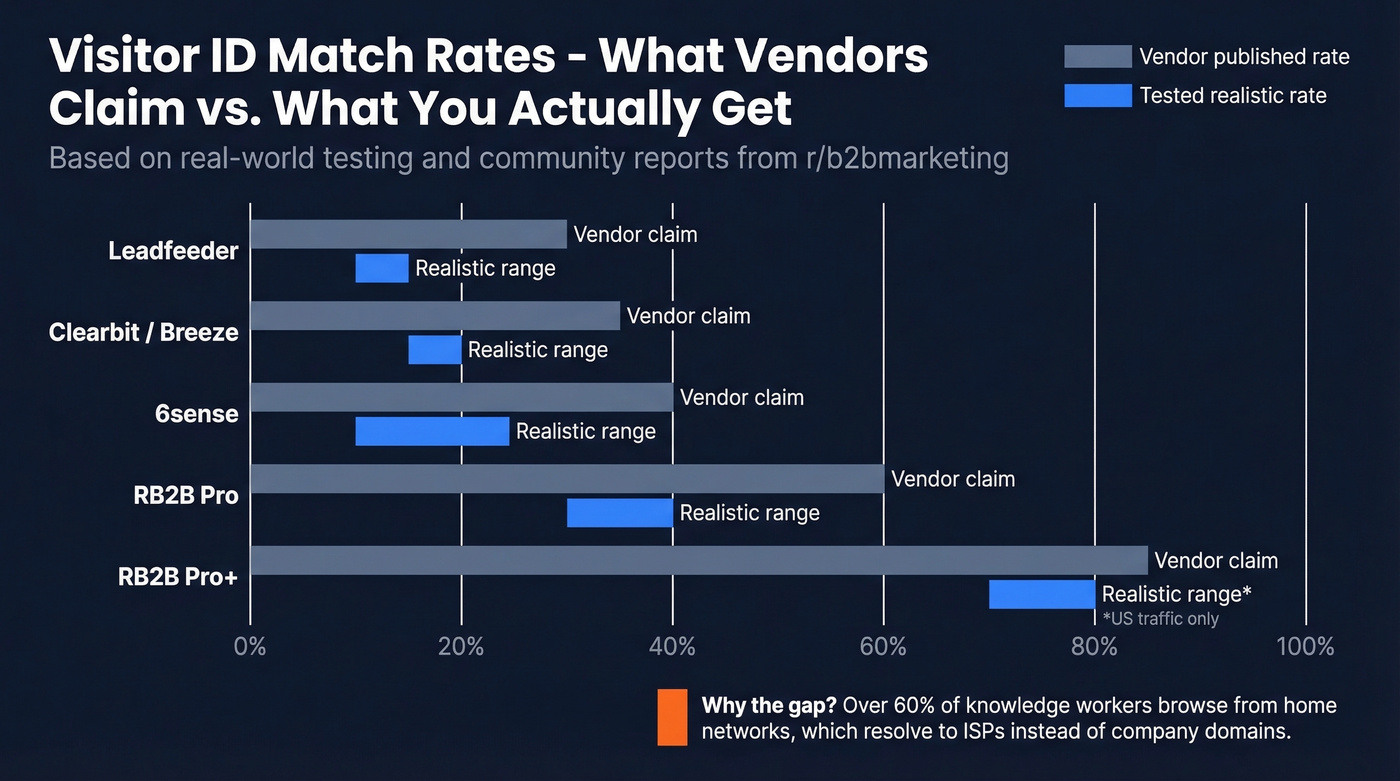
The consensus on r/b2bmarketing is blunt: match rates "vary wildly" and sales teams distrust the data quality. Remote work is the root cause. When most visitors are on residential ISPs, IP-based identification hits a ceiling no amount of AI branding can fix. Treat vendor-published rates as marketing, not benchmarks.
Skip visitor ID entirely if your monthly site traffic is under 5,000 visits. At a 15% match rate, you're getting 750 company names - many irrelevant. A database search approach will give you better contacts faster and cheaper.
The Enrichment Gap
Here's the thing: identifying that "Company X visited your pricing page" isn't a lead. You can't email a company name. You can't call a logo. The Slack-alert model - where a tool pings you with a company name and you manually hunt for contacts - creates noise, not pipeline. Contacting leads within 24 hours increases conversion by 5x. Manual follow-up kills that window.
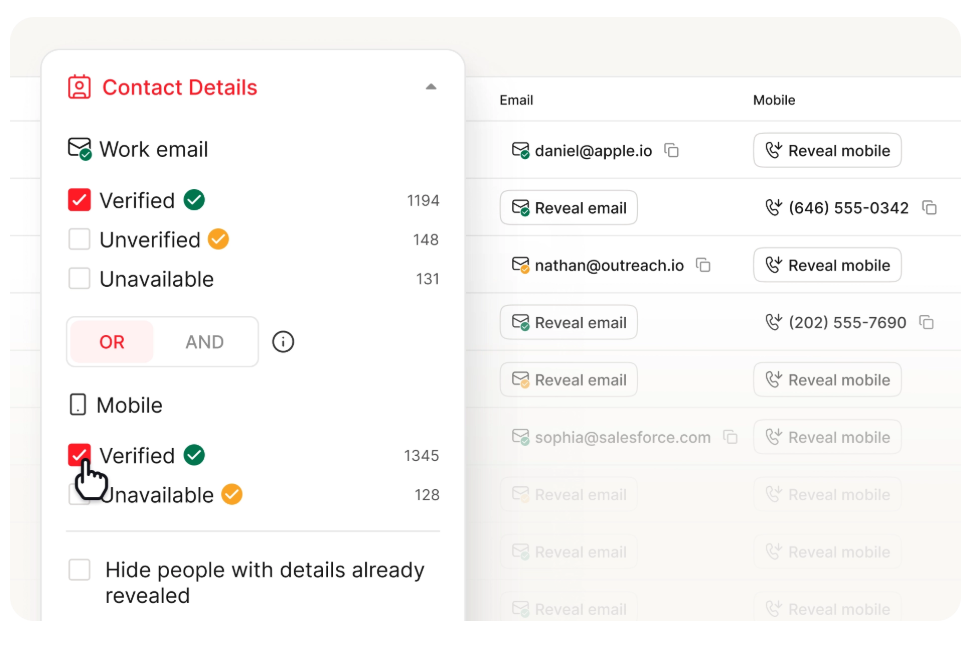
This is where enrichment tools earn their keep. Once you know which companies are showing interest, you need verified contacts fast. Prospeo handles that step - 98% email accuracy on a 7-day refresh cycle, 300M+ professional profiles, 125M+ verified mobile numbers - so your sequences actually land instead of bouncing into the void.
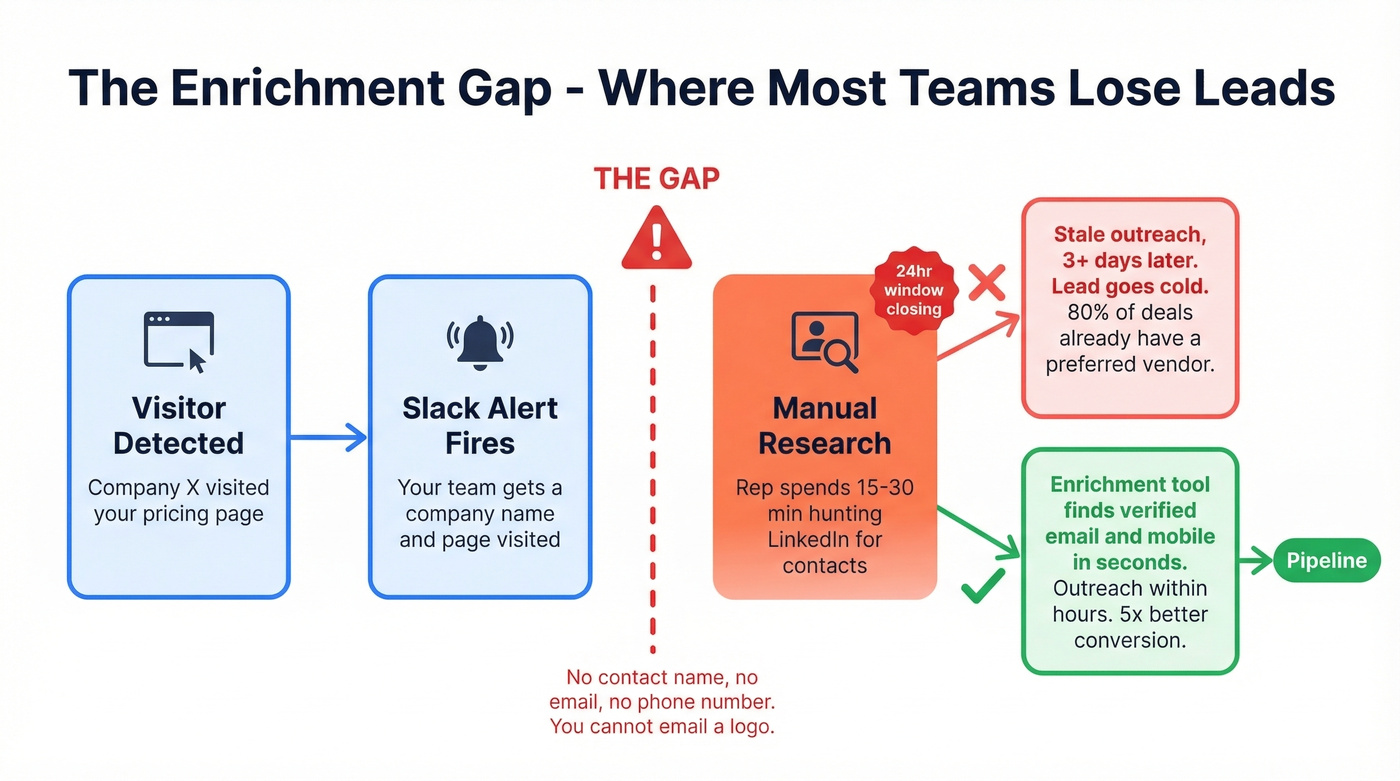
The article above shows the enrichment gap: knowing Company X visited your pricing page means nothing without a verified contact. Prospeo closes that gap with a 92% API match rate, 125M+ verified mobiles, and 50+ data points per contact - so your sequences land within hours, not days.
Bridge the gap between identified accounts and booked meetings.
B2B Lead Identification Tools Compared
| Tool | Method | Match Rate | Starting Price | Best For |
|---|---|---|---|---|
| Prospeo | Database + enrichment | 92% API match* | Free; ~$0.01/email | Verified contacts at scale |
| Leadfeeder | IP visitor ID | 10-15% | Free; EUR99/mo paid | Affordable company-level ID |
| RB2B | Person-level visitor ID | 30-40% (Pro) | Free; $79/mo Starter | US-focused person-level ID |
| Clearbit/Breeze | IP visitor ID | 15-20% | $45/mo (100 credits, HubSpot) | HubSpot-native teams |
| 6sense | Intent + visitor ID | 10-25% | ~$60-120k/yr | Enterprise ABM |
| Demandbase | Intent + visitor ID | 10-20% | ~$25-50k/yr | Mid-market ABM |
| Lead411 | Database + intent | N/A | ~$49/mo | SMB intent + contacts |
| VisitorQueue | IP visitor ID | 10-20% | ~$31/mo | Budget visitor tracking |
*Match rates for visitor ID tools reflect company/person identification from site traffic. Prospeo's 92% is an API enrichment match rate - it finds contacts for companies you already know.
Leadfeeder is the safe starting point for teams wanting company-level visibility without commitment. RB2B is worth testing if your traffic is primarily US-based, but watch overage costs ($0.25-$0.45 per resolution above your cap). 6sense and Demandbase are enterprise plays - $25k+ annually before you see value.
Compliance Quick Reference
- Permitted under legitimate interest: Company-level IP identification using network metadata - no cookies, no fingerprinting. Requires transparency and opt-out.
- Requires explicit consent: Person-level identification, tracking cookies, device fingerprinting, cross-site tracking.
- US (CCPA): More permissive, but still requires opt-out mechanisms.
If you're selling into the EU, company-level tools like Leadfeeder are safer than person-level tools. RB2B's own documentation acknowledges person-level ID is US-only for compliance reasons.
Simple ROI Math
Let's run the numbers on a common scenario:
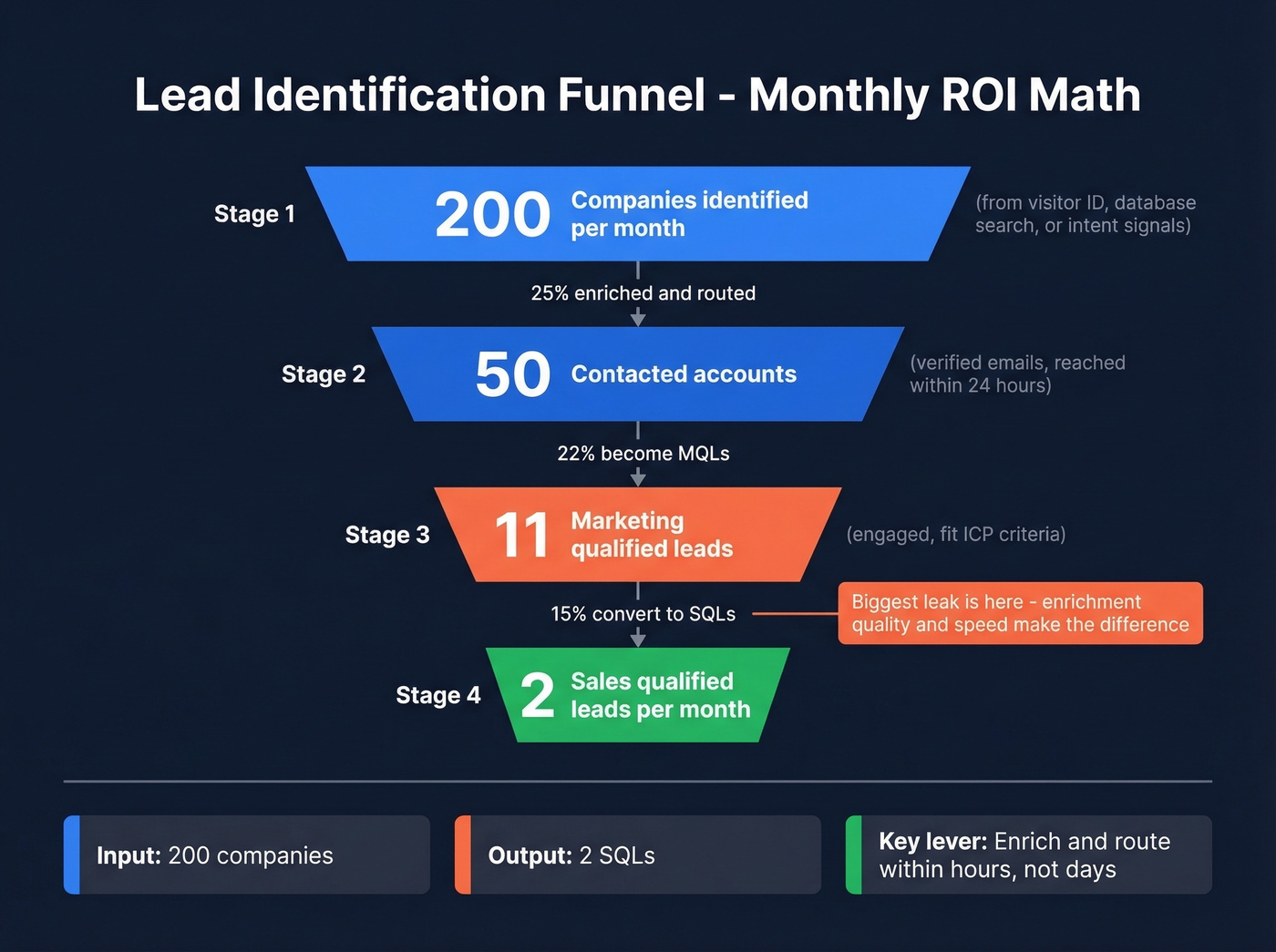
- Start with 200 identified companies/month
- Turn 25% into sales-ready contacts via enrichment and routing: 50 contacted accounts/month
- 22% become MQLs: ~11 MQLs/month
- 15% become SQLs: ~2 SQLs/month
Close rate depends on deal size, sales cycle, and whether you're doing ABM or high-volume outbound. But the pattern is consistent: the biggest leak is usually MQL-to-SQL, and that's exactly where enrichment quality - verified emails, mobile numbers, and fast follow-up - makes the difference. In our experience, teams that enrich and route within hours rather than days see dramatically better SQL conversion.
FAQ
What's the difference between lead identification and lead generation?
Lead identification discovers who your buyers are by name and contact info before they self-identify. Lead generation attracts them to you through content, ads, or events. Identification is proactive and outbound-adjacent; generation is inbound-adjacent. Most teams need both working together.
What's a realistic match rate for visitor ID tools?
Expect 10-20% company-level from IP-based tools like Leadfeeder or Clearbit. Person-level tools like RB2B push 30-40% on US traffic at the Pro tier. Remote work has compressed these numbers - treat all vendor-published rates as directional, not guaranteed.
How do I turn identified companies into actual contacts?
Use an enrichment platform to find verified emails and phone numbers for decision-makers at identified companies. Teams that reach out within 24 hours see 5x better conversion, so speed matters as much as accuracy here.
Is website visitor identification GDPR compliant?
Company-level IP identification using network metadata generally falls under legitimate interest and doesn't require explicit consent, provided you offer transparency and opt-out. Person-level identification, tracking cookies, and device fingerprinting do require explicit consent under GDPR. If you sell into the EU, stick with company-level tools.