

B2B Marketing Automation Strategy: A Practical 2026 Playbook
A solo founder on r/b2bmarketing summed it up perfectly: adding more tools and more automation made everything worse. More complexity, more generic content, more noise. The shift that actually worked wasn't a new platform - it was standardizing inputs first. Automation amplifies whatever foundation already exists. If that foundation is unclear positioning and a vague ICP, you'll just produce garbage faster.
That's the core of any effective B2B marketing automation strategy. Software second. Scoring models that don't lie to your sales team. A foundation worth amplifying.
Automation Isn't Strategy
We've watched teams spend six figures on marketing automation platforms and end up with nothing but a more sophisticated way to send emails nobody reads. The pattern is always the same: buy the tool, build a few workflows, realize the messaging is generic, blame the platform.
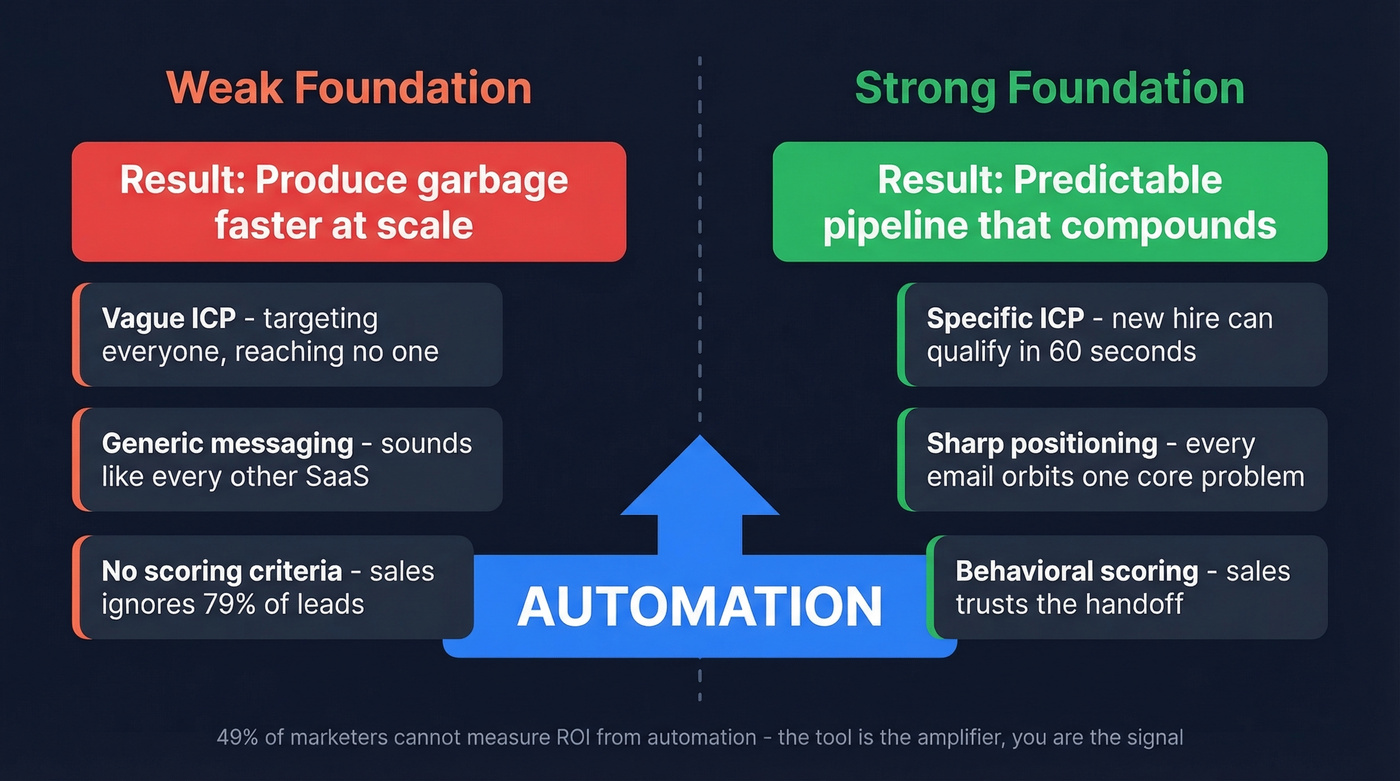
Here's the uncomfortable truth: 49% of marketers can't even measure ROI from their automation efforts. That's not a technology failure. It's a strategy failure. Automation multiplies whatever you feed it - sharp positioning and a well-defined ICP scale beautifully, while vague value props and a "spray and pray" contact list just annoy more people, faster.
The tool is the amplifier. You're the signal.
What Automation Actually Means
B2B marketing automation is rule-based workflows that trigger actions based on prospect behavior, then measure the results. That's it. Everything else is marketing fluff.
The table-stakes channels: email automation (drip sequences, nurture tracks, re-engagement), segmentation by firmographic, behavioral, and intent signals, lead scoring that assigns numerical weight to actions so sales knows who's warm, and multi-channel orchestration coordinating email, SMS, WhatsApp, push notifications, and web personalization into a single journey.
The magic isn't in any one channel. It's in the triggers connecting them and the measurement telling you what's working.
Start Before Software
Before you touch a single workflow builder, nail these four things. If your CEO asks what changed after 90 days of automation, these are the answers that matter.
Standardize your inputs. Define your ICP with enough specificity that a new hire could identify a qualified account in under 60 seconds. Lock in a brand tone guide - not a novel, just a one-pager that prevents your nurture emails from sounding like they were written by five different people. Identify the single repeated problem your product solves and make every piece of content orbit that problem. Map your buyer's journey stages to real actions, not theoretical ones.
Build your lifecycle before your workflows. Agree with sales on what "qualified" means - in writing, with criteria. Define handoff triggers that are behavioral, not arbitrary. "Visited pricing 3x" beats "downloaded any eBook." Set SLAs for follow-up speed on both sides. Create a feedback loop for rejected leads so they route back into nurture with a reason code, not into a black hole.
If you can't articulate these on a whiteboard in five minutes, you're not ready for automation. You're ready for a strategy session.
Lifecycle Stages That Convert
Every automation platform lets you build workflows. The question is whether those workflows map to how buyers actually move through your funnel.
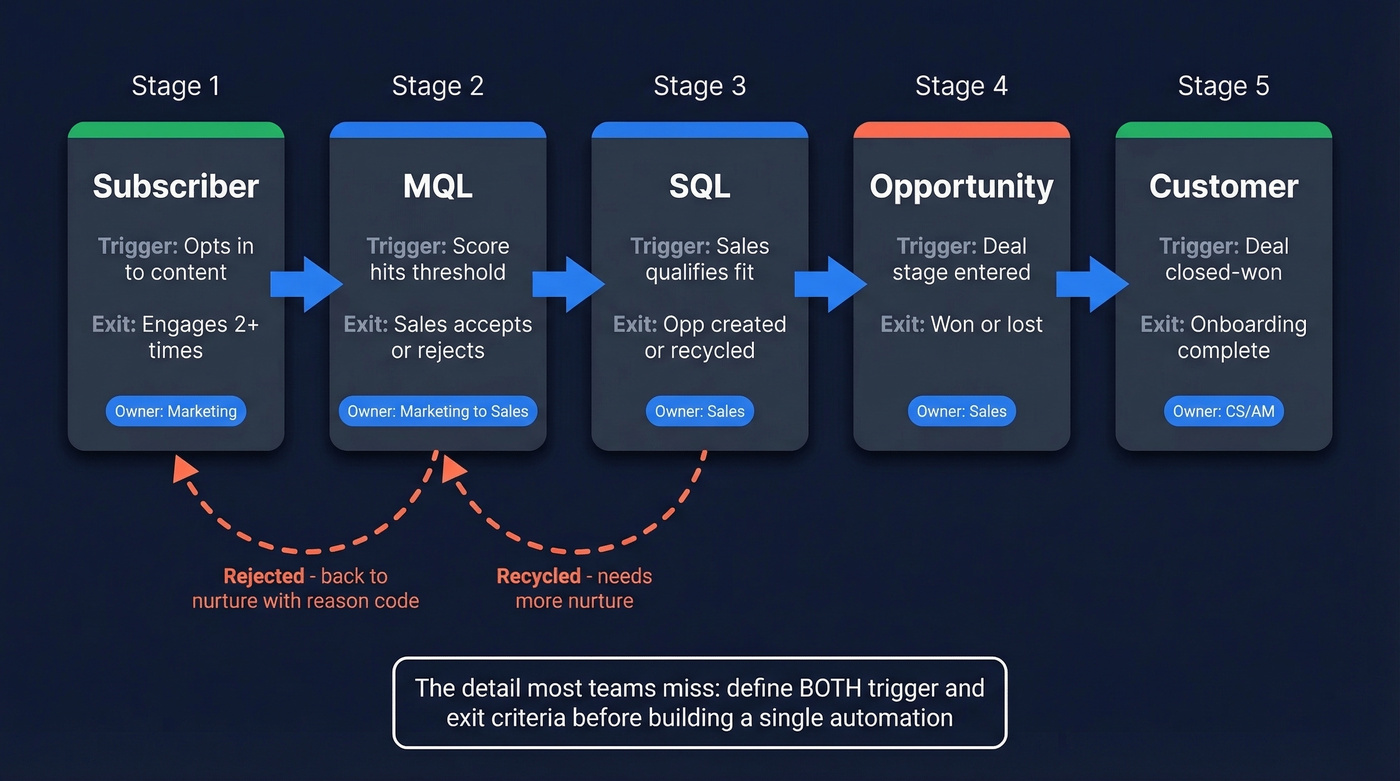
| Stage | Trigger to Enter | Exit Criteria | Handoff Owner |
|---|---|---|---|
| Subscriber | Opts in to content | Engages 2+ times | Marketing |
| MQL | Score hits threshold | Sales accepts/rejects | Marketing → Sales |
| SQL | Sales qualifies fit | Opp created or recycled | Sales |
| Opportunity | Deal stage entered | Won or lost | Sales |
| Customer | Deal closed-won | Onboarding complete | CS/AM |
The critical detail most teams miss is exit criteria. Without them, leads pile up in MQL limbo and your scoring model becomes meaningless - every stage needs a clear "what moves them forward" and "what sends them back," and you need to define both trigger and exit criteria before you build a single automation. The workflow is just the plumbing for these decisions.
Build attribution into each stage from the start. Track which channel and campaign created the lead, which touchpoints accelerated them, and which content appeared in the final conversion path. Without this, you'll never know which workflows actually drive pipeline.
Lead Scoring That Works
Lead scoring is where automation either earns its keep or becomes an expensive fiction. The goal is simple: surface the prospects most likely to buy so sales doesn't waste time on tire-kickers.
A Scoring Template You Can Steal
Combine two dimensions - fit (who they are) and engagement (what they do).
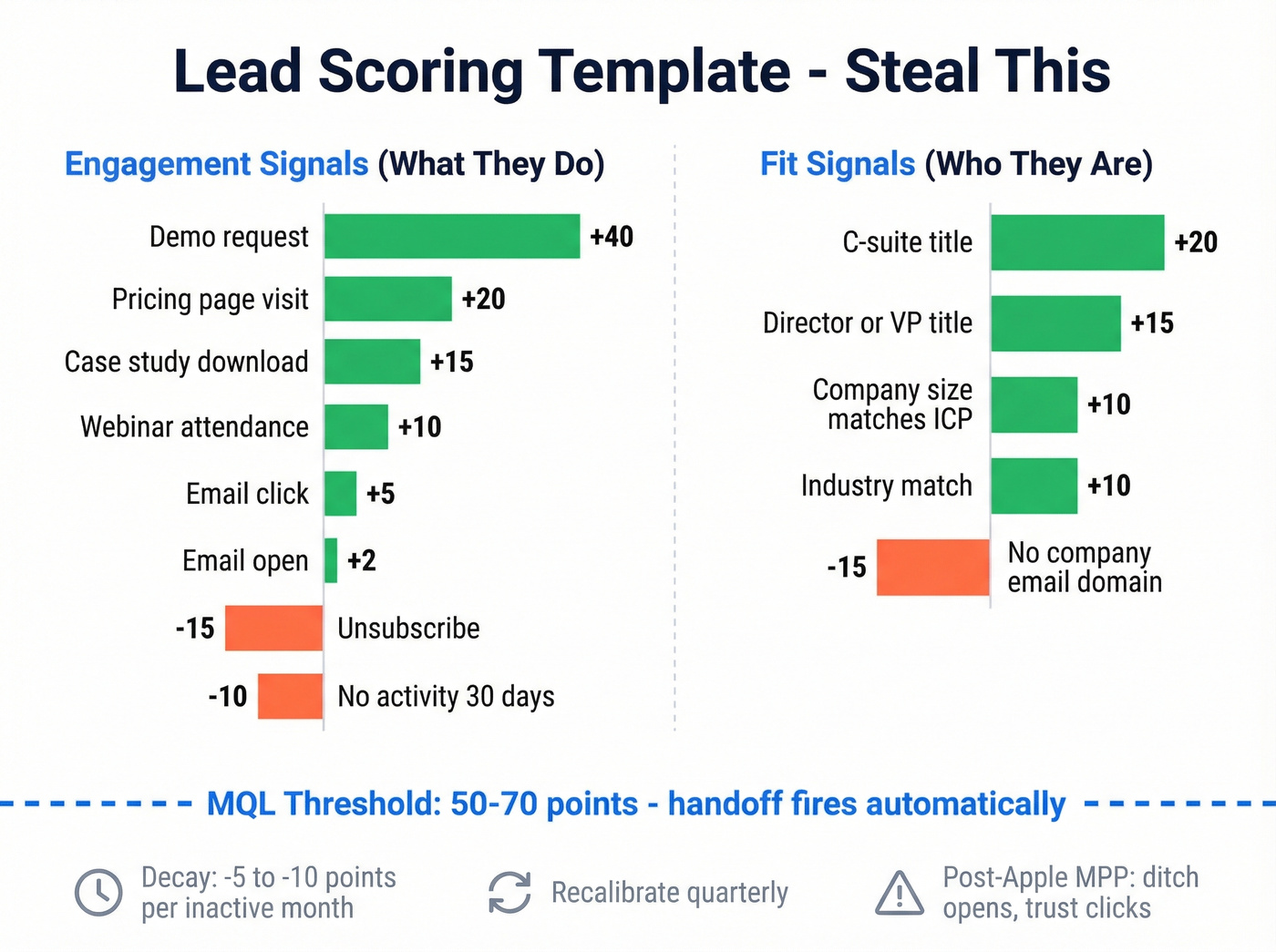
Engagement signals:
| Action | Points |
|---|---|
| Demo request | +40 |
| Pricing page visit | +20 |
| Case study download | +15 |
| Webinar attendance | +10 |
| Email click | +5 |
| Email open | +2 |
| Unsubscribe | -15 |
| No activity 30 days | -10 |
Fit signals:
| Attribute | Points |
|---|---|
| C-suite title | +20 |
| Director/VP title | +15 |
| Company size matches ICP | +10 |
| Industry match | +10 |
| No company email domain | -15 |
Set your MQL threshold around 50-70 points. When a lead crosses that line, the handoff fires automatically.
Ditch Opens, Trust Clicks
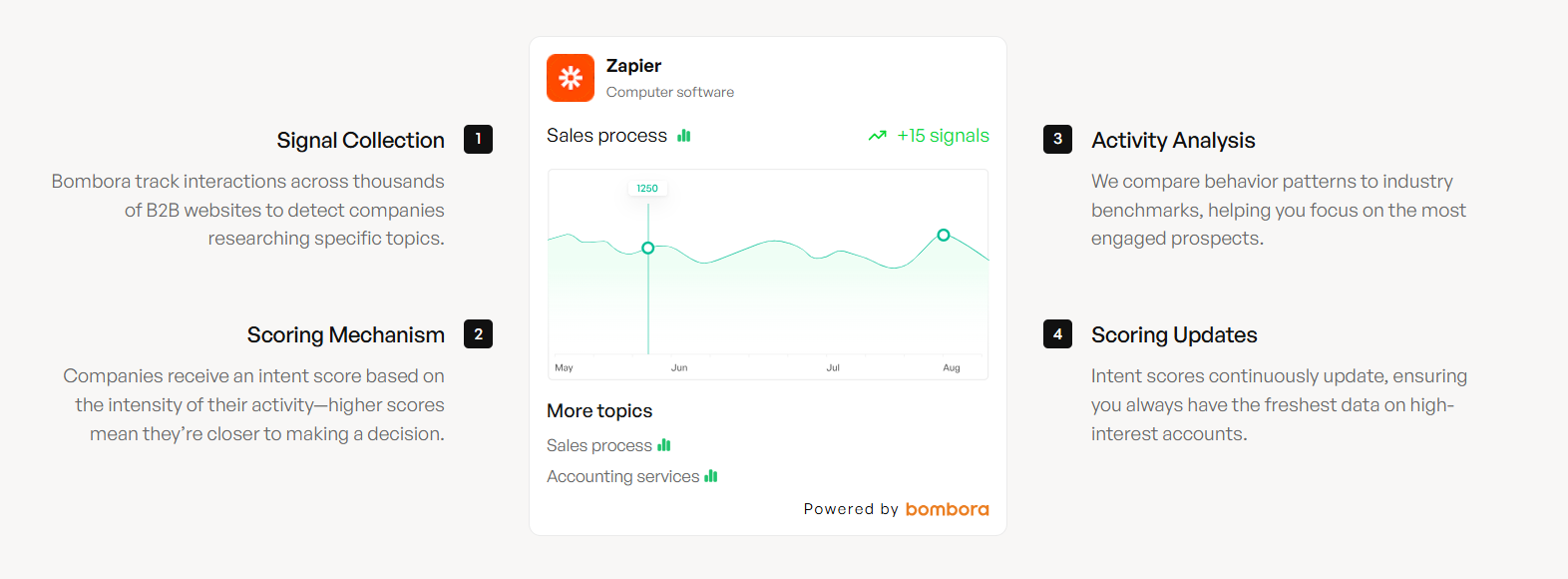
Post-Apple Mail Privacy Protection, email opens are unreliable. Privacy features pre-load pixels and inflate open rates with phantom engagement. If you're still weighting opens heavily, you're scoring ghosts. Shift weight toward on-site behavior - pricing page views, form submissions, demo requests. These signals can't be faked.
Score Decay
Scores should decay. A prospect who was active six months ago isn't the same as one who visited your pricing page yesterday. Drop 5-10 points per month of inactivity, and recalibrate quarterly. If high scorers aren't converting, audit your criteria. If low scorers are closing, you're weighting the wrong signals.
Pardot separates scoring (engagement) and grading (fit). HubSpot and Marketo typically roll both into a single score, which works but requires more discipline to keep the weighting honest.
Start With Clean Data

Your lead scoring model is fiction if the emails underneath it bounce. Prospeo's 5-step verification delivers 98% email accuracy and refreshes every 7 days - so the contacts entering your automation workflows are real buyers, not dead addresses inflating your MQL count.
Stop scoring leads you can't actually reach.
Alignment and Handoff SLAs
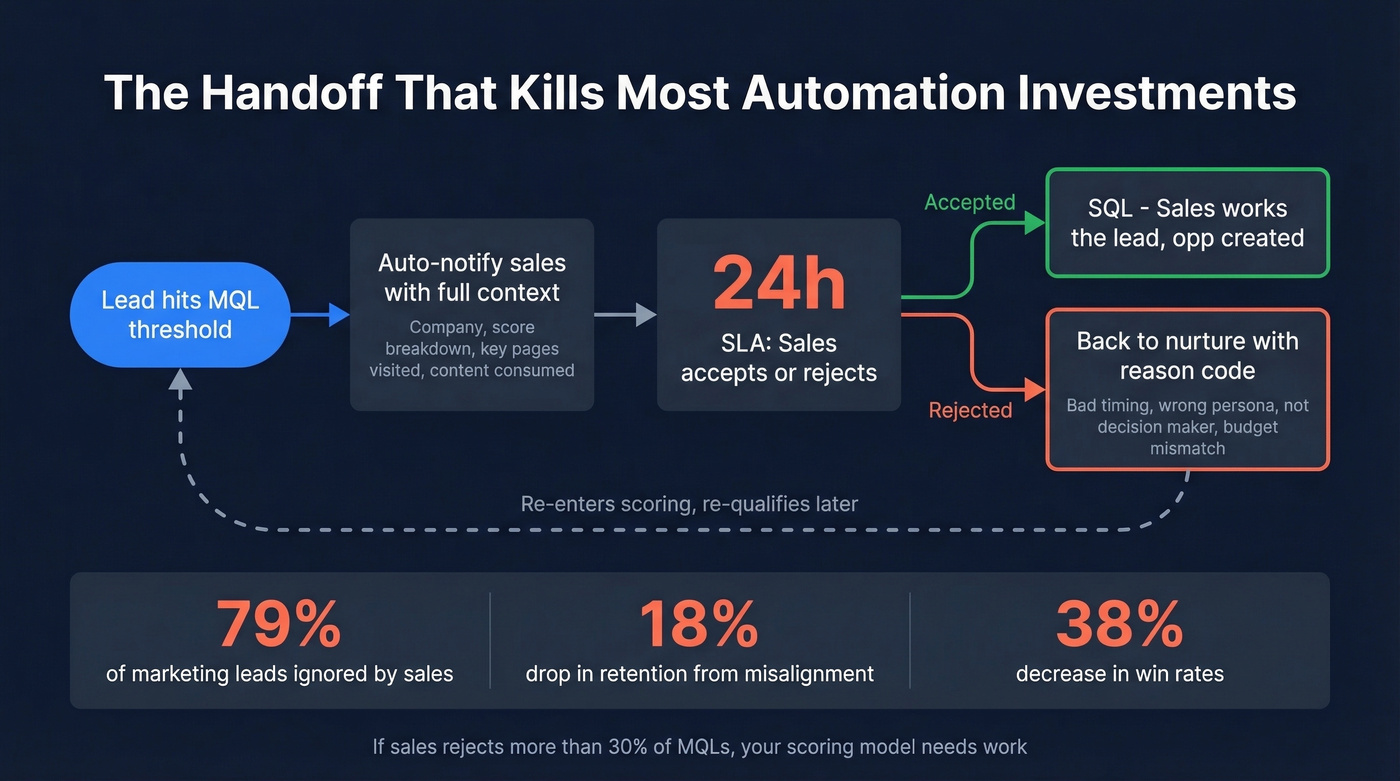
Sales ignores 79% of marketing-generated leads. Nearly four out of five leads that marketing works to generate and qualify never get a meaningful follow-up. Marketing-sales misalignment causes an 18% drop in retention and a 38% decrease in win rates. That's pipeline evaporating because two teams can't agree on what "qualified" means.
Threads on r/sales and r/MarketingAutomation tell the same story over and over: marketing celebrates MQL volume while sales complains about lead quality, and neither team examines the handoff process sitting between them.
Do this. Write down MQL criteria in a shared doc - both teams sign off. Set a 24-hour SLA for sales to accept or reject an MQL. Build a closed-loop for rejected leads so they go back into nurture with a reason code. Review conversion rates monthly; if sales rejects more than 30% of MQLs, your scoring model needs work.
Stop doing this. Throwing leads over the wall with no context beyond a name and email. Letting "I'll get to it" replace a real SLA. Running separate dashboards that tell different stories about the same pipeline.
The handoff is where most automation investments die. Not in the workflow builder. Not in the email copy. In the gap between marketing and sales.
Seven Mistakes to Avoid
These come up in every automation audit we've run.
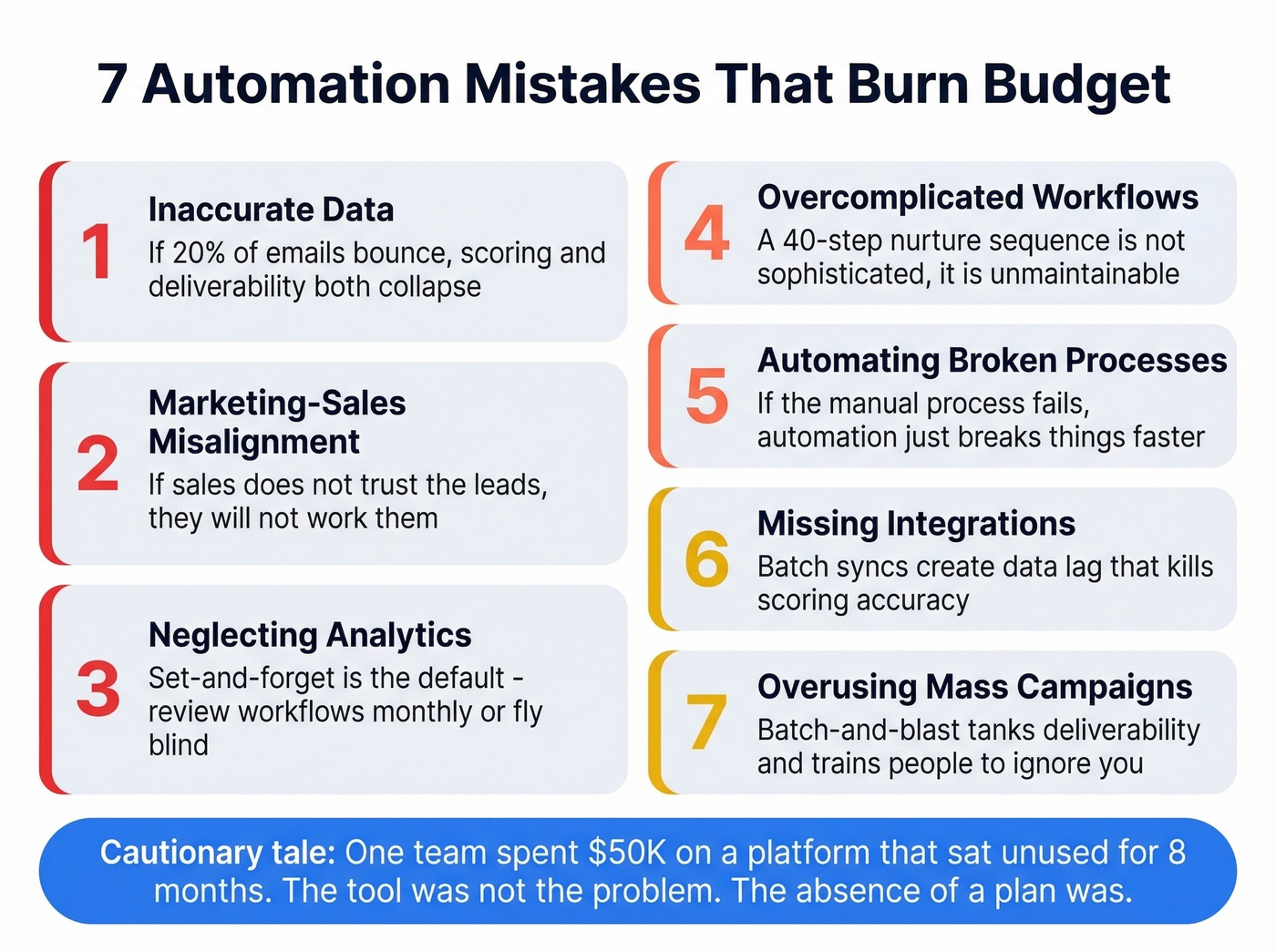
Inaccurate data - If 20% of your emails bounce, your scoring, segmentation, and deliverability all suffer. Fix the data layer first.
Marketing-sales misalignment - If sales doesn't trust the leads, they won't work them. Period.
Neglecting analytics - Set-and-forget is the default mode. If you're not reviewing workflow performance monthly, you're flying blind.
Overcomplicated workflows - A 40-step nurture sequence with branching conditions everywhere isn't sophisticated. It's unmaintainable. Start simple.
Automating broken processes - If your manual process doesn't work, automating it just breaks things faster.
Missing integrations - Your automation platform needs to talk to your CRM in near real time. Batch syncs create data lag that kills scoring accuracy.
Overusing mass campaigns - Batch-and-blast is the fastest way to tank deliverability and train your audience to ignore you.
One cautionary tale: a team spent $50K on a platform that sat unused for eight months because nobody mapped out the strategy before buying. The tool wasn't the problem. The absence of a plan was.
Privacy-First Automation
Privacy isn't a compliance checkbox anymore - it's a live execution constraint that affects segmentation, suppression workflows, and reporting accuracy.
GDPR requires explicit consent for marketing communications, with fines up to EUR 20M or 4% of global turnover. CCPA/CPRA follows an opt-out model with penalties reaching $7,500 per intentional violation. Global Privacy Control signals must be detected and propagated across your entire downstream stack - CRM, CDP, paid media, email platform. IAB TCF 2.3, mandatory since February 2026, imposes stricter transparency and vendor disclosure requirements for any ad-tech or tracking in your automation workflows.
Operationally: audit every data vendor for GDPR compliance and available DPAs, build suppression workflows that honor opt-outs within 24 hours across all channels, store consent records with timestamps and source, and test GPC signal propagation end-to-end quarterly. 81% of consumers believe how an organization treats personal data reflects how it respects them as customers.
AI and Agentic Automation
The shift from AI-assisted features to AI that runs campaigns autonomously is happening faster than most marketing teams expected. Daily AI usage is up 233% in six months per the Slack Workforce Index, with daily users reporting 64% higher productivity. Juniper Research projects AI-agent-automated customer interactions will grow from 3.3 billion in 2025 to 34 billion-plus by 2027.
For B2B marketing automation, this means the move from scheduled workflows to self-optimizing systems that adjust creative, timing, and channel mix in real time. Only about a third of B2B organizations have implemented agentic AI at scale, which means there's still a window to get ahead.
Invest in first-party data infrastructure now - AI models are only as good as the data they train on. Add human QA checkpoints to any AI-generated content or workflow decisions, because autonomy without oversight is how you send the wrong email to your biggest account. Start testing self-optimizing workflows in low-stakes campaigns like re-engagement and content nurture before rolling them into pipeline-critical sequences. And maintain testing discipline - AI doesn't eliminate the need for A/B testing, it accelerates it.
Our take: The teams that win in 2026 won't be the ones with the most AI features. They'll be the ones with the cleanest data and the most disciplined testing culture. AI is a force multiplier, and if your data is dirty, it multiplies the mess.
What It Actually Costs
| Platform | Starting Price | Best For |
|---|---|---|
| HubSpot | $800-$3,600/mo | Mid-market all-in-one |
| Pardot | $1,250-$4,000/mo | Salesforce-native teams |
| Marketo | ~$895/mo | Enterprise complexity |
| Eloqua | $2,000+/mo | Oracle ecosystem |
| 6sense | $60K+/yr | ABM + intent |
| ActiveCampaign | ~$49/mo | SMB automation |
| Brevo | Free-$18/mo | Budget-friendly start |
| Clay | $149/mo | Workflow orchestration |
| Apollo | Free-$79/mo | Outbound + database |
| Instantly | $30/mo | Cold email at scale |
The mistake most teams make is buying a $3,000/mo platform when their real problem is a $30/mo data quality issue. If your emails bounce and your contact data is stale, no amount of workflow sophistication will save you. This is especially true for outbound marketing automation, where deliverability is the entire game - a verified list is the difference between landing in the inbox and landing in spam.
For teams spending $1,000+/mo on automation, ROI typically turns positive within 6-12 months if the strategy work is done upfront. Skip the strategy, and that timeline stretches indefinitely.
Automation amplifies your inputs - and nothing kills a nurture sequence faster than bad data. Prospeo enriches your CRM with 50+ data points per contact at a 92% match rate, giving your scoring models the firmographic and behavioral foundation they need to surface real pipeline.
Clean data in, qualified pipeline out. Starting at $0.01 per email.
Implementation Checklist
Before you launch anything, work through this list. Every item you skip now becomes a fire drill later.
- Goal - What specific outcome does this automation drive? Pipeline, retention, expansion - pick one per workflow.
- Success definition - What number tells you it's working? Define it before launch.
- Segments - Who enters this workflow? Be specific with title, industry, and behavior trigger.
- Timing - Map the cadence against your sales cycle length.
- Follow-ups - What happens when someone engages? When they don't? (If you need a baseline, start with auto follow-up rules.)
- CRM integration - Is data syncing in near real time, not batch? (This is where CRM API integration decisions show up fast.)
- Measurement plan - Which dashboards exist? Who reviews them, and how often? (Use a few proven sales dashboard examples to avoid vanity metrics.)
- Suppression lists - Are opt-outs, competitors, and existing customers excluded?
- Decay rules - Is scoring set to degrade over time?
The teams that treat this checklist as a formality are the same ones debugging broken workflows three months later. Do the boring work upfront.
FAQ
What's the difference between lead scoring and lead grading?
Lead scoring measures engagement - what a prospect does. Lead grading measures fit - who they are. Pardot separates these explicitly with a numeric score and an A-F grade. HubSpot and Marketo combine both into a single score, which works but requires careful weighting so a perfect-fit prospect who hasn't engaged doesn't get buried beneath someone who clicked three blog posts.
Should you still use email opens in lead scoring?
Not as a primary signal. Apple Mail Privacy Protection pre-loads tracking pixels, inflating open rates with phantom engagement. Weight on-site behavior instead: pricing page visits, form submissions, demo requests. Keep opens at +1 or +2 points as a tiebreaker, nothing more.
How does marketing automation help sales reps?
It eliminates guesswork. Instead of cold-calling a static list, reps receive leads pre-scored by fit and engagement with full behavioral context - pages visited, emails clicked, recency of activity. Reps spend time on conversations with buyers already educated on the problem, which shortens sales cycles and improves win rates. (This is also where sales engagement systems outperform ad-hoc outreach.)
What's the fastest way to improve results without changing platforms?
Clean your data. Verify emails, enrich missing firmographic fields, and remove stale contacts. Most automation underperformance traces back to bounced emails tanking deliverability, outdated titles breaking scoring, and missing fields preventing segmentation. A 98% email accuracy rate and a 7-day refresh cycle fix this at roughly $0.01 per lead.
What should this strategy include in 2026?
At minimum: a defined ICP, lifecycle stages with exit criteria, a lead scoring model balancing fit and engagement, marketing-sales SLAs with feedback loops, privacy compliance workflows, and a measurement plan tied to pipeline - not vanity metrics. The strategy comes first. The platform is just the execution layer.