

Benefits of Email Automation in 2026 (With Real Data)
Automated emails earn $2.87 per send versus $0.18 for scheduled campaigns. That's a 16x revenue multiplier, and it's not a cherry-picked stat - it holds across industries and list sizes. The benefits of email automation go far beyond saving time: they reshape how revenue actually flows through your funnel.
We've spent the last year watching teams build, break, and rebuild their automation stacks. What separates the ones printing money from the ones burning sender reputation comes down to three things: which workflows they prioritize, how clean their data is before anything fires, and whether they bother optimizing after launch. Let's break it down.
TL;DR: Automated emails earn 16x more per send than manual campaigns. Welcome + abandoned cart flows account for 76% of automation revenue. Verify your list before you launch anything - bounces destroy sender reputation quietly.
Core Benefits of Email Automation
Revenue efficiency that compounds. Automated emails represent roughly 2% of total sends but generate 30% of email-attributed revenue. The top 10% of workflows generate $16.96 per recipient versus $1.94 for the average. That gap isn't incremental - it's a fundamentally different revenue engine running on the same infrastructure.
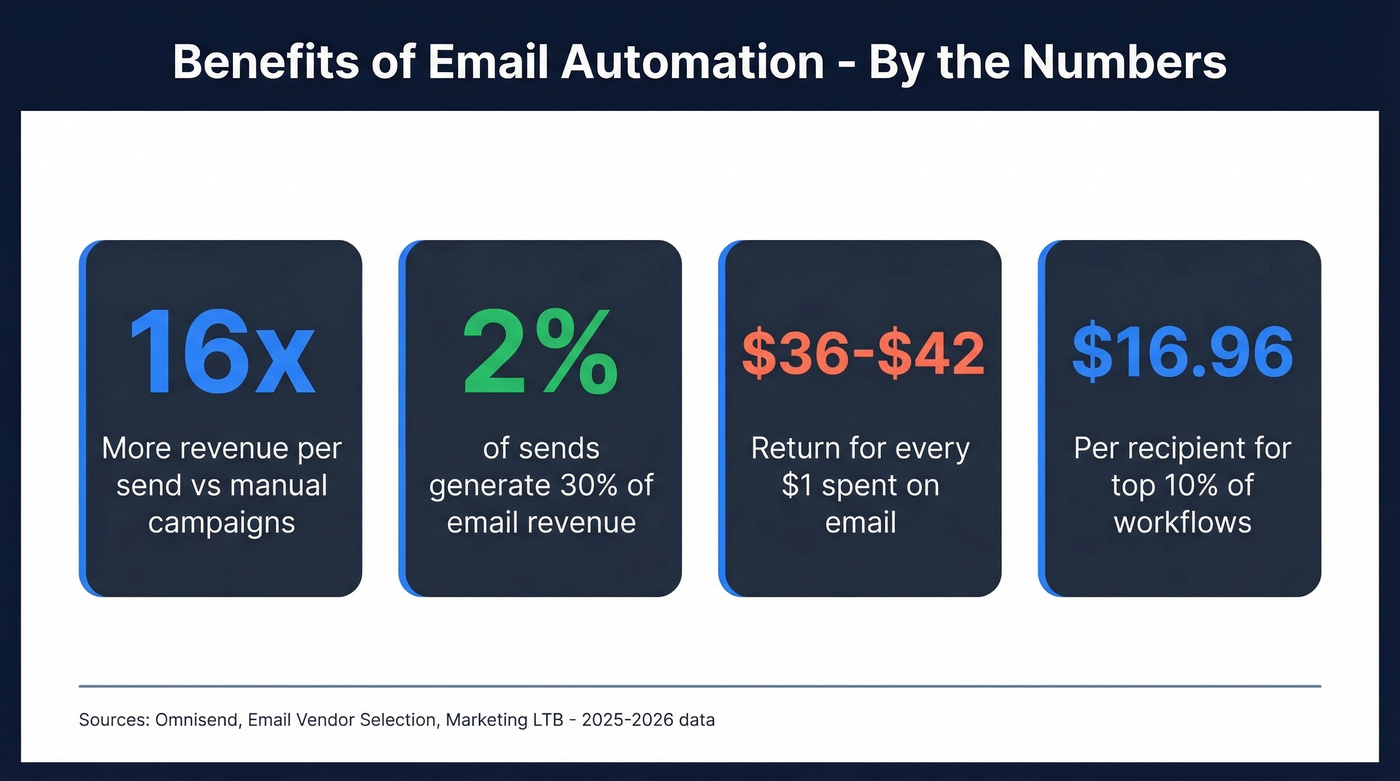
Time savings without headcount. One marketer can manage dozens of automated flows that would be impossible to execute manually at the same quality. Welcome sequences, cart recovery, post-purchase nurture - once built, they run 24/7. The ROI sits around $36-$42 per $1 spent, and automation is one of the biggest levers for capturing that return at scale.
Personalization that actually converts. Cart abandonment emails hit a 35.75% open rate because the subscriber literally just left something behind. That's not "personalization" in the vague marketing sense. It's the right message at the exact right moment, fired automatically. If you want to push this further, pair behavior triggers with intent based segmentation.
| Workflow Type | Open Rate | Revenue/Email |
|---|---|---|
| Abandoned Cart | 35.75% | $2.54 |
| Welcome Series | 40%+ | Varies by offer |
| Post-Purchase | 25-30% | $4-$8 (practitioner-reported) |
No leads falling through cracks. Someone signs up Friday evening, your team doesn't send the welcome until Monday, and the 15-minute engagement window is gone. Automation eliminates that gap entirely. Every subscriber gets the same high-quality journey regardless of when they convert - consistency that humans can't match at scale, period. (If you're running outbound too, this same logic applies to automated cold email scheduling.)
Compounding optimization. Automation flows get better the longer they run. A/B test subject lines, tweak send times, adjust cadence - each iteration compounds on the last. The top 10% of abandoned cart workflows earn $28.89 per recipient versus $3.65 for the average. That gap is optimization, not luck. For faster iteration, keep a swipe file of email subject line examples.
The 3 Workflows That Drive 76% of Revenue
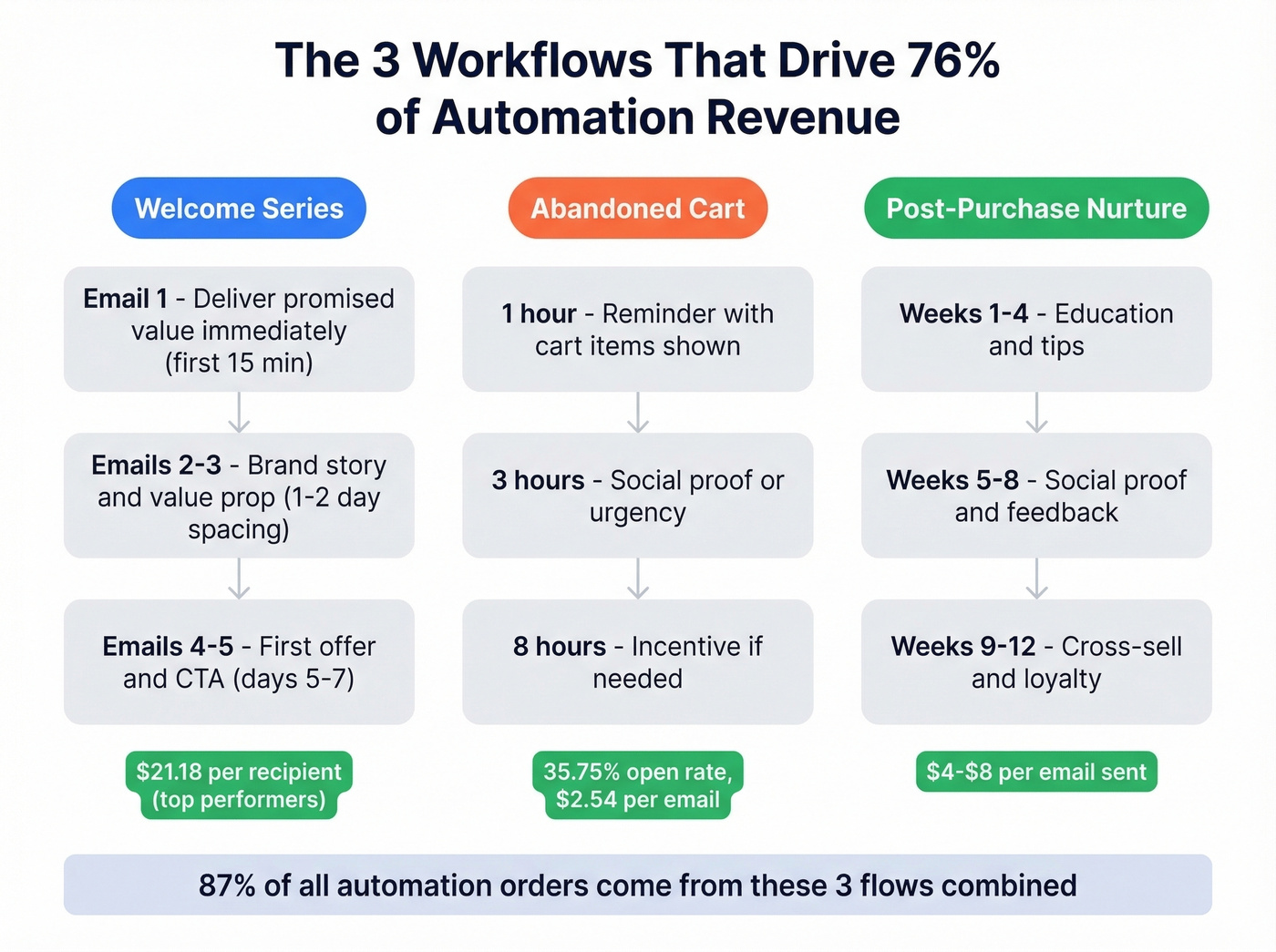
Abandoned cart and welcome series alone generated 76% of all automation revenue, with 87% of all automation orders coming from cart, welcome, and browse abandonment combined. Build these first. Everything else is secondary.
Welcome Series
Fire Email 1 immediately - subscribers are at peak engagement in the first 15 minutes. Send 3-5 emails spaced 1-2 days apart. Top-performing welcome flows generate $21.18 per recipient, and Remix's 3-step welcome journey drove a 104% increase in first purchases. Move from brand story to value proposition to first offer. Don't lead with a discount.
Here's the thing: most teams overthink welcome sequences. They try to cram their entire brand narrative into Email 1. Keep it tight. Deliver the promised value (lead magnet, discount code, whatever got them to subscribe), set expectations for email frequency, and save the storytelling for Emails 2-3 when you've already earned a second open. When you’re ready to tighten copy, use a simple email copywriting checklist.
Abandoned Cart
Use a 1-hour, 3-hour, 8-hour cadence. Show the exact items left behind. Delay incentives until Email 2 - many shoppers just need the reminder. With a global cart abandonment rate of 70.22%, the addressable opportunity is massive. Teams focused on recovering lost revenue typically start here because the intent signal is strongest.
Post-Purchase Nurture
This is the flow most teams skip. That's a mistake.
Build a 12-email sequence sent weekly over roughly 3 months. Rotate content types: education, social proof, feedback requests, cross-sell. Practitioners on r/Emailmarketing report $4-$8 per email sent from well-built post-purchase flows. In our experience, the teams that invest here see dramatically higher LTV because they're building a relationship instead of treating the first purchase as the finish line. If you’re measuring impact, track it like a funnel with funnel metrics.

Automated flows only compound revenue when they reach real inboxes. Prospeo's 5-step verification catches spam traps, honeypots, and invalid addresses before your welcome series ever fires - 98% accuracy at ~$0.01/email. Teams using Prospeo maintain sub-3% bounce rates across every campaign.
Clean data is the foundation. Build your automation stack on verified contacts.
Why Deliverability Limits Your Results
Your automations are worthless if they land in spam.
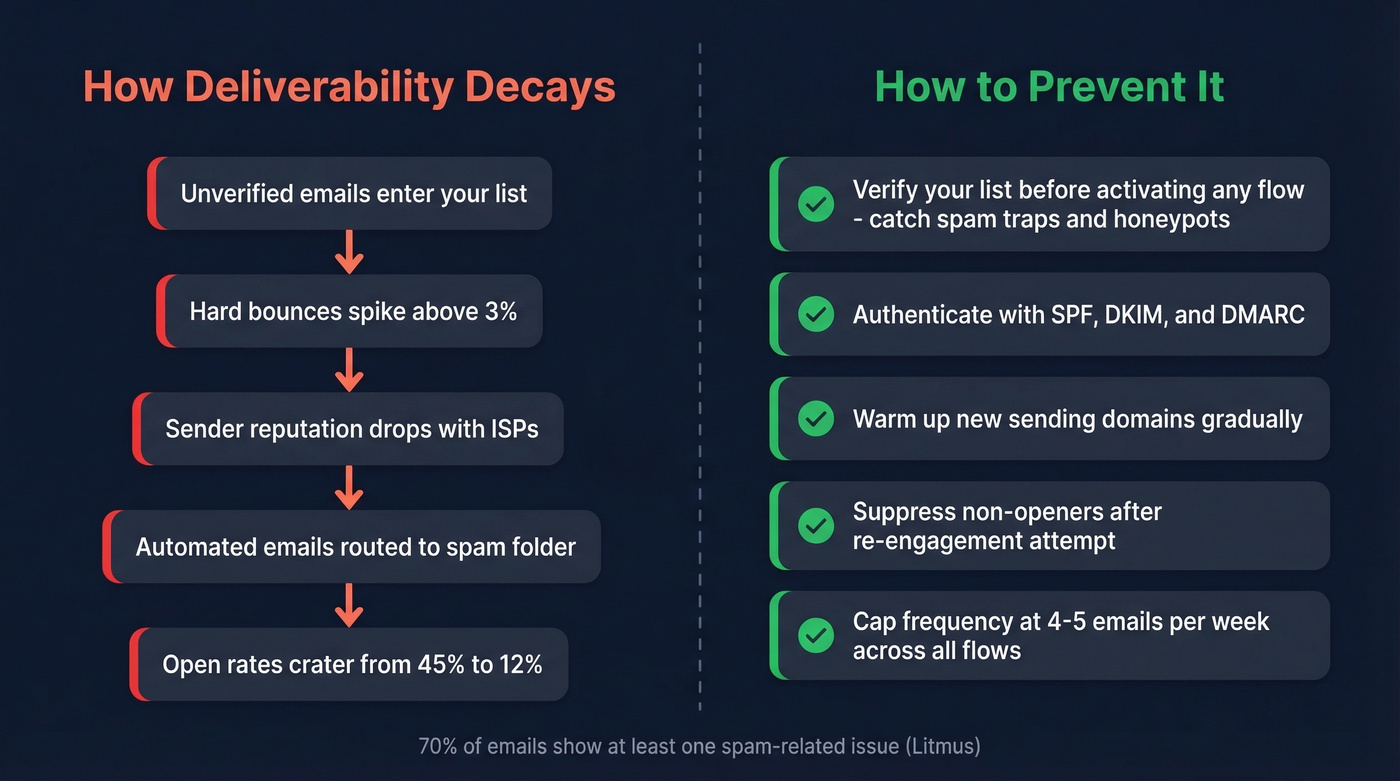
We've watched teams with 45% welcome series open rates crater to 12% within a quarter - not because their copy got worse, but because their list decayed. And 70% of emails show at least one spam-related issue, per Litmus research. The problem is almost always upstream: invalid addresses generating hard bounces, damaging sender reputation, and routing every automated email to junk.
This is where clean data stops being a "nice to have" and becomes the foundation everything else depends on. Run your list through Prospeo's 5-step verification before activating any flow - it catches invalid addresses, spam traps, and honeypots with 98% accuracy. Stack Optimize built their agency from $0 to $1M ARR maintaining 94%+ deliverability and sub-3% bounce rates across all client campaigns using this approach. If you want the deeper mechanics, start with an email deliverability guide and then work through how to improve sender reputation.
Deliverability checklist before launching any flow:
- Implement SPF, DKIM, and DMARC authentication (use these SPF record examples to avoid syntax mistakes)
- Warm up new sending domains gradually
- Remove invalid addresses before activating automations
- Suppress chronic non-openers after a re-engagement attempt
- Cap total email frequency at 4-5 emails per week across all flows
The 3 workflows above drive 76% of automation revenue - but only if your sender reputation stays intact. One agency built $0 to $1M ARR on Prospeo-verified data with 94%+ deliverability and zero domain flags. No contracts, no sales calls, 75 free verifications to start.
Stop feeding bad data into great automations. Verify before you send.
Mistakes That Tank Your ROI
Delayed welcome emails. The first 15 minutes are your best engagement window. Don't waste them with a Monday-morning batch send for Friday signups.
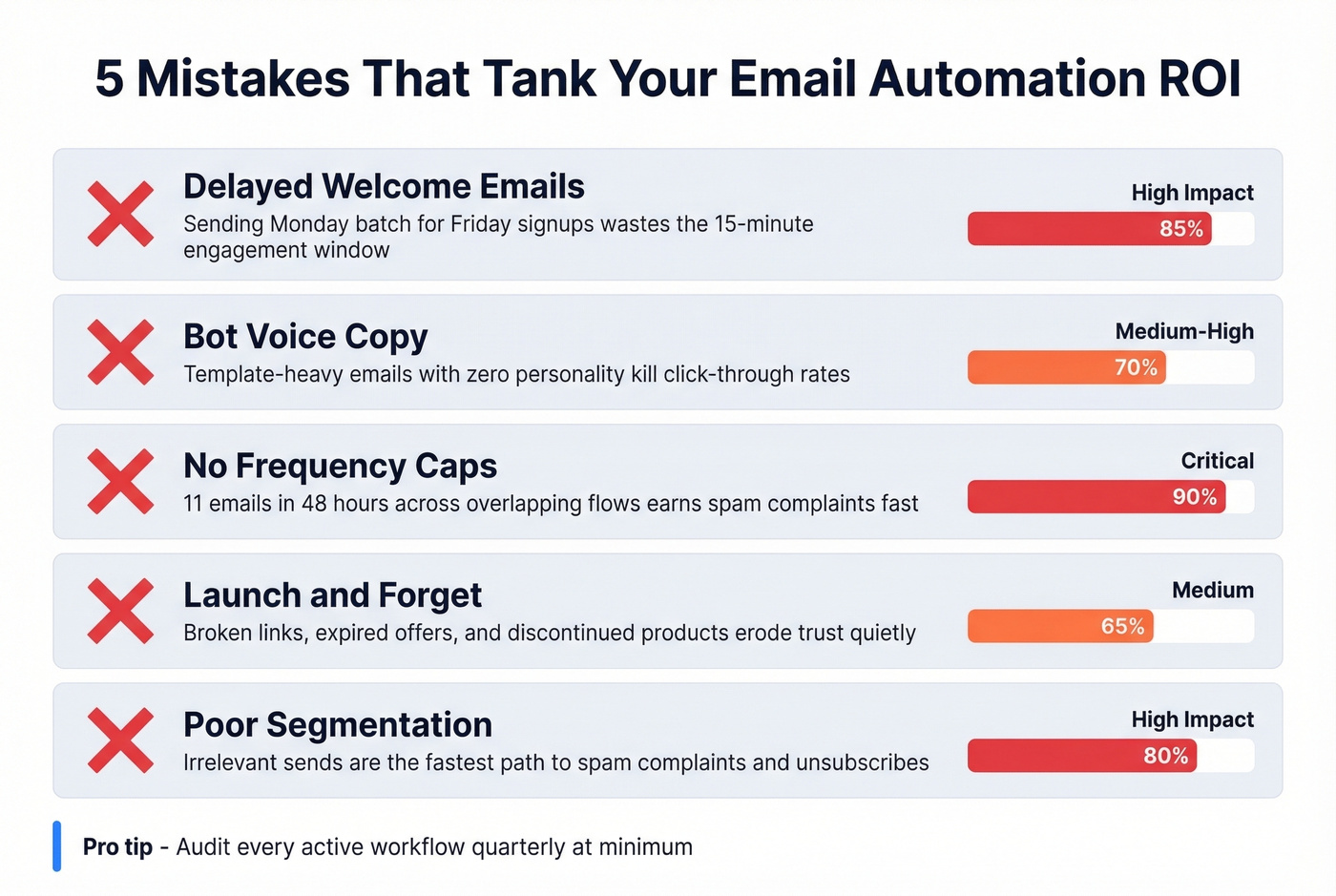
Bot voice. Template-heavy copy with zero personality kills click-through rates. If your automated emails read like they were written by a committee, they'll perform like it too. If you need a quick fix, borrow patterns from emails that get responses.
No frequency caps. Stacking welcome + cart + browse abandonment triggers fatigue fast. I've seen accounts where a single subscriber received 11 emails in 48 hours across overlapping flows. That's how you earn spam complaints. If you're scaling volume, watch email velocity closely.
Launch and forget. Links break, offers expire, products get discontinued. Audit every active workflow quarterly at minimum.
Poor segmentation. The consensus on r/MarketingAutomation is clear: irrelevant sends are the fastest path to spam complaints. Segment by behavior, not just demographics.
Quick Tool Comparison
Let's be honest: if your average deal size is under five figures, you probably don't need Klaviyo or HubSpot-level tooling. Brevo or MailerLite will get you 90% of the way there at a fraction of the cost. (If you’re building a broader stack, compare options in sales funnel automation tools.)
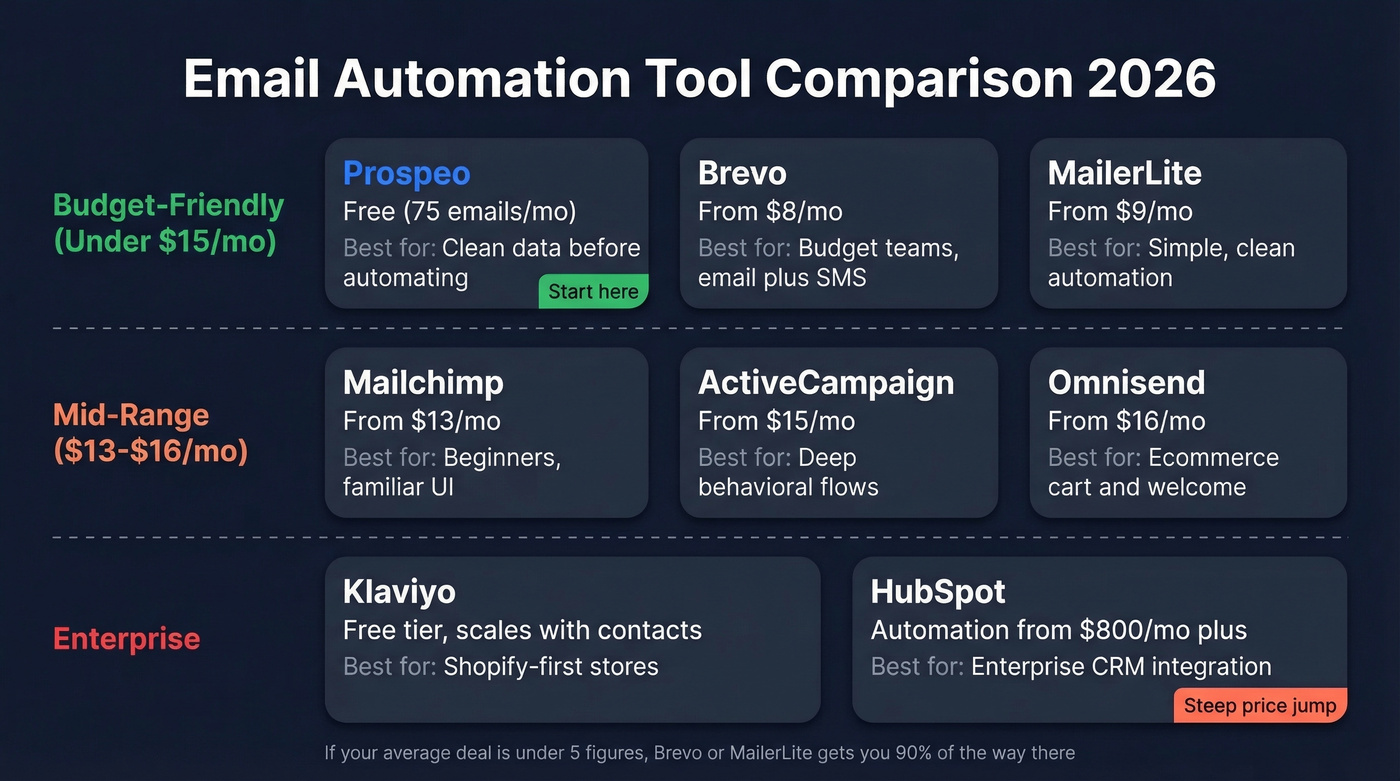
| Tool | Starting Price | Best For |
|---|---|---|
| Prospeo | Free (75 emails/mo); ~$0.01/email | Clean data before automating |
| Brevo | From $8/mo (free: 300/day) | Budget teams, email + SMS |
| MailerLite | From $9/mo (free: 1K subs) | Simple, clean automation |
| Mailchimp | From $13/mo (free: 500 contacts) | Beginners, familiar UI |
| ActiveCampaign | From $15/mo | Deep behavioral flows |
| Omnisend | From $16/mo (free tier) | Ecommerce cart + welcome |
| Klaviyo | Free tier; paid plans scale with contacts | Shopify-first stores |
| HubSpot | Free CRM; automation ~$800/mo+ | Enterprise CRM integration |
Skip HubSpot's automation tier unless you're already deep in their CRM ecosystem. The jump from free CRM to marketing automation pricing is steep, and for teams under 50 employees, ActiveCampaign or Brevo covers the same ground for a twentieth of the cost.
FAQ
How many automated emails should I send per week?
Cap at 4-5 across all active flows combined. Exceeding that threshold consistently spikes unsubscribe rates and spam complaints, which erodes sender reputation and undermines every automation you've built. If you're running welcome, cart, and browse abandonment simultaneously, map out the worst-case scenario for a single subscriber hitting all three triggers in the same week.
What's a good open rate for automated emails?
Cart abandonment averages 35.75%, and welcome emails often exceed 40%. If your automated flows consistently land below 20%, that signals a deliverability issue - not a content problem. Check bounce rates and authentication first before rewriting a single subject line.
Do I need to verify my list before setting up automations?
Yes. Invalid emails cause hard bounces that tank sender reputation and route automations to spam. Tools like Prospeo catch bad addresses, spam traps, and honeypots at 98% accuracy. Free tools like MailerLite's built-in validation help too, but they typically lack catch-all domain handling, which matters more than most teams realize.