

B2B Marketing for Software Companies: The ACV-First Strategy Guide
Your CEO just asked why pipeline is flat despite running the full checklist - blog posts, webinars, paid ads, a podcast. The problem isn't effort. It's that most software marketing teams pick channels before they understand what their ACV actually demands, and then they run the same playbook whether they're selling a $3K self-serve tool or a $150K enterprise platform.
We've watched this play out dozens of times. The fix isn't more channels. It's starting from the number that shapes everything else.
What You Need (Quick Version)
- Match your GTM motion to ACV. Under $5K = product-led growth. $5K-$50K = hybrid. $50K+ = sales-led. This single decision shapes everything downstream.
- Pick 2-3 channels and go deep. Two to three channels drive 80% of revenue. The rest is noise.
- Measure CAC and NRR, not vanity metrics. MQLs don't pay salaries. Track customer acquisition cost, LTV:CAC ratio (target 3:1+) (target 3:1+), and net revenue retention.
Match Your GTM Motion to ACV
Your ACV isn't just a pricing decision. It dictates your entire go-to-market architecture - who you hire, what you measure, and where you spend.
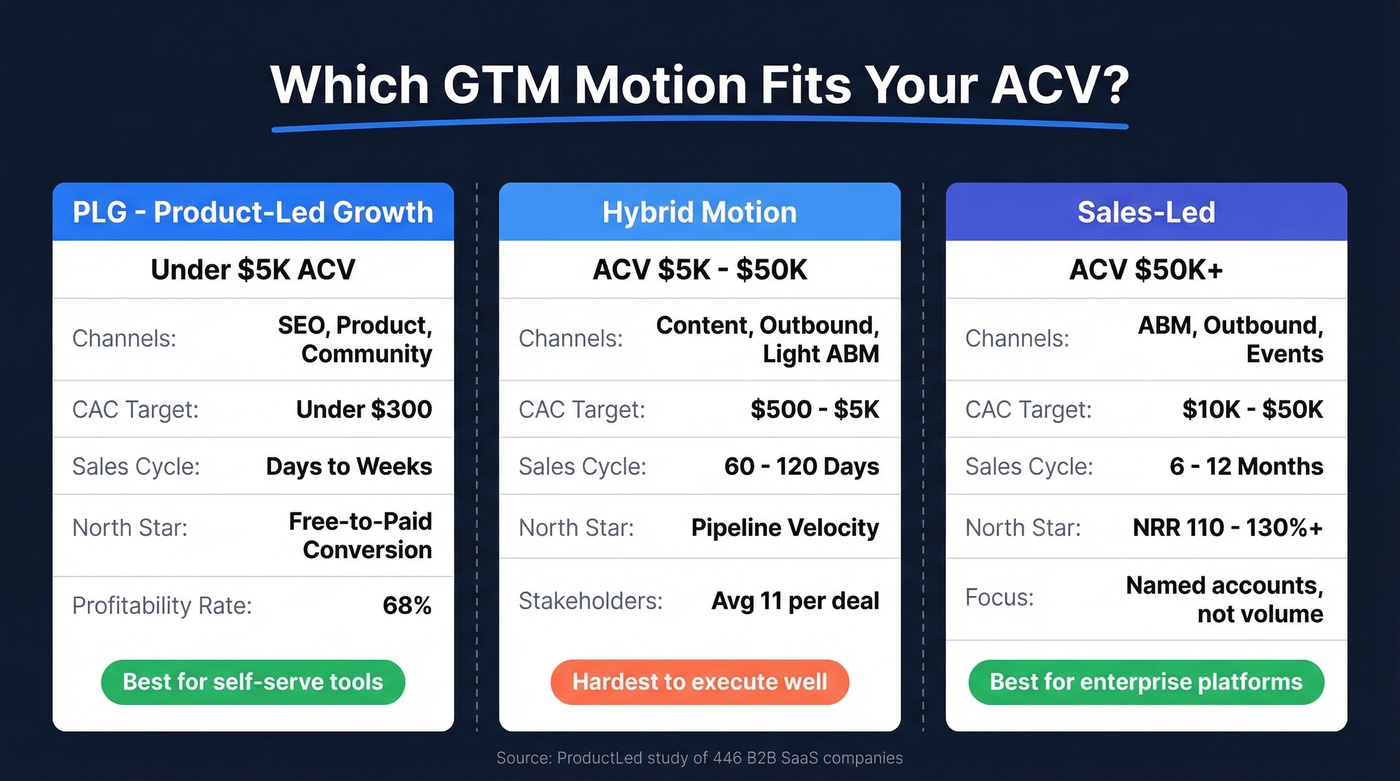
| PLG | Hybrid | Sales-Led | |
|---|---|---|---|
| ACV | Under $5K | $5K-$50K | $50K+ |
| Channels | SEO, product, community | Content, outbound, light ABM | ABM, outbound, events |
| CAC target | <$300 | $500-$5K | $10K-$50K |
| Sales cycle | Days to weeks | 60-120 days | 6-12 months |
| Key metric | Free-to-paid conversion | Pipeline velocity | NRR (110-130%+) |
A ProductLed study of 446 B2B SaaS companies found that companies with a self-serve motion reported 68% profitability rates vs. 36.4% without one. They also saw 25.9% better free-to-paid conversion, 18.3% faster time-to-value, and 57% stronger conversion when the free model was built with intentionality rather than bolted on as an afterthought. If your ACV supports PLG, a self-serve motion isn't optional - it's the strongest performance lever you've got.
The hybrid zone ($5K-$50K) is where most mid-market SaaS lives, and it's the hardest motion to execute well. You need content generating inbound demand while outbound fills the gaps, with sales cycles running 60-120 days across multiple stakeholders. Get the balance wrong and you're burning cash on both sides.
For sales-led motions ($50K+), marketing exists to create and accelerate pipeline for named accounts. Your north star shifts from acquisition volume to NRR - top performers target 110-130%+.
Channels That Actually Move Pipeline
PLG Motion (Under $5K ACV)
Skip first: Enterprise ABM, heavy outbound, expensive events. Your CAC target is under $300 - you can't afford a $50K booth at SaaStr when your product should be selling itself.
Go deep on SEO and content marketing, product experience (onboarding, activation loops), community, and free/freemium models with intentional conversion paths. Content marketing takes 6-12 months to generate meaningful inbound, and if your board expects pipeline in 90 days from a PLG motion, you've got an expectations problem, not a marketing problem. SEO is also shifting fast - Generative Engine Optimization matters now as AI search tools reshape how SaaS buyers discover products. Factor that into your content strategy today, not next quarter.
Hybrid Motion ($5K-$50K ACV)
This motion demands content, outbound, and light ABM working in concert. Content builds awareness. Outbound targets accounts showing intent. Light ABM coordinates messaging across the average B2B deal's 11 stakeholders, each consuming 5-7 assets before engaging sales.
Skip spray-and-pray email blasts and gated whitepaper funnels. Drip sequences on whitepaper downloaders create unsubscribes, not pipeline.
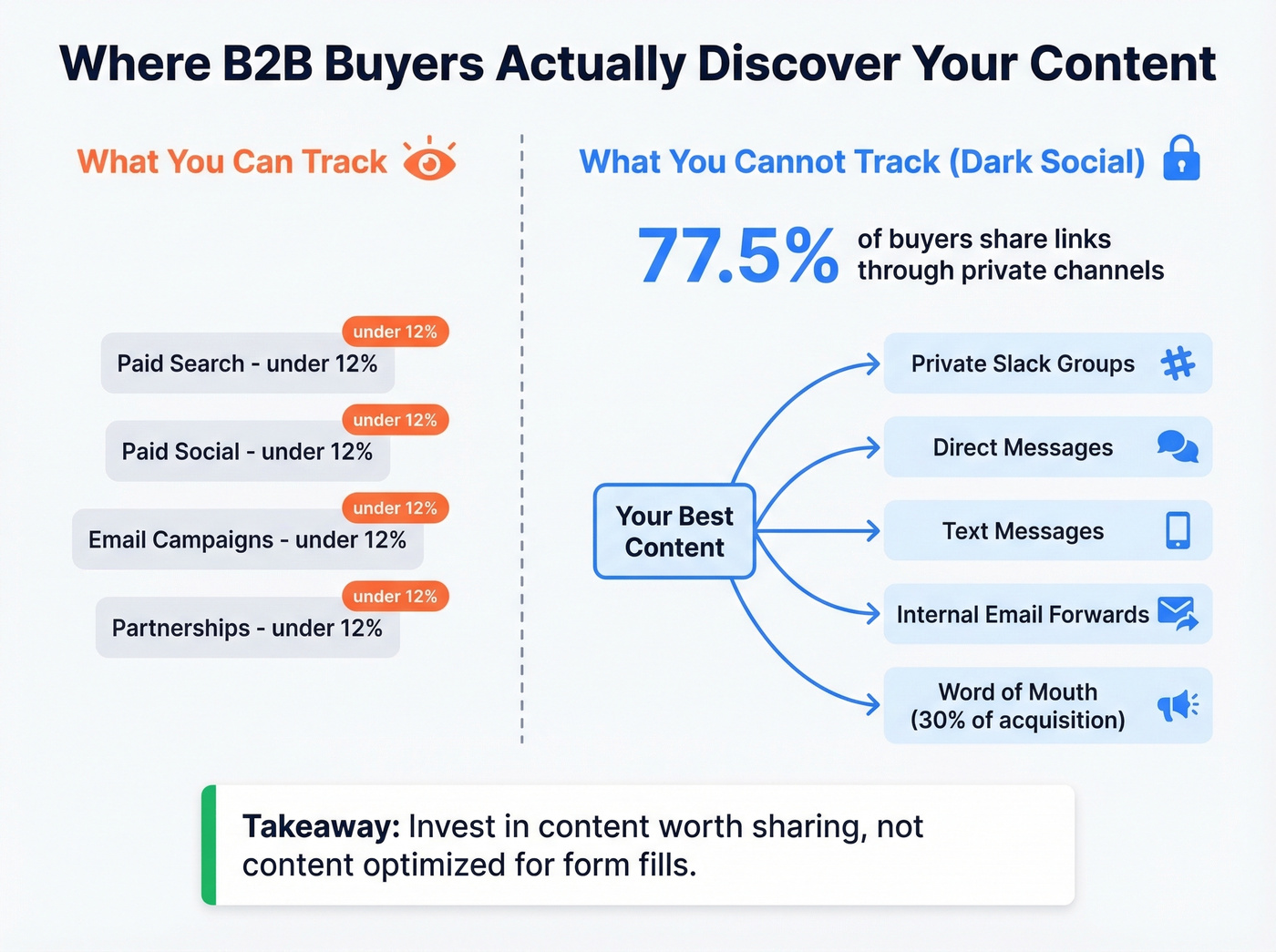
Here's a stat that should change how you think about distribution: 77.5% of buyers share links through dark social channels - private Slack groups, DMs, text messages. Your content's real reach is invisible to attribution software. Invest in content worth sharing, not content optimized for form fills.
Let's be honest: buyers self-educate through 80% of their journey before talking to sales. That means your content is your sales team for most of the cycle. Treat it accordingly.
Sales-Led Motion ($50K+ ACV)
ABM and outbound are your primary channels, supported by executive events and strategic content. Tier your target accounts:
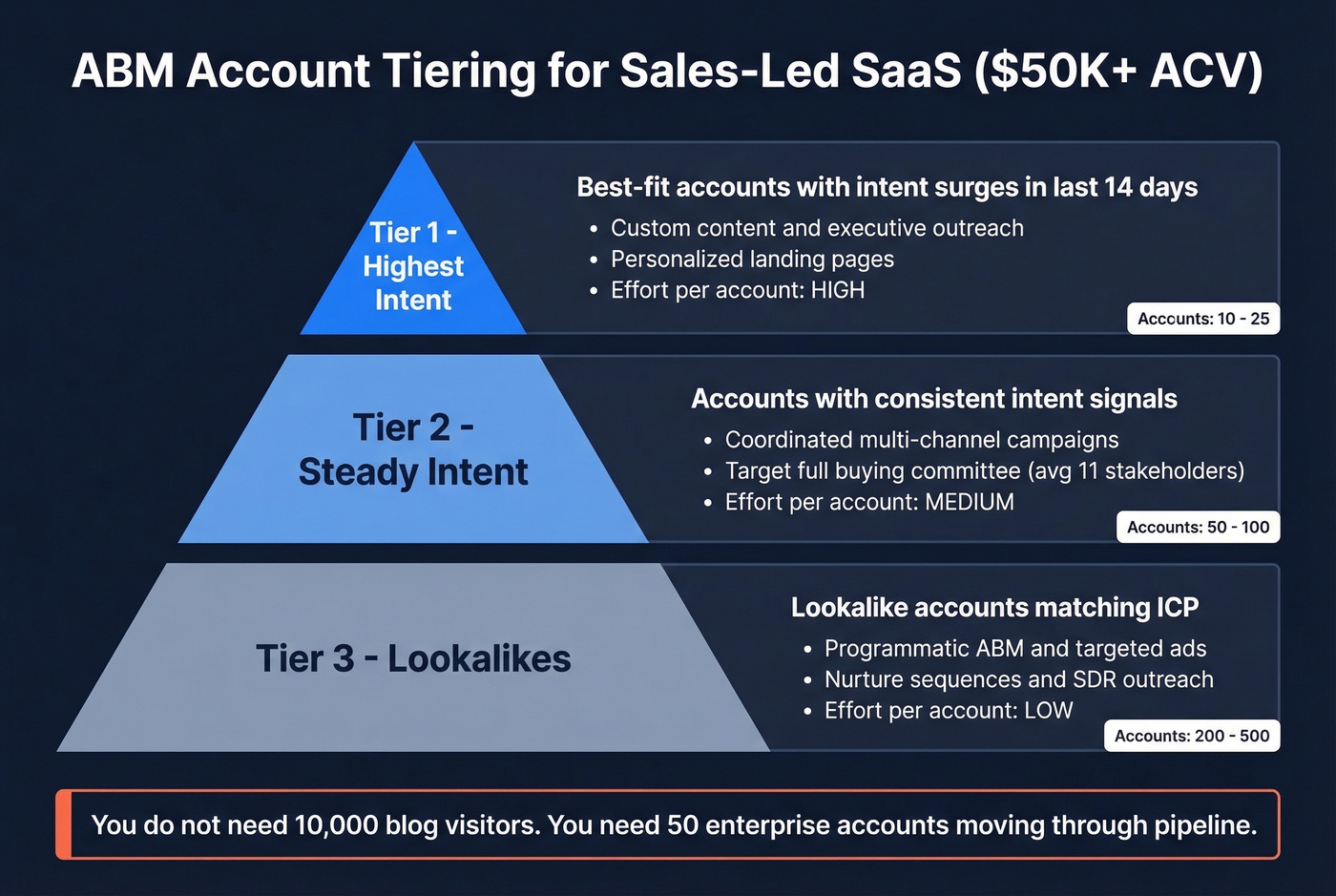
- Tier 1: Best-fit accounts showing intent surges in the last 14 days. Custom content, executive outreach, personalized landing pages.
- Tier 2: Accounts with steady intent signals. Coordinated multi-channel campaigns across the buying committee.
- Tier 3: Lookalike accounts. Programmatic ABM - targeted ads, nurture sequences, SDR outreach.
You don't need 10,000 blog visitors. You need 50 enterprise accounts moving through pipeline. NRR matters more than new logo acquisition at this ACV.

Running a hybrid or sales-led motion? Your ABM and outbound channels collapse when 35% of emails bounce. Prospeo delivers 98% email accuracy on a 7-day refresh cycle - not the 6-week industry average - so your SDRs reach real buyers, not dead inboxes. Layer in intent data across 15,000 topics to target accounts actively researching your category.
Stop feeding your outbound machine stale data. Start at $0.01 per verified email.
Budget and CAC Benchmarks
Median SaaS marketing spend is roughly 8% of ARR, and companies targeting above-median growth allocate 14%+ of revenue. Early-stage companies should budget 12-20%; established fast-growers can run 6-12% as brand and inbound compound.
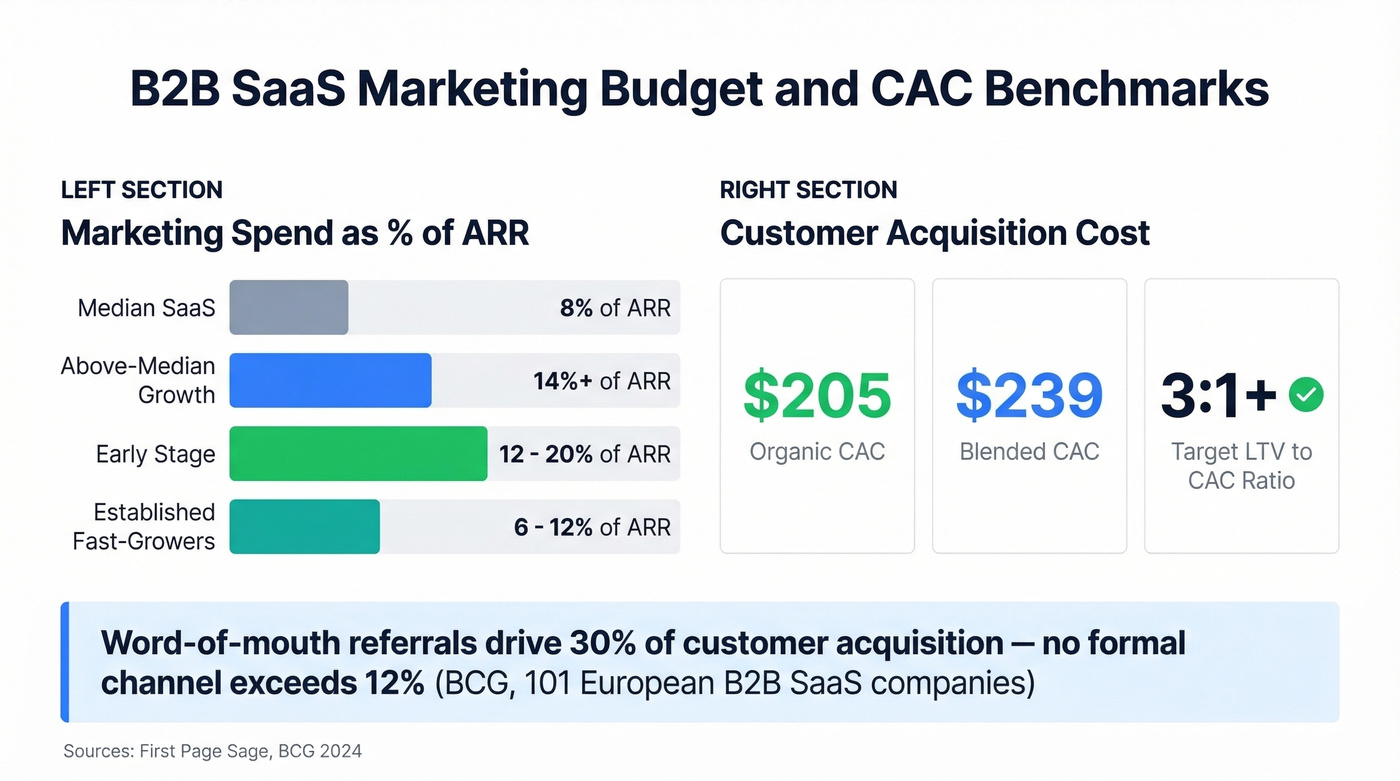
First Page Sage's CAC dataset puts B2B SaaS organic CAC at $205 and blended CAC at $239. Those numbers are useful benchmarks, but your mileage will vary wildly depending on ACV and sales cycle length.
BCG's survey of 101 European B2B SaaS companies found that word-of-mouth referrals drive 30% of customer acquisition, while no single formal channel - email, paid social, paid search, partnerships - exceeds 12%. Your best "channel" is building a product and experience worth talking about. Companies personalizing their marketing showed 40% faster growth vs. those running generic campaigns.
AI Beyond Content Generation
Most SaaS marketing teams use AI for content drafts and call it a day. That's layer one of three, and it's the least valuable.
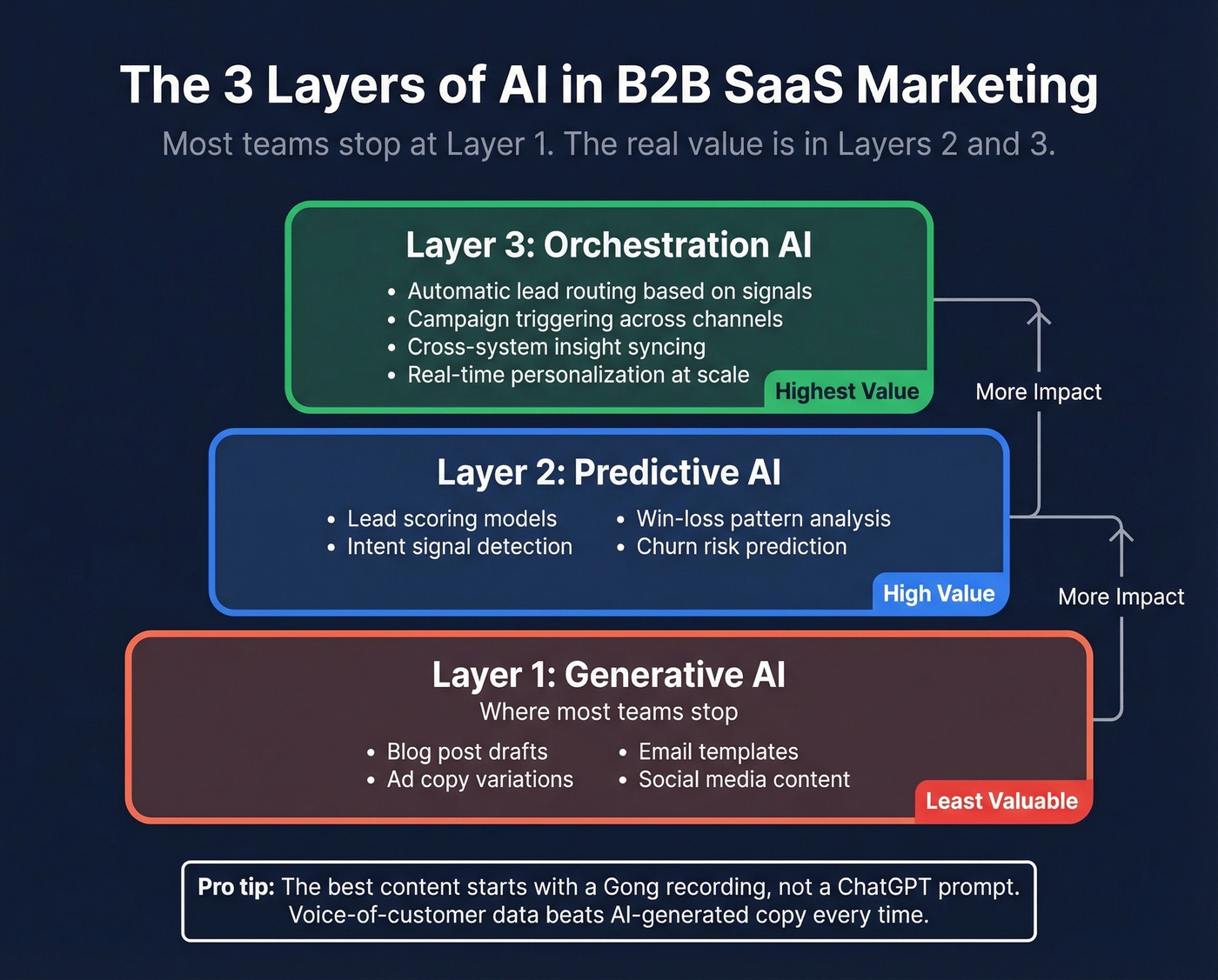
The real gains come from predictive AI - lead scoring, intent detection, win-loss pattern analysis - and orchestration AI that routes leads based on signals, triggers campaigns automatically, and syncs insights across systems. One B2B marketing lead with 15 years' experience put it bluntly on Reddit: "The best content and highest-performing landing pages all started with a Gong recording." Voice-of-customer data beats AI-generated copy every time. If your AI strategy is "ChatGPT writes our blog posts," you're leaving 80% of the value on the table.
Fixing the Data Quality Problem
Here's the thing: your SDR team sends 500 emails a week with a 35% bounce rate. They blame the messaging. Leadership blames the SDRs. The actual culprit is stale contact data.
Teams invest in sequencing tools, hire SDRs, build playbooks, then feed the entire machine bad data. The result is bounced emails, burned domains, and a pipeline that flatlines despite increasing activity. We've seen this pattern wreck outbound programs that were otherwise well-designed - great copy, smart targeting, solid ICP definition, all undermined by emails that never reach an inbox.
The fix is switching to a provider with real-time verification and frequent refresh cycles. Prospeo refreshes data every 7 days with 98% email accuracy - one outbound agency, Meritt, went from 35% bounce rates to under 4% and tripled pipeline from $100K to $300K per week. With 30+ search filters including buyer intent and technographics, plus native integrations with Salesforce, HubSpot, and major sequencing tools, it slots directly into existing workflows without ripping anything out.
If bounce is killing deliverability, start with email bounce rate benchmarks and remediation, then lock in a repeatable email deliverability process so fixes stick.

You just tiered your ABM accounts by intent signals. Now you need verified contact data for every stakeholder on the buying committee. Prospeo's 300M+ profiles with 30+ filters - buyer intent, technographics, headcount growth, funding - let you pinpoint decision-makers across all 11 stakeholders in a typical B2B deal. 92% API match rate. Native integrations with HubSpot, Salesforce, and every major sequencer.
Reach the full buying committee with data that actually connects. No contracts required.
FAQ
What's the biggest mistake software companies make with B2B marketing?
Running the same playbook regardless of ACV. A $5K product needs PLG and SEO; a $100K product needs ABM and outbound. The channel mix should follow the GTM motion, not a generic best-practices checklist. A usage-based platform, a per-seat collaboration tool, and an enterprise data warehouse each demand fundamentally different marketing approaches because their revenue models shape how buyers evaluate and purchase.
How much should a SaaS company spend on marketing?
Median SaaS marketing spend is roughly 8% of ARR. Companies targeting above-median growth allocate 14%+ of revenue. Early-stage companies should budget 12-20% of revenue; established fast-growers can run 6-12% as brand and inbound compound.
How do you fix high bounce rates in outbound prospecting?
The problem is almost always stale data, not messaging. Switch to a provider with real-time verification - Prospeo's 7-day refresh cycle and 98% email accuracy helped teams like Snyk cut bounce rates from 35-40% to under 5%, protecting domain reputation and keeping sequences in primary inboxes.
How is marketing different for software vs. other B2B industries?
Software buyers expect to self-educate before talking to sales, trial the product before committing, and see ROI projections grounded in their specific tech stack. Unlike physical-product B2B, there's no shipping logistics or inventory - the entire evaluation happens digitally, which means your website, content, and in-product experience carry the weight that a field sales team would in traditional industries.