

How to Build a B2B Marketing Plan That Connects to Revenue
You just finished your Q4 planning deck. Forty slides, three weeks of work, and the CEO's only question is: "How does this connect to pipeline?" Most B2B marketing plans die right there - not because the tactics are wrong, but because the plan never tied marketing activity to revenue in the first place.
Here's what makes B2B planning brutal: the average buying decision involves seven stakeholders and takes 4-8 months to close. Your buyers are roughly 70% through their purchasing process before they ever talk to sales. That means your marketing plan isn't just a channel list - it's the architecture for how revenue gets built before a rep even picks up the phone. Get the architecture wrong and no amount of tactical brilliance saves you.
The Plan in Six Lines
If you're short on time, here's the whole thing compressed:
- Revenue target first. Every channel, campaign, and budget line traces back to a number.
- ICP definition. Firmographic + technographic + behavioral. If you can't describe your best customer in two sentences, stop and fix this.
- Three channels max to start. SEO, email, and one paid channel. Expand after you have data.
- Budget pegged to 7-12% of revenue. Lower if you're mature, higher if you're burning toward growth.
- Conversion benchmarks. MQL-to-SQL at 25-35%, SQL-to-Opp at 50%+, win rate at 20%+. Measure against these, not vanity metrics.
- Sales alignment SLA. Written, shared, enforced. No exceptions.
The rest of this article gives you the numbers, frameworks, and templates for each of those bullets.
The 4-Pillar Framework
Before you pick channels or allocate budget, you need an operating system for how your marketing generates demand. The strongest plans we've seen organize around four pillars - not a channel list, but a system that compounds over time.
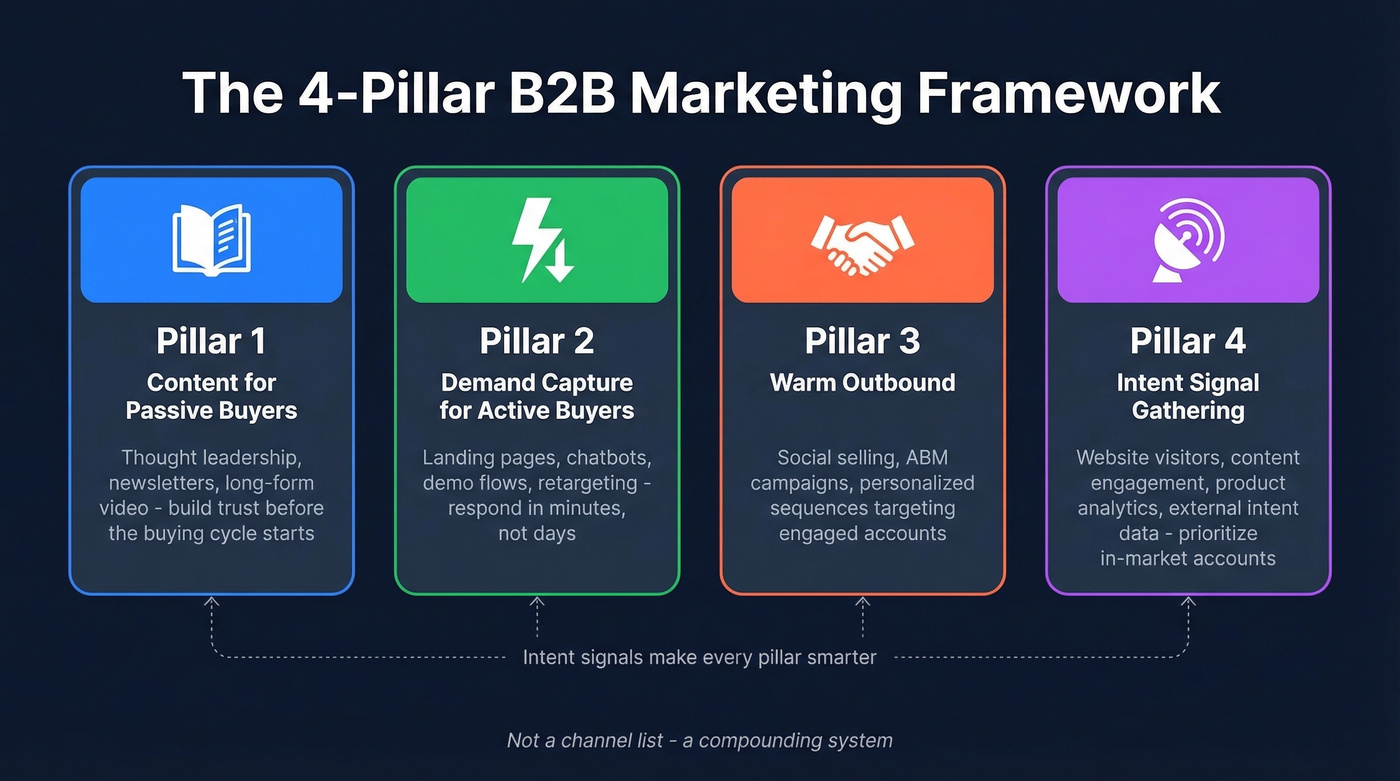
Pillar 1: Content for passive buyers. Thought leadership, newsletters, long-form video. This isn't about lead capture. It's about being the name your buyer already trusts when they start evaluating solutions. 69% of marketing leaders plan to increase thought leadership investment this year, and for good reason - the brands that own the conversation before the buying cycle starts are the ones that show up on shortlists.
Pillar 2: Demand capture for active buyers. When someone's ready to buy, you need a fast response system. Optimized landing pages, chatbots, demo booking flows, retargeting. Speed matters here - minutes, not days.
Pillar 3: Warm outbound. Social selling, ABM campaigns, and personalized email sequences targeting accounts that already show engagement signals. This is where marketing and sales overlap, and where most plans fall apart without alignment.
Pillar 4: Intent signal gathering. The glue that makes the other three pillars smarter. Combine website visitor data, content engagement, product analytics, and external intent signals to prioritize accounts that are actually in-market right now. Layer buyer intent with job role and company growth signals so your outbound isn't cold - it's timed.
Build Your B2B Marketing Plan Step by Step
Set Revenue Targets First
Start with the number your CEO cares about, then work backward. Every objective in your plan should ladder up to revenue - not impressions, not followers, not "brand awareness."
Strong objective examples:
- 25% increase in ARR
- 200 new leads matching ICP criteria per quarter
- 500 MQLs in Q2
- CAC below $500
- A 4:1 LTV:CAC ratio
These aren't aspirational slogans. They're the scorecard your plan gets judged against. If a campaign doesn't connect to one of these, it doesn't belong in the plan.
Define Your ICP and Buyer Personas
Vague personas are the single biggest planning mistake in B2B marketing. Let's be honest: "mid-market SaaS companies" isn't an ICP. "Series B-C SaaS companies with 100-500 employees, using Salesforce and Outreach, with a VP of Sales who's been in role less than 12 months" - that's an ICP.
Your definition should include:
- Firmographics: industry, revenue range, employee count, geography
- Technographics: what tools they already use - CRM, marketing automation, data stack
- Behavioral signals: recent funding, headcount growth, job postings in your category, intent data spikes
- Buyer role: title, seniority, department, reporting structure
If you can't filter for these criteria in your data tools, your ICP is still too vague to execute against.
Build Your Prospect List
This is where plans go from strategy to execution - and where most teams stumble. ABM without clean data is just expensive spam. You can have the best ICP definition in the world, but if your contact list bounces 20%+ on the first sequence, you've torched your domain reputation and wasted your budget.
Do this: Start with your ICP filters, pull verified contacts, and validate emails before they hit any sequence. We use Prospeo for this step - 300M+ profiles with 98% email accuracy, 30+ filters including buyer intent, technographics, and job change signals. Data refreshes every 7 days versus the 6-week industry average, so you're not emailing people who changed jobs last month. The free tier gives you 75 verified emails plus 100 Chrome extension credits per month, enough to test your ICP hypothesis before scaling spend.
Skip this: Buying bulk lists from data brokers. Scraping without verification. Using data providers that refresh on a 4-6 week cycle. If your bounce rate is above 5%, your data source is the problem.

Choose Your Channels
Start with three channels. Not seven. Not "omnichannel." Three.
For most B2B companies, the right starting trio is SEO, email/outbound, and one paid channel. LinkedIn if your average deal size supports $5+ CPCs, Google if you're capturing existing demand. These map cleanly to the funnel: SEO captures top-of-funnel awareness, email/outbound drives mid-funnel engagement, and paid captures bottom-funnel demand.
Layer in additional channels only after you have 90 days of data on what's converting.
Here's a take that'll annoy some people: annual marketing plans are a fiction. The companies that execute well plan in 90-day sprints with quarterly rebalancing. Your channel mix in Q1 should look different from Q4 because you'll have learned what works. Build your plan to accommodate that learning, not to lock you into twelve months of commitments.
Allocate Your Budget
Everyone asks about the benchmark: B2B companies spend an average of 7.7% of revenue on marketing, down from 9.1% the prior year. But that average hides enormous variance by stage.
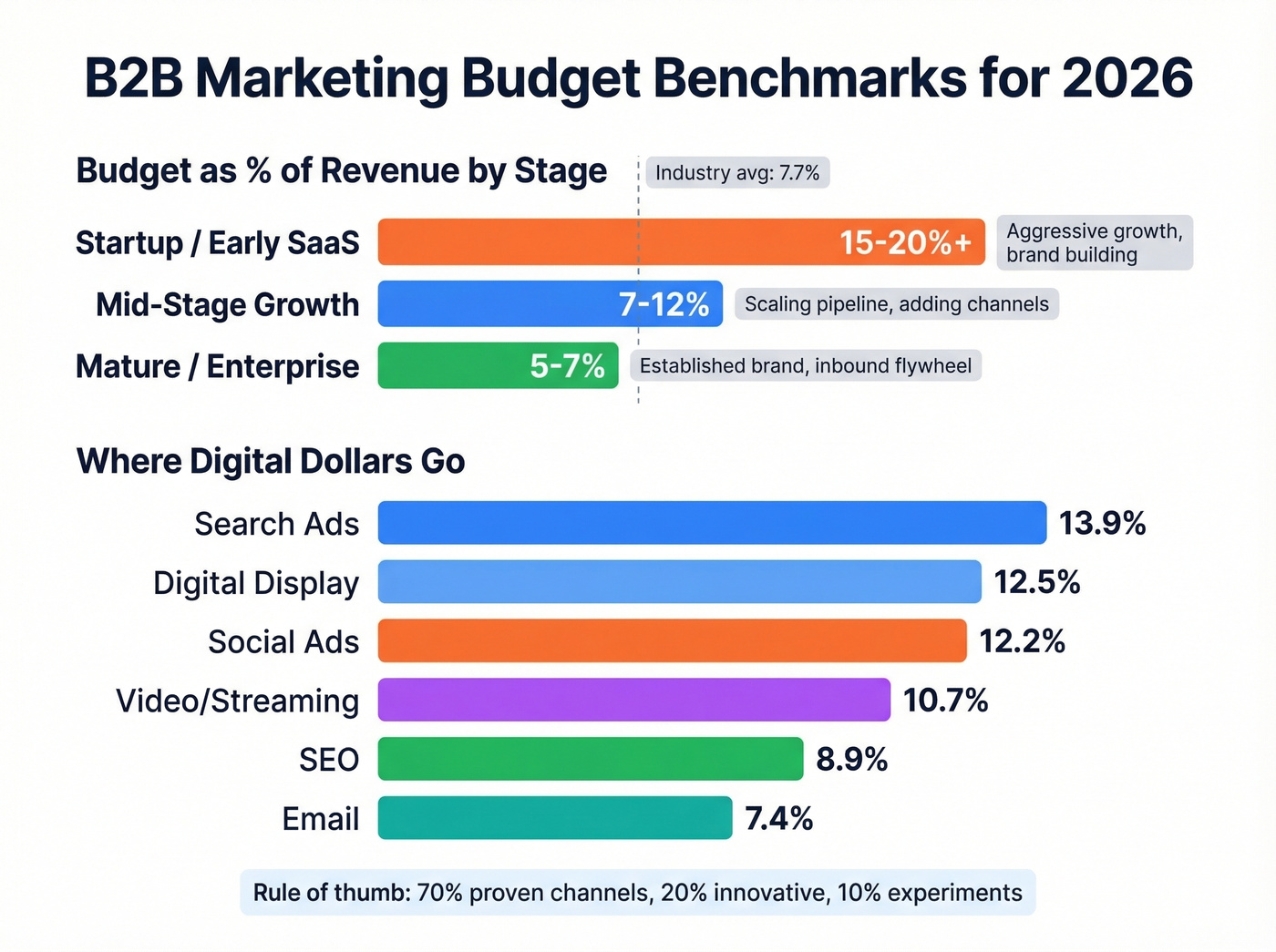
| Company Stage | % of Revenue | Notes |
|---|---|---|
| Mature / enterprise | 5-7% | Established brand, inbound flywheel |
| Mid-stage growth | 7-12% | Scaling pipeline, adding channels |
| Startup / early SaaS | 15-20%+ | Aggressive growth, brand building |
Industry variance is just as dramatic. Gartner benchmarks used for 2026 planning show clear differences:
| Industry | Marketing Spend (% of Revenue) |
|---|---|
| Media | 8.0% |
| Insurance | 7.5% |
| Financial services | 7.2% |
| Technology | 7.1% |
| Healthcare | 5.9% |
| IT & business services | 5.8% |
If you're a tech company benchmarking against the 7.7% cross-industry average, you're likely overshooting. Know your vertical's norm before setting a number.
Where the digital dollars go. Roughly half of total marketing budget flows into digital. Here's how that breaks down:
| Digital Channel | Share of Digital Budget | |---|---|---| | Search ads | 13.9% | | Digital display | 12.5% | | Social ads | 12.2% | | Video / streaming | 10.7% | | SEO | 8.9% | | Email | 7.4% |
Within your total budget, the funnel split matters more than the top-line number. Allocate 60-80% to demand generation and direct response, 10-20% to brand building, and 10-20% to lead nurturing and retention. The 70/20/10 rule is a useful gut check - 70% on proven channels, 20% on innovative approaches, 10% on pure experiments.
Reserve 10-15% of your total budget for testing and iteration. This isn't a nice-to-have. It's the line item that prevents your plan from going stale by March. Only 24% of CMOs feel they have enough budget to execute their strategies. Don't make it worse by locking every dollar into fixed commitments.
Set Up Measurement and KPIs
If you're reporting on impressions and email open rates to your leadership team, you're measuring the wrong things.
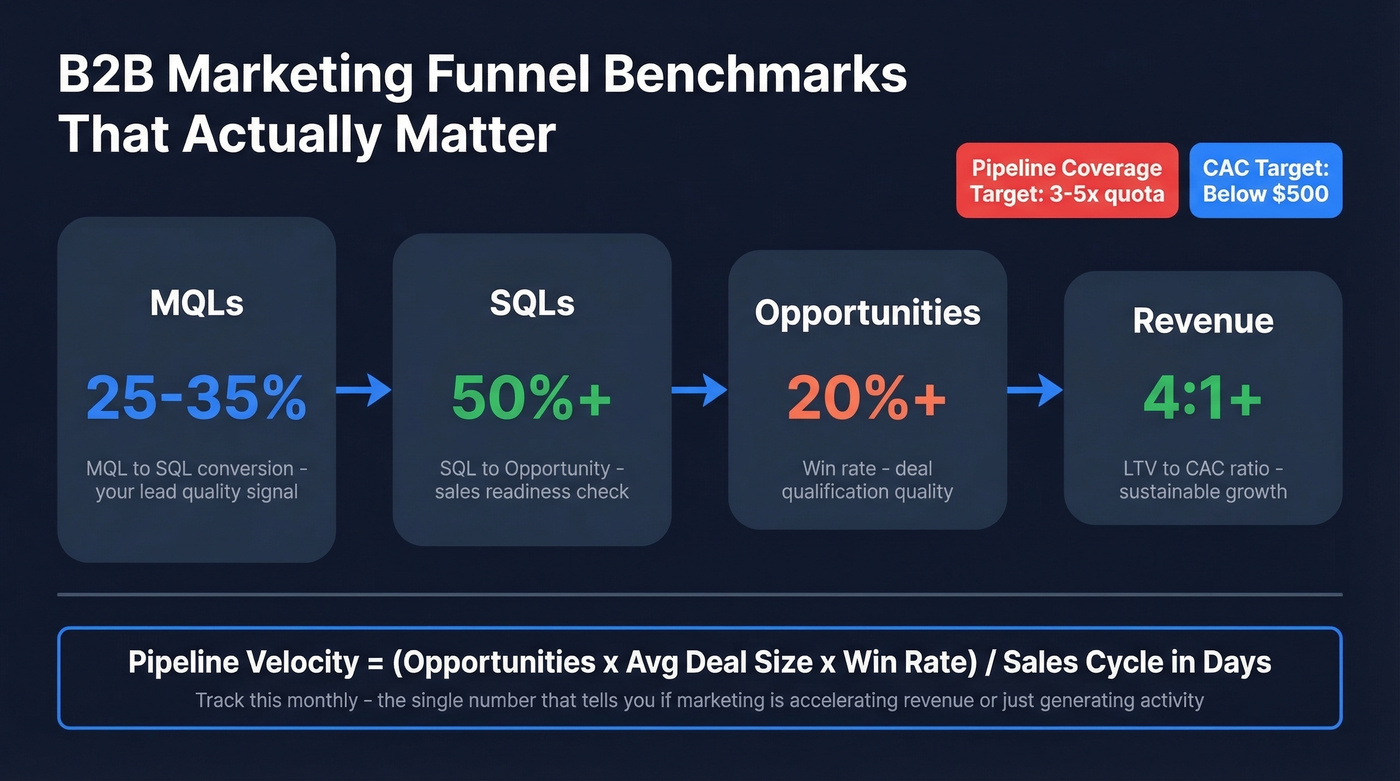
| Metric | Benchmark Target | Why It Matters |
|---|---|---|
| MQL to SQL | 25-35% | Lead quality signal |
| SQL to Opportunity | 50%+ | Sales readiness |
| Win rate | 20%+ | Deal qualification |
| Pipeline coverage | 3-5x quota | Forecast health |
| CAC | Below $500 (varies) | Unit economics |
| LTV:CAC | 4:1+ | Sustainable growth |
The formula that ties it all together: Pipeline Velocity = (Opportunities x Avg Deal Size x Win Rate) / Sales Cycle in Days. Track this monthly. It's the single number that tells you whether your marketing plan is accelerating revenue or just generating activity.
Align Sales and Marketing
"Sales says the leads are garbage. Marketing says sales doesn't follow up." We've heard this exact conversation at dozens of companies. It's exhausting, and the fix is simpler than anyone wants to admit: a written SLA with specific commitments on both sides.
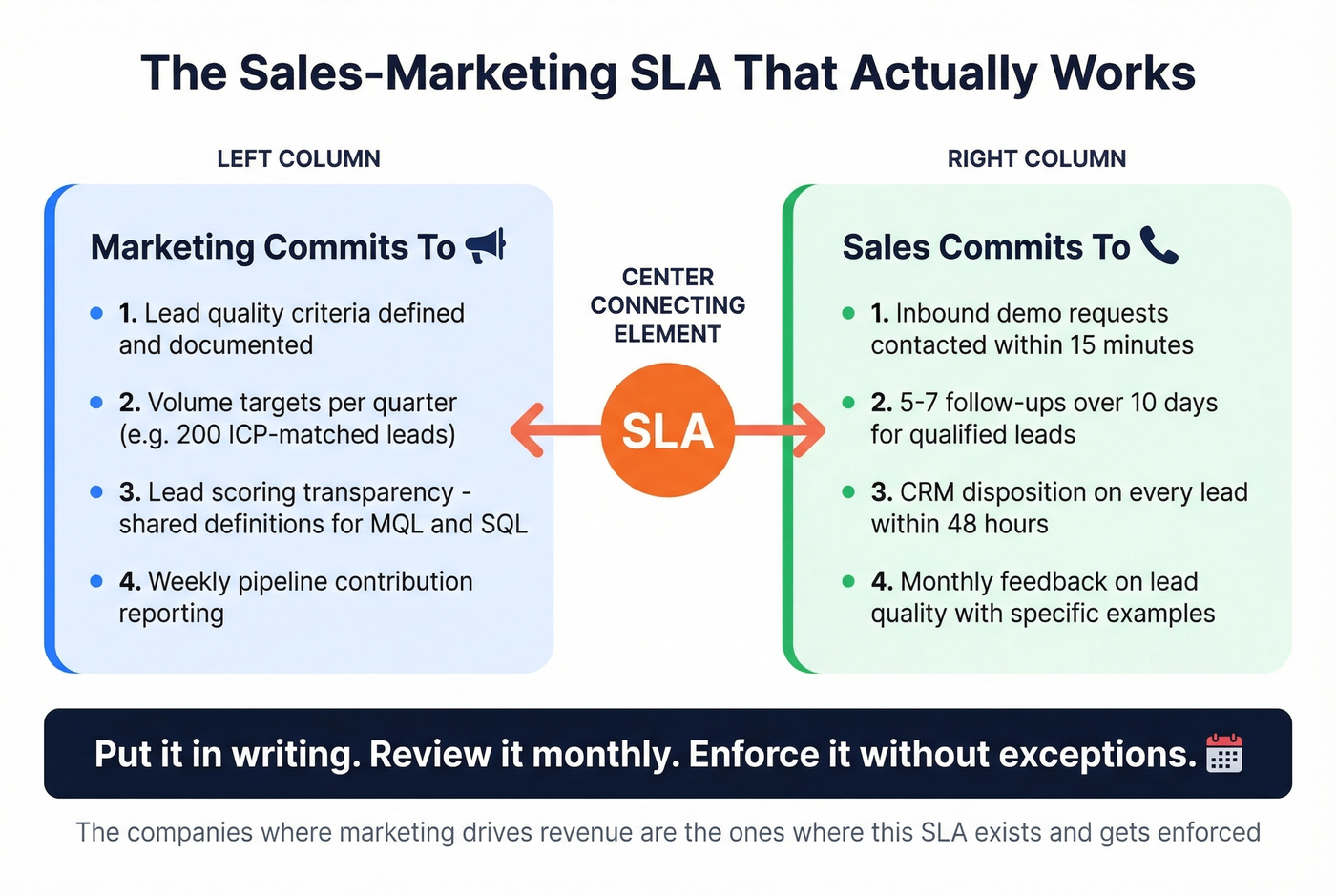
Marketing commits to lead quality criteria and volume targets. Sales commits to response times and follow-up cadence - inbound demo requests contacted within 15 minutes during business hours, 5-7 follow-ups over 10 days for qualified leads. Put it in writing. Review it monthly. The companies where marketing actually drives revenue are the ones where this SLA exists and gets enforced.

Your marketing plan is only as good as the data behind it. Prospeo gives you 300M+ profiles with 30+ filters - buyer intent, technographics, job changes, headcount growth - so every campaign targets your actual ICP. 98% email accuracy. 7-day refresh. $0.01/email.
Stop planning campaigns on stale data. Start with contacts that convert.
Paid Media Benchmarks
Here's where your paid dollars should go. The data comes from 2026 B2B PPC benchmarks, and the patterns are clear.
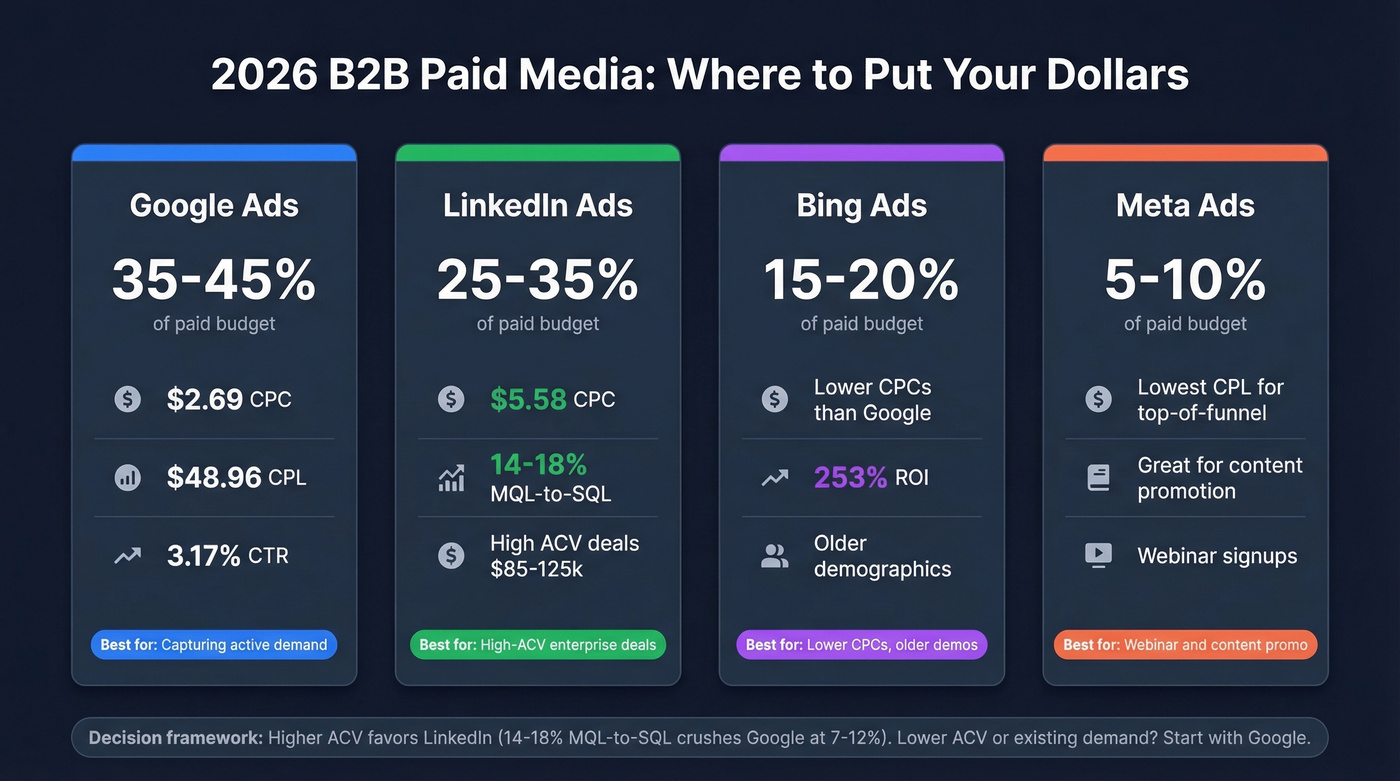
| Channel | Budget Share | Key Metrics | Best For |
|---|---|---|---|
| Google Ads | 35-45% | $2.69 CPC, $48.96 CPL, 3.17% CTR | Capturing active demand |
| LinkedIn Ads | 25-35% | $5.58 CPC, 14-18% MQL-to-SQL | High-ACV deals ($85-125k) |
| Bing Ads | 15-20% | 253% ROI | Lower CPCs, older demos |
| Meta | 5-10% | Lowest CPL for top-of-funnel | Webinar/content promo |
The decision framework is straightforward. Higher ACV favors LinkedIn - the MQL-to-SQL rate of 14-18% crushes Google's 7-12%, and deal values from LinkedIn-sourced opportunities run $85-125k. Lower ACV or high-volume models favor Google's cheaper CPLs. Bing is the sleeper: 253% ROI with less competition, but a smaller audience.
Don't spread budget equally across all four. Pick two, get them working, then expand. Equal allocation across channels is one of the most common budget mistakes we see in B2B.
Real-World Campaign Examples
Numbers from actual campaigns, not theoretical frameworks.
SAP's "Inspire the Future" campaign generated EUR924M in pipeline and EUR266M in projected revenue. Their podcast hit 22,000+ listeners (top 2% benchmark is 18,000), and industry videos crossed 10,000 YouTube views within 30 days. The takeaway isn't "be SAP" - it's that multi-format content campaigns compound when they're tied to pipeline tracking from day one.
BOLT ON Technology saw a 272% increase in inbound demos and 411% ROI on marketing-impacted revenue after restructuring their plan around ICP-targeted content and demand capture. They didn't add channels - they got sharper on who they were targeting.
A practitioner running a webinar-first funnel in the legal niche shared their numbers on r/b2bmarketing: $3.91 cost per opt-in, $54.88 cost per demo, and $192-$274 cost per close on $14-20k ACV deals. The key insight? They validated webinar titles with dummy landing pages before producing anything - headline wording alone swung results from $16.00 to $2.50 per qualified opt-in. Precision targeting consistently outperforms broad-reach tactics, and the Reddit thread's comments backed that up with similar stories from SaaS and professional services.
Mistakes That Kill Your Plan
These are the anti-patterns we see repeatedly:
- Copying last year's plan. Markets shift. Channels decay. What worked last year is saturated now. Start from your revenue target, not last year's spreadsheet.
- Optimizing for lead volume instead of revenue. 10,000 MQLs mean nothing if they convert at 2%. Track pipeline created, not leads generated.
- No testing budget. If 100% of your budget is committed to "proven" channels, you'll never find the next one. Reserve 10-15%.
- Equal budget across all channels. This feels fair and is almost always wrong. Double down on what's working; cut what isn't.
- Confusing tactics with strategy. "We'll run LinkedIn ads" isn't a strategy. "We'll capture demand from VP-level buyers in mid-market fintech using matched audiences" is closer.
- Ignoring sales cycle length. If your average deal takes six months to close, a Q3 budget cut means a Q1 pipeline crater. Budget to the cycle, not the quarter.
B2B Marketing Plan Template
Use this as your skeleton. Fill in each section with your specific numbers.
| Plan Section | What Goes Here | Example KPI |
|---|---|---|
| Executive summary | One-page overview | Revenue target |
| Business objectives | 3-5 SMART goals | 25% ARR increase |
| ICP & personas | Firmographic + behavioral | 200 ICP leads/quarter |
| Competitive analysis | 3-5 competitors, positioning | 10% market share gain |
| SMART marketing goals | Quarterly targets | 500 MQLs in Q2 |
| Channel strategy | 3 primary channels + rationale | 3% CTR on paid |
| Budget & resources | % of revenue + allocation | CAC below $500 |
| Measurement & KPIs | Dashboard + review cadence | 4:1 LTV:CAC |
| Sales-marketing SLA | Response times + lead criteria | 15-min demo response |
| Testing plan | 10-15% budget for experiments | 2 new channels tested/Q |
The plan isn't the strategy. The plan is how you execute the strategy with specific numbers, timelines, and accountability. If you can't hand this document to a new marketing hire and have them understand what success looks like in their first week, it's not done yet.
If you want to pressure-test your funnel math, start with funnel metrics and pipeline health before you lock budgets.
ABM without verified contacts is expensive spam. Prospeo's 5-step verification keeps bounce rates under 5%, and weekly data refreshes mean you're never emailing someone who left the company last month. 75 free verified emails to test your ICP hypothesis today.
Build the prospect list your marketing plan actually deserves.
FAQ
What should a B2B marketing plan include?
A complete plan covers business objectives tied to revenue, ICP and buyer persona definitions, channel strategy (start with three), budget allocation benchmarked to 7-12% of revenue, conversion KPIs, a sales-marketing SLA, and a testing plan with reserved budget. Skip any of these and the plan has a structural gap that compounds over time.
How much should a B2B company spend on marketing?
Most B2B companies spend 7-12% of revenue, with the Gartner benchmark at 7.7% cross-industry. Mature companies run at 5-7%, while startups often invest 15-20%+ to build pipeline and brand simultaneously. Tech companies average 7.1%, so know your vertical before setting a number.
What's the difference between a marketing plan and a marketing strategy?
Strategy defines your direction - who you're targeting, how you're positioned, and why buyers should choose you. The plan is the execution document with specific budgets, timelines, channel selections, and KPIs. Strategy answers "where are we going?" The plan answers "how do we get there by Q3?"
How do you measure B2B marketing success?
Pipeline velocity is the north star metric: (Opportunities x Deal Size x Win Rate) / Sales Cycle Days. Supporting benchmarks include MQL-to-SQL conversion at 25-35%, pipeline coverage at 3-5x quota, and LTV:CAC ratio of 4:1 or better. Vanity metrics like impressions and raw lead counts don't belong in executive reporting.
How do you build a prospect list for outbound campaigns?
Define your ICP criteria first - firmographics, technographics, and behavioral signals like intent data or job changes. Then use a verified data platform to find contacts matching those criteria and export directly to your CRM. Prioritize accuracy above volume - bounced emails destroy domain reputation and tank deliverability fast.