

B2B Personalization Starts With Data, Not Messaging
A sales team sent 200 "personalized" cold emails in a single week. Every one opened with a scraped icebreaker - "Love your podcast episode on supply chain resilience!" - stitched together by an AI tool pulling from stale profiles. The bounce rate hit 23%. The reply rate landed at 0.8%.
B2B personalization wasn't the problem. The data underneath it was.
What You Need (Quick Version)
- Fix your data first. Personalization built on stale contacts and bad emails is just expensive spam.
- Use 1-2 business signals per prospect, not personal trivia. Hiring patterns, tech stack changes, and funding rounds beat "saw your post" every time.
- Measure with control groups or don't measure at all. Gut feel isn't ROI.
What Personalization Actually Means in B2B
Tailoring your messaging, content, and buying experience to a specific account or stakeholder based on real business context - that's the job. It's not writing a custom paragraph about someone's dog.
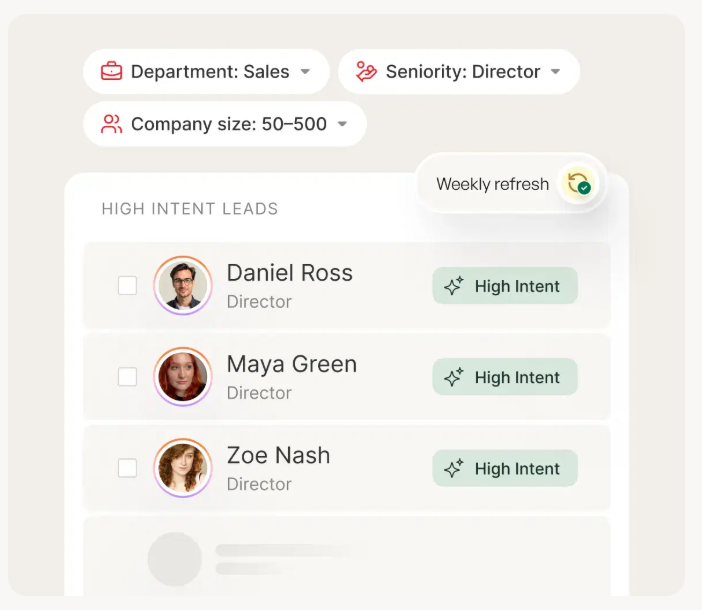
The distinction matters because most teams confuse the two. 71% of buyers expect personalized interactions, and 76% get frustrated when it doesn't happen. That gap defines the current state of buyer expectations. But "personalized" doesn't mean "familiar." It means relevant.
The consensus on r/b2bmarketing is blunt: icebreaker-style openers - pets, hobbies, "loved your recent post" - sound like scraped crap and signal cheap automation. Signal-based outreach, where you reference a real business trigger, earns the reply.
The ROI Case
Personalization drives 10-15% revenue lift on average, with company-specific results spanning 5-25% depending on execution and sector. Faster-growing companies drive 40% more of their revenue from tailored experiences than slower-growing peers. The personalization software market is projected to hit $11.6B in 2026, up from $7.6B in 2021 - the money is following the results.
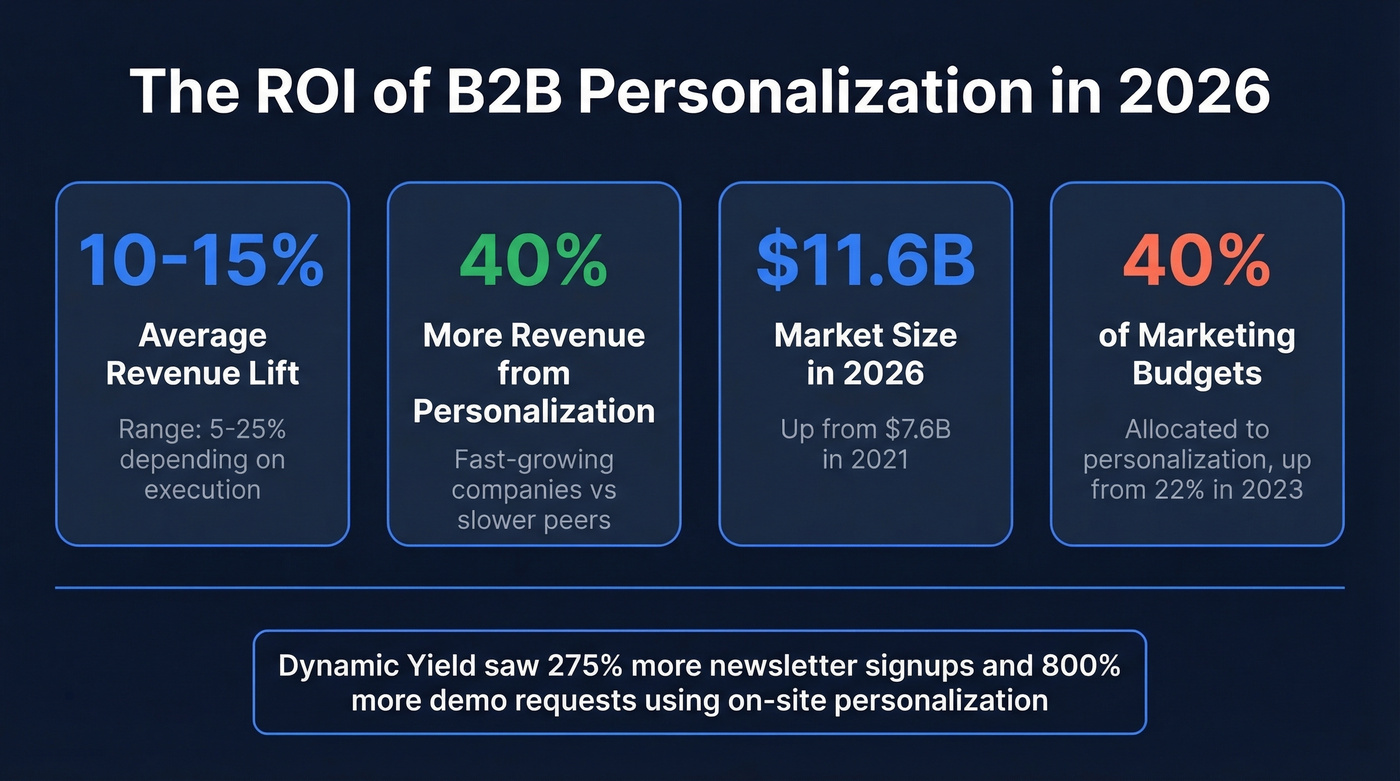
On the website side, Dynamic Yield ran its own platform on its own site and reported a 275% increase in newsletter signups and an 800% increase in demo requests. One finding worth stealing: ebook downloads converted 20% better on landing pages than modals, but case study downloads converted 30% better on modals. The format matters as much as the message.
Roughly 40% of marketing budgets now go toward personalization, up from 22% in 2023.
The Outbound Personalization Trap
Most outbound personalization fails before the copy is even written. If your contact list is six weeks stale, a big chunk of your "personalized" emails never reach a human inbox. The messages are the last 10% of the problem.
Do this: Automate the research, not the relationship. Pull hiring signals, tech stack changes, funding rounds, and recent news automatically. Then write one sentence that connects a real business trigger to a specific problem you solve. And verify your list before you personalize anything - a 23% bounce rate doesn't just waste your copy, it tanks your domain reputation for every future campaign.
Skip this if you're tempted: Don't write custom paragraphs for 1,000 prospects. As one r/b2bmarketing practitioner put it: "How do I personalize 1,000 emails? You don't. That's the trap." And don't open with personal trivia. "Saw you went to Michigan State" isn't personalization - it's surveillance dressed up as rapport.
Here's the thing: data quality is the prerequisite, not a nice-to-have. Prospeo's 7-day data refresh cycle means the contacts you're personalizing against are current, not cached from last quarter. Meritt, a sales agency, saw this firsthand - their bounce rate dropped from 35% to under 4% after switching their data source, and pipeline tripled from $100K to $300K per week.


Personalization built on 6-week-old data is just expensive spam. Prospeo's 7-day refresh cycle and 98% email accuracy mean the contacts you personalize against are real, current, and reachable. Meritt tripled pipeline from $100K to $300K/week after switching - bounce rate dropped from 35% to under 4%.
Stop personalizing emails that bounce. Start with data that's actually fresh.
Signals That Drive Personalized B2B Experiences
Forrester's buying signal model splits data sources into three categories, and each one maps to a different personalization layer.
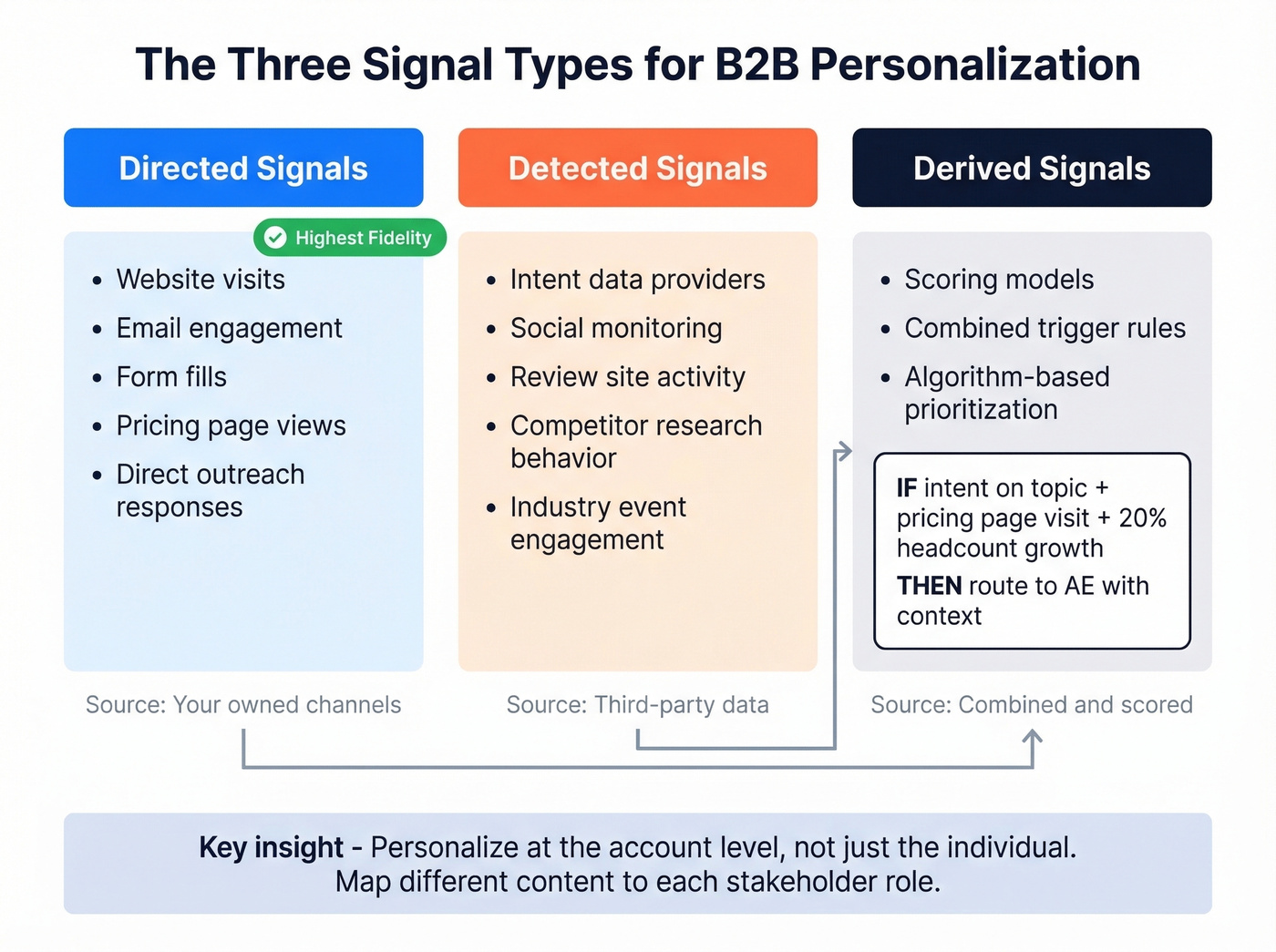
Directed signals come from your owned channels - website visits, email engagement, form fills, direct outreach responses. These are the highest-fidelity signals you have because the prospect is interacting with your content. A VP of Engineering who's visited your pricing page three times in a week is telling you something.
Detected signals come from third-party sources - intent data providers, social monitoring, review site activity. These tell you what accounts are researching before they ever hit your site. In practice, many teams combine intent-style signals with firmographic filters to prioritize accounts showing active buying behavior.
Derived signals combine the first two through scoring models, rules, and algorithms. This is where you build triggers: "If account shows intent on [topic] AND champion visited pricing page AND company headcount grew 20% this quarter, route to AE with context."
Here's the part most teams botch: personalize at the account level, not just the individual. A B2B buying group includes multiple stakeholders - often 3-10 people - and your champion, the budget holder, and the technical evaluator all need different messages tied to the same account signals. Map technical whitepapers to engineering evaluators, ROI calculators to finance stakeholders, and case studies to champions building internal consensus.
One critical gap worth calling out: 92% of companies personalize their marketing, but only 54% personalize customer engagement. That's a problem when 61% of B2B revenue comes from existing customers. The buying group doesn't stop being a buying group after they sign. Expansion, renewal, and cross-sell all benefit from the same signal-based approach.
How to Measure Personalization ROI
Let's be honest: under 25% of marketing teams rate their own measurement practices as fair. 82% have adopted ABM, but most still lean on MQLs and last-touch attribution to prove impact. That's like measuring a restaurant's quality by counting how many people walk through the door.
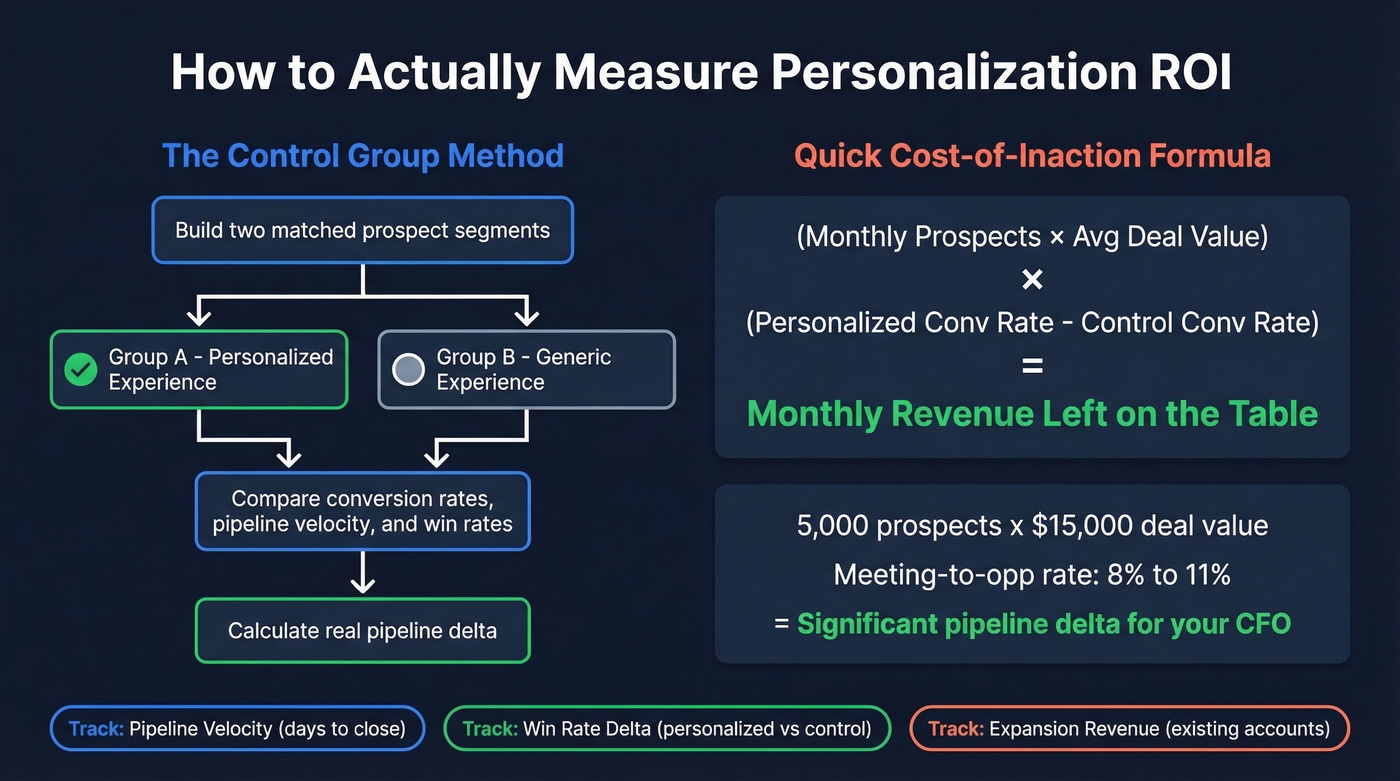
The only credible way to measure ROI on personalized campaigns is control groups. Run the same campaign to two matched segments - one gets the personalized experience, one gets the generic version. Compare conversion rates, pipeline velocity, and win rates. Everything else is correlation.
For a quick cost-of-inaction estimate:
(Monthly Prospects x Average Deal Value) x (Personalized Conversion Rate - Control Conversion Rate) = Monthly Revenue Left on the Table
If you're running 5,000 prospects per month at a $15,000 average deal value, and personalization lifts your meeting-to-opportunity rate from 8% to 11%, that's real pipeline delta you can take to your CFO. Track three KPIs: pipeline velocity in days to close, win rate delta between personalized and control groups, and expansion revenue from existing accounts.
Tools for Account-Based Personalization
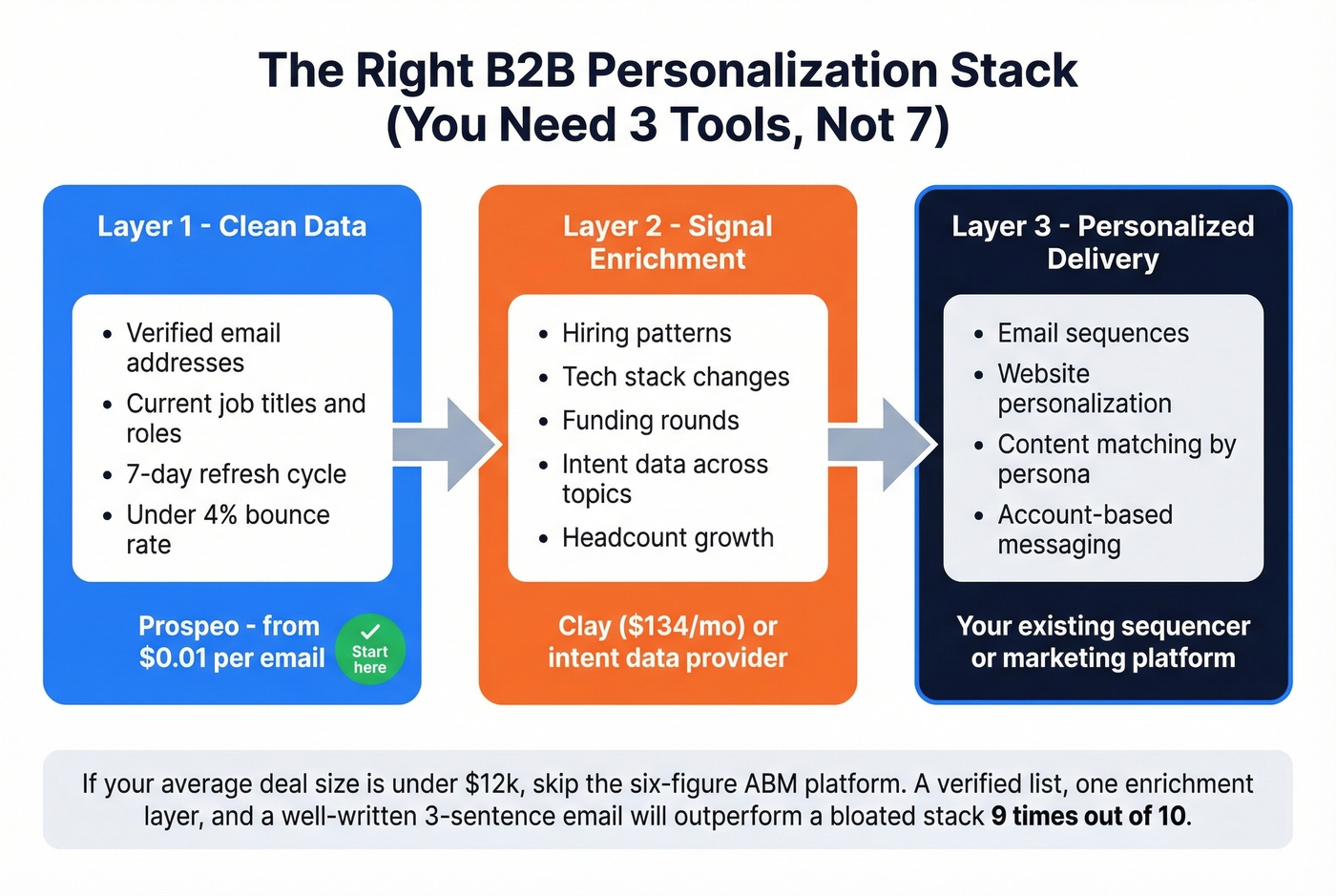
You don't need a $50k platform to personalize effectively. You need a clean data layer, a signal enrichment tool, and a delivery mechanism you already own. We've seen teams that verify contacts before personalizing get 2-3x the reply rates of teams that skip that step and go straight to clever copy.
| Tool | Category | Starting Price | Best For |
|---|---|---|---|
| Prospeo | Data / verification | Free; ~$0.01/email | Bounce-proof email lists for outbound |
| Clay | Signal enrichment | $134/mo | Research automation at scale |
| Apollo | Sales engagement + data | Free; $49/user/mo | All-in-one outbound on a budget |
| Lavender | Email coaching | $29/mo | AI-assisted email writing |
| Mutiny | Website personalization | ~$1,000-3,000/mo | ABM website experiences |
| Segment | CDP | $120/mo | Cross-channel data unification |
| HubSpot | Marketing automation | $800/mo | Marketing personalization suite |
If your average deal size is under $12k, you probably don't need a six-figure ABM tool or a $50k intent data platform. A verified contact list, one enrichment layer, and a well-written three-sentence email will outperform a bloated tech stack nine times out of ten.
Our recommended stack: start with clean, verified data, layer in signals through Clay or intent data, then personalize delivery through your existing sequencer or marketing automation platform. You don't need all seven tools. You need the right three for your workflow.
Building a Strategy That Scales
Gartner predicts that by 2028, 90% of B2B buying will be agent-intermediated - meaning AI systems will evaluate, shortlist, and recommend vendors on behalf of human buyers. Your personalized content increasingly needs to work for two audiences: the human decision-maker and the AI agent filtering options before that human ever sees them.
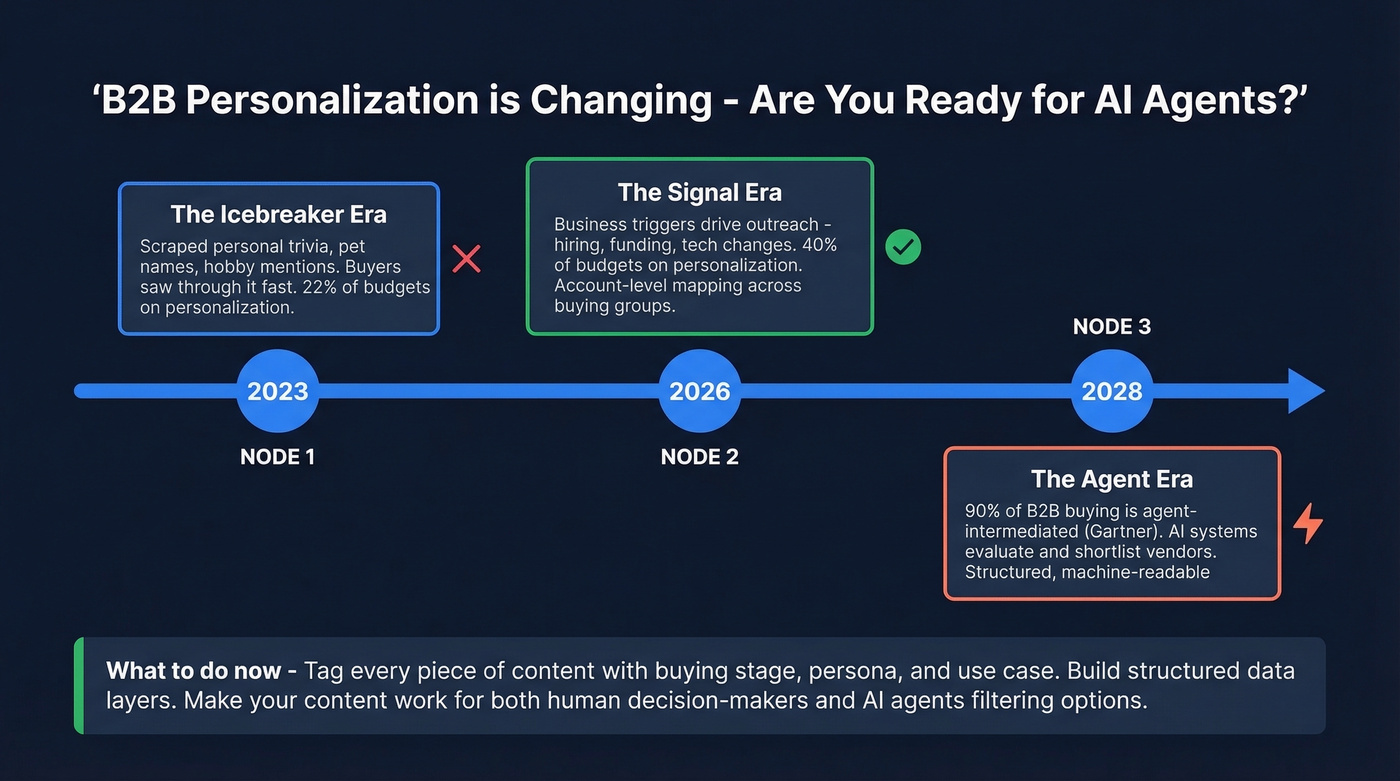
Structured, machine-interpretable content - clear pricing, explicit use cases, quantified outcomes - will matter more than clever copy. The game is about to get a lot more technical, and the teams building structured data layers now will have a head start when agents become the primary gatekeepers.
Among the most effective strategies for this shift: tag every piece of content with the buying stage, persona, and use case it serves so both humans and AI agents can match it to the right context instantly.
If you want a more operational approach, start by identifying buying signals and building a repeatable process to track sales triggers across your ICP.
Signal-based personalization needs signal-rich data. Prospeo gives you 30+ filters - buyer intent across 15,000 topics, tech stack, hiring patterns, funding, headcount growth - so every message ties to a real business trigger, not scraped trivia.
Layer real buying signals into every outreach for $0.01 per verified email.
FAQ
What's the difference between B2B and B2C personalization?
B2B targets buying groups of 3-10 stakeholders using firmographic data and intent signals across sales cycles averaging 3-6 months. B2C targets individuals for near-immediate conversion using behavioral and demographic data. The multi-stakeholder dynamic makes account-level signal mapping essential in B2B - you're not personalizing for one person, you're personalizing for a committee.
How do I personalize outbound without sounding fake?
Skip personal trivia entirely. Find 1-2 business signals - hiring patterns, tech stack changes, funding rounds - and write one sentence connecting that signal to a problem you solve. Tools with technographic and headcount growth filters surface these signals before you write a word, so the research step takes minutes instead of hours.
What's the minimum tool stack for effective personalization?
Start with three layers: a verified data source for clean contacts, a signal enrichment tool like Clay for research automation, and your existing email sequencer for delivery. Teams spending under $15k ACV rarely need more than this to outperform bloated enterprise stacks.