

B2B Sales Process Steps: The Data-Backed Guide for 2026
Old process: 7 steps, 12 weeks, 19% close rate. New process: 3 steps, 3 weeks, 37% close rate. That's not a hypothetical - it's a real example from a practitioner on r/EntrepreneurRideAlong who cut their B2B sales process steps from seven to three and nearly doubled their win rate.
The best process uses the fewest stages that still do the job. Each step should qualify, advance, or remove objections - otherwise cut it. Below: the stages that matter, the conversion benchmarks to aim for, and which qualification framework fits your deal size.
Why Most B2B Sales Processes Fail
86% of B2B purchases stall during the buying process. Not because buyers don't want to buy - because sellers create too many opportunities for momentum to die. Every additional step is a drop-off point, a scheduling conflict, a chance for a competitor to swoop in.
Here's the thing: teams add a "technical validation call" and a "stakeholder alignment meeting," thinking more touchpoints mean more control. What actually happens is a short cycle turns into a multi-month endurance test, close rates crater, and the team only recovers when they collapse back to a few core stages. Even when deals do close, 81% of buyers end up dissatisfied with the provider they chose - often because a bloated process eroded trust before the contract was signed.
How B2B Buying Changed in 2026
Buyers define 83% of their purchase requirements before talking to sales. By the time you get a discovery call, the shortlist is already set - 95% of winning vendors are on the Day One shortlist.
Average deals now involve 13 decision-makers, and 80% of buyer interactions happen digitally. The average buying cycle compressed from 11.3 months to 10.1 months recently, with buyers reaching out to sellers earlier - at 61% of their journey instead of 69%. That earlier contact is an opportunity, but only if your process capitalizes on it rather than burying it under unnecessary steps.
The buying journey isn't linear. Buyers loop back, re-evaluate, and pull in new stakeholders at random. These sales cycle stages represent seller-side structure, not a rigid path buyers follow.
The 6 Stages That Move Deals
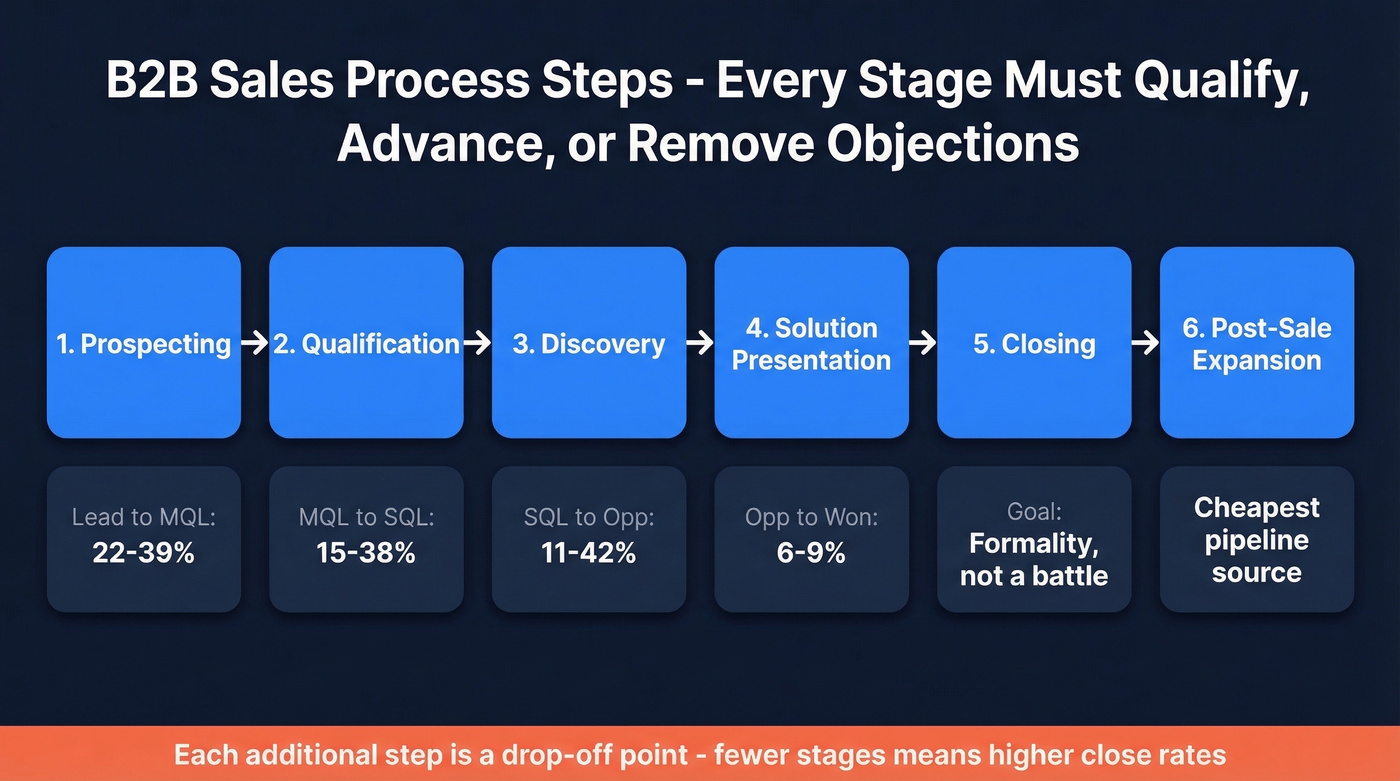
Every step below earns its place by qualifying, advancing, or removing objections. If a step in your current process doesn't do one of those three things, cut it.
1. Prospecting
Build a targeted list of verified contacts who match your ICP. The quality of this list determines everything downstream - garbage in, garbage out. Use intent signals, technographics, job changes, and headcount growth to narrow from a universe of profiles to a focused target list.
Prospeo's database covers 300M+ profiles with 98% email accuracy and intent data across 15,000 topics, so you're starting with contacts who are both reachable and in-market. We've found that teams who layer intent data on top of firmographic filters cut their prospecting time by more than half while generating higher-quality pipeline.
Move to the next step when you have an ICP-matched list with verified emails and direct dials. Lead-to-MQL conversion runs 22-39% depending on targeting quality, and contacting leads within 24 hours increases conversion 5x.

2. Qualification
This is where most pipeline bloat lives - and one of the biggest drop-offs in the entire funnel. MQL-to-SQL conversion runs 15-38%, meaning the difference between a disciplined qualification process and a sloppy one is literally 2.5x more pipeline.
Use a structured framework (more on which one below) and don't waste discovery calls on prospects who lack budget, authority, or a real timeline. You advance when framework criteria are met. Skip this if your deal size is under $5K and your sales cycle is under two weeks - at that point, just qualify on the first call and move straight to a demo.
3. Discovery
The common mistake: pitching to one champion and hoping they sell internally. With 13 decision-makers per average deal, that's a losing bet.
Discovery is the process of uncovering pain, mapping every stakeholder who matters, and documenting how decisions actually get made. You're not just asking "what keeps you up at night?" - you're building a political map of who has veto power, who controls budget, and who'll sabotage the deal because they preferred a competitor. You're done when you have documented pain and a mapped buying committee.
4. Solution Presentation
Tailor your pitch to the pain you documented in discovery. Generic demos kill deals.
Smart practitioners combine the demo and proposal into a single meeting - every additional scheduling step is another chance for the deal to stall. We've seen teams cut a full week off their cycle just by sending the proposal during the demo call instead of scheduling a separate "proposal review." Advance when the prospect confirms the solution addresses their documented needs.
5. Closing
If discovery and presentation were done right, closing is a formality, not a battle. Negotiate terms, get the signature. Opportunity-to-Closed Won runs 6-9% from the top of the funnel - which means the real leverage is in the stages above, not in closing tactics.
6. Post-Sale Expansion
Neglecting existing customers is one of the most expensive mistakes in B2B. They're your cheapest pipeline source and your best proof points. Onboard, deliver first value, and build the expansion playbook from day one.

Step 1 of your sales process determines every conversion rate downstream. Prospeo gives you 300M+ profiles with 98% email accuracy, intent data across 15,000 topics, and 30+ filters to build lists that actually convert - at $0.01 per email.
Fix your prospecting step and every stage after it improves.
Which Qualification Framework to Use
Don't overthink this. Match the framework to your deal complexity.
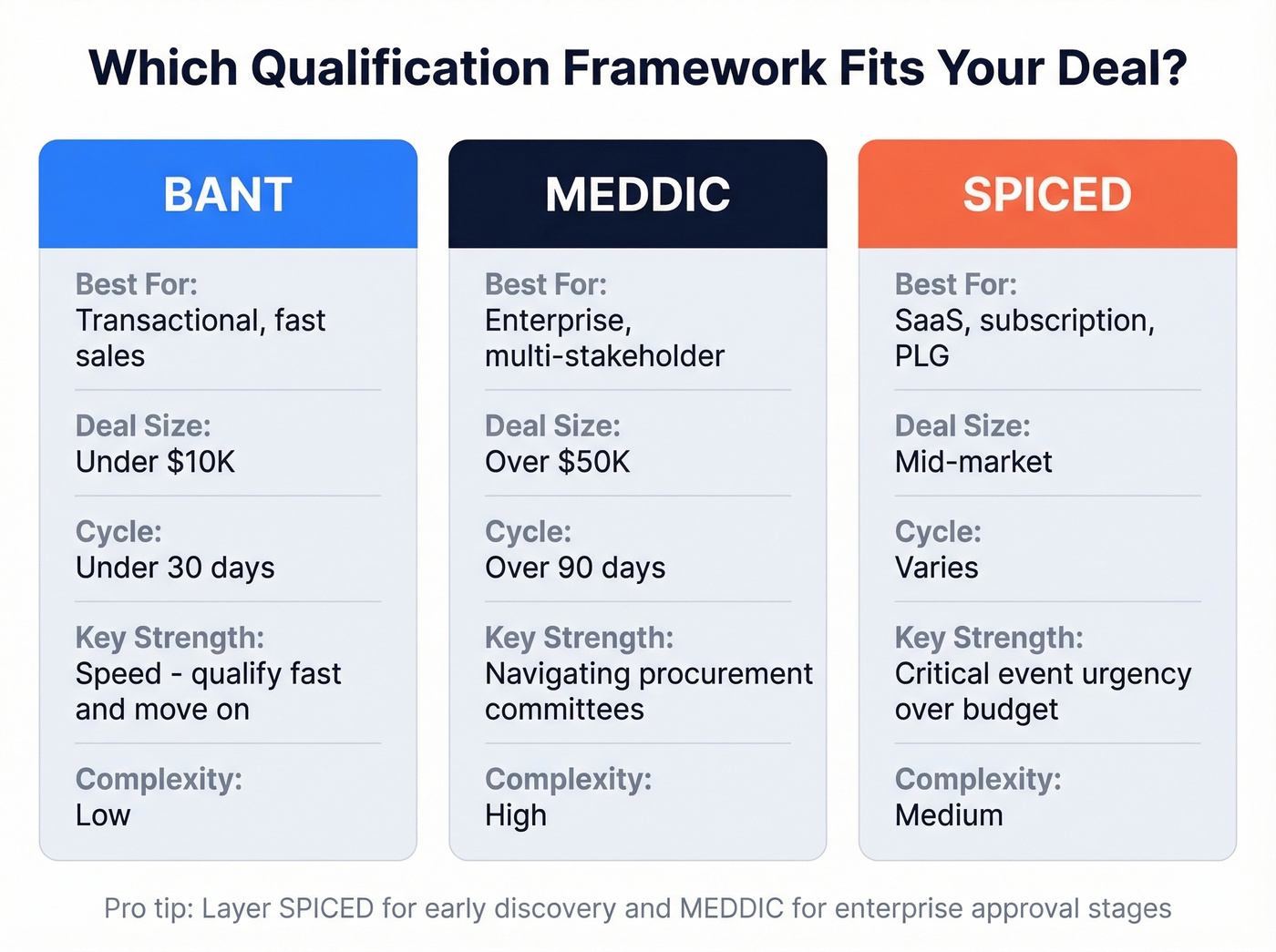
| Framework | Best For | Deal Size | Cycle Length |
|---|---|---|---|
| BANT | Transactional, fast | Under $10K | Under 30 days |
| MEDDIC | Enterprise, multi-stakeholder | Over $50K | Over 90 days |
| SPICED | SaaS, subscription, PLG | Mid-market | Varies |
BANT works when you need to qualify fast and move on. MEDDIC earns its complexity when you're navigating procurement committees and six-figure contracts. SPICED fits subscription models where the "critical event" driving urgency matters more than a traditional budget conversation.
Some teams layer SPICED for early discovery and MEDDIC for the approval stage on larger deals - that hybrid approach is increasingly common on r/sales threads, and it makes sense when your pipeline spans both mid-market and enterprise.
Stage Conversion Benchmarks
Three sources, three methodologies, remarkably consistent patterns:
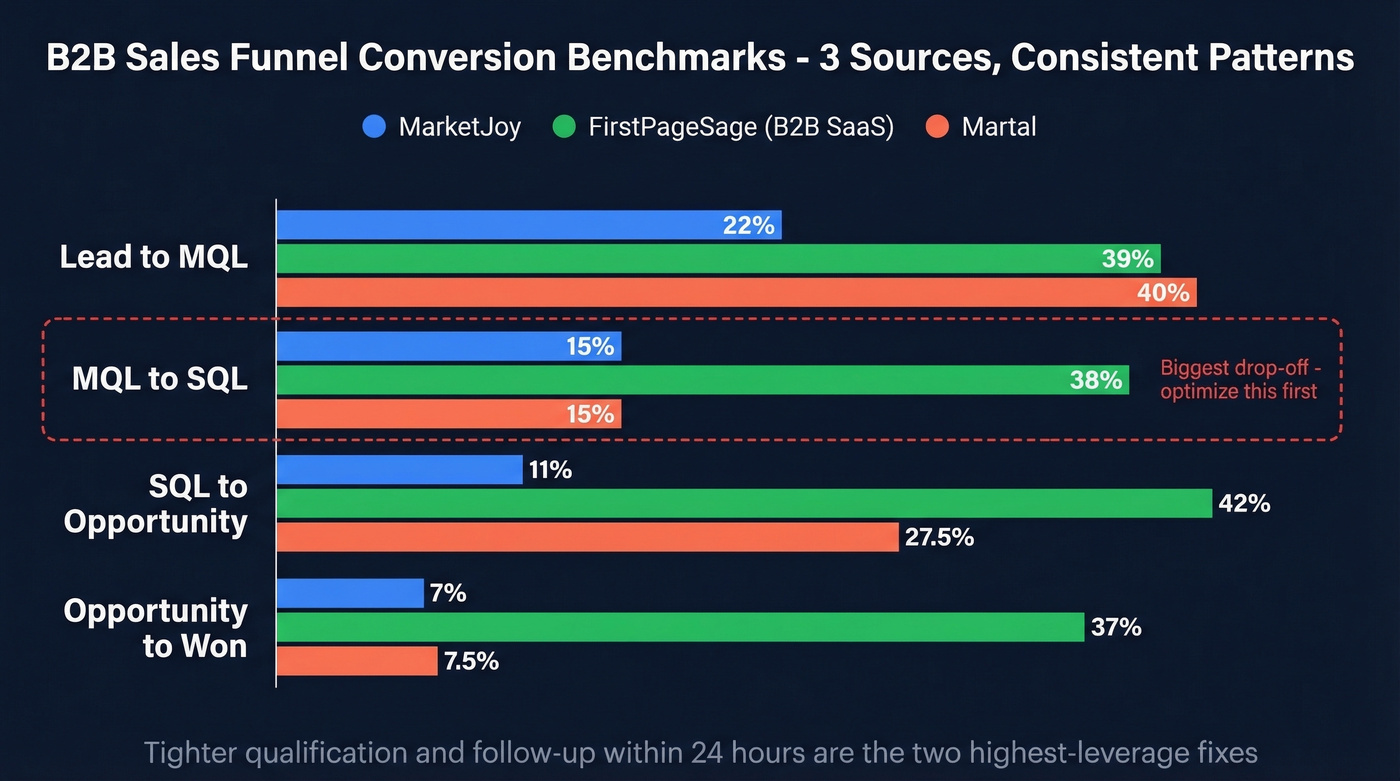
| Stage | MarketJoy | FirstPageSage (B2B SaaS) | Martal |
|---|---|---|---|
| Lead to MQL | 22% | 39% | 35-45% |
| MQL to SQL | 15% | 38% | 15% |
| SQL to Opp | 11% | 42% | 25-30% |
| Opp to Won | 7% | 37% | 6-9% |
The biggest drop-off is often MQL-to-SQL - leads that look good on paper but aren't truly sales-ready. In our experience, this is where most teams bleed pipeline. If you're only going to optimize one transition, start here. Tighter qualification criteria and faster follow-up within 24 hours are the two highest-leverage fixes.
Let's be honest: if your average contract value is under $15K, you probably don't need a 6-step process at all. Collapse qualification and discovery into a single call, combine the demo with the proposal, and run a 3-step process. The Reddit data backs this up, and I've seen it work repeatedly for SMB and mid-market teams.
Five Mistakes That Kill Your Process
Too many steps. Each additional step is a drop-off point. Fewer stages, shorter cycles, higher close rates - the data is unambiguous on this.
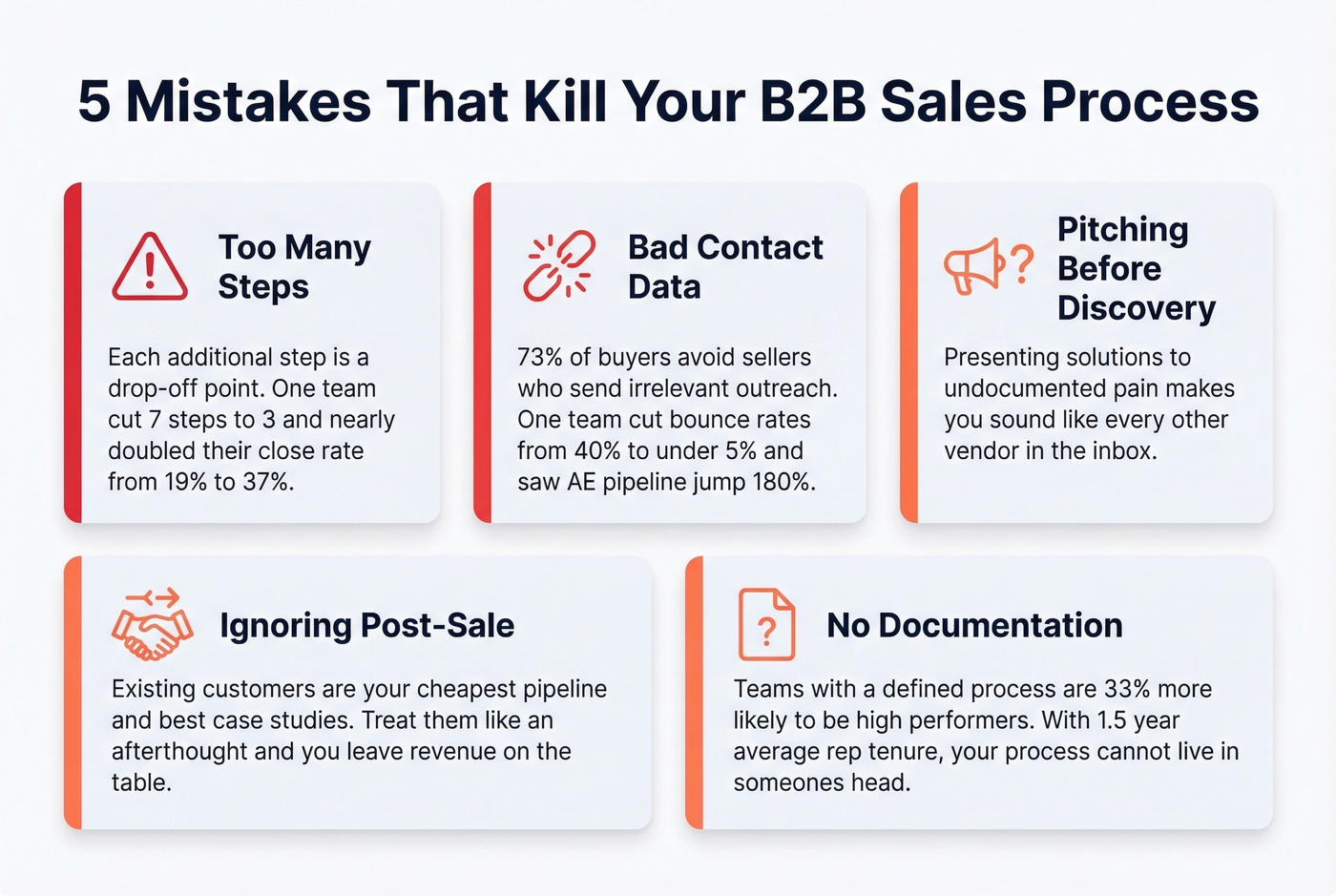
Bad contact data. 73% of B2B buyers avoid sellers who send irrelevant outreach. High bounce rates tank your domain reputation and waste your reps' time. Snyk's team went from 35-40% bounce rates to under 5% after switching to verified data, and AE-sourced pipeline jumped 180%. That's not a marginal improvement - it's a completely different business.
Pitching before discovery. Presenting solutions to undocumented pain is the fastest way to sound like every other vendor in the prospect's inbox.
Ignoring post-sale. Existing customers are your cheapest pipeline and your best case studies. Treat them like an afterthought and you're leaving revenue on the table.
No documentation. Teams with a defined sales process are 33% more likely to be high performers. When average rep tenure is 1.5 years, your process can't live in someone's head - it needs to live in your CRM as documented stages with clear exit criteria.
With 13 decision-makers per deal, you need direct dials - not gatekeepers. Prospeo's 125M+ verified mobile numbers hit a 30% pickup rate, so your reps spend time in discovery calls instead of voicemail boxes. Teams using Prospeo book 35% more meetings than Apollo users.
Reach the full buying committee, not just one champion.
FAQ
How many steps should a B2B sales process have?
Five to eight stages is typical, but fewer is often better. Each step must qualify, advance, or remove objections - teams that cut unnecessary stages routinely see close rates jump 10-20 percentage points. For deals under $15K, three steps can outperform six.
How long is a typical B2B sales cycle?
SMB deals close in 2-6 months; enterprise runs 6-18 months. The average across segments dropped from 11.3 to 10.1 months, driven by buyers engaging sellers earlier. Match your cycle length to deal complexity - a one-size-fits-all timeline leads to either rushed enterprise deals or sluggish SMB ones.
What's the best qualification framework for B2B sales?
BANT for sub-$10K transactional deals, MEDDIC for $50K+ enterprise with multiple stakeholders, SPICED for SaaS and subscription models. Layer intent data to prioritize which leads to qualify first - tracking topics your buyers are actively researching helps you focus energy on accounts that are actually in-market.
How do you build a B2B sales process from scratch?
Map your current buyer journey, then define the fewest stages that qualify, advance, or remove objections. Document exit criteria for each stage in your CRM, assign a qualification framework that fits your deal size, and measure stage-to-stage conversion rates to find where deals stall. Iterate quarterly based on real pipeline data rather than trying to perfect it on day one.