

B2B Software Buyer Intent Data: The 2026 Guide
A $65,000 annual renewal for an intent data platform that sourced 8% of closed-won pipeline last quarter. The other 92% came from inbound, referrals, and reps doing their own prospecting. We've watched this play out at dozens of companies - it's not an ROI problem, it's an architecture problem. Teams buy B2B software buyer intent data, pipe it into a dashboard nobody checks, and wonder why it doesn't move numbers.
Intent data works. 67% of the B2B buying journey is digital, and 92% of buyers already have a shortlist before they fill out a form. The real issue is buying signals without building the operational muscle to act on them. This guide breaks down what intent data actually is, which providers are worth your money in 2026, and how to turn signals into booked meetings instead of expensive dashboards.
What You Need (Quick Version)
- Enterprise teams ($100k+ budget): Demandbase or 6sense as your orchestration layer, supplemented by Bombora and G2 Buyer Intent for signal diversity.
One principle applies regardless of budget: you need a way to go from "account is surging" to "verified email in your sequencer" within 24 hours. Every day you wait, response rates drop.
What Is B2B Buyer Intent Data?
B2B buyer intent data is behavioral intelligence that identifies companies actively researching a product category, solution, or competitor before they raise their hand. It tracks digital signals - content consumption, product comparisons, review-site activity, topic research - across thousands of websites, then scores which accounts show abnormal interest relative to their baseline.
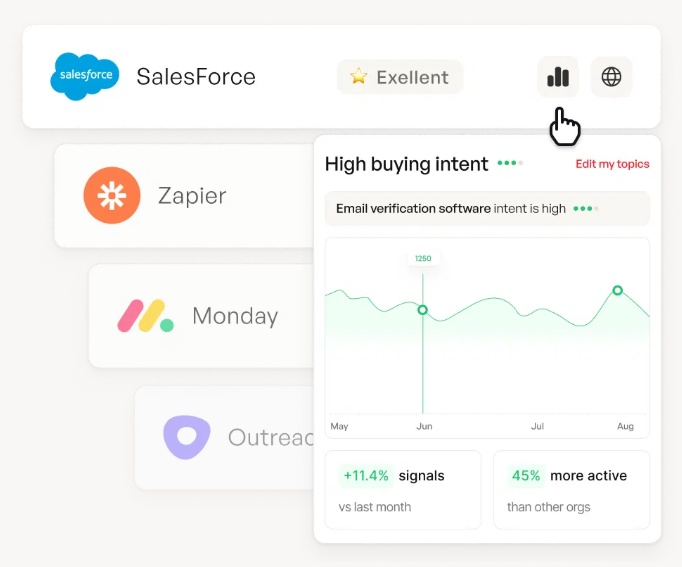
It's not lead generation. Intent data doesn't give you a name and email. It's not predictive analytics either - it doesn't forecast revenue. It answers one specific question: which accounts are in-market right now, and what topics are they researching?
A typical output includes the account name, topics being researched, and signal strength (commonly called a surge score), sometimes with the personas involved. It won't tell you which individual is doing the research, what their budget is, or whether they'll take your call.
That distinction matters because B2B buying committees now average 11+ stakeholders, and 41% already have a preferred vendor before formal evaluation begins. Intent data identifies the window. You still need contacts, messaging, and speed to capitalize on it.
Types of Intent Data
Not all intent signals carry equal weight. The source determines signal quality, compliance profile, and proximity to a purchase decision.
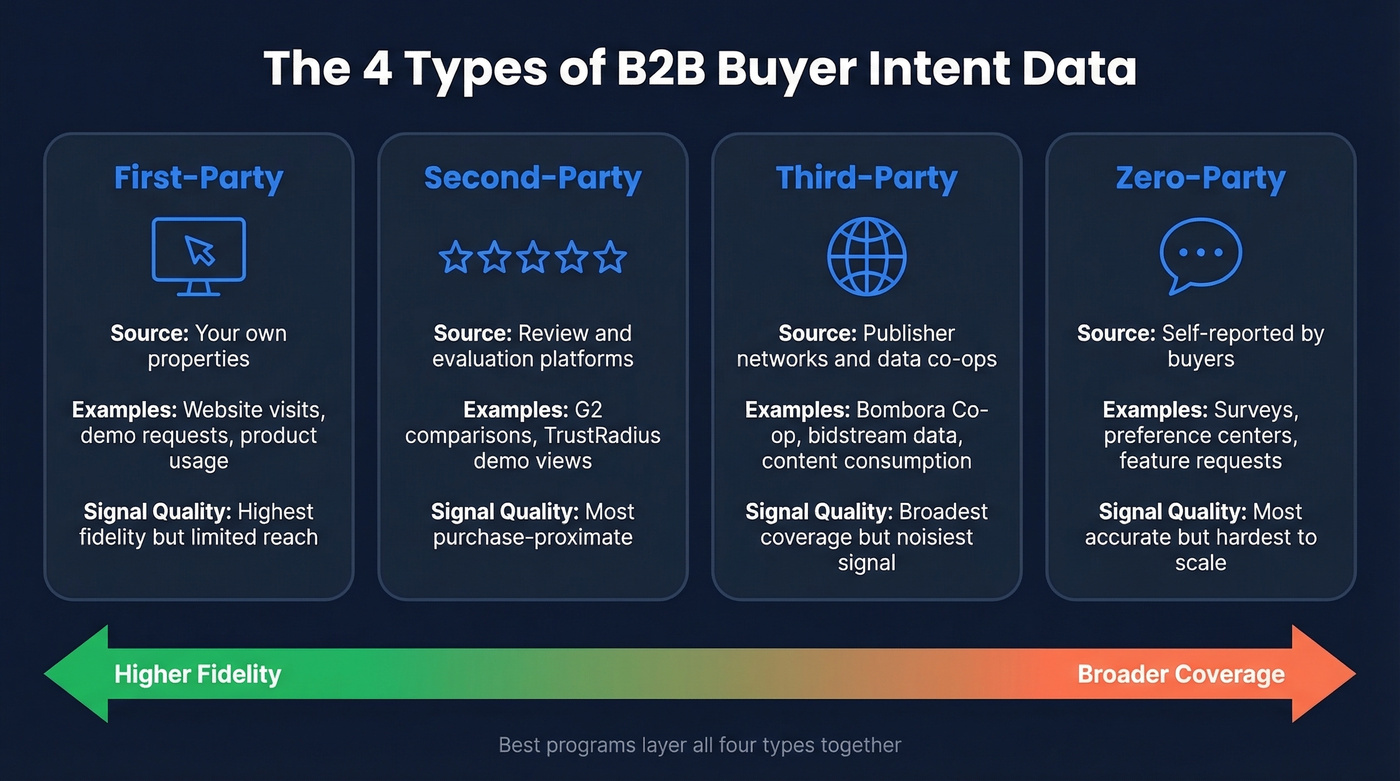
First-party intent comes from your own properties - website visits, content downloads, product usage, demo requests. It's the highest-fidelity signal because you control the data collection and know exactly what the visitor engaged with. The limitation is reach: you only see accounts that already found you.
Second-party intent comes from platforms where buyers actively evaluate vendors. G2 and TrustRadius are the canonical examples. When someone compares your product to a competitor on G2 or watches a demo on TrustRadius, that's active evaluation, not passive browsing. These signals are the most purchase-proximate in the market.
Third-party intent comes from external publisher networks and data co-ops. Bombora's Data Co-op, spanning 5,000+ B2B websites and tracking 17 billion monthly interactions, is one of the most established sources. These signals show topic-level research behavior across the open web. The tradeoff: broader coverage but noisier signal, since you're inferring business intent from content consumption patterns rather than observing direct product evaluation.
Zero-party intent is self-reported - survey responses, preference center selections, explicit feature requests. The most accurate signal of all, but the hardest to collect at scale. Most teams underinvest here.
The best programs layer all four types rather than relying on a single source.
How Intent Data Works
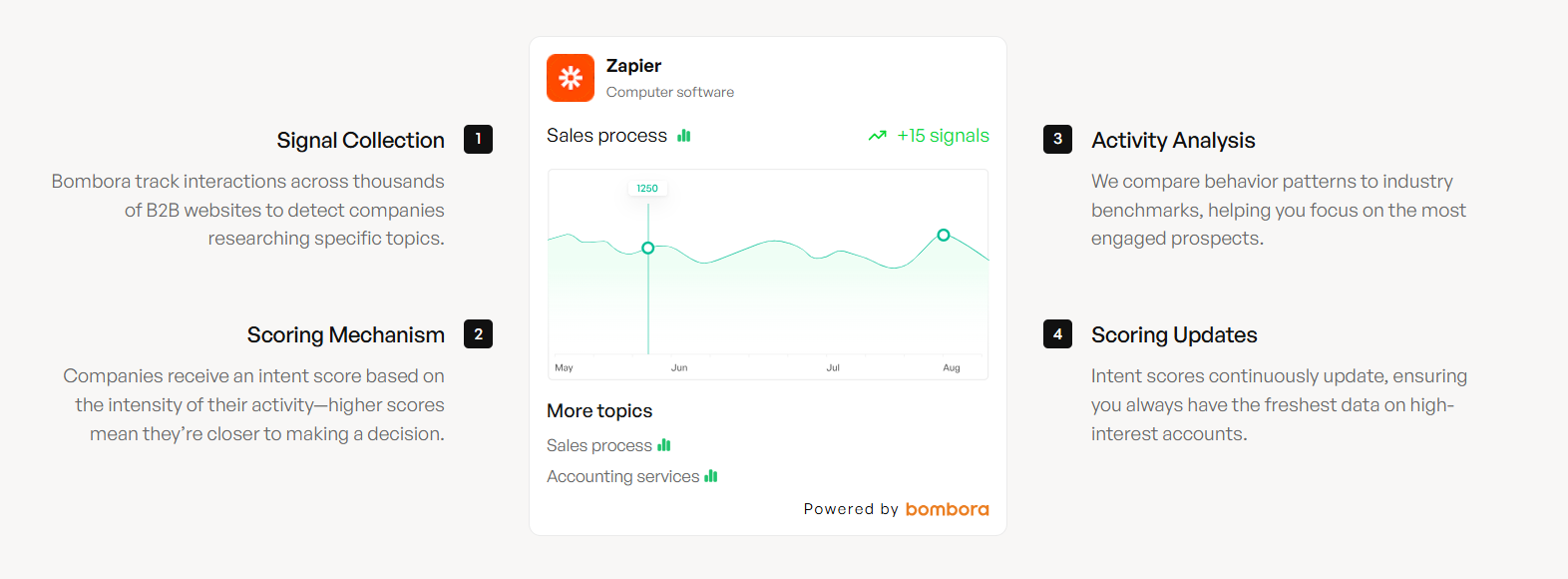
Collection
Publishers, ad networks, and co-op members embed tracking pixels or share anonymized browsing data. Bidstream data from programmatic ad exchanges is another major source, and it carries elevated compliance risk.
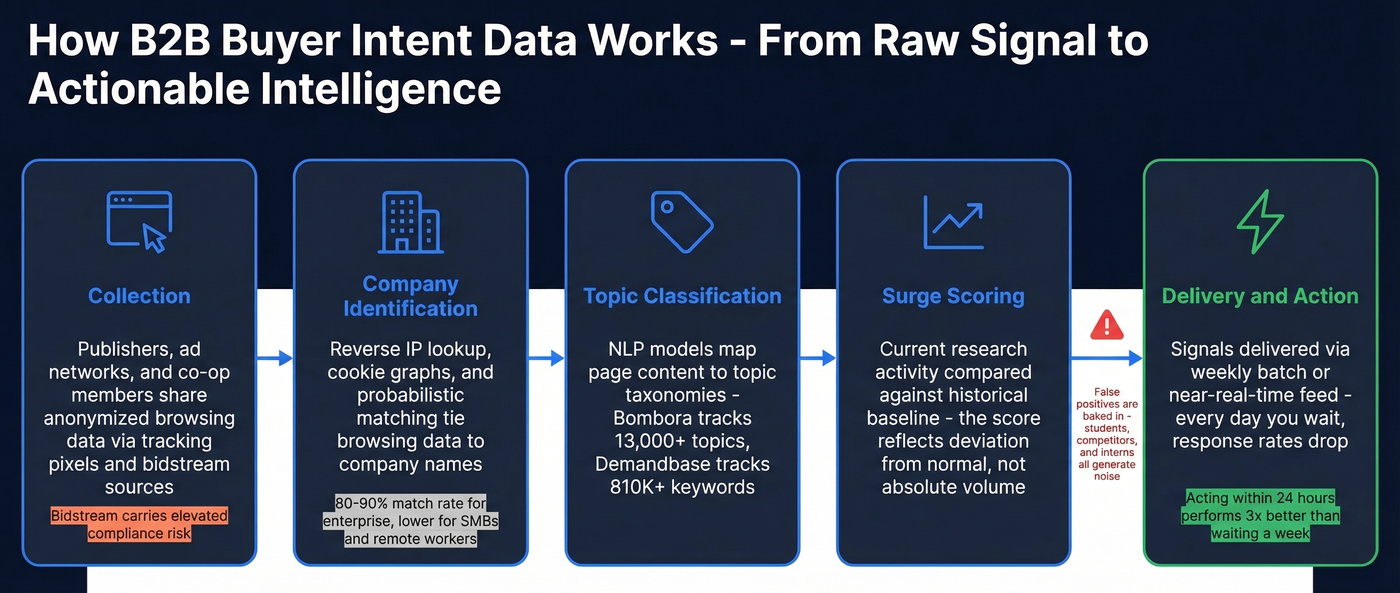
Company Identification
Raw browsing data gets matched to companies via reverse IP lookup, cookie graphs, and probabilistic matching. This is where accuracy diverges sharply between providers. The best hit 80-90% match rates for enterprise accounts, but accuracy drops for SMBs, remote workers on residential IPs, and international traffic. The rise of distributed workforces has made IP-based identification significantly harder, pushing providers toward cookie graphs and deterministic matching.
Topic Classification
NLP models map page content to topic taxonomies. Bombora tracks 13,000+ topics; Demandbase tracks 810K+ intent keywords. Topic taxonomies are curated and stable, while keyword-level tracking is more granular but noisier.
Surge Scoring
The system compares an account's current research activity against its historical baseline. If Acme Corp normally reads 3 articles about "cloud security" per week and suddenly reads 15, that's a surge. The score reflects deviation from normal, not absolute volume.
Delivery
Many providers deliver signals in weekly batches, though some offer near-real-time feeds. Weekly delivery means you're already up to a week behind the buyer's actual behavior - which is why activation speed matters so much.
False positives are baked into the system. Students researching for a paper, competitors monitoring your category, interns doing market scans - they all generate signals that look like buying intent. Gartner estimates the average cost of poor data quality at $12.9M-$15M per year per organization. In intent data, that cost shows up as wasted SDR time chasing accounts that were never in-market.
Signal Tiering Framework
We use a three-tier framework to prioritize which signals deserve immediate action versus background monitoring.
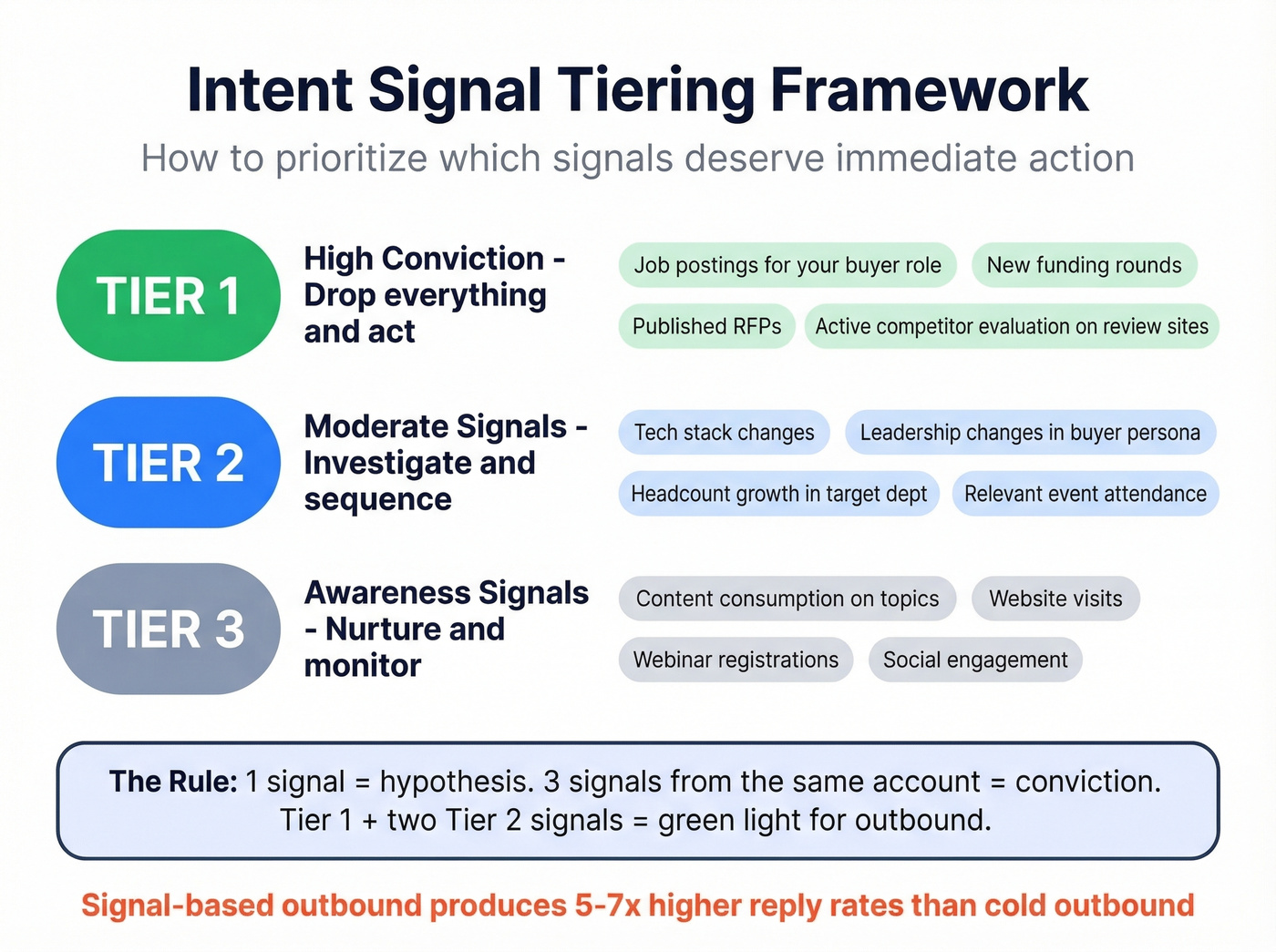
Tier 1 - High conviction. Job postings for roles that use your product. New funding rounds. Published RFPs. Active competitor evaluation on review sites. A buying process is already underway. Drop everything and act.
Tier 2 - Moderate signals. Tech stack changes - a competitor's tool just got ripped out. Leadership changes in your buyer persona. Headcount growth in the target department. Event attendance at relevant conferences. Companies researching hybrid workplace tools or office expansion can also serve as a strong Tier 2 signal for vendors selling facilities management, collaboration software, or real estate services.
Tier 3 - Awareness signals. Content consumption on relevant topics. Website visits. Webinar registrations. Social engagement. These are the noisiest signals - useful for nurture and ad targeting, but not for triggering direct outbound.
Here's the operational heuristic: a single signal is a hypothesis. Three signals from the same account is conviction. When an account shows a Tier 1 signal backed by two Tier 2 signals, that's your green light.
The timing data backs this up. Signal-based outbound produces 5-7x higher reply rates than cold outbound, and acting within 24 hours performs 3x better than waiting a week. Intent data without operational speed is just expensive market research.

Intent data identifies surging accounts. Prospeo closes the gap between signal and outreach. Layer Bombora intent signals across 15,000 topics with 300M+ verified profiles, 98% email accuracy, and 125M+ direct dials - so your reps reach the right buyer within hours, not days.
Go from "account is surging" to verified contact in your sequencer - today.
Top Intent Data Providers
Bombora
The gold standard for third-party intent data. Bombora's Data Co-op spans 5,000+ B2B websites, processes 17 billion monthly interactions, and tracks 13,000+ topics. The Company Surge methodology - measuring research activity against an account's historical baseline - is one of the most widely used scoring models in the market.

Basic Company Surge access starts at $25k-$30k/year. Mid-market packages with enhanced data run $50k-$100k/year. Enterprise configurations push $100k-$300k+ annually. Premium topics can add $5,000-$25,000 per topic per year.
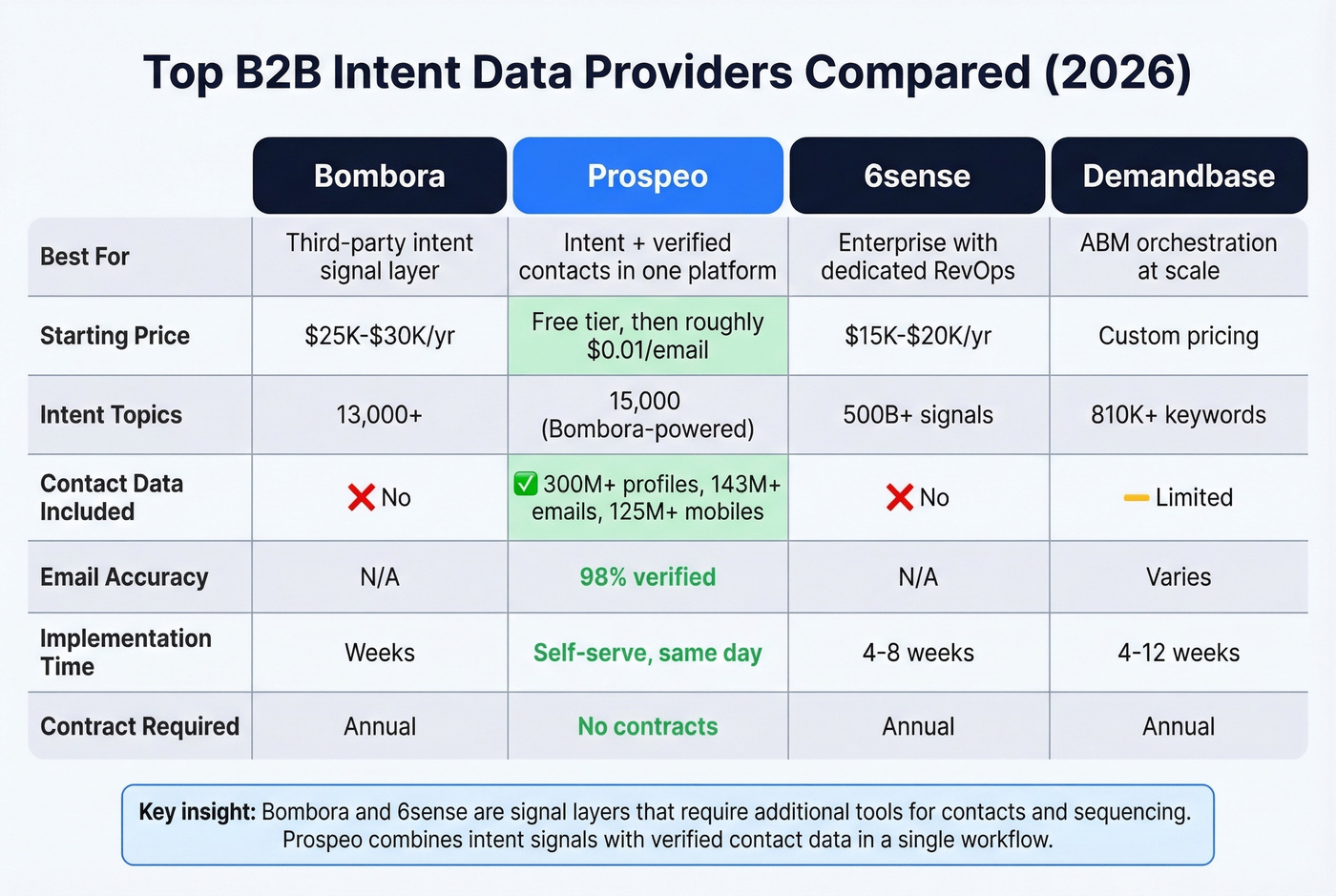
The bottom line: Bombora is the most established intent co-op, but it's a signal layer. It doesn't include contacts, enrichment, or sequencing. You'll need three or more additional tools on top, which means your true cost of operationalizing Bombora is significantly higher than the sticker price.
Prospeo
Where Bombora tells you who's surging, Prospeo gives you surging accounts and verified contact data to reach them in the same interface.
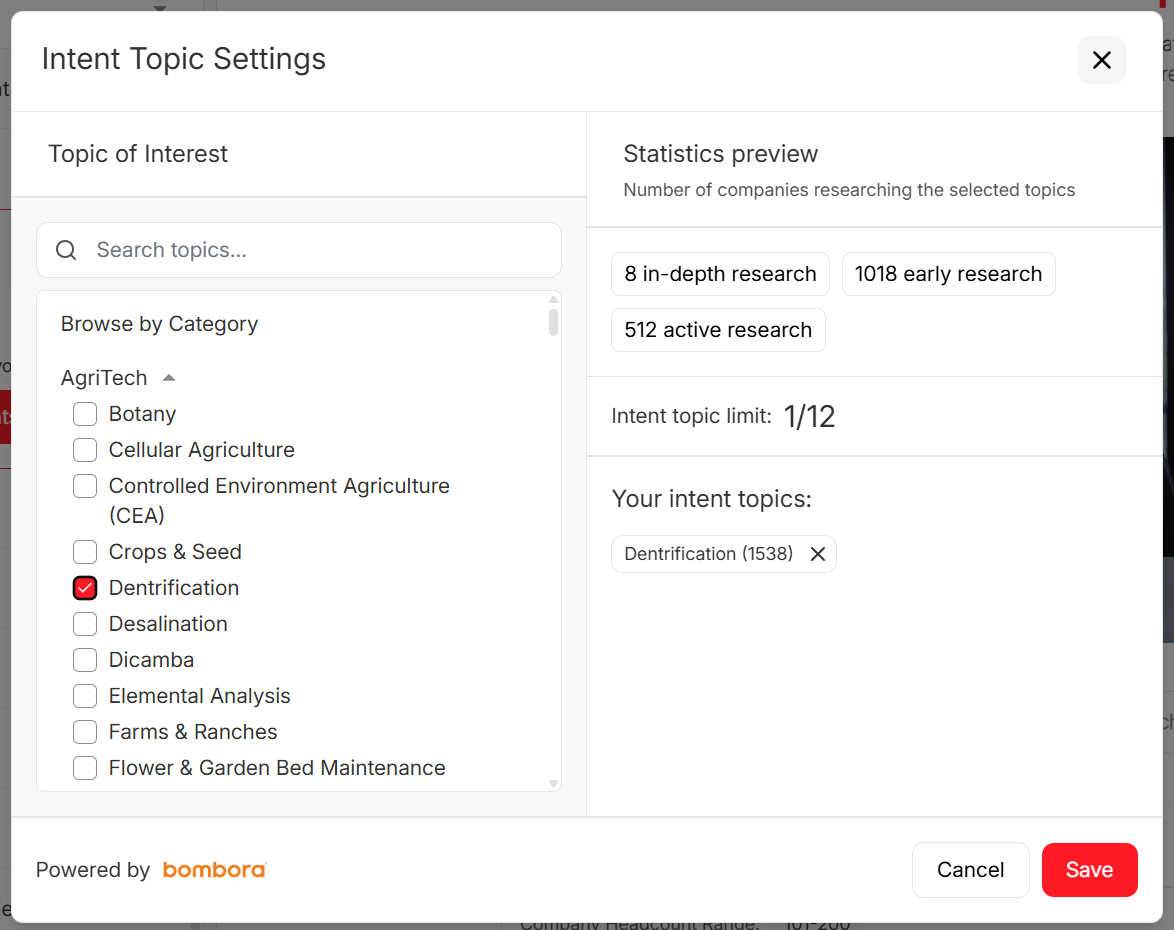
The platform layers 15,000 Bombora-powered intent topics on top of 300M+ professional profiles, 143M+ verified emails at 98% accuracy, and 125M+ verified mobile numbers with a 30% pickup rate. The 30+ search filters - including technographics, job change signals, headcount growth, funding, and department-level headcount - let you go from "accounts researching cloud security" to "verified VP of Engineering emails at those accounts" in a single workflow. Data refreshes every 7 days, compared to the 6-week industry average.
Real-world impact: Snyk's 50 AEs cut bounce rates from 35-40% to under 5% and generated 200+ new opportunities per month after switching to verified data from Prospeo.
Pricing starts free with 75 emails and 100 Chrome extension credits per month. Paid plans run roughly $0.01 per email with intent data included. No contracts, no annual commitments, self-serve onboarding.
6sense
Best for: Enterprise teams with dedicated RevOps and a 4-8 week implementation runway.
6sense predicts buying stages, mapping accounts from awareness through consideration to decision using 500B+ intent signals and proprietary AI models. The Salesforce and HubSpot integrations are deep, and the orchestration capabilities let you trigger ads, sequences, and alerts based on predicted buying stage.
Team tier starts at $15k-$20k/year. Growth plans run $25k-$60k/year. Enterprise configurations push $60k-$200k+ annually.
Skip this if you're a 20-person sales team without a RevOps function. Users on Reddit and review sites consistently flag credit expiry with no rollover as a pain point, the learning curve is steep, and we've seen teams spend more time implementing than selling. 6sense is powerful infrastructure - not a quick win.
Demandbase
Demandbase runs one of the broadest intent engines available: bidstream data plus AI/NLP using 810,000+ intent keywords and processing 70 billion+ page views per day. It also imports Bombora, G2, and TrustRadius signals, making it a natural aggregation layer.
The median annual contract is $65,981 based on 175 purchases tracked by Vendr, ranging from $22,860 to $164,265. Enterprise configurations on AWS Marketplace list at $215,000/year. Implementation takes roughly 2 months, and the median ROI timeline is 13 months. Pricing opacity is a recurring complaint in buyer communities - negotiate hard. One commonly cited limitation: syncing to and from Salesforce custom objects can be difficult, which complicates RevOps workflows.
G2 Buyer Intent
Impact.com reduced CPL from $120 to $53 by activating campaigns based on G2 Buyer Intent - and that result isn't unusual. When someone compares your product to a competitor, views your pricing page, or reads reviews on G2, that's not "intent." That's active evaluation. With 100 million software buyers researching on G2 annually, the signal volume is substantial.
G2 Core list price is $15,000/year, but packages with Buyer Intent commonly push total spend to $30k-$87k+ annually. 38-49% discounts on Core are common - negotiate. The catch: you need to be a listed vendor on G2 to access these signals.
TrustRadius
Second-party downstream intent from buyers actively comparing vendors, watching demos, and checking pricing. Customer Voice Package runs $30,000/product/year. Category Intent Data is an add-on - typically $20k-$40k per year on top. A solid complement to third-party signals, especially for enterprise software categories.
Intentsify
Monitors 1.1 trillion intent signals per month and earned a Forrester Wave Leader designation in Q1 2025. Strong for multi-source signal aggregation. Pricing typically runs $40k-$100k+/year depending on volume and modules.
RB2B
Person-level website visitor identification, not topic-based intent. Free plan offers 150 credits/month; Pro runs $129/month for 300 credits. A complementary layer for identifying individual visitors to your site, but not a replacement for topic-based intent data.
Pricing Comparison
| Provider | Starting Price | Mid-Market | Enterprise | Intent + Contacts? |
|---|---|---|---|---|
| Prospeo | Free (75 emails/mo) | ~$0.01/email | ~$0.01/email | Yes - both |
| Bombora | $25k-$30k/yr | $50k-$100k/yr | $100k-$300k+/yr | Signals only |
| 6sense | $15k-$20k/yr | $25k-$60k/yr | $60k-$200k+/yr | Signals only |
| Demandbase | ~$23k/yr | ~$66k/yr (median) | $164k-$215k/yr | Signals only |
| G2 Intent | $15k/yr (Core list) | $30k-$50k/yr | $50k-$87k+/yr | Signals only |
| TrustRadius | $30k/product/yr | + intent add-on | Custom | Signals only |
| Intentsify | ~$40k+/yr | $60k-$80k/yr | $100k+/yr | Signals only |
| RB2B | Free (150 credits) | $129/mo | Custom | Person-level ID only |
Closing the Activation Gap
Let's be honest about what actually happens with most intent data purchases. A demand gen manager pulls the weekly Bombora report. Twelve accounts are surging on "marketing automation platform." She forwards the list to the SDR team. The SDRs open the spreadsheet and see company names - no contacts, no direct dials, no verified emails. They spend two days hunting through various databases, piecing together contact info of questionable accuracy. By the time they send the first sequence, the buying committee is already demoing two competitors.
That's the activation gap. A weather forecast without an umbrella.
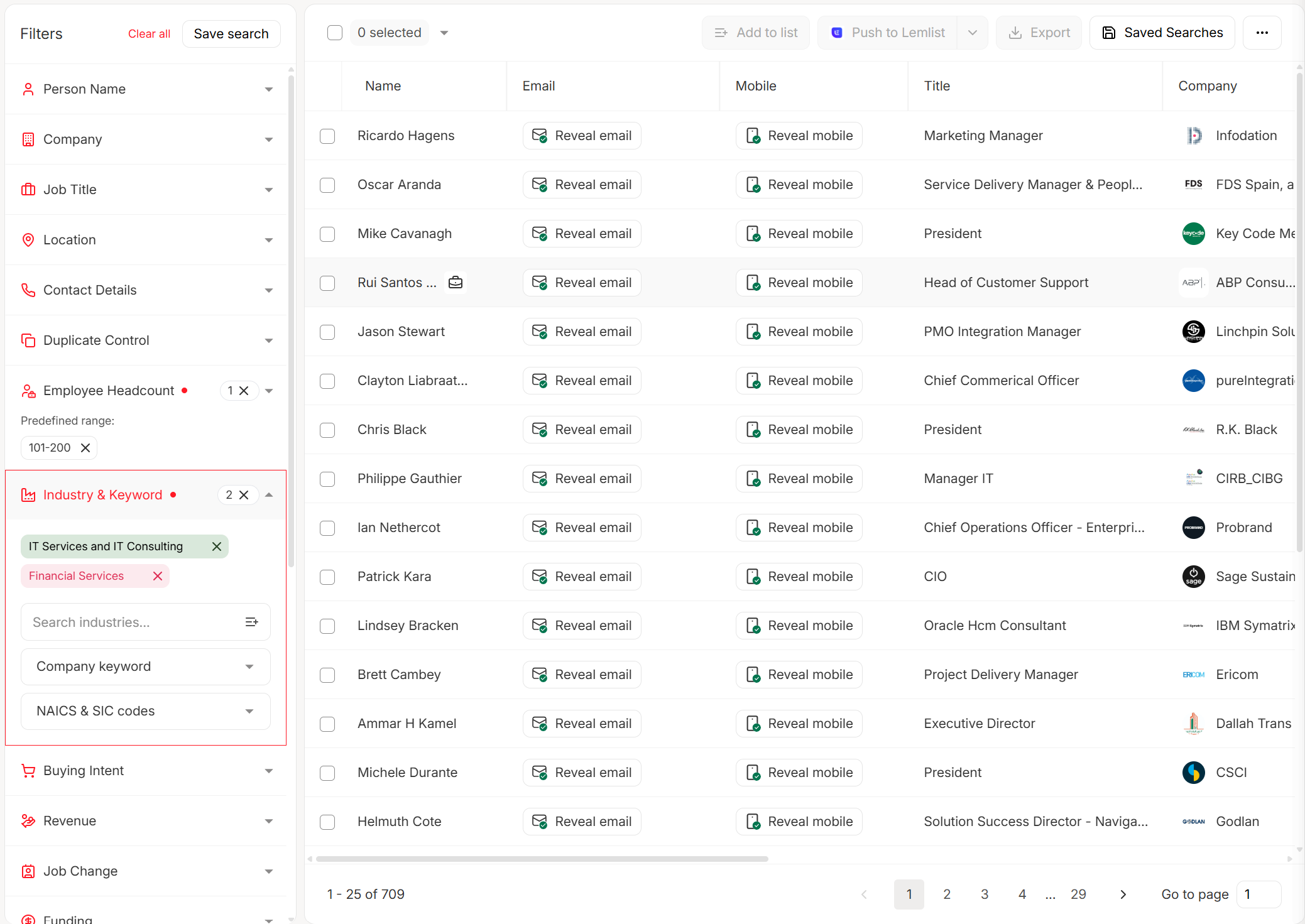
Every provider in the table above except Prospeo delivers account-level signals without contact-level data. You get a list of surging companies and then need to buy contacts from a second vendor, verify them with a third tool, and push them into a sequencer through a fourth integration. The average enterprise uses 897 apps, with only 29% integrated - so these handoffs break constantly. By the time the workflow completes, the intent signal is stale.
If your average deal size is under $25k, you probably don't need a $60k+ intent platform. A tool that combines intent signals with verified contacts in one workflow will outperform a best-of-breed stack that takes a week to activate. Speed beats signal sophistication every time.
Every day between an intent signal and outreach costs you pipeline. Prospeo's 7-day data refresh and 92% API match rate mean your enrichment workflows return fresh, verified contacts - not stale records that bounce. At $0.01 per email, acting fast on buyer intent doesn't require a $65K platform budget.
Stop paying enterprise prices to chase signals with dead emails.
How to Operationalize Intent Data
Look - buying intent data is the easy part. Making it produce pipeline requires four activation plays, each triggered by different signal tiers.
ABM ad targeting. Push surging accounts into programmatic and social ad audiences. When an account starts researching your category, serve them relevant ads before your SDRs ever reach out. This warms the account and increases the odds your outbound lands.
Real-time sales alerts. Configure Slack or CRM notifications when target accounts surge above threshold. The SDR shouldn't be checking a dashboard - the signal should find them. Salesforce and HubSpot both support automated workflows triggered by intent score changes.
Outbound sequences within 24 hours. This is where the money is. When a Tier 1 signal fires, trigger a personalized sequence referencing the specific topic the account is researching. Pull verified contacts for surging accounts, push them into your sequencing tool via native integrations with Salesforce, HubSpot, Instantly, or Lemlist, and send before the window closes.
Content personalization. Serve relevant case studies, landing pages, and resources based on the intent topics an account is researching. If they're surging on "CRM migration," show them the CRM migration case study - not your generic homepage.
In our experience, the fastest results come from teams that measure meetings booked per surging account, not signal volume. That single metric tells you whether intent data is producing pipeline or just generating dashboards.
Industry-Specific Applications
B2B software buyer intent data isn't limited to SaaS companies selling to other SaaS companies. The same signal infrastructure applies across verticals, though the topics and activation playbooks differ.
For manufacturing, intent data helps industrial suppliers and equipment vendors identify companies researching ERP migrations, supply chain automation, or new production technologies. A surge on "CNC machine comparison" or "MES software evaluation" is just as actionable as a surge on "marketing automation" - the difference is the buyer persona and the sales cycle length.
Insurance works similarly. When a growing company researches cyber liability coverage, D&O insurance, or workers' compensation platforms, those content consumption patterns generate intent signals that brokers and insurtech vendors can act on. The key is mapping the right topic taxonomies to insurance-specific buying journeys.
Understanding buyer intent at the industry level lets you build more targeted account lists and craft outreach that speaks to vertical-specific pain points rather than generic value propositions.
Compliance and Privacy
Intent data sits in a regulatory gray zone that's getting less gray every year.
GDPR requires freely given, specific, informed, and reversible consent for tracking. Bundling "analytics + marketing" consent into a single toggle is increasingly risky. Regulators are scrutinizing dark patterns - consent UX where "Accept" is prominent and "Reject" is buried. If your intent data provider relies on bidstream data collected from European users, ask hard questions about their consent chain.
CCPA/CPRA operates on an opt-out model for adults, fundamentally different from GDPR's opt-in requirement. CPRA requires opt-in consent for minors under 16. Fines start at $2,663 per incident and increase to $7,988 for willful violations. Disney's $2.75 million settlement over CCPA violations is a reminder that enforcement is real.
Bidstream-based intent data carries the highest compliance risk because the consent chain between the user, publisher, ad exchange, and intent data provider is long and often opaque. Before signing with any provider, evaluate their data sourcing methodology, consent mechanisms, and whether they offer a Data Processing Agreement.
For a deeper audit checklist, use a GDPR Compliant Database framework before you sign.
How to Evaluate and Pilot
Don't sign an annual contract based on a demo. Run a structured bake-off with 2-3 providers over 30 days, measuring outcomes that matter.
Six evaluation criteria:
- Activation speed - Can you go from signal to outreach in one platform, or do you need 3+ tools stitched together?
- Coverage - Does the provider cover your ICP's industries and geographies? Enterprise-heavy providers often have weak SMB coverage.
- Accuracy - What are the match rates and false positive rates? Ask for specifics, not marketing claims.
- Integrations - Native connections to your CRM, sequencing tool, and ad platforms? Manual CSV exports kill adoption.
- Compliance - GDPR/CCPA compliant? DPA available? Ask about bidstream sourcing specifically. (If you need a broader view, start with B2B compliance.)
- Total cost - Not just the platform fee. Include enrichment, contacts, sequencing tools, and implementation time. A $30k intent platform that requires $40k in supporting tools is a $70k investment.
During the pilot, measure meetings booked per surging account. Not leads generated, not MQLs, not "accounts identified." Meetings booked. That's the number that tells you whether your investment in buyer intent data is actually working or just producing expensive reports.
FAQ
What is buyer intent data in B2B?
Behavioral signals - content consumption, product research, competitor comparisons, review-site activity - that identify companies actively researching a purchase in your category. It helps sales and marketing teams prioritize accounts showing real buying behavior over cold outreach.
How much does B2B intent data cost?
Bombora starts at $25k-$30k/year for basic access. 6sense begins around $15k-$20k/year. Demandbase averages $66k/year. Prospeo offers intent data with verified contacts starting free, with paid plans at roughly $0.01 per email - the only provider bundling signals and contacts at SMB-friendly pricing.
What's the difference between first-party and third-party intent?
First-party comes from your own properties - website visits, content downloads, product usage. Third-party comes from external publisher co-ops and review sites, tracking behavior across thousands of websites you don't own. First-party is higher fidelity; third-party offers broader reach. Most effective programs layer both.
How do you use intent data for ABM?
Layer intent signals on your target account list to identify which accounts are actively researching your category. Prioritize ad spend, trigger personalized outbound sequences, and alert sales reps when accounts surge. Acting within 24 hours produces response rates roughly 3x higher than waiting a week.
Is intent data GDPR compliant?
It depends on the provider and data source. Bidstream-based intent carries the highest risk due to long, opaque consent chains. GDPR requires specific, informed consent for tracking. Always evaluate your provider's data sourcing methodology, consent mechanisms, and DPA availability before signing.