

B2B Technographic Data: The Practitioner's Guide to Collection, Validation, and Action
A RevOps lead we worked with built a "perfect" outbound segment: companies running Marketo, 200-1,000 employees, hiring SDRs. The personalization was sharp. The results were not - because a chunk of those accounts had quietly switched to HubSpot months earlier, and the messaging landed like it was written for someone else entirely.
B2B technographic data is powerful, but only if you treat it like a signal you validate - not a fact you worship.
Here's the short version: pixel/tag tools like BuiltWith and Wappalyzer mostly see the frontend. Job-posting tools like TheirStack catch what teams are actively implementing, including backend stacks. DNS TXT records give you a free validation layer. Enterprise platforms like ZoomInfo go broad at enterprise prices, while HG Insights focuses more on install-base and IT-spend intelligence.
What Is Technographic Data?
Technographic data is information about the technologies a company uses - software, hardware, cloud infrastructure, and tools - mapped to an account. Think CRM, marketing automation, data warehouse, CDP, helpdesk, security tooling, cloud provider, payment stack. In practice, company technographics cover everything from the frontend analytics pixel to the backend data pipeline a team is building around.
It's different from firmographic data (industry, headcount, revenue) and demographic data (person-level attributes). Firmographics tell you who fits your ICP. Technographics tell you what they run and what they're likely to buy next.
The technology-lookup software segment grew from $367M in 2020 to $1.17B in 2025. That growth happened because stacks change constantly, and GTM teams got tired of guessing.
Why Business Technographics Matter in 2026
Gartner's 2024 Tech Trends Survey found 60% of buyers regret a software purchase within 12-18 months. That regret drives churn, replacements, and rip-and-replace projects - your opening. Their 2024 Software Buying Behavior Survey showed 61% of businesses increasing tech investment and 92% evaluating AI-powered software, with price and security as the top purchase factors. Stacks are churning faster than most databases refresh.
So what does that mean for your team? Three things.
First, you can displace competitors by selling "why switch" to accounts already paying for a rival. Second, you can personalize credibly with integration talk that matches their actual reality instead of a guess. Third, you can prioritize accounts - a company hiring for Snowflake + dbt isn't "maybe later." They're mid-project.
How Technographic Data Is Collected
The consensus on r/gtmengineering is blunt: pixel detection is "surface, not truth" and should be treated as a weak prior, not ground truth.
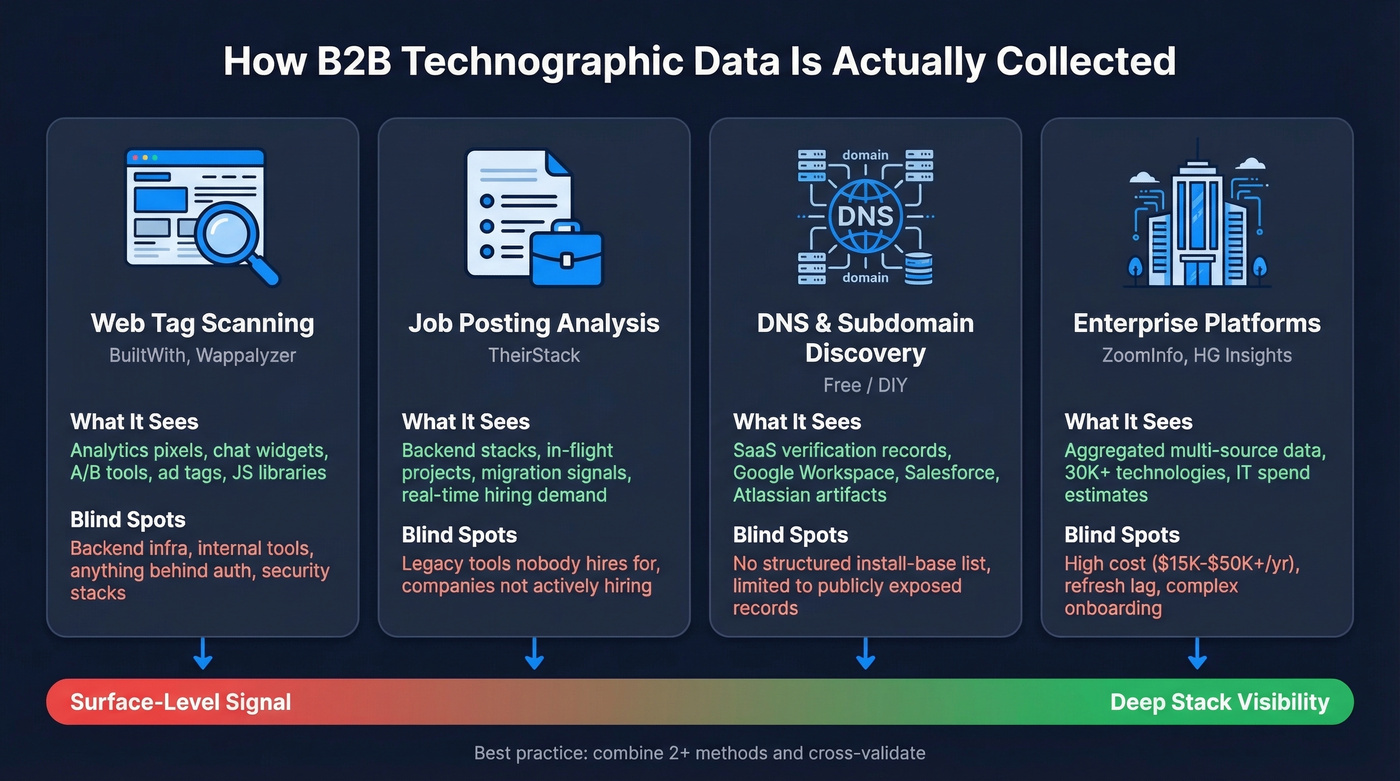
Website Tag Detection (BuiltWith, Wappalyzer)
These tools scan what a website exposes: HTML, JavaScript libraries, headers, DNS/SSL hints. They're excellent for martech wrappers - analytics, chat widgets, A/B testing, ad pixels. They're also biased. Anything behind auth, internal tooling, data infrastructure, and most security stacks won't show up.
We've run bake-offs where a web-scan tool "disqualified" accounts that were actually perfect fits because the detectable tags were stale or incomplete. One Reddit buyer found BuiltWith caused them to mark leads unqualified, while PredictLeads returned "the exact stack" for many of those same accounts. That's the risk: false negatives that quietly kill pipeline. Single-source detection is dangerous.
Job Posting Analysis (TheirStack)
Job postings are the strongest "current state" signal because they reflect what teams are implementing right now. TheirStack is the cleanest self-serve example: it analyzes 179M+ job postings across 195 countries and turns tech mentions into structured technology stack data. You also get time-series context if the provider stores history, which matters when you're selling migrations or tracking stack changes over time.
Let's be honest: if your deal sizes sit below $15k, job-posting signals from a tool like TheirStack will outperform a $30k/year ZoomInfo contract for technographic use cases. You're trading breadth for a cleaner, cheaper, more current signal - and for most mid-market teams, that's the right trade.
DNS & Subdomain Discovery (Free Validation)
DNS TXT records reveal SaaS validations and tooling footprints that never appear on a homepage. TXT inspection and subdomain brute-forcing work as a scrappy validation layer - useful for spotting Google Workspace, Atlassian, and Salesforce verification artifacts. This won't give you a neat install-base list, but it's a great tie-breaker when web-scan and job posts disagree.
Any collection method touching company infrastructure should respect GDPR and local privacy regulations. Stick to publicly available records.
Enterprise Platforms (ZoomInfo, HG Insights)
Enterprise platforms aggregate multiple sources and wrap them in workflows: segmentation, enrichment, intent, routing, and governance. ZoomInfo tracks 30,000+ technologies across 100M+ companies. The tradeoff is cost and complexity - a mid-market ZoomInfo contract lands around $15k-$40k/year, and it climbs fast with add-ons. HG Insights focuses on install base and IT spend intelligence, typically $15k-$50k+/year.
For teams with budget and headcount to operationalize these platforms, they're worth evaluating. For everyone else, the ROI math gets shaky fast.

Knowing a company runs Marketo means nothing if your contact data bounces. Prospeo's 30+ filters include technographics, buyer intent, and growth signals - and every email comes back 98% verified on a 7-day refresh cycle. Teams book 26% more meetings than with ZoomInfo data, at roughly $0.01 per lead.
Stop detecting stacks and start reaching the people who run them.
B2B Technographic Data Providers Compared
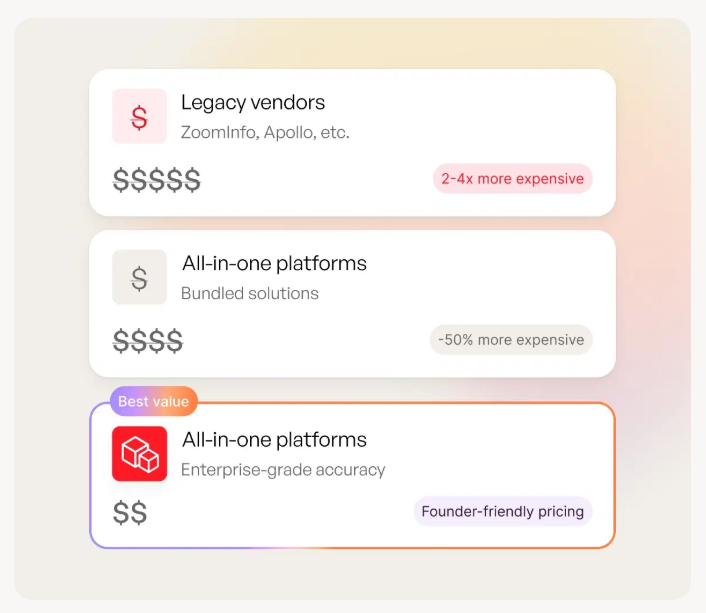
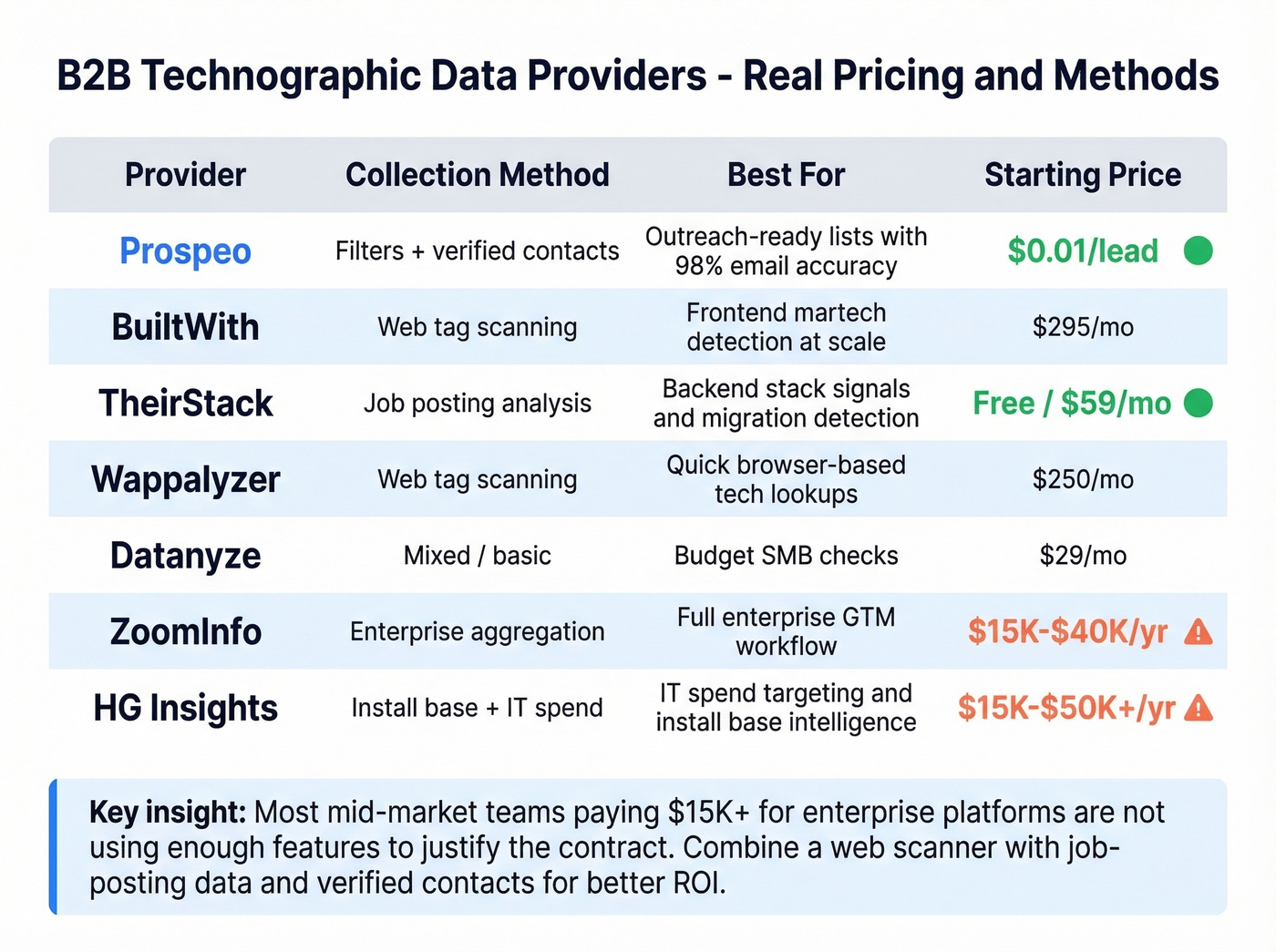
Every "top 10" list magically ranks the vendor writing the list as #1. We're not going to pretend we don't have a horse in this race - Prospeo is our product - but the pricing and collection methods below are real, and they matter more than any logo.
| Provider | Method | Coverage | Starting Price | Best For |
|---|---|---|---|---|
| Prospeo | Filters + contacts | 300M+ profiles | ~$0.01/lead | Outreach-ready lists |
| BuiltWith | Web tags | 673M+ sites, 112K+ tech | $295/mo | Martech scans |
| TheirStack | Job posts | 179M+ posts | Free / $59/mo | Backend signal |
| Wappalyzer | Web tags | 7,400 tech | $250/mo | Quick lookups |
| Datanyze | Mixed/basic | SMB coverage | $29/mo | Cheap checks |
| ZoomInfo | Enterprise mix | 30K+ tech | ~$15-40K/yr | Enterprise GTM |
| HG Insights | Install base | IT spend | ~$15-50K+/yr | IT targeting |
Prospeo isn't a pure technographic detection tool - it's where technographic intelligence becomes outreach. With 30+ search filters covering technographics, buyer intent, and company growth signals, it turns stack intelligence directly into verified contact lists. At roughly $0.01 per lead with 98% email accuracy and a 7-day refresh cycle, teams report booking 26% more meetings compared to ZoomInfo data.
BuiltWith is the best-known web-scan tool. Solid frontend visibility at scale, but it's a detection layer you still need to operationalize with separate contact data.
TheirStack wins for in-flight project signals because hiring demand is hard to fake. Skip it if you need a full GTM workflow; choose it if you want the freshest backend-stack intelligence at a fraction of enterprise pricing.
Datanyze works for budget-conscious teams doing basic lookups, but don't expect the depth or freshness of the tools above.
For teams already paying $15k+ on ZoomInfo or HG Insights, the question isn't whether those platforms have data - they do. It's whether you're actually using enough of it to justify the contract. In our experience, most mid-market teams aren't.
How to Act on Account Technographics
Technographics only matter when they change what you do next.
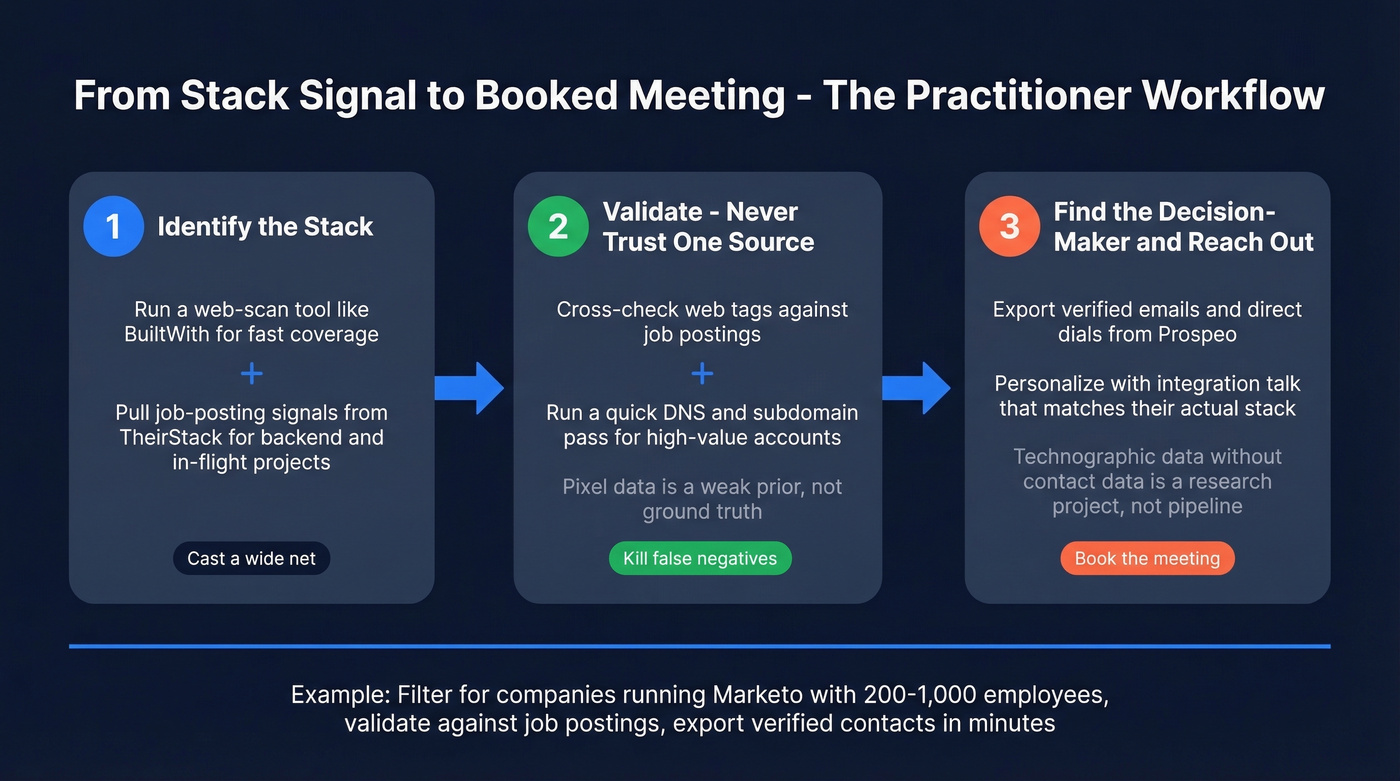
Identify the stack. Start with a web-scan tool for fast coverage, then pull job-posting signals for anything you're serious about. For high-value accounts, do both.
Validate - never trust one source. Cross-check web tags with job postings and a quick DNS/subdomain pass. Pixel data is a weak prior, not truth.
Find the decision-maker and reach out. This is where most teams stall. Knowing a company runs Salesforce is useless without the VP of RevOps' verified email. Technographic data without verified contact data is a research project, not a pipeline.
Remember that RevOps lead from the intro? With the right workflow, you'd filter for companies running Marketo with 200-1,000 employees, validate against job postings to confirm the stack is current, and export verified contacts in minutes instead of days.
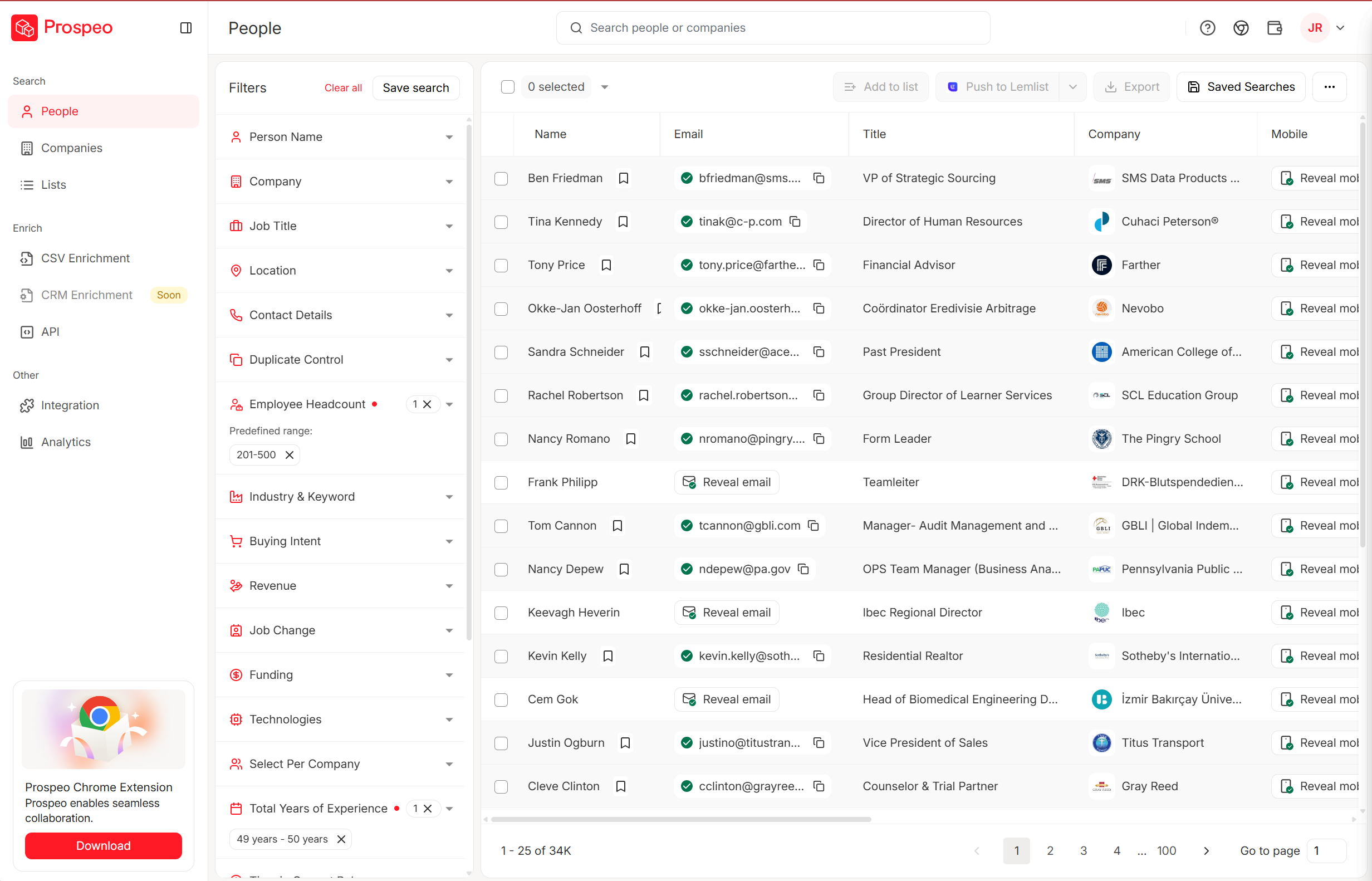
You've layered web scans, job postings, and DNS records to validate a tech stack. Now you need verified emails and direct dials for the decision-makers at those accounts. Prospeo turns technographic intelligence into outreach-ready lists across 300M+ profiles - with 125M+ verified mobiles and no annual contract.
Go from stack signal to booked meeting without switching tabs.
Mistakes That Waste Your Budget
Treating pixel data as ground truth. It's frontend-biased and often stale. Use it to form a hypothesis, not to disqualify accounts.
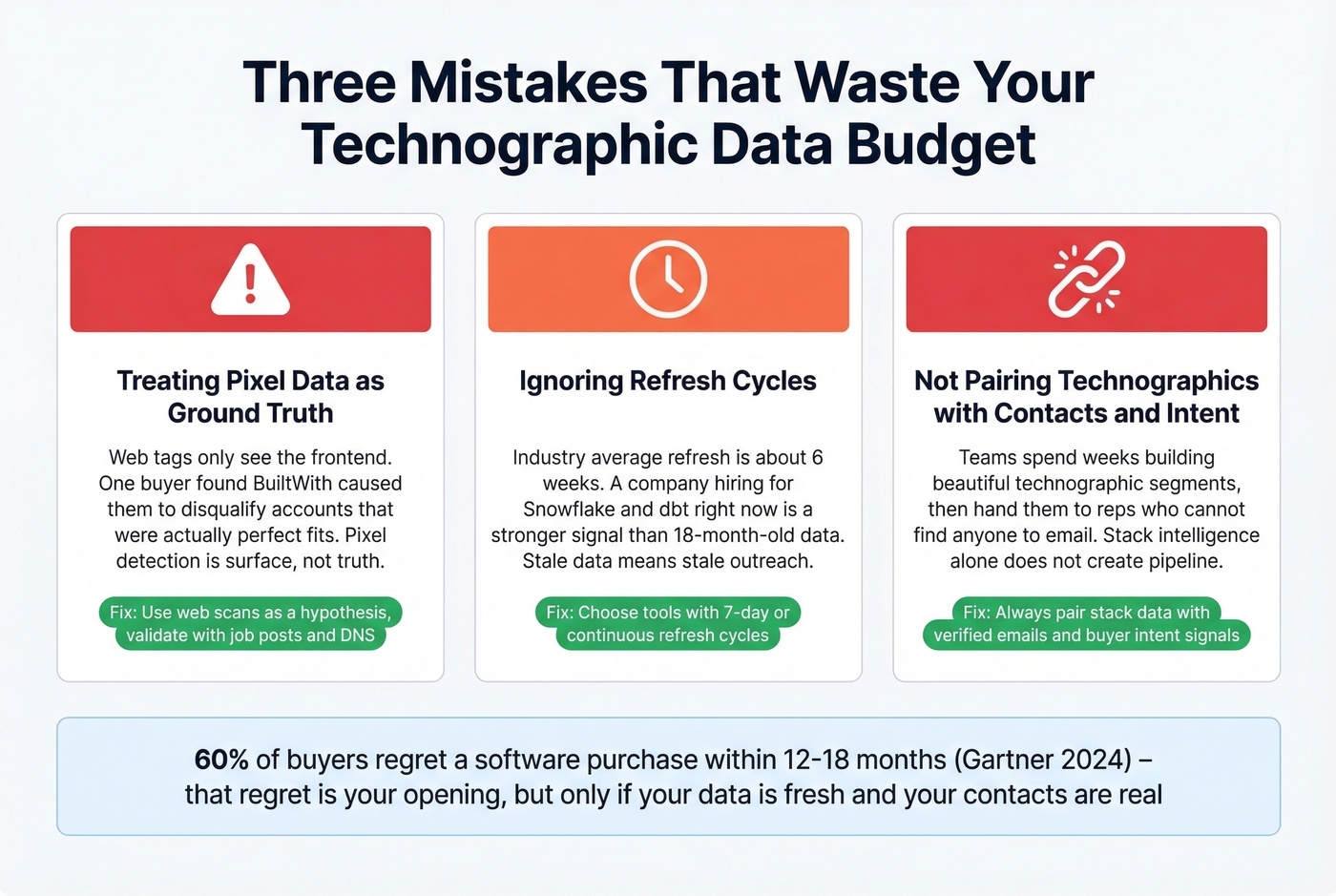
Ignoring refresh cycles. A company hiring for Snowflake + dbt right now is a stronger signal than data from 18 months ago. Freshness isn't a nice-to-have - it's a data quality dimension that directly affects whether your outreach lands or bounces.
Not pairing technographics with contact and intent. Stack intelligence alone doesn't create pipeline. It needs a reachable human and a reason to act now. This is the single most common failure mode we see: teams spend weeks building beautiful technographic segments, then hand them off to reps who can't find anyone to email.
FAQ
What's the difference between technographic and firmographic data?
Firmographic data describes company structure - industry, revenue, headcount. Technographic data describes the technology stack a company runs. Firmographics tell you who to target; technographics tell you why they'd buy and when they're ready to switch.
How often should technographic data be refreshed?
Weekly refresh cycles catch stack changes that quarterly databases miss entirely. The industry average is about six weeks, but faster tools refresh every 7 days and job-posting signals update continuously. Aim for the fastest cadence you can operationally support.
Can I get technographic data for free?
Yes, partially. Wappalyzer offers 50 free lookups/month, TheirStack has a free tier with 50 company credits/month, and DNS inspection costs nothing but time. For scaled prospecting with verified contacts, paid tools start at $29/month.
How do teams use technographic data for prospecting?
Most teams layer account technographics on top of firmographic filters to build segments reflecting both company fit and stack readiness. For example, filtering for mid-market SaaS companies running a competitor's CRM narrows your list to accounts where a displacement pitch actually makes sense - pairing that with verified contact data turns research into outreach.