

B2B Website Visitor Tracking Tools: Which Ones Actually Work in 2026?
A Customers.ai report tested three major visitor identification providers and found two of them were 70-95% inaccurate. That's not a rounding error - that's a broken category. B2B website visitor tracking tools sit in a $3.55B market projected to hit $9.99B by 2032, which means a lot of money is chasing tools that don't deliver.
Here's what actually works, what doesn't, and the verification step most teams skip entirely.
Our Picks
| Category | Tool | Why | Starting Price |
|---|---|---|---|
| Person-level ID (US) | RB2B | Best coverage at scale | Free / $79/mo |
| Company-level + CRM | Leadfeeder | Mature, CRM-native | Free / €99/mo |
| Budget entry point | Visitor Queue | Simple, under $100/mo | ~$39/mo |
Best Visitor Tracking Tools for 2026
RB2B
Use this if: You need person-level identification for US website traffic and your outbound team can act on Slack notifications fast.
Skip this if: Your traffic is mostly international, or you need verified email addresses without paying for a Pro plan.
RB2B's free tier gives you 150 monthly resolutions at the company level only - pushed to Slack or Teams, no emails, no integrations beyond those two channels. The Starter plan at $79/mo adds professional profile URLs but still no email addresses. You need Pro ($149/mo+) to unlock business emails, and Pro+ ($199/mo+) for their "Premium Resolution" tier that targets roughly 70-80% average identification rates. A 7-day Pro trial is available.
Overages hit hard: $0.45 per resolution on Starter, $0.25 on Pro and Pro+. Additional domains cost $99/mo for up to five.

Reddit sentiment is mixed. Threads on r/b2bmarketing flag lead quality concerns - irrelevant leads, near-zero ROI in niche verticals - and recurring questions about legality and accuracy. Real-world results vary heavily by traffic composition, so if you're in a narrow vertical, test before committing to a paid plan.
If you're planning to act on these leads via outbound, pair it with a real sales outreach strategy so the alerts turn into meetings.
Leadfeeder (Dealfront)
Use this if: You need company-level identification with native CRM integration and your team thinks in accounts, not individuals.
Skip this if: You need person-level identification or your traffic is under 50 companies per month.
Leadfeeder's free plan reveals up to 100 companies per month with 7-day data retention. The paid plan starts at €99/mo billed annually (€165/mo monthly) and scales by identified companies - up to €1,199/mo annually for high-traffic sites. Each website requires its own subscription.

The 14-day trial auto-converts to the free plan if you don't upgrade, which is a nice touch. Where Leadfeeder earns its spot is CRM depth - Salesforce and HubSpot integrations are mature, and the Dealfront acquisition added European data coverage. Company-level identification won't give you a person to email, though. You'll need an enrichment tool downstream to turn company visits into verified contacts.
If you're building an account-first motion, align this with your ideal customer profile so you don't chase the wrong accounts.
Lead Forensics
Lead Forensics is the legacy player in company-level identification, and it shows - in both the product and the pricing. Annual contracts only, no published pricing, and typical spend lands between $22K-$35K/year. Add-ons for contact data ($260-$600/mo), setup ($1-3K), and additional domains ($500-$2K each) push costs higher. Renewal increases of 10-20% are common.
G2 reviews give it 4.4/5 across 1,049 reviews, but the top complaints tell the real story: lead quality, outdated contacts, and incorrect information. In 2026, the value proposition doesn't hold. You can get Leadfeeder plus a verification layer and come out ahead on both cost and data freshness.
Breeze Intelligence (HubSpot)
If you're already all-in on HubSpot, Breeze Intelligence (formerly Clearbit) is the easiest option. It starts at $45/mo for 100 credits on an annual plan, with one credit consumed per enriched record. Credits don't roll over, which stings if your volume fluctuates.
Breeze is tied to HubSpot tiers, so your total cost depends on your existing HubSpot plan. For teams doing 1,000+ enrichments monthly, the per-record cost climbs fast. Convenient? Yes. Cheap? Not really.
If you want to compare options, start with the broader landscape of data enrichment tools.
6sense
Enterprise ABM platform with AI-driven intent prediction and account scoring. Free tier offers 50 credits. Enterprise contracts run $30K-$100K+/year with significant implementation time.
6sense is the right call if you have 50+ sellers and need predictive buying-stage models. For everyone else, it's a six-figure distraction.
Warmly
Real-time visitor engagement platform that combines identification with chat and automated meeting booking. Mid-market focus, with pricing typically running $500-$1,500/mo. Worth evaluating if you want to shorten the time from identification to live conversation, but the product is still early.
Visitor Queue
Budget-friendly company-level identification starting around $39/mo for small sites. No person-level data, limited integrations, but it's the best way to test whether visitor identification is worth the investment before committing to a bigger tool. We've recommended it to teams who aren't sure the category is right for them - low risk, fast setup, and you'll know within a month if the data is useful.
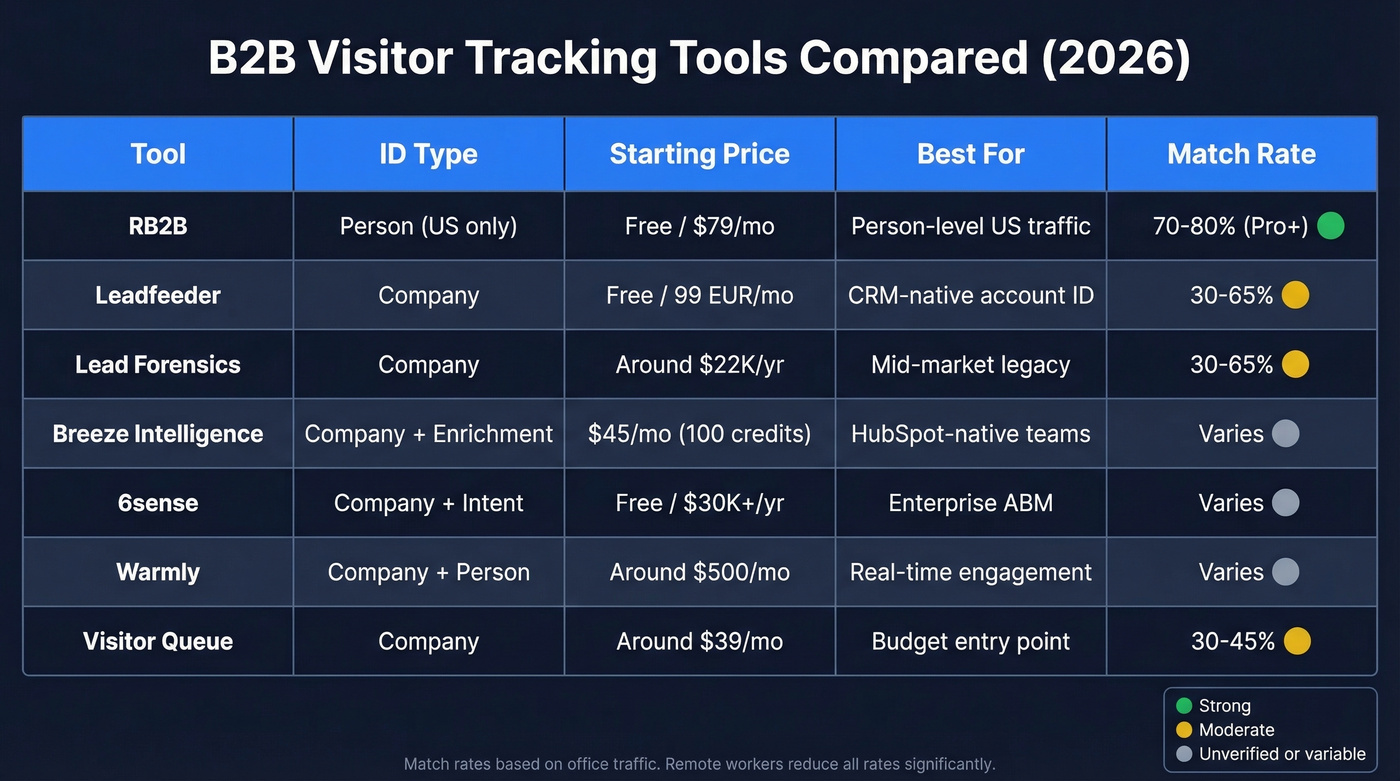
Comparison Table
| Tool | ID Type | Starting Price | Best For |
|---|---|---|---|
| RB2B | Person (US) | Free / $79/mo | Person-level US traffic |
| Leadfeeder | Company | Free / €99/mo | CRM-native account ID |
| Lead Forensics | Company | ~$22K/yr | Mid-market, legacy |
| Breeze Intelligence | Company + enrichment | $45/mo (100 credits) | HubSpot-native teams |
| 6sense | Company + intent | Free / $30K+/yr | Enterprise ABM |
| Warmly | Company + person | ~$500/mo | Real-time engagement |
| Visitor Queue | Company | ~$39/mo | Budget entry point |

Visitor identification tells you who visited. It doesn't give you verified contact data to reach them. Prospeo fills that gap - 300M+ profiles, 98% email accuracy, and 125M+ verified mobile numbers refreshed every 7 days. At $0.01 per email, it costs less than a single RB2B overage charge.
Turn anonymous visitors into verified contacts you can actually email.
Why Match Rates Disappoint
Over 60% of knowledge workers now work remote or hybrid. That single fact breaks IP-based visitor identification, because a remote worker's home IP resolves to their ISP - not their employer.
This is also why teams often get more leverage from pipeline generation ideas than from adding another tracking script.
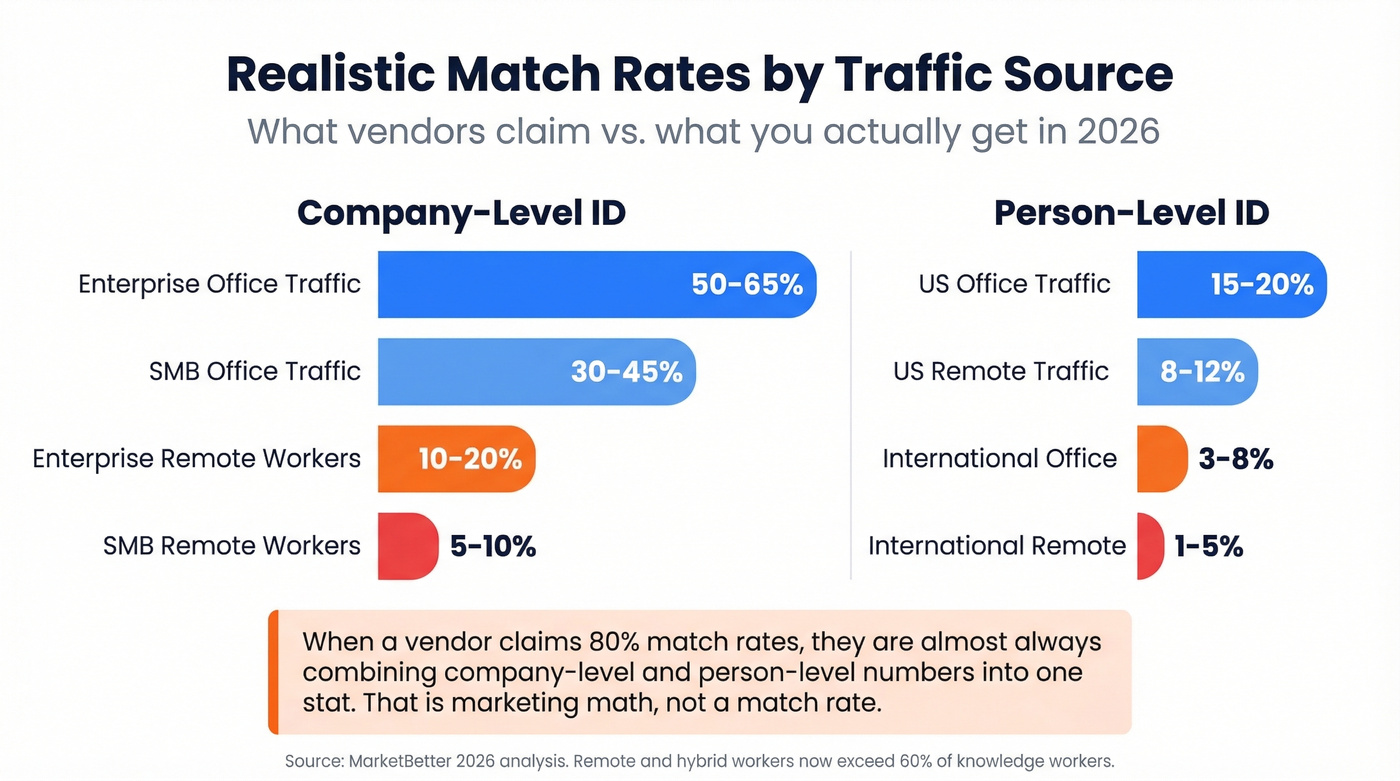
Here's what realistic match rates look like by traffic source: enterprise office traffic hits 50-65% company-level identification. SMB office traffic drops to 30-45%. Enterprise remote? 10-20%. SMB remote? 5-10%. Person-level identification runs 5-20% across the board, with US traffic at the high end.
When a vendor claims "80% match rates," they're almost always combining company-level and person-level numbers into a single stat. That's marketing math, not a match rate.
Let's be honest: most B2B teams with under 10,000 monthly sessions don't need a visitor tracking tool at all. They need better landing pages and a tighter ICP. Visitor ID is a scaling lever, not a starting point.
The Verification Step Most Teams Skip
We've seen this pattern over and over. A team installs a visitor ID tool, exports 200 contacts, loads them into a sequence, and 47 emails bounce on the first send. Domain reputation tanks. Deliverability craters across every campaign they run for the next three weeks.
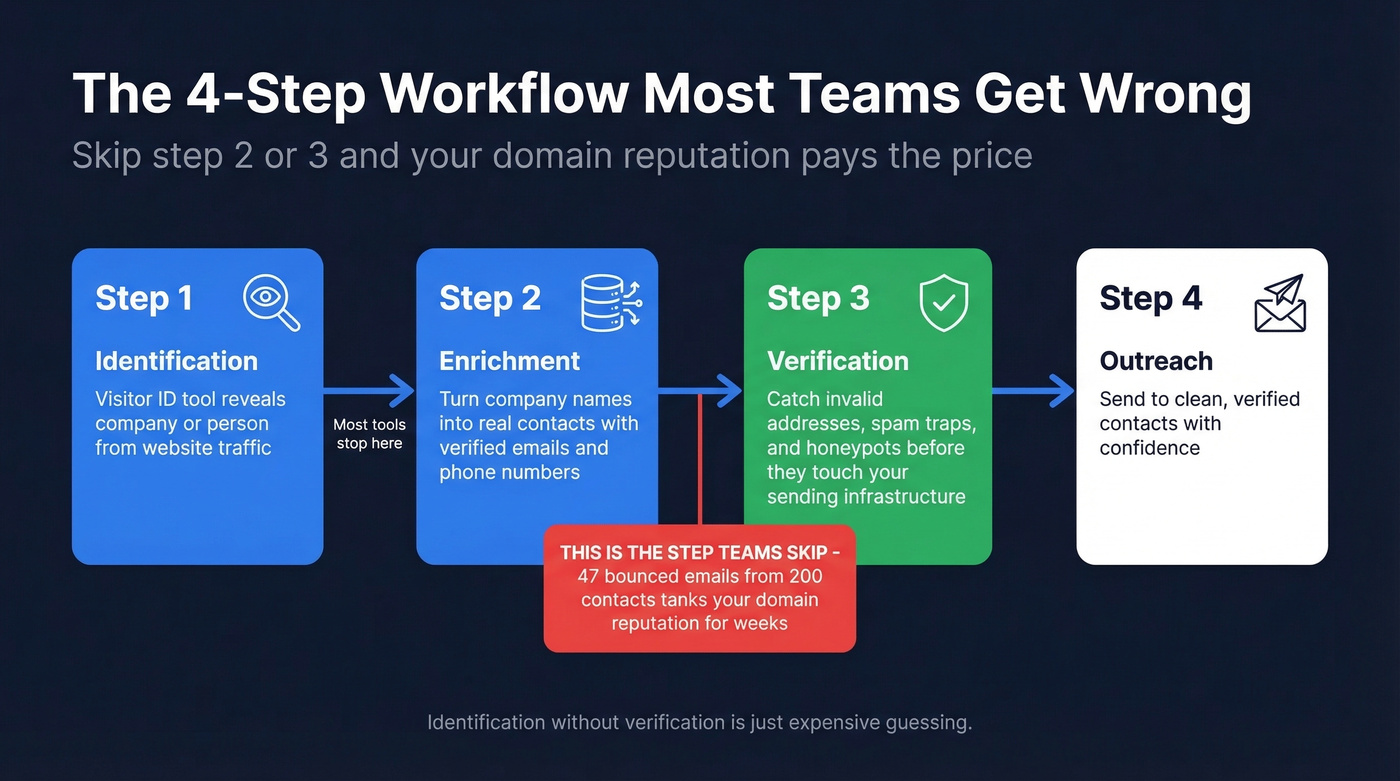
The fix is straightforward but almost nobody does it: identification, then enrichment, then verification, then outreach. That middle step matters more than the tool you pick for step one.
Running contacts through a verification layer catches invalid addresses, spam traps, and honeypots before they touch your sending infrastructure. Prospeo's email finder runs a 5-step verification process - including catch-all handling, spam-trap removal, and honeypot filtering - on a 7-day data refresh cycle, keeping records current long after most identification tools have gone stale. With 98% email accuracy and an 83% enrichment match rate returning 50+ data points per contact, you're turning anonymous company visits into outreach lists you can actually trust.
If you're diagnosing bounces and inboxing issues, use an email reputation check and fix the root cause before scaling volume.
Every tool on this list has the same blind spot: company-level ID without verified person-level contact data. Prospeo's enrichment API returns 50+ data points per contact at a 92% match rate - plug it downstream from any visitor tracking tool and start reaching real buyers, not generic company pages.
Stop paying for identification that ends at the company name.
CCPA 2026 Compliance
New CCPA regulations took effect January 1, 2026. The key changes: risk assessments are now required before you start collecting visitor data, a $1.35M enforcement settlement has already been approved, and personal information of consumers under 16 is now classified as sensitive PI. Cybersecurity audit certifications phase in through 2030.
If you're building a process around this, keep a dedicated B2B compliance checklist alongside your tracking setup.
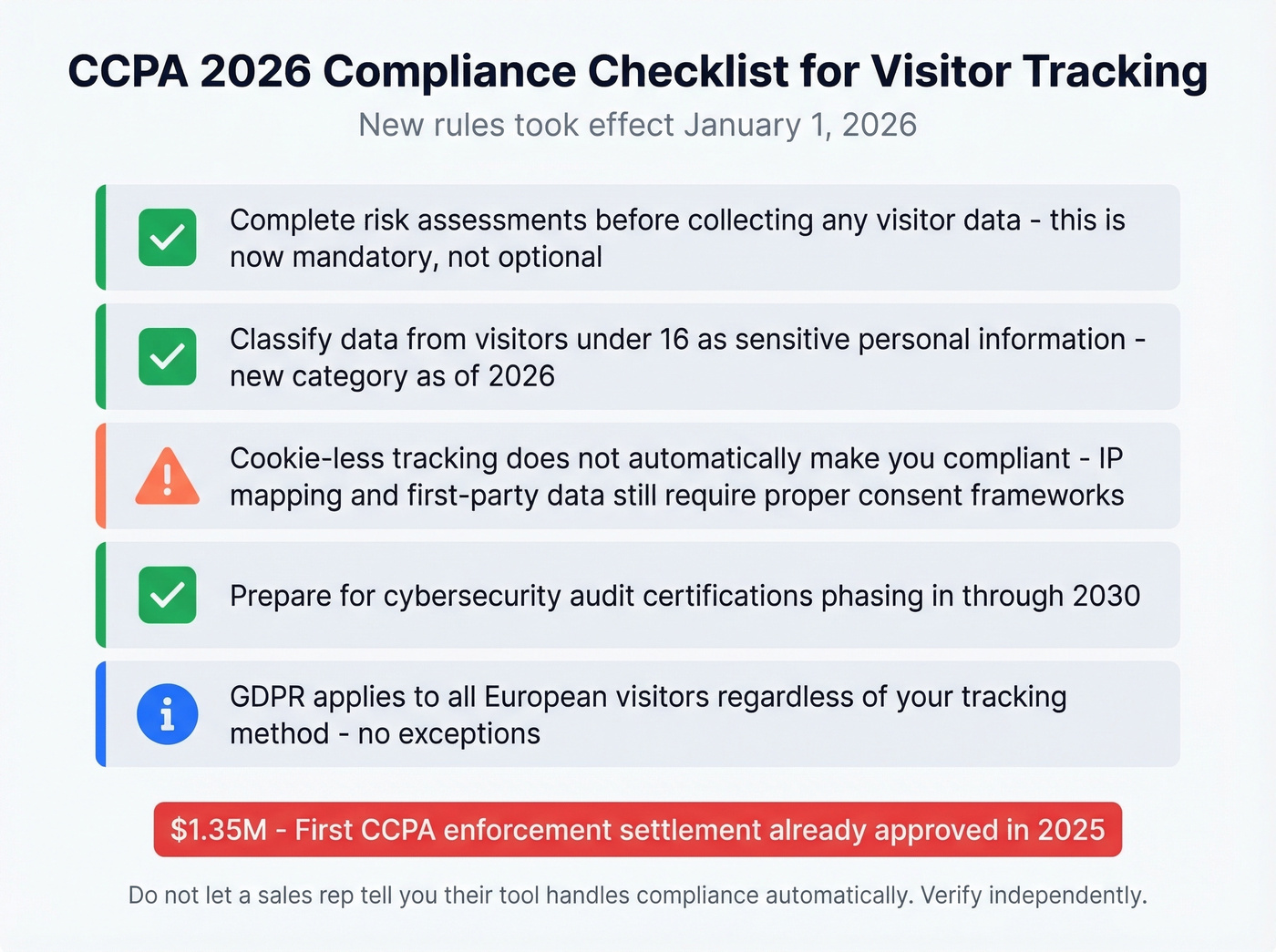
GDPR still applies to European traffic. Cookie-less tracking doesn't automatically make you compliant, even if a vendor leans on IP mapping and first-party data rather than third-party cookies. Don't let a sales rep tell you otherwise.
FAQ
What's the difference between company-level and person-level visitor tracking?
Company-level tools use reverse IP lookup to identify the organization - you get "Acme Corp," not a name. Person-level tools resolve individuals, primarily in the US. Company-level match rates run 30-65%; person-level runs 5-20%.
Are these tools legal under CCPA and GDPR?
Yes, when implemented with proper compliance. Most use IP mapping and first-party data rather than third-party cookies. Under CCPA's 2026 regulations, you must complete risk assessments before processing visitor data. GDPR applies to all European visitors regardless of tracking method.
What's a realistic match rate to expect?
Company-level: 30-65% for office traffic, 5-20% for remote workers. Person-level: 5-20% overall. Vendors claiming 80%+ are combining both metrics into one number. Remote-heavy traffic significantly reduces IP-based accuracy.
How do I verify visitor data before outreach?
Run identified contacts through an enrichment and verification tool before any sequence. Prospeo's email finder returns 98% accurate addresses with catch-all handling and spam-trap removal - the free tier includes 75 verifications per month. Unverified emails bounce and damage sender reputation fast.
Do I need an enterprise platform like 6sense?
Only if you have 50+ sellers and a six-figure martech budget. For most teams, a visitor identification tool paired with a verification layer covers 90% of the use case at a fraction of the cost.