

How to Build a B2C Sales Pipeline That Actually Closes
Most "B2C pipeline" guides are actually funnel guides. They walk you through awareness, consideration, and purchase - the buyer's journey - and call it a pipeline. It's not. A B2C sales pipeline tracks what you do: the calls you make, the proposals you send, the deals you push forward. The funnel is the customer's perspective. The pipeline is yours.
That distinction matters because you can't optimize what you can't control. And you control your actions, not your buyer's mindset.
B2C pipelines also run faster than B2B, where buying decisions involve committees, procurement reviews, and months of back-and-forth. In most B2C businesses, the real movement happens on phone calls and SMS, which means your stages and follow-up system need to match that pace.
Let's build one that works.
B2C Sales Pipeline Stages
Here's a practical five-stage model for high-ticket B2C:
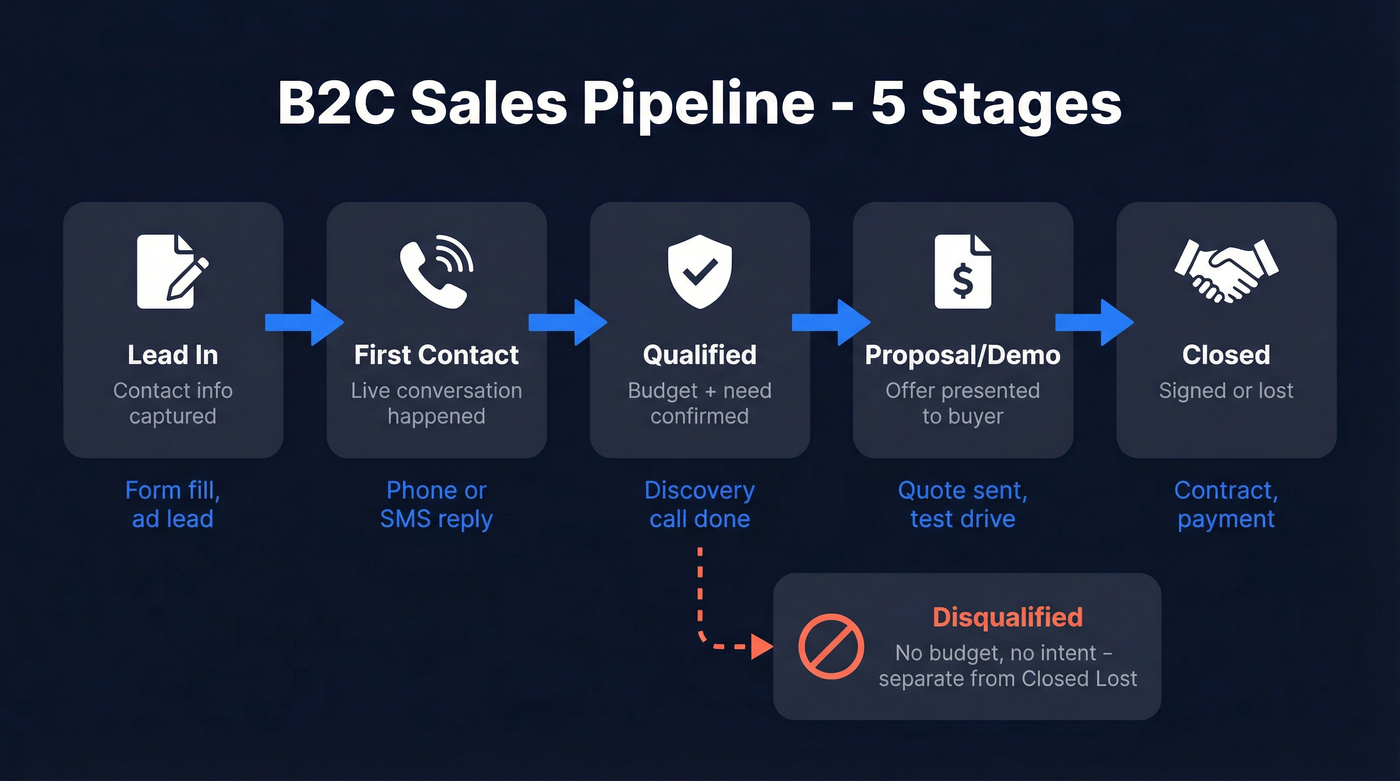
| Stage | Exit Criteria | B2C Example |
|---|---|---|
| Lead In | Contact info captured | Form fill, ad lead |
| First Contact | Live conversation | Phone/SMS reply |
| Qualified | Budget + need confirmed | Discovery call done |
| Proposal/Demo | Offer presented | Quote sent, test drive |
| Closed | Signed or lost | Contract, payment |
Adapt the middle stages to your industry. Car sales teams add "Test Drive" between Qualified and Proposal. Real estate agents slot in "Home Showing." Coaches use "Discovery Call." DTC ecommerce often compresses everything into Session/Lead, Cart, Checkout, Purchase.
The point isn't to copy a template. It's to make each stage represent a real decision point where the buyer either advances or drops.
If you're a solo operator, four stages is plenty: Prospecting, Qualification, Proposal, Close. That's the RingCentral model, and it works because it keeps your CRM from becoming a graveyard of stages nobody updates.
One critical addition: create a "Disqualified" status separate from "Closed-Lost." A team on r/sales had a 5% close rate and suspected it was distorted by window shoppers with no budget or intent. The fix was simple - add a Disqualified stage so your real close rate isn't buried under unqualified noise. Without it, every metric downstream lies to you.
B2C qualification also looks different from B2B. You're not mapping org charts - you're gauging household budget and life stage. A family with two kids shopping for a minivan has different urgency than a single renter browsing for fun. Build that into your Qualified stage criteria.
Speed-to-Lead: The Biggest Lever
This is the single highest-ROI change you can make to your pipeline.
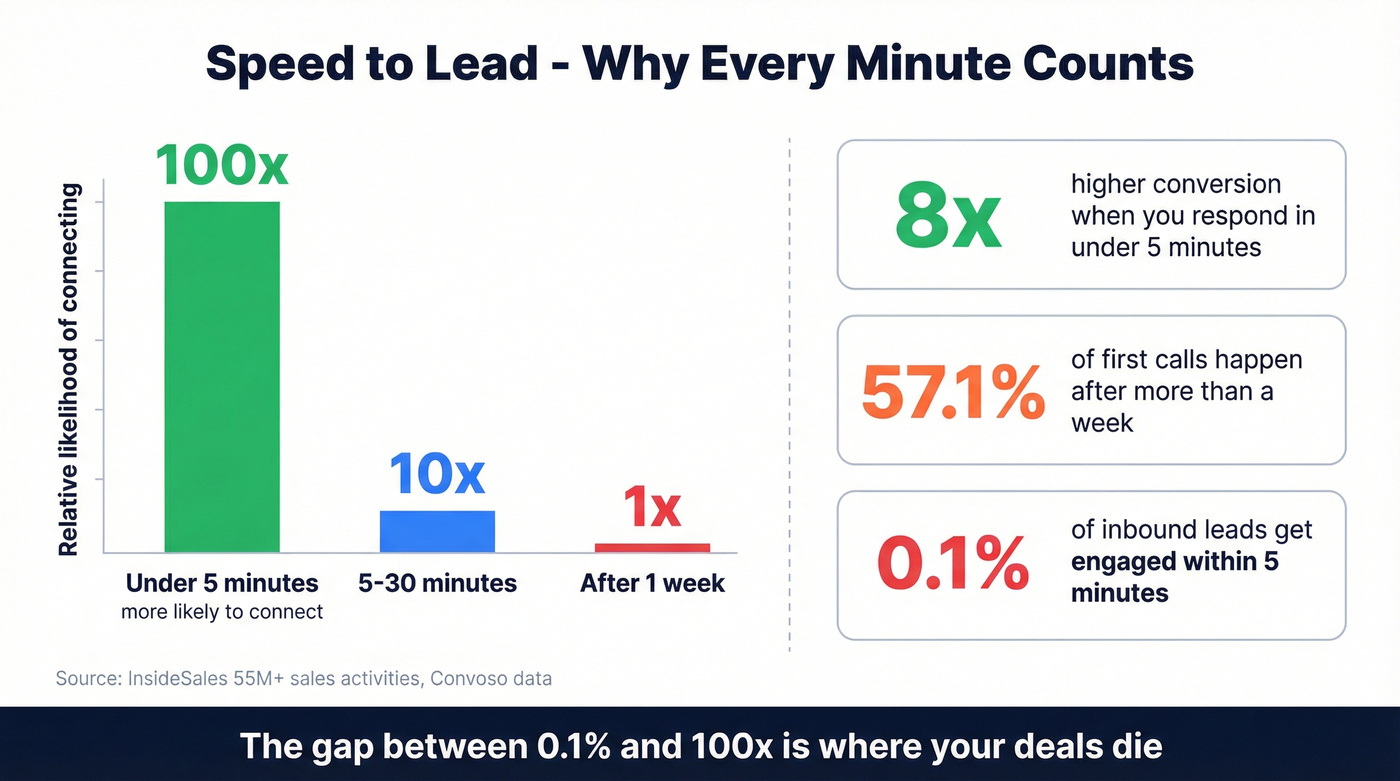
The InsideSales Lead Response Study - covering 55M+ sales activities across 400+ companies - found that conversion rates are 8x higher when you contact a lead within the first five minutes. Convoso's data puts it more starkly: responding in under five minutes makes you 100x more likely to connect and 21x more likely to qualify.
Here's the problem: 57.1% of first call attempts happen after more than a week. Only 0.1% of inbound leads get engaged within five minutes.
That gap is where deals die. And it's the easiest gap to close.
One caveat we've learned the hard way: speed-to-lead only works if the number is real. We've watched teams celebrate a sub-three-minute response time while dialing disconnected numbers. Verify before you dial.
Follow-Up Cadence That Works
77% of customers expect immediate interaction when they reach out. That expectation doesn't vanish after the first touch.
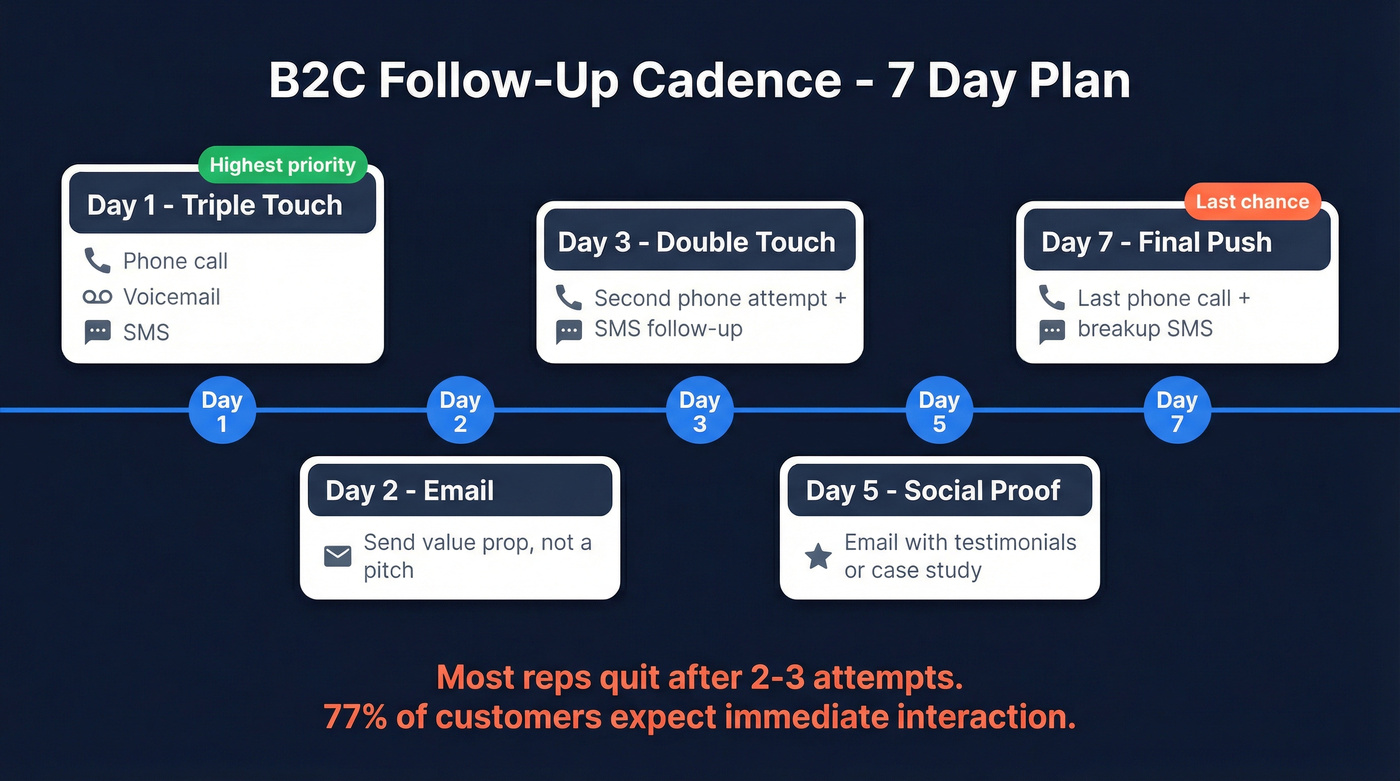
Plan for 8-12 touchpoints spaced 2-3 days apart, mixing channels:
- Day 1: Phone call + voicemail + SMS
- Day 2: Email with value prop
- Day 3: Second phone attempt + SMS follow-up
- Day 5: Email with social proof
- Day 7: Final phone + breakup SMS
Most reps quit after two or three attempts. That's leaving money on the table. The deals aren't gone - they're sitting in voicemail purgatory waiting for someone persistent enough to follow through.
If you want plug-and-play messaging, start with these follow-up templates and adapt them to your offer.

Speed-to-lead means nothing if you're dialing disconnected numbers. Prospeo gives B2C sales teams 125M+ verified mobile numbers with a 30% pickup rate - so your five-minute response time actually reaches a human. 98% email accuracy and verified phones at ~$0.01/lead.
Stop burning your cadence on dead lines. Verify before you dial.
Metrics That Reveal Pipeline Health
Track these four and you'll know whether your pipeline is healthy or just full.
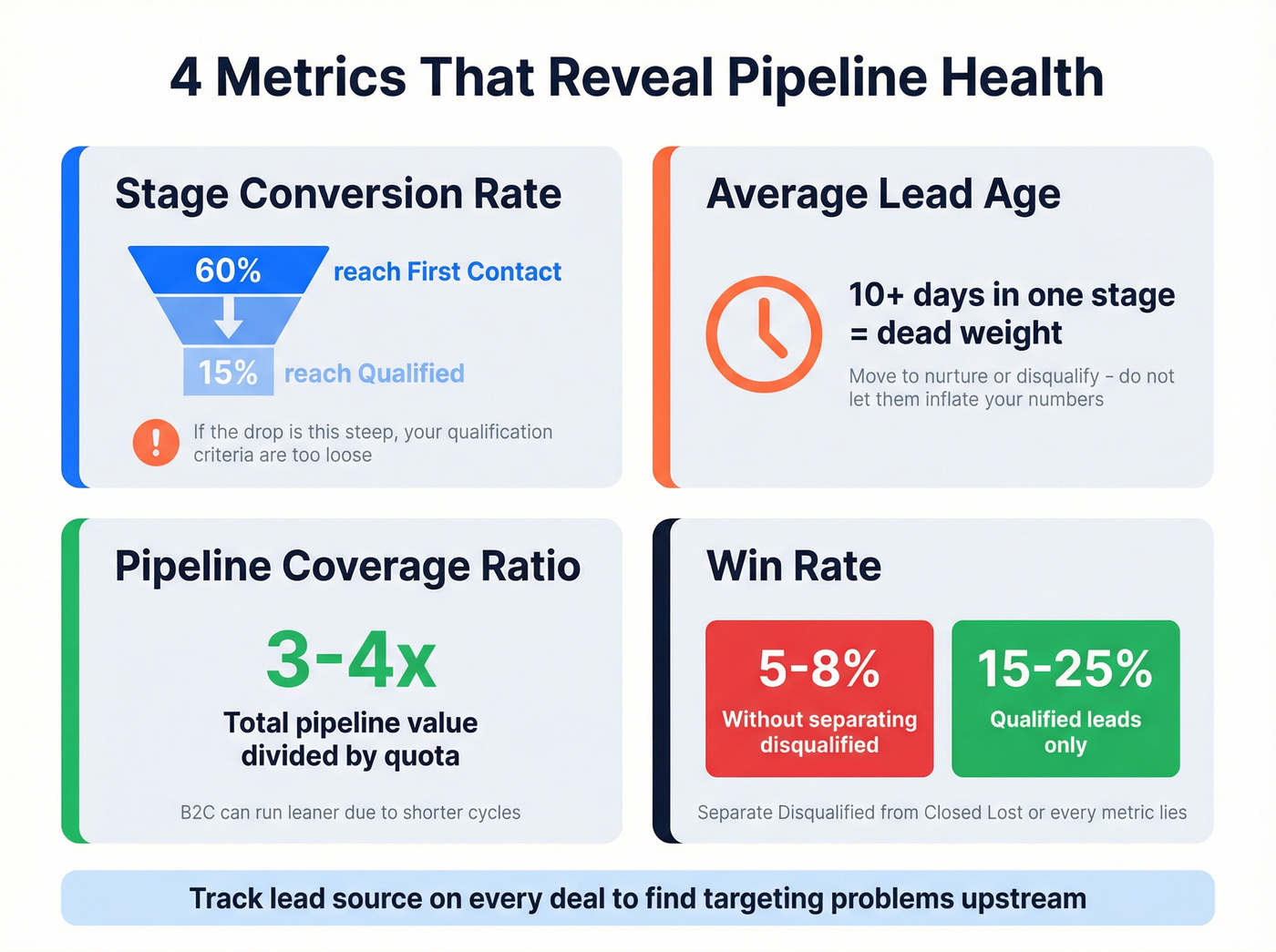
Stage conversion rate tells you exactly where deals stall. If 60% of leads make it to First Contact but only 15% reach Qualified, your qualification criteria are too loose - or your first-contact script isn't surfacing budget early enough.
Average lead age measures how long leads sit in each stage. Treat anything over 2x your normal cycle length as dead weight. In our experience, B2C leads that stall more than 10 days in any single stage rarely close. Move them to a nurture sequence or disqualify them - don't let them inflate your pipeline numbers.
Pipeline coverage ratio is total pipeline value divided by your quota. A 3-4x ratio is a common benchmark in B2B and works as a starting point for high-ticket B2C, though shorter cycles mean you can run leaner.
Win rate - but only after you've separated Disqualified from Closed-Lost. Otherwise you're measuring noise.
Track lead source on every deal. If 40% of your disqualified leads come from one channel, that's a targeting problem to fix upstream, not a closing problem. (If you want more benchmarks, compare against these sales pipeline benchmarks.)
Tool Stack
| Tool | Use Case | Price |
|---|---|---|
| Google Sheets | Starter pipeline | Free |
| HubSpot CRM | Free CRM, paid automation | Free; paid plans vary |
| Pipedrive | Visual pipeline management | ~$15-$100/user/month |
| Close | Phone/SMS-heavy B2C | ~$99-$199+/user/month |
| DocuSign | E-signatures | ~$10-$40+/user/month |
| Prospeo | Contact verification | Free tier; paid is credit-based |
Your pipeline is only as good as your contact data. If 15% of your phone numbers are wrong, you're burning through your cadence on dead leads and tanking your speed-to-lead metrics in the process.
Prospeo verifies emails and phone numbers before leads enter your pipeline - 98% email accuracy, 125M+ verified mobile numbers, 30% pickup rate across all regions. The free tier gives you 75 email verifications per month plus 100 Chrome extension credits to test the workflow. For phone-first B2C teams, verified mobiles mean actual conversations instead of dead lines.
Here's the thing: most B2C teams don't need an expensive CRM. They need a spreadsheet with clean data and a five-minute response time. I've seen teams on Pipedrive with garbage contact data get outperformed by a solo agent running Google Sheets and verified phone numbers. The tool matters less than the data inside it.
The hybrid approach - keeping cold leads in a spreadsheet and moving qualified leads into a CRM - is practitioner-tested and works well until you're managing 50+ active deals. Graduate to HubSpot (free) or Pipedrive when the spreadsheet starts slowing you down. If you're evaluating options, start with these examples of contact management software.
TCPA Compliance
Skip this section at your own risk. If you're texting or calling consumers, TCPA compliance isn't optional. Violations run $500-$1,500 per message, lawsuits surged 95% year-over-year, and class actions spiked 285% in a single month.
The basics:
- Obtain prior express written consent before marketing SMS
- No texts before 8am or after 9pm in the recipient's time zone
- Include a STOP opt-out in every message
- Record when, how, and the exact language of consent
- Watch state-level "mini-TCPA" laws - Texas SB 140 now expands telephone solicitation to include texts, with treble damages
Build consent tracking into your pipeline from day one. This gets harder every year, not easier. If you're doing outbound SMS, read this before you scale: cold texting.
Pipeline Template
Your columns: Deal Name, Contact, Assignee, Deal Size, Win Probability, Stage, Priority (High/Medium/Low), Next Step, Expected Close Date, Lead Source. Add "Disqualified" as a status option alongside your stages.
The "Next Step" column is non-negotiable. Without it, your pipeline is a list of names, not a system. If you want a visual dashboard, Close has a free template worth grabbing. To pressure-test your stages, use this checklist of sales activities that should move deals forward.
FAQ
How many stages should a B2C sales pipeline have?
Four to six. Solo operators can run with four: Prospecting, Qualification, Proposal, Close. Add industry-specific stages like "test drive" or "discovery call" only if they represent a real decision point where the buyer's commitment level changes.
What's a good B2C close rate?
Healthy high-ticket B2C teams close 15-25% of qualified leads. If you don't separate disqualified leads from closed-lost, your rate will look artificially low - often 5-8% - because unqualified leads are counted as losses.
Do I need a CRM or can I use a spreadsheet?
Start with Google Sheets. A spreadsheet works fine until you're managing 50+ active deals or need automated follow-up reminders. Then move to HubSpot (free) or Pipedrive (~$15/user/month).
How do I keep bad contact data out of my pipeline?
Verify phone numbers and emails before leads enter your first stage. Prospeo's free tier covers 75 email verifications per month, and its mobile finder pulls from 125M+ verified numbers - enough for most small B2C teams to test whether data quality is the bottleneck.
Four stages, verified data, and a five-minute response window. That's the whole B2C sales pipeline system - everything else is optimization on top. If you're still building top-of-funnel volume, pair this with a few reliable sales prospecting techniques so the pipeline stays full.