

B2G Lead Generation: A Tactical Playbook for 2026
The federal government spent $833.83 billion on contracts in FY25 - up 7.47% year-over-year - with $194.13 billion going to small businesses. You're not struggling because the market is small. You're struggling because most B2G lead generation advice stops at "build relationships" and never tells you how to actually generate pipeline.
Here's the thing: stop treating this as a marketing problem. It's a research problem. The real bottleneck is intelligence - knowing which agencies buy what you sell, when contracts expire, and who the decision-makers are. Solve research first, then layer on outreach.
What Makes B2G Different
If you're coming from B2B SaaS, selling to government agencies will feel like moving through water. Government buying cycles run 9 to 24 months, and complex enterprise procurements stretch well beyond that. Decisions are group-based - program managers, contracting officers, end users, and budget holders all influence the outcome. Multiple contacts from the same agency may engage with your content over months before an RFP ever drops.
Access is the other wall. As one practitioner on r/LeadGeneration noted, visits are appointment-only and response rates are painfully low. Government buyers consume an average of 15 pieces of content before purchasing. You're playing a long game whether you want to or not.
B2G also extends to state, local, and education markets, though federal is the largest and most structured - and where this playbook focuses.
Where the Money Is
Defense dominates: $508.8 billion, or 61% of total federal contract spending. But the fastest-growing agencies tell you where new money is flowing - the VA hit $78.2 billion (up 17%), and DHS reached $28.3 billion (up 20%). Navy contracts alone jumped $41.2 billion.
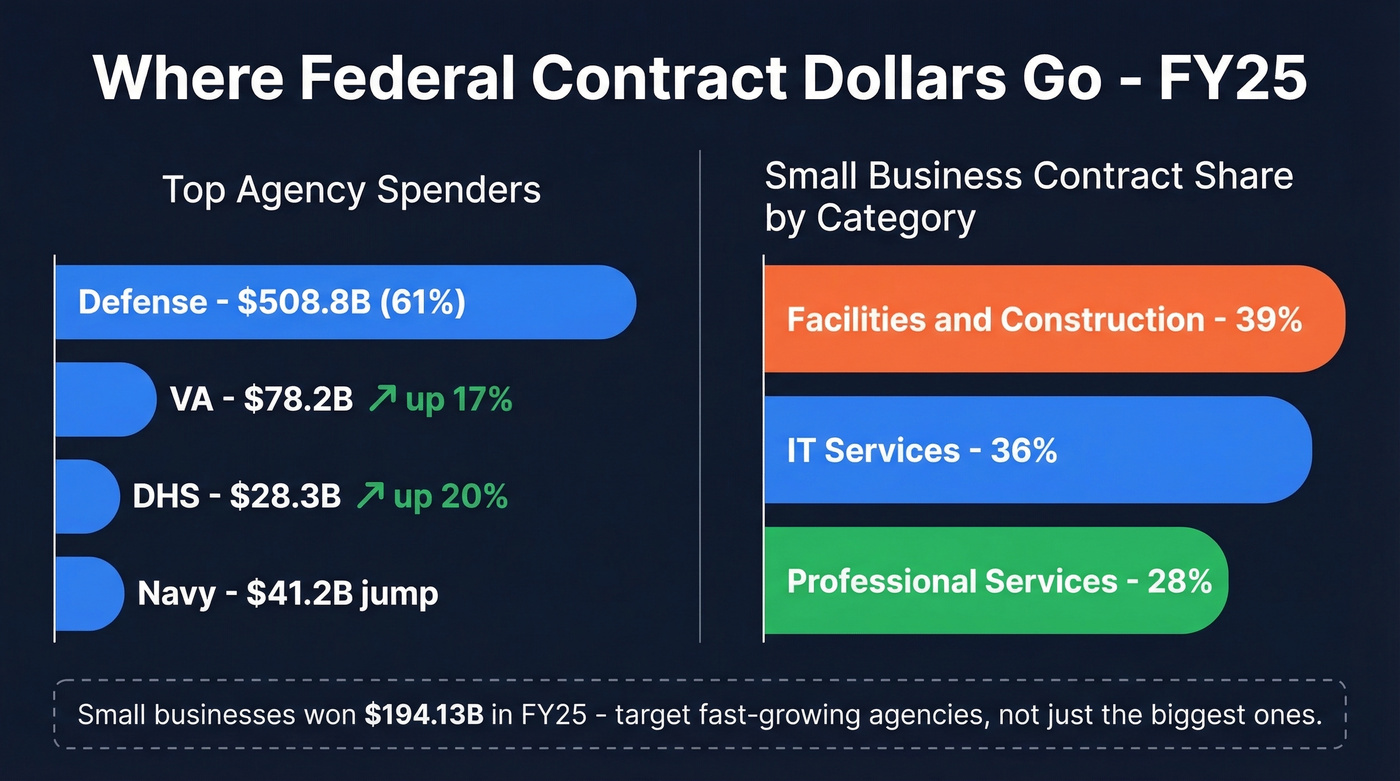
For small businesses, the category breakdown matters more than the headline number. Facilities & Construction captured 39% of small business contract dollars, IT took 36%, and Professional Services accounted for 28%. If you sell IT services and you aren't targeting agencies with growing IT budgets, you're leaving pipeline on the table.
Most small businesses chase the wrong agencies. They target the biggest spenders instead of the fastest growers. A mid-size agency whose budget just jumped 20% is far more likely to need new vendors than the DoD, where incumbent primes have locked down relationships for decades. We've watched teams burn a full year chasing a single DoD opportunity when three VA contracts in the same NAICS code went uncontested.
Two Paths: RFP vs. Direct Sales
The RFP path works when you can perform roughly 60% of the work yourself and have 3-5 past-performance examples aligned to the contract's major tasks. This is the traditional route - compete on technical merit and price through SAM.gov solicitations.
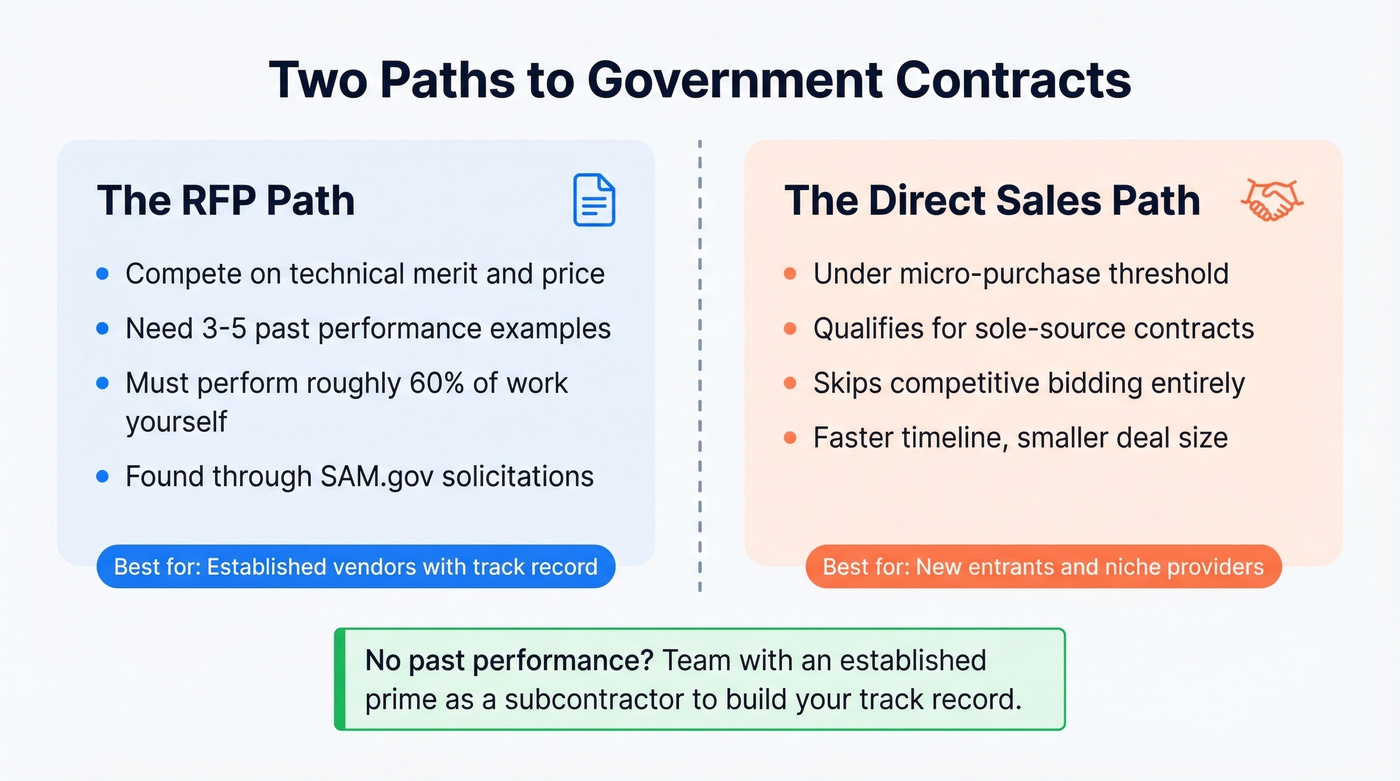
The direct sales path works when the purchase falls under the micro-purchase threshold or qualifies for sole-source contracts. These skip competitive bidding entirely.
If you lack past performance, teaming with an established prime is the fastest way to build your track record - and it's a lead-gen strategy in its own right, since primes actively seek qualified subcontractors. Set-aside certifications like SBA 8(a), HUBZone, and SDVOSB expand your addressable opportunity pool significantly, so pursue them early.
Getting Started on SAM.gov
SAM.gov registration is mandatory for federal contracting. The process is free - avoid unofficial "registration help" services that charge for what .gov channels provide at no cost.
- Get your UEI (replaced DUNS numbers in April 2022) and gather your TIN/EIN plus banking information.
- Identify your NAICS codes - these determine which opportunities you're eligible for. Your CAGE code gets issued during registration.
- Match your entity name and TIN exactly to IRS records. Name/TIN mismatches are the most common delay.
- Don't misrepresent your status in Representations & Certifications - False Claims Act penalties include suspension and debarment.
- Renew annually, starting 30+ days before expiration.

Your SAM.gov research identified the right agencies. Now you need verified emails for contracting officers and program managers - not stale .gov addresses that bounce and torch your sender reputation. Prospeo's 5-step verification delivers 98% email accuracy on a 7-day refresh cycle, so every outreach to a government buyer actually lands.
Start with 75 free verified emails - enough to cover your top target agencies.
Finding Opportunities the Smart Way
The consensus among practitioners is that most newcomers use SAM.gov wrong. We've seen teams waste months scrolling through irrelevant postings when a smarter workflow exists:
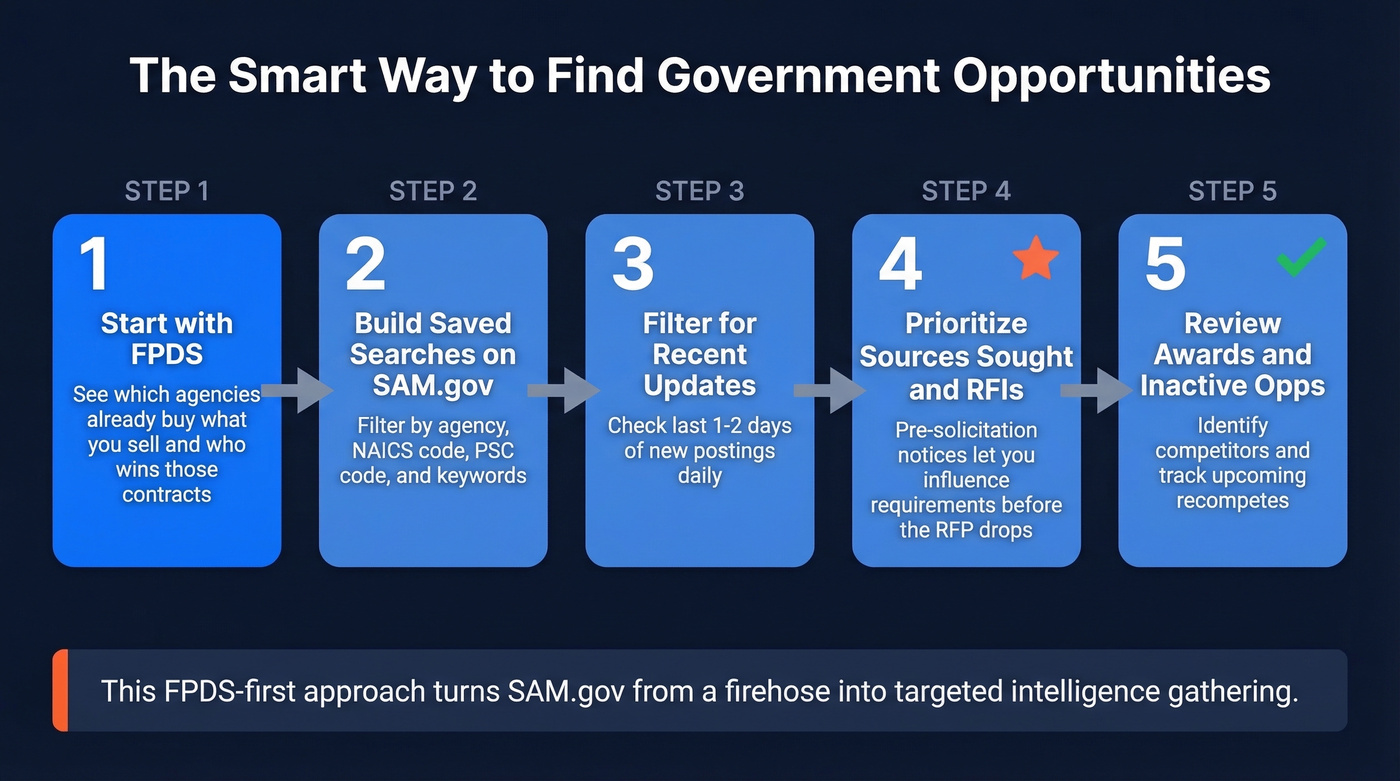
- Start with FPDS, not SAM.gov search. FPDS shows which agencies already buy what you sell and who's winning those contracts. This is your market map.
- Build saved searches on SAM.gov filtered by agency, NAICS code, PSC code, and keywords. Saved searches beat email notifications for reliability.
- Filter for recent updates (last 1-2 days) and check daily.
- Prioritize Sources Sought and RFI notices. These are pre-solicitation - you can influence requirements before the RFP drops.
- Review awarded and inactive opportunities to identify competitors and track upcoming recompetes.
This FPDS-first approach turns SAM.gov from a firehose - the #1 complaint on Reddit - into targeted intelligence gathering. In our experience, it saves weeks of unfocused searching.
Building Your Contact List
You've identified target agencies and upcoming contracts. Now you need verified emails for the program managers, contracting officers, and influencers who shape procurement decisions. This is where most B2G teams stall out - agency directories are incomplete, and generic B2B databases carry stale government contact data.
Let's be honest: a 15% bounce rate on your first outreach to a .gov address doesn't just waste credits. It tanks your sender reputation for every future campaign. We've talked to teams who had to spin up entirely new domains after a bad batch of government emails from another provider.
Prospeo's 98% email accuracy on a 7-day refresh cycle helps here. The free tier gives you 75 verified emails per month - enough to start building relationships at your top target agencies. The Chrome extension lets you pull verified contacts from agency staff pages or procurement office directories in one click.
B2G sales cycles run 9-24 months. One bad data batch that kills your domain reputation sets you back even further. Prospeo's proprietary email infrastructure verifies every contact before you send - with catch-all handling, spam-trap removal, and honeypot filtering - at ~$0.01 per email. No contracts, no sales calls, cancel anytime.
Stop rebuilding domains because your last provider sold you dead government emails.
Content That Actually Works
Educational content is the only format that consistently performs when selling to government buyers. Product brochures are the worst-performing content type for government audiences. A Merritt Group post recounts attendees literally walking out of a session that turned into a sales pitch. If your deck has more logos than data, leave it at home.
What works: best practices guides, case studies from similar agencies, newsworthy research, and webinars with actionable takeaways. Repurpose aggressively - turn a webinar into a short video, then a written Q&A, then a one-pager. Two tactical notes worth remembering: some agencies can't receive HTML emails on their networks, and many social platforms are blocked on government devices. Plain-text email and downloadable PDFs still matter here.
B2G Tools and Pricing
The government sales tool market has a pricing problem. The gap between "free and overwhelming" (SAM.gov) and "$30K+/year" (GovWin) is absurd - especially when set-aside programs exist specifically to help small businesses compete.
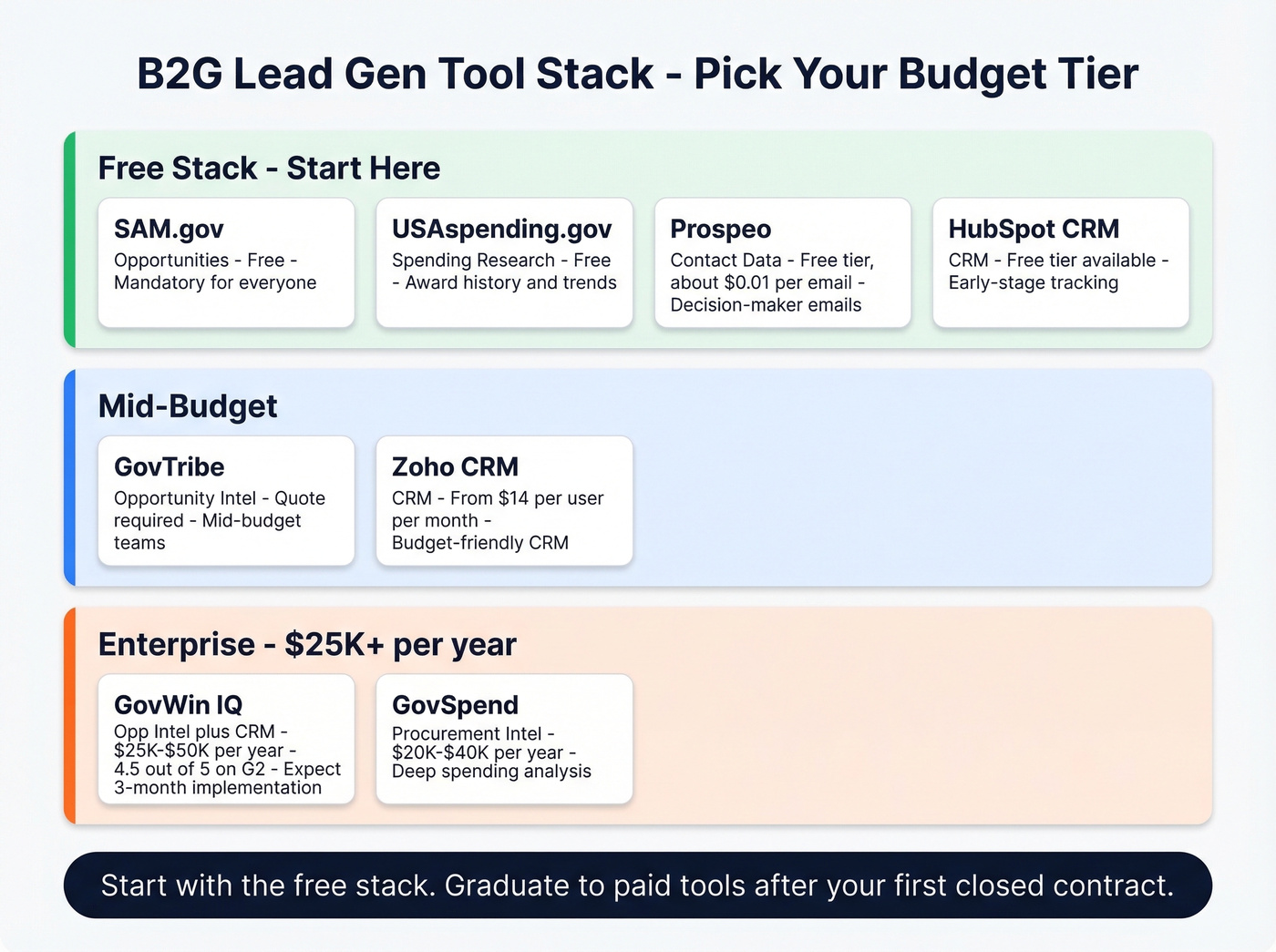
| Tool | Category | Price | Best For |
|---|---|---|---|
| SAM.gov | Opportunities | Free | Everyone (mandatory) |
| USAspending.gov | Spending research | Free | Award history + trends |
| Prospeo | Contact data | Free tier; ~$0.01/email | Decision-maker emails |
| GovTribe | Opportunity intel | Quote required | Mid-budget teams |
| GovWin IQ | Opp intel + CRM | $25K-$50K/yr | Enterprise teams |
| GovSpend | Procurement intel | $20K-$40K/yr | Spending analysis |
| HubSpot CRM | CRM | Free; $20/user/mo | Early-stage tracking |
| Zoho CRM | CRM | From $14/user/mo | Budget-friendly CRM |
| Salesforce GovCloud | CRM | $25-$75/user/mo | Enterprise compliance |
GovWin IQ scores 4.5/5 on G2 with 152 reviews, but expect a 3-month implementation timeline and 15 months to see ROI. Skip it if you haven't validated government as a revenue channel yet. For teams just starting out, the free stack above gets you 80% of the way there. Graduate to paid intelligence tools once you've closed your first contract and know the market is real.
If you're still building your stack, start with free lead generation tools and add a lightweight CRM before you buy enterprise intel.
Email Compliance Basics
CAN-SPAM applies to all commercial email with no B2B exemption. Penalties run up to $53,088 per violation. Use truthful headers and non-deceptive subject lines, include a valid physical postal address, provide a working opt-out mechanism, and honor opt-out requests within 10 business days. You're responsible even if a third party sends on your behalf.
If you're running outbound, keep an eye on email bounce rate and follow a real email deliverability process, not guesswork.
FAQ
How long does it take to win a government contract?
Plan for 9-24 months from first engagement to award. Defense and IT procurements often run 12-24+ months. Build your pipeline with this timeline in mind - don't expect quick wins in year one.
Can small businesses compete for federal contracts?
Yes. Small businesses won $194.13 billion in FY25 federal contracts - 23.8% of total spending across 76,270 companies. Set-aside programs like SBA 8(a), HUBZone, and SDVOSB give qualified small businesses a real competitive advantage.
What's the cheapest way to start generating government leads?
SAM.gov for opportunities, USAspending.gov for spending research, Prospeo's free tier for decision-maker contacts, and HubSpot's free CRM for pipeline tracking. Total cost: $0. You can run this stack for months before considering paid intelligence platforms.