

How to Build a BDR Program That Actually Generates Pipeline
Your CEO just approved two BDR headcount. You've got 90 days to show pipeline. No pressure - except that 58% of BDR orgs expanded in the past year, which means your competitors already have reps dialing while you're still writing a job description. Here's how to build a BDR program that produces real revenue, not just activity reports.
The 90-Day Checklist
- Hire in twos - one rep is a coin flip, two give you a real signal
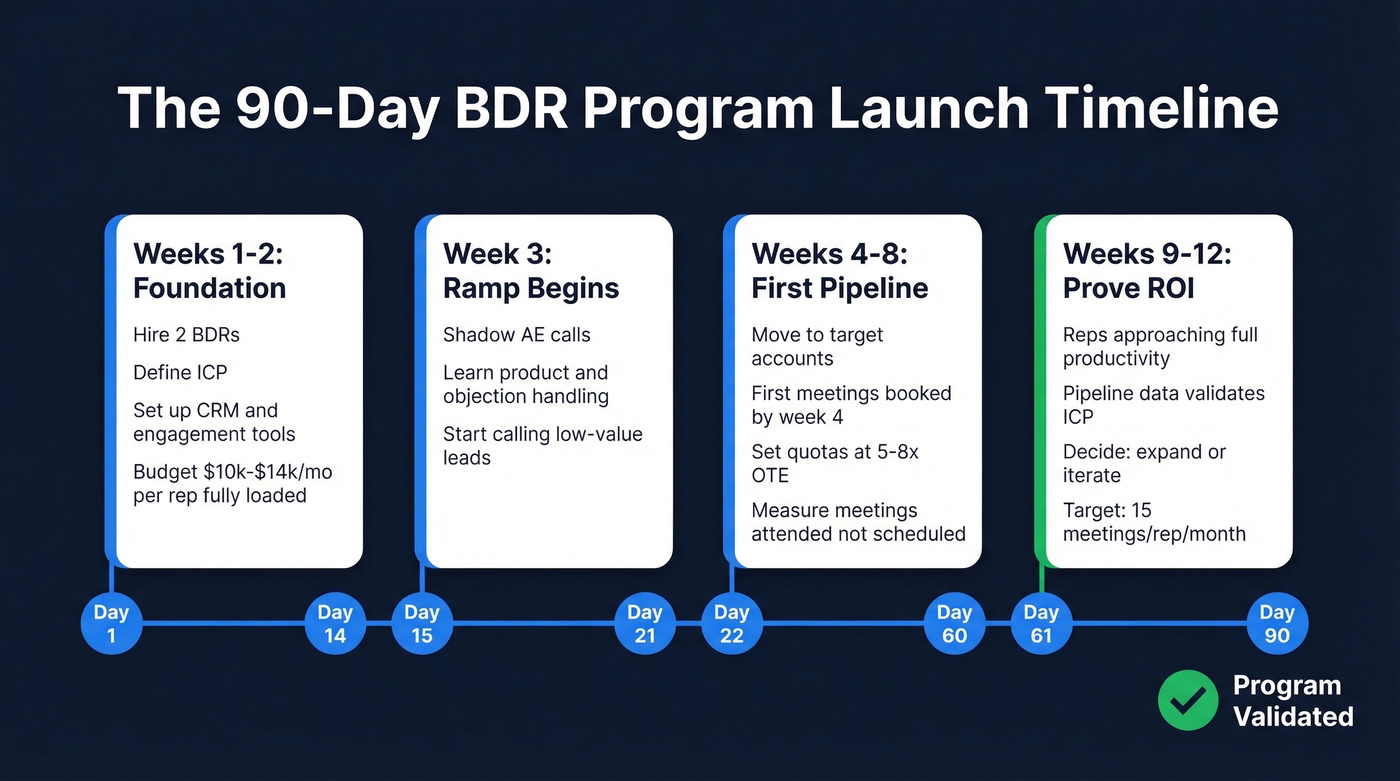
- Budget $10k-$14k/mo per rep fully loaded
- Set quotas at 5-8x OTE - anything less and the math doesn't work
- Measure meetings attended, not meetings scheduled
- Invest in verified contact data first - bad data kills more programs than bad reps
What a BDR Program Actually Is
A BDR program isn't hiring someone to make cold calls. It's the system around them: ICP definition, tech stack, comp plan, handoff process, management layer, and the metrics framework that tells you whether any of it's working. People, process, and tooling working together to create predictable pipeline.
BDRs focus on outbound prospecting - researching accounts, cold outreach, creating net-new pipeline. SDRs handle inbound: qualifying demo requests, form fills, MQLs. In early-stage companies, one person often does both. Split the roles once inbound volume justifies a dedicated qualifier.
Org Structure That Scales
Start with two BDRs reporting to a sales leader. 80% of BDR orgs report to Sales, and in our experience, that alignment produces faster feedback loops between prospecting and closing. Add a dedicated manager at four BDRs. Before that, a player-coach works fine. After that, you're asking someone to manage people and hit their own number, and both suffer.
The average SDR-to-AE ratio runs about 1:2.6. Separate inbound from outbound once inbound volume can keep a rep busy full-time. If you're launching with a small team, consider a tiger team rollout - a focused pod of two to three reps attacking a single vertical or territory before expanding.
Hiring and Onboarding
Hire for coachability, curiosity, and resilience - not industry experience. A rep who takes feedback and iterates will outperform a "seasoned" BDR stuck in their old playbook every time.
Here's a ramp schedule that works: Weeks 1-2, shadow AEs and learn the product. Week 3, start calling low-value leads. Week 4+, move to target accounts. Most programs see first meetings by week 4 and full productivity by month 3-4. Letting reps work lower-stakes inbound leads before graduating to outbound builds confidence and product knowledge at the same time, and it gives managers early signal on who needs extra coaching before the stakes get higher.
The biggest variable in ramp time is data quality. GreyScout cut rep ramp from 8-10 weeks to 4 weeks after switching to Prospeo's verified contact data, because reps stopped wasting their first month chasing dead numbers.
Compensation and Quotas
Comp plan design is where most programs quietly fail. Pay too little variable and reps coast. Push goals too far down-funnel and reps can't control their outcomes.
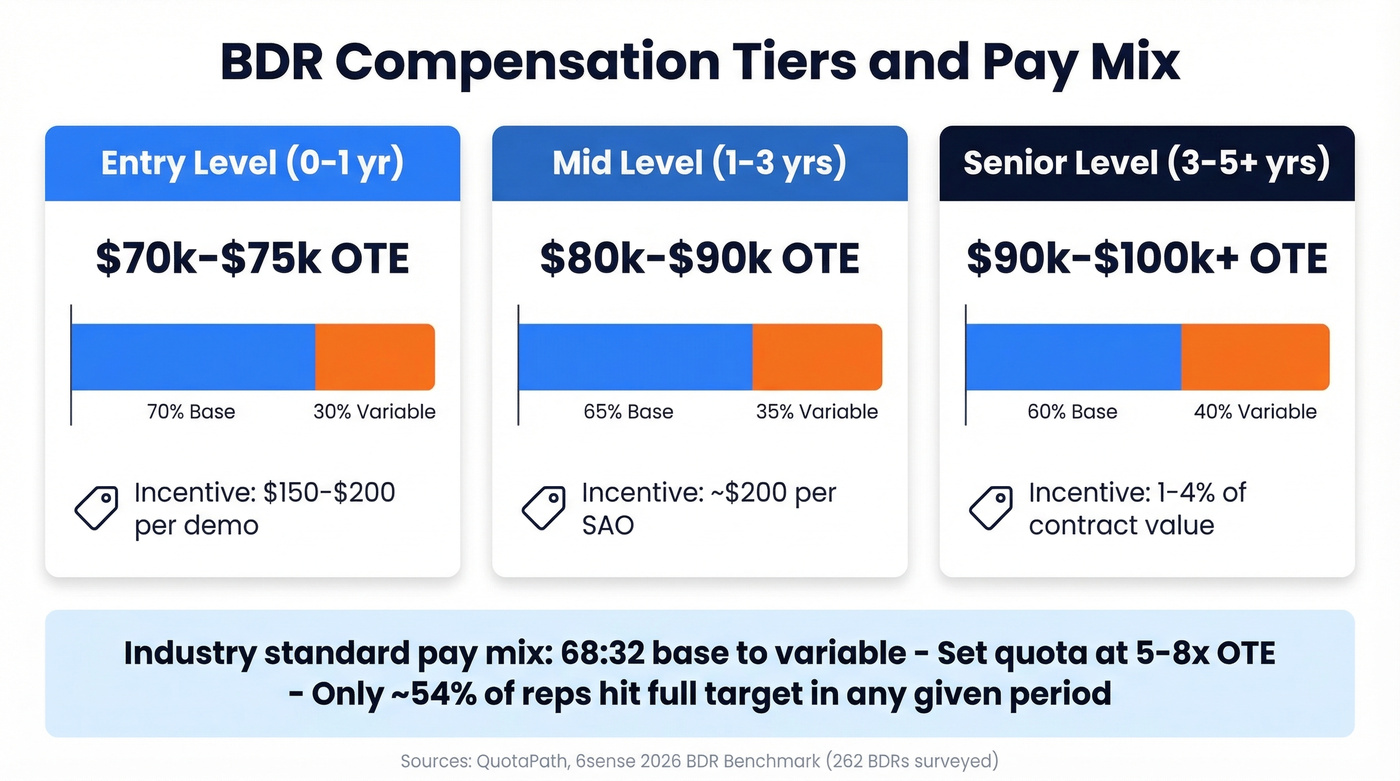
| Level | OTE | Base/Variable | Typical Incentive |
|---|---|---|---|
| Entry (0-1 yr) | $70k-$75k | 70/30 | $150-$200/demo |
| Mid (1-3 yrs) | $80k-$90k | 65/35 | ~$200/SAO |
| Senior (3-5+ yrs) | $90k-$100k+ | 60/40 | 1-4% of contract |
The industry-standard pay mix runs about 68:32 base-to-variable. Set quota at 5-8x OTE - that's the math that makes the program ROI-positive.
The 6sense benchmark of 262 BDRs found average quota attainment around 88%, but that's self-reported. Manager-reported data from other surveys puts the share of reps who actually hit target closer to 54%. Build your model conservatively: assume roughly half your reps hit full target in any given period, and structure accelerators to reward the ones who blow past it. Promotion timelines have stretched to ~15-16 months, so make sure your comp plan keeps reps motivated through that longer runway.
Incentivize meetings attended, not meetings scheduled. Scheduled meetings reward gaming. Attended meetings reward quality.

GreyScout cut BDR ramp time from 10 weeks to 4 and saw pipeline jump 140% - all by switching to verified contact data. Prospeo gives your reps 300M+ profiles with 98% email accuracy and a 7-day refresh cycle, so new hires spend week one calling real buyers instead of chasing dead numbers.
Stop losing your first 90 days to bad data.
Activity Benchmarks and Metrics
These are the numbers that matter for a healthy outbound motion:
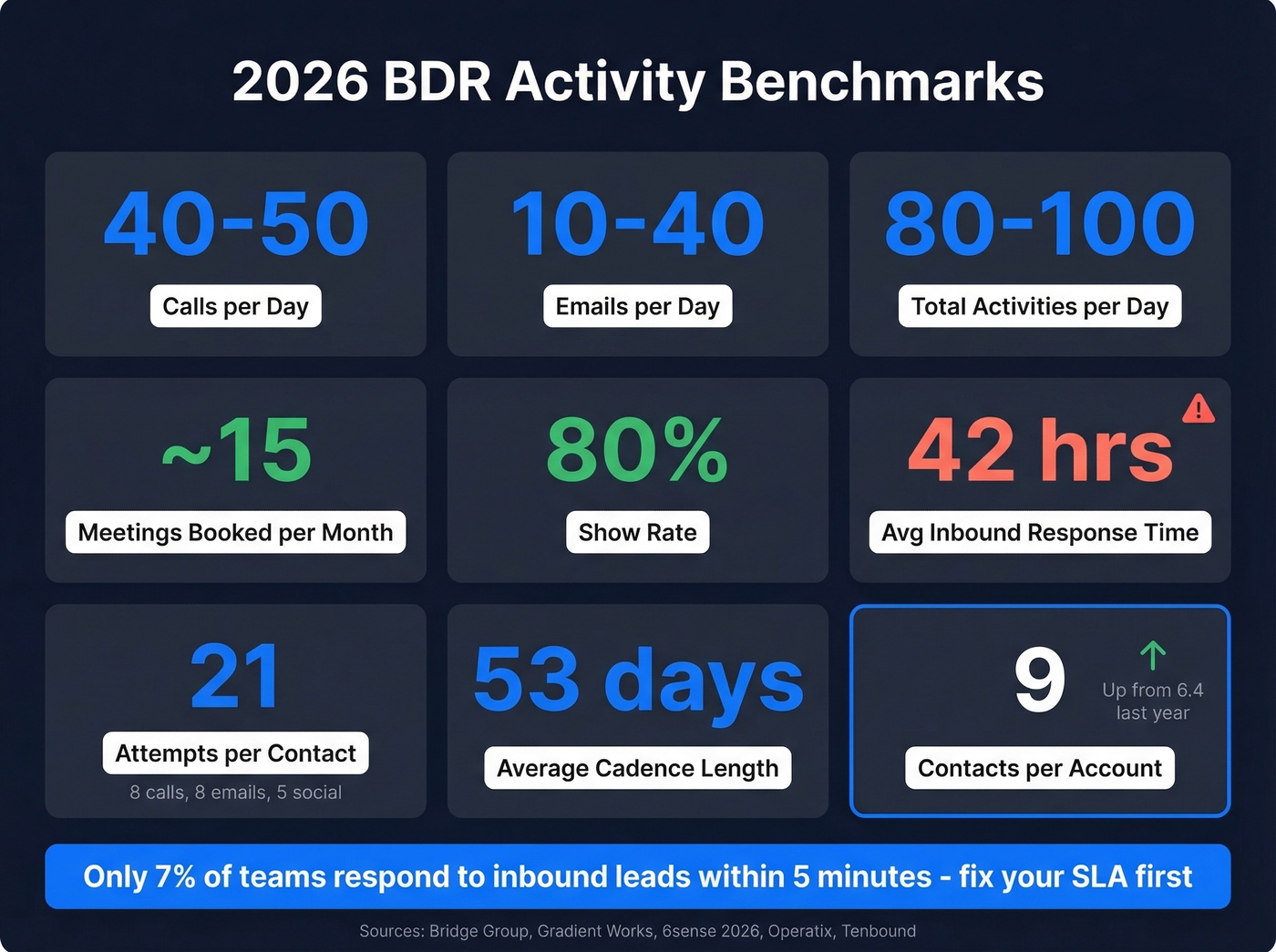
| Metric | Benchmark | Source |
|---|---|---|
| [Calls/day | 40-50](https://blog.bridgegroupinc.com/sales-development-metrics) | Bridge Group |
| [Emails/day | 10-40](https://operatix.net/blogs/sdr-metrics-outbound-inbound-teams/) | Operatix |
| Total activities/day | 80-100 | Tenbound |
| Meetings booked/mo (outbound) | ~15 | Gradient Works |
| [Show rate | ~80%](https://www.gradient.works/blog/benchmarks-for-metrics-that-matter-to-sales-development) | Gradient Works |
| Attempts per contact | 21 (8 calls, 8 emails, 5 social) | 6sense 2026 |
| Cadence length | 53 days | 6sense 2026 |
| Individuals contacted per account | 9 | 6sense 2026 |
The multithreading number is the one most teams underinvest in. BDRs now reach out to 9 individuals per account on average, up from 6.4 last year. That's not optional - it's what separates programs that generate pipeline from programs that generate "activity." If you're rethinking outreach strategy in 2026, start here: more threads per account, not more accounts per rep.
Only 7% of teams respond to inbound leads within 5 minutes. The average? 42 hours. Nail your SLA before you optimize your cadence. SDRs generate 46-73% of total pipeline depending on deal size - the function is too important to run on gut feel. And reps who feel supported hit 95% of quota versus 80% for those who don't. Enablement isn't a nice-to-have.
Tech Stack
You need four tools that integrate cleanly, not eight that require manual CSV exports between them. On r/sales, the most common complaint about BDR tech stacks isn't cost - it's the clunky workflow of exporting lists from one tool, enriching in another, and importing to a third while losing data along the way. 60% of BDRs now use AI tools and 62% report measurable productivity gains, so factor AI-native features into your evaluation.
| Category | Examples | Cost/BDR/Mo |
|---|---|---|
| CRM | Salesforce, HubSpot | $100-$150 |
| Sales engagement | Outreach, Salesloft | $110-$165 |
| Data provider | Prospeo, ZoomInfo, Apollo | Free tier-$300 |
| Dialer | Nooks, Orum | $100-$200 |
| Conversation intel | Gong, Chorus | $115-$135 |
| Total | $475-$1,000 |
For the data provider slot, we'd start with Prospeo. 300M+ profiles, 98% email accuracy, 125M+ verified mobile numbers with a 30% pickup rate, and a 7-day data refresh cycle. It integrates natively with Salesforce, HubSpot, Outreach, Salesloft, and sequencing tools like Instantly and Lemlist - so your reps stay in one workflow instead of juggling CSVs.
Here's the thing about contact data: it decays at 2-3% per month. If your provider refreshes every 6 weeks, a meaningful chunk of your database is stale at any given time. That's rep activity wasted before they even pick up the phone.
ZoomInfo typically runs $15k-$40k/year. Apollo's free tier is generous but credit limits choke enrichment at scale.

In-House vs. Outsourced
| Model | Monthly Cost | Cost/Held Meeting |
|---|---|---|
| In-house (steady state) | $9,800-$14,200 | ~$1,000 |
| In-house (ramp period) | Same cost, fewer meetings | $1,500-$2,000 |
| Outsourced (retainer) | $3,000-$6,500 | $375-$500 |
| Outsourced (pay-per-meeting) | $175-$350/meeting | $175-$350 |
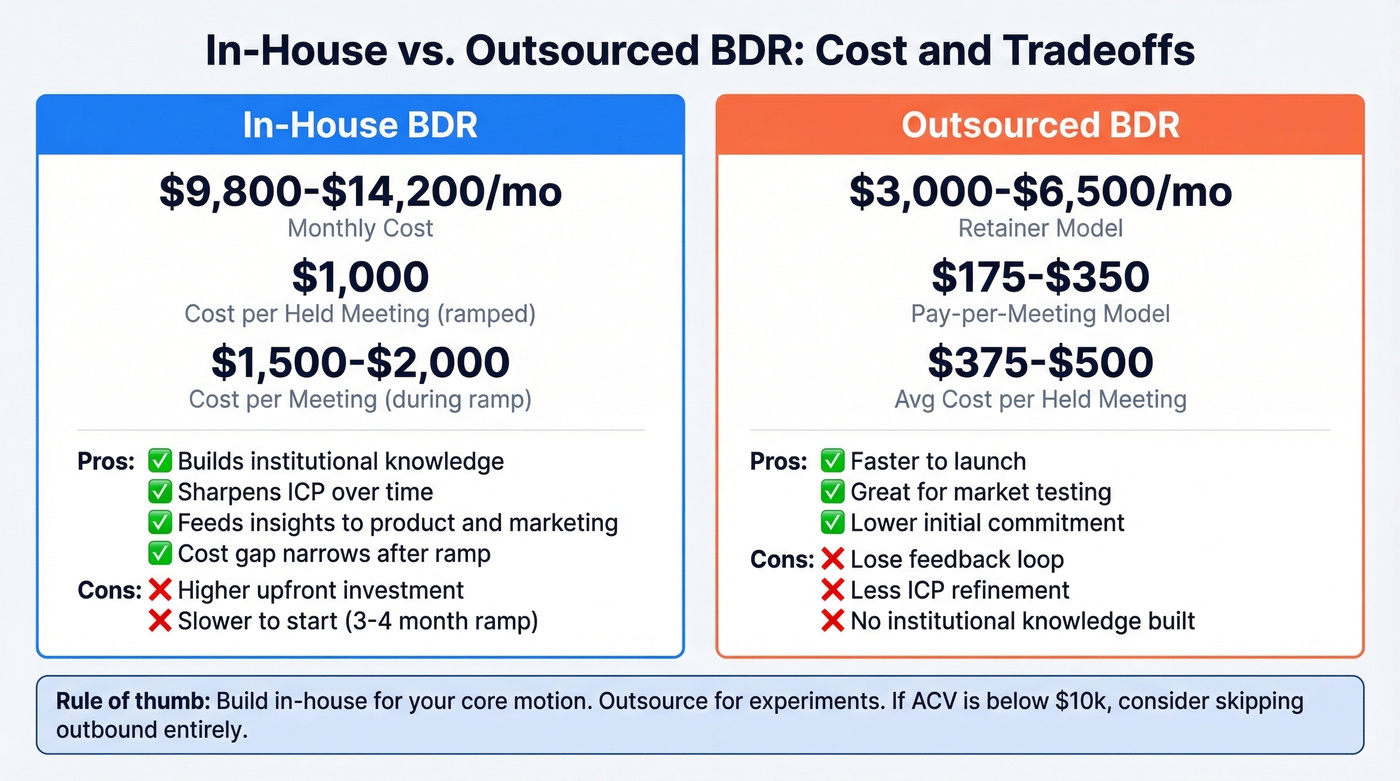
Outsourced looks cheaper on paper, and it is - for testing. If you're entering a new market or lack management capacity, an outsourced team gets you data fast. But the cost-per-meeting gap narrows once your in-house team ramps. In-house reps build institutional knowledge, sharpen your ICP over time, and feed insights back to product and marketing. For your core motion, build in-house. For experiments, outsource.
Skip outsourcing entirely if you're building your core ICP motion - you'll lose the feedback loop that makes the program smarter over time.
Hot take: If your average deal size sits below $10k, you probably don't need a dedicated outbound team at all. Product-led growth or marketing-driven inbound will get you further per dollar. BDR programs pay off when deal sizes justify the human cost of outbound - roughly $25k+ ACV is where we've seen the math consistently work.
Account-Based Strategy
Once your team is ramped, layering in an account-based approach is the highest-leverage move you can make. Instead of spraying outreach across thousands of contacts, assign each rep a defined list of 50-100 target accounts and go deep: multithread across 9+ contacts per account, personalize messaging by persona, and coordinate with marketing on account-level air cover.
The data backs this up. Teams that shifted to account-based motions saw higher show rates and larger average deal sizes because reps entered discovery calls with real context, not generic pitches. Pair this with intent data from providers like 6sense or Bombora to prioritize accounts showing active buying signals.
Mistakes That Kill Programs
Bad data hygiene. Contact data decays 2-3% per month. A 7-day refresh cycle dramatically reduces the problem; a 6-week cycle means a meaningful chunk of your reps' activity gets wasted on dead contacts.
If you're building your list workflow from scratch, data enrichment and data enrichment services can help you keep records fresh without adding manual work to your reps' day.
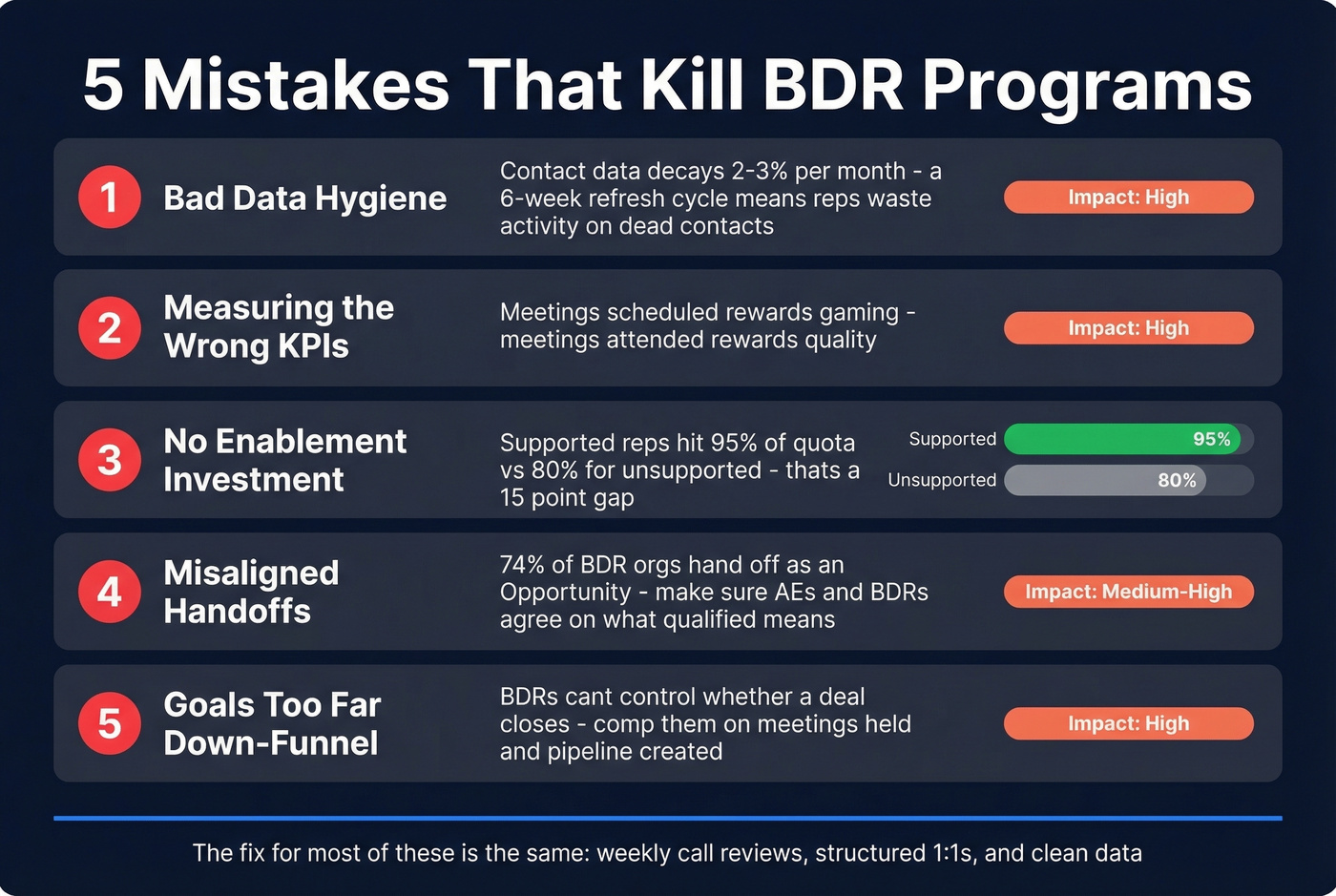
Measuring the wrong KPIs. Meetings scheduled rewards gaming. Meetings attended rewards quality. Pick the right one.
No enablement investment. The gap between supported and unsupported reps is 15 percentage points of quota attainment. That's not marginal - in our experience, it's the single biggest lever most managers ignore. Weekly call reviews, shared objection libraries, and structured 1:1s close this gap faster than any tool purchase.
Misaligned handoffs. 74% of BDR orgs hand off as an Opportunity. Make sure your AEs and BDRs agree on what "qualified" means before the first meeting gets booked. A simple handoff email template can prevent a lot of early friction.
Pushing goals too far down-funnel. BDRs can't control whether a deal closes. Comp them on what they can control - meetings held and pipeline created.
Multithreading 9 contacts per account means your BDRs need accurate emails and direct dials at scale - not stale CSVs. Prospeo delivers 125M+ verified mobiles with a 30% pickup rate and integrates natively with Salesforce, HubSpot, Outreach, and Salesloft. No exports. No workflow gaps.
Give your BDRs the direct dials your competitors can't find.
BDR Program FAQ
What's the difference between a BDR and an SDR?
BDRs focus on outbound prospecting - cold outreach to create net-new pipeline. SDRs handle inbound leads like demo requests and form fills. Some companies use the titles interchangeably; what matters is whether the role is outbound-first or inbound-first.
How long does it take to ramp a new BDR?
Expect first meetings by week 4 and full productivity by month 3-4. Data quality is the biggest variable - GreyScout cut ramp from 8-10 weeks to 4 weeks after switching to verified contact data.
How much does a BDR program cost?
An in-house BDR costs $9,800-$14,200/month fully loaded, including $475-$1,000/month in tooling. Outsourced alternatives run $3,000-$6,500/month on retainer or $175-$350 per qualified meeting.
What tools does a BDR team need?
Four essentials: a CRM, a sales engagement platform, a data provider with verification and fresh data, and a dialer. Conversation intelligence is a strong fifth add. Everything else is nice-to-have until you hit 6+ reps.
What's the best way to structure a BDR sales process?
Map your process to the buyer's journey: research the account, identify 9+ contacts, execute a multi-touch cadence across phone, email, and social over ~53 days, then qualify and hand off to an AE. Agree on handoff criteria with your closing team before the first outreach goes out.