

Benefits of Sales and Marketing Alignment: What 2026 Data Actually Shows
82% of C-level executives say their sales and marketing teams are aligned. 65% of the people actually doing the work disagree. That's not a minor gap - it's a structural blind spot.
Understanding the real benefits of sales and marketing alignment means looking past executive perception and into the pipeline. A 2026 Influ2 study found 53% of companies have a fundamentally broken handoff, with sales following up on fewer than 35% of marketing-engaged prospects. The executives think everything's fine. The pipeline says otherwise.
The Short Version
Legacy benchmarks from Aberdeen in the early 2010s put the upside of alignment in the 24-38% range across growth and conversion outcomes. More recent data still shows big gains where alignment is real: a Demandbase VP of Sales pegged the cost of misalignment at 10%+ of annual revenue, and the same analysis highlights up to 38% more closed deals and up to 36% higher retention when teams genuinely get on the same page. The 2026 Influ2 data confirms the gap hasn't closed - it's probably widened. The problem isn't strategy. It's infrastructure: broken handoffs, bad data, competing KPIs.
Three things matter most:
- Shared lead definition. If sales and marketing can't agree on what an MQL is, nothing downstream works.
- A 6-component SLA. Definitions, commitments, metrics, review cadence, feedback loops, escalation paths.
- Bi-weekly syncs. Not optional. Not quarterly. Every two weeks, minimum.
The Real Cost of Misalignment
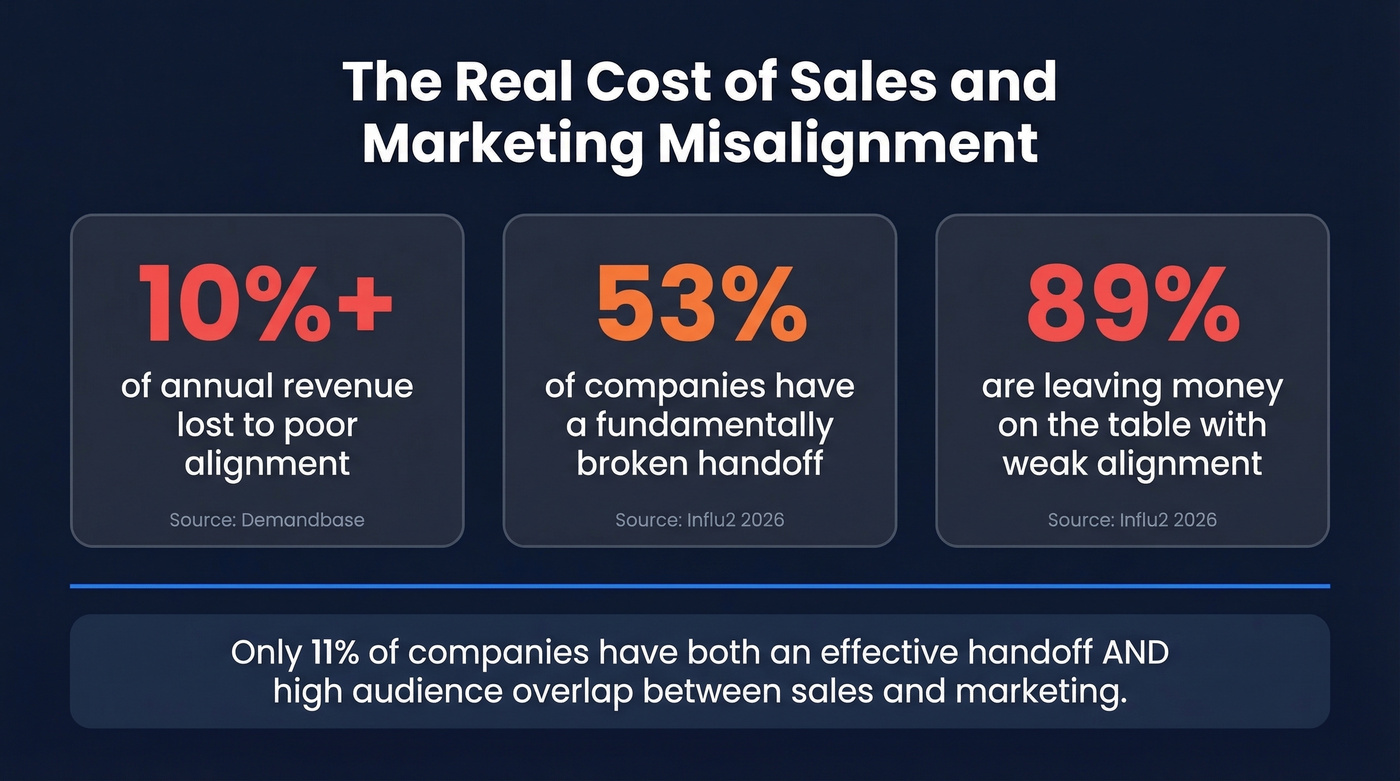
A Demandbase VP of Sales estimated that poor alignment costs businesses 10% or more of annual revenue. And 48% of enterprises still struggle with it.
We've watched this play out dozens of times. Marketing runs a $50K campaign. Leads come in. Sales follows up with fewer than a third of them. The rest sit in a CRM queue until they're cold, then get blamed on "lead quality." Practitioners have a name for this: the "black hole between MQL and closed-won." It's the single most expensive process failure in B2B, and most leadership teams don't even know it's happening because their dashboards don't surface it.
Only 11% of companies have both an effective handoff and high audience overlap between sales and marketing. That means 89% are leaving money on the table.
Seven Benefits of Aligning Sales and Marketing
Faster Revenue Growth
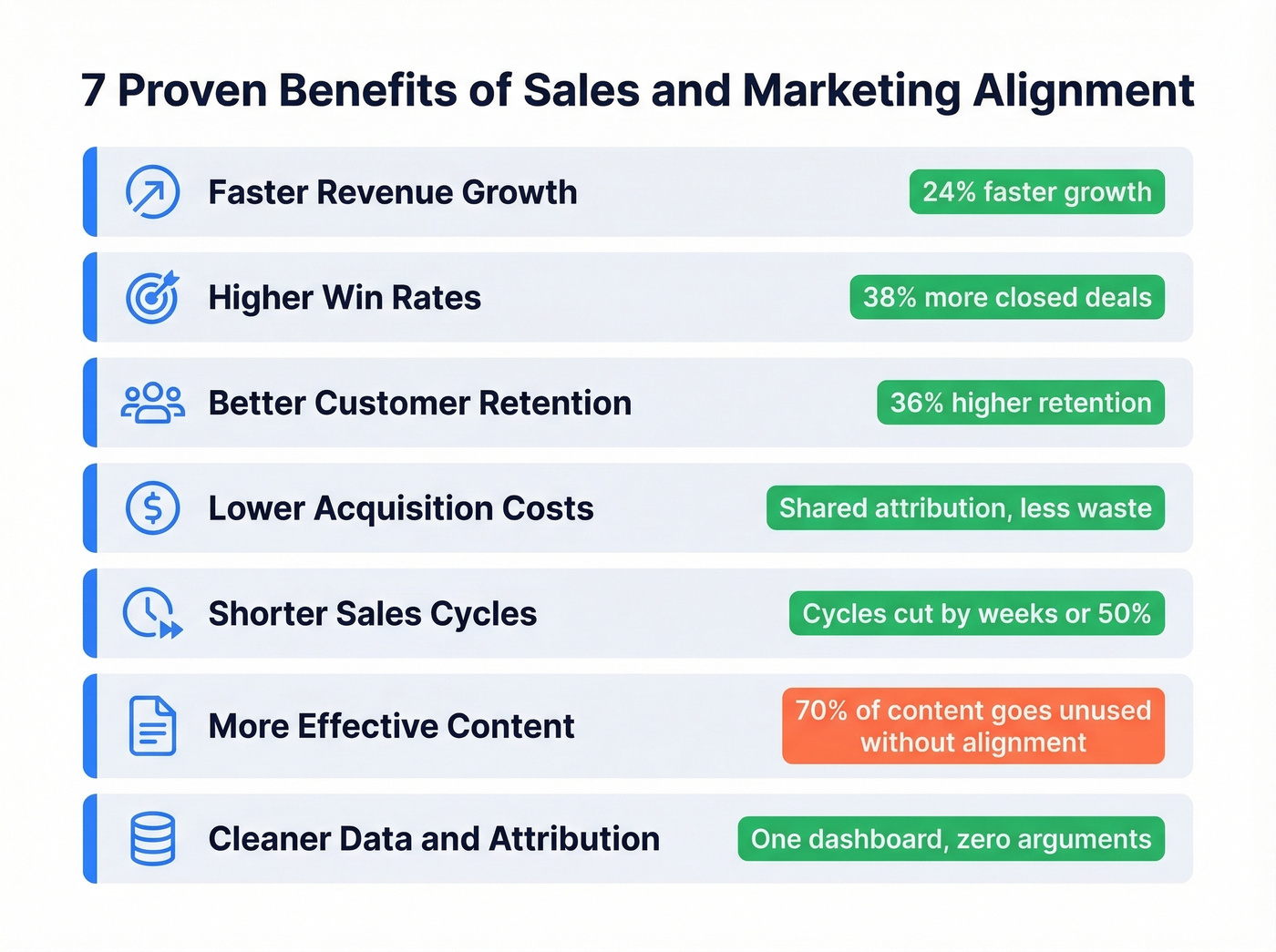
Aberdeen's commonly cited benchmark showed aligned organizations grow revenue 24% faster. With only 11% of companies achieving strong alignment, the competitive advantage for those who do is massive. Revenue growth at this scale compounds quickly - a few quarters of tighter handoffs can reshape your entire trajectory, turning a flat pipeline into a hockey stick without adding headcount.
Higher Win Rates
Aligned teams drive up to 38% more closed deals. When sales knows which prospects marketing warmed up, and marketing knows which objections sales keeps hearing, the entire funnel tightens. This isn't theory. It's what happens when two teams stop operating like separate companies that share a logo.
Better Customer Retention
Alignment is tied to up to 36% higher retention. Consistent messaging from first touch through renewal means customers don't feel like they bought from one company and got handed to another.
Lower Acquisition Costs
Before alignment, two teams track "marketing-sourced" vs. "sales-sourced" pipeline and fight over attribution. After alignment, shared attribution eliminates duplicate spend and the turf wars that waste budget. Every dollar works harder when both teams pull in the same direction.
Shorter Sales Cycles
If a buyer has already consumed three pieces of content and attended a webinar, the first sales call isn't a cold intro - it's a continuation. We've seen this compress deal cycles by weeks, sometimes cutting them in half for mid-market deals where the buying committee was already primed by content.
More Effective Content
70% of marketing content goes unused when sales and marketing aren't coordinated. Shared content planning - where sales feeds objections to marketing and marketing builds assets around them - fixes this fast.
Cleaner Data and Attribution
McKinsey research puts it bluntly: only 30% of companies have a unified data strategy. Alignment forces data unification because you can't run a shared pipeline on two disconnected tech stacks. The consensus on r/sales and r/marketing echoes this - attribution arguments evaporate once both teams look at the same dashboard.

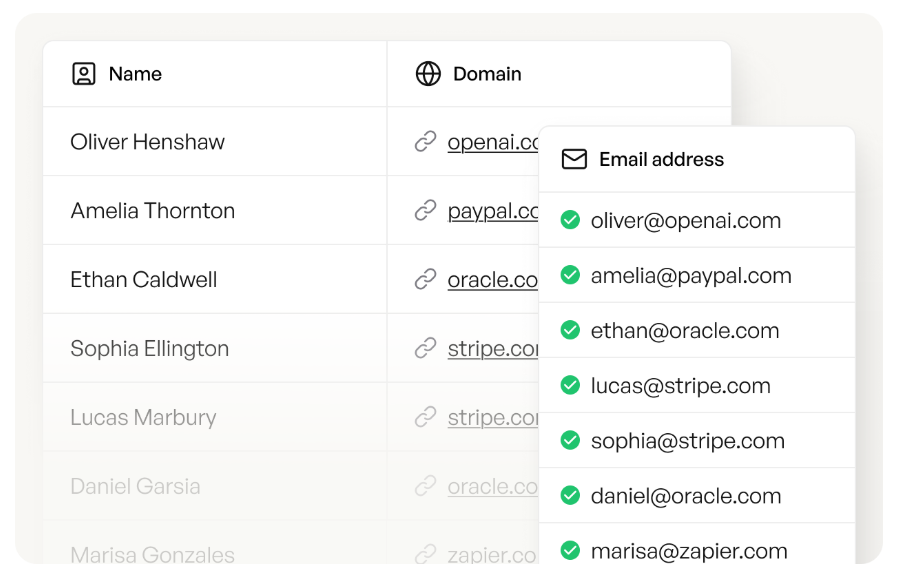
The article says it clearly: disjointed tech stacks and stale leads kill alignment. Prospeo enriches every lead with 50+ data points at a 92% match rate - so when marketing hands off to sales, the contact data is verified, current, and actionable. No more 'black hole between MQL and closed-won.'
Stop losing pipeline to bad data. Start with 75 free verified emails.
Why Alignment Keeps Failing
The Forrester perception gap is the root problem. Leadership thinks alignment is a culture issue. Practitioners know it's infrastructure. Here are the four failure modes we see over and over:
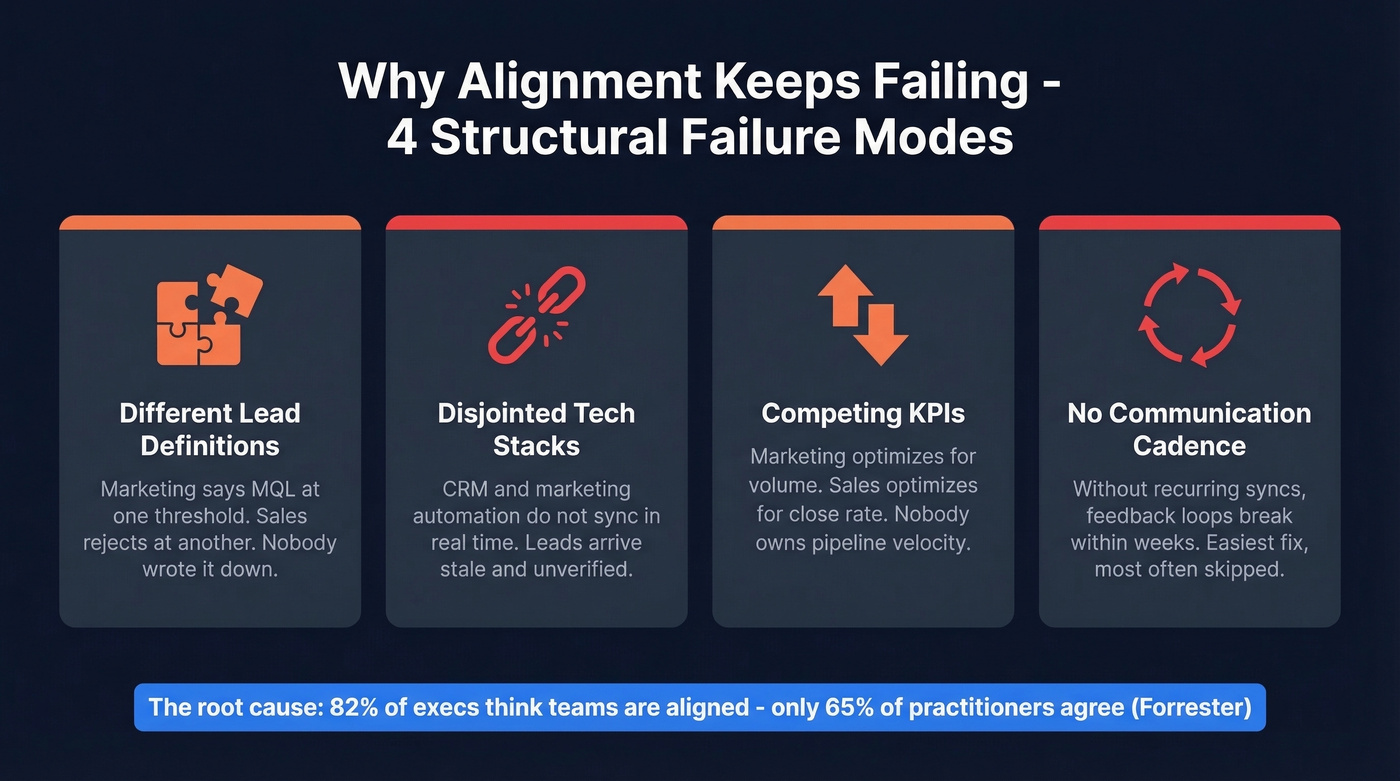
Different lead definitions. Marketing calls it an MQL at one threshold; sales rejects it at another. Nobody wrote it down. This alone accounts for more pipeline friction than any competitor ever will.
Disjointed tech stacks. Marketing automation and CRM don't sync in real time. Leads arrive stale. Run them through a verification layer before handoff to catch dead emails and bad phone numbers - tools like Prospeo return 50+ data points per contact with a 92% match rate, which means stale contact data stops being the bottleneck.
Competing KPIs. Marketing optimizes for volume. Sales optimizes for close rate. Neither owns pipeline velocity. Until someone does, the incentive structures will keep pulling in opposite directions.
No communication cadence. Without a recurring sync, feedback loops break within weeks. This is the easiest one to fix and the one most teams skip.
Here's the thing: if your average deal size is above $5K and you don't have a documented SLA between sales and marketing, you're probably losing more revenue to internal friction than to any competitor.
68% of SDR teams report to sales, not marketing. Many companies "solve" alignment by rebranding sales ops as RevOps and calling it done. That's not alignment - that's a title change.
How to Build Revenue Alignment
Alignment isn't a workshop. It's a system. Start with a 6-component SLA:
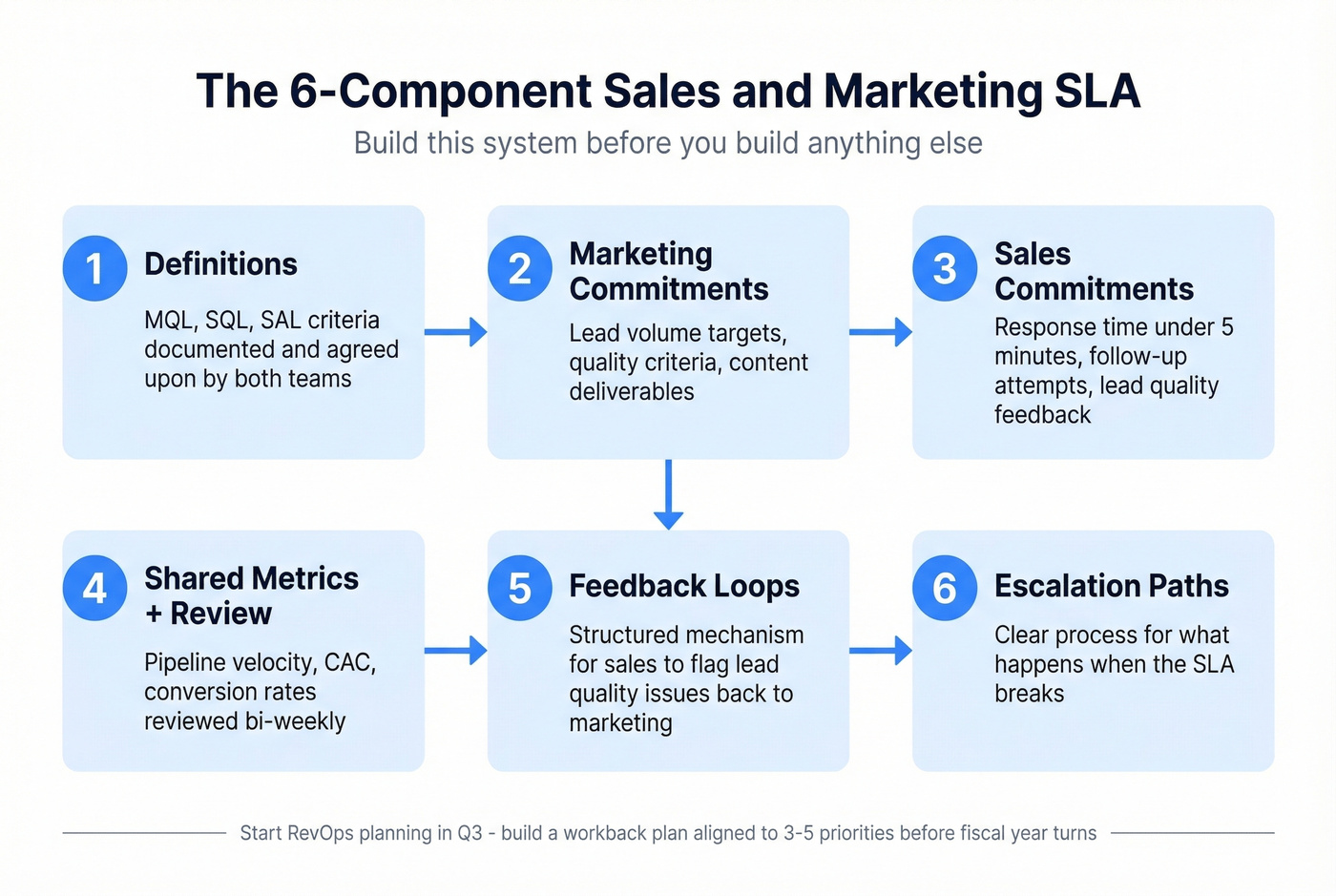
- Definitions - MQL, SQL, SAL criteria documented and agreed upon
- Marketing commitments - lead volume, quality criteria, content deliverables
- Sales commitments - response time under 5 minutes, follow-up attempts, feedback on lead quality
- Shared metrics + review cadence - pipeline velocity, CAC, conversion rates reviewed bi-weekly
- Feedback loops - structured mechanism for sales to flag lead quality issues
- Escalation paths - what happens when the SLA breaks
For frameworks, look at the SiriusDecisions Revenue Operations model (now part of Forrester), the Bowtie model from Winning by Design, or HubSpot's Flywheel. Pick one that fits your org's maturity. Sales and marketing convergence isn't optional in 2026 - it's the baseline for competitive B2B organizations. Start RevOps planning in Q3, early enough to build a workback plan aligned to 3-5 priorities before the fiscal year turns.
How to Measure Alignment
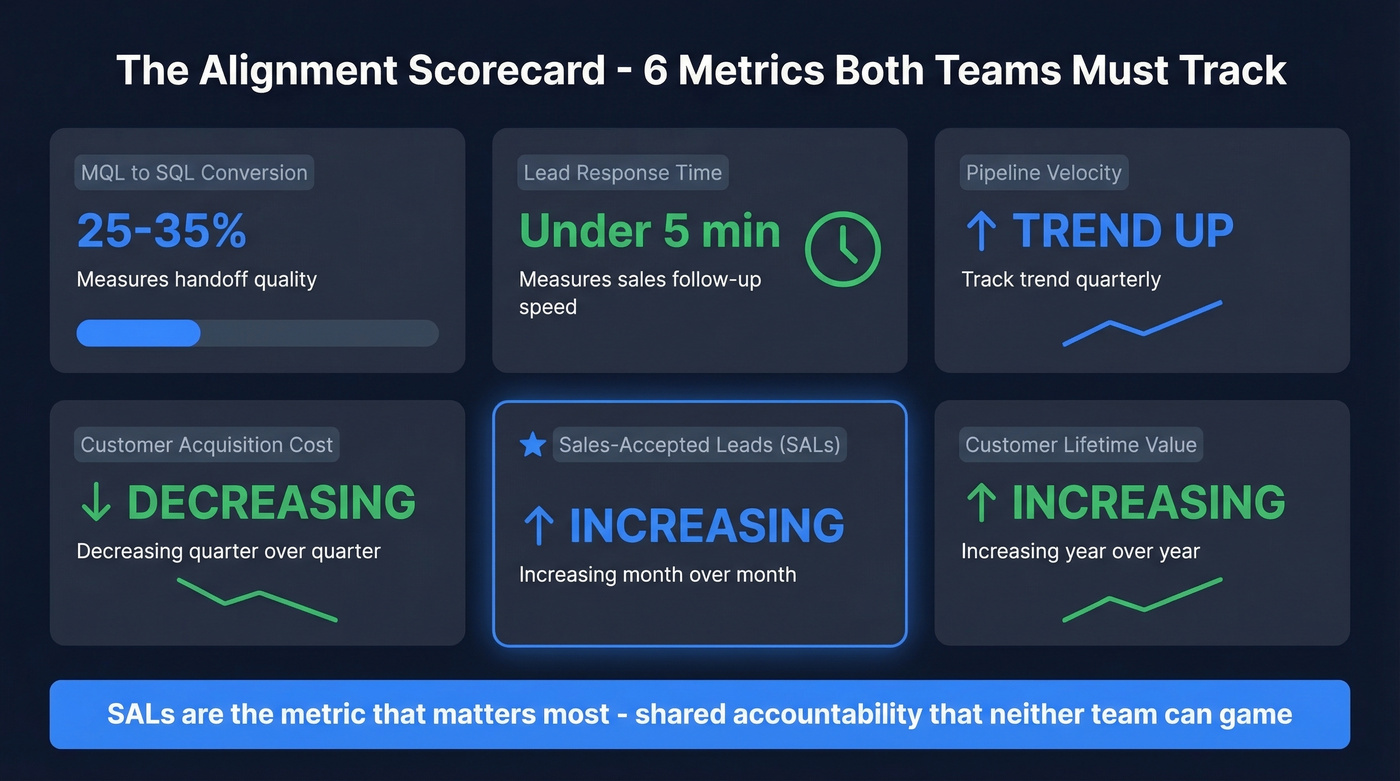
Shared metrics replace department-specific KPIs. When alignment drives revenue, you need numbers both teams trust:
| Metric | What It Measures | Aligned Target |
|---|---|---|
| MQL to SQL conversion | Handoff quality | 25-35% |
| Lead response time | Sales follow-up speed | Under 5 minutes |
| Pipeline velocity | Deal speed through stages | Track trend quarterly |
| CAC | Combined spend efficiency | Decreasing QoQ |
| SALs (sales-accepted) | Shared accountability | Increasing MoM |
| CLV | Long-term revenue per customer | Increasing YoY |
SALs are the metric that matters most. They're the shared accountability number - marketing can't game them with volume, and sales can't dismiss them without documenting why. Skip this metric if you want, but don't be surprised when the finger-pointing starts again by Q2.
FAQ
What's the difference between alignment and RevOps?
Alignment is the goal - shared definitions, metrics, and accountability between sales and marketing. RevOps is the operational framework (people, processes, data, technology) that makes alignment sustainable. You can be "aligned" without RevOps, but it rarely lasts past one quarter.
How long until alignment efforts show results?
Most teams see measurable improvements in lead response time and MQL-to-SQL conversion within 3-6 months of implementing an SLA and bi-weekly syncs. Pipeline velocity gains typically follow in months 4-8 as compounding effects kick in.
What's the fastest way to improve lead handoffs?
Verify that every lead marketing passes to sales has a valid email and current phone number - bad contact data kills 30%+ of handoffs before a rep even dials. Document a shared MQL definition and enforce a maximum response time in your SLA. Prospeo automates the verification step at scale, with 98% email accuracy and a 7-day data refresh cycle that keeps contacts current.
Aligned teams close 38% more deals - but only when both sides trust the data. Prospeo's 7-day refresh cycle means sales never calls a dead number or bounces an email that marketing swore was good. At $0.01 per email with 98% accuracy, cleaning up your shared pipeline costs less than one misaligned meeting.
Give both teams one source of truth they actually trust.