

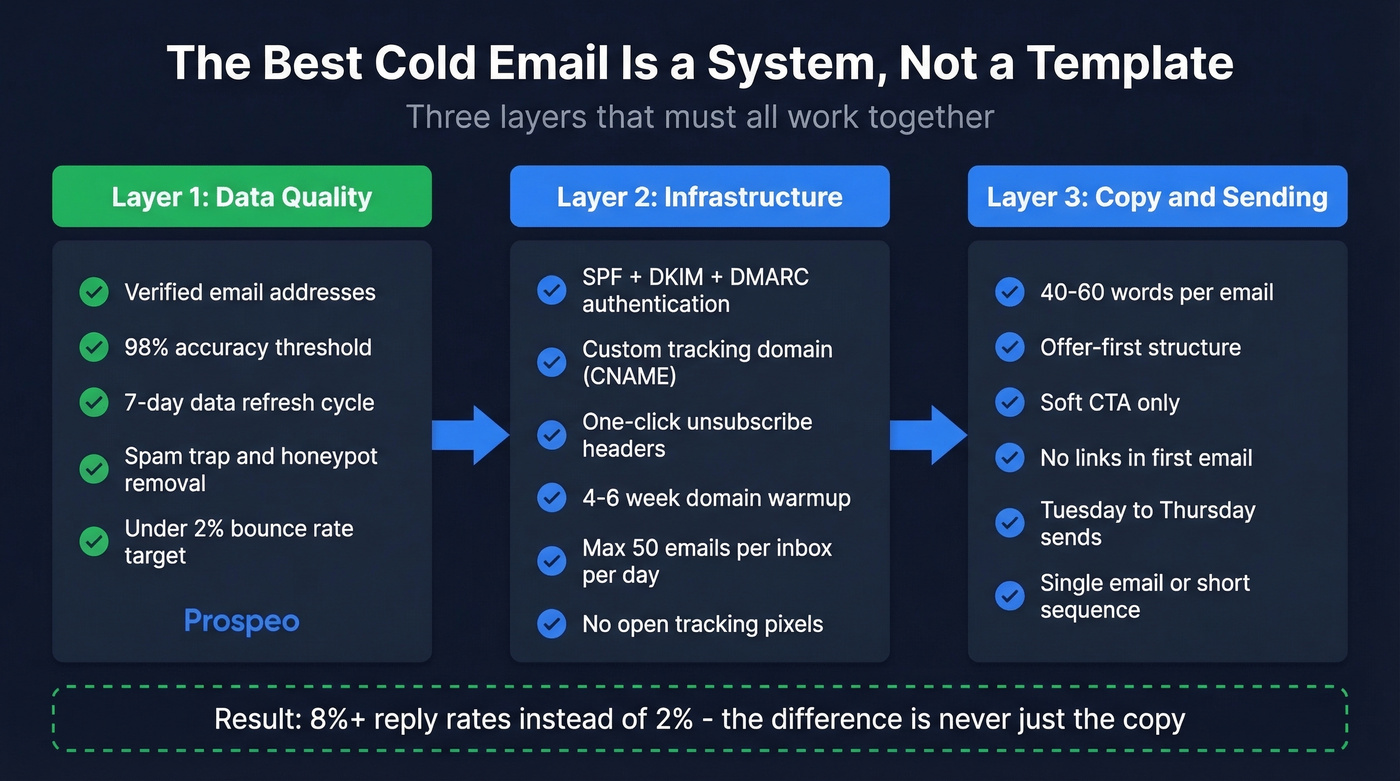
The Best Cold Email Is a System, Not a Template
You sent 200 emails last week. Three replies - two "please remove me" and one confused CFO who thought you were their vendor. The copy wasn't bad. The targeting wasn't terrible. But something in the machine is broken, and no template will fix it.
Belkins analyzed 16.5M cold emails and found the average reply rate sitting at 5.8%, down roughly 15% year-over-year. What worked two years ago genuinely doesn't work now. The best cold email isn't a subject line or a clever opener. It's a system: the right copy, sent from a healthy domain, to a verified list.
The Short Version
Your email needs to be 40-60 words with a soft CTA. Your infrastructure needs SPF, DKIM, DMARC, and a proper warmup. Your list needs to be verified before you send a single message. That's the whole game. A winning outreach message doesn't come from a single template - it comes from a system where every layer works together.
What the Benchmark Data Says
The Belkins benchmark is one of the largest cold email datasets available: 93 domains tracked over a full year.
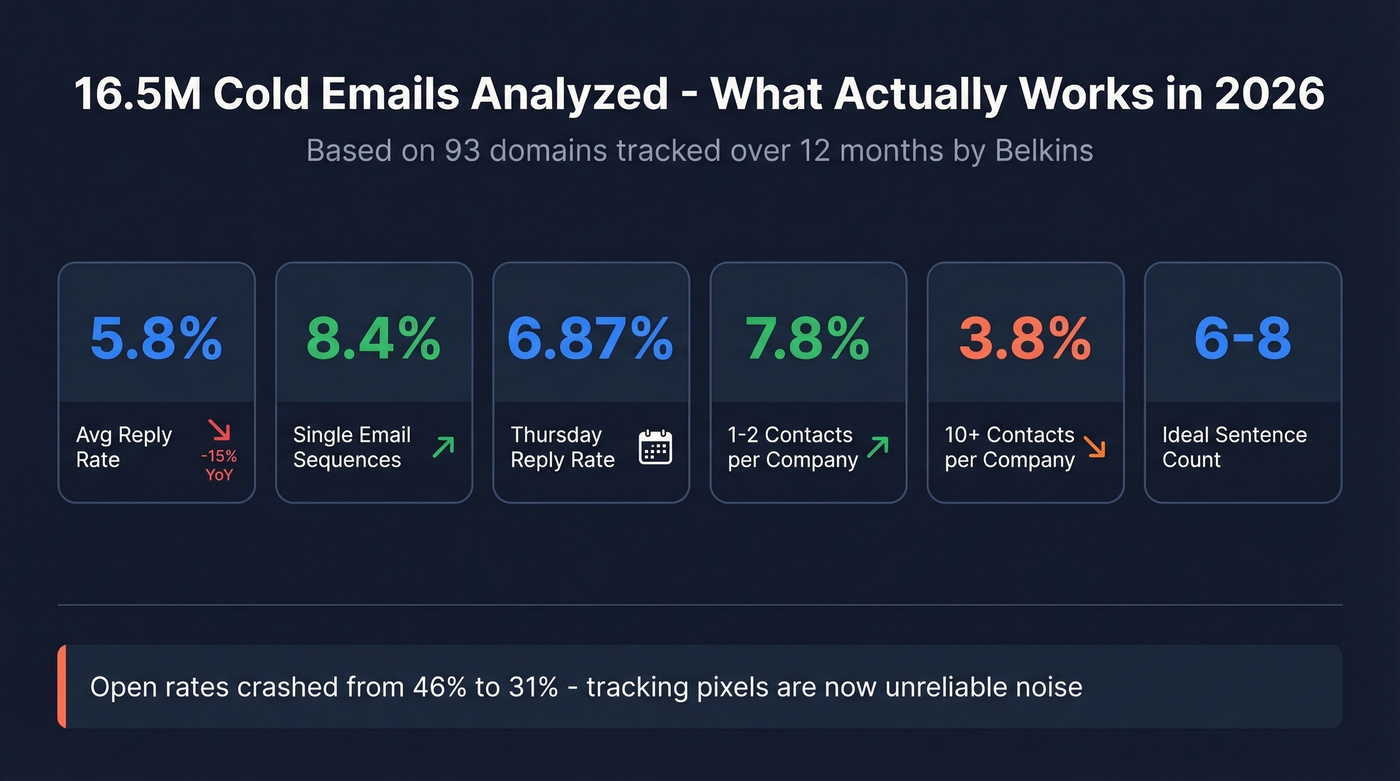
| Metric | Number |
|---|---|
| Avg reply rate | 5.8% |
| 1-email sequences | 8.4% reply |
| Best day (Thursday) | 6.87% reply |
| 1-2 contacts/company | 7.8% reply |
| 10+ contacts/company | 3.8% reply |
| Best copy length | 6-8 sentences |
Single-email sequences outperform multi-touch campaigns on raw reply rate. Targeting fewer contacts per company dramatically outperforms spray-and-pray. Thursday is the best send day in the dataset.
Here's the thing about open rates: they cratered from 46% to 31% as providers cracked down on tracking pixels. The benchmark study actually stopped tracking opens mid-year because the data became unreliable. If you're still optimizing for open rates, you're optimizing for noise.
Cold Emails That Actually Worked
Benchmarks are useful. But nothing beats seeing what real campaigns produced.
The "Custom Video" Email (34% Reply Rate)
A practitioner on r/coldemail shared results from 150 emails sent to e-commerce brands: 51 replies, 31 booked calls, 8 paying clients, roughly EUR12K in revenue. The subject line was dead simple: "I recorded a video for you."
The email contained no pitch, no link, no calendar widget. Just a short note explaining they'd built a custom strategy overview in Miro and asking, "Would you like me to send it to you?" The curiosity gap did all the work - the prospect had to reply to get the video. After getting a "yes," the sender followed up with a 3-5 minute Loom walkthrough. About 60% of video recipients booked a call.
The math: 150 emails, 51 replies, 31 calls, 8 clients. Each prospect required about 10 minutes of prep. When your conversion funnel looks like that, 10 minutes per prospect is the best ROI you'll find in outbound.
The 7-Email Sequence (38% Reply Rate)
A detailed breakdown from RiverEditor documented a 7-email sequence hitting 38% reply rate and 12% meeting book rate across 1,200+ emails. The model: 15-20 daily sends with 10-15 minutes of research per prospect, sent Tuesday through Thursday during early morning or late afternoon windows.
Quality over quantity, every time.
The subject line data tells the real story:
| Subject Line Type | Open Rate |
|---|---|
| Trigger-based | 71% |
| Breakup ("Close your file?") | 73% |
| "Quick question" | 23% |
| "Following up" | 18% |
The breakup email consistently outperformed every other touch - which tracks with what we've seen across dozens of campaigns we've reviewed.

The benchmark data is clear: fewer contacts per company and verified lists crush spray-and-pray. Prospeo's 5-step email verification delivers 98% accuracy - meaning sub-2% bounce rates out of the box. At $0.01 per email, cleaning your list costs less than a single wasted send.
Fix your list before you fix your copy.
Crafting the Perfect Cold Email
The consensus among practitioners on r/copywriting and in the benchmark data converges on the same format: 40-60 words, offer-first, soft CTA. The 16.5M-email study found 6-8 sentences hit 6.9% reply rate - the sweet spot before attention drops off.
Your offer does the heavy lifting, not your personalization. A mediocre email with a great offer beats a beautifully personalized email with a weak one every single time, and I've watched teams learn this lesson the hard way after spending weeks building personalization engines that moved the needle by fractions of a percent. The PAS framework (Problem, Agitate, Solve) still works, but compressed into 50 words instead of 200. One more heuristic worth stealing: aim for a 1:2 ratio of "I" to "you" - every sentence about yourself should be balanced by two about the prospect.
The Checklist
- 40-60 words, no more
- Offer-first - lead with what they get, not who you are
- Soft CTA ("Worth a look?" not "Book 30 minutes")
- No links in email one - they hurt deliverability
- Subject line: 6-7 words, specific to their situation
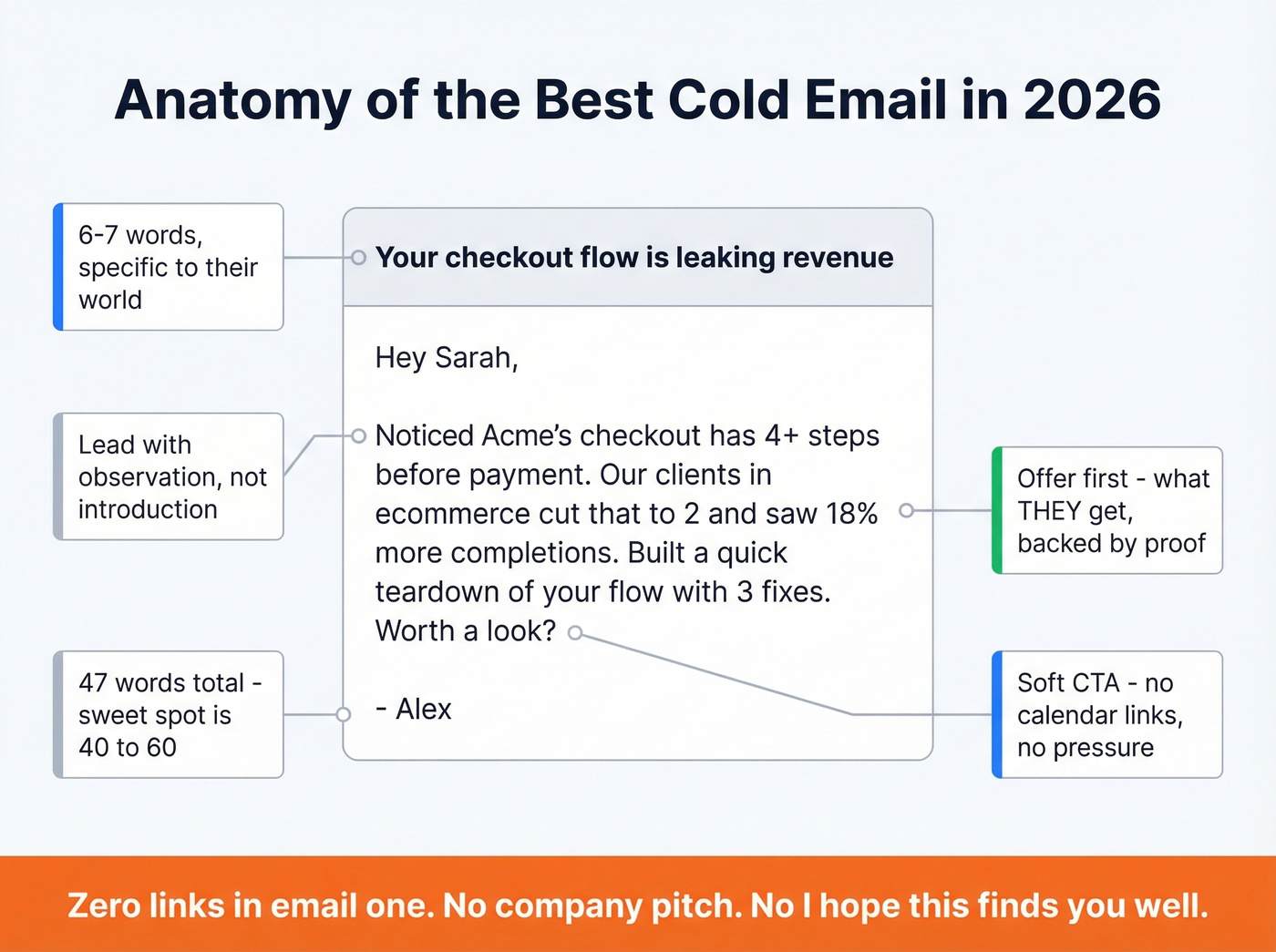
And an annotated example putting it all together:
Subject: Your checkout flow is leaking revenue
Hey {{firstName}},
Noticed {{company}}'s checkout has 4+ steps before payment. Our clients in {{industry}} cut that to 2 and saw 18% more completions.
Built a quick teardown of your flow with 3 fixes. Worth a look?
- [Name]
That's 47 words. No company pitch. No "I'm reaching out because." No link. The CTA is soft. Every element earns its place.
Hot take: If your deal size is under $10K, you probably don't need hyper-personalized video emails or 7-touch sequences. A clean list, a strong offer, and a single well-written email will outperform most elaborate setups - the benchmark data proves single-email sequences hit 8.4% reply rate.
What NOT to Do
Hi [First Name], I hope this email finds you well! My name is Jake and I work at GrowthCo, a leading provider of innovative solutions for scaling businesses. I wanted to reach out because I think we could really help [Company] achieve its goals. Would you have 30 minutes next week for a quick call?
That's 56 words of nothing. No offer, no specificity, no reason to reply. "Leading provider of innovative solutions" is the cold email equivalent of a white noise machine. A successful outreach message gives the reader a reason to care in the first sentence - this one doesn't give them a reason at all.
Why Infrastructure Matters More Than Copy
You can write the perfect 47-word email and it won't matter if it lands in spam. Deliverability is the invisible variable separating teams getting 2% reply rates from teams getting 8%.
Authentication Setup
SPF, DKIM, and DMARC are table stakes - Microsoft started enforcing these for Outlook.com in May 2025 for high-volume senders. You also need a custom tracking domain (CNAME) and RFC 8058 one-click unsubscribe headers. If any of these terms are unfamiliar, stop writing emails and fix your infrastructure first.
Warmup Schedule
New domains need 4-6 weeks of warmup before you can send at volume. Rush this and you'll torch your reputation before your first real campaign.
| Week | Daily Volume |
|---|---|
| 1-2 | 5-10 emails |
| 3-4 | 15-20 emails |
| 5-6 | 30-40 emails |
| 7+ | Max 50/inbox |
Monitor throughout: bounce rate under 2%, spam complaints under 0.3%. Never exceed 50 emails per day from a single inbox.
One counterintuitive move worth making: stop tracking opens entirely. Tracking pixels reduce deliverability, and the data they produce is increasingly unreliable.
The Data Quality Problem
Bad data leads to bounces, bounces destroy reputation, and a destroyed reputation means the spam folder. It's a death spiral, and it starts before you write a single word of copy. The benchmark data shows spam complaints escalate from 0.5% on the first email to 1.6% by the fourth - and that assumes your list is clean.
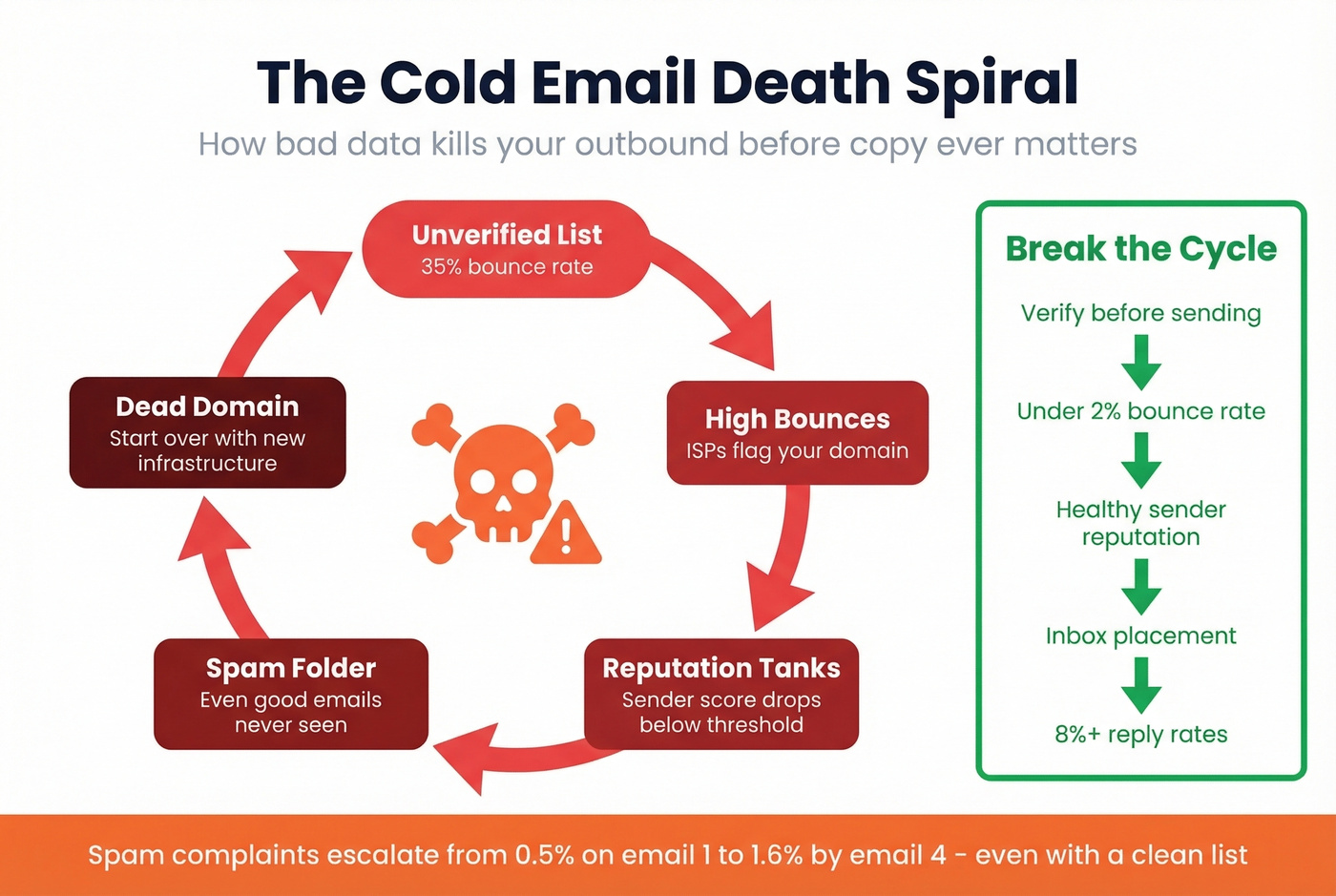
Meritt, an outbound agency, was running a 35% bounce rate before switching their data source. Pipeline was stalling despite solid copy and targeting. After moving to Prospeo for list building and verification, their bounce rate dropped under 4% and pipeline tripled from $100K to $300K per week.
The 5-step verification process catches invalid addresses, spam traps, and honeypots before they ever touch your sending infrastructure. With 98% email accuracy and a 7-day data refresh cycle, you aren't sending to someone who changed jobs six weeks ago. You pay only for valid addresses - at roughly $0.01 per email, verification costs are negligible compared to the cost of a burned domain.
Infrastructure and copy won't save a campaign built on bad data. Teams using Prospeo's 7-day refresh cycle send to contacts verified this week, not last quarter. That's how agencies like Stack Optimize maintain 94%+ deliverability and under 3% bounce across every client.
Stop warming up domains just to email dead addresses.
The Tools You Actually Need
Cold email infrastructure breaks into three layers: data and verification, sending, and CRM. You don't need an all-in-one platform. You need each layer to be good at its job.

| Tool | What It Does | Starting Price | Free Tier | Best For |
|---|---|---|---|---|
| Prospeo | Data + verification | ~$0.01/email | 75 emails/mo | Data accuracy |
| Instantly | Sending + warmup | ~$30-100/mo | Trial | Volume sending |
| Lemlist | Sending + templates | ~$59/mo | Trial | Personalization |
| Apollo | All-in-one | $59/user/mo | 100 credits/mo | Solo founders |
| Gmass | Gmail sending | $25/mo | 50 emails/day | Gmail-only teams |
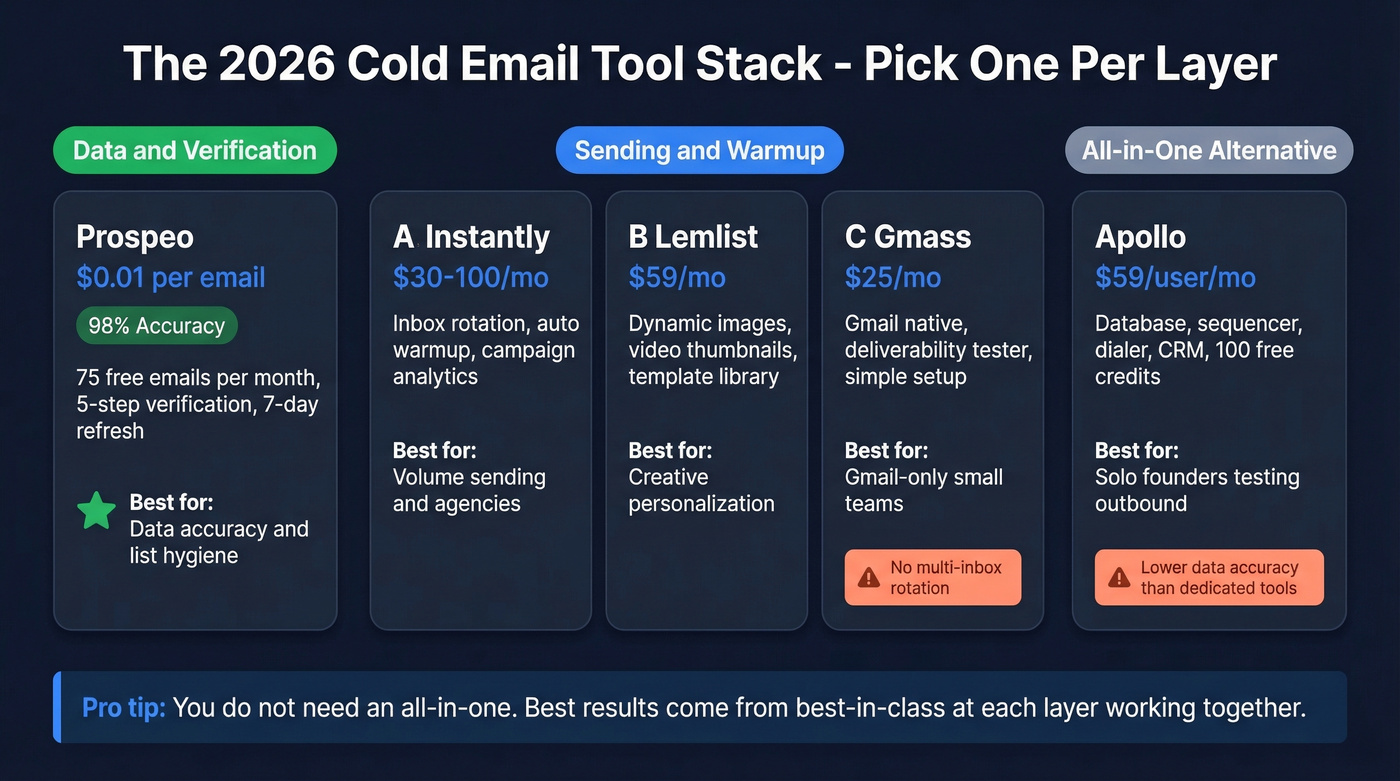
Instantly has become the default sending tool for outbound agencies. Inbox rotation, automated warmup, and campaign analytics for ~$30-100/mo depending on volume. Its integration ecosystem means you can push verified lists straight into sequences without manual CSV work.
Lemlist is the pick if you want built-in personalization - dynamic images, video thumbnails, and a template library backed by 400M+ emails. Starts at ~$59/mo. We've found it works best for teams that want creative flexibility without building everything from scratch.
Apollo tries to be everything - database, sequencer, dialer, CRM. The free tier is genuinely useful for solo founders testing outbound. Paid plans start at $59/user/mo. The tradeoff: data accuracy runs lower than dedicated verification tools, so expect higher bounce rates if you're relying solely on their database.
Skip Gmass if you need multi-inbox rotation or advanced sequencing. But at $25/mo with a built-in deliverability tester, it's the simplest option for low-volume Gmail senders.
If you want to go deeper on safe sending limits, see email velocity and bulk email threshold.
CAN-SPAM in 60 Seconds
CAN-SPAM applies to B2B email. The FTC is explicit: "The law makes no exception for business-to-business email." Penalties run up to $53,088 per email in violation.
- Accurate From/To/Reply-To headers
- Honest subject lines (no bait-and-switch)
- Identify the message as an ad
- Include a valid physical postal address
- Honor opt-outs within 10 business days
If you're emailing EU prospects, layer GDPR on top - legitimate interest basis, easy opt-out, and data processing transparency. None of this is hard. Ignoring it is expensive.
For follow-up strategy, use cold email follow-up templates and sales follow-up templates to keep touches tight.
FAQ
What makes the best cold email in 2026?
A system, not a template. The 16.5M-email benchmark puts the average reply rate at 5.8%, while top-performing campaigns hit 8-15%. Anything consistently above 10% means your targeting, copy, and deliverability are all working together. Benchmark against 5.8% and try to beat it.
How many follow-ups should I send?
Three to five total touches over 3-4 weeks. Benchmark data shows spam complaints triple by the fourth email (0.5% to 1.6%), and unsubscribes climb to 2% by round four. More follow-ups isn't a strategy - it's a reputation risk.
What's the ideal cold email length?
Forty to sixty words for the body, or 6-8 sentences at 6.9% reply rate. Under 200 words always outperforms longer copy. Your offer should do the heavy lifting, not your word count.
How do I keep cold emails out of spam?
Set up SPF, DKIM, and DMARC. Warm your domain over 4-6 weeks. Keep bounce rate under 2% and complaints under 0.3%. Verify your list before sending - tools like Prospeo's 5-step verification catch spam traps and honeypots, and NeverBounce or ZeroBounce offer similar safeguards.
When's the best time to send cold emails?
Thursday wins at 6.87% reply rate, with optimal windows at 7-11am in the recipient's timezone and a secondary window from 4-6pm. Avoid Mondays (5.29%) and Fridays. Tuesday and Wednesday are solid middle-ground options.