

The Best Email Sign-Offs for Every Situation (Backed by Data)
You're drafting an email to someone two levels above you. The body's done. The cursor's blinking after your last sentence. And now you're stuck on two words that shouldn't be this hard.
"Best regards"? Too stiff. "Cheers"? You're in Ohio. You could list 100 sign-offs, but that's the opposite of helpful. Let's narrow down the best email sign-offs to the ones that actually work.
The Short Answer
Three rules cover 90% of professional email:
- Default sign-off: "Thanks," - warm, brief, and part of the highest-performing gratitude-based closings in Boomerang's 350K-thread analysis.
- Formal contexts (job apps, executives, proposals): "Kind regards."
- People you actually like: "All the best."
That's the 90% answer. The rest of this guide covers the data, the edge cases, the cultural landmines, and the closings that make people quietly hate you.
Why Your Sign-Off Matters
There's a persistent myth that tone doesn't come through in email. A 2026 study in Computers in Human Behavior (N=361 email receivers) found the opposite: sender and receiver tone ratings align remarkably well. No moderation effects for emoji use, age, gender, or social closeness. People read your tone correctly - including your sign-off.
Boomerang's analysis of 40 million emails backs this up. Emails at a 3rd-grade reading level got a 36% response lift over college-level writing and a 17% higher response rate than high-school-level writing. The sweet spot for length is 50-125 words, pushing response rates above 50%. Slightly positive or slightly negative emails outperformed neutral ones by 10-15%.
Every word carries tone signal. Your sign-off is the last one the reader processes, which makes it a real lever - not an afterthought.
Sign-Offs Ranked by Response Rate
Boomerang analyzed 350,000 email threads and measured response rates by closing phrase. The baseline - no particular sign-off pattern - sat at 47.5%.
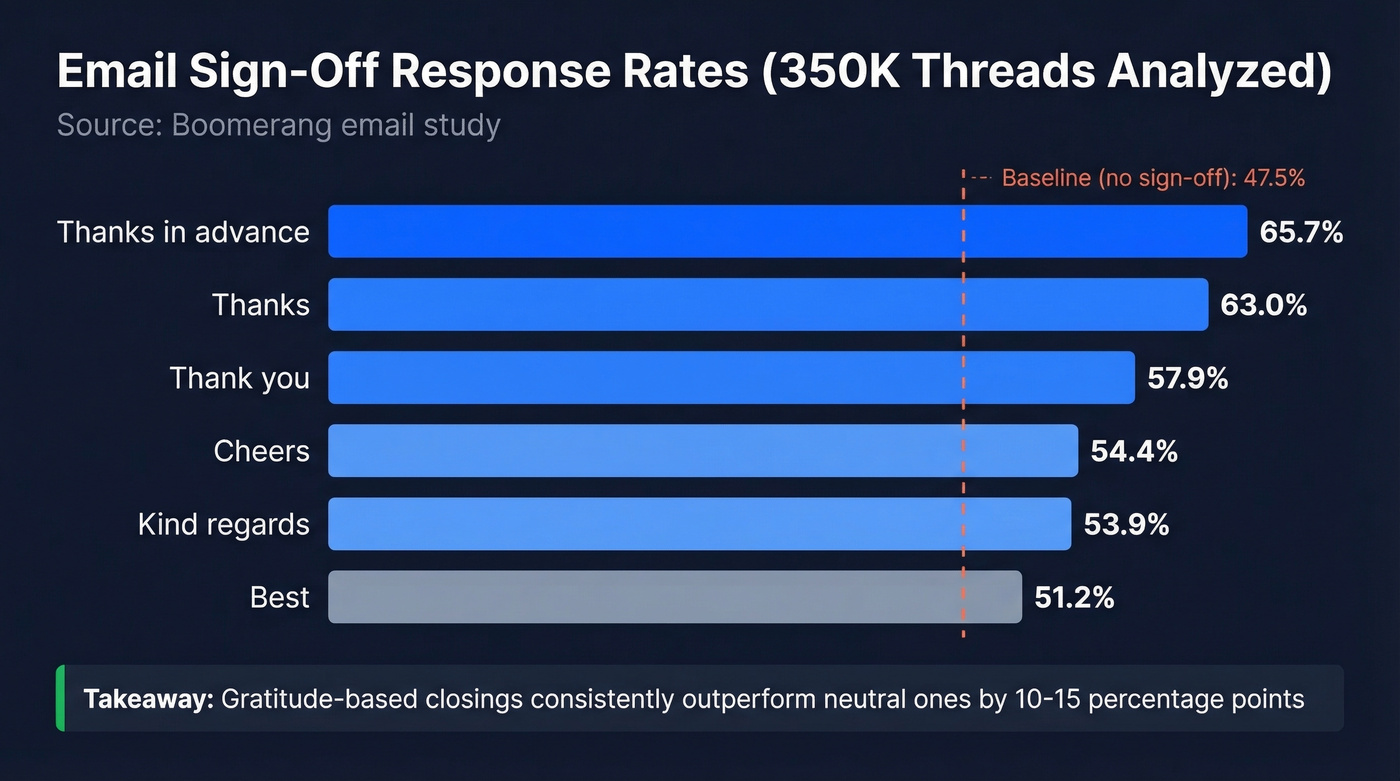
Two numbers stand out:
- "Thanks in advance" led the pack at 65.7% response rate.
- Gratitude-based closings like "Thanks" and "Thank you" consistently outperformed neutral closings, while "Best" was the weakest among common sign-offs in the ranking.
The pattern is clear: gratitude closings crush neutral ones. Thanking someone for a response that hasn't been written yet creates a subtle social obligation - you've pre-acknowledged their effort, and people don't want to leave that hanging.
Here's the thing: "Thanks in advance" works through social pressure, not politeness. It's effective and it can feel presumptive. We'll get to that tension in the passive-aggressive section below.
How to End an Email (By Situation)
Context matters more than any universal "best" answer:
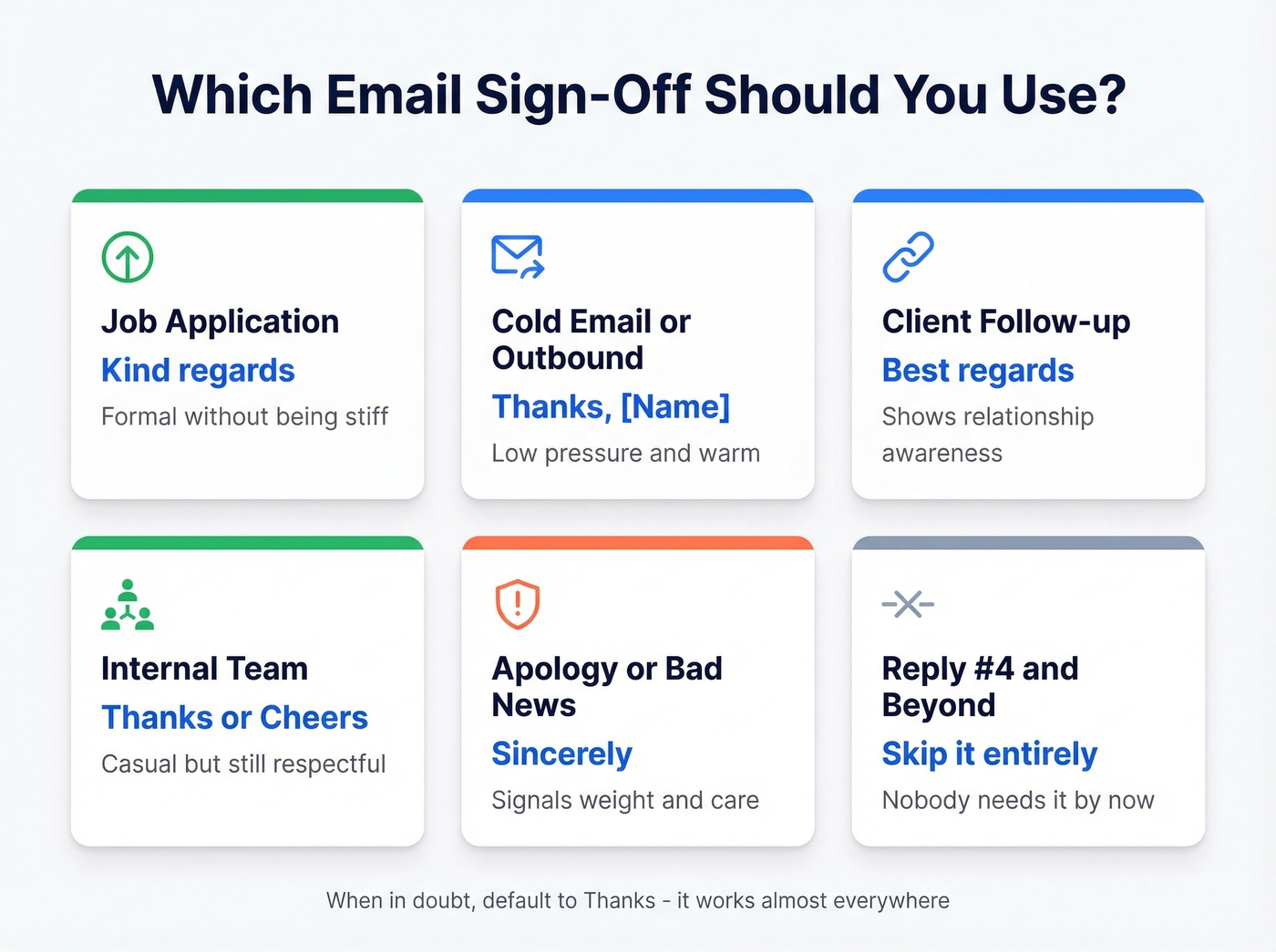
| Situation | Recommended | Why |
|---|---|---|
| Job application | Kind regards | Formal without being stiff |
| Cold email / outbound | Thanks, [Name] | Low-pressure, warm |
| Client follow-up | Best regards | Shows relationship awareness |
| Internal team | Thanks / Cheers | Casual, still respectful |
| Apology / bad news | Sincerely | Signals weight and care |
| Ongoing thread (reply #4+) | Skip it | Nobody needs it by now |
For cold outbound specifically, your sign-off matters less than whether the email actually arrives. If you're sending to unverified lists, you're burning domain reputation on bounces before anyone even reads your closing line. Prospeo verifies emails in real time with 98% accuracy - the free tier covers 75 emails/month, so there's no reason to skip this step.


The perfect sign-off is worthless if your email never reaches the inbox. Bounced emails torch your domain reputation and kill future deliverability. Prospeo verifies emails in real time with 98% accuracy - so every carefully crafted closing actually gets read.
Stop perfecting sign-offs for emails that bounce. Verify first.
The Full List (Categorized)
Formal Closings
Use these for job applications, executive outreach, legal correspondence, government communications, and first-contact emails where you don't know the recipient's style.
- Sincerely - the safest formal option; reads slightly dated in casual contexts
- Respectfully - strong for upward communication or sensitive topics
- Kind regards - the modern formal default; warm enough to not feel robotic
- Yours faithfully - British English convention when you don't know the recipient's name
- Yours sincerely - British English convention when you do know their name
- With appreciation - formal gratitude; works well for thank-you emails to senior leaders
- With respect - appropriate for government or military correspondence
- Very truly yours - legal and financial contexts; rarely seen outside them
- Respectfully yours - a slightly warmer variant of "Respectfully"
Semi-Formal Closings
This is the sweet spot for most professional email - clients, vendors, cross-functional colleagues, and anyone you've exchanged a few messages with.
- Best regards - safe, universally understood, slightly warmer than "Regards"
- Warm regards - a step warmer; good for established relationships
- Thank you - clean and direct; works almost everywhere
- Much appreciated - signals genuine gratitude without being effusive
- Many thanks - common in UK/Australian English; slightly more casual than "Thank you"
- With thanks - a subtle variant; reads well in emails requesting something
- Looking forward - implies momentum; good for project-based threads
- With best wishes - warmer than "Best regards" without going casual
- Until then - works well when a meeting or call is already scheduled
If you're writing follow-ups, keep your closing consistent with the ask and the timing (and borrow a few proven lines from these follow-up templates).
Casual Closings
For teammates, close colleagues, and anyone you'd grab coffee with. Don't use these in your first email to a VP you've never met.
- Best - the weakest performer among common closings in the response-rate data, but ubiquitous; fine for low-stakes messages
- Cheers - natural in UK/Australian contexts; can feel performative in American email
- All the best - warmer than "Best" with almost no additional effort
- Take care - genuine warmth; good for wrapping up a thread
- Talk soon - implies ongoing relationship; don't use if you won't actually talk soon
- Have a great week - friendly and specific; works well on Mondays
- Later - fine for close colleagues; too abrupt for anyone else
- Catch you later - Slack energy in email form; internal only
- Have a good one - casual and universally friendly
- Until next time - works well for recurring check-ins
- Onward - slightly motivational; good for team threads after a win
Gratitude Closings
These outperform every other category in response-rate data. Use them when you're asking for something or genuinely thankful.
- Thanks - the workhorse; one of the top performers in Boomerang's sign-off data
- Thanks so much - slightly more emphatic; good when someone went above and beyond
- Thanks in advance - highest raw response rate (65.7%) but carries passive-aggressive risk
- With gratitude - formal gratitude; works in mentorship or advisory contexts
- Appreciate your help - specific and warm; great for cross-functional requests
- Thanks for your time - works well after meetings or lengthy email exchanges
- Grateful for your help - a notch more personal than "Appreciate your help"
- Thanks for considering this - good for proposals and pitches where the ask is implicit
- Thanks a million - informal but enthusiastic; internal use only
That's 40+ options. Bookmark the ones that fit your voice and rotate based on context.
Closings That Sound Passive-Aggressive
Some closings have a dark side. They technically say one thing but emotionally communicate another - especially in tense threads. We've been on the receiving end of all of these, and the subtext lands harder than you think.
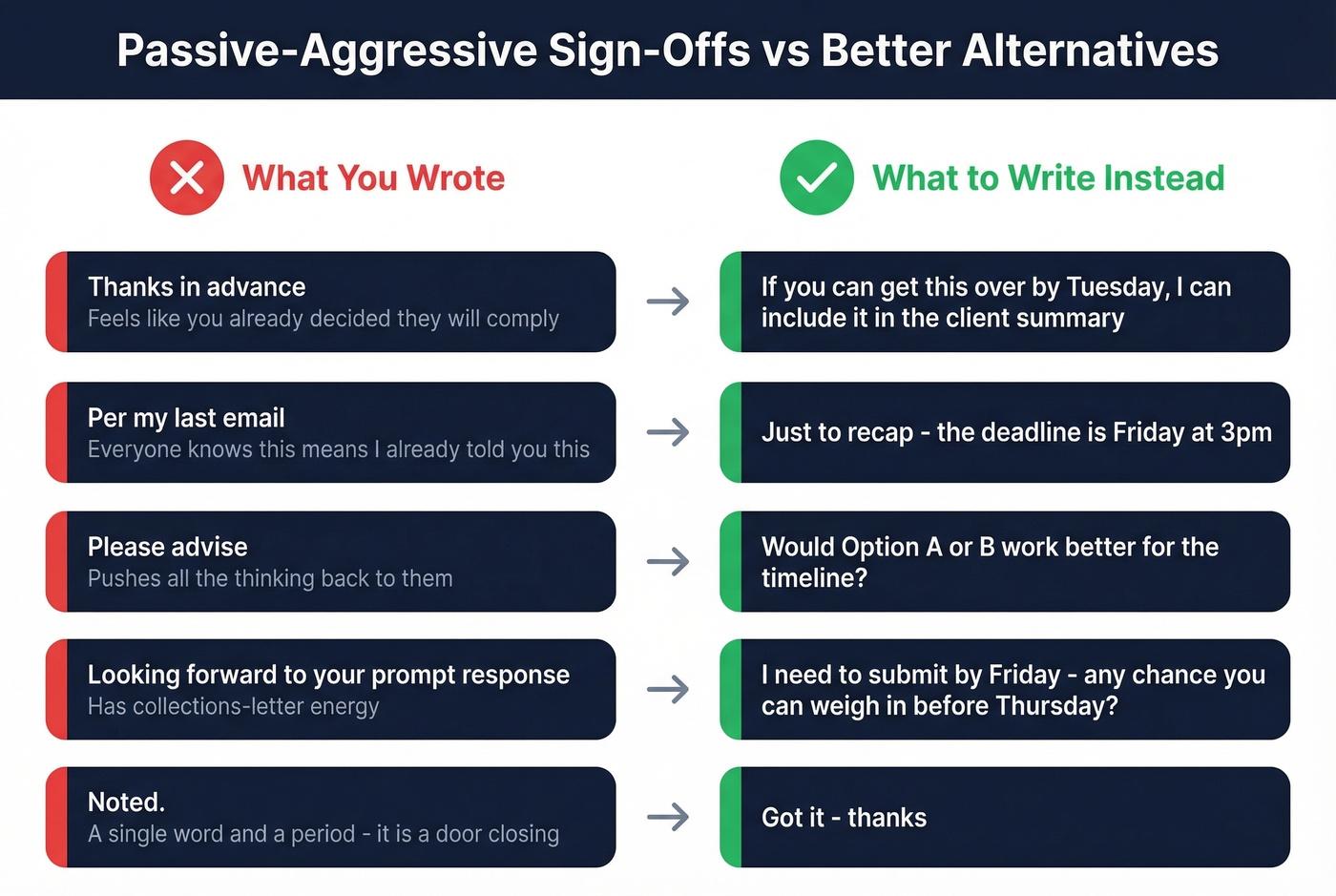
"Thanks in advance" is the most interesting case. It tops the response-rate charts at 65.7%, but it can feel presumptive. You're thanking someone for work they haven't agreed to do. In a friendly context, it's fine. In a tense one, it reads like you've already decided they'll comply. Rewrite: "If you can get this over by Tuesday noon, I can include it in the client summary."
"Per my last email" is keeping score. Everyone knows it means "I already told you this." Rewrite: Restate the key point briefly without the attribution.
"Please advise" pushes the entire cognitive load back to the recipient without giving them anything to work with. Rewrite: Ask a specific question. "Would Option A or B work better for the timeline?"
"Looking forward to your prompt response" has collections-letter energy. Rewrite: Give a deadline with context. "I need to submit by Friday - any chance you can weigh in before Thursday?"
"Noted." A single word followed by a period. It's a door closing. If you need to acknowledge without adding substance, try "Got it - thanks."
"Regards" alone, at the end of a tense thread, reads cold. "Kind regards" or "Best regards" softens it. One word makes the difference.
If you're doing outbound, passive-aggressive closings are just one way to tank replies - your overall sales communication matters more than any single line.
International Email Closings
Email sign-offs are culturally loaded in ways most people don't realize. A BBC analysis found that roughly 40% of Korean academics perceived Australian emails as impolite, compared to 28% in the reverse direction. The same words carry different weight across cultures.
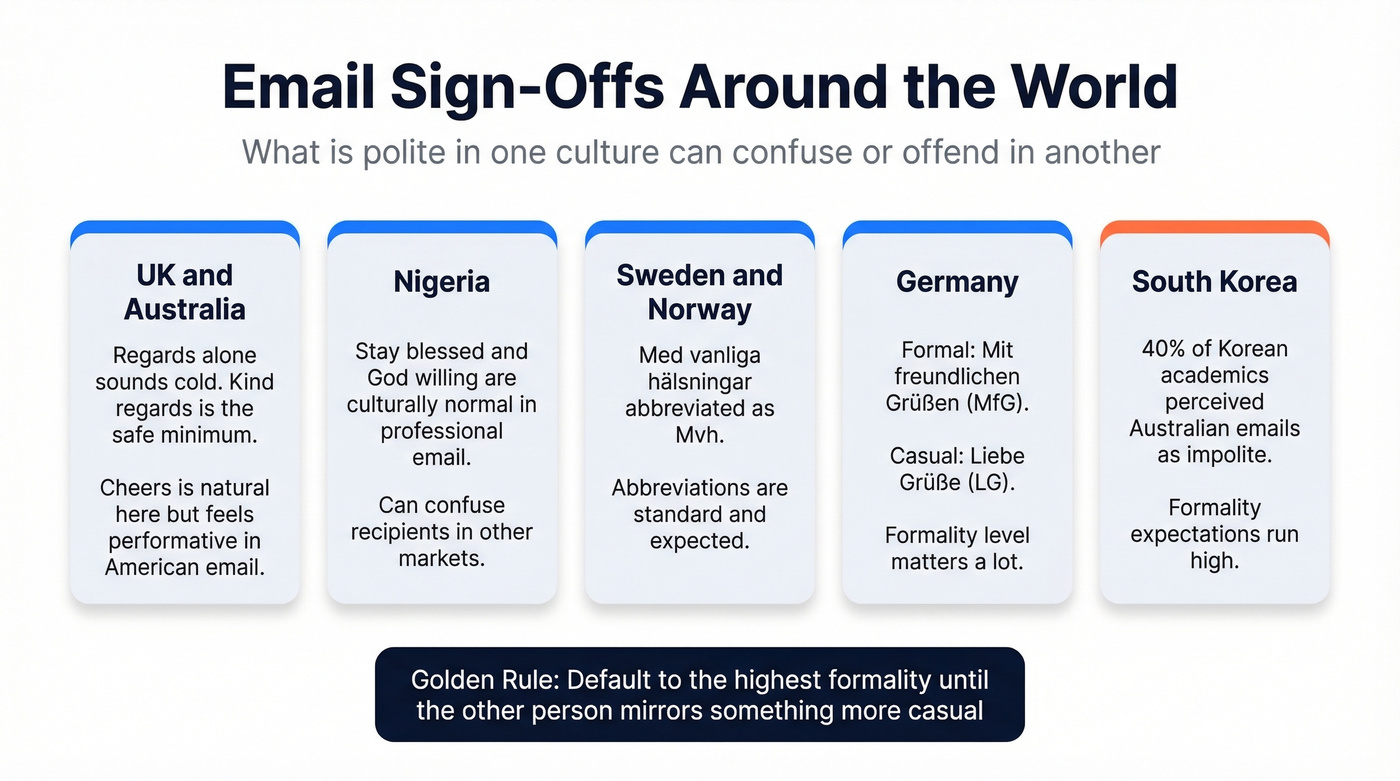
In the UK, "Regards" alone can sound cold. "Kind regards" is the safe minimum. In Nigeria, religious closings like "Stay blessed" are culturally normal in professional email - but they can confuse recipients in other markets. One example from the BBC piece: a Nigerian professional's closing "I hope to read from you soon" was misread by an American colleague as scam-like phrasing, damaging the professional relationship.
European languages have their own abbreviated conventions:
| Language | Full Form | Abbreviation |
|---|---|---|
| Swedish/Norwegian | Med vanliga halsningar | Mvh |
| German (formal) | Mit freundlichen Grussen | MfG |
| German (casual) | Liebe Grusse | LG |
| Hungarian | Udvozlettel | Udv |
The safest rule for international email comes from businessemailetiquette.com: default to the highest level of formality until the other person mirrors something more casual. You can always dial it back. You can't un-send "Hey dude" to a German CFO.
Gen Z Email Closings
Gen Z makes up roughly 27% of the global workforce and is projected to hit 31% by 2035. Their email style is already reshaping workplace norms - and sign-offs are ground zero.
Common Gen Z closings include "Catch you later," "Stay awesome," "Peace out," "Later, skater," "Deuces," and "Toodles." These show up mostly in internal Slack-to-email crossover and team threads, not client-facing communication. The bigger trend isn't a new sign-off - it's no sign-off at all. In ongoing threads, younger professionals increasingly just sign their first name or skip the closing entirely.
Honestly, that's fine. After the third reply, "Kind regards" is just noise.
Our take: use Gen Z closings freely with peers and in internal communication. For external or upward-facing email, stick with the classics. "Later, skater" in a proposal follow-up is a career risk nobody needs.
Formatting Rules Most People Get Wrong
Small formatting errors in your sign-off undermine the professionalism of everything above it.
Capitalize only the first word. It's "Kind regards," not "Kind Regards." The second word isn't a proper noun. End with a comma, not a period. "Thanks," flows into your name. "Thanks." feels like a full stop on the conversation.
Your sign-off and your signature are separate elements. The sign-off is the closing phrase ("Best regards,"). The signature is the name block with title, phone, and company info. Don't blend them.
Proofread your closing line specifically. A PubMed study across six experiments found that typos amplify perceived sender emotion - both positive and negative. A typo near your sign-off can make a friendly email feel frantic or a neutral one feel careless.
Match your sign-off to the thread's trajectory. Start formal, mirror the other person's style as the thread progresses, and drop the sign-off entirely once you're in rapid back-and-forth.
Let's be honest about something: your sign-off is the least important part of your email. The subject line gets it opened (use a few proven subject line examples), the first sentence gets it read, and the ask gets it answered. The sign-off just needs to not screw things up. If you've spent more than 30 seconds choosing between "Best regards" and "Kind regards," you've already overthought it. Pick one, send the email, move on.
If you're sending at scale, make sure your sending volume and pacing are sane - email velocity mistakes can undo great copy.
Gratitude closings boost response rates by 18%+ according to the data. But cold outbound response rates depend on reaching real inboxes first. Prospeo's 143M+ verified emails and 7-day refresh cycle mean your outreach lands - and your sign-off gets the chance to do its job.
Great copy deserves verified contacts. Start finding them at $0.01 each.
FAQ
Is "Best" a rude email sign-off?
Not rude, but it's the weakest common sign-off in the response-rate data - it says nothing and scored lowest among popular closings in Boomerang's 350K-thread analysis. Switch to "All the best" for warmth or "Thanks" for utility.
Should I still use "Sincerely" in 2026?
Reserve it for highly formal contexts - cover letters, legal correspondence, government communications. In everyday professional email, "Kind regards" covers the same formality level with less friction and reads more modern.
Is it okay to skip the sign-off entirely?
Yes - especially after the third reply in an ongoing thread. Just sign your first name or skip it entirely. The exception: if the thread has been tense, a warm sign-off on your final reply can reset the tone.
What's the best closing for cold emails?
"Thanks, [Name]" or "Looking forward to hearing from you" - keep it short and low-pressure. The closing matters less than whether the email arrives, so verify addresses before sending to avoid bounces that torch your domain reputation.
Does "Cheers" work in American business emails?
It can feel performative if you've never been to the UK or Australia. If it's natural to you, use it. If you're adopting it to sound casual, "Thanks" does the same job without the cultural baggage.