

The 10 Best Email Validation Tools in 2026
You just ran 50,000 emails through a verifier. 4,000 came back as "catch-all" or "unknown." Do you send and risk bounces that torch your domain reputation, or skip them and leave deals on the table?
Every tool on the market touts 97-99% accuracy, but none of them publish their methodology in a way that lets you actually compare. Finding the right email validation tool matters, but the process around it matters more. At least 23% of an email list degrades annually, and catch-all addresses now represent more than 9% of all emails checked - nearly one in ten contacts sitting in a gray zone where most verifiers shrug and hand you an "unknown" result.
We've tested most of the tools below across real outbound campaigns. Here's what separates the top-tier verification services from the rest, and a strategy that goes beyond picking just one.
Our Picks (TL;DR)
| Category | Pick | Why |
|---|---|---|
| Best for accuracy & freshness | Prospeo | 98% accuracy, 5-step verification with catch-all handling, 7-day data refresh |
| Best for catch-all verification | Bouncer | Deep Catch-All Verification, <2% unknown results, 4.8/5 on G2 |
| Best for speed | Emailable | 30K+ emails/minute, anti-greylisting tech, 99% deliverability guarantee |
| Best for integrations | ZeroBounce | 45+ integrations, SOC 2 Type 2, 4.7/5 on G2 |
| Best on a budget | MillionVerifier | $39 per 10K - cheapest per-verification that's still reliable |
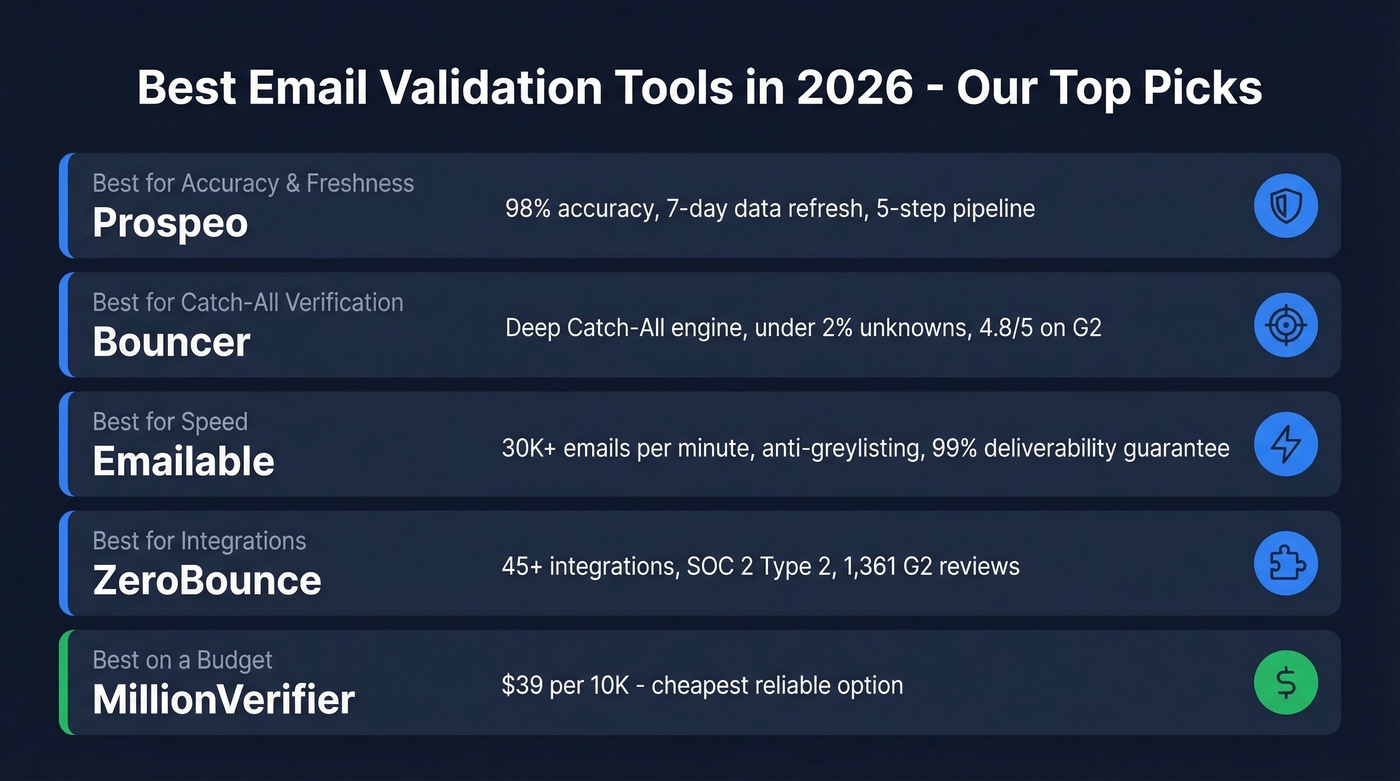
If you're running cold outbound and can't afford bounces, start with Prospeo or Bouncer. Cleaning a marketing list before a big send? Emailable's speed is hard to beat. Just need the cheapest option that won't embarrass you? MillionVerifier.
Master Comparison Table
Every tool side by side. Accuracy and speed figures are vendor-reported - treat them directionally, not as gospel.
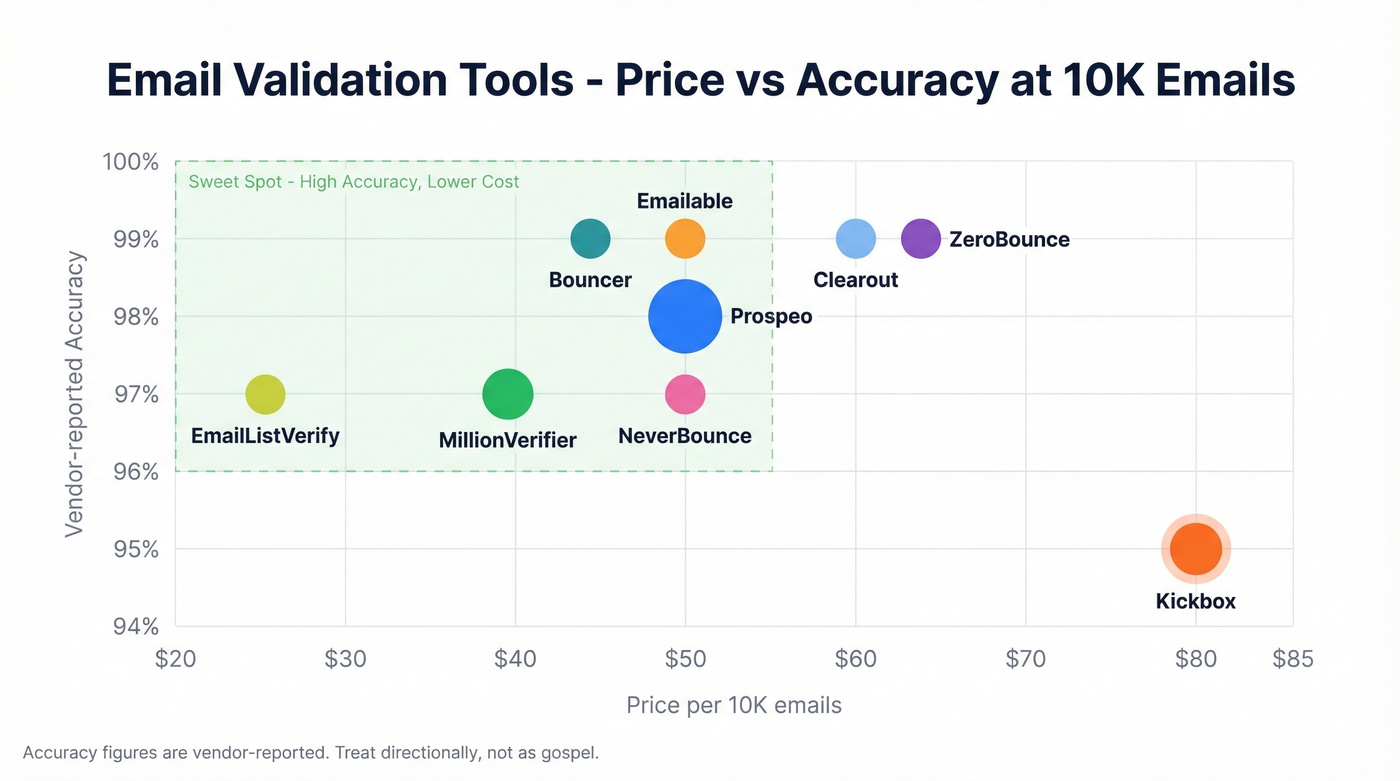
| Tool | 10K Price | Accuracy | Speed | Catch-All |
|---|---|---|---|---|
| Bouncer | $45 | 99%+ | 180-200K/hr | Deep Catch-All |
| ZeroBounce | $64 | 99% | 133K/hr | Partial |
| Emailable | $50 | 99%+ | ~1.8M/hr | Accept-all detect |
| NeverBounce | $50 | 97% | 100K/hr | 20+ step process |
| MillionVerifier | $39 | 97% | Batch upload | Basic |
| Clearout | $58 | 99% | 160K/hr | Yes |
| Kickbox | $80 | 95% | Batch/API | Basic |
| EmailListVerify | $24 | 97% | Batch upload | Basic |
| Verifalia | From $9.90/mo | Tiered | Tiered | Limited |
Top Email Validation Services Compared
Prospeo
Prospeo isn't just a standalone verifier - it's a full B2B data platform with 143M+ verified emails, where verification is baked into the core infrastructure rather than bolted on as an afterthought. The 5-step verification pipeline handles catch-all domains, strips spam traps, and filters honeypots, which is the exact combination most standalone verifiers skip.
The real differentiator is the 7-day data refresh cycle. Most tools verify against data that's four to six weeks old. Prospeo's proprietary email-finding infrastructure doesn't rely on third-party email providers, so accuracy stays at 98% even on fresh contacts. Stack Optimize built their agency to $1M ARR on Prospeo's data, maintaining 94%+ deliverability and under 3% bounce rates across every client. Snyk's 50-person AE team cut bounce rates from 35-40% to under 5% after switching.
Best for: Cold outbound teams who care about data freshness and catch-all accuracy, where domain reputation is everything. The free tier gives you 75 emails/month to test.
Pair with: MillionVerifier or EmailListVerify if you also need a high-volume bulk clean at the lowest possible cost.

Most validation tools verify against data that's 4-6 weeks stale. Prospeo refreshes every 7 days and runs a 5-step pipeline - catch-all handling, spam-trap removal, and honeypot filtering included. That's how Snyk cut bounce rates from 35-40% to under 5%.
75 free verifications per month. No credit card. 98% accuracy.
Bouncer
Bouncer's entire positioning revolves around one problem: catch-all emails. Their Deep Catch-All Verification feature is the reason they hold a 4.8/5 on G2 with 332 reviews - it resolves the exact addresses that other tools mark as "unknown" and move on from.
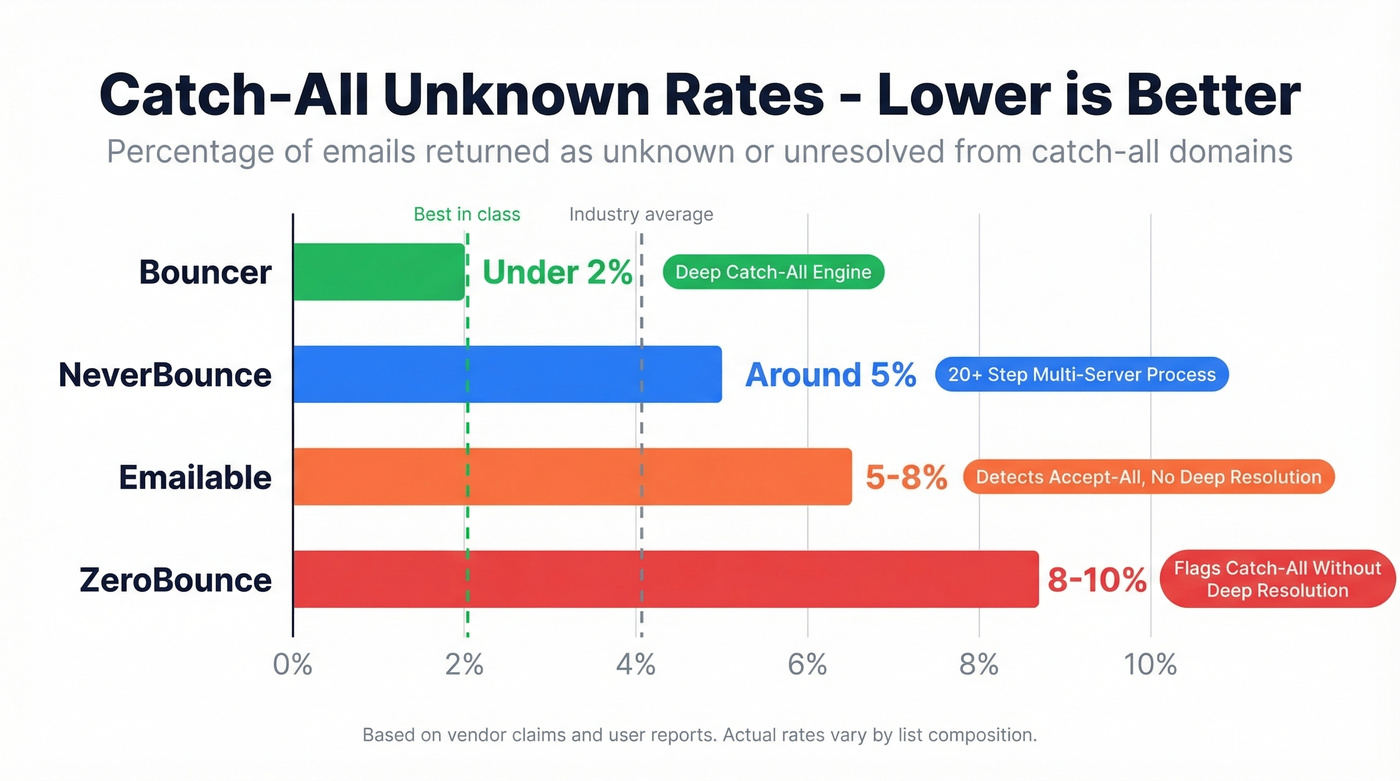
The numbers back it up. Less than 2% unknown results across 4B+ verified emails. That's a meaningful gap when most verifiers return 5-10% unknowns on any given list. Throughput runs at up to 200K emails/hour depending on list composition, which is solid for mid-size lists.
Credit pricing starts at $8 per 1,000, dropping to $7 per 1,000 at the 5K+ tier - roughly $45 per 10K with volume discounts. Middle of the pack on price, but near the top on catch-all resolution.
Use this if catch-all domains are your biggest headache and you need the lowest possible unknown rate. Bouncer also offers Bouncer Shield for real-time form protection.
Skip this if you need 40+ native integrations. Bouncer only has 16. ZeroBounce or NeverBounce are better for complex tech stacks.
ZeroBounce
ZeroBounce is the enterprise-grade pick. With 1,361 G2 reviews and a 4.7/5 rating, it has the largest review footprint of any tool on this list. Accuracy gets 434 positive mentions on G2 - more than any other attribute. The 45+ integrations and SOC 2 Type 2 posture make it a default for teams that need to plug verification into an existing marketing stack without custom API work.
The tradeoff is price. It's the #1 complaint, with 159 G2 mentions flagging cost. At $64 per 10K, that's 42% more expensive than Bouncer and 64% more than MillionVerifier. Some users also report that a large chunk of results come back as catch-all without resolution - so you're paying premium prices and still facing the same gray zone.
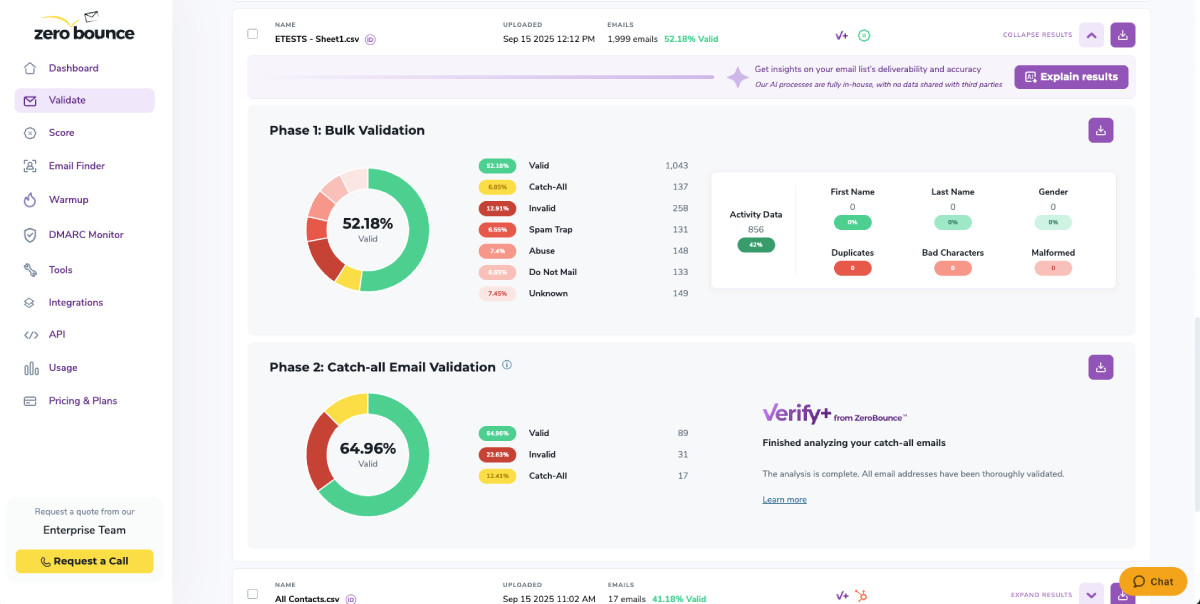
Verdict: If your organization needs SOC 2 Type 2, deep integrations, and has the budget, ZeroBounce is the safest enterprise bet. For cost-sensitive teams or those primarily dealing with catch-all domains, look elsewhere.
Emailable
Emailable is the speed play. 30K+ emails verified per minute means a 100,000-email list finishes in under three minutes. That's not a typo.
Their infrastructure also handles anti-greylisting tech and detects secure email gateways from Proofpoint, Mimecast, and Barracuda. If you're verifying enterprise contacts protected by corporate email security, this matters more than you'd think. They back it with a 99% deliverability guarantee: no more than 1% of emails marked "deliverable" will bounce. At ~$50 per 10K with 250 free credits to start, the pricing is competitive.
Best for: Cleaning large marketing lists on tight timelines, or verifying enterprise contacts behind secure gateways.
Watch out for: Catch-all resolution isn't the focus. Emailable detects accept-all domains but doesn't attempt deep verification on them the way Bouncer does.
NeverBounce
NeverBounce is worth considering if you care about methodology. Their proprietary 20+ step cleaning process verifies each email up to 75 times across multiple global servers, and they offer a bounce-rate refund policy - the kind of skin-in-the-game commitment that builds trust.
They also advertise 80+ integrations and multiple verification methods: dashboard, API, JS widget, and Zapier. At ~$50 per 10K, pricing matches Emailable. The free tier is stingy though - just 10 credits, compared to 100-250 at competitors. You'll need to commit to a paid plan faster than with most alternatives.
Catch-all handling uses their multi-step process rather than a dedicated engine. It's thorough but doesn't specifically target catch-all resolution the way Bouncer's approach does.
MillionVerifier
The budget king. $39 per 10K, dropping to $0.000389/email at the 1M tier. Cheapest credible option on this list.
Clearout
Clearout sits in the mid-range sweet spot at $58 per 10K, with 38 integrations and 160K emails/hour throughput. It offers 99% accuracy and 100 free credits. The integration count is second only to ZeroBounce and NeverBounce, and catch-all handling is included.
Here's the thing - it's a capable tool that doesn't generate strong opinions in either direction. For a verification tool, that might be exactly what you want. Worth a trial for teams that need reliable mid-range performance with good integrations.
Kickbox
Kickbox is the premium API-first option at $80 per 10K - the most expensive tool on this list. Documentation is excellent and the developer experience is clean, with 27 integrations and 100 free credits. But 95% accuracy is one of the lowest figures listed here, and the price-to-accuracy ratio doesn't favor it. Unless your engineering team specifically needs Kickbox's API architecture, other tools deliver more for less.
EmailListVerify
The absolute cheapest option at $24 per 10K with 97% accuracy and 100 free credits. If you're cleaning a massive list on a shoestring budget and can tolerate slightly higher unknown rates, it gets the job done. No frills, no deep catch-all handling, but the price is unbeatable for basic hygiene.
Verifalia
A niche pick for low-volume or compliance-heavy teams. The free tier gives you roughly 25 verifications per day, paid plans start at $9.90/month, and premium speed tiers run up to $499/month. Overkill for most outbound teams, but useful if you need granular quality levels and compliance documentation.
You shouldn't need two tools - one to find emails and another to validate them. Prospeo's 143M+ emails are verified at the source through proprietary infrastructure, not third-party providers. Stack Optimize maintained under 3% bounce rates across every client.
Stop paying twice. Find and verify emails in one platform at $0.01 each.
The Catch-All Problem
Let's be honest: catch-all emails are the single biggest source of disagreement between verification tools. A catch-all domain accepts mail to any address - valid or not - which means SMTP checks can't distinguish real inboxes from dead ones. Over 9% of all emails verified were catch-all. That's nearly one in ten contacts in a gray zone.
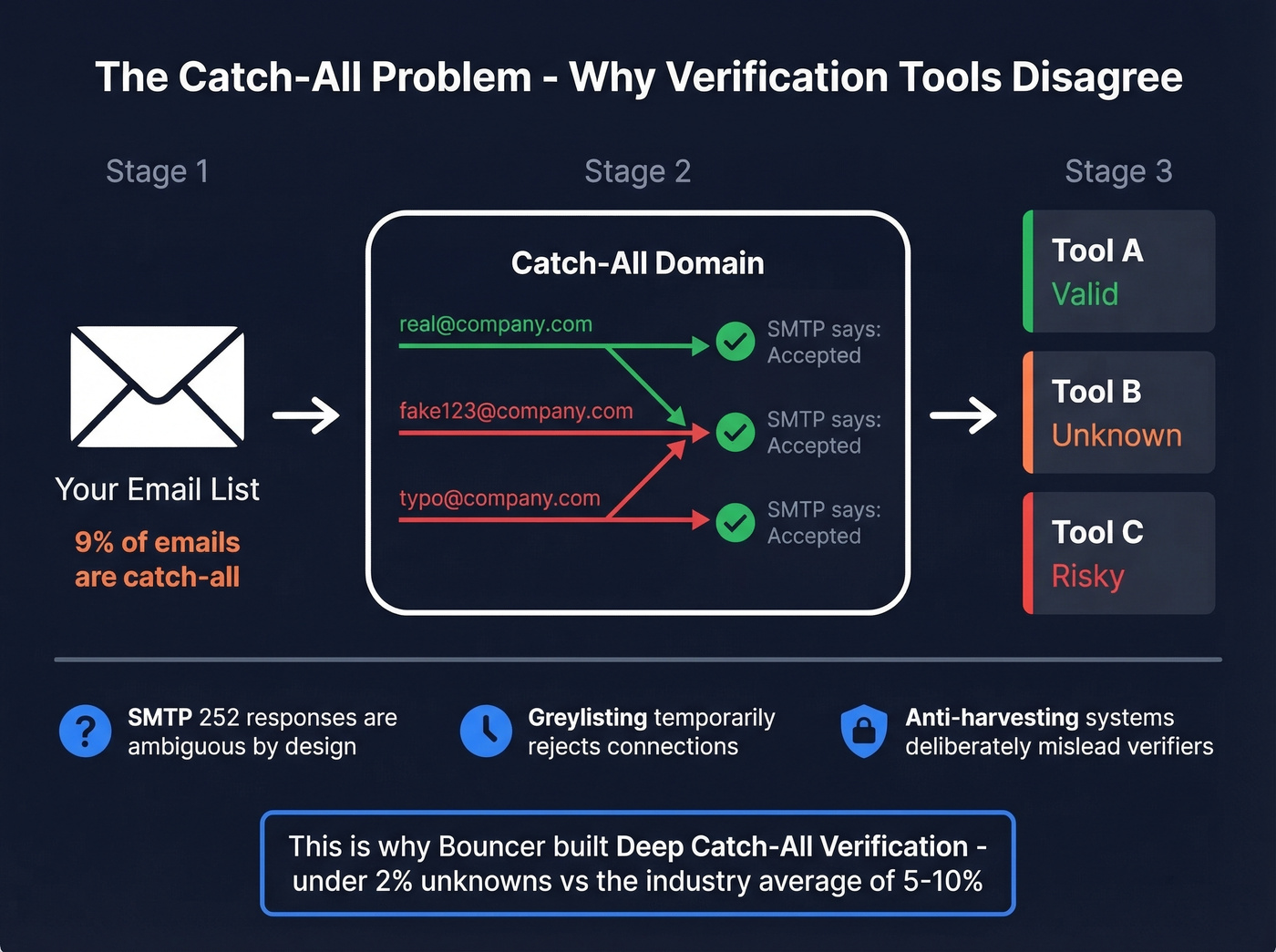
Why do tools disagree on these? SMTP 252 responses are ambiguous by design. Greylisting temporarily rejects connections. Anti-harvesting systems deliberately mislead verification tools. Each provider interprets these signals differently, which is why the same email can be "valid" in one tool and "unknown" in another.
Catch-All Handling by Tool
| Tool | Approach | Unknown Rate |
|---|---|---|
| Bouncer | Deep Catch-All Verification engine | <2% |
| NeverBounce | 20+ step multi-server process | ~5% |
| ZeroBounce | Flags catch-all without deep resolution | ~8-10% |
| Emailable | Detects accept-all domains, no deep resolution | ~5-8% |
Clay's catch-all verifier benchmark shows the spread clearly: top tools hit 90-95% data quality at 100% coverage, while Hunter scored ~93% quality but only 30-44% coverage. That coverage gap means tools are either guessing aggressively or punting on difficult addresses entirely.
One agency owner on r/coldemail reported higher bounce rates traced directly to catch-all tools returning false-positive "valid" results. The lesson: don't trust a single tool's catch-all verdict without a second opinion.
The Waterfall Verification Strategy
The smartest teams don't rely on one verifier. They run a waterfall.
The sequential model works like this: run your full list through your primary verifier, then take only the unknowns, catch-alls, and risky results and escalate those to a second provider. If you're still sitting on a meaningful chunk of unknowns, run them through a third. Re-verify your entire active list every 60-90 days.
The parallel aggregation model is more sophisticated. Run two or three providers simultaneously, convert their verdicts to scores - deliverable = 1.0, risky/catch-all = 0.5, unknown = 0.35, undeliverable = 0. Weight each provider by past performance and set a send threshold. Anything scoring 0.75 or above gets sent. Everything else gets held.
A Reddit practitioner reported that Apollo and Lusha produced roughly 60-70% valid emails in side-by-side testing. After implementing a cascade approach with secondary verification, valid rates jumped to ~90%.
Here's our hot take: price per verification is a vanity metric. Cost per valid contact is what actually matters. A tool at $50/10K with 70% deliverable contacts gives you a cost of $0.0071 per usable email. A tool at $64/10K with 90% deliverable gives you... $0.0071 per usable email. The cheaper tool isn't actually cheaper if it returns more unknowns. Run the math on your own lists before committing to the "budget" option.
What's a Normal Bounce Rate?
Before you panic about your numbers:
| Metric | Benchmark |
|---|---|
| Hard bounce (avg) | 0.21% |
| Soft bounce (avg) | 0.70% |
| Software/SaaS | 0.93% |
| Architecture | 1.04% |
| Daily deals | 0.17% |
These are Mailchimp benchmarks. The global inbox placement rate sits at roughly 83.5%, meaning nearly one in six emails doesn't reach the inbox even when it doesn't bounce.
If your hard bounce rate is above 2%, you have a data quality problem. Most ESPs flag accounts exceeding 5%, and some will suspend you outright. The difference between a 0.5% bounce rate and a 3% bounce rate is often just one verification step.
How to Choose the Right Verifier
Your use case should drive the decision, not a feature matrix.
Cold outbound - accuracy and catch-all handling are non-negotiable. A single bounced email in a 50-email sequence can flag your domain. Bouncer's Deep Catch-All Verification is purpose-built for this, and in our experience, pairing it with Prospeo's pre-verified data cuts the problem off before it starts.
Marketing list hygiene - you need bulk speed and integrations into your ESP. Emailable's 30K+/minute throughput and ZeroBounce's 45+ integrations are built for this exact workflow.
Real-time form validation - API speed and deliverability guarantees matter most. Emailable offers real-time verification with a guarantee that protects you if their verdicts are wrong.
For budget-constrained teams, MillionVerifier at $39/10K or EmailListVerify at $24/10K will handle basic list hygiene. You'll sacrifice some catch-all resolution, but the per-verification cost is hard to argue with.
Compliance-sensitive organizations should check whether the tool is SOC 2 Type 2 (ZeroBounce), GDPR compliant (Bouncer, Prospeo), and whether they delete your data after processing. In regulated industries, treat data handling policies as a hard requirement, not a nice-to-have.
If you want to go deeper on deliverability beyond verification, use an email deliverability guide and keep an eye on sender reputation as you scale.
FAQ
What's the difference between email verification and email validation?
The terms are used interchangeably in practice. Validation checks format and syntax - is this shaped like an email? Verification confirms the mailbox exists via SMTP. Every tool on this list does both, so the distinction rarely matters when choosing a provider.
How often should I re-verify my email list?
Every 60-90 days. At least 23% of email lists degrade annually, meaning roughly 2% of contacts go stale each month. High-volume outbound teams should re-verify their most active segments monthly.
Can any tool fully verify catch-all emails?
No tool achieves 100% accuracy on catch-all domains, but Bouncer's Deep Catch-All Verification and Prospeo's 5-step pipeline resolve significantly more than competitors. Running unknowns through a second provider in a waterfall approach pushes valid rates from ~70% to 90%+.
What bounce rate should trigger concern?
Anything above 2% hard bounces signals a data quality problem. The cross-industry average is 0.21%. Most ESPs flag accounts exceeding 5%, and some suspend sending privileges entirely. One verification pass typically cuts bounce rates below 1%.
Is a free email validation tool reliable enough?
Free tiers are useful for testing accuracy on your specific list, but they won't handle bulk cleaning. For lists over 1,000 contacts, paid plans from MillionVerifier ($39/10K) or EmailListVerify ($24/10K) are the most cost-effective starting points.