

Best Email Verification Tools in 2026
Most tools on this list claim 95-99%+ accuracy. The only public benchmark with published methodology shows the top performer hitting 70%. That gap between marketing copy and reality is where your sender reputation lives or dies. Finding the best email verification tool isn't about trusting vendor claims - it's about testing against your own data.
Here are 12 verification tools worth evaluating, what they actually cost per 1,000 emails, and a framework for picking the right one without torching your domain.
Why Verification Isn't Optional in 2026
Roughly 1 in 6 emails never reaches the inbox, according to Validity's deliverability benchmark. Global inbox placement sits around 84%, and the numbers get worse by provider - Gmail lands at 87.2%, but Microsoft hovers at 75.6%. If you're running outbound to enterprise targets on Outlook, a quarter of your emails are already fighting upstream.

25% of email databases decay annually. People change jobs, companies rebrand domains, mailboxes get deactivated. A list you verified six months ago has roughly 12% stale data baked in. The industry-standard bounce threshold is 2% - top-performing teams target hard bounces under 1%. Cross 2% and ESPs start throttling you. Push past 5% and you're looking at domain reputation damage that takes weeks to recover from.
Here's the thing: email marketing returns $36-$40 per $1 spent. That ROI collapses the moment your deliverability tanks. A $50 verification run on 10,000 contacts isn't a cost - it's insurance against losing your most profitable channel.
Our Picks (TL;DR)
| Category | Tool | Why |
|---|---|---|
| Best integrated prospecting + verification | Prospeo | Verifies at data creation; 98% accuracy across 143M+ emails |
| Best standalone accuracy | Bouncer | <2% unknown results; 4B+ emails verified |
| Best deliverability suite | ZeroBounce | Deliverability diagnostics beyond pass/fail |
| Best budget pick | EmailListVerify | $2.40/1k at 10k volume |
| Best for high-volume sends | Emailable | 2M emails/hour processing speed |
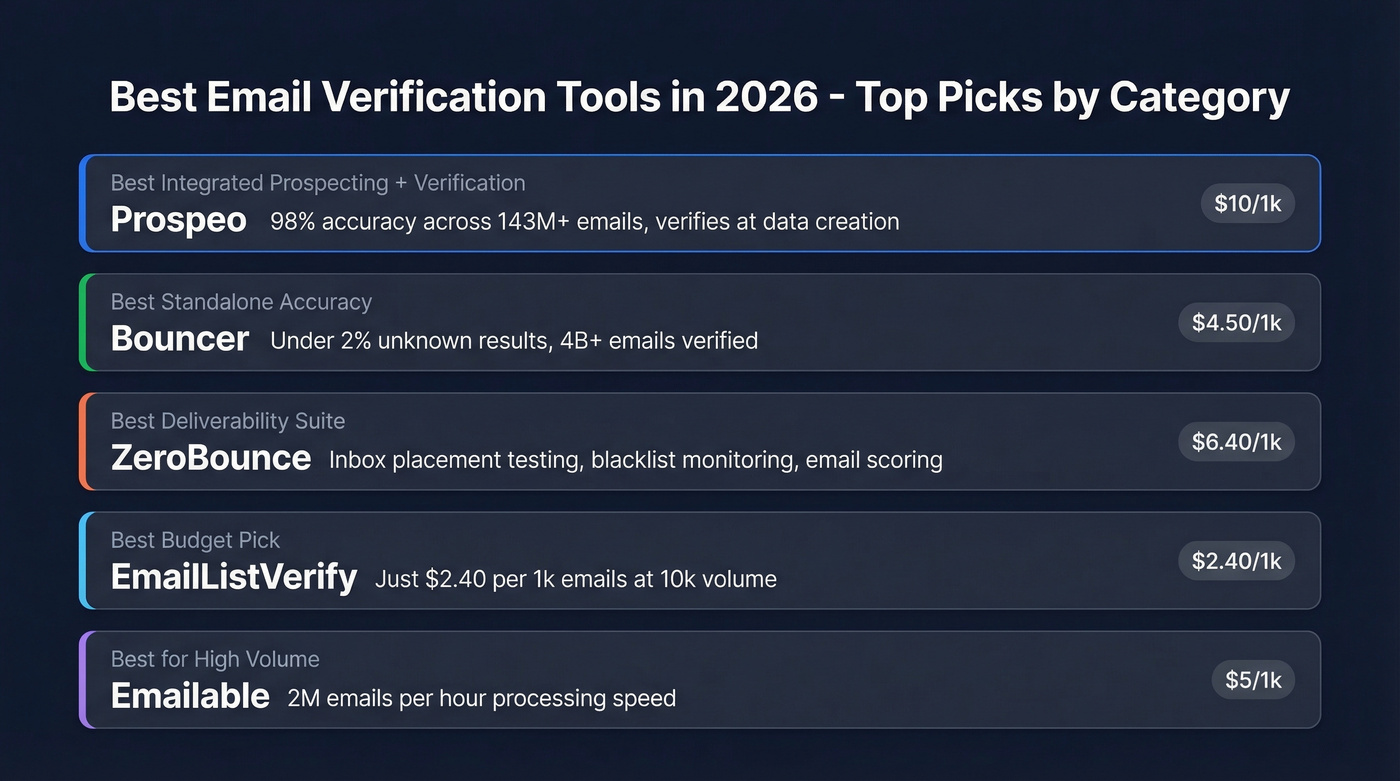
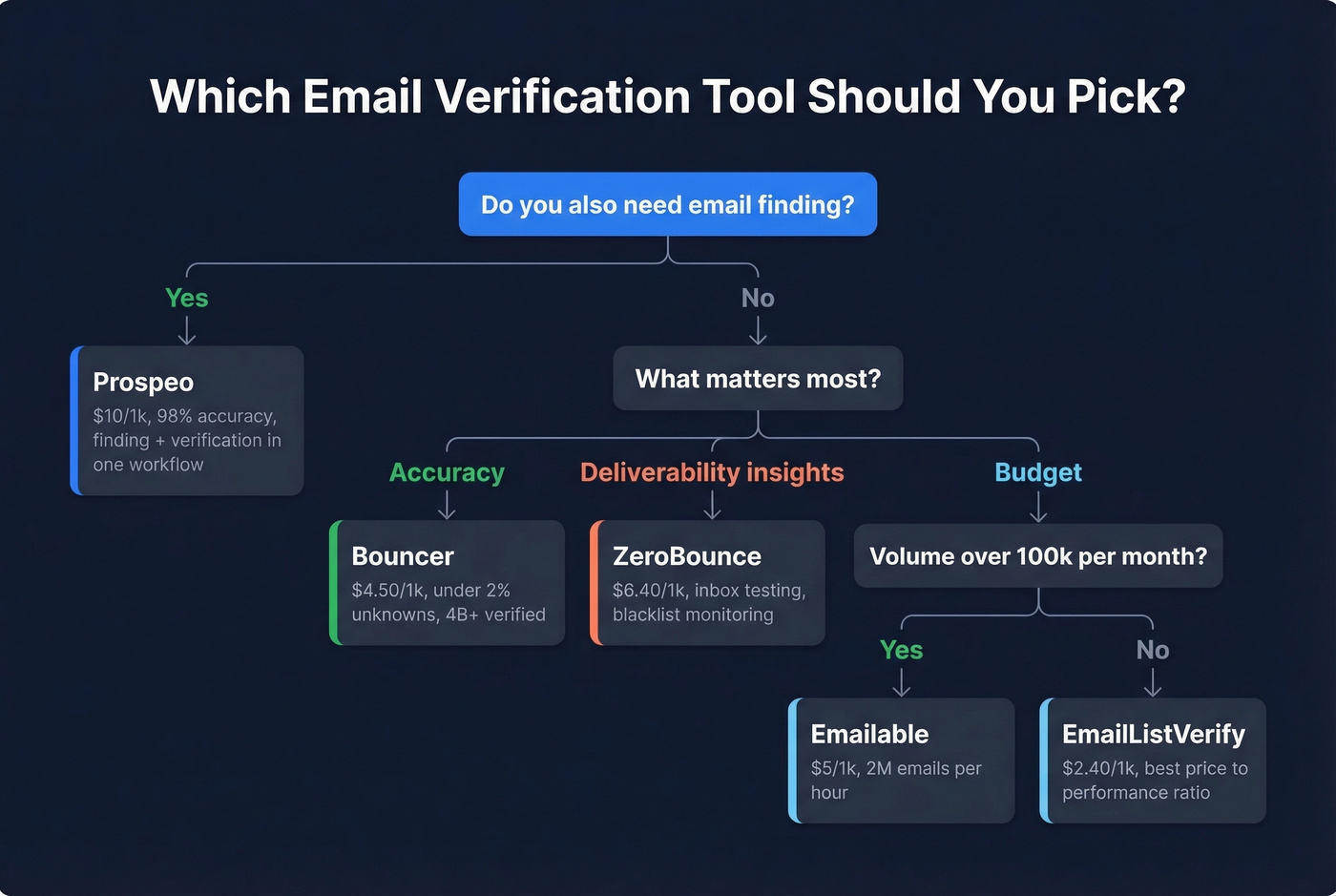
Short version: Prospeo is the pick when you need email finding and verification in one workflow. Bouncer wins for pure standalone verification with the lowest unknown rate. ZeroBounce is the choice if you need deliverability diagnostics beyond pass/fail.
What the Benchmarks Actually Show
Every verifier's marketing page says 97-99% accuracy. The only public benchmark with transparent methodology tells a different story.
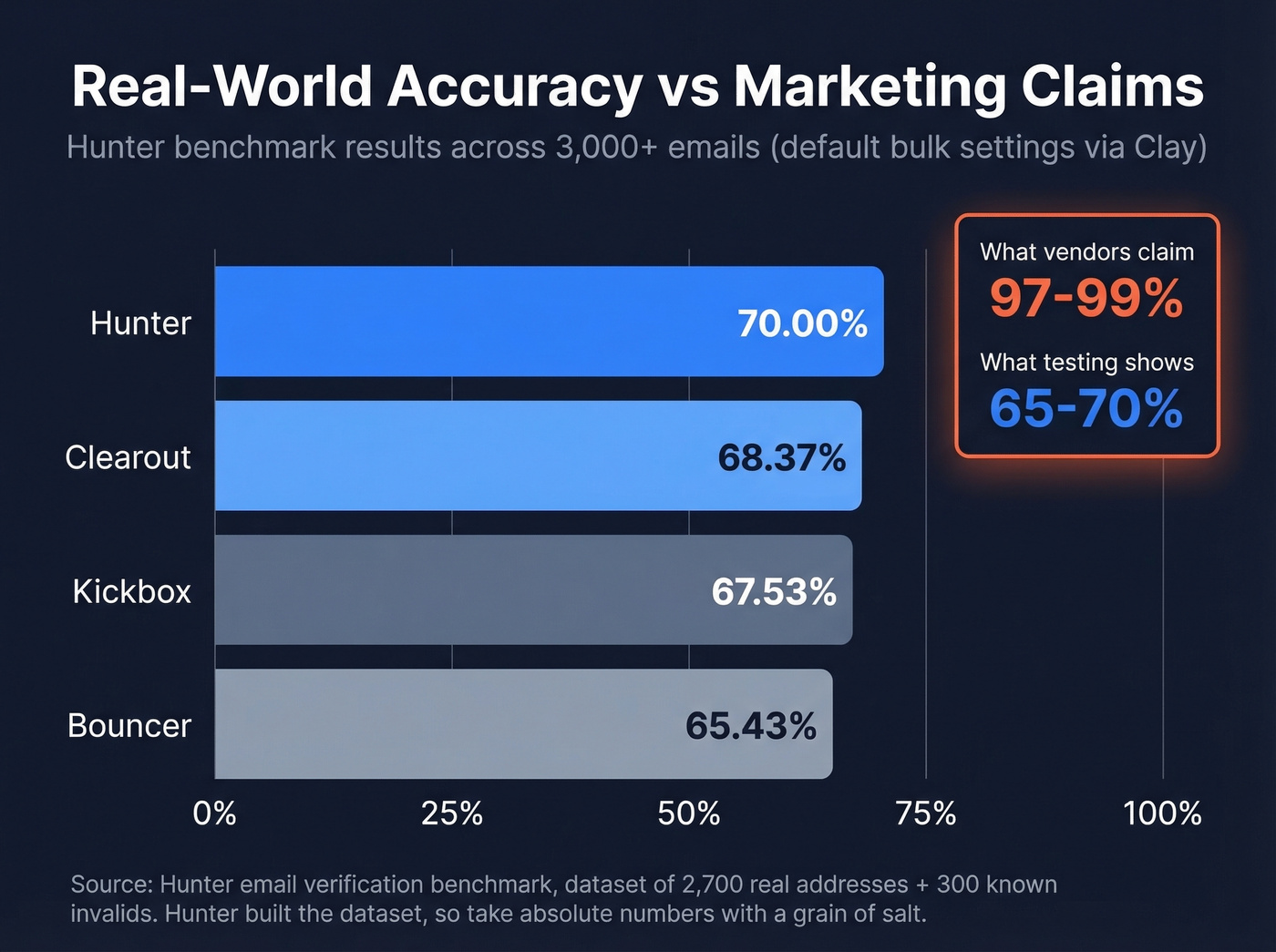
Hunter ran a test across multiple tools using 3,000+ emails - 2,700 real addresses from recent outreach responses plus 300 known invalids. They segmented by company size and ran everything through Clay in bulk mode on default settings.
The results: Hunter topped its own benchmark at 70%, Clearout hit 68.37%, Kickbox came in at 67.53%, and Bouncer landed at 65.43%. The obvious caveat is that Hunter built the dataset from its own campaign activity, which advantages Hunter's verification engine. Take the absolute numbers with a grain of salt.
But the relative spread matters. The gap between the top performer and mid-pack tools is meaningful - and the distance between these real-world numbers and the "99% accuracy" claims on every vendor's homepage should make you skeptical of any tool that won't show you methodology. Step count alone doesn't equal accuracy. Test with your own data before committing.
Pricing Compared at Scale
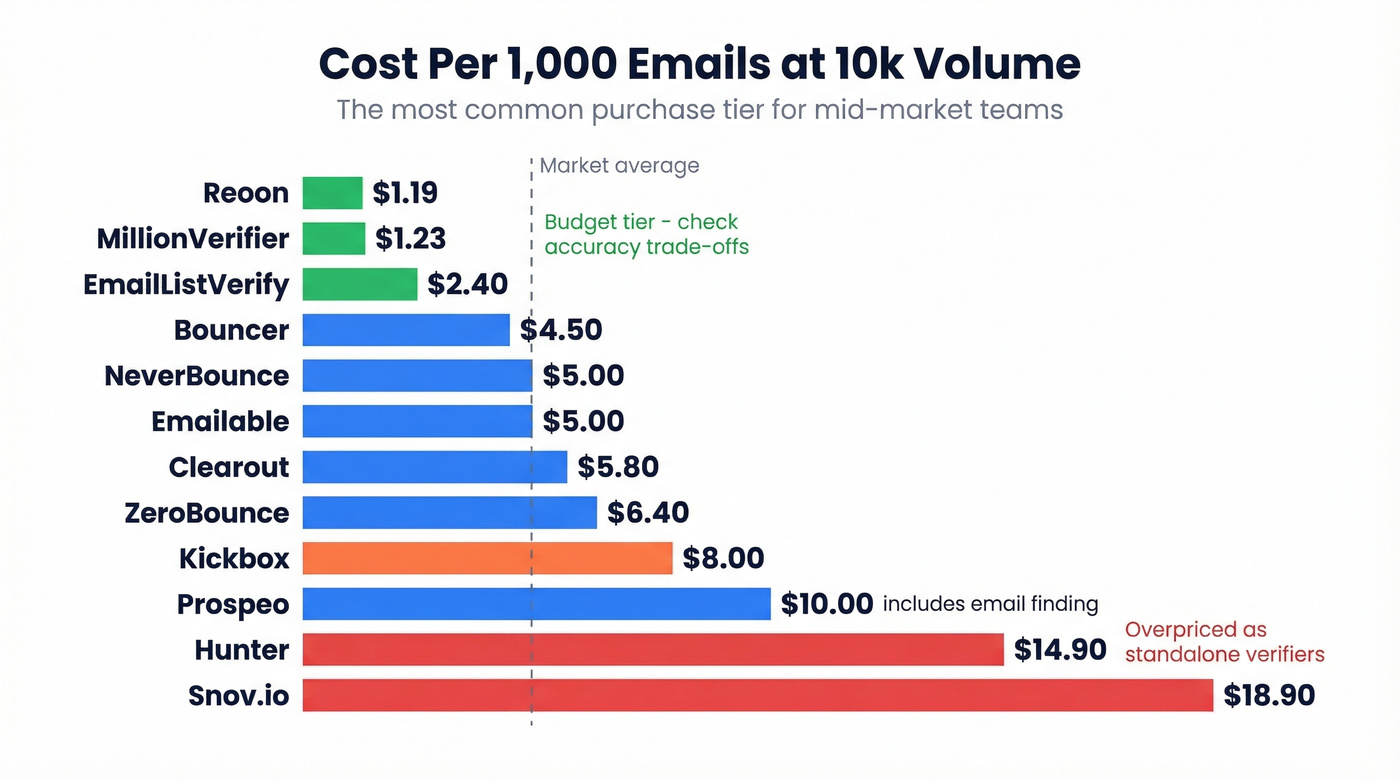
Here's what you'll actually pay per 1,000 emails at the 10k volume tier - the most common purchase for mid-market teams. At lower volumes, costs per 1k can run 2-3x higher.
| Tool | 10k Price | Cost/1k | Free Tier | Notes |
|---|---|---|---|---|
| Prospeo | $100 | $10 | 75 emails/mo (+100 extension credits) | Bundled with email finding |
| Bouncer | $45 | $4.50 | 100 credits | Discounted bulk rate |
| ZeroBounce | $64 | $6.40 | 100/mo | Deliverability extras |
| NeverBounce | $50 | $5.00 | 10 credits | 20% annual discount |
| Emailable | $50 | $5.00 | 250 credits | Fastest processing |
| Clearout | $58 | $5.80 | 100 credits | 3% bounce guarantee |
| Kickbox | $80 | $8.00 | 100 credits | Strong benchmark score |
| EmailListVerify | $24 | $2.40 | 100 credits | Budget leader |
| MillionVerifier | ~$12.30 | $1.23 | - | Accuracy trade-offs |
| Hunter | $149 | $14.90 | 50/mo | Overpriced standalone |
| Snov.io | $189 | $18.90 | 50 credits | Suite pricing, not a la carte |
| Reoon | $11.90 | $1.19 | - | Cheapest available |
Two things jump out. Hunter at $14.90/1k and Snov.io at $18.90/1k are dramatically overpriced if you're only using them for verification. Those prices make sense inside their full outreach platforms, but as standalone verifiers, you're paying 3-4x the market rate. On the other end, MillionVerifier and Reoon look like steals - until you read the accuracy caveats below.
Prospeo's $10/1k includes email finding, not just verification. You're comparing apples to oranges if you stack it against a tool that only cleans a list you already built.

You just saw the gap between claimed and real accuracy. Prospeo's 5-step verification - syntax, domain, SMTP, catch-all, and spam-trap removal - delivers 98% email accuracy across 143M+ verified addresses. Data refreshes every 7 days, not every 6 weeks. Snyk's 50 AEs dropped from 35-40% bounce to under 5%.
Stop cleaning bad lists. Start with verified emails from the source.
Top Services Reviewed
Prospeo
Use this if you want verification baked into your prospecting workflow - not bolted on after the fact.
Most verifiers clean a list after you've built it. Prospeo verifies at the point of data creation, so bad emails never enter your pipeline. Every email runs through a 5-step verification process: syntax validation, domain checks, SMTP handshake, catch-all handling, and spam-trap/honeypot removal. The result is 98% email accuracy across 143M+ verified addresses, with data refreshing every 7 days versus the 6-week industry average.
Production results back this up. Snyk's 50-person AE team went from a 35-40% bounce rate to under 5% after switching, with AE-sourced pipeline jumping 180%. That's not a marginal improvement - that's the difference between a domain that's flagged and one that's healthy.
The free tier gives you 75 emails per month to test, plus 100 Chrome extension credits. Paid plans start at $0.01 per email with native integrations into Salesforce, HubSpot, Instantly, Lemlist, Clay, Zapier, and Make. For teams that need both email finding and verification in a single workflow, it eliminates the need to pay for two separate tools.
Skip this if you already have a reliable email source and just need a standalone CSV cleaner.
Bouncer
Use this if you need the lowest unknown rate in the market and want a pure verification specialist.
Bouncer has verified over 4 billion emails and delivers less than 2% unknown results - the best rate we've seen from any standalone verifier. That matters because "unknown" is the bucket where most tools dump catch-all domains and anything they can't confidently classify. A lower unknown rate means fewer emails in limbo and more actionable data.
Processing speed runs at 180,000 emails per hour, handling most mid-market list sizes in under an hour. Deep catch-all verification is a standout feature - Bouncer actively works to classify addresses that other tools punt on. At $45 for 10k verifications, it's competitively priced. The tool carries a 4.9 on Capterra and 4.8 on G2, which is unusually high for a verification-only product. Sixteen integrations cover the major CRMs and sequencers, with 100 free credits to test.
Skip this if you need email finding bundled with verification - Bouncer is verification only. If you want more options in this category, see Bouncer alternatives.
ZeroBounce
Use this if you need deliverability intelligence beyond pass/fail.
We watched a team switch from MillionVerifier to ZeroBounce after discovering that their budget tool was passing emails on unregistered domains as valid. ZeroBounce caught every one of them. That's the core value proposition: it catches the edge cases that cheaper tools miss.
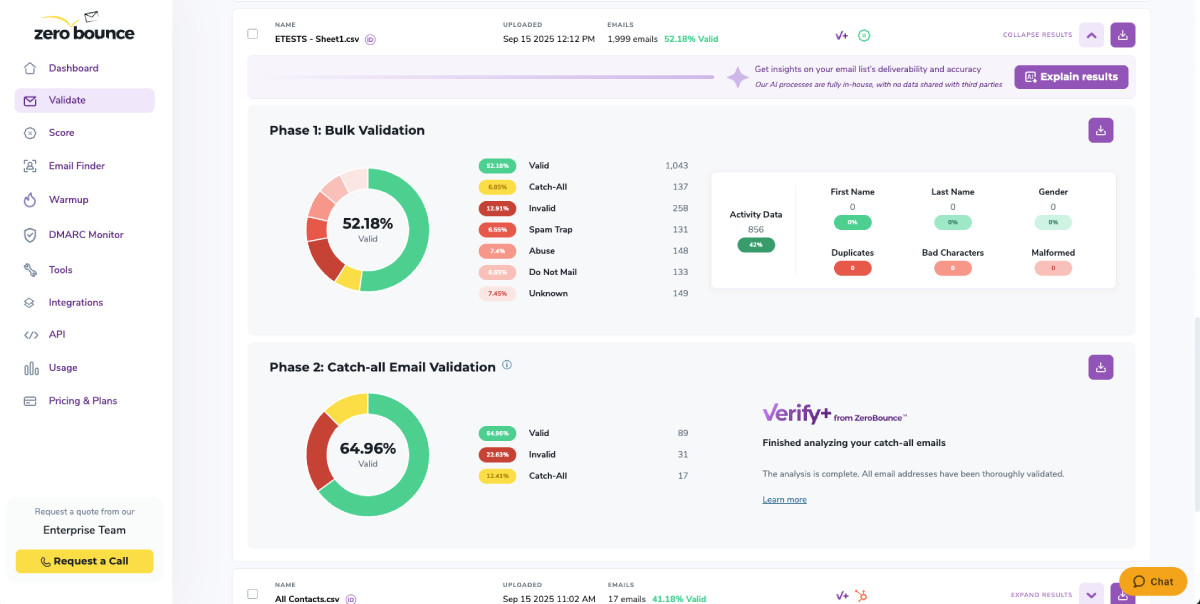
At $64 for 10k, ZeroBounce costs more than Bouncer or NeverBounce. But you're getting deliverability diagnostics beyond basic pass/fail - inbox placement testing, blacklist monitoring, and email scoring that tells you why an address is risky, not just that it is. With 45 integrations and 133,000 emails/hour processing speed, it slots into virtually any stack. The 100 free monthly credits are enough to evaluate accuracy on your own data.
One concrete complaint that comes up repeatedly in cold email communities: MillionVerifier can miss unregistered domains and invalid TLDs that ZeroBounce catches.
Skip this if you only need basic list cleaning and don't care about deliverability diagnostics.
NeverBounce
The reliable mid-range option that rarely gets people excited but also rarely lets them down. $50 for 10k verifications, 100,000 emails per hour, 22 integrations. The consensus on r/sales and r/coldemail is that it's a solid default - nothing flashy, just consistent. The 20% annual discount makes it competitive for teams running regular verification cycles. Free tier is stingy at 10 credits, so you'll need to commit to a paid plan quickly.
Clearout
The 3% bounce rate guarantee is the headline here - Clearout credits you if your verified list bounces higher. That's a confidence signal most competitors won't match. Behind the guarantee sit 20+ validation checks including greylisting verification, catch-all detection, and blocklist screening. G2 rates it 4.9/5. Pricing lands around $5.80/1k at the 10k tier, with 100 free credits to start.
Emailable
Two million emails per hour. That's roughly 11x faster than Bouncer and 20x faster than NeverBounce. For agencies managing multiple client lists where verification is a bottleneck, Emailable eliminates the wait. Pricing sits at $50 for 10k with 22 integrations and 250 free credits - the most generous free tier among mid-range tools.
EmailListVerify
At $24 for 10k verifications, EmailListVerify costs roughly half what Bouncer or NeverBounce charges. The integration count is lower at 11, and you won't get ZeroBounce-level deliverability diagnostics. But for straightforward list cleaning at scale, the price-to-performance ratio is hard to beat. 100 free credits to test.
Kickbox
Third place in the Hunter benchmark at 67.53% - behind Hunter and Clearout but ahead of Bouncer. At $80 for 10k, it's pricier than most mid-range options. The real draw is strong API documentation and developer-friendly infrastructure, making it a solid choice for engineering teams building verification into custom workflows.
MillionVerifier
At $1.23/1k, it's the cheapest option with name recognition. But Reddit users report it misses unregistered domains and invalid TLDs that ZeroBounce catches. Fine for low-stakes one-off cleans. Risky for production outbound.
Hunter
Hunter topped its own benchmark at 70%, but at $149 for 10k it's dramatically overpriced for verification alone. Only makes sense inside Hunter's full email-finding and outreach platform. If you're comparing platforms, check Hunter alternatives.
Snov.io
The most expensive verifier on this list at $189 for 10k. The 46 integrations are impressive, but the pricing only works if you're using the full outreach suite. As a standalone verifier, it's 4x the market rate.
Reoon
The absolute cheapest at $1.19/1k. Limited integrations, minimal brand recognition. Suitable for one-off list cleans on a tight budget where you'll accept some accuracy risk. Not recommended for ongoing production use.
The Catch-All Problem
30-40% of B2B email addresses sit on catch-all domains. That's a third of your list that most verifiers can't definitively classify.
The technical reason is straightforward. When a verifier runs an SMTP handshake against a catch-all server, the server accepts any address - valid or not. The verifier can't distinguish between a real mailbox and a nonexistent one, so it returns "unknown" or "risky." Enterprise environments make this worse: Secure Email Gateways from Proofpoint, Mimecast, and Microsoft Defender actively block verification probes, producing "unknown" results for a completely different reason.
A simple pass/fail verdict is non-actionable for a huge chunk of your list. Teams need tools that go beyond basic SMTP checks - using domain behavior analysis, network pattern recognition, and identity matching to return binary deliverable/undeliverable verdicts. When evaluating verifiers, ask three questions about catch-all handling: Does the tool give you an actionable verdict or just label it "risky"? Can you enforce results at the CRM or sequencer level? Does the pricing support frequent re-checks as data decays?
Also look at spam-trap and complainer detection. These signals matter as much as catch-all classification for protecting sender reputation.
When Cheap Verification Costs More
Let's walk through a scenario we've seen play out more than once. An SDR uploads a purchased list of 20,000 contacts. They run it through a budget verifier at $1.23/1k - total cost: $24.60. The tool passes 18,500 as valid. The SDR loads them into Instantly and launches a sequence.
Within 48 hours, 800 of those "valid" emails turn out to be spam traps and honeypots the budget tool missed. The domain gets blacklisted. Now the entire sales team's outbound is dead - not just that one sequence, but every email from that domain. Recovery takes 2-4 weeks of warming, reputation repair, and lost pipeline.
The cost of a better verifier for that same list? Maybe $90 with Bouncer or $128 with ZeroBounce. The cost of a blacklisted domain? Weeks of dead outbound, missed quota, and the operational headache of spinning up new sending infrastructure.
If your average deal size is above $5k, the difference between a $25 verification run and a $100 one is meaningless. One recovered deal pays for a year of premium verification. Stop optimizing for the cheapest per-email rate and start optimizing for the lowest bounce rate. (If you're troubleshooting bounces, see email bounce rate.)
Building a Verification Workflow
The smartest approach isn't picking one tool - it's building a verification pipeline with clear triggers.
Verify at capture. Every new contact gets verified before entering your CRM. If your data source verifies at creation, this step is automatic. If not, run new imports through a standalone verifier before they touch Salesforce.
Verify pre-send. Before every campaign launch, re-verify the segment you're targeting. Even a list verified last month has decay baked in.
Verify aging records. Run quarterly verification passes on your full database. At 25% annual decay, a record that was valid in January has a ~6.25% chance of being stale by April.
Consider stacking tools. Reddit practitioners consistently recommend using multiple verification providers rather than relying on one. Run your list through two verifiers and only send to addresses both confirm as valid. For real-time verification via API, also evaluate latency - a 200ms response time works for form submissions, but a 2-second delay will kill conversion rates.
The contrarian take: you don't need a standalone verifier if your data source verifies at creation. When every email is validated before it reaches your CRM, the CSV-upload-and-clean workflow becomes redundant. That's a fundamentally different architecture - and it eliminates an entire category of operational risk. The best email verification strategy is to never let bad addresses into your pipeline in the first place. (For the bigger picture, see our email deliverability guide.)
At $0.01 per email, Prospeo bundles finding and verification into one workflow - no separate CSV cleaner needed. That's less than half the cost of Hunter or Snov.io for verification alone, and you get the email discovery included. 15,000+ companies already made the switch.
Pay once for finding and verification instead of twice for each.
FAQ
How does email verification work?
Email verification runs a multi-step process: syntax check, DNS/MX lookup to confirm the domain accepts mail, SMTP handshake to confirm the mailbox exists, catch-all detection, and filtering for spam traps, honeypots, and disposable addresses. The entire sequence takes milliseconds per email via API or minutes for bulk CSV uploads.
How often should you re-verify your list?
Before every campaign, at minimum. Quarterly is the baseline for your full database. With 25% annual database decay, a list verified six months ago carries roughly 12% stale data. Pre-send verification is the single most effective habit for protecting deliverability.
What should you do with "unknown" results?
Don't send to them blindly - either run them through a catch-all specialist for a second pass or suppress them entirely. With 30-40% of B2B lists returning unknown results on catch-all domains, ignoring this bucket will tank your deliverability. Re-verify unknowns monthly as mailbox statuses change.
Are free email verification tools accurate enough?
Free tiers of 75-250 credits work for testing a tool's accuracy against your own data, but they won't catch spam traps, honeypots, and catch-all domains at scale. Use them to evaluate, then commit to a paid plan for production sends.
What's the best email verification tool for small teams?
For teams verifying under 5,000 emails per month, EmailListVerify at $2.40/1k offers the strongest price-to-performance ratio for standalone list cleaning. If you need email finding and verification in one workflow, Prospeo's free tier covers 75 emails per month with paid plans at $0.01 per email - eliminating the need to pay for two separate tools.