

The Best Power Dialers for Sales Teams in 2026
It takes 209 calls to generate one appointment, according to the often-cited Baylor University research. At 15-20 manual dials per hour, that's roughly 12 hours of dialing for a single meeting. The best power dialer cuts that to two or three hours. But here's the part nobody talks about: a rep who loaded 5,000 unverified contacts into a parallel dialer got their caller ID flagged as spam by Wednesday. Speed without data quality is just faster failure.
Benchmarks back this up. One tracked test logged a 15% connection rate - 31 real conversations on 200 dial attempts - and with the right dialer setup, teams can hit 35-40% connection rates using the same leads and scripts.
Your dialer is only as good as the numbers you feed it. That's the thread running through every recommendation below.
Our Picks (TL;DR)
| Pick | Tool | Why |
|---|---|---|
| Best calling data | Prospeo | 125M+ verified mobiles, 30% pickup rate |
| Best overall dialer | PhoneBurner | Transparent pricing, ARMOR spam protection |
| Best high-volume SDR | Orum | Parallel dialing up to 10 lines |
| Best value (solo reps) | WAVV | $99/mo power dialer, no seat minimums |
| Highest G2 rating | Nooks | 4.8/5 with 1,167 reviews on G2 |
Power vs. Parallel vs. Predictive Dialers
The term "power dialer" has become a marketing catch-all. Half the tools labeled as such are actually parallel dialers. Here's the real taxonomy:
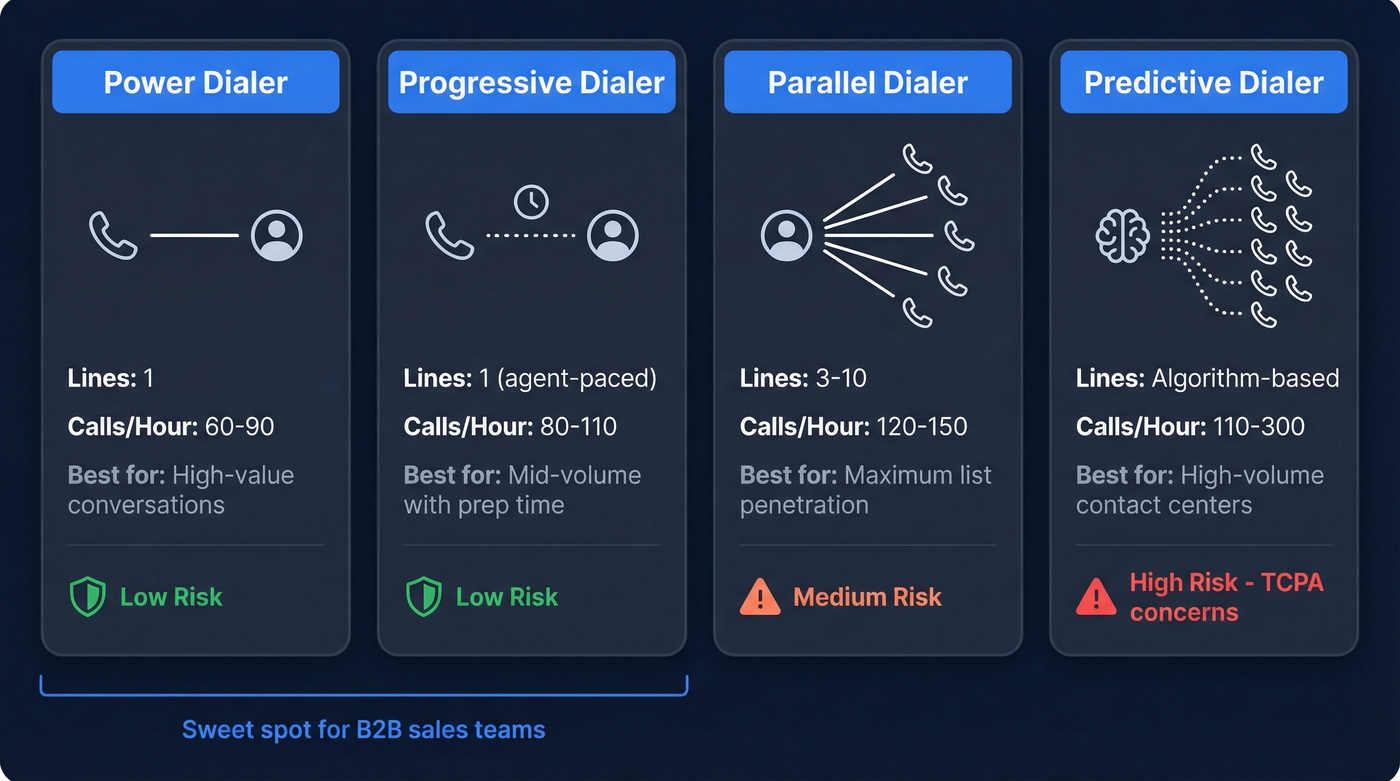
| Type | Lines per Agent | Calls/Hour | Best For |
|---|---|---|---|
| Power | 1 | 60-90 | Controlled pacing, high-value conversations |
| Progressive | 1 (agent-paced) | 80-110 | Mid-volume with prep time |
| Parallel | 3-10 | 120-150 | Maximum list penetration |
| Predictive | Algorithm-based | 110-300 | High-volume contact centers |
Power dialers auto-advance to the next number after each call ends. Parallel dialers ring multiple numbers simultaneously and connect the first live answer. Predictive dialers use algorithms to dial ahead of agent availability - powerful, but they risk abandoned calls and TCPA headaches. For most B2B sales teams, a true power dialer or a parallel dialer with 3-5 lines hits the sweet spot between speed and compliance.
For a broader outbound stack beyond dialing, see our roundup of SDR tools.
Best Power Dialers Compared for 2026
PhoneBurner - Best Overall
Use this if you want a reliable single-line power dialer with transparent pricing and built-in spam protection. PhoneBurner is the safest pick for most teams. Pricing is published clearly: $140/user/month on annual (Standard), $165 (Professional), or $183 (Premium). Monthly billing runs $165/$195/$215 respectively. Every plan includes power dialing and unlimited calling.
We've tested the ARMOR add-on and it caught spam flags within 24 hours, kicking off remediation automatically - a feature that's table stakes as carrier filtering gets more aggressive. Connect Scores filter out disconnected and unlikely-to-connect numbers before you waste a dial. SMS is available on Premium (1,000 outbound/month included, $15 per additional 1,000), and you'll need A2P 10DLC compliance registration to use it.
Skip this if you need parallel dialing or you're running 200+ dials per rep per day. PhoneBurner is single-line only, and that's by design - it prioritizes call quality and compliance over raw volume.

Kixie - Best CRM-Native Dialer
Three tiers scale from basic phone service to single-line power dialing to multi-line dialing up to 10 lines. The CRM integrations are the real draw - Kixie lives inside your Salesforce or HubSpot, not alongside it. ConnectionBoost handles local presence dialing, and the AI Human Detection add-on ($30/mo) skips voicemails on multi-line plans. There's a 7-day free trial with unlimited US/Canada minutes.
The downside: Kixie still doesn't publish dollar pricing in 2026, which is a red flag for a tool targeting SMBs. Expect ~$35-$95/user/month depending on the tier and add-ons, based on what we've seen in competitive bake-offs. Conversation Intelligence and DNC scrubbing are paid add-ons on top of the base plan, so factor those in.
Kixie works best for teams that want their dialer embedded directly in the CRM rather than running as a separate app. The multi-line dialer with AI detection is genuinely useful for high-volume work. Just be prepared to sit through a sales conversation to get a price.
If you're evaluating CRM options alongside dialing, our guide to examples of a CRM can help you shortlist faster.
Orum - Best for High-Volume SDR Teams
Orum is the dialer SDR teams reach for when they need parallel dialing at scale. Launch gives you parallel dialing up to 5 lines with unlimited dials, 5 caller IDs per user per month, and a 3-seat minimum. Ascend pushes that to 10 parallel dialing up to 10 lines, 10 caller IDs per user per month, international calling across 160+ countries/regions, AI coaching, and 200 data enrichment credits per month. The G2 rating sits at 4.6/5 with 781 reviews.
The frustrating part: Orum doesn't publish pricing either. Expect ~$250/user/month for Launch and ~$400-500+/user/month for Ascend based on what teams have shared in communities. One Reddit user described Orum as working "about 80% of the time" - not exactly a glowing review, but parallel dialers are inherently less stable than single-line tools. At these price points, you need the volume to justify the spend.
If you're building a full outbound motion, pair dialing with proven sales prospecting techniques so volume turns into meetings.
Nooks - Highest-Rated Dialer on G2
Nooks holds a 4.8/5 rating with 1,167 reviews on G2 - one of the highest ratings in the auto-dialer category. Somehow, almost nobody writing about top dialers mentions it. We've run parallel dialing sessions on both Orum and Nooks, and Nooks' virtual salesfloor is the differentiator: it lets managers coach reps in real time and recreates the energy of a shared calling floor for remote teams.
Pricing isn't public. Expect ~$150-300/user/month based on team size, with custom enterprise deals going higher. If your team is remote and you want the buzz of a bullpen without the office, Nooks deserves a serious look.
WAVV - Best Value for Solo Reps
Use this if you're a solo rep or small agency that needs a dialer without seat minimums or enterprise pricing. WAVV's single-line power dialer runs $99/month. Multi-line (up to 3 lines) is $149/month. Team plans start at $99/user/month with a 2-seat minimum, dropping to $84/user/month billed annually. The most underrated dialer on this list.
Skip this if you need bulletproof pickup rates at scale. One Reddit user in r/InsuranceAgent reported their pickup rate cratering from 5% to 0.08% - likely a number reputation issue, but worth monitoring. Also note the "unlimited minutes" caveat: unlimited on computer audio, but phone dial-ins cap at 7,500 minutes per user per month.
Aircall vs. CloudTalk vs. JustCall - Mid-Market Showdown
These three compete for the same buyer: mid-market teams that want dialing, SMS, and integrations in one platform without enterprise pricing.
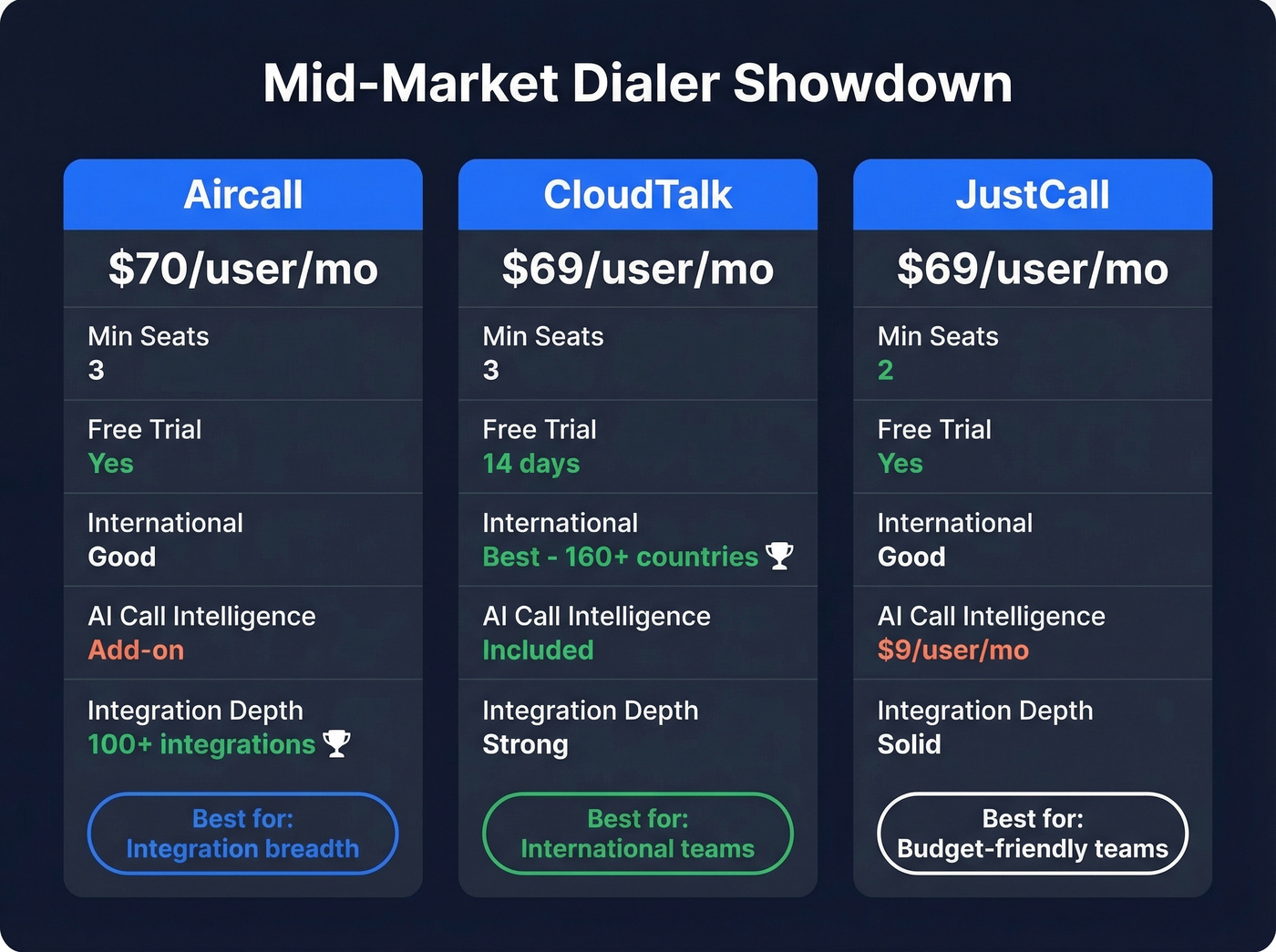
| Feature | Aircall | CloudTalk | JustCall |
|---|---|---|---|
| Power dialer tier | Professional (~$70/user/mo) | Expert ($69/user/mo) | Pro ($69/user/mo) |
| Min seats | 3 | 3 | 2 |
| International strength | Decent | Best (160+ countries) | Good |
| Integration depth | 100+ integrations | Strong | Solid |
| AI call intelligence | Add-on | Included at Expert | $9/user/mo add-on |
| Free trial | Yes | 14 days | Yes |
Aircall is the pick if your team handles both inbound support and outbound sales from the same platform. The integration ecosystem is the broadest of the three, and if you're already running Aircall for support, adding sales dialing to the same stack is the obvious move.
CloudTalk wins for international teams. Local numbers and calling coverage across 160+ countries, transparent pricing starting at $27/user/month (Lite), and a 14-day free trial to test call quality before committing.
JustCall splits the difference at a $39/user/month entry point, power dialer at $69, and AI analytics at $109. The lowest seat minimum of 2 makes it accessible for smaller teams that don't want to pay for three licenses they don't need.
In our experience, CloudTalk edges out the other two for teams dialing internationally, while Aircall wins on integration breadth. JustCall is the budget-friendly middle ground.
If you want a deeper head-to-head, read our Aircall vs CloudTalk comparison.
Mojo Dialer - Best for Real Estate
Mojo is the dialer real estate agents swear by. Base license runs $10/user/month, then add single-line ($89/month) or triple-line ($139/month) dialing. Voice costs $30 extra, recording $25, caller ID $10. Purpose-built for real estate prospecting - if you're in B2B SaaS sales, look elsewhere.
If you're in real estate, you may also want these phone scripts for contacting internet leads.
Dialpad - Best for Salesforce-Native Teams
Dialpad's Sell plan includes a power dialer with deep Salesforce integration and AI-powered call transcription baked in. Expect ~$95-$150/user/month based on typical enterprise UCaaS pricing. If your org already runs Dialpad for communications and lives in Salesforce, adding the dialer is a natural extension rather than another vendor to manage.
If you're considering other options, see our Dialpad alternatives.
Five9 - Best for Enterprise Contact Centers
Five9 starts around $119-$149/user/month depending on plan and scales into full enterprise custom pricing. It's built for blended inbound/outbound contact centers, not pure outbound SDR teams. The Reddit consensus calls it "fairly reliable with maybe a few hiccups" - about the best endorsement any enterprise contact center platform gets.

A power dialer burning through unverified numbers is just an expensive spam machine. Prospeo gives you 125M+ verified mobile numbers with a 30% pickup rate - that's 3x the industry average. Feed your dialer numbers that actually connect.
Stop dialing dead numbers. Start every session with verified contacts.
Pricing Comparison
| Tool | Starting Price | Dialer Tier | Min Seats | Free Trial |
|---|---|---|---|---|
| PhoneBurner | $140/user/mo | All plans | 1 | Yes |
| Kixie | ~$35/user/mo | Professional+ | 1 | 7 days |
| Orum | ~$250/user/mo | Launch | 3 | 500 dials |
| Nooks | ~$150/user/mo | Custom | Custom | Demo |
| WAVV | $99/mo | Power Dialer | 1 | Yes |
| Aircall | $40/user/mo | Professional ($70) | 3 | Yes |
| CloudTalk | $27/user/mo | Expert ($69) | 3 | 14 days |
| JustCall | $39/user/mo | Pro ($69) | 2 | Yes |
| Mojo | $10/user/mo + $89/mo | Single-line+ | 1 | Yes |
| Dialpad | ~$95/user/mo | Sell plan | Custom | Demo |
| Five9 | ~$119-$149/user/mo | All plans | Custom | Demo |
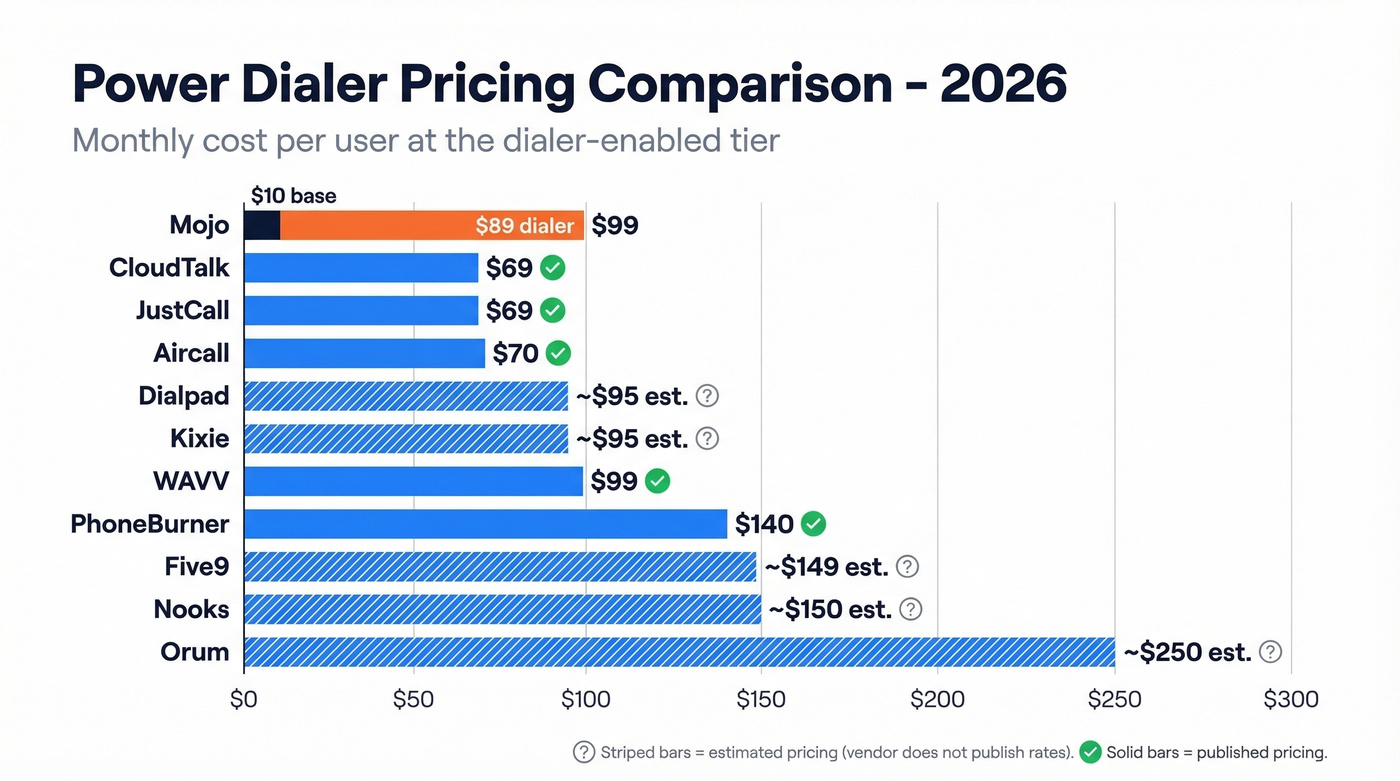
Orum and Kixie still hide their pricing in 2026. PhoneBurner, WAVV, CloudTalk, and JustCall all publish real numbers - that transparency should count for something when you're evaluating vendors.
Your Dialer Is Only as Good as Your Data
Here's the hot take: most teams overspend on their dialer and underspend on their data. A $250/month parallel dialer fed garbage numbers will underperform a $99 single-line tool fed verified mobiles every single time.
If you're shopping for the data layer, start with our guide to data enrichment services.
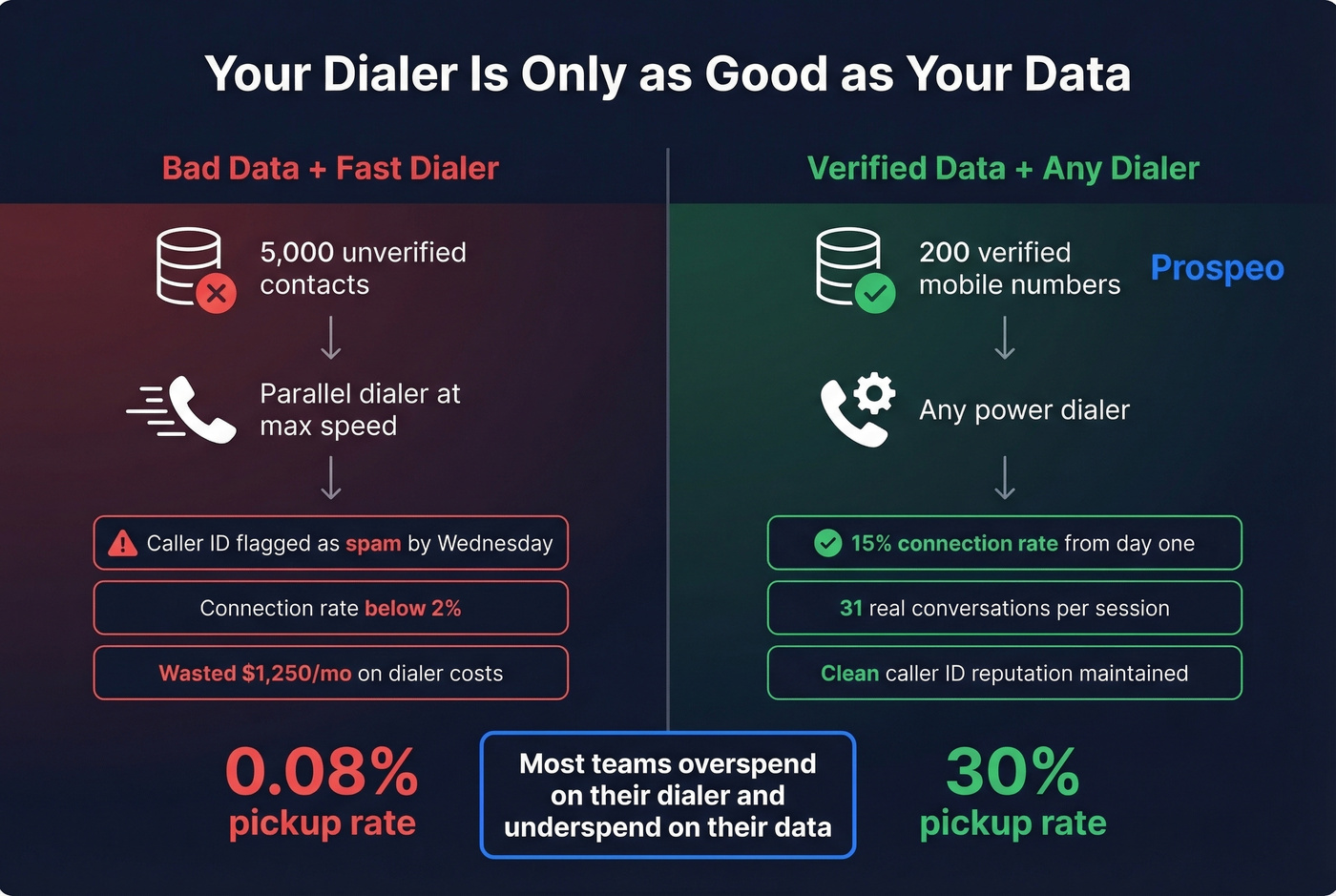
Let's do the math. Say you load 5,000 contacts into a parallel dialer. If 30% of those numbers are disconnected, wrong person, or landlines, you're burning through 1,500 dead dials. Each dead dial trains carrier algorithms that your number is spam. By day three, your caller ID shows "Spam Likely" on half the phones you're reaching. Now even the good numbers don't pick up.
Prospeo's 125M+ verified mobiles refresh every 7 days - not the ~6-week cycle most providers run. That 30% pickup rate translates to roughly 15 connected conversations per 100 dials versus 5 on unverified lists. Meritt tripled their pipeline from $100K to $300K/week and saw connect rates jump to 20-25% after switching their data source. At ~$0.01 per email, verifying and cleaning your outreach list costs less than a single wasted hour of rep time.
At 209 calls per appointment, every disconnected number costs you time and caller ID reputation. Prospeo's mobile data is refreshed every 7 days - not every 6 weeks - so your reps dial current, verified numbers at $0.10 per mobile.
Triple your connect rate before you upgrade your dialer.
Compliance and Number Reputation
TCPA violations run $500-$1,500 per call. Not per campaign - per call. The basics aren't optional:
- Calling hours - 8am-9pm local time for the recipient, not your time zone
- Express written consent - required for autodialed calls to mobile numbers
- DNC scrubbing - check the national registry and maintain internal suppression lists
- State variance - Florida and Oklahoma have stricter rules; California's CCPA adds data handling requirements
Legal compliance is only half the battle, though. Carrier filtering is a separate problem entirely. Carriers score your caller ID reputation and label high-risk traffic fast. High dial volume to bad numbers tanks that score.
The defensive playbook: rotate across multiple verified numbers and register them with Free Caller Registry. Monitor reputation through Numeracle or Hiya, and pace your volume - carriers flag sudden spikes. Verifying numbers before dialing reduces the disconnected-number signals that trigger carrier filtering in the first place. Keep an audit trail for every call: date, time, number dialed, agent, result, consent source, and recording. Even the best-configured dialer won't protect you if your compliance hygiene is sloppy.
For a tighter outbound process, build a repeatable cold calling system so compliance and pacing are baked in.
How to Choose the Right Dialer
The decision framework is simpler than most vendors want you to believe.
Solo rep, under $100/month - WAVV. No seat minimums, transparent pricing, gets the job done.
SMB team of 3-10, $100-200/user/month - PhoneBurner or Kixie. PhoneBurner for transparency and spam protection, Kixie for deeper CRM integration.
Funded SDR team of 10+, $250+/user/month - Orum or Nooks. Parallel dialing at scale with coaching tools.
International dialing - CloudTalk. 160+ countries, local numbers, reasonable pricing.
Honorable mention - VanillaSoft is worth evaluating if you want queue-based lead routing baked into the dialer. It's popular in insurance and financial services.
Here's the contrarian take: if your deal size is under $10K ACV, you probably don't need a $250/month parallel dialer. A $99-$140 single-line power dialer with verified data will outperform an expensive parallel setup fed unverified lists. You need one dialer and one data source. Pick one of each, run a two-week test with 500 verified contacts, and measure connected conversations - not dials. Dials are a vanity metric. Conversations are revenue.
To improve what happens after the call connects, keep a set of proven sales follow-up templates ready for every outcome.
FAQ
What's the difference between a power dialer and a predictive dialer?
A power dialer dials one number at a time per agent, advancing automatically after each call - typically 60-90 calls per hour. A predictive dialer uses algorithms to dial multiple numbers ahead of agent availability, hitting 110-300 calls per hour. The tradeoff: predictive dialers risk abandoned calls when no agent is free, creating TCPA liability and a poor prospect experience.
How much does a power dialer cost?
WAVV starts at $99/month for solo reps. PhoneBurner runs $140-$195/user/month depending on plan. Enterprise parallel dialers like Orum cost $250+/user/month. Budget for the data layer separately - bad numbers waste more money than the dialer itself costs.
Do I need a separate tool for phone number verification?
Most dialers don't verify whether numbers are active or connected to the right person. Loading unverified lists causes spam flags and wasted dials at scale. Prospeo's Mobile Finder provides 125M+ verified numbers on a 7-day refresh cycle - negligible cost compared to the rep time you'll save on dead dials.
How do I stop my caller ID from getting flagged as spam?
Rotate across multiple verified numbers, register them with Free Caller Registry, and monitor reputation via Numeracle or Hiya. Pace your dialing volume - carriers flag sudden spikes. Most importantly, dial verified numbers. Disconnected and wrong numbers trigger carrier filtering algorithms faster than anything else.
Can I use a power dialer with my CRM?
Most modern dialers integrate with Salesforce, HubSpot, and Pipedrive natively. Kixie and Dialpad offer the deepest CRM-embedded experiences - the dialer lives inside your CRM rather than running as a separate window. Check that your dialer syncs call outcomes, recordings, and notes automatically so reps aren't stuck doing double data entry.