

Best Sales Decks in 2026: Frameworks, Examples & Templates
A founder on Reddit cut a 40-slide feature dump down to 6 slides and watched their close rate jump 35%. Calls got shorter. Prospects remembered the product. That's not an anomaly - it's what happens when you stop treating your deck like a brochure and start treating it like a closing tool. The best sales decks aren't the prettiest. They're the clearest.
Most sales deck advice is either too theoretical or too shallow. Here you'll get both: four proven frameworks mapped to deal types, slide-by-slide templates you can copy today, real examples worth stealing, and the tools to build and deliver them.
The Cheat Sheet
If your deck is longer than 12 slides, cut it.
- 6 slides - SMB, fast cycles, transactional deals
- 7 slides - mid-market, consultative sales
- 12 slides - enterprise, multi-stakeholder buying committees
- Framework pick: Raskin Narrative Arc for enterprise, Before-After-Bridge for SMB, Problem-Cost-Cause-Solution for mid-market, Gong Nexus for competitive displacement
- Build tool: Gamma for speed - free tier; that Reddit founder built theirs in about 20 minutes
Why Your Deck Matters More Than Ever
96% of prospects research your company before they'll talk to a rep. 71% prefer doing that research independently. By the time someone agrees to a meeting, they've completed up to 67% of their decision-making before the first conversation even starts.
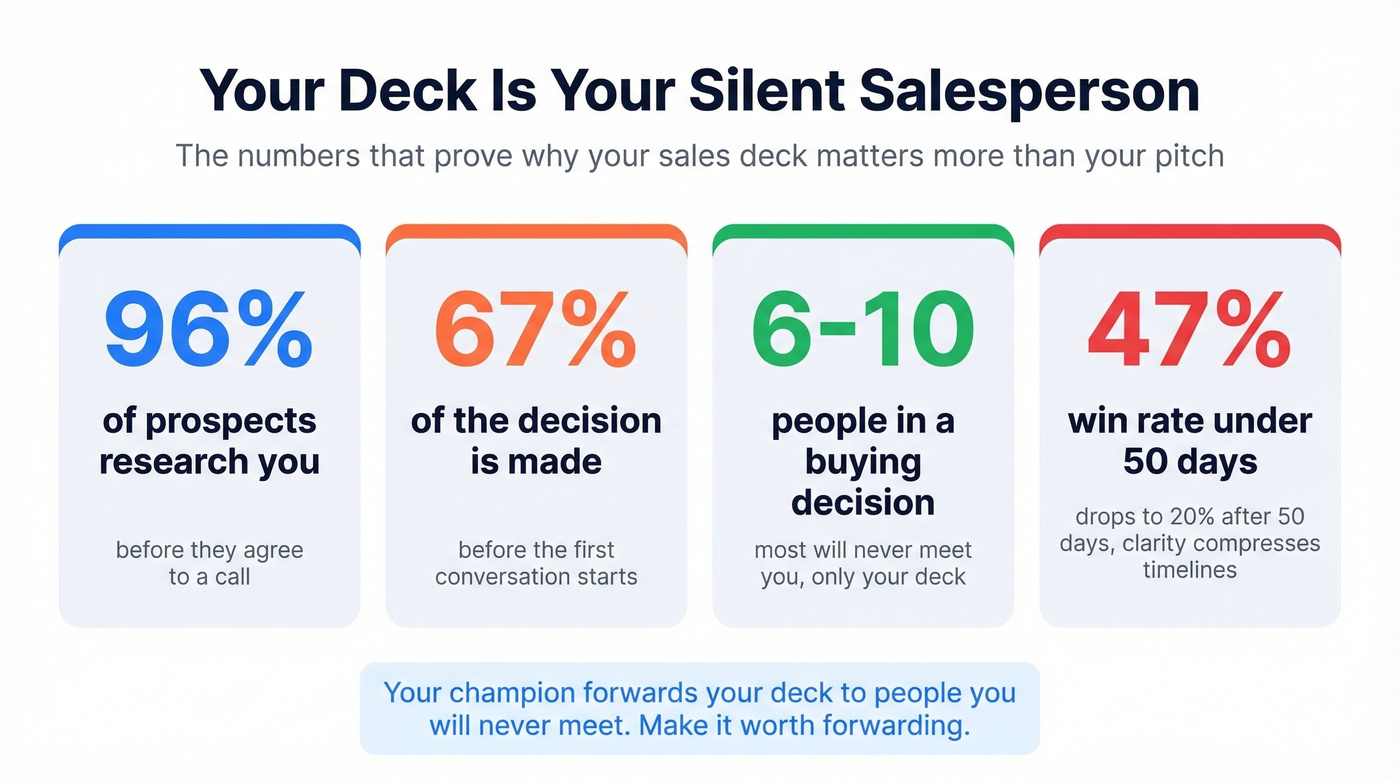
Your deck isn't just a presentation aid. It's a validation asset - the thing your champion forwards to the CFO, the VP of Engineering, and the procurement lead who weren't on the call. According to Gartner, 6-10 people are involved in a typical B2B buying decision. Most of them will never meet you. They'll meet your deck.
Speed matters too. Outreach's latest benchmarks show deals closed within 50 days hit a 47% win rate. After 50 days, that drops to 20% or lower. A deck that's clear, concise, and easy to share internally compresses that timeline. A confusing deck extends it. The difference between winning decks and forgettable ones often comes down to how quickly a champion can retell your story without you in the room.
Sales Deck Frameworks That Work
The right framework depends on your deal type, cycle length, and competitive landscape. These four consistently produce decks that close.
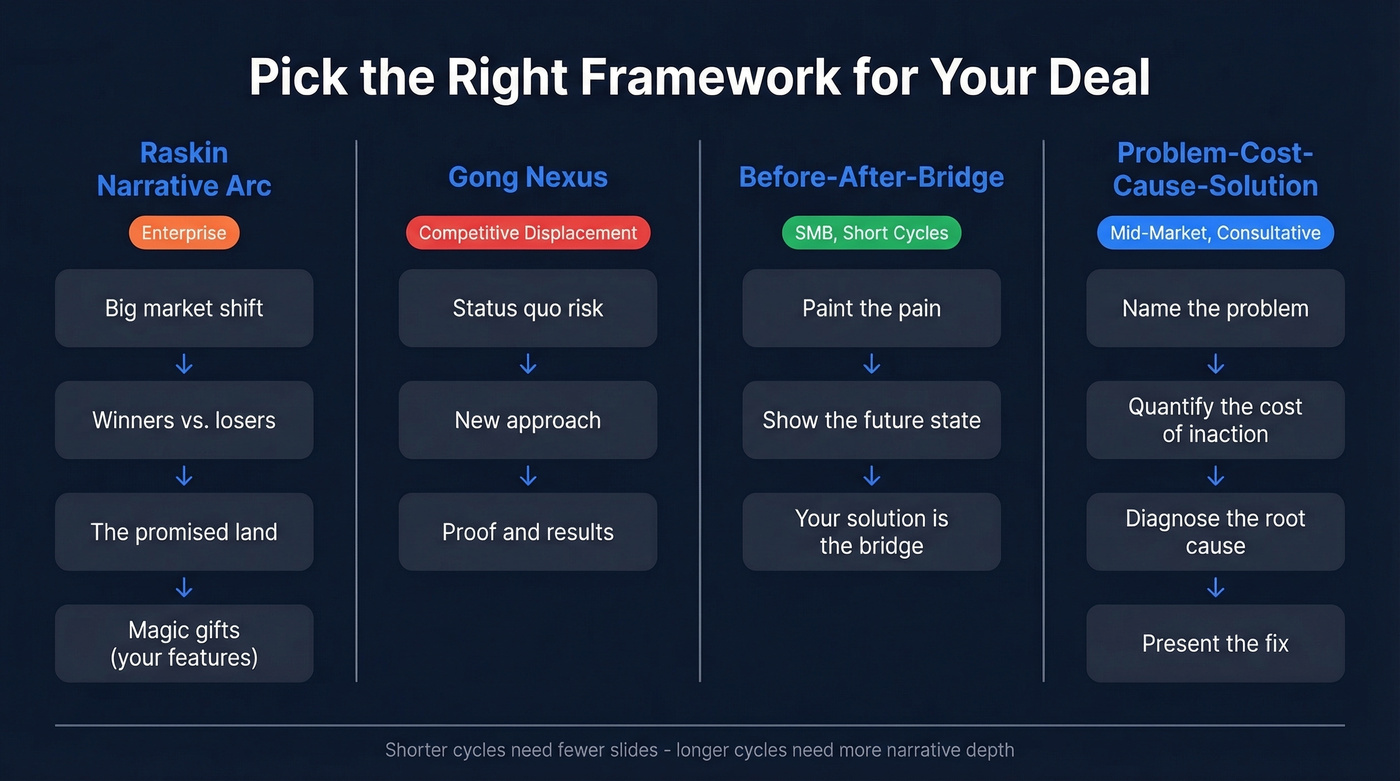
| Framework | Best For | Opens With | Structure |
|---|---|---|---|
| Raskin Narrative Arc | Enterprise, multi-stakeholder | A macro shift in the market | Shift → winners/losers → promised land → magic gifts |
| Gong Nexus | Competitive displacement | Status quo risk | Risk → new approach → proof |
| Before-After-Bridge | SMB, short cycles | The prospect's pain | Pain → future state → your solution |
| Problem-Cost-Cause-Solution | Mid-market, consultative | Quantified cost of inaction | Problem → cost → root cause → fix |
Raskin Narrative Arc is the gold standard for enterprise. Andy Raskin's framework - built around the Zuora deck - starts not with your product, but with a big, relevant change in the world. You show winners and losers, tease the "promised land" (a future state, not your product), then introduce features as "magic gifts" that get them there. Raskin later critiqued the standard problem/solution pitch as the "arrogant doctor" approach. His updated thinking frames the strongest narratives as "old worldview → new worldview" shifts.
Before-After-Bridge is the simplest. Paint the pain, show the future, explain the bridge. It works for SMB deals where one person makes a fast decision.
Problem-Cost-Cause-Solution adds consultative depth. You don't just name the problem - you quantify its cost and diagnose the root cause before presenting your solution. In our experience, the "cost of inaction" slide is what separates good decks from great ones. It turns a sales call into an advisory conversation.
A DocSend audit found only 17.5% of viewers reached the last page of a typical deck. After rebuilding with narrative structure, that jumped to 65.4%. Framework choice directly drives whether people finish your deck.
Pick Your Template
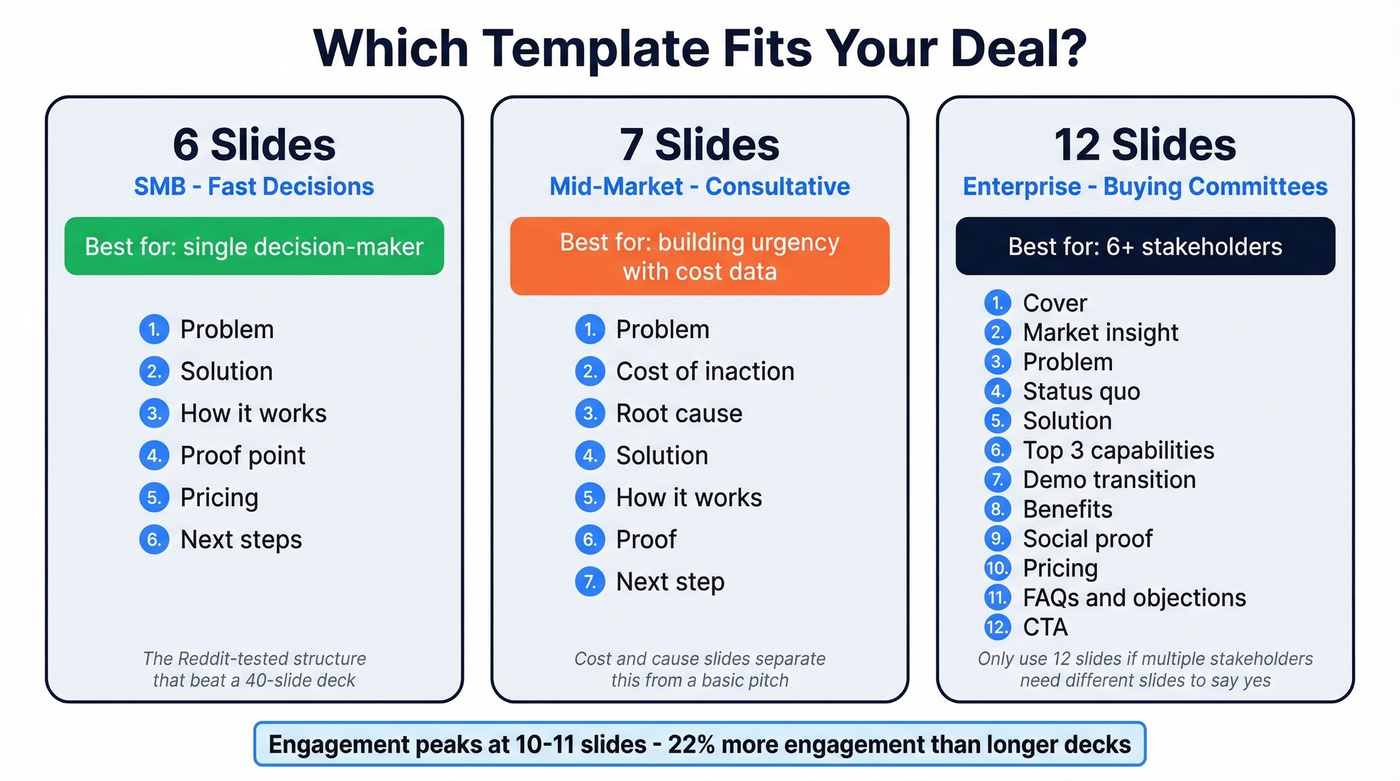
Engagement peaks at 10-11 slides - decks in that range see 22% more engagement than longer formats. The templates below are calibrated to that reality. If you go to 12, every slide earns its spot or gets cut.
6-Slide SMB Template
This is the Reddit-tested structure that outperformed a polished 40-slide deck:
- Problem - name the pain in the prospect's language
- Solution - one sentence on what you do
- How it works - 3 steps max, with a visual
- Proof point - one case study with a number
- Pricing - transparent, no "contact us"
- Next steps - single CTA
No company history slide. No team bios. No market size. Brevity forces ruthless focus on what the buyer actually needs to decide. We've seen this structure outperform longer decks across dozens of teams - the constraint is the feature.
7-Slide Consultative Template
Built on Problem-Cost-Cause-Solution:
- Problem - what's broken in their world
- Cost - what doing nothing costs, quantified
- Cause - why existing solutions fail
- Solution - your approach, high-level
- How it works - 3 steps max
- Proof - one case study with hard numbers
- Next step - single CTA
The "cost" and "cause" slides are what separate this from a basic pitch. They build urgency and position you as someone who understands the problem deeply, not just someone selling a fix.
12-Slide Enterprise Template
For complex deals with buying committees, you need more surface area. This slide-by-slide structure covers every base:
- Cover - one-sentence description of what you do
- Market insight - the macro trend driving change
- Problem - specific to their role and industry
- Status quo - why the old way doesn't work
- Solution - high-level positioning
- Top 3 capabilities - features framed as outcomes
- Demo transition - bridge to live product
- Benefits - 3-4 max, tied to business metrics
- Social proof - logos, quotes, case study
- Pricing - tiers or ranges
- FAQs / objections - preempt the "what about..." questions
- CTA - clear next step with timeline
Here's the thing: most teams using a 12-slide enterprise deck should actually be using the 7-slide version. The 12-slide template exists for buying committees of 6+ where multiple stakeholders need different slides to say yes. If your deal has one decision-maker, you don't need 12 slides - you need 6 great ones.

A great sales deck needs a great prospect list. Your 6-slide masterpiece won't close deals if it lands in the wrong inbox - or bounces entirely. Prospeo gives you 98% verified emails and 125M+ direct dials so your deck reaches the actual decision-makers, not dead ends.
Stop perfecting slides for prospects you can't even reach.
Sales Deck Examples Worth Stealing
Personalized decks get 41% more reading time and are shared internally 2.3x more often. Six examples that show what "good" looks like - and why many people consider some of these the greatest sales deck ever created.
Zuora - The Canonical Narrative Shift
Zuora doesn't open with their product. They open with the "subscription economy" as an unstoppable force, then position themselves as the inevitable infrastructure for that shift. Many sales leaders point to this as the greatest sales deck ever because it never mentions a feature until the audience is already bought into the worldview. Steal this move: frame your product as inevitable, not optional.
TeleTracking vs. Reddit Ads
These two decks sit at opposite ends of the tone spectrum but share one trait: total commitment to voice. TeleTracking's deck is 6 slides and built for executive scanability - one idea, one visual, one takeaway per slide. Reddit Ads goes culture-forward and irreverent, making the deck feel like Reddit itself. The lesson from both: a deck with a clear personality outperforms a deck that tries to sound "professional."
Outreach
Opens with a "day in the life" of the prospect, not the product. Empathy before features. Mirror the buyer's reality before you pitch the solution.
Slack
Classic before/after transformation. Shows the chaos of email-based collaboration, then the calm of Slack. Let the contrast do the arguing.
Snapchat
Snapchat's 2015 deck is stat-forward and minimal - bold claims, strong visuals, and very little copy. If your product has strong usage data, this is the format to study.
Mistakes That Kill Deals
The consensus on r/sales is clear: the slides that matter most are pricing, implementation plan, and a single proof point - not your company timeline. If your company handed you a 48-page deck and told you to "make it your own," they gave you homework, not a sales tool. Reps spend 31% of their working hours searching for and creating content, leaving about two hours daily for active selling.
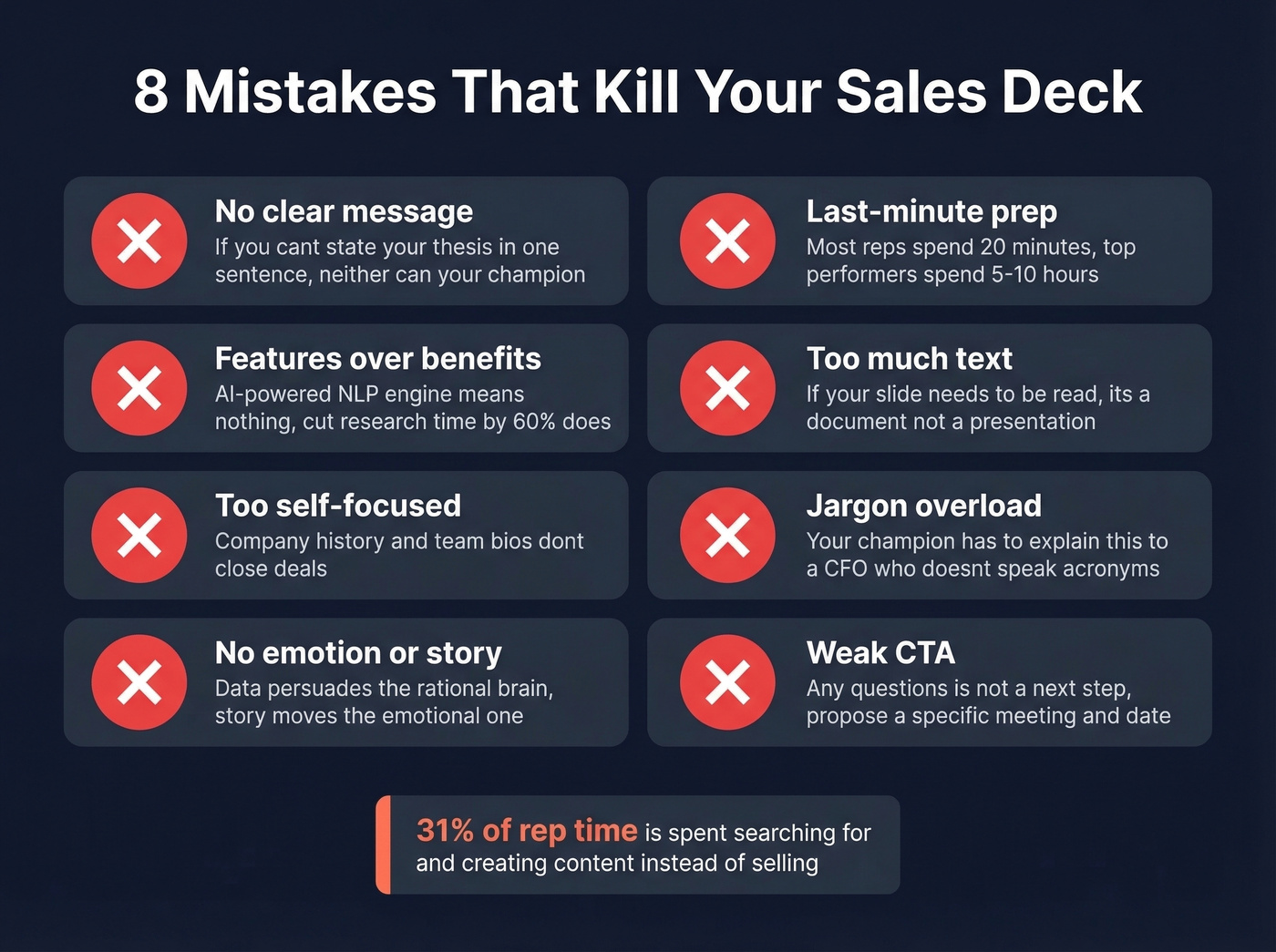
Eight mistakes we see kill deals repeatedly:
- No clear message - if you can't state your deck's thesis in one sentence, neither can your champion
- Last-minute prep - Venngage recommends 5-10 hours per pitch; most reps spend 20 minutes
- Features over benefits - "AI-powered NLP engine" means nothing; "cut rep research time by 60%" does
- Too much text - if your slide needs to be read, it's a document, not a presentation
- Too self-focused - company history, team bios, and office photos don't close deals
- Jargon overload - your champion has to explain this to a CFO who doesn't speak your acronyms
- No emotion or story - data persuades the rational brain; story moves the emotional one
- Weak CTA - "any questions?" isn't a next step; "let's schedule a 30-minute technical review with your team on Thursday" is
Skip the "about us" slide entirely unless you're selling to a regulated industry where credibility markers are table stakes. Even then, keep it to one slide with three proof points, not a corporate biography.
Data Quality Makes or Breaks Your Deck
Your deck has to create an internal seller. Decisions happen behind closed doors - in Slack threads and forwarded emails - without you in the room. Your champion is your proxy, and they need a deck worth forwarding.
But none of that matters if the deck never reaches the right person. If your prospect list has outdated emails, your deck sits in a bounce log instead of a decision-maker's inbox. Tools like Prospeo cover 300M+ professional profiles with 30+ search filters so you can target the right role, title, and seniority - then verify the email before you hit send. With 98% email accuracy and a 7-day data refresh cycle, you're not sending decks to addresses that went stale six weeks ago.
If you're tightening your outbound motion, pair your deck with better sales prospecting techniques and a clear ideal customer profile so you're not pitching the wrong accounts in the first place. Once you have the right targets, lead enrichment helps you route decks to the right stakeholders faster.
You just learned that 6-10 people sit on a typical buying committee. Prospeo's 30+ search filters - including job title, department, and buyer intent - let you identify every stakeholder in the deal and get their verified contact data for ~$0.01 per email. Map the full committee before you even open your deck.
Reach every stakeholder on the buying committee, not just the one who took the call.
Tools for Building Sales Decks
| Tool | Starting Price | Best For |
|---|---|---|
| Gamma | Free / $10 Plus / $20 Pro | Speed + AI-assisted design |
| Beautiful.ai | $12/mo annual | Design-challenged teams |
| Pitch | Free / $20/mo | Real-time collaboration |
| Canva | Free / $15 Pro | Best free-to-paid upgrade |
| Google Slides | Free | No-budget teams |
| PowerPoint + Copilot | ~$27/user/mo total | Enterprise orgs on M365 |
| Figma Slides | Free / $15/user/mo | Design-forward teams |
Gamma is a popular pick for fast, AI-assisted deck building. That Reddit founder built a 6-slide deck in 20 minutes that outperformed a designer-polished version. For most sales teams, speed and iteration matter more than pixel-perfect design. If you're already in the Microsoft ecosystem, PowerPoint with Copilot is the path of least resistance - but $27 per user per month adds up fast across a team.
Real talk: the tool matters less than the framework. A clear 6-slide deck in Google Slides will outclose a beautiful 30-slide deck in Figma every time. If you want to go deeper on narrative and structure, use these sales deck storytelling principles alongside a tighter sales communication talk track.
FAQ
How many slides should a sales deck have?
Six to twelve, depending on deal complexity. SMB deals close best with 6 slides, mid-market consultative deals fit 7, and enterprise deals with buying committees of 6+ need up to 12. Engagement data shows 10-11 slides is the sweet spot for read-through rates.
Sales deck vs. pitch deck - what's the difference?
A pitch deck raises money from investors; a sales deck closes deals with buyers. Sales decks focus on the prospect's problem, proof you can solve it, and a clear next step. Pitch decks focus on market size, traction, and team - different audience, different structure entirely.
Should I send the deck before or after the call?
After, as a leave-behind your champion can forward internally. Before the call, send a one-sentence teaser that creates curiosity - not the full deck. You want the meeting, not a pre-read that lets them self-disqualify.
How do I make sure my deck reaches the right person?
Ask your champion who else needs to see it and get their direct contact info. Then verify those emails before sending - a quick verification step confirms addresses are live so your deck lands in inboxes instead of bouncing off stale addresses.