

The Best Time to Send an Email Blast in 2026 (2B+ Emails Analyzed)
Every article about email timing says the same thing: Tuesday at 10 AM. They've been saying it since 2014. We synthesized seven studies covering over 2 billion emails to find out what actually works - and the real answer depends on whether you're optimizing for opens, clicks, or conversions. Those are three different goals with three different answers.
Quick Answer
- Best day for opens: Tuesday (HubSpot + Omnisend). MailerLite's dataset ranks Friday #1 for opens.
- Best day for conversions: Friday, which significantly outperforms every other weekday (Omnisend)
- Best time for opens: 9-11 AM local time
- Best time for clicks: 8-9 PM evening engagement window
- Friday 6 PM anomaly: Best combined open + click performance in MailerLite's dataset
Bottom line: Timing is a 5-10% improvement. List quality and deliverability are 50%+ improvements. Fix your data first.
Best Day to Send an Email Blast
The "Tuesday is best" consensus holds up in multiple studies - especially for opens. Once you look at clicks and conversions, the picture shifts.
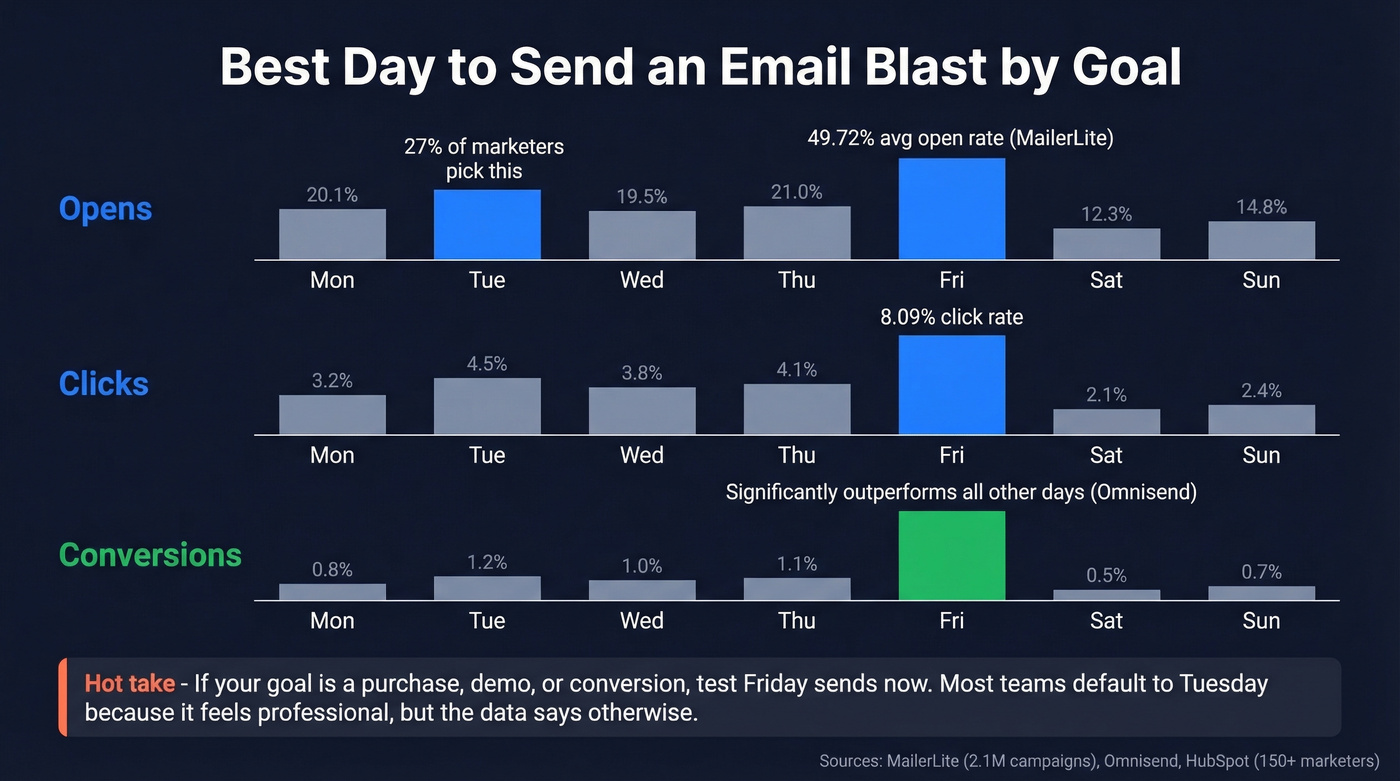
MailerLite's dataset of 2,138,817 campaigns across the US, UK, Australia, and Canada tells the most complete story. Friday posted the highest average open rate (49.72%) and click rate (8.09%). Monday came in close behind for opens at 49.44%.
Omnisend's data uses a different methodology and baseline, but it aligns on the big takeaway that matters for revenue: Friday is the strongest day for conversions, significantly outperforming other weekdays. Omnisend also ranks Tuesday as the top day for open rate, with Wednesday and Thursday close behind.
HubSpot's survey of 150+ US marketers paints a perception gap. 27% named Tuesday as the best day, followed by Monday (19%) and Thursday (17%). Marketers believe Tuesday works because everyone says so, but conversion-focused data increasingly favors Friday.
Here's our hot take: if your email's goal is a purchase, a demo booking, or any conversion event, you should be testing Friday sends right now. Most teams default to Tuesday because it "feels" professional. The data says Friday's mindset drives more action.
Monday is often a tough day for attention in B2B - people are buried in meetings and weekly planning. When you must send Monday, aim for 6-9 AM before calendars fill up. The B2B vs. B2C split matters too: HubSpot found 47.9% of B2B marketers see peak engagement between 9 AM and noon, compared to just 30.9% of B2C marketers in the same window.
Optimal Send Time by Goal
Most articles fail here. They give you one "best time" when opens, clicks, and conversions peak at completely different hours.
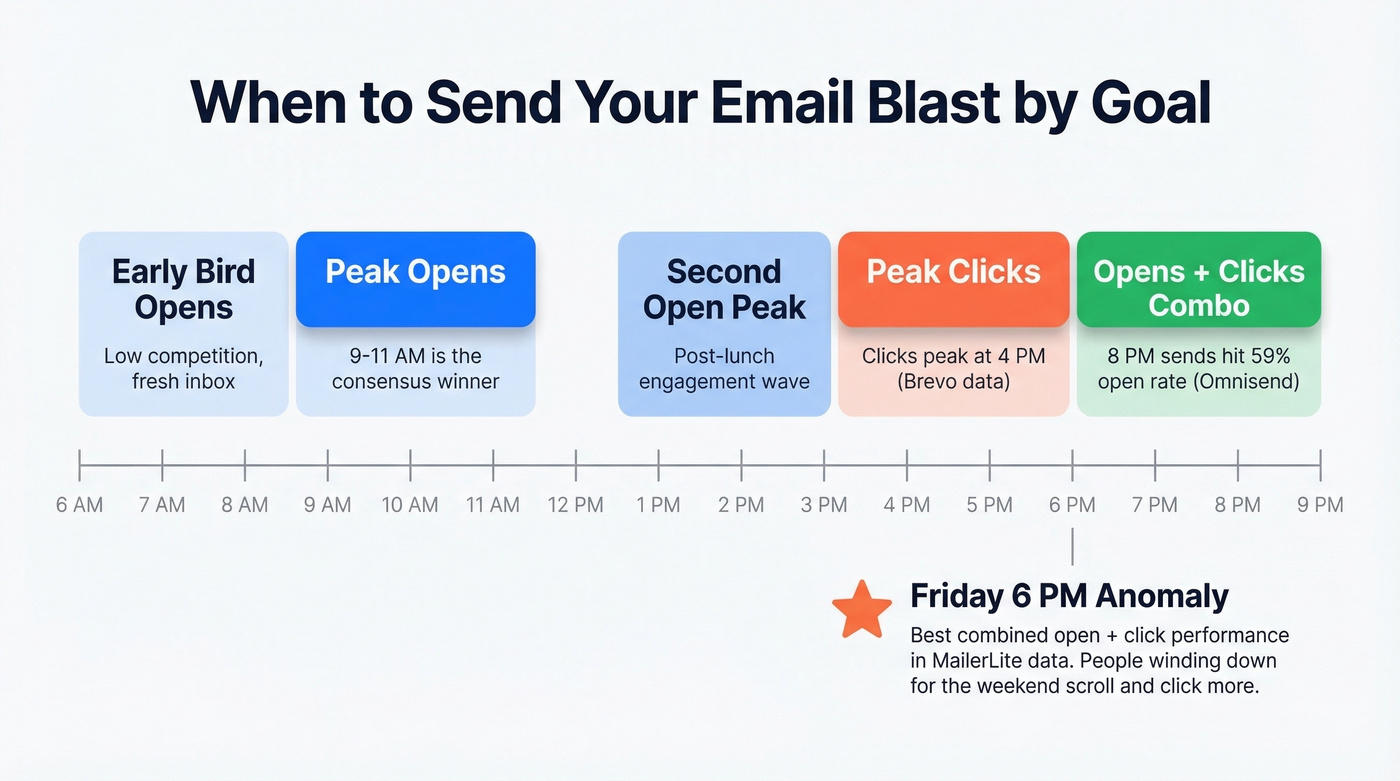
| Time Window | Best For | Why |
|---|---|---|
| 6-8 AM | Early-bird opens | Low competition, fresh inbox |
| 8-11 AM | Opens (peak) | Morning inbox clearing |
| 1-3 PM | Second open peak | Post-lunch engagement wave |
| 3-6 PM | Clicks | Clicks peak at 4 PM per Brevo |
| 6-9 PM | Opens + clicks | 8 PM sends hit 59% opens |
The morning window dominates for opens because that's when people clear their inbox. But MailerLite's data reveals something most articles skip: clicks peak between 8-9 PM. People open emails in the morning and click them in the evening. Omnisend reinforces this - 8 PM sends hit a 59% open rate compared to 45% at 2 PM, a 14-point swing based purely on timing.
Brevo identifies two daily peaks: 10 AM for opens and 4 PM for clicks, with engagement staying elevated through 6-7 PM. If you're optimizing for clicks rather than opens, afternoon sends deserve serious testing.
The Friday 6 PM anomaly deserves special attention. That's the point where best open and click times coincide in MailerLite's dataset - delivering the week's strongest combined performance. People winding down for the weekend are scrolling their phones and apparently more willing to click.
Best Day of the Month to Send
This is genuinely useful for monthly newsletter senders, and almost nobody covers it.
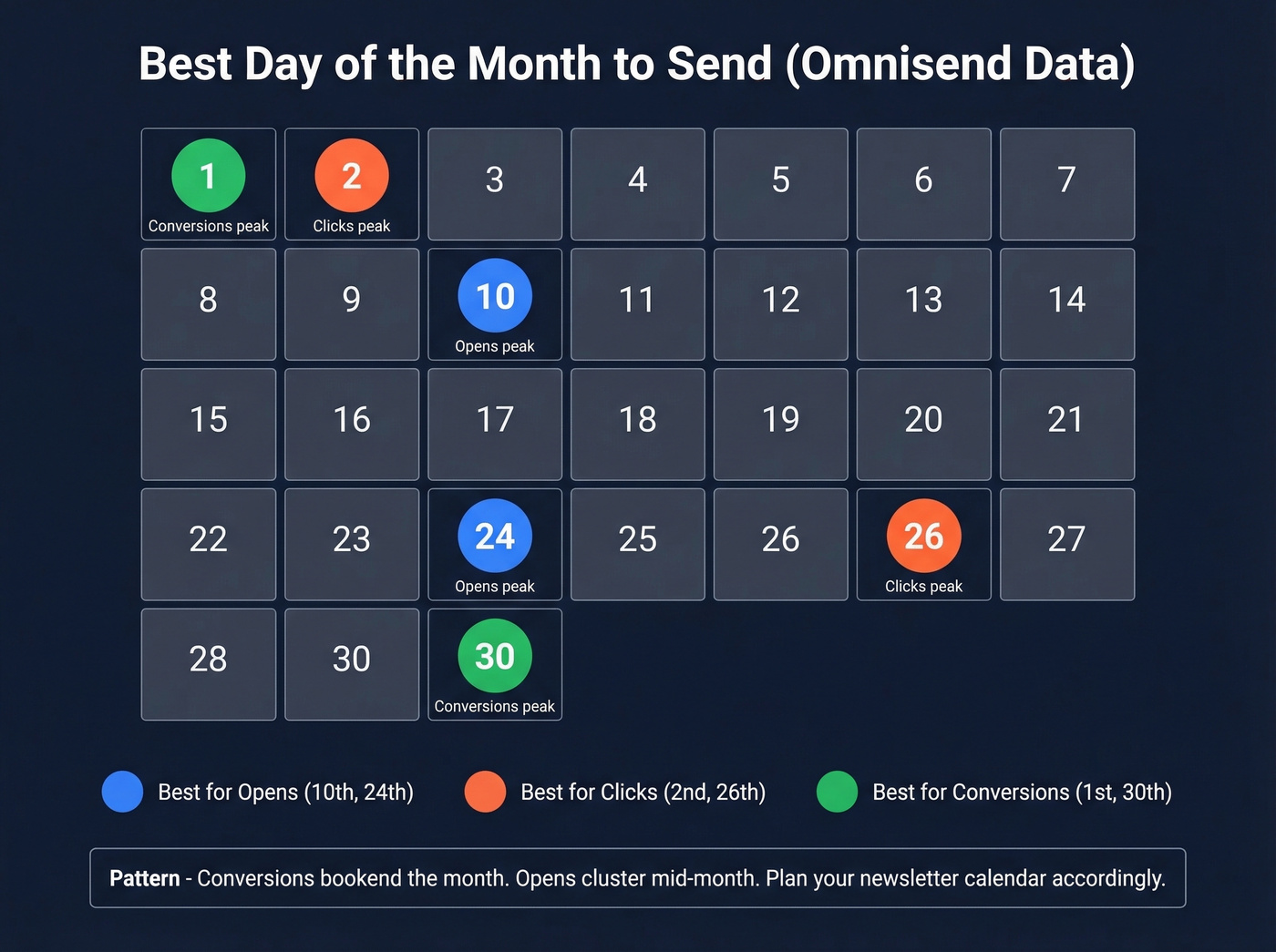
Omnisend's data shows opens peak on the 10th and 24th. Clicks peak on the 2nd and 26th. Conversions peak on the 1st and 30th - bookending the month. The 1st isn't just a default choice; it's backed by conversion data. The 10th is your best bet if opens are the primary KPI.

You just optimized your send time. Now fix the lever that matters 10x more: list quality. A 12% bounce rate destroys sender reputation faster than any bad timing ever could. Prospeo's 5-step email verification catches spam traps, honeypots, and invalid addresses with 98% accuracy - at $0.01 per email.
Stop perfecting your send schedule on a list full of dead addresses.
Timing by Industry
Generic timing advice breaks down fast when you account for how different industries actually work.
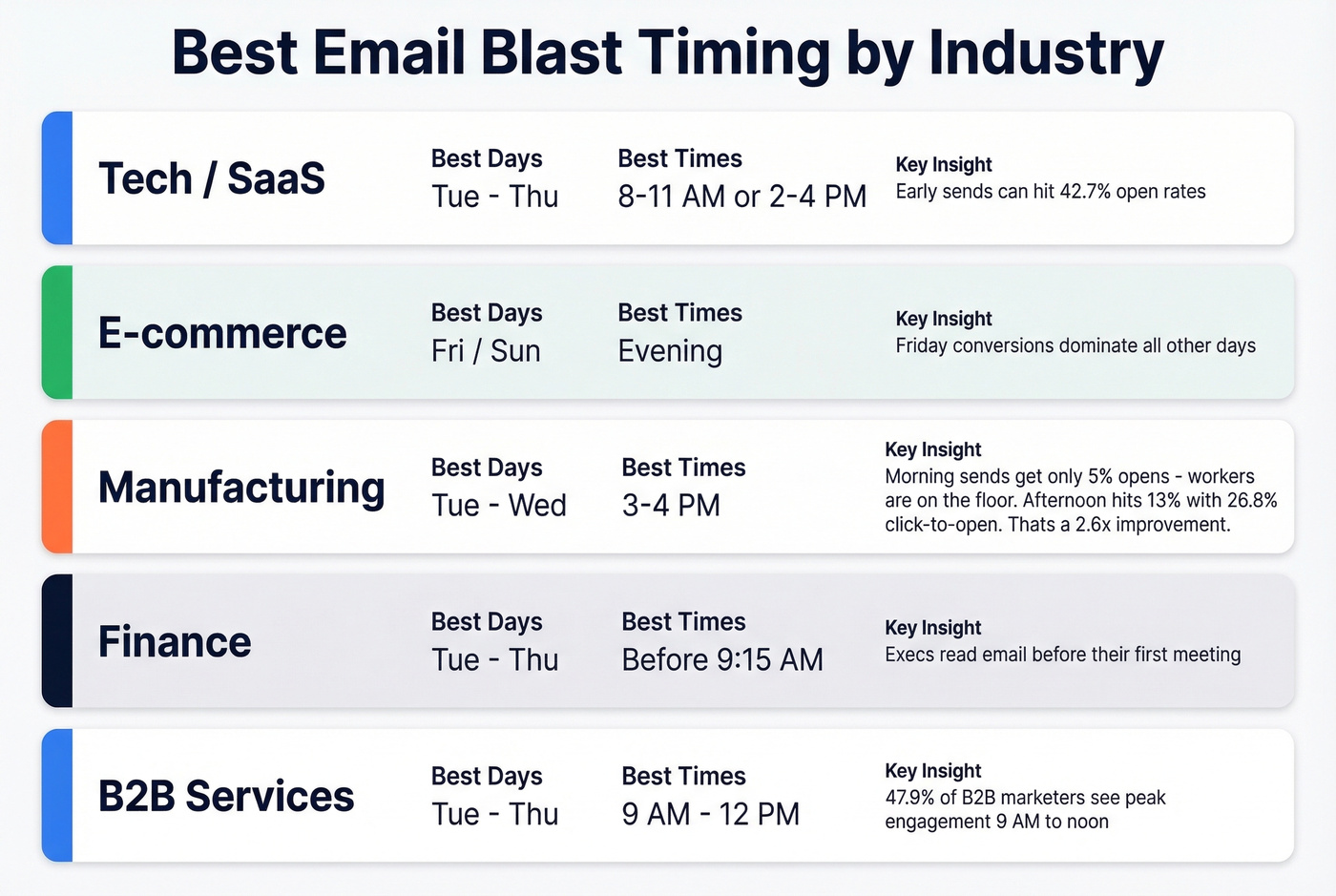
| Industry | Best Days | Best Times | Notes |
|---|---|---|---|
| Tech/SaaS | Tue-Thu | 8-11 AM or 2-4 PM | Early sends: up to 42.7% opens |
| E-commerce | Fri/Sun | Evening | Friday conversions dominate |
| Manufacturing | Tue-Wed | 3-4 PM | Morning: only 5.01% opens |
| Finance | Tue-Thu | Before 9:15 AM | Execs read pre-meetings |
| B2B Services | Tue-Thu | 9 AM-12 PM | Aligns with HubSpot B2B data |
The manufacturing data is striking. Morning sends produce just a 5.01% open rate - people are on the factory floor, not at a desk. But 3-4 PM hits 13.05% with a 26.8% click-to-open rate. That's a 2.6x improvement from shifting by a few hours.
Role-based timing matters in B2B as well. C-suite executives tend to check email before 9:15 AM, while VPs and Directors are more reachable between 10:15 and 11:45 AM. For account-based campaigns, segmenting by seniority can move the needle more than any global send-time tweak.
Cold Email vs. Marketing Blast
Let's be honest: marketing email timing rules don't apply to cold outreach. We've tested this extensively, and timing is a weak lever for cold email. Offer, targeting, and deliverability matter 10x more.
Operational rules that actually matter:
- Distribute sends throughout business hours in the prospect's timezone
- Avoid the 12-2 PM lunch window
- Stagger delivery: one email every 15 minutes per sending account
- Follow the 100/5 rule: max 100 emails per inbox per day, no more than 5 inboxes per domain
- Start new inboxes at 20-30 emails/day and ramp 10-20% every few days
Gmail throttles gradually. Microsoft is more binary - you're fine until you're not. Yahoo is the most aggressive. Diversifying your sending infrastructure matters.
Bad data kills cold campaigns before timing ever enters the equation. A 12% bounce rate tanks sender reputation faster than any poorly timed campaign. Verify every address before it hits your sequence - Prospeo catches invalid emails, spam traps, and honeypots using a 5-step verification process with 98% accuracy. (If you're running outreach, compare this to dedicated cold email timing guidance.)
The 10 AM to 2 PM Problem
You schedule a blast for 10 AM. Half your list gets it at 10:02. The other half trickles in over four hours.
ISP throttling is the culprit. When mailbox providers detect volume spikes, new IP addresses, or missing SPF/DKIM/DMARC authentication, they don't bounce your emails - they queue them. Those throttled messages show up as deferrals, and ESPs keep retrying delivery for up to 72 hours. This is why nailing your send schedule is only half the battle.
The fix isn't a more precise send time. It's maintaining consistent sending patterns so ISPs trust your domain. Erratic volume is the fastest way to trigger throttling.
One tactical tip: schedule sends at odd minutes - 10:07 or 11:23 instead of 10:00. Most promotional emails go out on the hour, creating an inbox pile-up. Sending at non-standard times gives your subject line a few extra seconds of visibility before the next wave arrives.
AI Send-Time Optimization
29% of email marketers already use AI for send-time optimization. One brand saw a 23% conversion lift from AI-driven STO compared to static scheduling - a meaningful gain for zero ongoing effort.
Mailchimp includes send-time optimization on paid plans, typically starting around $20-$30/month depending on list size. MailerLite's Smart Sending is available on their Advanced plan, with pricing that varies by list size. Both analyze individual subscriber behavior to predict optimal delivery windows.
One caveat: Apple Mail accounts for nearly half of all email opens, and Apple Mail Privacy Protection pre-loads tracking pixels, inflating open rate data. STO tools that account for this are more reliable than those that don't. Ask your ESP how they handle it.
The mobile angle reinforces evening sends - over 60% of emails are now opened on mobile devices, and evening sends align perfectly with couch-scrolling behavior. We've seen STO outperform manual scheduling within two to three weeks of activation. If your ESP offers it, turn it on and stop guessing.
What Matters More Than Timing
Here's the uncomfortable truth: timing is a 5-10% lever. List quality, subject lines, and deliverability are 50%+ levers. In our experience, teams that fix their bounce rate before touching send times see 3-5x the improvement.
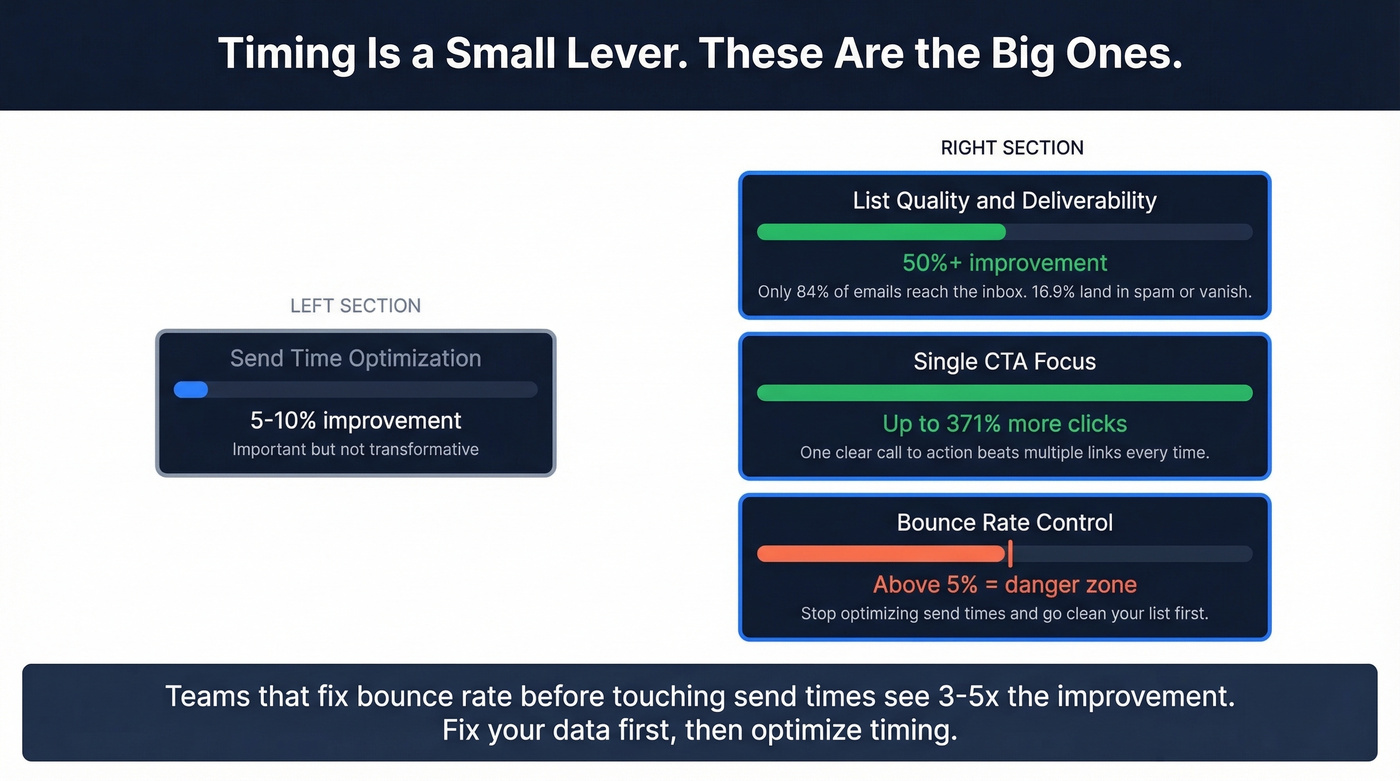
Only 84% of marketing emails actually reach the inbox - 16.9% land in spam or vanish entirely. Meanwhile, 69% of users unsubscribe because they receive too many emails. And a single CTA increases click-through rates by as much as 371%, which tells you where your optimization energy should really go. (If you're diagnosing performance, use a clean click rate formula before changing timing.)
Frequency guidelines that work:
- B2B: 2-4 emails per month
- B2C retail: 4-8 emails per month
- E-commerce: 4-5 per week if properly segmented
- Service businesses: 2-3 per month
Clean your lists every 3-6 months. Remove subscribers who haven't engaged in 6-12 months after a re-engagement attempt. If your bounce rate is above 5%, stop optimizing send times and go clean your list. Before you fine-tune your send schedule, verify your data - Prospeo verifies emails in real time with 98% accuracy and refreshes data every 7 days, so your list doesn't decay between campaigns. (If you're troubleshooting, start with bounce rate benchmarks and fixes.)
Friday 6 PM only works if your emails actually land in the inbox. Bad data triggers ISP throttling, deferrals, and reputation damage - the exact problems this article warns about. Prospeo refreshes 300M+ contacts every 7 days (not 6 weeks) so your next blast hits real, verified inboxes.
Send at the perfect time to contacts that actually exist.
FAQ
Is Tuesday really the best day for email blasts?
For open rates, yes - multiple studies confirm it. But Friday outperforms every other day for conversions in Omnisend's data, and MailerLite's 2.1M-campaign dataset shows Friday leads the week on both opens and clicks. The "best" day depends on whether you want eyeballs or action.
Does send time matter for cold emails?
Barely. Offer, targeting, and deliverability are 10x more important. Distribute sends throughout business hours, follow the 100/5 rule, and fix your data quality first.
What's the worst time to send an email blast?
Monday mornings - inbox overload from the weekend kills engagement for most B2B audiences. The weekday lunch window of 12-2 PM also underperforms consistently across every dataset we reviewed.
How do I find my audience's ideal send time?
A/B test two time slots over 4-6 sends. Start with Tuesday 10 AM vs. Thursday 8 PM and measure clicks, not opens - open rates are unreliable due to Apple Mail Privacy Protection. If your ESP offers AI send-time optimization, enable it and let it learn for 2-3 weeks.
Does the best day to send mass email differ for B2B and B2C?
Yes. B2B audiences engage most on Tuesday through Thursday during business hours, while B2C and e-commerce lists see stronger conversions on Fridays and weekends when people have time to browse and buy.