

Best Time to Send Marketing Emails in 2026 (Data + Tests)
You "sent at 9am" to 200,000 subscribers last Tuesday, but ISPs throttled you, so half the list didn't receive it until lunchtime. Your timing test was never a timing test. Here's what actually determines when your emails land - and a framework for finding your real best send window.
Quick Answer: Default Schedule
If you need a starting point right now:
| Metric | Best Days | Best Window |
|---|---|---|
| Opens | Tue-Wed | 9-11am local |
| Clicks (afternoon) | Wed-Thu | ~4pm local |
| Clicks (evening) | Tue-Thu | 8-9pm local |
| Cold email replies | Tue-Wed | Morning send |
HubSpot's survey of 150+ U.S. marketers found 27% pick Tuesday as the best day, with 47.9% of B2B marketers reporting peak engagement between 9am and 12pm. Global email marketing revenue crossed nearly $10B last year - getting timing right isn't academic. But the consensus default is a starting line, not a finish line.
Why "Tuesday 10am" Fails
Every email marketing blog publishes some version of the same advice: send Tuesday or Wednesday, mid-morning, done. The problem? When Twilio SendGrid's data scientists analyzed their own dataset, they couldn't find a statistically significant single best open time. Open times varied so much across segments that the "best time" dissolved into noise.
That makes sense at scale. The world will send roughly 392.5 billion emails per day in 2026, fired off by 4.59 billion global email users. If every marketer follows the same "Tuesday 10am" playbook, you're competing with the entire industry for the same inbox window. The default advice creates its own crowding problem.
Then there's the measurement issue. Apple Mail accounts for roughly 48-54% of email opens. Apple's Mail Privacy Protection preloads tracking pixels, which means a huge chunk of your "opens" aren't real opens at all - they're proxy servers fetching images. So the studies that generated "Tuesday 10am" in the first place? Many are built on data that's structurally compromised.
The default schedule isn't wrong. It's just incomplete. Treat it as your control variable, not your strategy.
Opens, Clicks, and Conversions Peak at Different Times
This is the nuance most guides skip entirely.
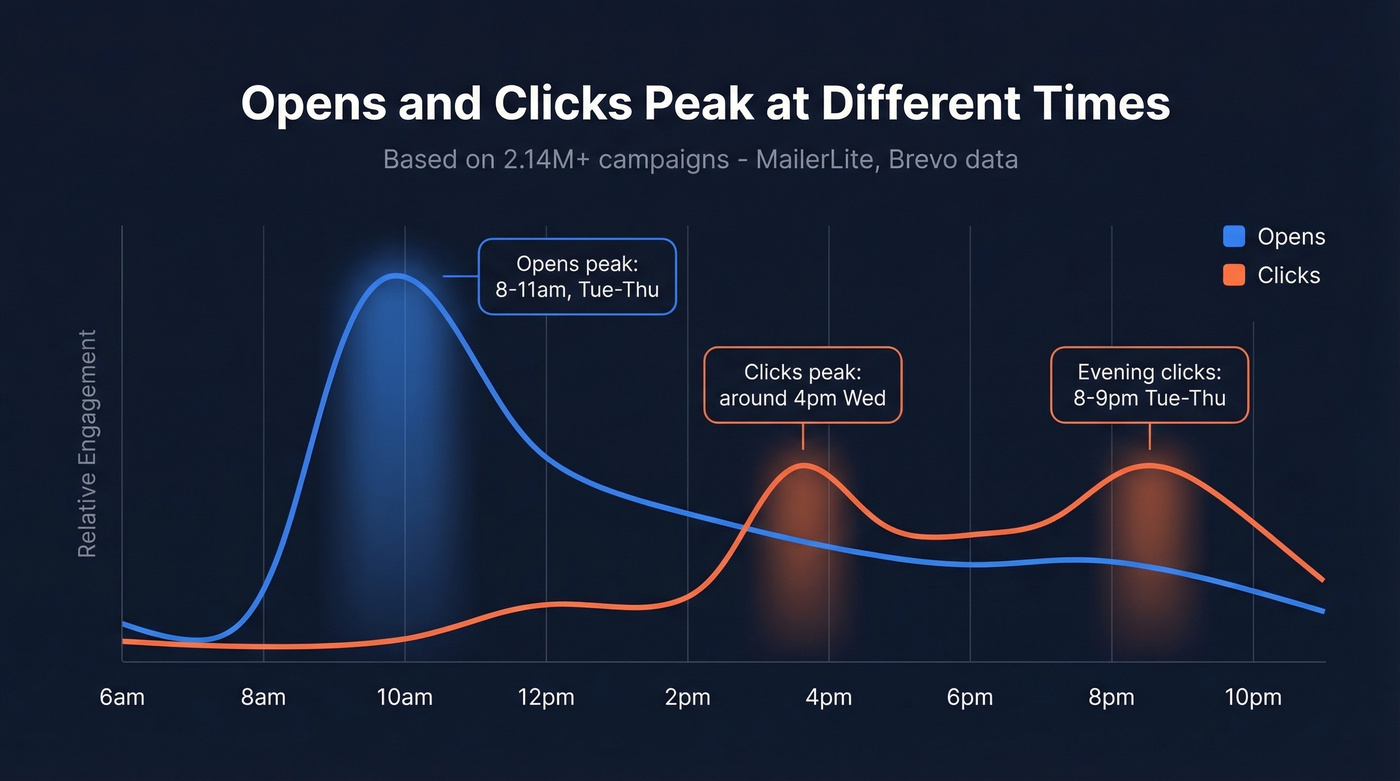
| Metric | Peak Time | Peak Day | Source |
|---|---|---|---|
| Opens | 8-11am | Tue-Thu | MailerLite (2.14M campaigns) |
| Clicks | ~4pm | Wednesday | Brevo |
| Clicks (evening) | 8-9pm | Tue-Thu | MailerLite |
| Opens + clicks aligned | 6pm | Friday | MailerLite |
Brevo's analysis found two cross-industry peak windows around 10:00 AM and ~3:30 PM, with clicks peaking closer to 4pm. Wednesday drove the most click-throughs even when Tuesday and Thursday drove more opens. MailerLite's dataset of 2.14 million campaigns tells a similar story: opens cluster in the morning, but clicks often spike between 8-9pm.
Here's the thing: if you're measuring opens to pick your send time, you're measuring the wrong thing. Clicks and conversions are what matter, and they peak later in the day than most "best time" articles suggest.
Open Rate Is Broken
Let's be honest - open rate is no longer a reliable metric for timing decisions, and anyone telling you otherwise hasn't updated their thinking since 2020.
Apple's Mail Privacy Protection preloads tracking pixels via proxy servers. This inflates opens, hides timestamps, strips IP addresses, and obscures device data. It doesn't matter what email provider your subscriber uses - if they read email in Apple Mail, their "open" is a ghost. Up to 75% of reported opens in some segments are artificial, per Eksido's analysis.
The fix isn't complicated. Segment your list into "high-confidence openers" - people who open and click - versus "low-confidence openers" who register an open but never engage further. Use clicks, conversions, and post-send website traffic as your primary timing signals. Chasing the best open-rate window alone isn't trustworthy enough to anchor your entire sending schedule around.

Open rates are broken, but bounce rates don't lie. Every bounced email tanks your sender reputation and makes your next timing test meaningless. Prospeo's 5-step verification delivers 98% email accuracy - so your carefully timed campaigns actually reach real inboxes.
Stop optimizing send times on a list full of dead addresses.
When to Send Based on Your Goal
The optimal window depends entirely on what you're sending and who you're sending it to.
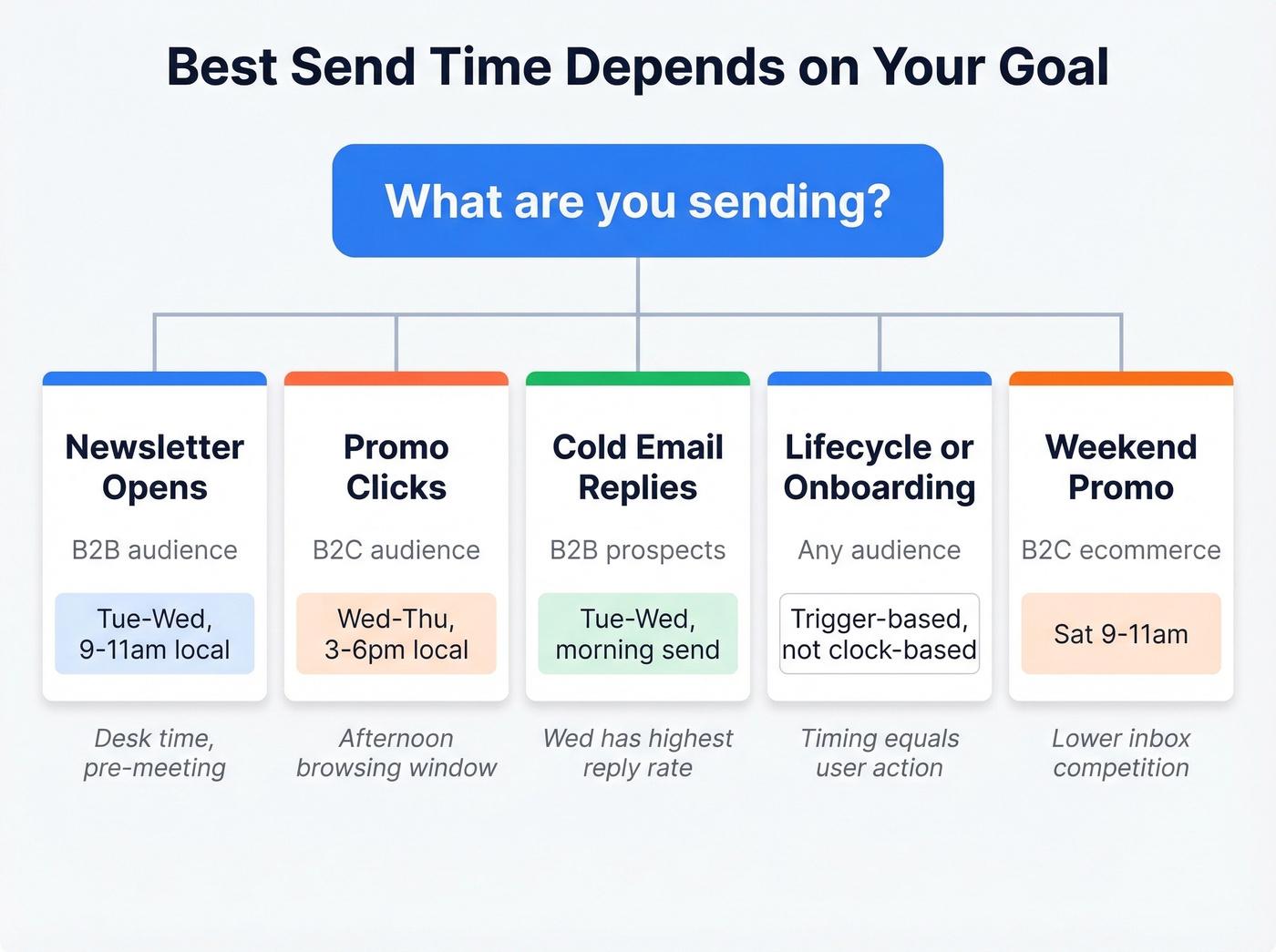
| Goal | Audience | Recommended Window | Why |
|---|---|---|---|
| Newsletter opens | B2B | Tue-Wed, 9-11am | Desk time, pre-meeting |
| Promo clicks | B2C | Wed-Thu, 3-6pm | Afternoon browsing |
| Cold email replies | B2B prospects | Tue-Wed, morning | Wed highest reply day |
| Lifecycle/onboarding | Any | Trigger-based | Timing = action, not clock |
| Weekend promo | B2C ecommerce | Sat 9-11am | Lower competition |
| Holiday promos | B2C | 7am send | Peak opens 8-9am |
For cold email specifically, the data is clearer than for marketing email. Instantly's benchmark report across billions of cold email interactions shows Wednesday as the highest reply day, with an average reply rate of 3.43% and top performers exceeding 10%. Keep first-touch emails under 80 words, use 4-7 touchpoints, and know that 58% of all replies come from step one. If your first email doesn't land at the right time, the whole sequence suffers.
For B2B marketing email, the HubSpot survey data is useful as a baseline: nearly half of B2B marketers report 9am-12pm as their peak window. B2C skews later and more weekend-friendly. But these are averages across industries - your audience's behavior will look different.
Hot take: If your deal size is under $15K and your list is under 20,000, stop obsessing over send-schedule optimization. Consistent Tuesday morning sends with clean data will outperform any sophisticated timing algorithm running on a thin dataset. The teams that benefit most from STO are the ones that already have their fundamentals locked down.
Deliverability Kills Your Timing
Here's the variable that most send-time articles ignore entirely: it doesn't matter when you send if your emails don't arrive on time.
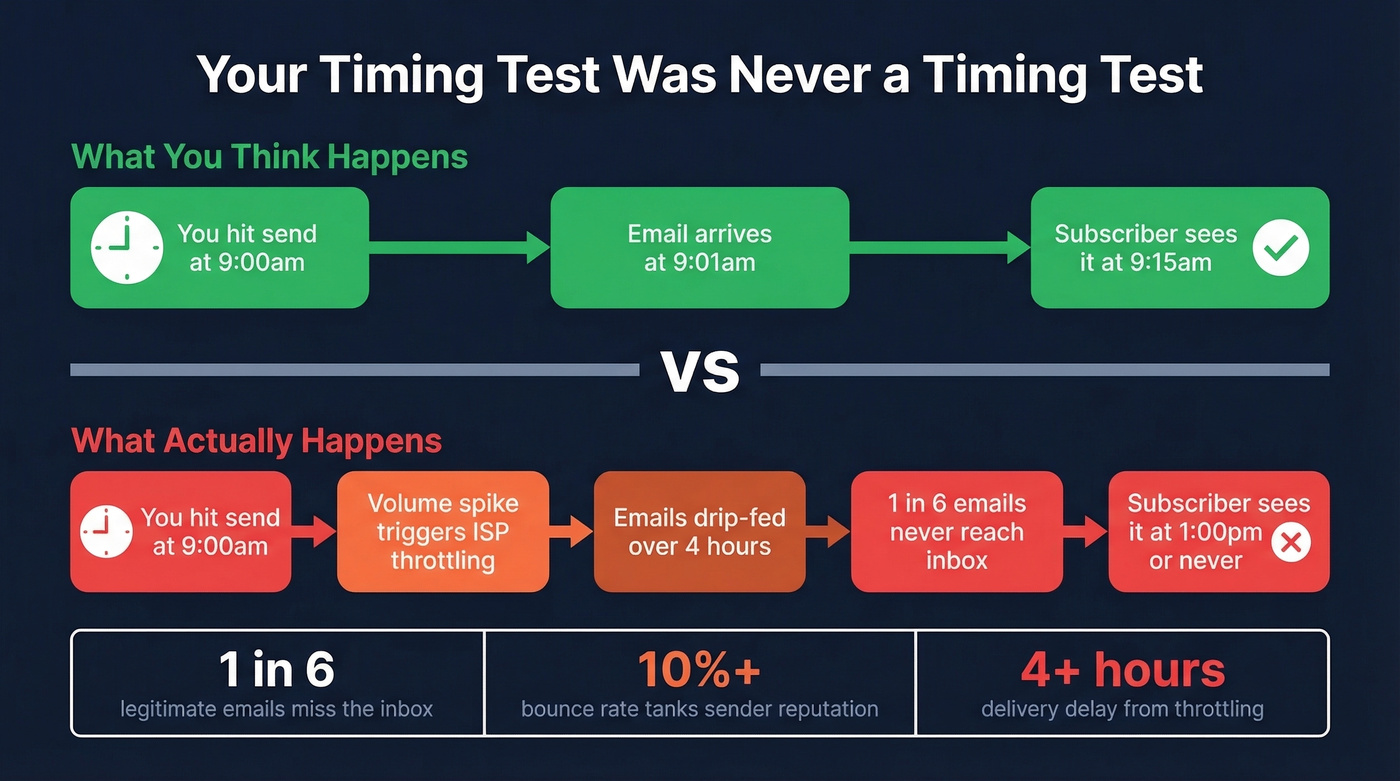
Allegrow's research identifies sudden volume spikes as the #1 trigger for reactive ISP throttling. That "feast or famine" pattern - nothing all week, then a massive Monday blast - is exactly the behavior that gets your sending reputation flagged. When ISPs throttle you, your "9am send" gets drip-fed to inboxes over hours. Your timing test was never a timing test; it was a deliverability test you didn't know you were running.
The scale of the problem: 1 in 6 legitimate emails never reaches the inbox. That's not a rounding error. That's a structural problem.
Deliverability doesn't just depend on sending patterns - it depends on list quality. High bounce rates signal to ISPs that you're not maintaining your list, which triggers more aggressive filtering. If 10% of your emails bounce, your sender reputation takes a hit, delivery slows down, and your carefully planned 10am send becomes a 1pm trickle. We've seen teams at agencies like Stack Optimize hold deliverability above 94% and bounce rates under 3% by verifying every address before it enters a sequence - that kind of hygiene is what makes timing tests actually mean something. (If you want a deeper baseline on bounce thresholds and what they mean, see our guide to bounce rates.)
Consistency matters too. Mailchimp's guidance on common email mistakes emphasizes that inconsistent sending frequency hurts engagement and deliverability. Send at roughly the same cadence, at roughly the same times, and your ISP reputation stabilizes. Then - and only then - can you meaningfully test timing.
How to Test Your Send Time
Most teams skip straight to "AI send-time optimization" without doing the basic work first. Here's a protocol that actually produces useful data.
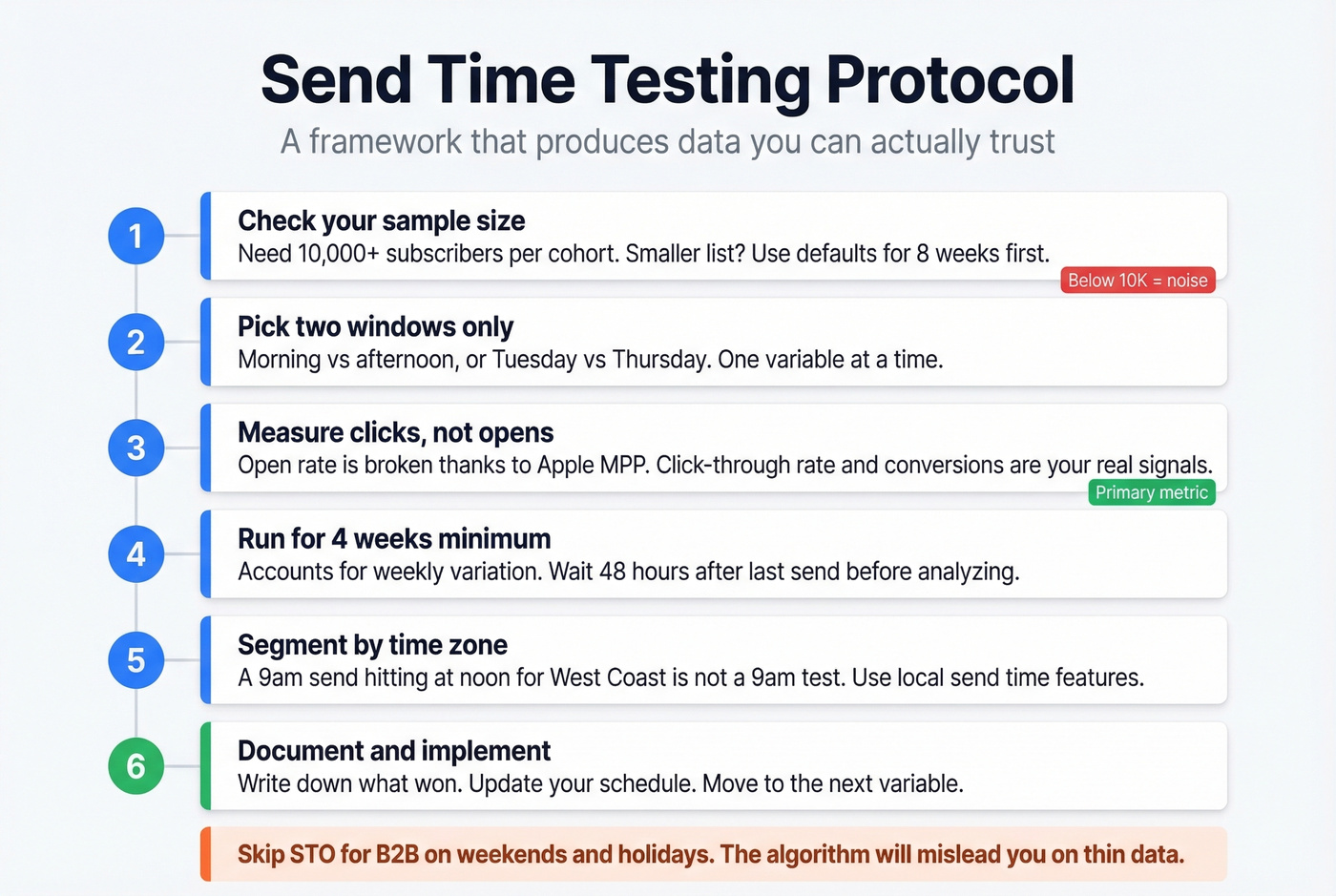
Minimum sample size
Litmus recommends at least 10,000 subscribers per test cohort for statistically meaningful results. Below that, you're reading tea leaves. If your list is smaller, pick the Tue-Wed 9-11am default, send consistently for 8 weeks, and compare click rates across sends.
Two windows, not five
Test your current send time against one alternative. Morning vs afternoon. Tuesday vs Thursday. One variable at a time. Run each test for 4 weeks minimum to account for weekly variation.
Measure clicks, not opens
For the reasons we covered above, open rate is unreliable as a standalone signal. Click-through rate and conversion rate are your real signals. (If you need a clean definition and calculation, use this click-through rate guide.)
Wait before declaring a winner
Give it at least 48 hours after the last email is sent before analyzing results. Early openers skew data, and ISP throttling means some emails arrive late.
Handle time zones
If your list spans multiple time zones, segment sends by recipient time zone. A 9am send that hits at noon for West Coast subscribers isn't a 9am test. Most ESPs support time-zone-based delivery - Mailchimp calls it "Timewarp," others call it "local send time." Use it.
STO vs. blast testing
If you're testing send-time optimization against a blast, send the STO cohort first and the blast cohort last. This reduces bias from ISP rate-limiting. Don't test STO until you've been sending consistently for at least 90 days - the algorithm needs historical data to learn from. If you're also managing sending limits, pair this with an email velocity baseline.
Document and roll out
The biggest testing mistake isn't methodology - it's running a test, getting a result, and then never implementing it. Write down what won, update your send schedule, and move on to the next variable.
Skip STO entirely for B2B audiences on weekends and holidays. If the algorithm decides Saturday 2pm is "optimal" based on a few data points, it's wrong for your VP of Engineering subscribers.
Per-Recipient Timing: The Real Optimization
Once you've nailed consistent sending and clean segmentation, per-recipient send-time optimization is the highest-leverage upgrade available.
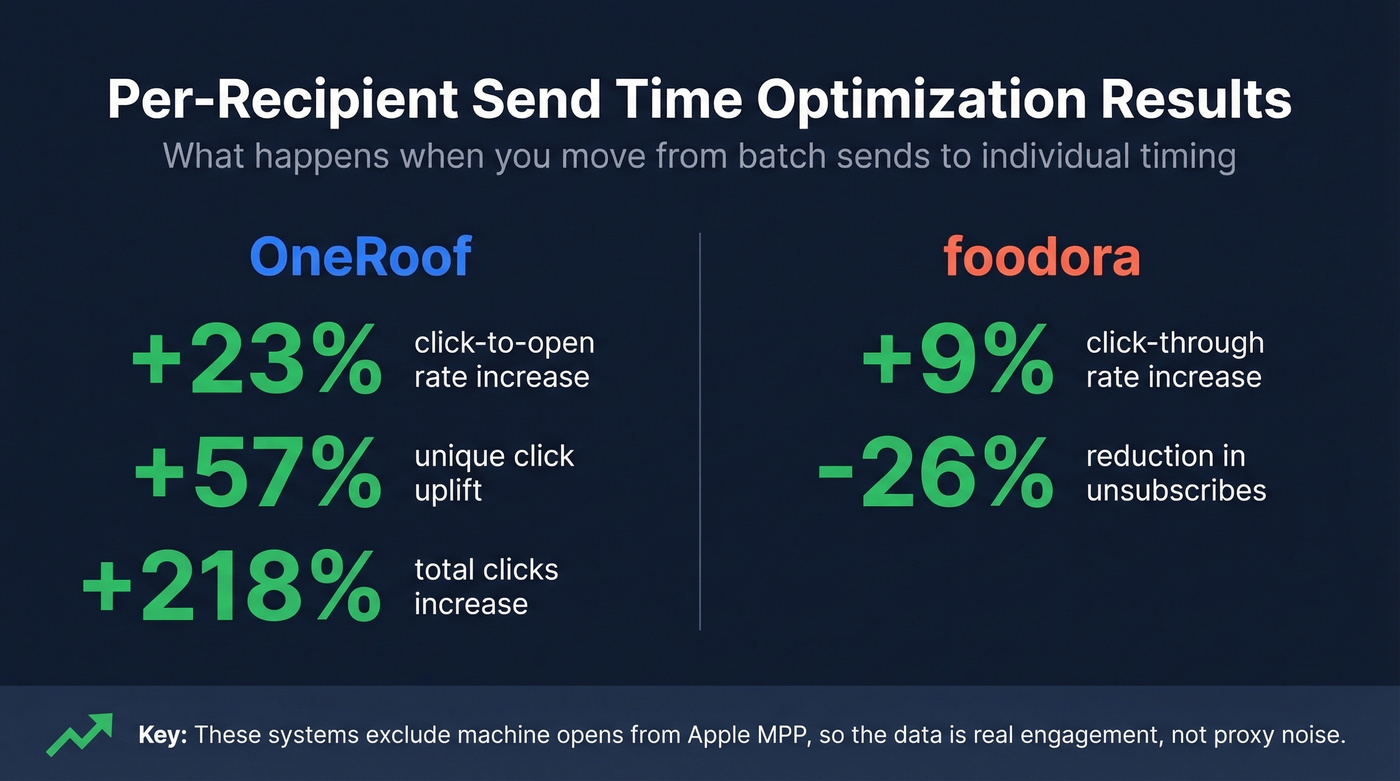
Braze's Intelligent Timing feature uses each user's interaction history - session times, push opens, email clicks, and email opens - to predict when they'll engage. Critically, it excludes machine opens from the model, which means it's not fooled by Apple MPP.
The case studies speak for themselves. OneRoof saw a 23% increase in click-to-open rate, 57% uplift in unique clicks, and a 218% increase in total clicks after implementing Intelligent Timing. foodora reported a 9% CTR increase and a 26% reduction in unsubscribes. KFC Ecuador saw a 15% lift in opens. These aren't small numbers. And they compound - better timing means better engagement, which means better deliverability, which means even better timing accuracy over time. We've watched this flywheel effect kick in once teams get their data quality and sending consistency right. (If you're tightening the foundation first, start with an email deliverability checklist and a basic sender reputation plan.)
Per-recipient STO isn't where you start. It's where you graduate to after you've built a clean list, established consistent sending patterns, and run basic timing tests. But once you're there, it's the closest thing to a statistically optimal send time that actually exists - because it's different for every subscriber.
Cold email reply rates peak on Wednesday - but only if you're reaching real buyers at valid addresses. Prospeo gives you 143M+ verified emails refreshed every 7 days, not the stale data that triggers ISP throttling and destroys your domain reputation.
Land in the inbox on Wednesday morning, not the spam folder.
FAQ
When is the best time to send a marketing email?
The strongest defaults are Tuesday through Wednesday between 9-11am for opens and Wednesday through Thursday around 3-6pm for clicks, based on MailerLite's analysis of 2.14M campaigns. These are cross-industry averages - your audience will differ by vertical and geography. Use these windows as a control, then A/B test clicks over 4+ weeks.
Is it bad to send marketing emails on weekends?
Not for B2C. Ecommerce brands often see strong Saturday morning engagement when inbox competition drops. B2B lists typically underperform on weekends. Test a Saturday 9-11am send against your best weekday and measure click-through rate - not opens - to decide.
What if my email list is too small to A/B test?
Below 10,000 subscribers, timing tests won't produce statistically significant results. Pick the Tuesday-Wednesday 9-11am default, send consistently for 8 weeks, then compare click rates across sends. At small scale, consistency and list hygiene matter more than optimization.
Does list quality affect send-time performance?
High bounce rates trigger ISP throttling, which delays delivery and corrupts your timing data. If 10% of your list bounces, your "10am send" lands at noon for half your subscribers. Clean your list before running any timing experiments - keeping bounce rates under 4% is the baseline that makes everything else work.