

The Best Way to Find Email Addresses - Every Method Ranked
You uploaded 500 leads, hit send, and watched your bounce rate spike to 12%. Three sequences paused. Your sending domain got flagged. Two weeks of pipeline work, gone.
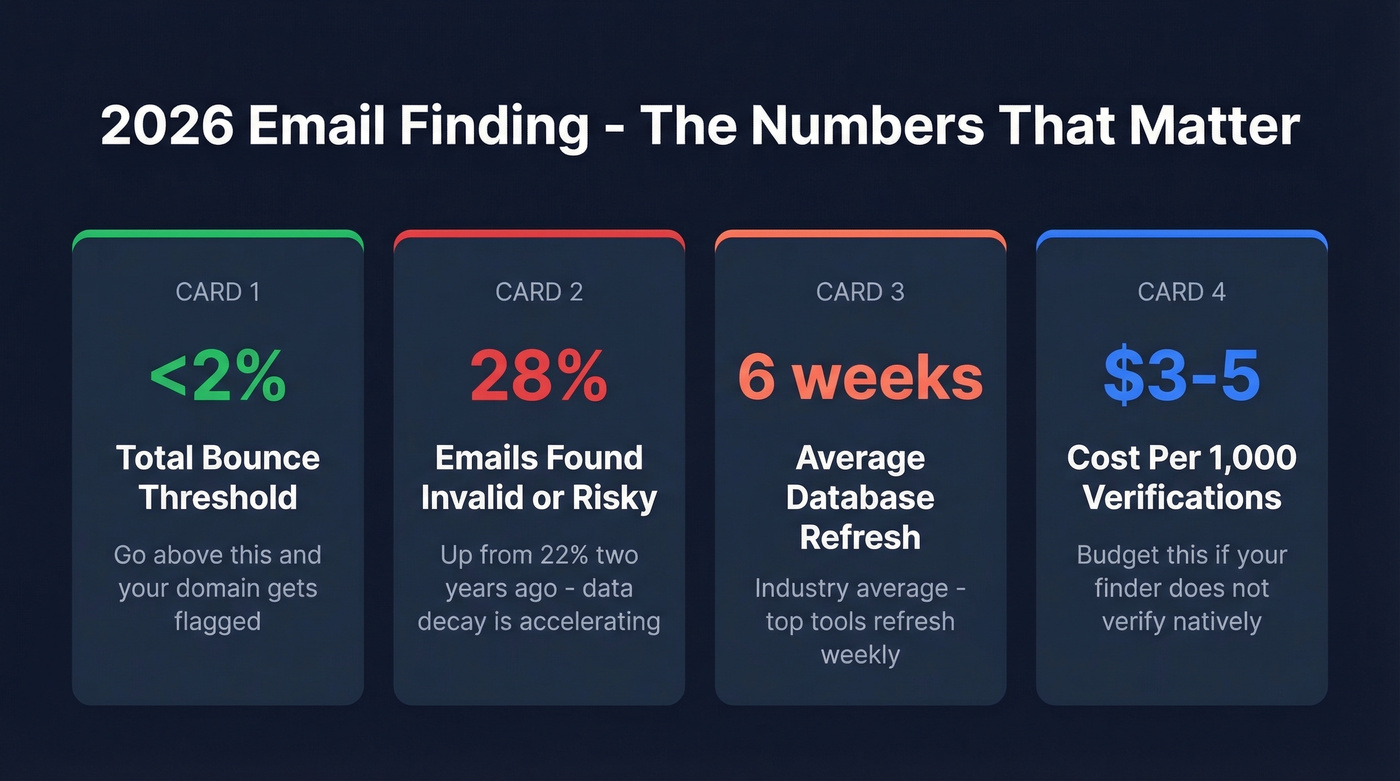
The problem isn't your messaging or your ICP - it's that the emails were wrong. In recent benchmarks, nearly 28% of all emails checked came back invalid or risky, up from roughly 22% two years earlier. The industry threshold for keeping your domain healthy sits at total bounces under 2%, with hard bounces under 1%. One bad campaign can blacklist you.
So what's the best way to find email addresses that actually reach an inbox? Not just "found" emails - deliverable ones. Let's rank every method.
What You Need (Quick Version)
- For domain-level searches on a budget - Hunter. 25 free searches/month, strong domain search, clean UI.
- For the largest raw database (verify separately) - Apollo. Free tier with ~250 emails/day, 275M+ contacts, but real-world accuracy runs 65-70%.
Whichever tool you pick, verify before you send.
Free Methods That Actually Work
Manual email finding works. It just doesn't scale. Your SDR spent three hours Googling and found 12 emails. Seven bounced. That's the reality - free methods make sense for a handful of high-value targets, not for filling a pipeline.
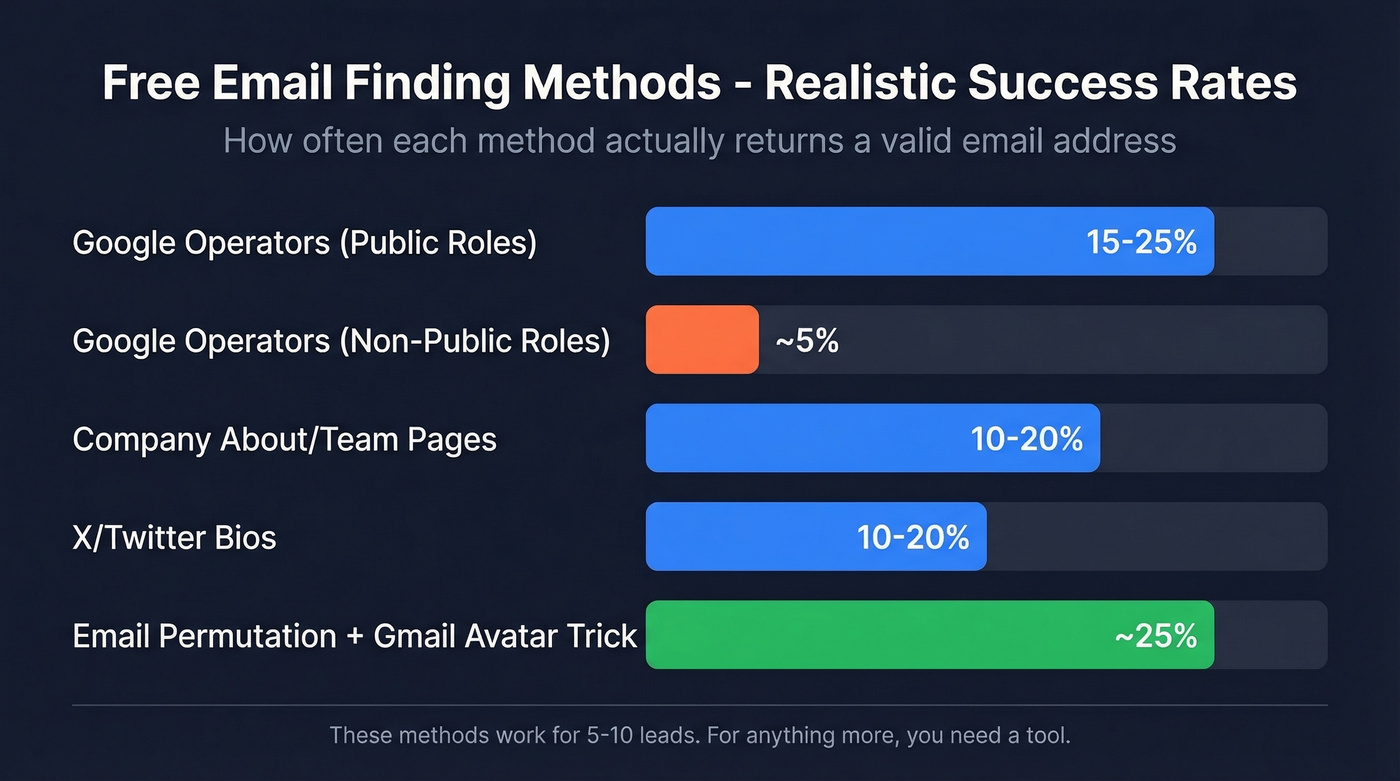
Google operators are the fastest free approach. Try these exact queries:
"Jane Smith" email site:acme.comsite:acme.com "team" OR "contact" email"Jane Smith" "jane.smith@" OR "jsmith@"filetype:pdf "Jane Smith" email- this catches speaker bios and whitepapers that most people overlook
Realistic success rate: 15-25% for public-facing roles like marketing directors, founders, and developer advocates. For everyone else - VPs of Finance, operations leads, mid-level buyers - expect closer to 5%.
Company websites and social bios still surface emails, especially "About" and "Team" pages. X/Twitter bios work for creators and journalists at roughly a 10-20% hit rate.
The email permutation + Gmail avatar trick is underrated. Generate common permutations (jane.smith@, jsmith@, j.smith@) using a free tool like Mailmeteor, then hover over each in Gmail compose. If a Google avatar or profile photo appears, that's a strong signal the address is live. In our testing, this confirmed roughly 1 in 4 permutations. Don't send to all permutations to "see what sticks" - that's a fast track to domain damage.
Manual methods work for 5-10 leads. For anything more, you need a tool.
Best Email Finder Tools in 2026
Prospeo
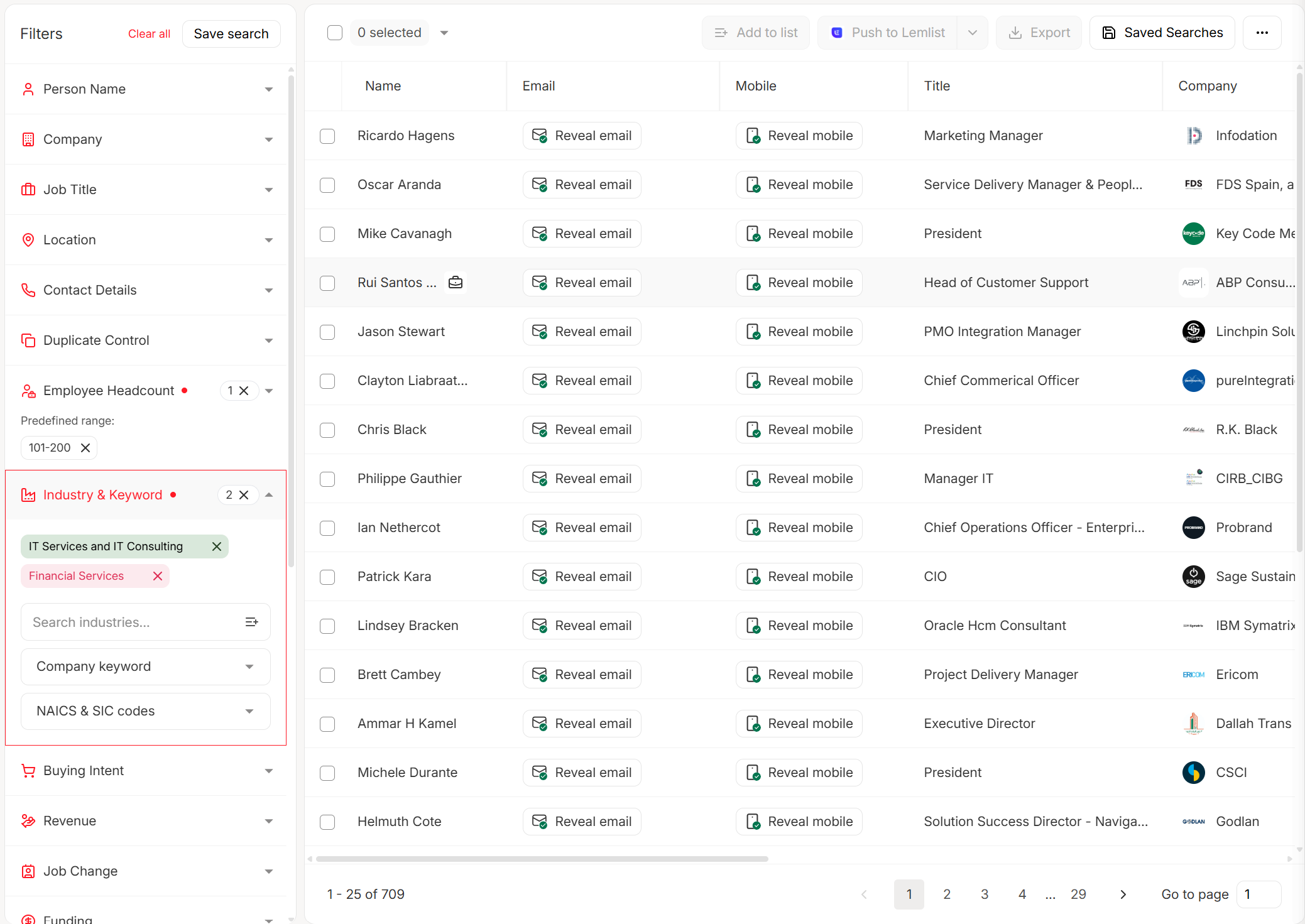
Use this if you're tired of finding emails that bounce and want verification baked into the search itself. Prospeo's 300M+ professional profiles - including 143M+ verified emails - run through a proprietary 5-step verification process with catch-all handling, spam-trap removal, and honeypot filtering before you ever see a result. The entire infrastructure is proprietary, with no reliance on third-party email providers. Email accuracy sits at 98%, and the database refreshes every 7 days (the industry average is 6 weeks).
That's not a theoretical number. Meritt, an outbound agency, dropped their bounce rate from 35% to under 4% after switching - and tripled their pipeline from $100K to $300K per week. At ~$0.01 per email on paid plans, the cost-per-valid-email math is hard to beat. The free tier gives you 75 emails/month, and the API supports programmatic lookups for teams building enrichment workflows.
Skip this if you need sequencing and a dialer in the same tool - Prospeo pairs with Instantly or Lemlist for that.
Hunter.io
Use this if you're doing domain-level research - "show me every email at acme.com" - and want a clean, simple interface. Hunter's domain search is one of the best in the category for that specific use case, and the G2 rating of 4.4/5 across 592 reviews reflects solid user satisfaction.

The free tier gives you 25 searches and 50 verifications per month. Paid plans start around $39/month depending on the package. Here's the thing: independent benchmarks put Hunter's combined valid rate around 37-38%. That means roughly 6 out of 10 results either don't return an email or return one that doesn't verify. The consensus on r/sales is consistent - Hunter has a small database and works best for US targets.
Skip this if you need high-volume prospecting or international coverage. Hunter's strength is precision domain search, not scale.
Apollo.io
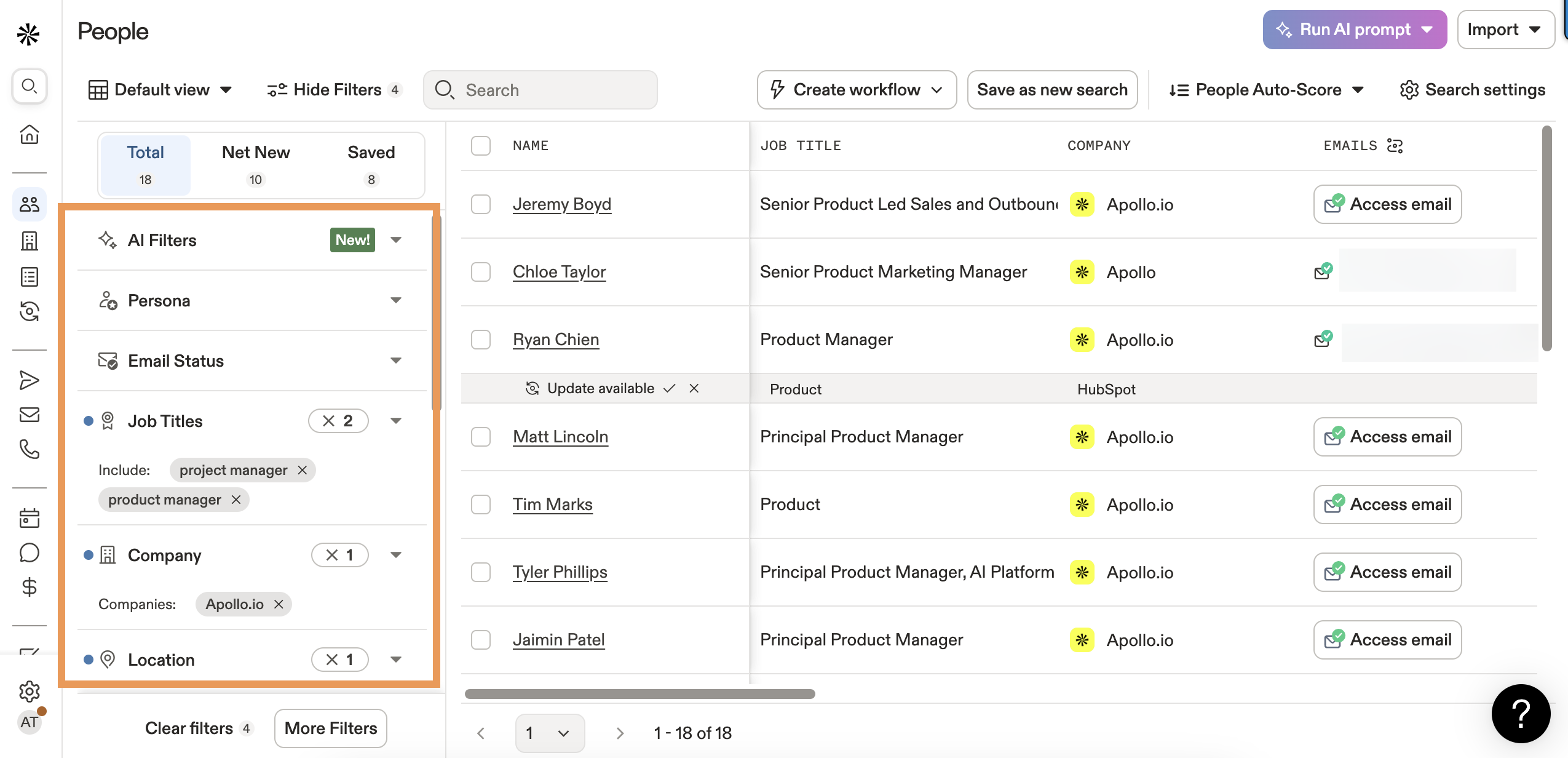
Use this if you want the biggest database and a free tier that's genuinely usable. Apollo covers 275M+ contacts with a G2 rating of 4.7/5 across 8,904 reviews. The free plan gives you ~250 emails/day under fair use, and the Saleshandy benchmark clocked a 91% found rate on their 100-contact test.
"Found" doesn't mean "deliverable." We've seen bounce rates of 15-25% when sending to Apollo-sourced contacts without additional verification, and Reddit threads consistently flag outdated contacts as the platform's biggest weakness. Paid plans start at $49/user/month on annual billing, with credits that expire each billing cycle and $0.20 overages sold in 250-credit minimum blocks.
Skip this if you can't afford to verify separately. Apollo gives you volume; you'll need a verification layer on top.
Snov.io
Snov.io (G2 4.5/5) occupies a useful middle ground: 50 free credits/month, paid plans from $39/month for 1,000 credits, and the Saleshandy benchmark put its found rate at 79%. It also bundles basic email sequences, which saves you a separate tool if you're just getting started with outbound. The credit system gets expensive fast at scale, though - once you're past a few hundred emails per month, the per-contact cost climbs quickly compared to flat-rate or verification-first tools.
GetProspect
At 61.9% in independent valid-rate benchmarks, GetProspect lands better than Hunter but well below the top tier. It offers a Chrome extension, and the 50 free emails/month plus $49/month paid plans make it accessible. The real question is whether a 62% valid rate is acceptable for your workflow - that means verifying and discarding nearly 4 out of 10 results. For teams already running a separate verification step, it's a reasonable source. For everyone else, the math doesn't work.
Anymail Finder
Most tools charge you whether the email works or not. Anymail Finder flips that - you only pay for valid results. If they can't confirm the address, you don't spend a credit. The free tier includes 100 credits, plans start at $14/month, and independent benchmarks show a 77.5% valid rate. Catch-all handling is built in. It's a finder and verifier, not a lead database, so don't expect Apollo-scale prospecting. But for teams who want to control data quality spend, the pay-for-verified model is genuinely smart.
Quick Mentions
- RocketReach - 5 free searches, paid from $36/month. Saleshandy benchmark: 83% found rate. Decent for one-off lookups, but per-search pricing adds up fast for teams.
- VoilaNorbert - 50 free leads, paid from $49/month. G2 4.6/5. Clean UX, reliable for individual searches, limited filtering compared to database tools.
- Lusha - 5 free credits/month, paid from $29/month. Best known for phone + email enrichment. Useful if you need direct dials alongside emails, less compelling as a pure email finder.

This article exists because most email finders return addresses that bounce. Prospeo's 5-step verification runs before you see a single result - 98% accuracy, 143M+ verified emails, refreshed every 7 days. At $0.01 per email, one bad campaign costs more than a year of clean data.
Find emails that actually reach inboxes. 75 free emails to prove it.
Pricing and Accuracy Compared
Stop comparing tools by database size. A tool with 300M profiles at 98% accuracy beats 275M at 65% every time. What matters is cost per valid email - the price you pay for an address that actually lands.
| Tool | Free Tier | Starting Price | Accuracy | ~Cost/Valid Email |
|---|---|---|---|---|
| Prospeo | 75 emails/mo | ~$39/mo | 98% | ~$0.01 |
| Hunter | 25 searches/mo | ~$39/mo | ~37.6% | ~$0.26 |
| Apollo | ~250/day | $49/user/mo | 65-70% | ~$0.07-0.10 |
| Snov.io | 50 credits/mo | $39/mo | 79% | ~$0.05 |
| GetProspect | 50 emails/mo | $49/mo | 61.9% | ~$0.08 |
| Anymail Finder | 100 credits | $14/mo | 77.5% | ~$0.02* |
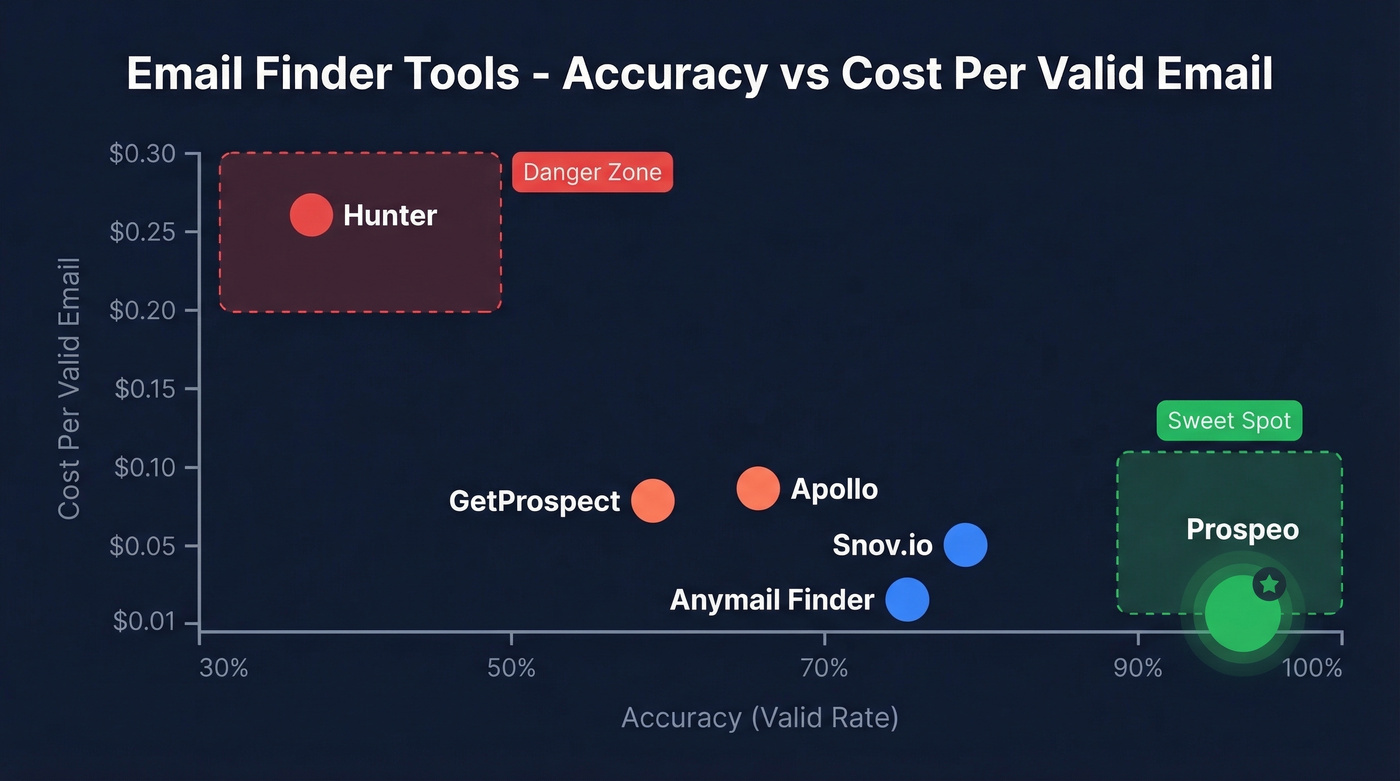
*Anymail Finder charges only for valid results, which changes the math significantly.
Look, if your deal sizes sit below five figures, you probably don't need a $49/user/month platform with 275M contacts. You need 500 verified emails that actually land. Hunter looks cheap until you realize that only ~37-38% of results come back valid - you're effectively paying far more per usable email than the sticker price suggests. The cheapest tool is the one where you don't throw away half the results.
Why Verification Isn't Optional
We've seen teams skip verification to save $20/month and then spend weeks recovering a blacklisted domain. The math never works out.
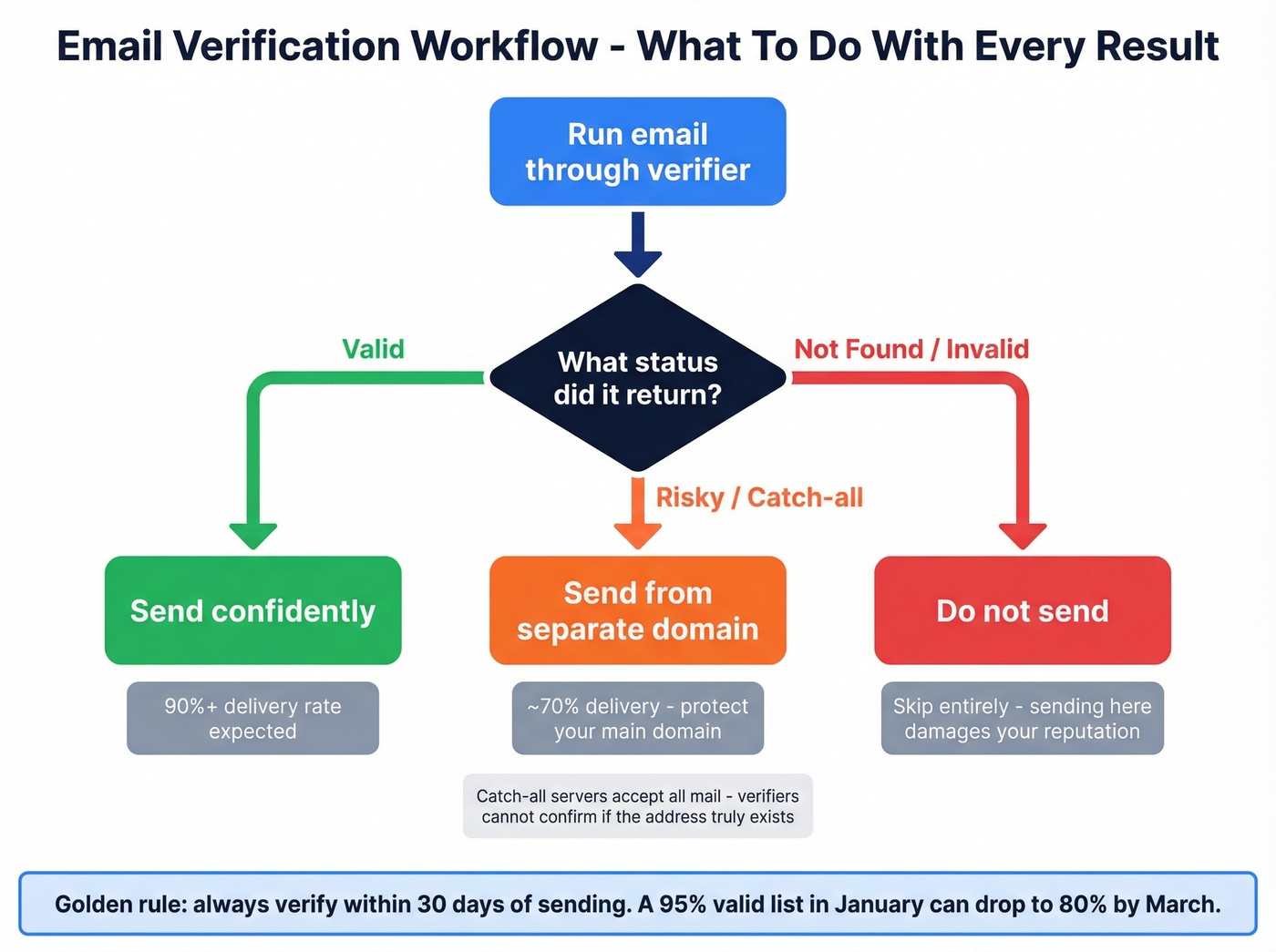
| Status | What It Means | What to Do |
|---|---|---|
| Valid | Confirmed deliverable, 90%+ success rate | Send confidently |
| Risky | Catch-all or greylisted, ~70% delivery | Send from separate infrastructure |
| Not Found | Unverifiable or nonexistent | Skip entirely |
Catch-all domains are the silent killer. These servers accept mail to any address, so a verifier can't confirm whether jane.smith@acme.com actually exists. Most tools label these "risky" and leave you guessing. External verifiers can reduce a previously "valid" list by up to 20%, mostly because of catch-all reclassification.
If your email finder doesn't include verification natively, budget $3-5 per thousand for a standalone verifier (or compare options in our email verification alternatives).
The golden rule: verify within one month of sending. Email data decays fast. A list that was 95% valid in January can be 80% valid by March.
GDPR and CAN-SPAM Compliance
Under GDPR, B2B cold email is legal if you have a legitimate interest - meaning the recipient's professional role is relevant to what you're selling. A SaaS company emailing CTOs about their DevOps tool has legitimate interest. That same company emailing CTOs about life insurance does not. Three requirements:
Transparency. Identify yourself and your purpose clearly. No deceptive subject lines.
Relevance and personalization. Generic blasts to purchased lists are the fastest way to get reported. Tailor the message to the recipient's role and company (use an ideal customer profile to keep targeting tight).
One-click opt-out. Every email needs an unsubscribe mechanism that works immediately. No "reply to opt out" workarounds.
Beyond the legal minimum, use reputable data sources, clean your lists regularly, and practice data minimization - collect only what you need. CAN-SPAM adds the requirement of a physical mailing address and honest "From" headers. Neither law bans cold email outright. They ban lazy, irrelevant, deceptive cold email.
Outreach Infrastructure Setup
Finding the email is step one. This is the infrastructure that keeps your domain alive after you hit send.
Never send from your primary domain. Buy secondary domains (acme-team.com, getacme.com) and route all cold outreach through them. Set up 2-3 inboxes per domain, each sending 10-15 emails/day. Scale by adding domains, not by cranking volume per inbox (see email velocity for safe sending limits).
Configure SPF, DKIM, and DMARC on every sending domain. Non-negotiable (use these SPF record examples and a DMARC alignment checklist).
Warm up for 14-21 days before sending any cold email. Keep warmup running even after you start campaigns. Most teams obsess over subject lines and ignore infrastructure - a perfectly written email sent from an unwarmed domain with bad SPF records goes straight to spam. Fix the plumbing first (more in our email deliverability guide).
Expect a 2-4% reply rate at scale. That's genuinely good in 2026. Below 1% means your list quality or messaging needs work, not your infrastructure.
Meritt dropped their bounce rate from 35% to under 4% and tripled pipeline to $300K/week - just by switching to data that was already verified. No extra verification step, no wasted credits on dead addresses, no domain flags.
Every method above needs a verification layer. Prospeo has one built in.
FAQ
What's the best way to find someone's email address in 2026?
Use an email finder with built-in verification - tools that return unverified results waste credits and risk your domain. Prospeo leads at 98% accuracy with a proprietary 5-step verification process; Anymail Finder and Snov.io also perform well. Always test on your own ICP, since accuracy varies by industry and geography.
Can I find email addresses for free?
Yes. Google operators, company websites, and social bios work for small batches at a 15-25% success rate for public-facing roles. Most paid tools offer free tiers - Hunter gives 25 free searches, Apollo's free plan includes ~250 emails/day, and Prospeo provides 75 verified emails per month with full verification included.
How do I know if a found email is valid?
Run it through verification before sending. "Valid" means confirmed deliverable with a 90%+ success rate. "Risky" typically indicates a catch-all domain with ~70% delivery. "Not found" means the address can't be verified - skip it entirely. Never send to unverified addresses.
Is it legal to cold email someone whose address I found online?
In most B2B contexts, yes - provided you have a legitimate interest, identify yourself, personalize the message, and include a one-click opt-out. Both GDPR and CAN-SPAM permit B2B cold outreach under these conditions. What they prohibit is deceptive, irrelevant mass emailing.
How often should I re-verify my email list?
Re-verify as close to send time as possible - ideally within 30 days. Email data decays fast: external verifiers routinely flag 20% of a previously "valid" list as undeliverable after just a few months. Re-verification costs $3-5 per thousand emails, trivial compared to the cost of a blacklisted domain.