

BigDBM Pricing, Reviews, Pros and Cons (2026)
BigDBM doesn't make its pricing easy to find. That's frustrating when you're evaluating consumer data vendors and just want a straight answer. Here's the actual breakdown: 4-7 cents per match, or $500 per purchase to $1,500/month depending on the dataset and API tier. For US consumer data, that's competitive. But whether BigDBM fits your stack depends entirely on what kind of data you actually need - and there's a big gap between consumer identity data and B2B sales prospecting that a lot of buyers gloss over.
30-Second Verdict
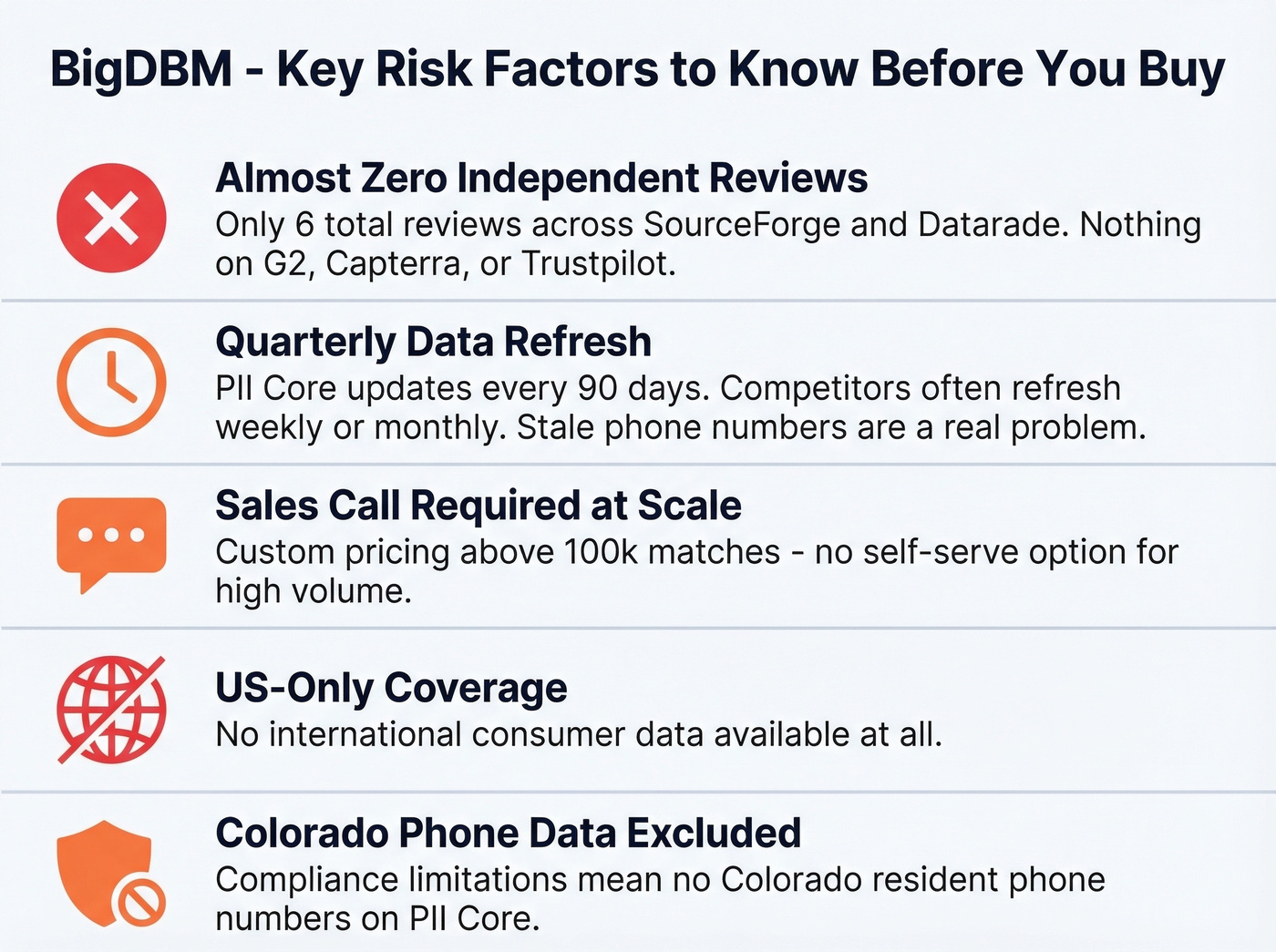
BigDBM is a solid pick for US consumer data. Per-match pricing is competitive, identity graph coverage spans 280M+ records, and the intent data scale is real at 12B+ weekly intent records. The catches: independent reviews are almost nonexistent, the flagship PII Core dataset refreshes quarterly (not weekly or monthly), and scaling past 100k matches means a sales conversation for custom pricing.
Worth trialing for consumer marketing teams. If your actual need is B2B sales prospecting with verified professional emails and direct dials, BigDBM isn't built for that.
BigDBM Pricing Breakdown
BigDBM is commonly bought two ways: per-match and monthly dataset licensing.
| Pricing Model | Cost | Details |
|---|---|---|
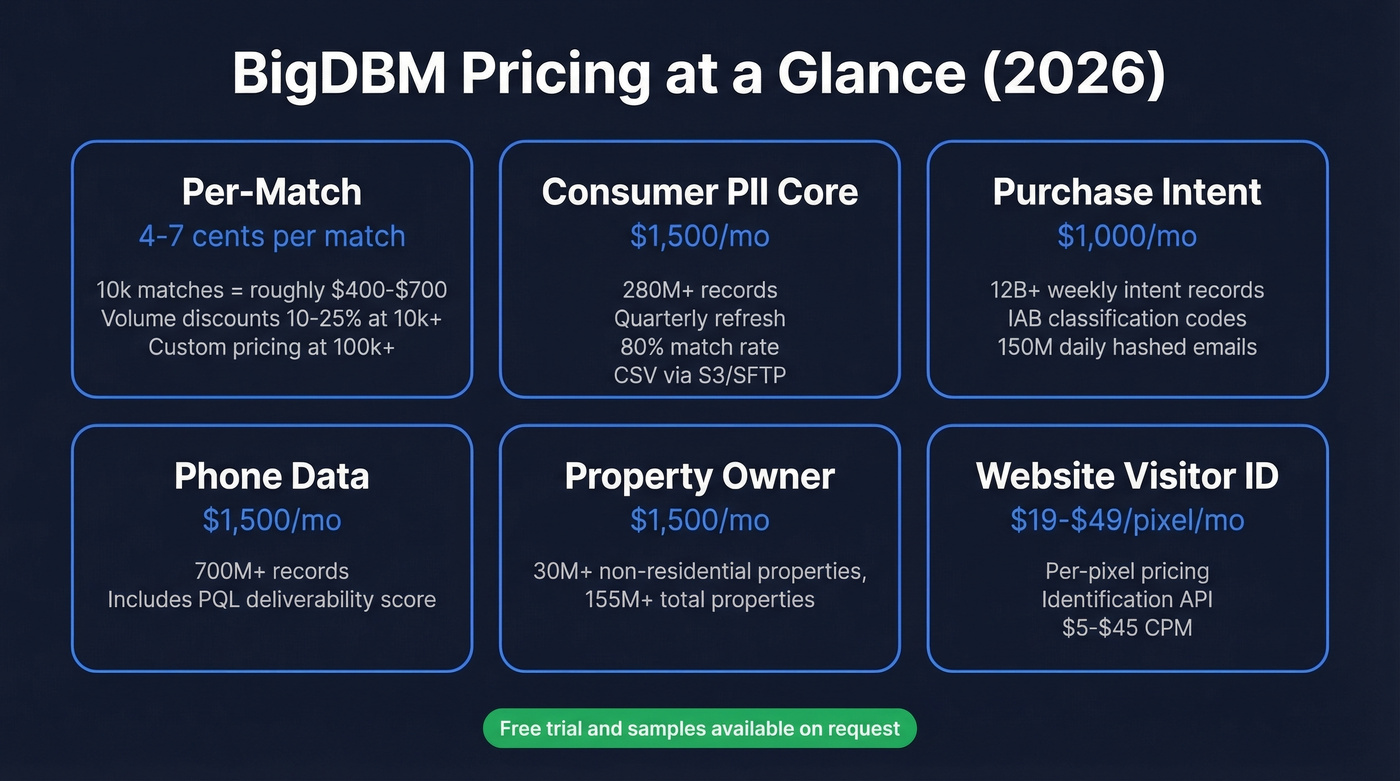
| Per-match | 4-7¢ per match | Volume discounts 10-25% above 10k matches; 100k+ gets custom pricing with 30%+ discounts |
| APIs & datasets | $500/purchase to $1,500/month | Range across BigDBM's catalog |
| Consumer PII Core | Starts at $1,500/month | 280M+ records, quarterly delivery, CSV via S3/SFTP, 80% match rate |
| Purchase Intent | Starts at $1,000/month | 12B+ weekly intent records, IAB classification codes, 150M daily hashed emails |
| Phone Number Data | Starts at $1,500/month | 700M+ records, includes a PQL score for deliverability |
| Property Owner Data | Starts at $1,500/month | 30M+ non-residential properties |
| Website Visitor ID | $19-$49 per pixel/month | Pixel pricing scales by number of pixels; Identification API is $5-$45 CPM by volume |
| Free Trial | $0 | Free samples available on request |
The per-match model is the better deal for most teams. At 4-7 cents per match, a 10k-record pull runs roughly $400-$700 before volume discounts. Monthly licensing only makes sense if you're pulling data continuously at scale.
For context, enterprise consumer data vendors like Experian and D&B often land in the $10k-$50k+/year range for comparable dataset access. BigDBM's $1,500/month entry point can be a fraction of that. They also advertise "estimated 30% better commercials than immediate competitors" on Datarade, and the per-match rates line up with that positioning.
What BigDBM Includes
BigDBM's data marketplace lists 22 United States datasets spanning consumer PII, intent, property, and identity resolution:
- 765M+ emails and 600M+ phone numbers across its coverage stats
- 12B+ weekly intent records with IAB classification
- 155M+ properties and 30M+ non-residential property records
- 10B+ IP addresses for identity resolution
- 30M+ student marketing records
- Confidence and quality scoring using recency, frequency, intensity, and strength
BigDBM has been building identity graphs since 2016, and they're positioned as a leading US consumer data provider with 7+ years of experience in the space.

BigDBM refreshes quarterly. Prospeo refreshes every 7 days - with 300M+ B2B profiles, 98% email accuracy, and 125M+ verified mobiles. If your actual need is reaching decision-makers, not consumers, the data gap is massive.
Get B2B emails at $0.01 each - no contracts, no sales calls.
Pros
- Competitive per-match pricing with clear discount tiers - 4-7 cents is affordable for consumer match-based buying
- Massive consumer coverage at 280M+ records with an 80% match rate on the PII Core package
- Deep intent data - 12B+ weekly records plus 150M daily hashed emails on the intent SKU
- Free trial and samples before any financial commitment
- CCPA-aligned with opt-out mechanisms
- Proprietary PQL score for phone deliverability, helpful for outbound calling campaigns
- Compliance transparency on the PII Core package, including a clear caveat about Colorado resident phone data exclusions
Cons
Here's the thing - BigDBM's data coverage is impressive, but the review situation is concerning.
Almost no independent reviews. Five reviews on SourceForge and one on Datarade. Nothing from G2, Capterra, or Trustpilot. That's a due diligence problem when you're buying data at scale, and it's the kind of gap that makes procurement teams nervous for good reason.
Quarterly delivery on the flagship dataset. Competitors in the consumer data space often refresh weekly or monthly. In fast-moving consumer markets, 90-day-old phone data means a meaningful percentage of numbers will have churned. We've seen quarterly refresh cycles create real problems for teams running time-sensitive campaigns - by the time you get your next batch, a chunk of your last one is already stale.
Custom pricing above 100k matches requires a sales conversation. No way around it.
US-only coverage. No international consumer data at all.
Colorado phone data exclusion due to compliance limitations on the PII Core package.
Who BigDBM Fits (and Who Should Skip It)
Good Fit
US consumer marketing teams running large-scale identity resolution, property data enrichment, or intent-based campaigns. Real estate data buyers, consumer direct mail teams, and identity verification use cases all map well to BigDBM's strengths. The per-match pricing works especially well for campaign-based buying where you're pulling records in bursts rather than continuously, and the consensus on r/dataengineering threads about consumer data vendors is that per-match models beat flat-rate licensing for most mid-market teams.
Skip BigDBM If...
You need verified B2B professional emails and direct dials with weekly refresh. BigDBM's consumer identity graph and B2B sales prospecting are fundamentally different jobs - don't try to force one into the other. Also skip if you need international coverage or prefer self-serve transparent per-seat pricing without sales calls.
If you're building a workflow around enrichment and list quality, start with data enrichment and a clear lead enrichment process before you pick a vendor.
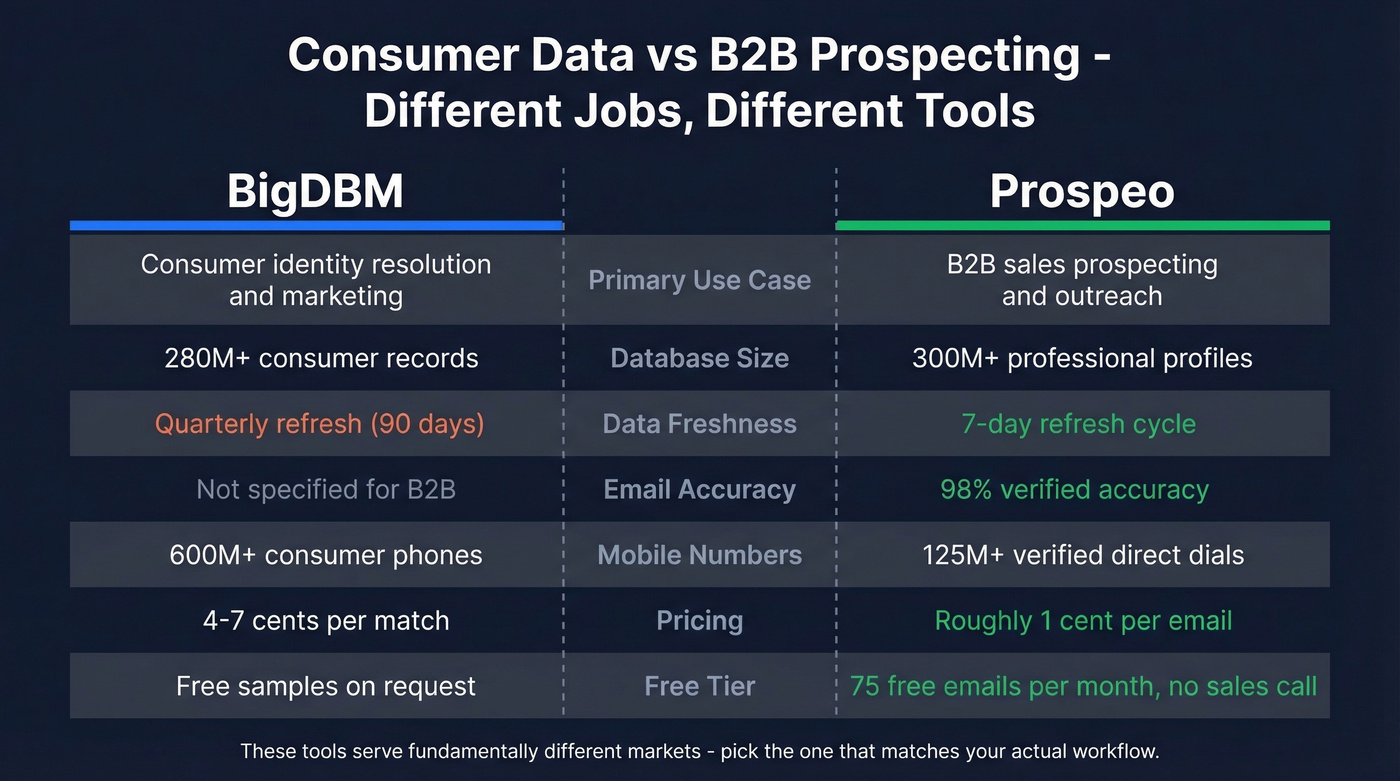
For B2B prospecting, Prospeo covers 300M+ professional profiles with 98% email accuracy and 125M+ verified mobile numbers on a 7-day refresh cycle. Pricing starts free at 75 emails/month, scales at roughly $0.01 per email, and requires no contract or sales call.
If you're comparing options, it helps to benchmark against other sales prospecting databases and broader B2B company data providers.
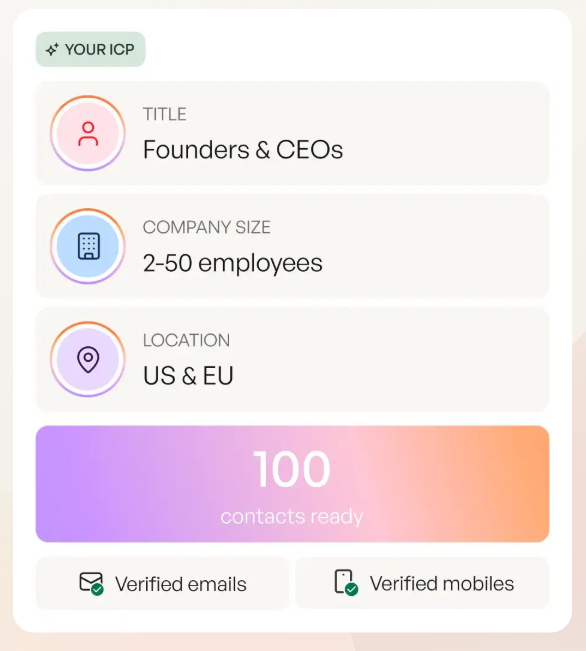
BigDBM's 4-7¢ per match buys you consumer PII. Prospeo's ~$0.01 per email buys you verified B2B contacts with direct dials and a 30% mobile pickup rate. Different job, different tool - and 15,000+ companies already made the switch.
Stop forcing consumer data into B2B workflows. Get 75 free emails now.
FAQ
Is BigDBM legit?
BigDBM was founded in 2016 and is a Verified Data Provider on Datarade. It's a real company with real products - just limited independent social proof. Only six total reviews exist across SourceForge and Datarade, so run your own match-rate test before committing budget.
Does BigDBM offer a free trial?
Yes. Free data samples are available on request, and a free trial is listed on review platforms. Evaluate match rates against your own records before committing - the advertised 80% match rate on PII Core will vary by list quality.
What if I need B2B emails, not consumer data?
BigDBM specializes in consumer identity data, not B2B sales prospecting. For verified professional emails and direct dials, tools like Prospeo are purpose-built for that job - 98% email accuracy, 125M+ verified mobiles, and a free tier to start with no sales call required.
How does BigDBM compare on data freshness?
BigDBM's flagship PII Core dataset refreshes quarterly. That's a 90-day cycle, which lags behind many consumer data providers offering weekly or monthly updates. For B2B use cases, platforms like Prospeo refresh every 7 days - though they serve a different market entirely, so it's not an apples-to-apples comparison.