

BigDBM vs CUFinder: Different Tools for Different Jobs
Comparing BigDBM and CUFinder is like comparing AWS to Mailchimp. Both involve "data," but the buyers, use cases, and pricing models have almost nothing in common. We've seen teams waste months evaluating tools in completely different categories because someone said "get better data" without specifying what that actually means.
Here's the thing: B2B data decays at roughly 22.5% per year, and poor data quality costs organizations an average of $12.9M annually. Picking the right type of data tool matters more than picking the "best" data tool. BigDBM sells raw datasets and identity graphs to marketing, advertising, and data teams. CUFinder sells a self-serve search-and-enrich experience for sales reps. Those are fundamentally different products solving fundamentally different problems.
30-Second Verdict
Choose BigDBM if you're a data or marketing ops team licensing consumer and B2B datasets at scale - Identity resolution, visitor identification, intent data for ad targeting.
Choose CUFinder if you're an SDR or small sales team that needs a self-serve search bar, Chrome extension, and CRM integrations under $300/month.
BigDBM at a Glance
BigDBM isn't a tool you log into to search for prospects. It's a data infrastructure layer - identity graphs, raw datasets, and APIs that feed into your existing marketing and analytics stack. If you're evaluating vendors in this category, start with a broader list of B2B company data providers and narrow by use case.
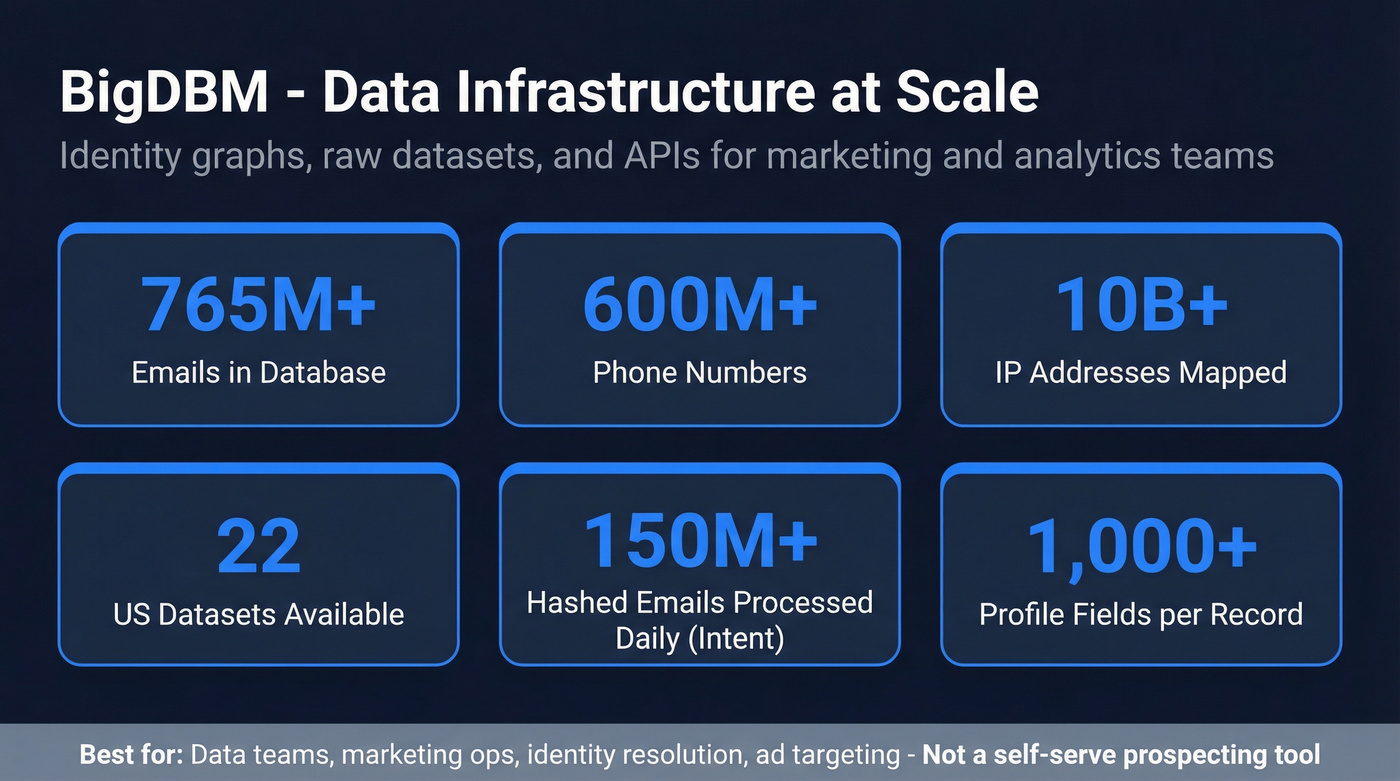
The scale is impressive for US-focused data. We're talking 765M+ emails, 600M+ phones, 10B+ IP addresses across 22 US datasets. Their visitor identification pixel resolves IPs and MAIDs into consumer and B2B profiles with 1,000+ fields. The intent dataset processes 150M+ distinct hashed emails per day, and their proprietary Phone Quality Level scoring uses telecom carrier signals to grade numbers before you dial them.
They've been building identity graphs for 7+ years and maintain CCPA compliance. One Datarade reviewer praised BigDBM's team for going "above and beyond" on support. But the review footprint is thin - 5.0/5 on SourceForge with 5 reviews, 5.0/5 on Datarade with 1 review. Virtually no Reddit chatter. This is a niche infrastructure play, not a mass-market SaaS.
CUFinder at a Glance
CUFinder is the opposite experience. Sign up, search for contacts by industry or job title, enrich your lists, and export to your CRM. It's built for reps who need leads now, not data engineers building pipelines. If you're comparing tools like this, it helps to benchmark against other sales prospecting databases and data enrichment services.
The platform claims 419M+ individual profiles, 260M+ valid company domains, 269M+ detailed company profiles, and 452M+ verified phone numbers. You get a Chrome extension, 10+ CRM integrations, a Google Sheets add-on, and API access. They claim 98% data accuracy, though we haven't independently verified that number.
Where CUFinder earns genuine praise is European lead data. One G2 reviewer called it the "best database for European leads" with competitive pricing. Reddit mentions are sparse - CUFinder shows up in generic tool lists but lacks dedicated discussion threads.

BigDBM requires engineering resources and $1,000+/month dataset licenses. CUFinder caps you at 10,000 credits for $299/month. Prospeo gives you 300M+ profiles with 98% email accuracy, 125M+ verified mobiles, and 30+ search filters - all self-serve at ~$0.01 per email.
Get outbound-ready data without infrastructure costs or credit ceilings.
Head-to-Head Comparison
| Category | BigDBM | CUFinder |
|---|---|---|
| Target buyer | Data/marketing ops | SDRs, small teams |
| Pricing model | CPM / dataset licensing | Credit-based SaaS |
| Data type | Consumer + B2B | B2B (sales intelligence) |
| Key use case | Identity resolution, ads | Search and enrich |
| Self-serve UI | No (APIs + datasets) | Yes (search bar + extension) |
| Integrations | API-based | 10+ CRMs, Sheets |
| Review rating | 5.0/5 (thin volume) | 4.8/5 (988 reviews) |
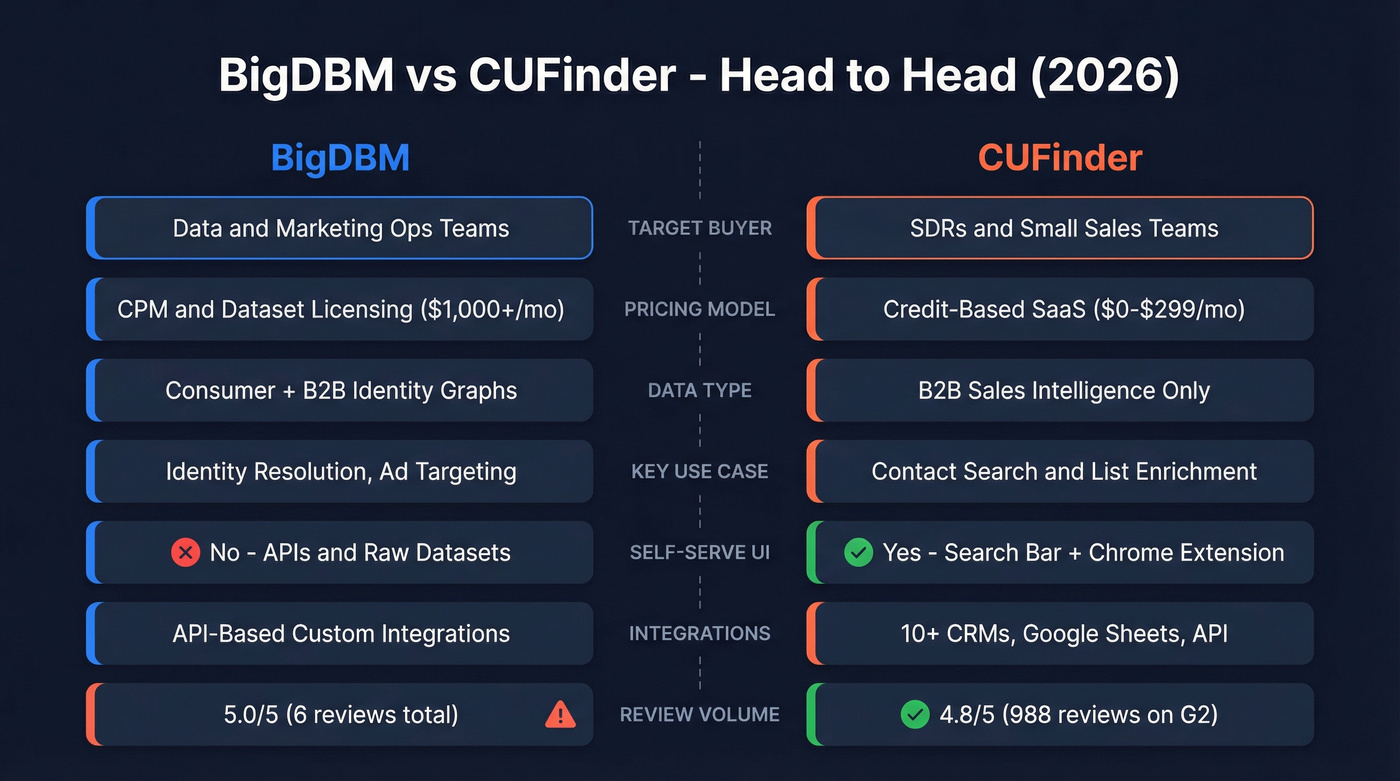
In our experience, most teams searching this comparison actually want a self-serve prospecting tool - not a dataset license. If that's you, the BigDBM column is irrelevant to your workflow. You’ll likely get more value from an SDR tool stack that includes prospecting, enrichment, and sequencing.
Pricing Breakdown
CUFinder
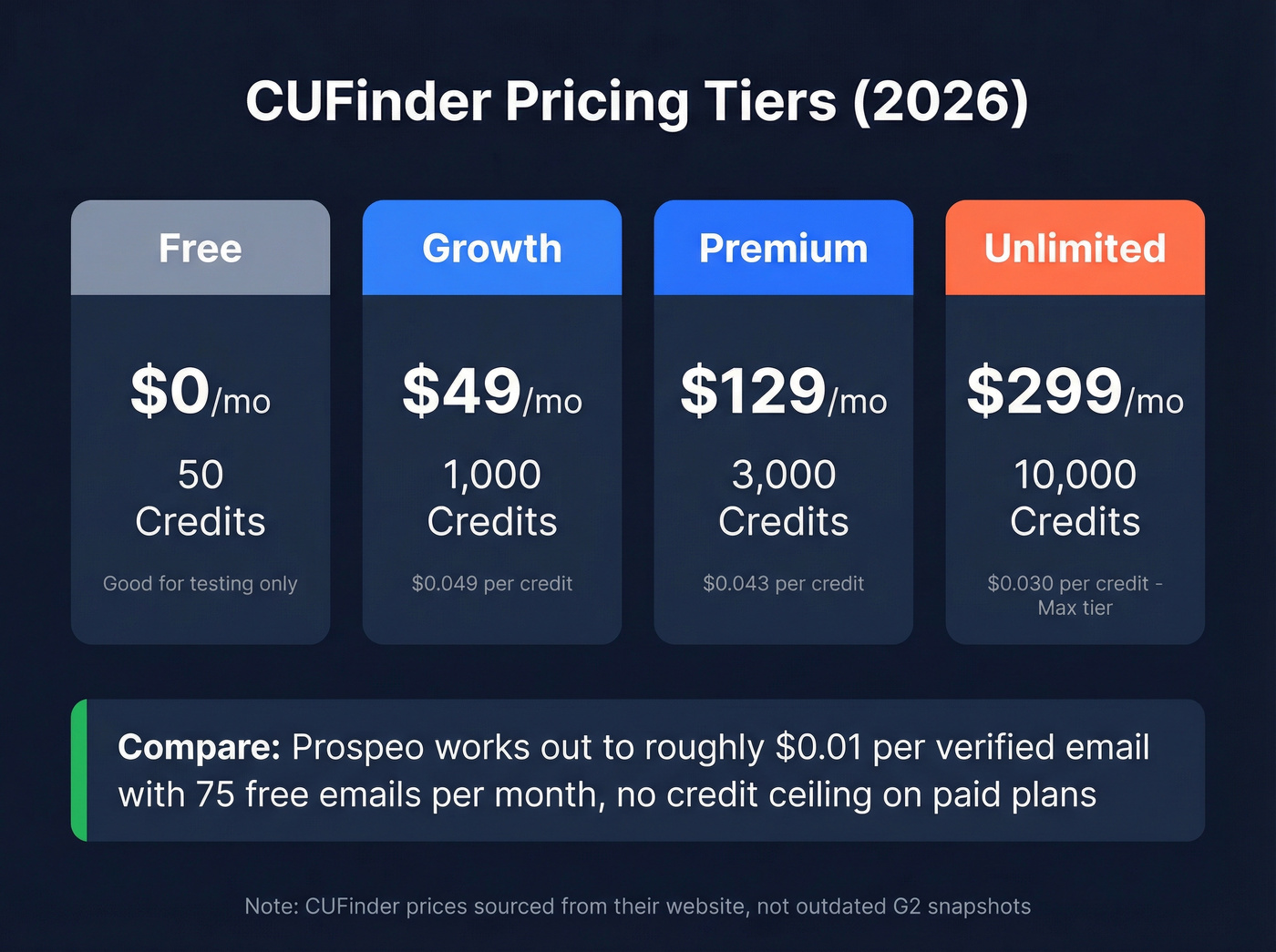
CUFinder runs credit-based SaaS pricing:
| Plan | Monthly Price | Credits |
|---|---|---|
| Free | $0 | 50 |
| Growth | $49 | 1,000 |
| Premium | $129 | 3,000 |
| Unlimited | $299 | 10,000 |
G2's pricing page shows lower figures, but that snapshot is outdated. CUFinder's own site is the canonical source - prices went up.
BigDBM
Totally different animal. Visitor identification pixels run $19-$49/month. Their identification API charges $5-$45 CPM based on match volume, with discounts kicking in as volume increases. Dataset and API purchases range from $500/purchase to $1,500/month, with intent data starting at $1,000/month. Enterprise contracts with multiple datasets and full API access run $3,000-$10,000+/month.
Let's be honest: if your average deal size is under $15k and your team is under 10 reps, you almost certainly don't need BigDBM-level data infrastructure. A self-serve tool will get you to pipeline faster. If your bottleneck is list quality, start with lead enrichment and then tighten your outbound process.
Which Tool Should You Pick?
Pick BigDBM if:
You need identity resolution at scale, have a data team that works with APIs, and your budget supports $1,000+/month in data licensing. You're building marketing infrastructure, not running outbound sequences. Skip this if you're an individual rep or a team without engineering resources - you'll be paying for capabilities you can't use.
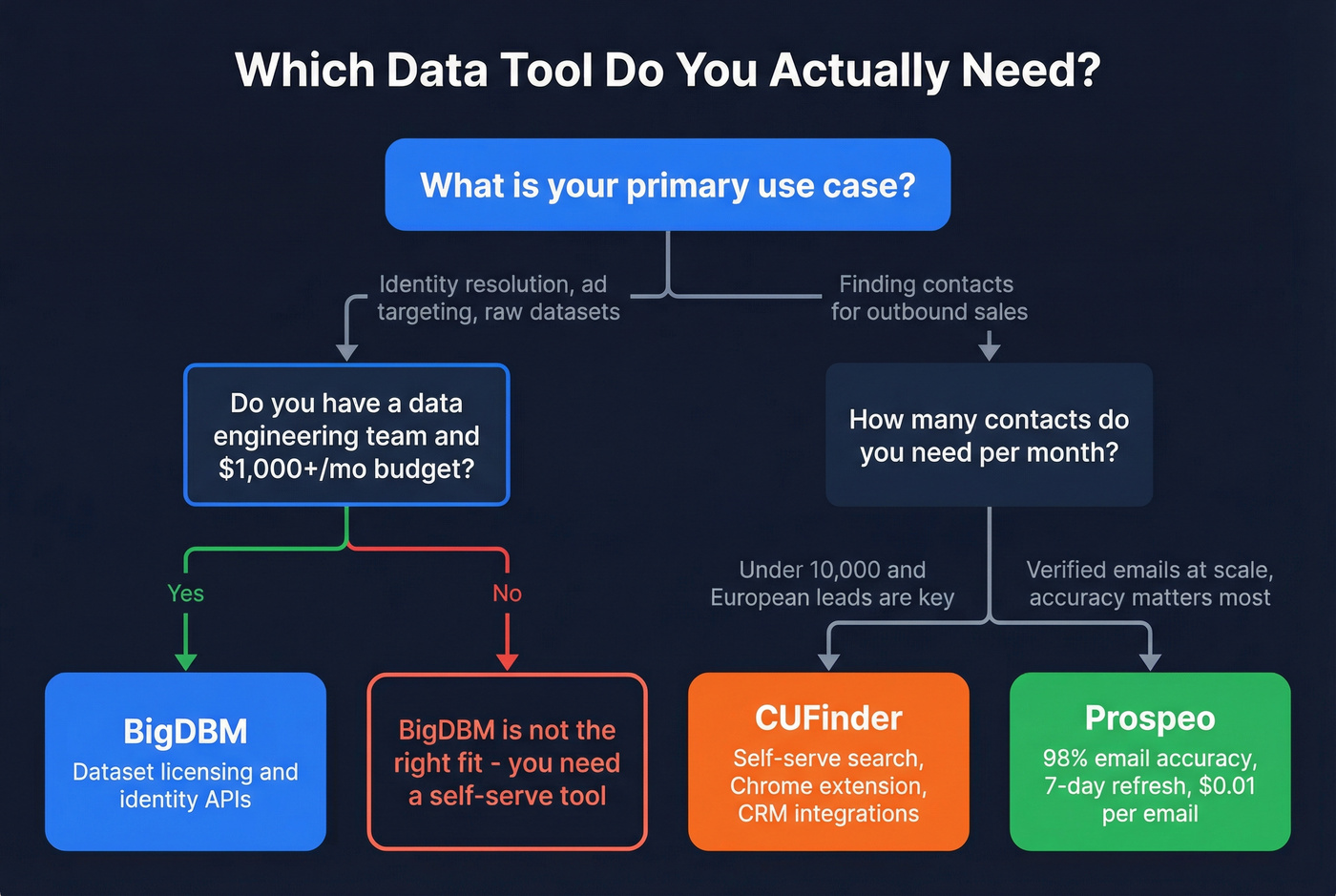
Pick CUFinder if:
You're an SDR or small team that wants to search contacts, enrich lists, and push to your CRM without touching an API. European lead coverage is a priority and your budget stays under $300/month. For teams that need more than 10,000 credits monthly, the per-contact cost starts to add up quickly, so run the math against your outbound volume before committing.
A Better Fit for Outbound Teams
Look, if you're an SDR comparing these two, neither is purpose-built for verified outbound contact data. BigDBM is infrastructure. CUFinder is a generalist prospecting tool. If you're building a repeatable outbound motion, pair your data source with proven sales prospecting techniques and a deliverability-first workflow.
The free tier gives you 75 verified emails and 100 Chrome extension credits per month. No contract required.

B2B data decays 22.5% per year, yet BigDBM and CUFinder can't match Prospeo's 7-day refresh cycle - 6x faster than the industry average. Pair that with proprietary 5-step email verification and you get bounce rates under 4%, just like Meritt did scaling pipeline from $100K to $300K/week.
Stop prospecting on stale data. Every Prospeo record refreshes weekly.
FAQ
Do BigDBM and CUFinder compete directly?
No. BigDBM sells raw datasets and identity resolution APIs to data teams. CUFinder is a self-serve prospecting SaaS for SDRs. They target different buyers with entirely different use cases - comparing them only makes sense if you're deciding which category of data tool you need.
What's the cheapest way to get verified B2B emails?
Prospeo's free tier includes 75 verified emails per month with no contract. Paid plans work out to roughly $0.01 per email - significantly cheaper than BigDBM's dataset licensing and more cost-effective than CUFinder's credit packs at higher volumes.
Can CUFinder replace BigDBM for identity resolution?
No. CUFinder doesn't offer IP-to-identity resolution, MAID matching, or raw dataset licensing. If you need to resolve anonymous website visitors into known profiles at scale, BigDBM is the right category. CUFinder solves a completely different problem - contact search and list enrichment.