

BigDBM vs Lusha: Data Marketplace vs Prospecting Tool
These two tools get compared because they both "sell contact data." That's like comparing a wholesale food distributor to a restaurant because they both involve chicken. When you weigh BigDBM against Lusha, you're looking at fundamentally different buyers, different problems, and completely different pricing models. Picking the wrong one wastes real money.
30-Second Verdict
BigDBM is a US-only data marketplace. You're buying raw datasets and APIs - 765M+ emails, 600M+ phones - priced from $500/purchase to $1,500/month. You need a data engineer to make it useful.
Lusha is a self-serve prospecting tool. Chrome extension, credit-based reveals, free tier with up to 70 credits/month. Easy to use, but phone accuracy is roughly a coin flip.
What Is BigDBM?
BigDBM is a US-only data provider selling datasets and APIs across B2B, consumer, identity, and property categories. The scale is massive - 765M+ emails and 600M+ phones - but this isn't a tool you log into and start prospecting. It's a data marketplace built for data teams and marketing ops.
Their catalog spans B2B contacts, purchase intent signals (150M daily hashed emails matched against their warehouse, with 65-70M successfully matched to their Universal Data Warehouse), 30M+ non-residential property records, identity graphs built over 7+ years, and WeVi - their website visitor identification product that uses pixel tracking and identity resolution APIs. Phone data comes with a proprietary Phone Quality Level (PQL) score based on telecom and carrier signals, which helps teams prioritize dialable numbers before burning through call lists.
Plans run $500/purchase to $1,500/month, with Datarade estimating roughly 30% better pricing than immediate competitors for enterprise file purchases.
What Is Lusha?
Lusha is a prospecting tool built for individual SDRs. The core experience is a Chrome extension: find a prospect, click, reveal their email or phone number. It's genuinely easy to use, and that's its biggest selling point.
The credit system is straightforward but lopsided. One credit reveals an email. Ten credits reveal a phone number. The free plan gives you up to 70 credits/month, which means you're getting either 70 emails or 7 phone numbers - not both. Paid plans start around $52.45/month for Pro, with Premium around $299.95/month and Scale on custom pricing. On G2, Lusha holds a 4.3/5 with 1,619 reviews, and users consistently praise ease of use and accessible contact info.
Side-by-Side Comparison
| Feature | BigDBM | Lusha |
|---|---|---|
| Database size | 765M+ emails, 600M+ phones | Not disclosed |
| Pricing model | Dataset/API purchases | Per-credit reveals |
| Data types | B2B + consumer + property | Primarily B2B prospecting |
| Self-serve UI | No SDR-style interface | Yes |
| Chrome extension | No | Yes |
| Coverage | US-only | US-focused |
| Starting price | $500/purchase | Free (up to 70 credits/mo) |
| Phone approach | PQL-scored datasets | Per-credit reveal |
| Best for | Data/marketing ops teams | Individual SDRs |
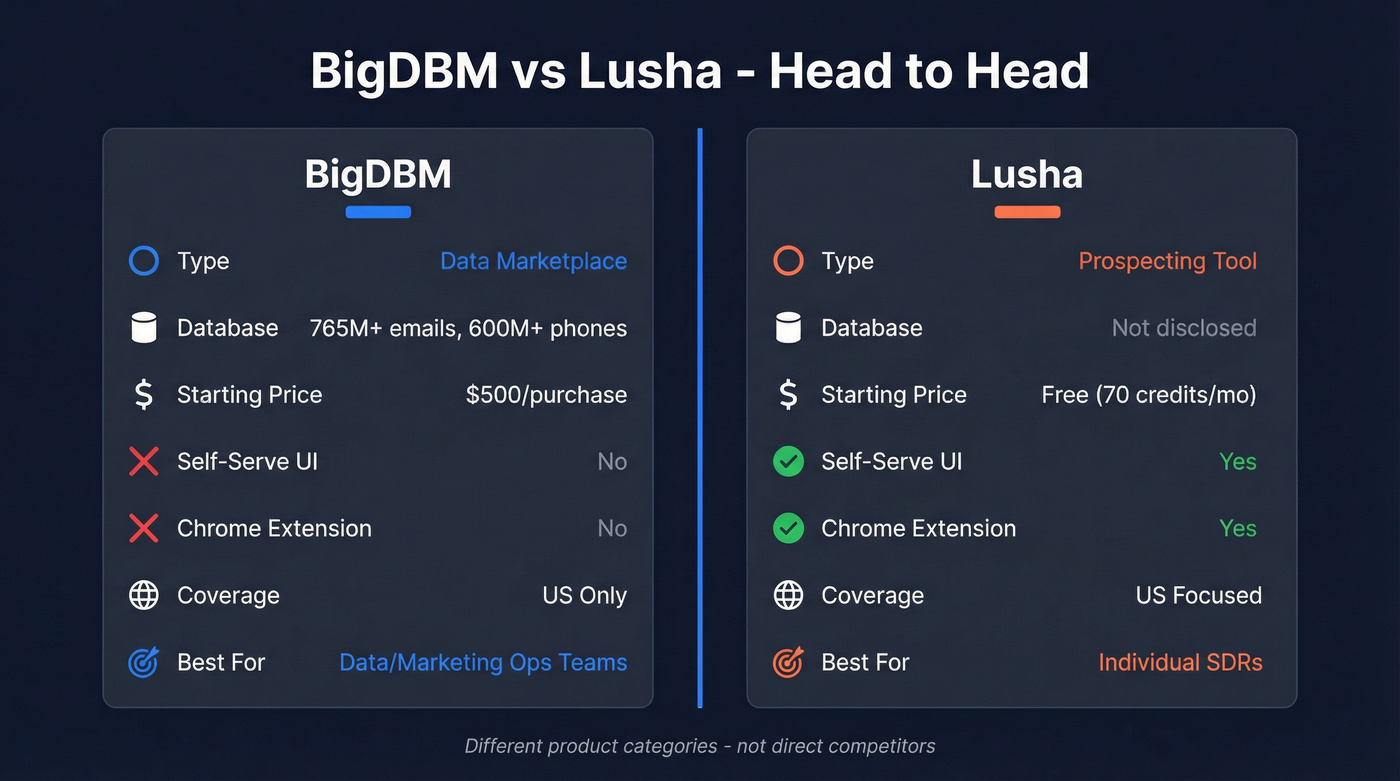
These aren't competitors. They're different product categories that happen to contain contact data.

BigDBM needs engineers to process. Lusha's phones are right ~50% of the time. Prospeo gives you 98% email accuracy and 125M+ verified mobiles with a 30% pickup rate - no data team required, no credits wasted on dead numbers.
Stop burning credits on contacts that don't exist.
Where Each Tool Wins
Pick BigDBM If...
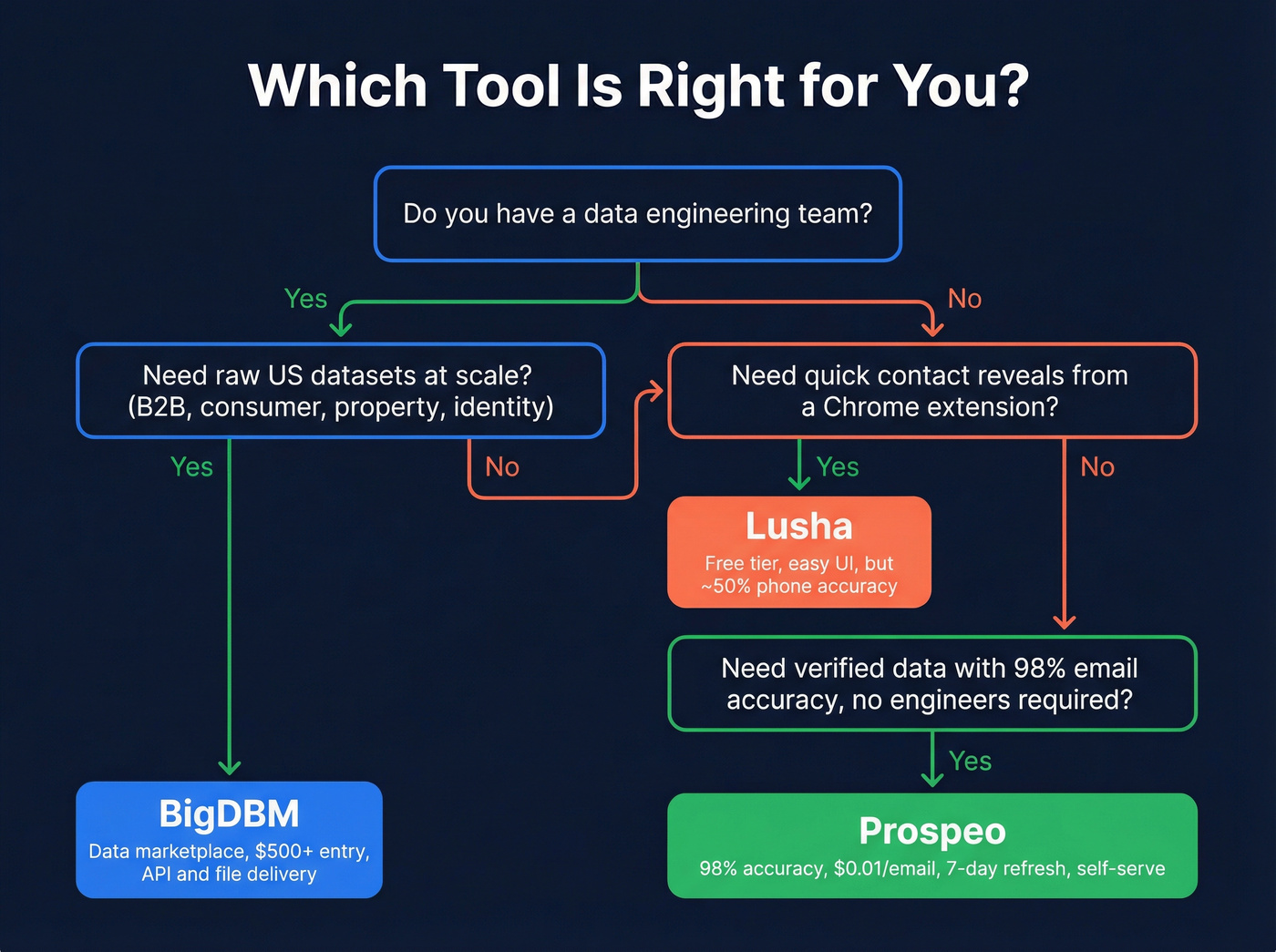
You're a data or marketing ops team that needs raw US datasets at scale. Identity graphs, consumer + B2B hybrid data, property records, intent signals, website visitor identification - BigDBM covers use cases Lusha doesn't attempt. If you're building custom audiences or feeding data into your own systems via API, the enterprise bulk pricing makes sense. But you'll need engineers to process it all, and the $500 minimum means there's no casual way to test the waters.
If you're building custom audiences or feeding data into your own systems via API, the enterprise bulk pricing makes sense. But you'll need engineers to process it all, and the $500 minimum means there's no casual way to test the waters.
Pick Lusha If...
You're an individual SDR who needs a Chrome extension that reveals contact info in two clicks. No data engineering required. The free tier lets you test without a credit card, and the learning curve is basically zero. If your workflow is "find prospect, reveal email, add to sequence," Lusha gets you moving fast.
The Accuracy Problem
Here's the thing: neither tool solves accuracy well.
BigDBM isn't built like a prospecting product. Even if you can generate audiences and lists, it's still a dataset-and-integration model - you're downloading files and piping them through APIs, not clicking a button in your browser. We've tested both approaches, and the dataset model requires significantly more setup time than most sales teams expect. Entry pricing starts around $500 per purchase, which means you need technical sophistication just to get started.
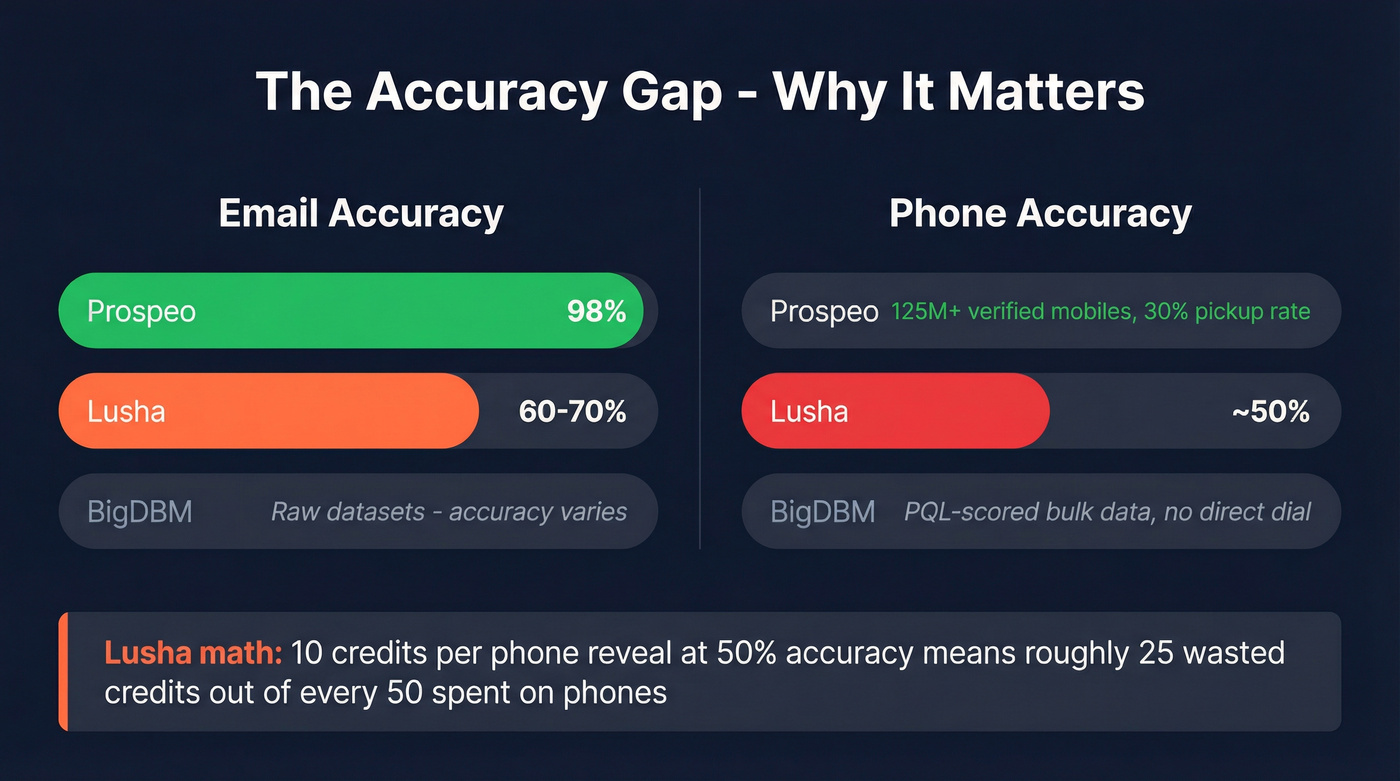
Lusha's problem is more frustrating because it looks easy. The #1 complaint across 1,619 G2 reviews is data inaccuracy, with 49 mentions of incorrect contacts and missing details. On Reddit, users in r/coldemail report phone numbers that are "outdated or wrong," and practitioners in r/b2bmarketing flag that "a lot of the phone numbers aren't found" when scaling cold calling. One bench test reported around 60-70% valid emails and phone accuracy at roughly 50/50.
Let's do the math on that. At 10 credits per phone reveal, bad numbers get expensive fast. If phone accuracy is ~50%, burning 50 credits on phone reveals wastes about 25 credits - over 35% of the free 70-credit allocation - on dead data.
A Better Fit for Most Sales Teams
Prospeo delivers 98% email accuracy against Lusha's ~60-70%. The database covers 300M+ professional profiles and 143M+ verified emails, with 125M+ verified mobile numbers hitting a 30% pickup rate. Every record refreshes on a 7-day cycle, which directly addresses Lusha's "outdated data" complaints.

The self-serve experience matches Lusha's simplicity. The Chrome extension has 40K+ users, and the interface lets you search, filter, verify, and export without ever talking to a data engineer. Native integrations push contacts straight into Salesforce, HubSpot, Smartlead, Instantly, and Lemlist. Pricing is transparent and credit-based at ~$0.01/email, with a free tier that includes 75 emails and 100 Chrome extension credits per month. No contracts. Snyk dropped from 35-40% bounces to under 5% after switching.
If you're worried about bounces, pair any finder with email verification before you send.
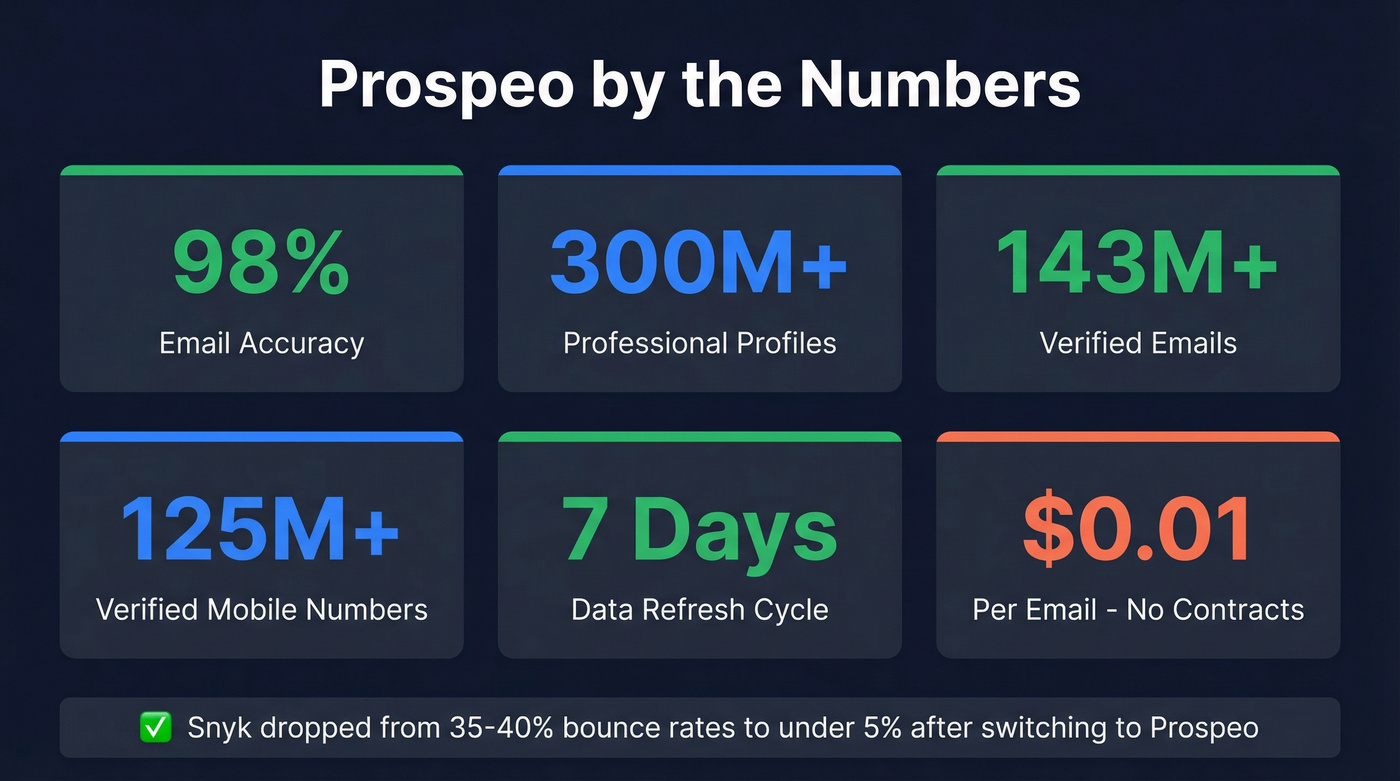
Snyk's 50 AEs went from 35-40% bounce rates to under 5% with Prospeo. Every record refreshes every 7 days - not 6 weeks - so you never prospect with stale data. Self-serve, $0.01/email, no contracts.
Replace coin-flip accuracy with 98% verified data.
Which Should You Choose?
Look - most teams searching BigDBM vs Lusha don't actually need either. BigDBM is infrastructure for data engineers. Lusha is a quick-reveal tool with a coin-flip on phone accuracy. If your deal sizes sit below $50k and you don't have a data team, both are the wrong fit.
Three clear paths:
- Data/marketing ops team buying raw US datasets at scale, with engineers to process them - BigDBM.
- Individual SDR who needs a quick Chrome extension and can tolerate hit-or-miss phone data - Lusha.
For most teams comparing these two, BigDBM wasn't built for you, and Lusha's accuracy gap will cost you more in burned sequences than you save on the free tier. If you're evaluating options, start with a shortlist of sales prospecting databases and compare accuracy first.
FAQ
Is BigDBM a prospecting tool like Lusha?
No. BigDBM is a data marketplace selling raw datasets and APIs in bulk. It has no Chrome extension and no SDR-style prospecting workflow. It's built for data teams who can integrate datasets into their own systems via API or file delivery.
How accurate is Lusha's phone data?
Roughly 50% accurate for phones and 60-70% for emails, based on user posts and bench-test writeups. The 49 complaints citing data inaccuracy make it the platform's top issue on G2. At 10 credits per phone reveal, bad numbers drain your allocation fast.
Is there a more accurate alternative to both?
Prospeo delivers 98% email accuracy and 125M+ verified mobile numbers with a 30% pickup rate. Data refreshes every 7 days versus the 6-week industry average. The free tier includes 75 emails and 100 Chrome extension credits per month - no contracts required.
Can I use BigDBM for cold outbound campaigns?
Technically yes, but it requires significant setup. BigDBM delivers raw data files and API access, not a ready-to-use prospecting interface. You'll need a data engineer to clean, deduplicate, and load records into your outbound stack before sending a single email.