

Biotech Sales: The Complete Career Guide for 2026
A RevOps lead we know spent six years in medical device sales before switching to biotech. Same therapeutic area, similar deal sizes, comparable OTE. The difference? He went from 60-hour weeks in the OR to closing bigger deals in 25 hours a week. His exact words: "I make more per hour and I actually see my kids."
That's the biotech sales pitch in a nutshell - and the numbers back it up. The global pharmaceutical market sits at roughly $1.21 trillion, and biotech is one of the fastest-growing slices. Yet most career resources lump biotech in with generic pharma advice, ignoring the distinct compensation structures, sales cycles, and entry paths that make this a different animal entirely.
Quick Snapshot
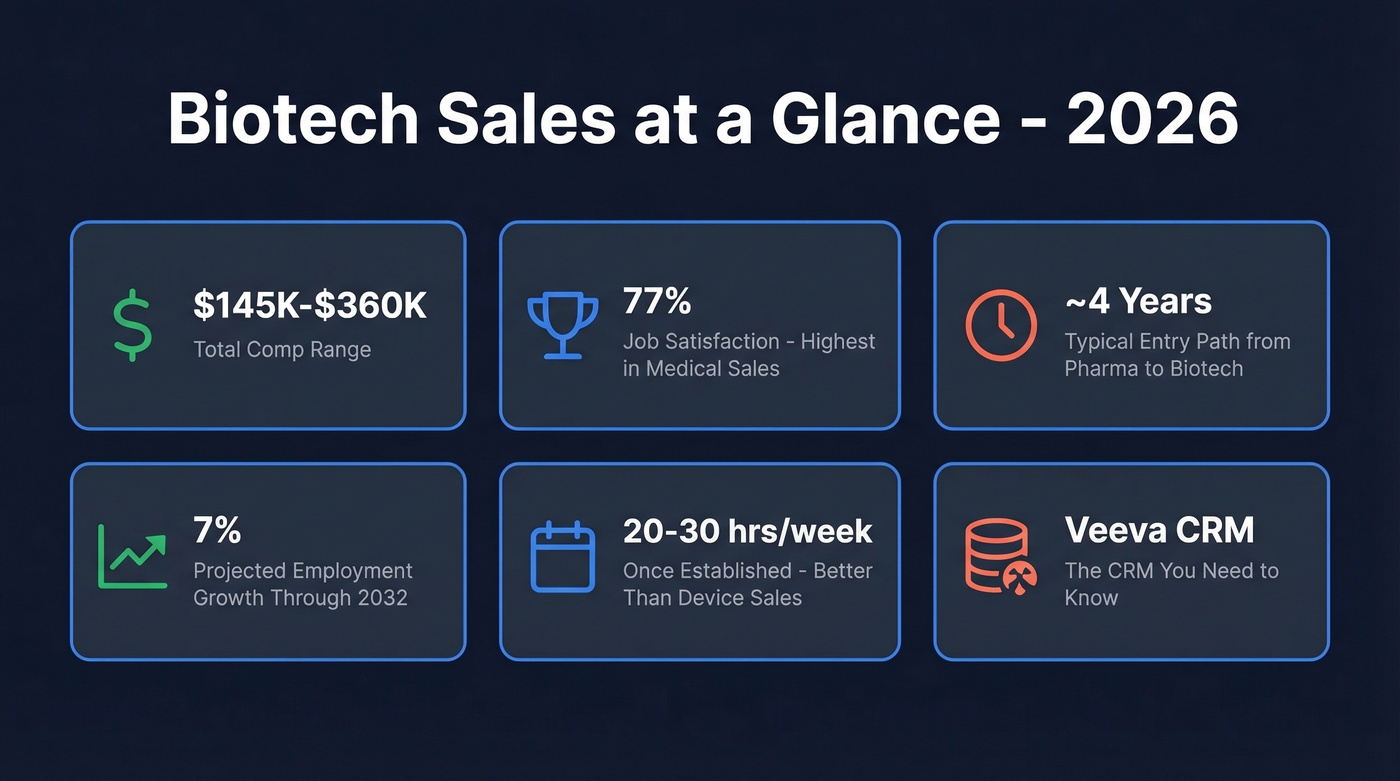
- Total comp range: $145K-$360K, with top performers clearing $500K+
- Job satisfaction: 77% - the highest in medical sales
- Proven entry path: Primary care pharma → specialty → biotech (~4 years)
- Growth outlook: BLS projects 7% employment growth in biological sciences through 2032
- Work-life balance: Consistently rated better than device sales; practitioners report 20-30 hour weeks once established
- CRM you should know: Veeva
What Is Biotech Sales?
Biotech sales sits at the intersection of advanced science and complex B2B selling. Unlike traditional pharma reps who call on physicians to drive prescription volume, biotech reps sell novel therapies, diagnostics, and scientific instruments to buying committees that include clinicians, procurement teams, lab directors, and C-suite executives.
The distinction from pharma and medical devices matters more than people realize. Pharma sales is largely relationship-driven - you're educating prescribers on established drug categories. Device sales is hands-on and procedural - you're often in the operating room. Biotech is consultative and technical. You're pitching gene therapies, cfDNA diagnostics, flow cytometry platforms, or bioprocessing equipment to people who understand the science as well as you do, and they'll call you out if you don't.
The Sub-Niches
Not all biotech sales roles look the same:
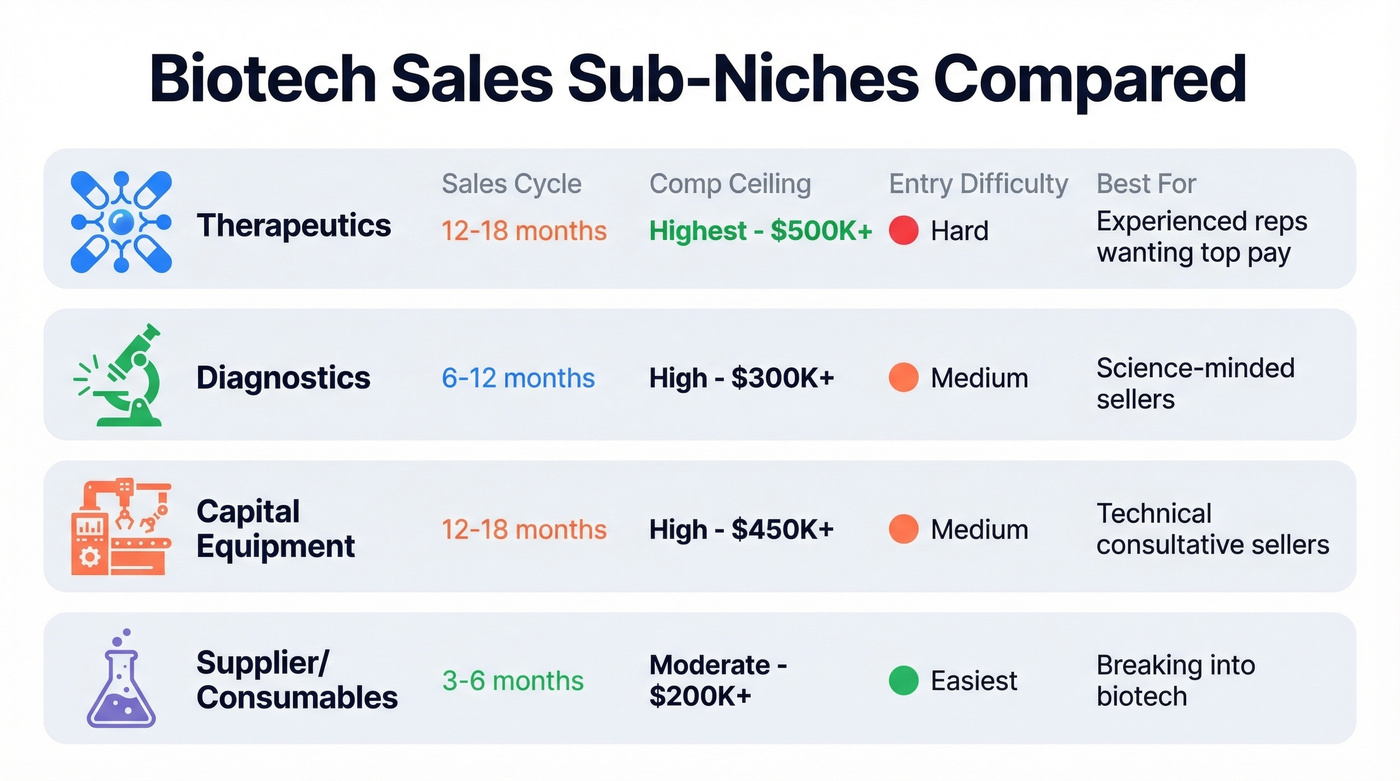
- Therapeutics - gene therapies, biologics, advanced treatments (highest comp ceiling)
- Diagnostics - cfDNA testing, molecular diagnostics, companion diagnostics
- Capital equipment - imaging systems, flow cytometers, sequencers
- Supplier/consumables - reagents, cell culture media, bioprocessing equipment (Cytiva, Repligen, Sartorius)
Therapeutics and capital equipment sit on the longer end of the typical 6-18 month sales cycle, with higher OTEs. Consumables move faster but involve more recurring revenue management.
Don't overlook the supplier side. A recurring theme in sales communities is that suppliers make a strong entry point because biopharma companies always need reagents, consumables, and equipment to keep labs running - and those roles are easier to land without specialty experience.
What unifies every sub-niche is complexity. Sales cycles typically run 6-18 months with 6-10 decision-makers involved. You're not closing a deal over lunch. You're navigating institutional buying processes, clinical validation requirements, and regulatory considerations that simply don't exist in most B2B sales.
A Typical Day
We've talked to enough biotech reps to sketch the pattern. Mornings usually start with pre-call planning - reviewing account histories in Veeva, checking for new clinical trial data or grant announcements that create conversation openers. Mid-day is meetings: virtual calls with lab directors, in-person visits to research facilities, or multi-stakeholder presentations where you're walking a buying committee through clinical evidence.
Afternoons are follow-up - sending requested papers, coordinating with your MSL, updating your CRM. The pace is deliberate, not frantic. You might have two or three meaningful interactions a day rather than the 10+ cold calls a device rep grinds through.
Salary & Compensation Breakdown
What You'll Realistically Earn
Let's talk money. Across sales broadly, quota attainment runs 41-57% depending on role level. That means the "realistic earnings" column below - derived by applying those attainment rates to OTE ranges - matters more than the number your offer letter quotes.
| Level | Base Salary | Variable | OTE | Realistic Earnings |
|---|---|---|---|---|
| Entry (0-2 yrs) | $55K-$75K | $25K-$45K | $80K-$120K | $70K-$100K |
| Mid (3-5 yrs) | $80K-$110K | $40K-$90K | $120K-$200K | $110K-$165K |
| Senior (6-10 yrs) | $110K-$150K | $90K-$210K | $200K-$360K | $175K-$280K |
| Director/RSM | $140K-$180K | $110K-$250K | $250K-$430K | $220K-$360K |
Top performers - the ones consistently at 120%+ of quota - can clear $500K+ in senior therapeutics roles. That's the top 10-15%, not the median.
How Commission Works
Comp plans typically follow a 70/30 or 60/40 base-to-variable split, with commission rates ranging from 5-15% depending on the product and plan structure. Most plans are uncapped for high performers, which is where the real upside lives. Accelerators kick in above quota - expect 1.5x to 2x rates once you clear 100%.
The 70/30 split means your base salary is substantial. You're not starving if you have a slow quarter. That's a meaningful difference from device sales roles where the variable component is much larger and the pressure is relentless. Sales roles average 35% annual turnover - nearly 3x the all-industry average of 13%. Comp design and lifestyle aren't perks; they're retention tools.
Biotech vs Device vs Pharma Pay
Here's the comparison everyone wants:
| Specialty | Total Comp Range | Lifestyle | Top Ceiling |
|---|---|---|---|
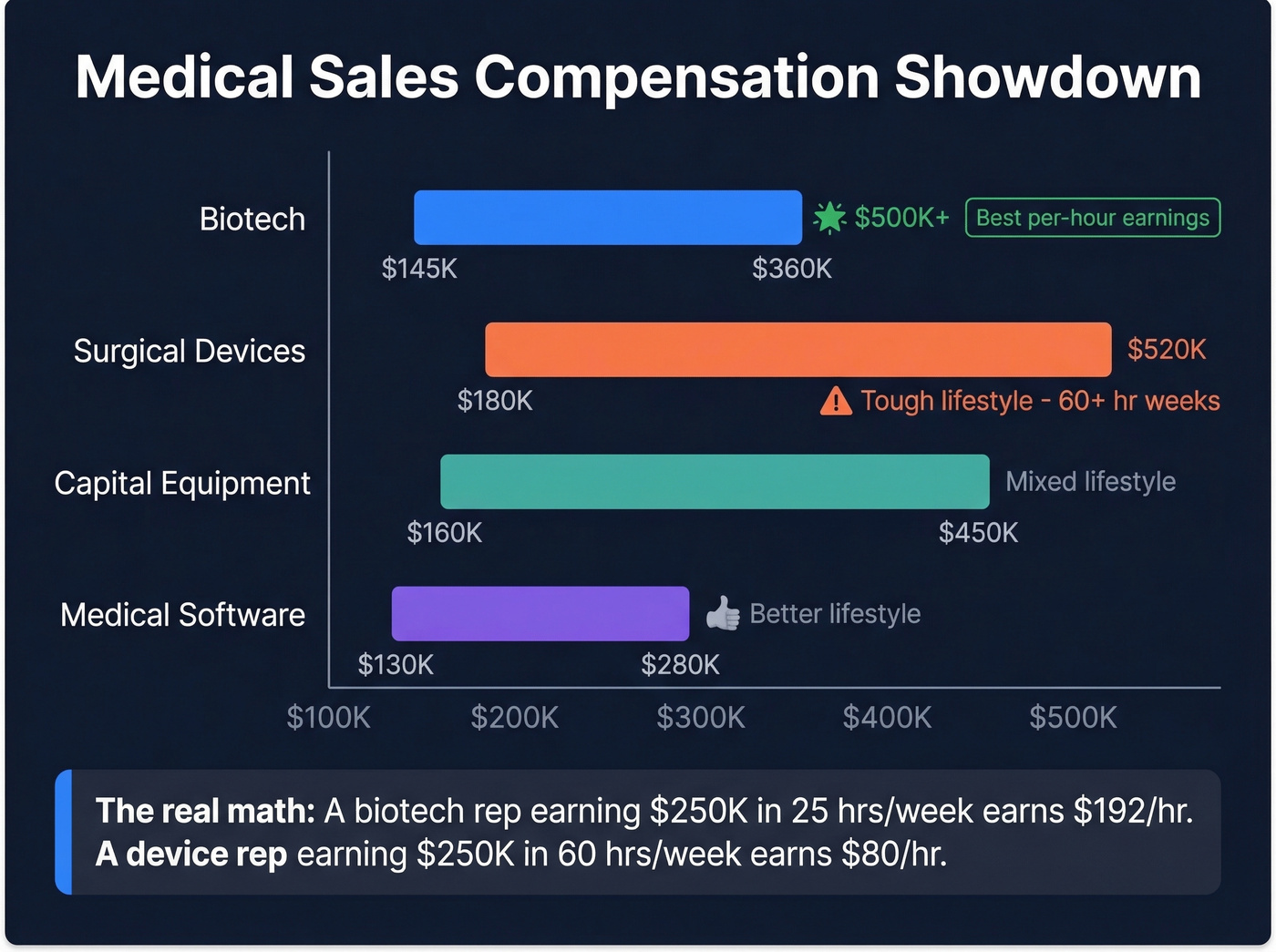
| Biotech | $145K-$360K | Better than devices | $500K+ |
| Surgical devices | $180K-$520K | Tough | ~$520K |
| Capital equipment | $160K-$450K | Mixed | $450K+ |
| Medical software | $130K-$280K | Better | $300K+ |
Device sales wins on raw ceiling - a top orthopedic device rep can hit around $520K. But the lifestyle cost is brutal. The consensus on Cafepharma forums is consistent: device sales is "churn and burn" at many organizations, with extreme hours and on-call demands. One poster captured it perfectly - they made $250K in device sales working 60+ hour weeks, then made $250K+ in biotech working 20-30 hours a week.
Here's the thing: if your goal is maximizing lifetime earnings - not peak-year earnings - biotech beats device sales. The math isn't close. A device rep who burns out at year 7 and switches careers earns less over 20 years than a biotech rep who compounds territory relationships for two decades. Per-hour earnings favor biotech over every other medical sales category, and that advantage compounds over a career.

Biotech reps spend mornings in Veeva planning calls - but the best reps already know which accounts are in-market. Prospeo tracks 15,000 intent topics via Bombora, so you can see which lab directors and procurement leads are actively researching your therapeutic area. Layer that with 30+ filters for headcount growth, funding, and technographics to build a list of biotech buyers who are ready to talk.
Stop guessing which accounts to call. Let intent data tell you.
How to Break Into Biotech Sales
The Stepwise Path
Biotech companies prefer experienced reps. The clinical complexity and long sales cycles mean hiring managers want someone who's already proven they can sell in healthcare. The most reliable path:
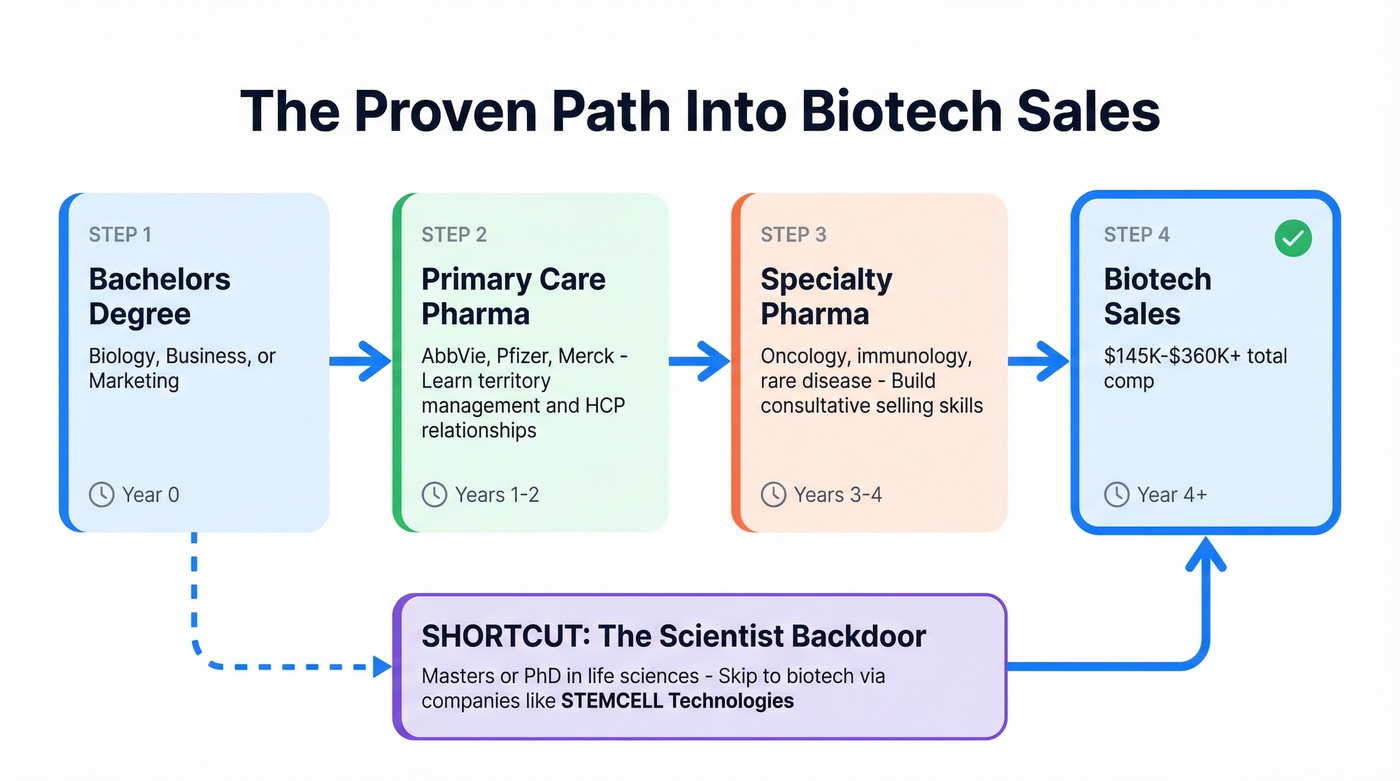
- Get your bachelor's degree - biology, business, or marketing all work. This is table stakes.
- Land a primary care pharma role (1-2 years) - companies like AbbVie, Pfizer, and Merck hire entry-level reps and train them well. You'll learn territory management, HCP relationships, and compliance basics.
- Move to specialty pharma (2-3 years) - oncology, immunology, rare disease. This is where you develop the consultative selling skills biotech demands.
- Transition to biotech - with 3-5 years of specialty experience, you're a credible candidate.
Plan roughly four years from your first pharma role to a biotech position. Some people do it faster, especially if they land in a specialty role early, but recruiters consistently advise against skipping the primary care step. CNPR certification can help differentiate you early, though it's not mandatory.
The Scientist Backdoor
Most career guides miss this path entirely. Companies like STEMCELL Technologies hire scientists directly into sales roles - Master's or Doctorate required, sales experience not required. Their model is "scientists helping scientists," and it's a legitimate backdoor for PhDs who realize they'd rather be in the field than at the bench.
I've seen scientists make this transition in under a year when they target the right companies. If you've got an advanced degree in immunology, cell biology, or molecular biology, this route skips the 4-year pharma ladder entirely.
What Hiring Managers Actually Ask
Biotech interviews are different from standard sales interviews. Expect questions like:
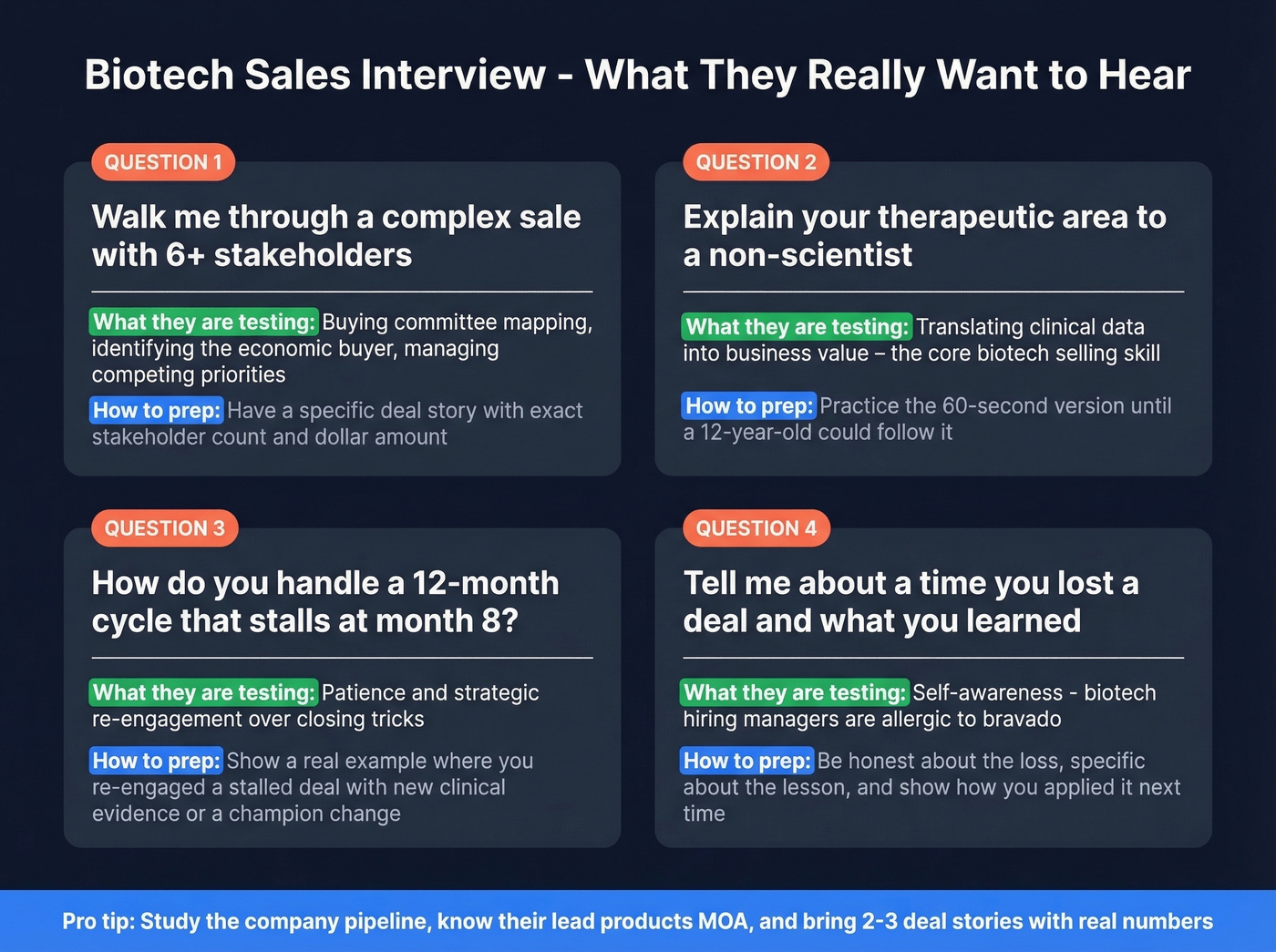
- "Walk me through a complex sale with 6+ stakeholders." They want to hear how you mapped the buying committee, identified the economic buyer, and managed competing priorities.
- "Explain [therapeutic area] to a non-scientist." This tests whether you can translate clinical data into business value - the core skill of biotech selling.
- "How do you handle a 12-month sales cycle that stalls at month 8?" Patience and strategic re-engagement matter more than closing tricks.
- "Tell me about a time you lost a deal and what you learned." Biotech hiring managers are allergic to bravado. They want self-awareness.
Prepare by studying the company's pipeline, knowing their lead products' mechanisms of action, and having two or three detailed deal stories ready with specific numbers.
Skills That Get You Hired
Beyond the obvious sales fundamentals, hiring managers screen for cross-functional collaboration (you'll work with MSLs, marketing, medical affairs, and regulatory), AI and data literacy for territory planning and CRM analytics, and deep enough clinical knowledge to hold your own in conversations with PhDs and MDs. Compliance awareness - FDA regulations, PDMA sample tracking, Sunshine Act reporting - isn't optional. And adaptability matters: biotech pipelines shift fast, and your product might get a new indication or lose a trial mid-year.
Top Companies to Target
Best Places to Work
The BioSpace 2026 Best Places to Work in Biopharma list, based on input from 3,600+ life sciences professionals, is one of the strongest "where to work" signals in the industry. Moderna took the #1 spot for the fourth consecutive year among large employers. Other perennial leaders include Eli Lilly, Regeneron, Amgen, and Novo Nordisk.
What the voters prioritized: compensation, innovation, career growth, and culture. These aren't just "nice places to work" - they're companies investing in commercial teams and pipeline expansion, which means more sales roles and better comp plans.
Who's Hiring Now
Five companies worth watching for biotech sales roles right now:
Danaher runs one of the broadest portfolios in life sciences - imaging, flow cytometry, molecular devices, immunohistochemistry, and microbiology capital equipment. Their internal mobility through the Danaher Business System is a genuine career accelerator. If you want optionality, Danaher gives you more lateral moves than almost any other employer.
Boston Scientific has clinical specialist sales opportunities in interventional oncology. Johnson & Johnson remains a perennial hirer across multiple therapeutic areas. Natera is particularly interesting - their Signatera cfDNA test for residual cancer detection is one of the hottest products in diagnostics, and they're hiring clinical genomic specialists and oncology sales reps.
Don't overlook the supplier side. Companies like Cytiva, Repligen, and Sartorius sell bioprocessing equipment and consumables to every major biopharma manufacturer. These roles are less glamorous but often offer strong comp ($140K-$250K OTE), shorter sales cycles, and recurring revenue that makes quota more predictable. For teams that want to break into the industry without the 4-year pharma ladder, supplier roles are one of the most underrated entry points.
Where the Jobs Are
Established hubs: Boston/Cambridge, San Francisco Bay Area, San Diego.
Emerging hubs: Houston, Raleigh-Durham, Seattle, Denver, and Chicago are all growing fast. When budget and cost of living matter, Raleigh-Durham and Denver are two of the best bets - legitimate biotech opportunity without Bay Area rent.
Tools and Tech Stack
Veeva Is Non-Negotiable
If you're going into biotech sales, learn Veeva CRM. It's the gold standard in life sciences - pre-validated for 21 CFR Part 11 and PDMA compliance, handling the regulatory requirements (audit trails, e-signatures, sample tracking) that generic CRMs can't touch.
The big news: Veeva fully transitioned to its Vault platform in September 2025, separating from Salesforce. Legacy Salesforce-based instances are supported through 2030, but new implementations are all Vault. In December 2025, Veeva launched AI Agents for Vault CRM - voice agents, pre-call agents, and free text agents. The pharma/biotech CRM market is valued at roughly $1.6 billion and projected to hit $8B+ by 2034. Veeva owns the lion's share. Learning it isn't optional - it's career infrastructure.
Your Data Is Your Pipeline
Most biotech sales guides stop at CRM. They ignore the prospecting layer - and in this industry, prospecting is where deals are won or lost.
When you're navigating 6-10 stakeholders over a 6-18 month sales cycle, every bounced email and wrong phone number compounds into weeks of wasted effort. Generic outreach gets 1-2% response rates. Trigger-based prospecting - targeting accounts based on grants, clinical trial phases, funding events, and hiring signals - drives 15-25% response rates. Omnichannel campaigns outperform single-channel by 287% in campaign performance.
This is where tools like Prospeo fit into your stack. When you're mapping a buying committee - the lab director, the procurement lead, the VP of Research, the CFO - you need verified contact data for all of them, not just the one person who answered your first cold call. With 98% email accuracy and 125M+ verified mobile numbers refreshed every 7 days, it solves the dead-data problem that plagues long sales cycles.
The free tier gives you 75 verified emails per month, enough to validate your territory list before committing any budget. For context, enterprise data platforms like ZoomInfo start at $15K+ annually. Prospeo starts free and scales from ~$39/mo - a meaningful difference when you're a new rep building your first territory.
If you're building your outbound motion from scratch, start with sales prospecting fundamentals, then layer in lead enrichment so your sequences don't die on bad data.
Breaking into biotech sales means building relationships with 6-10 decision-makers per deal. You need verified direct dials and emails - not gatekeepered switchboards. Prospeo delivers 98% email accuracy and 125M+ verified mobile numbers with a 30% pickup rate, refreshed every 7 days. At $0.01 per email, you can map an entire buying committee for less than the cost of a coffee.
Reach every stakeholder on the buying committee with data that actually connects.
FAQ
Is biotech sales a good career?
Yes. 77% job satisfaction (highest in medical sales), $145K-$360K total comp, 7% projected employment growth through 2032, and better work-life balance than device sales. It's one of the strongest career paths in B2B selling.
What degree do you need?
A bachelor's degree minimum - biology, business, or marketing all work. Scientific sales roles at companies like STEMCELL Technologies require a Master's or Doctorate but no prior sales experience.
How long does it take to break in?
About four years: 1-2 years in primary care pharma, then 2-3 years in specialty pharma. Scientists with advanced degrees can bypass this through companies that hire for clinical knowledge over sales experience.
Is biotech better than medical device sales?
Comparable pay, dramatically better lifestyle. Practitioners report 20-30 hour weeks in biotech versus 60+ in devices. Device pays more at the very top (up to around a $520K ceiling), but per-hour earnings favor biotech decisively.