

Bitrix24 vs Zoho CRM: Which One Actually Fits Your Team?
The price gap is the first thing you'll notice. Bitrix24 can work out to roughly $1.98/user/month at 50 users on its Standard plan, while Zoho CRM's cheapest paid tier starts around $14/user/month. Both also offer free plans, though with very different constraints.
We've run both through real sales workflows, and the "catch" is simple: Bitrix24 is a full work hub that includes a CRM; Zoho CRM is a purpose-built sales platform that expands into a broader suite when you need it. That's not a minor distinction - it shapes everything from onboarding speed to how your reps spend their first hour each morning.
Here's our honest take: if your average deal size stays in the low four figures and you're not running complex approvals, you'll get more ROI from clean data and simple pipelines than from "enterprise CRM features" you never touch.
30-Second Verdict
Zoho CRM wins if CRM is your primary use case. It's the cleaner sales experience, with stronger AI and a modular ecosystem that scales without forcing a bunch of extra modules on day one.
Bitrix24 wins if you need CRM + project management + internal comms in one tool and budget is the top constraint. The flat-rate pricing is a cheat code for teams of 15+.
Skip both if your real bottleneck is getting verified prospect data into a CRM in the first place. Neither platform generates contact data - they store it. Prospeo feeds both platforms with emails verified at 98% accuracy and 125M+ verified mobile numbers, starting free.
The Core Architectural Difference
This isn't a feature checklist decision. It's an architectural one.
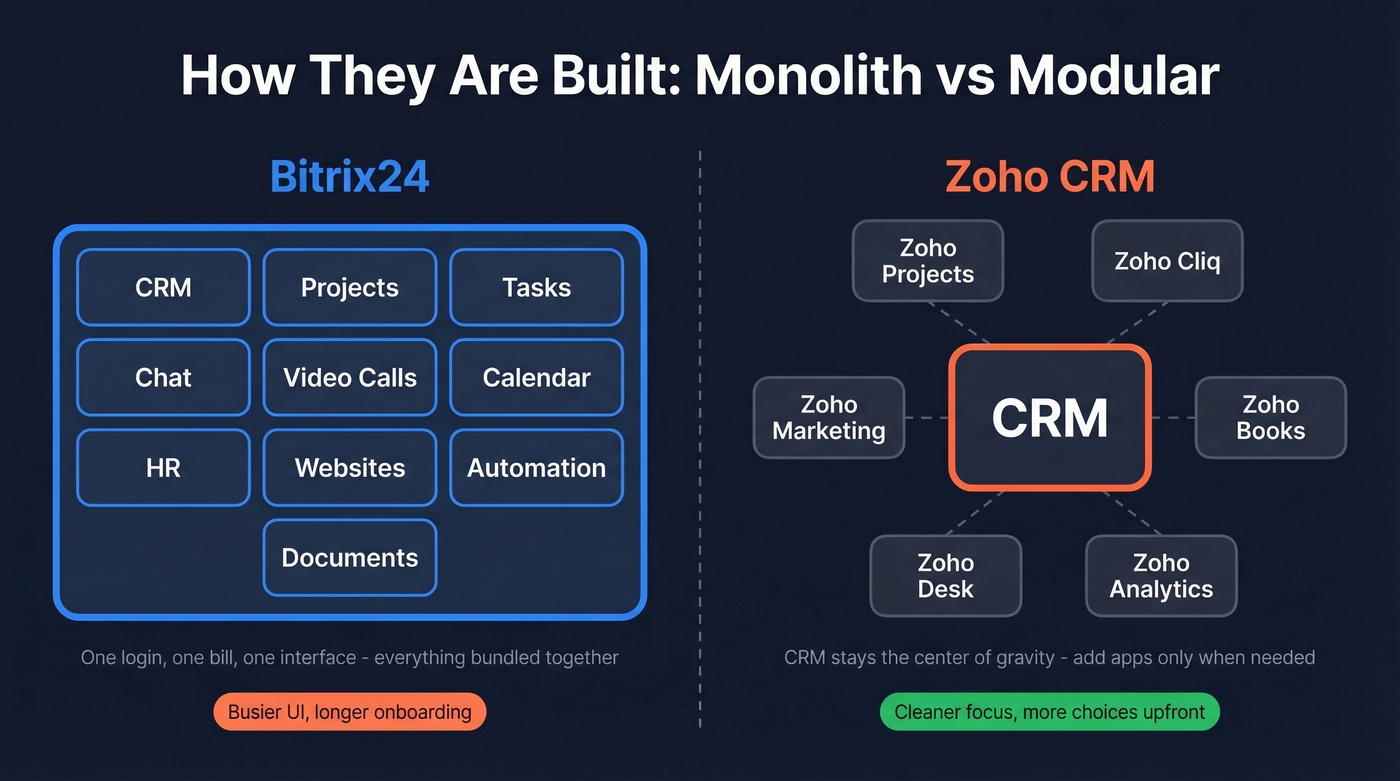
Bitrix24 is a monolith: CRM, tasks, projects, collaboration, websites, HR, and automation live under one roof. You get one login and one bill, but you also inherit a busier interface and a learning curve that slows onboarding - especially for reps who just want "pipeline, tasks, email, done." In our testing, it took noticeably longer for new users to get comfortable because the UI tries to surface everything at once.
Zoho CRM is modular. It's a purpose-built CRM that connects to Zoho's broader app ecosystem when you need it. You make more choices upfront, but the CRM stays the center of gravity instead of competing with a dozen other modules for screen real estate.
Pricing Breakdown for 2026
Bitrix24 Pricing (Flat-Rate)
Bitrix24 charges per organization, not per seat. That's the whole point.
| Plan | Monthly (Annual Billing) | User Cap |
|---|---|---|
| Free | $0 | Unlimited |
| Basic | $49 | 5 users |
| Standard | $99 | 50 users |
| Professional | $199 | 100 users |
| Enterprise | $399 | 250 users |
The Capterra starting-price discrepancy you'll sometimes see comes down to region and billing cadence. For canonical numbers, check Bitrix24's pricing page directly.
One thing to budget for: telephony credits are separate. If outbound calling is central to your motion, plan for per-minute usage on top of the plan, and note that the more advanced dialer features sit in higher tiers.
Zoho CRM Pricing (Per User)
Zoho CRM uses the standard per-user SaaS model.
| Plan | Price/User/Mo (Billed Annually) | Key Gate |
|---|---|---|
| Free | $0 | 3 users max |
| Standard | $14 | Core CRM + workflows |
| Professional | $23 | Blueprints, SalesSignals |
| Enterprise | $40 | Zia AI, Canvas, portals |
| Ultimate | $52 | Advanced BI, higher limits |
Verify current tiers on Zoho's pricing page.
Zoho also offers "team users" - a lower-cost license for non-sales roles. It's a genuinely smart way to give marketing, support, or finance visibility without paying full sales-seat pricing. The catch: team users can't own records, access reports/dashboards, use Zia AI, or connect Google/Microsoft integrations.
Real Cost: 3 to 50 Users
| Team Size | Bitrix24 | Zoho Standard | Zoho Professional |
|---|---|---|---|
| 3 users | $0 (Free) | $42/mo | $69/mo |
| 5 users | $49/mo | $70/mo | $115/mo |
| 15 users | $99/mo | $210/mo | $345/mo |
| 25 users | $99/mo | $350/mo | $575/mo |
| 50 users | $99/mo | $700/mo | $1,150/mo |
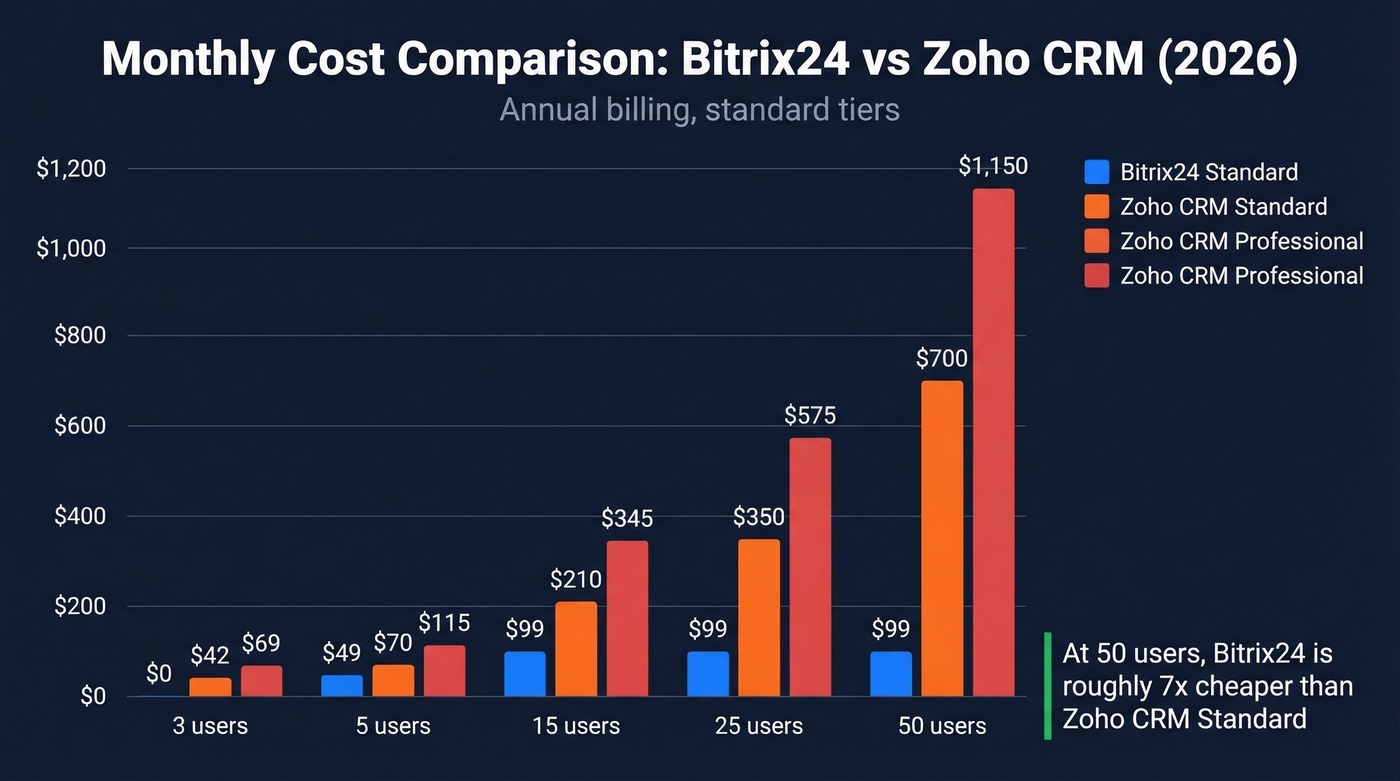
At 50 users, Bitrix24 Standard is roughly 7x cheaper than Zoho CRM Standard. That's the trade: Bitrix24's pricing rewards headcount; Zoho's pricing rewards CRM depth.
Feature Comparison
| Capability | Bitrix24 | Zoho CRM | Edge |
|---|---|---|---|
| CRM core (leads/deals/pipelines) | Solid basics | Stronger UX + depth | Zoho CRM |
| Workflow automation | Rules/triggers, basic | Blueprints, macros, advanced | Zoho CRM |
| Reporting & dashboards | Basic; limited depth | Custom dashboards, strong | Zoho CRM |
| Project management | Built-in (Kanban, Gantt) | Add Zoho Projects | Bitrix24 |
| Internal comms | Chat, video, calendar | Add Zoho Cliq | Bitrix24 |
| Customization | Moderate | Canvas designer, deeper | Zoho CRM |
| Mobile experience | Functional | Common complaint vs desktop | Bitrix24 |

Zoho CRM is the better CRM. Automation is more sophisticated, reporting goes deeper, and Canvas makes it easy to tailor layouts to how your team actually sells.
Bitrix24's advantage is that it bundles the "work around selling" - projects, internal comms, tasks - without making you stitch together extra apps. One underrated differentiator: Bitrix24 captures leads directly from Facebook and Instagram through its social CRM module. Zoho can cover the same ground, but you'll typically do it through integrations rather than it feeling native.

Neither Bitrix24 nor Zoho CRM generates prospect data - they just store it. Prospeo fills both with 98% accurate emails and 125M+ verified mobile numbers, with native integrations for your CRM of choice.
Stop debating CRMs and start filling them with contacts that convert.
AI Head-to-Head: Zia vs CoPilot
Zoho's Zia
Zia is the more mature sales AI. It handles the stuff revenue teams actually care about: deal scoring, churn prediction, best-time-to-contact recommendations, email sentiment analysis, anomaly detection, and AI forecasting. The generative layer also helps you draft modules, workflows, and reports from plain-English prompts.
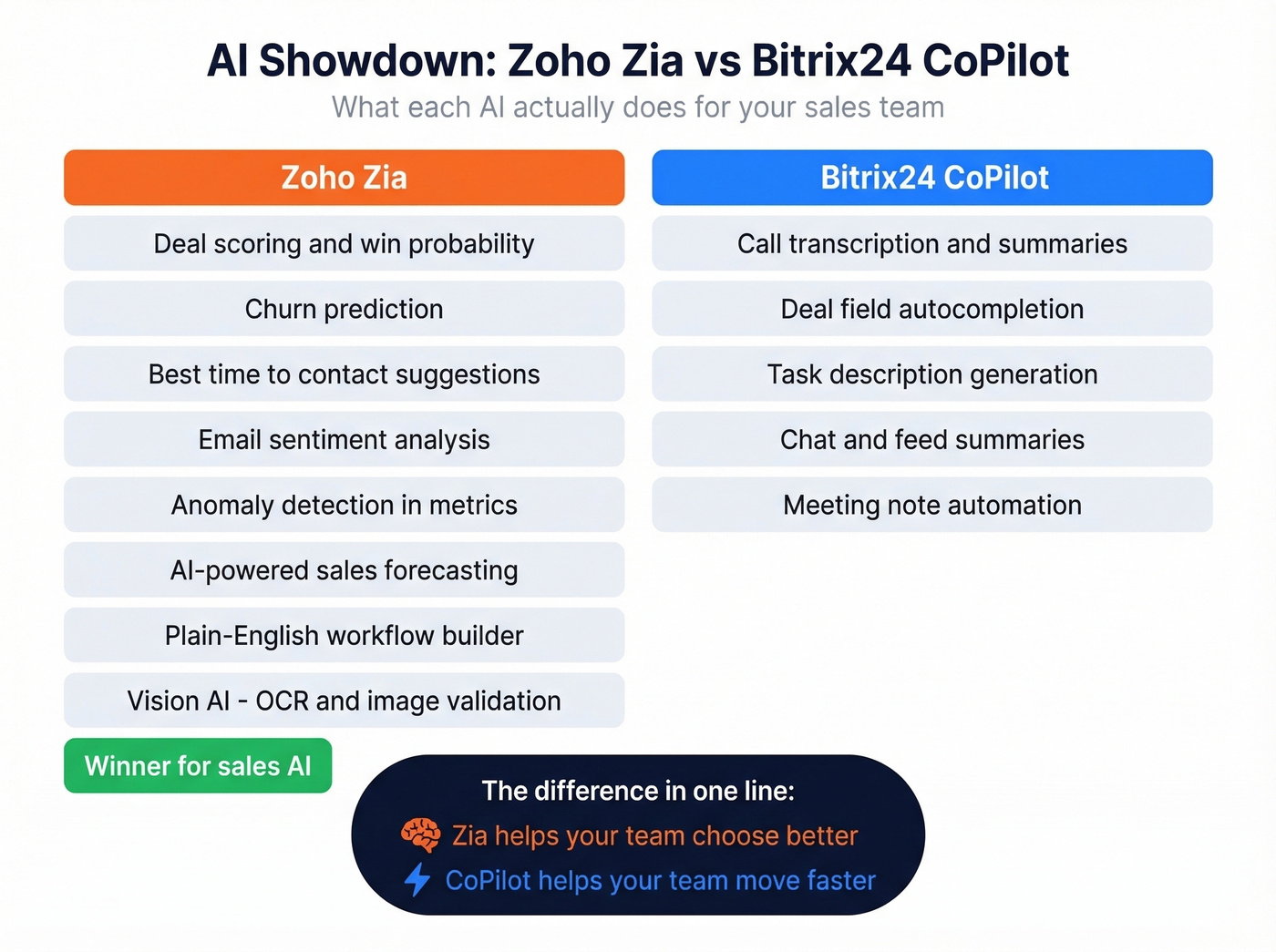
Zoho extends AI across its broader suite too, and Zia includes Vision AI capabilities like image validation and OCR extraction - useful if you're processing documents inside business workflows. For a deeper look, Zoho's AI overview is worth scanning.
Bitrix24's CoPilot
CoPilot is more execution-oriented. It shines in call transcription and summaries, deal field autocompletion, task description generation, and chat/feed summaries. If your team lives in internal updates and meetings, CoPilot reduces the "busywork tax" fast.
Let's be direct about the difference: CoPilot helps your team move faster; Zia helps your team choose better. If you want AI to prioritize pipeline and improve sales decisions, Zia is the clear winner.
What Real Users Say
We trust user-review patterns more than vendor pages because they expose day-to-day friction that marketing sites never mention.
| Metric (G2) | Bitrix24 | Zoho CRM |
|---|---|---|
| Ease of Use | 7.9 | 8.3 |
| Ease of Setup | 7.8 | 8.0 |
| Ease of Admin | 7.7 | 8.0 |
| Quality of Support | 7.7 | 7.6 |
| Product Direction | 8.2 | 8.0 |
Zoho CRM wins the usability scores. Bitrix24 edges support quality and product direction by a hair.
On Capterra, Zoho CRM sits around 4.3 stars across thousands of reviews, while Bitrix24 hovers around 4.2 with a much smaller review base. That larger volume makes Zoho's averages feel more settled and reliable.
Bitrix24 complaints cluster around terminology, complexity, and support delays. Zoho's most consistent criticism targets its mobile app experience compared to desktop. Reddit threads on r/CRM frequently fixate on the price gap but rarely reach consensus - the structured review data is more consistent about where each tool frustrates people.
Integrations and Ecosystem
Zoho CRM connects to a large set of first-party Zoho apps and a wide range of third-party tools via automation platforms. If you like building a suite where everything shares a design language and data model, Zoho is hard to beat.
Bitrix24 leans on "built-in first," then extends via its marketplace and API. Fewer moving parts, fewer separate subscriptions. That approach appeals to teams that hate managing a dozen SaaS logins.
A common third option worth mentioning is HubSpot CRM. It's the easiest to start with and has a legitimately useful free tier, but pricing ramps quickly as you scale - Professional commonly lands in the thousands per month once you're paying for the features serious teams need. If you're weighing that route, see our Bitrix24 vs HubSpot breakdown.
The Data Problem Neither Solves
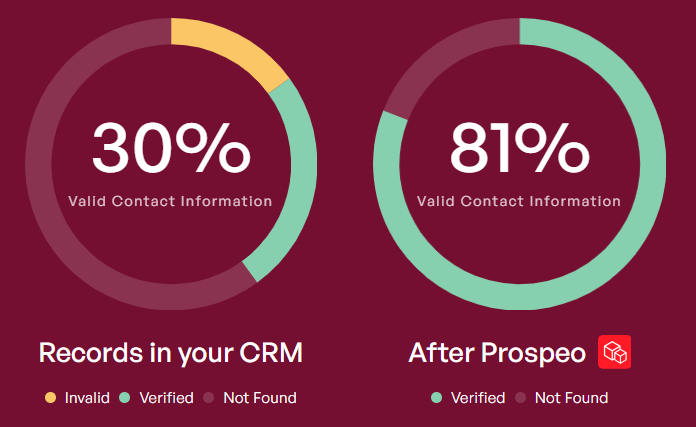
Both Bitrix24 and Zoho CRM store contact data. They don't generate it. If you import unverified lists, you pay for it immediately in bounces, wrong numbers, and reps burning hours on dead records.
Look - we've seen teams spend weeks debating CRM features while their reps dial disconnected numbers from a two-year-old spreadsheet. The CRM choice matters less than the data quality flowing into it.
Prospeo handles that layer: 143M+ verified emails at 98% accuracy, 125M+ verified mobile numbers refreshed every 7 days, and you can push verified contacts into either CRM via Zapier or API. You can also enrich existing CRM records with 50+ data points per contact at a 92% match rate.
Practical test we recommend: import 100 verified contacts into each platform and run the same mini-workflow - create lead, qualify, schedule, move stage, report. You'll learn more in an hour than you will from a week of reading feature grids. If you want a repeatable process, borrow a lead generation workflow and keep the test consistent.
Who Should Choose Which
Choose Bitrix24 if you want an all-in-one workspace and your workflow is heavy on internal coordination. Lead capture and quick follow-up are fine here. The tool feels strongest between meetings - tasks, handoffs, internal updates are all native. And if you run social lead capture from Facebook or Instagram, Bitrix24's built-in approach is a real advantage.
If your team is building a more outbound-heavy motion, pair it with proven sales prospecting techniques so reps don't default to random activity.
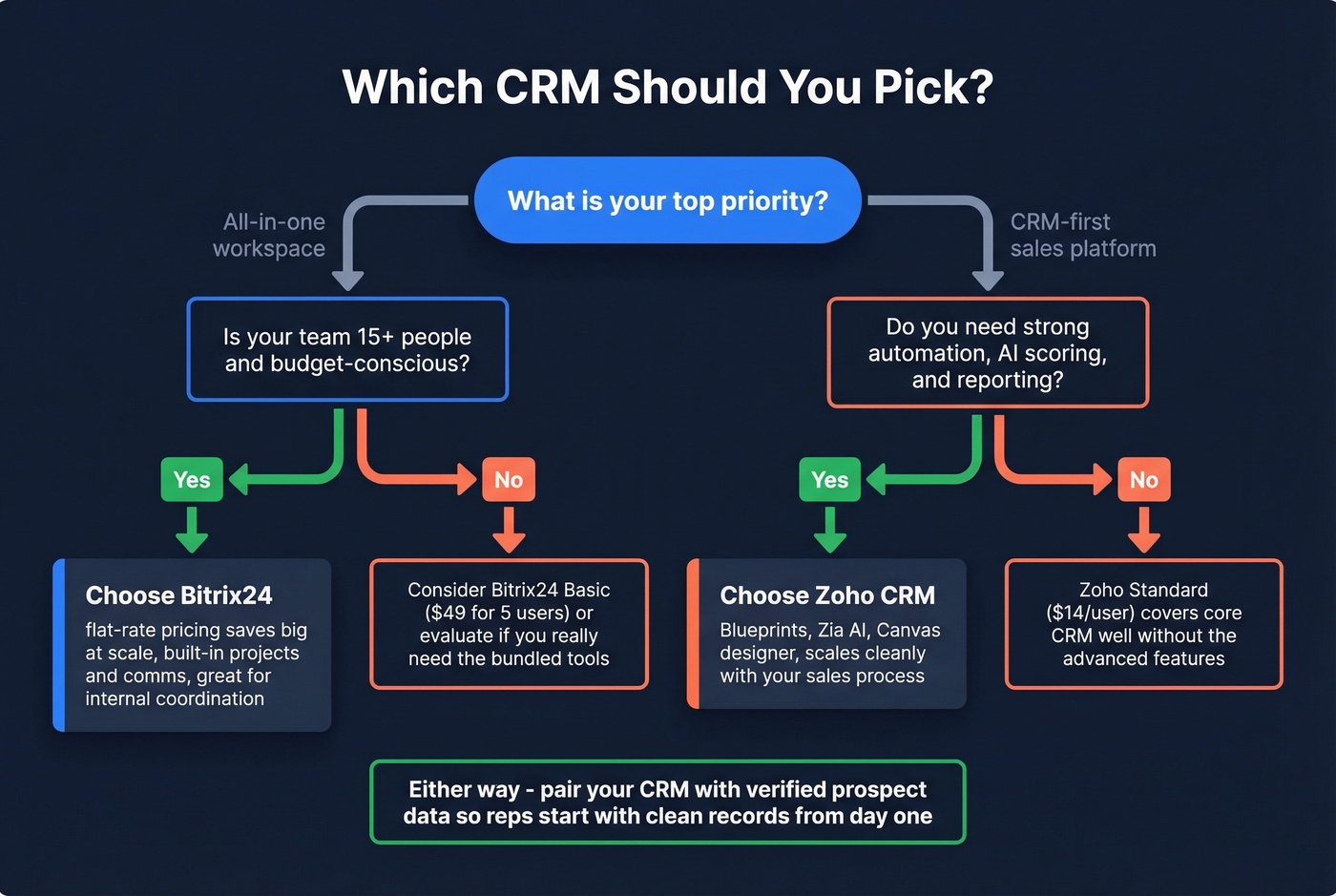
Choose Zoho CRM if you want a CRM-first system that stays clean as you scale. Qualification, pipeline governance, and stage discipline are better with Blueprints and deeper automation. Closing and forecasting are stronger because reporting and AI are more sales-native. If forecasting is a priority, compare dedicated sales forecasting tools before you commit.
Migration note if you're switching: both platforms can import CSVs, but the real work is field mapping, deduping, and rebuilding automations. Plan a short pilot where you migrate one pipeline and one team first. It exposes 90% of the "gotchas" before you move the whole org.
For teams where outbound prospecting is core to the workflow, pair either CRM with a verified data source so reps start dialing clean records from day one instead of spending their first week cleaning up imports. If you're evaluating vendors for that layer, start with these data enrichment services and free lead generation tools.
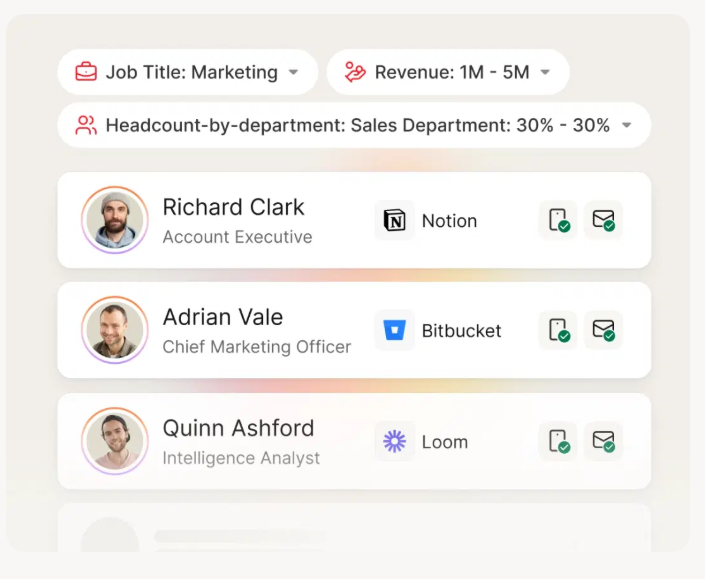
You can save thousands picking the right CRM plan. But the biggest ROI comes from what goes into it. Prospeo delivers verified emails at $0.01 each - refreshed every 7 days - and pushes directly into HubSpot, Salesforce, or any CRM via API.
Clean data in, closed deals out. That's the formula.
FAQ
Is Bitrix24 really cheaper than Zoho CRM?
Yes - dramatically so at scale. Bitrix24 Standard covers up to 50 users for $99/month, while Zoho CRM Standard at $14/user/month costs $700/month for the same headcount. The trade-off: Bitrix24 optimizes for headcount; Zoho optimizes for CRM depth and sales-specific features.
Can I use Zoho CRM for free?
Zoho CRM's free plan supports up to 3 users with core features like leads, contacts, and deals. Bitrix24's free plan supports unlimited users but imposes tighter functional and storage limits - fine for testing, but you'll outgrow it fast in a real sales process.
Which has better sales AI - Zia or CoPilot?
Zia is stronger for sales intelligence: deal scoring, forecasting, anomaly detection, and next-best-action guidance. CoPilot excels at productivity - call summaries, transcriptions, content generation. For pipeline-focused teams trying to close more deals, Zia wins.
How do I get verified contacts into Bitrix24 or Zoho CRM?
Neither CRM generates prospect data natively. Use a tool like Prospeo's Email Finder to find and verify contacts, then push them into either platform via Zapier, Make, or direct API so reps start with clean, dial-ready records from day one.