


BitScale Pros and Cons: Honest Review for 2026
You've been using Clay and the bills are getting ridiculous - credits stacking on credits, CRM integrations costing extra. BitScale keeps showing up as the cheaper alternative. Before you switch, here's an honest breakdown of BitScale's strengths and weaknesses based on real usage, credit math, and the tool's thin review footprint.
30-Second Verdict
BitScale is a solid Clay alternative for teams that want spreadsheet-style enrichment at a lower price. The pros: simpler setup, cheaper entry at $89/mo, decent AI personalization. The cons: credits burn fast, CRM integrations are gated behind expensive tiers, and the tool has almost no independent validation - two G2 reviews total. If you just need verified contact data and don't care about workflow orchestration, skip BitScale entirely and use a dedicated data platform instead.
What BitScale Actually Does
BitScale is an enrichment-first GTM tool built around a spreadsheet UI. You pull data from multiple sources, enrich it, and push it downstream - the same "smart spreadsheet" concept people like about Clay, but with an easier setup experience and a 300M+ contact database baked in.
The typical workflow looks like this: generate leads, enrich across 100+ sources, then push to outreach tools like Instantly or Smartlead. There's no built-in email sender, so you're still running sending elsewhere.

The Strengths Worth Knowing
Cheaper than Clay - and users notice. G2 reviewer Liam D. put it bluntly: BitScale is "cheaper than Clay" with setup that's "super easy." When Clay's credit model and third-party data costs start compounding, BitScale's $89/mo Starter plan feels like a relief.
Responsive Slack-based support. BitScale offers a private Slack channel, and early users highlight it as a genuine differentiator. That matters when you're debugging enrichment workflows at 11pm on a Tuesday.
AI personalization that works in production. Another G2 reviewer highlights that BitScale "comes up with the correct content to send out to prospects in volume." On r/coldemail, a user sharing their outbound workflow described using the tool to generate personalized first lines from professional profiles and websites. We've tested similar AI-personalization tools, and the output quality here is above average for the price point.
75+ pre-built playbooks lower onboarding friction compared to Clay's blank-canvas approach. You're modifying existing workflows, not building from scratch. A SyncGTM review also reported a sub-4% bounce rate on 500 enriched emails - though in our experience, tools that perform well at 500 emails don't always hold up at 5,000.
The Drawbacks That Matter
This is where things get interesting.
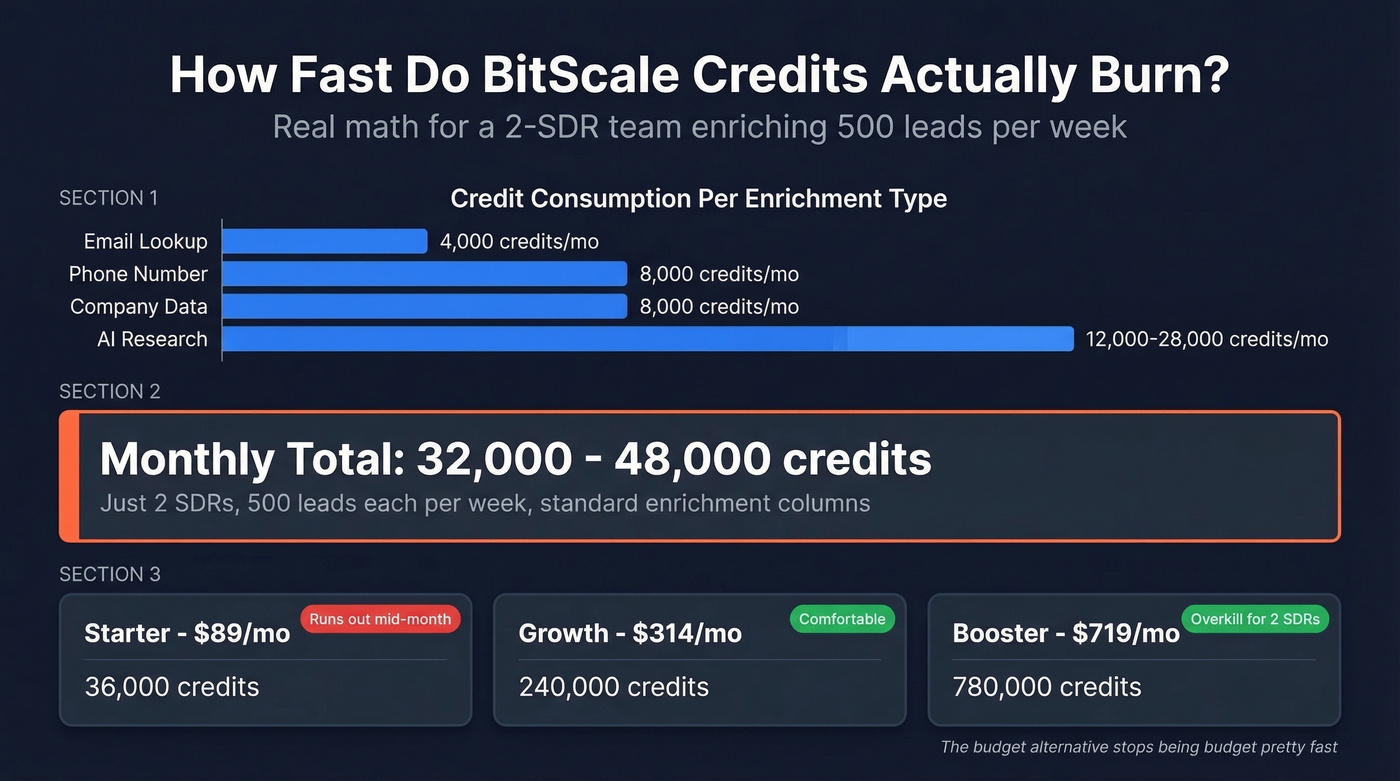
Credits burn faster than you'd expect. We ran the math: two SDRs enriching 500 leads per week with email, phone, company data, and AI research consume roughly 32,000-48,000 credits per month. The Starter plan includes 36,000. A two-person team can blow through Starter before month-end, pushing you to Growth at $314/mo. So much for the "budget alternative" positioning.
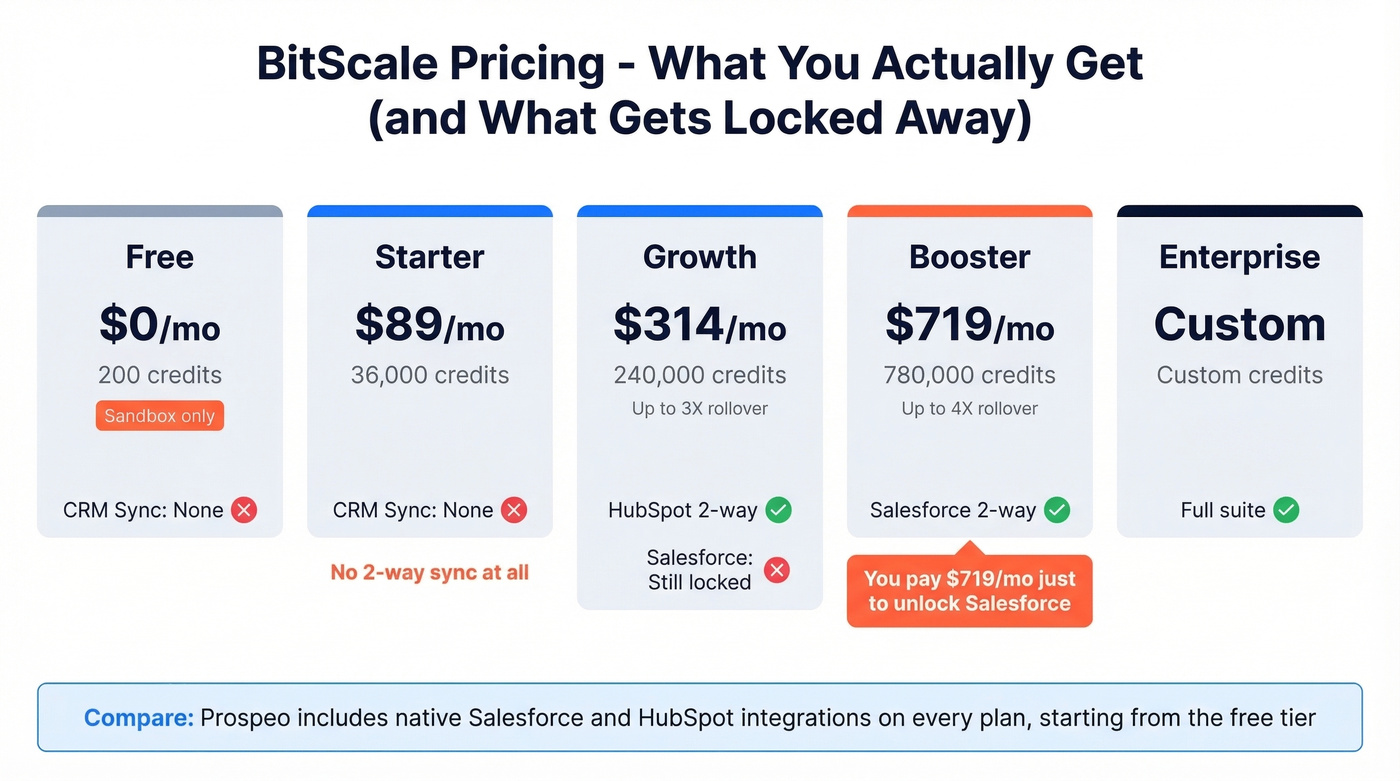
CRM integrations are gated behind expensive tiers. Two-way HubSpot sync requires Growth at $314/mo. Salesforce? That's Booster at $719/mo. For a tool positioning itself as the affordable Clay alternative, locking Salesforce behind $719/mo is a tough pill to swallow. We've seen teams sign up for Starter, realize they can't sync to their CRM, and immediately start shopping again.
Usability friction is real. One G2 reviewer noted performance "slows down a bit" during use, and despite the "easy setup" marketing, expect 1-2 weeks to configure enrichment columns, understand credit consumption, and build effective workflows. The playbooks help but don't eliminate the ramp.
The review footprint is paper-thin. BitScale has a perfect 5.0/5 on G2 - based on exactly two reviews. There's almost no community footprint: minimal Reddit mentions, no independent benchmarks. That's not necessarily bad for a new tool, but it means you're an early adopter with limited social proof. Vendor-claimed 94% email coverage and 89% phone match rates sound decent, but nobody outside BitScale has verified them.

BitScale gates Salesforce behind $719/mo and self-reports 94% email accuracy with zero independent verification. Prospeo delivers 98% verified email accuracy across 143M+ emails, refreshed every 7 days, with native Salesforce and HubSpot integrations on every plan - starting at $0.01/email.
Stop paying $719/mo for CRM access that should be standard.
Pricing Breakdown
Several directory sites have this wrong. Coldreach's review claims no free plan with paid tiers starting at $349/mo. Salesforge's listing shows Growth at $349 and Booster at $799. Here's what BitScale actually charges as of early 2026:
| Plan | Price/mo | Credits | CRM Integration |
|---|---|---|---|
| Free | $0 | 200 | None |
| Starter | $89 | 36,000 | No 2-way CRM sync |
| Growth | $314 | 240,000 | HubSpot 2-way |
| Booster | $719 | 780,000 | Salesforce |
| Enterprise | Custom | Custom | Full suite |
Unused credits roll over (up to 3X on Growth, 4X on Booster). The free tier's 200 credits are a sandbox - don't expect to run any real workflow on them.
BitScale vs Clay vs Prospeo
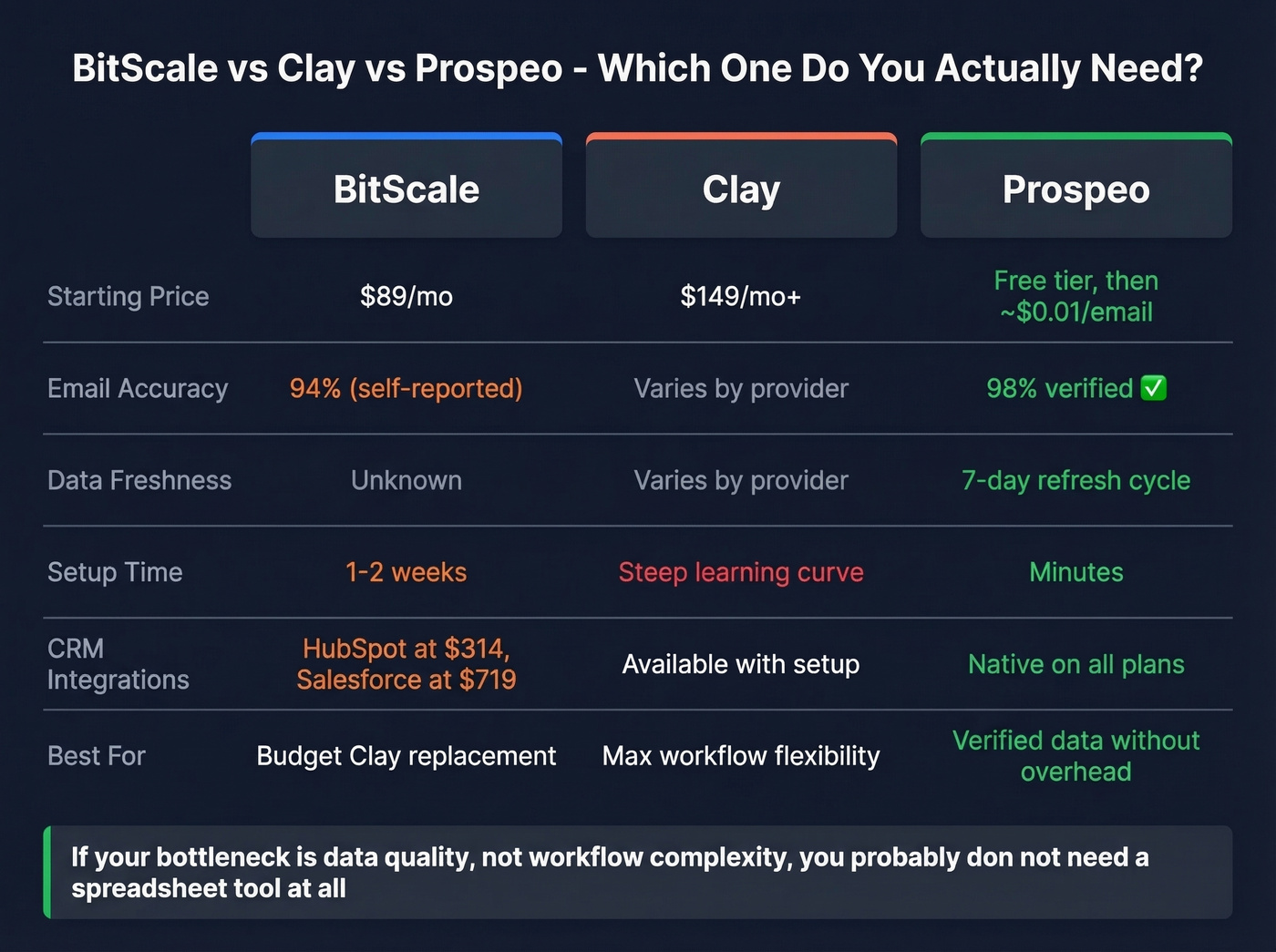
Here's the thing: most teams researching BitScale don't actually need a workflow orchestration tool. They need accurate contact data fed into their existing stack. The workflow layer is solving a problem many SDR teams don't have.
| Dimension | BitScale | Clay | Prospeo |
|---|---|---|---|
| Starting price | $89/mo | ~$149/mo+ | Free tier; ~$0.01/email |
| Email accuracy | 94% (self-reported) | Varies by provider | 98% verified |
| Data freshness | Unknown | Varies by provider | 7-day refresh cycle |
| Ease of setup | Moderate (1-2 week ramp) | Steep learning curve | Minutes |
| Best for | Budget Clay replacement | Max workflow flexibility | Verified data without overhead |
Prospeo delivers 98% email accuracy across 143M+ verified emails and 125M+ verified mobile numbers with a 30% pickup rate, all on a proprietary verification infrastructure that doesn't depend on third-party email providers. For teams whose real bottleneck is data quality rather than workflow complexity, that's a fundamentally different value proposition.
Who Should Use BitScale
Use it if you're migrating from Clay and want simpler enrichment at lower cost, need AI-generated personalization at scale, and your team is 1-3 SDRs who can stay within credit limits. If you're still building your outbound motion, it helps to align on sales prospecting techniques before you over-invest in tooling.
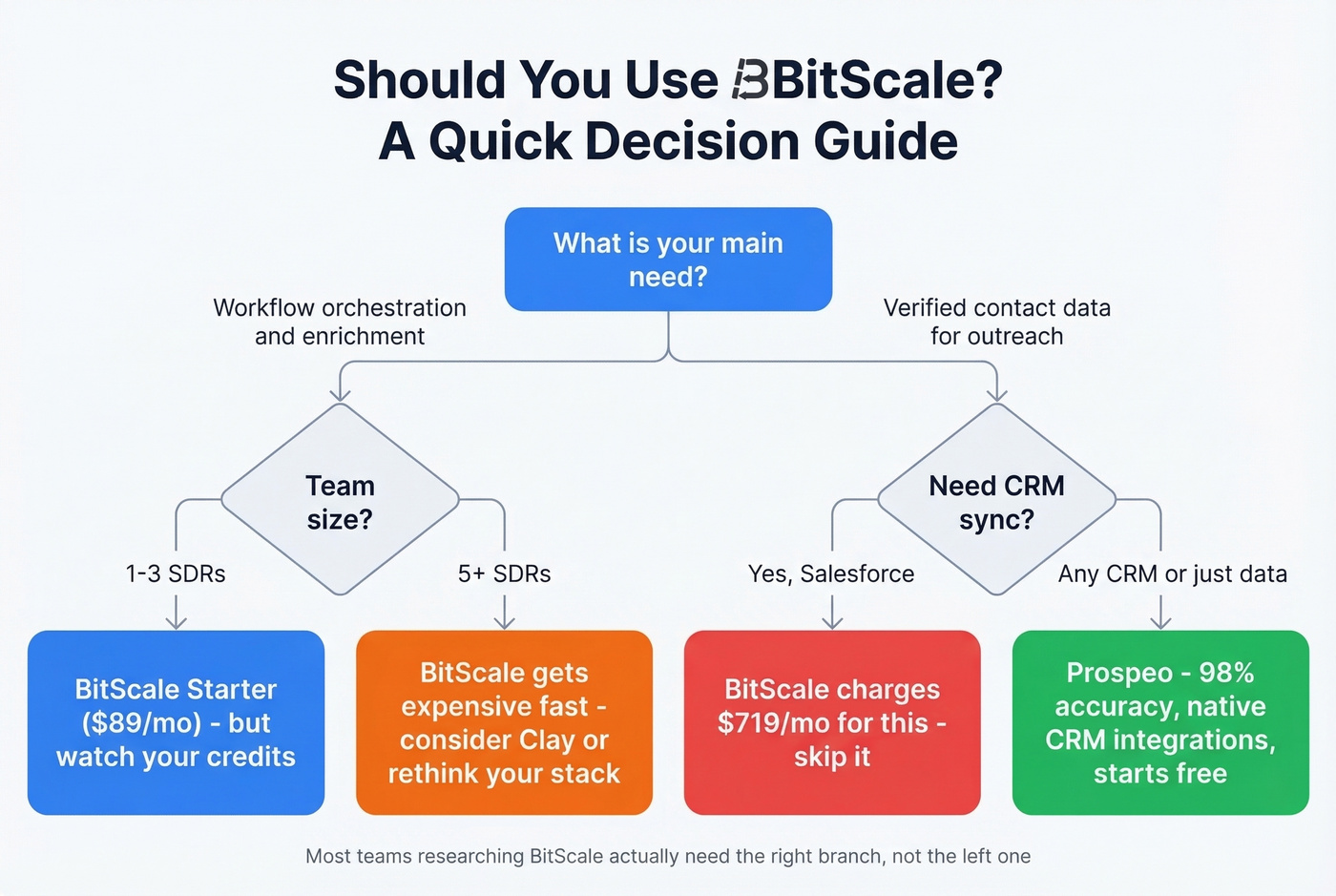
Skip it if your primary need is verified contact data without workflow overhead, you need Salesforce integration but can't justify $719/mo, or your team runs 5+ SDRs at volume where credits get expensive fast. In that last scenario, the "affordable alternative" math falls apart quickly.
Alternatives Worth Exploring
Prospeo is the pick when your core problem is data accuracy, not workflow building. Its 5-step verification process with catch-all handling, spam-trap removal, and honeypot filtering delivers 98% email accuracy - and the 7-day data refresh cycle means you aren't working with stale records while the industry average sits at 6 weeks. Self-serve from a free tier with 75 emails/month, no contracts, and native integrations with Salesforce, HubSpot, Smartlead, Instantly, and Clay. Teams like Meritt tripled their pipeline from $100K to $300K/week after switching, with bounce rates dropping from 35% to under 4%. If you're comparing vendors broadly, start with our roundup of data enrichment services.

Clay remains the maximum-flexibility option with 50+ data providers and deep customization. Plans run ~$149-800/mo before third-party data costs. Worth it only if you'll actually use the workflow power - and most teams we talk to overestimate how much they will. If you're trying to estimate real effort and cost, see Clay list building.
Apollo is the all-in-one play: 275M contacts plus sequencing plus a built-in dialer. Free tier available, paid from ~$49/user/mo. The tradeoff is data ecosystem lock-in and inconsistent quality at scale. If you're evaluating similar stacks, compare options in our guide to a sales prospecting database.
Two SDRs on BitScale Starter burn through 36,000 credits before month-end. Prospeo's credit model is radically simpler: ~$0.01 per verified email, 10 credits per mobile number, and you only pay when data is found. Meritt made the switch and tripled pipeline to $300K/week with bounce rates under 4%.
Ditch the credit anxiety - pay a penny per verified email instead.
FAQ
Is BitScale better than Clay?
BitScale is simpler and cheaper at $89/mo vs ~$149/mo+, but Clay offers more flexibility with 50+ data providers and deeper workflow customization. Pick BitScale for basic enrichment on a budget; pick Clay if you need maximum orchestration control.
How fast do BitScale credits run out?
Fast. Two SDRs enriching 500 leads/week with full data columns burn 32,000-48,000 credits monthly. Starter's 36,000 credits won't last a full month at that pace, pushing you to Growth at $314/mo.
What's a good alternative if I just need verified emails?
Prospeo delivers 98% verified email accuracy at ~$0.01 per email with a free tier of 75 emails/month. No spreadsheet configuration, no credit complexity - just verified contact data with a 7-day refresh cycle and native CRM integrations.
Does BitScale integrate with Salesforce?
Yes, but only on the Booster plan at $719/mo. HubSpot two-way sync starts at Growth ($314/mo). If CRM integration is essential and you're budget-conscious, tools like Prospeo offer native Salesforce and HubSpot integrations on lower-cost plans.