

Bottom of Funnel Marketing: The Data-Backed Playbook for 2026
Marketing teams ran an average of 209 campaigns last year - up 30% - while budgets dropped 15%. More campaigns, less money, same pipeline targets. Every bottom of funnel guide tells you to "use retargeting" and "send personalized emails" without telling you what conversion rate to expect, how many touches to send, or how to stop Meta from cannibalizing your budget. That's not a guide. It's a glossary entry.
Here's the thing most marketers won't say out loud: if your average deal size is under $10K and your team is still pouring 80% of content resources into top-of-funnel blog posts, you're lighting money on fire. BOFU pages convert at 4.78% - roughly 25x higher than TOFU content. The math isn't subtle.
The Funnel Is a Useful Lie
The funnel is a simplification. Buyers skip stages, enter late, self-educate through dark social and peer conversations. 67% of customers now prefer self-service over talking to a rep - they're reading your comparison pages, checking your pricing, and making decisions before your BDR even knows they exist.
But BOFU as a concept still matters because it describes a state of readiness, not a position in a sequence. Let's build a real playbook around that.
What You Need (Quick Version)
- Know your benchmarks. BOFU pages convert at 4.78% on average. If you're below that, your execution has a leak.
- Build around high-intent formats. Alternatives pages, comparison posts, case studies, and pricing pages do the heavy lifting.
- Measure by lead, not by click. If your attribution stops at CTR, you're doing content marketing theater.
- Fix your data first. A 35% email bounce rate can silently destroy BOFU campaigns - wrecked sender reputation, wasted ad spend, dead sequences.
What Does BOFU Actually Mean?
Most guides start with a textbook taxonomy of TOFU, MOFU, and BOFU. You already know the stages. What matters is this: the bottom of the funnel is the moment a prospect evaluates specific solutions, compares pricing, reads case studies, and decides whether to buy. It's not where you "push" people. It's where you meet people who've already decided they need something and are now deciding who to buy it from.
The baseline across 14 industries is a 2.9% qualified-lead conversion rate, drawn from 100M+ data points. The best BOFU operations dramatically outperform it - but only when they're intentional about content, measurement, and data quality. Your job at this stage is to remove friction, provide proof, and make the next step obvious.
BOFU Benchmarks by Industry
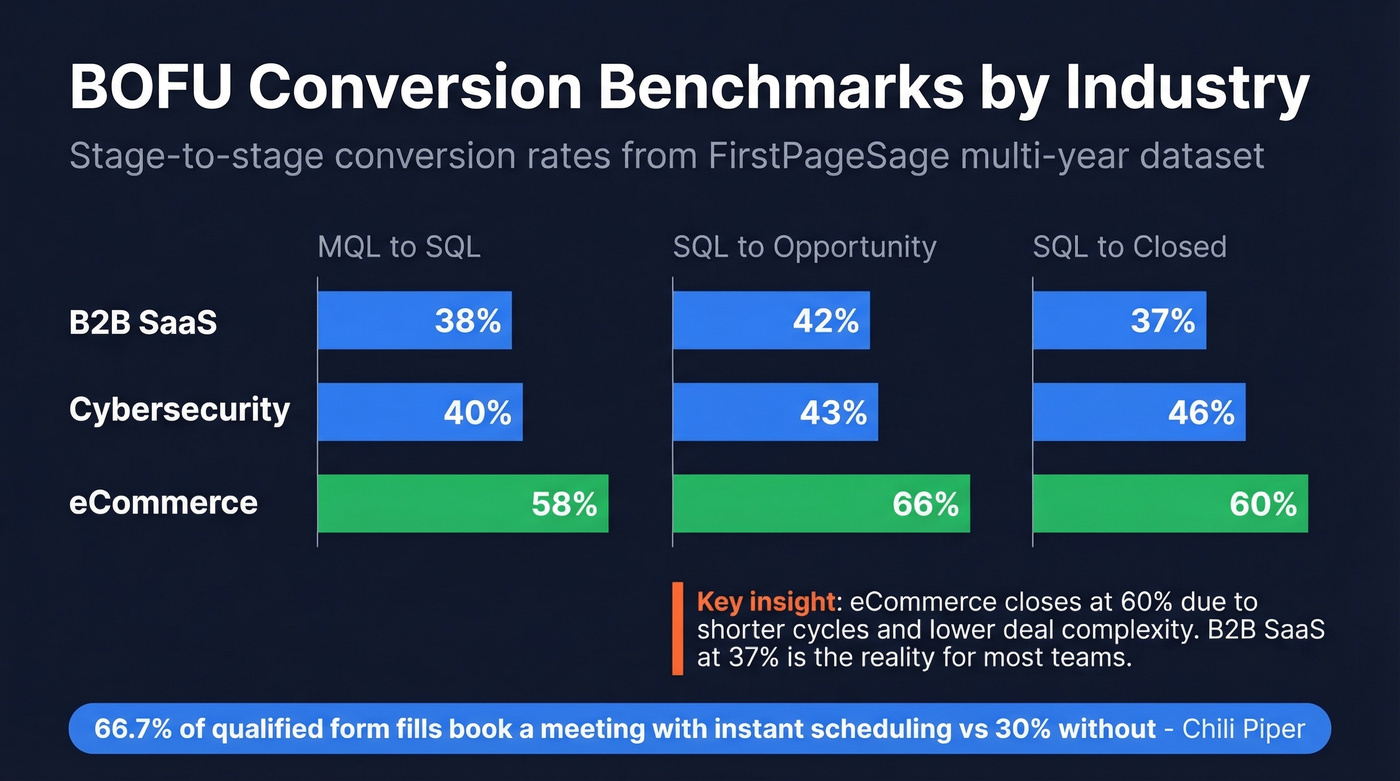
Benchmarks tell you whether your funnel has a structural problem or a volume problem. Here's what stage-to-stage conversion looks like across industries, based on FirstPageSage's multi-year dataset:
| Industry | MQL→SQL | SQL→Opp | SQL→Closed |
|---|---|---|---|
| B2B SaaS | 38% | 42% | 37% |
| Cybersecurity | 40% | 43% | 46% |
| eCommerce | 58% | 66% | 60% |
eCommerce's 60% SQL→Closed rate reflects shorter sales cycles and lower deal complexity. B2B SaaS at 37% is the reality most of us live in - longer cycles, more stakeholders, more friction.
Now layer in the demo-request benchmark from Chili Piper's analysis of ~4 million form submissions: 66.7% of qualified form fills book a meeting when instant scheduling is available. Without it? 30%. That's a 2x gap driven entirely by speed-to-lead and form design - not by better targeting or more spend.
One more number worth flagging: 14.1% of demo form submissions aren't qualified - spam, personal emails, bad-fit companies. If you're not filtering at the form level, you're feeding junk into your pipeline and wondering why close rates are low.
The Math of BOFU vs. TOFU
Search Engine Land's benchmark puts BOFU pages at 4.78% conversion - nearly 25x higher than TOFU content. That implies TOFU is around 0.19%.
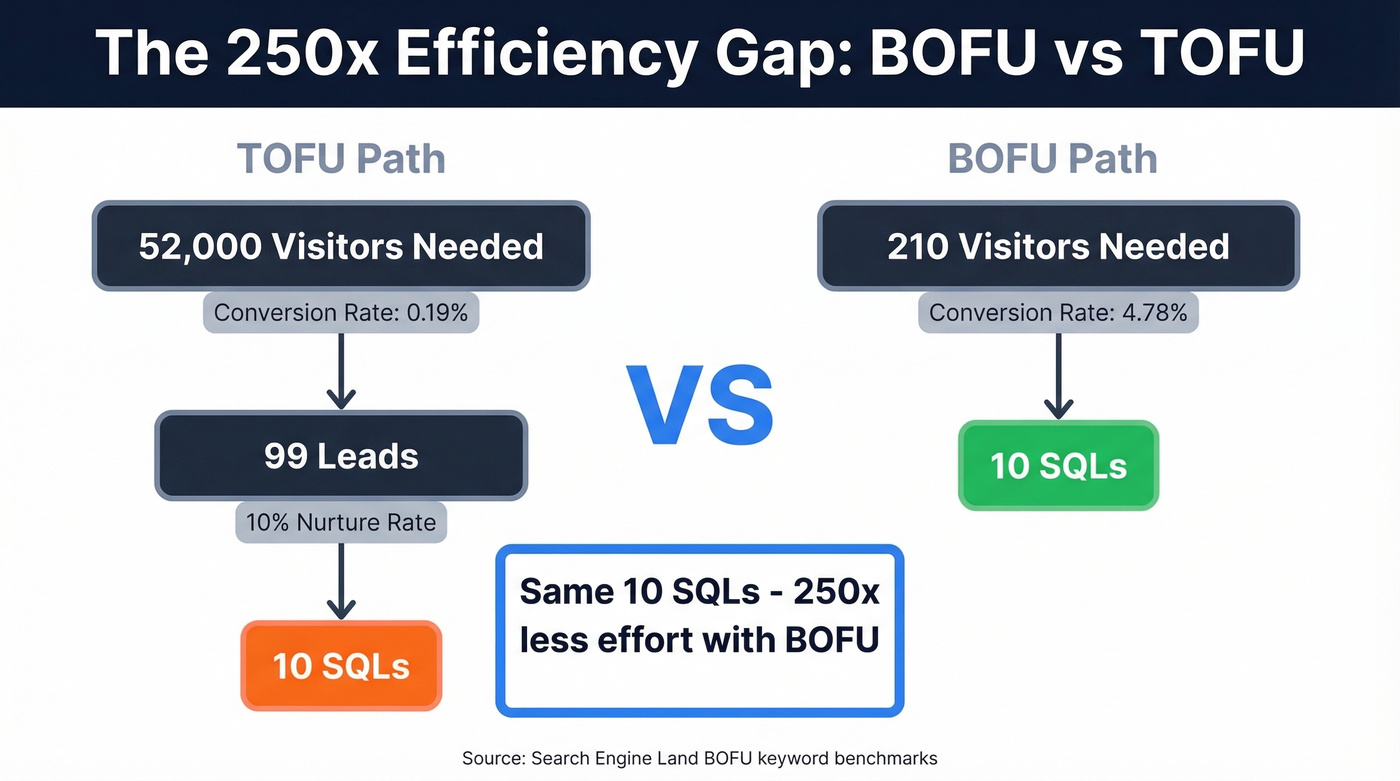
If TOFU converts at ~0.19% and your nurture sequence converts 10% of those to SQLs, you need about 52,000 TOFU visitors to generate 10 SQLs. A BOFU page converting at 4.78% gets you 10 SQLs from about 210 visitors. That's roughly a 250x efficiency gap. Full-funnel balance matters, but if you're under-investing in decision-stage content, you're working 250x harder than you need to.

You just saw the math: BOFU pages convert 25x better than TOFU - but only if your data connects you to real buyers. A 35% bounce rate silently kills sender reputation, wastes ad retargeting spend, and starves your pipeline. Prospeo's 98% email accuracy and 7-day data refresh cycle mean your BOFU sequences actually land.
Stop lighting BOFU budget on fire with bad contact data.
Tactics That Convert at the Decision Stage
Separate Paid Campaigns by Funnel Stage
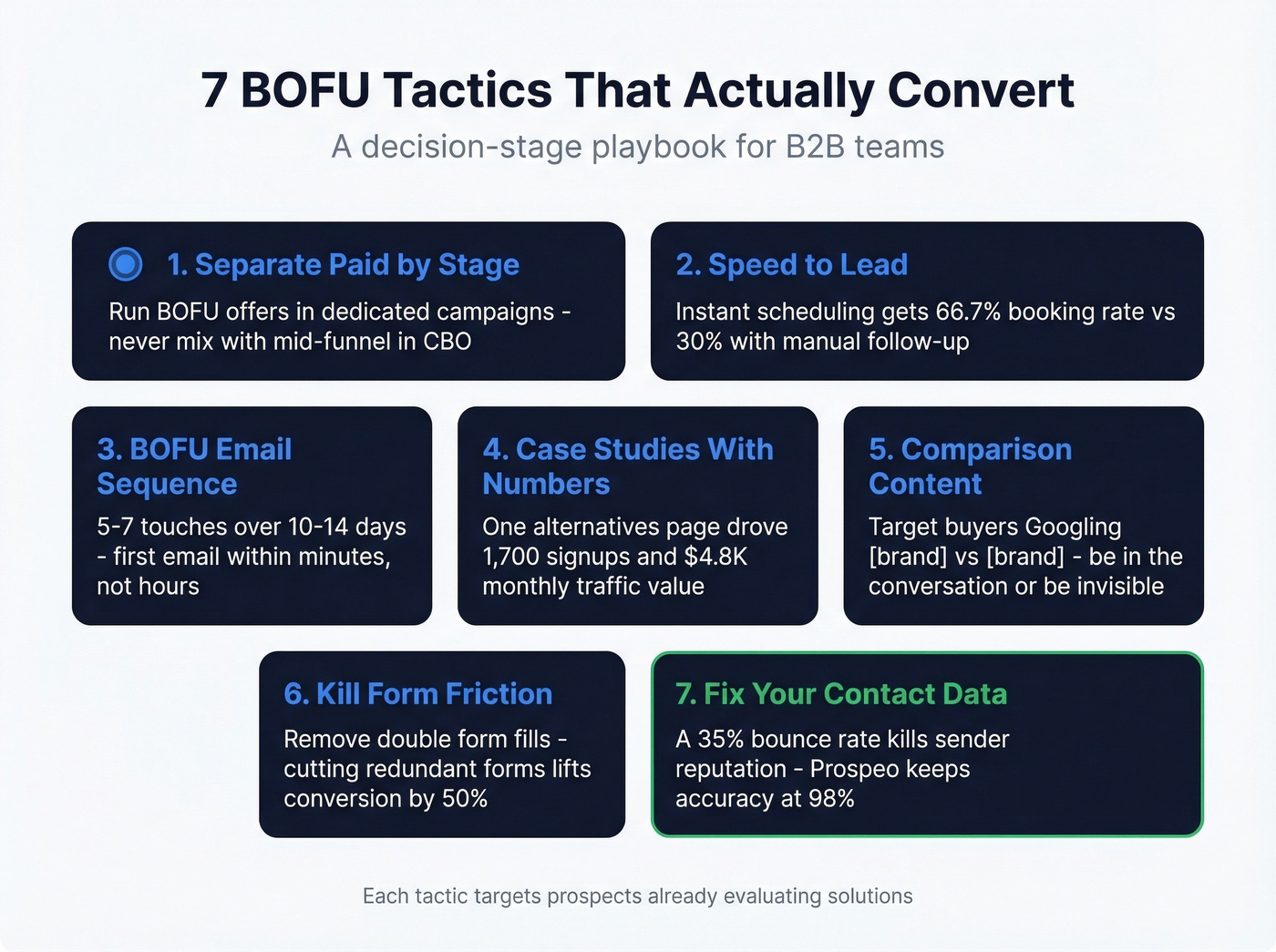
A practitioner on r/FacebookAds reported that adding a mid-funnel ad set to a CBO campaign caused Meta to funnel the entire budget toward it - while CPAs on offer ads doubled. Meta's algorithm optimizes for scale, not intent. Run BOFU offers in their own campaign with dedicated budget. No exceptions.
Speed-to-Lead Wins Demos
| Approach | Booking Rate | Why |
|---|---|---|
| Instant scheduling (Chili Piper, Calendly) | 66.7% | Prospect books while motivation is peak |
| "Someone will reach out" email | ~30% | Momentum dies in the wait |
The 66.7% benchmark isn't magic - it's removing the wait. Chili Piper calls out scheduler load time as a real conversion lever: their calendar loads in 3-4 seconds, while some competitors take 30-45 seconds. That load time gap is a conversion gap.
Build a BOFU Email Sequence
For high-intent actions - demo requests, pricing page visits, trial signups - run a 5-7 touch sequence over 10-14 days. First email within minutes, not hours. Reference the specific page they visited or the competitor they're evaluating. Every subsequent email adds new proof: a case study, a benchmark, a customer quote. Push SQLs to HubSpot or Salesforce and track conversion by cohort.
Publish Case Studies With Numbers
Skip this if your case studies say "we helped Company X grow" without a single metric.
Mentimeter's "Kahoot Alternatives" page generates $4.8K in traffic value per month, has driven 20K clicks, and produced 1.7K sign-ups. One page outperforming entire blog programs. Numbers convert. Vague narratives don't.
Comparison and Alternatives Content
Aline published a series of "vs" comparison posts and ranked in the top spot with featured snippets within days. Comparison content targets buyers who've already shortlisted solutions - they're Googling "[competitor] vs [other competitor]" right now. If you're not in that conversation, you're invisible at the exact moment the decision gets made.
BOFU SEO is the most underrated acquisition channel in B2B. We've seen this firsthand: our own comparison pages consistently outperform top-of-funnel content by 10-15x on a per-visitor pipeline basis.
Eliminate Form Friction
Double form fills - where a prospect completes one form, then gets routed to a second - are a conversion killer. Removing the redundant form can lift conversion rates by 50%. Audit your demo request flow end-to-end. Fill it out yourself. If it takes more than 30 seconds, you're bleeding leads that were ready to convert.
Use Behavior-Based Triggers
When a prospect visits your pricing page but doesn't convert within 24 hours, that's a trigger - not a lost cause. Set up automated interventions: a personalized email with a relevant case study, a retargeting ad with social proof, or a direct outreach from an AE. Layer intent data across 15,000 topics to identify accounts actively researching your category, then prioritize those accounts in your BOFU campaigns. Accounts showing active intent signals convert 3-4x better than cold outreach.
Fix Your Contact Data
You can build the perfect retargeting campaign, publish killer case studies, and optimize every form - but if the emails in your sequences bounce at 35%, none of it matters. Bounced emails damage your sender reputation, which tanks deliverability on every future campaign. It's a compounding problem.

Meritt was running a 35% bounce rate before switching their data source - they got it under 4%, and their pipeline tripled from $100K to $300K per week. That's not a content problem. It's a data quality problem. Prospeo's 5-step verification and 7-day data refresh cycle keep bounce rates under control at 98% email accuracy, and the free tier gives you 75 verified emails plus 100 Chrome extension credits per month to test it.
BOFU SEO - Keywords That Convert
BOFU pages convert at 4.78%. TOFU pages? Around 0.19%. Yet most B2B content programs pour 80% of resources into informational keywords that generate traffic reports, not pipeline.
The CXL framing puts it bluntly: you can rank #1 for "what is a KPI" and get 70,000 garbage clicks, or rank for a high-intent term that brings 50 clicks a month - and 10 convert. Intent beats volume every time at the decision stage.
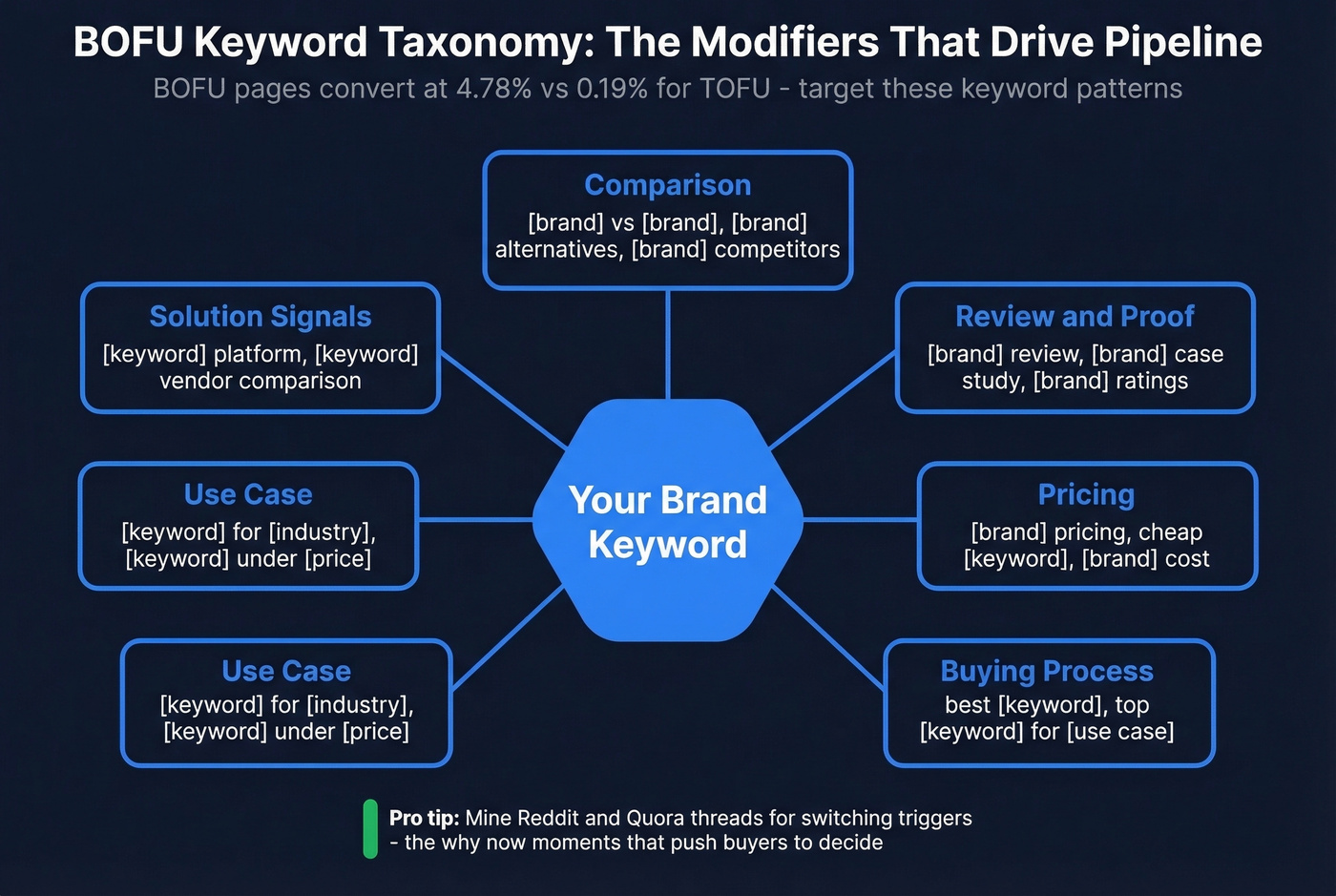
Here's a practical BOFU keyword modifier taxonomy for your content calendar:
- Comparison: "[brand] vs [brand]," "[brand] alternatives," "[brand] competitors"
- Review/proof: "[brand] review," "[brand] case study," "[brand] ratings"
- Pricing: "[brand] pricing," "cheap [keyword]," "[brand] cost"
- Buying process: "best [keyword]," "top [keyword] for [use case]," "[keyword] for small business"
- Use-case: "[keyword] for [industry]," "[keyword] under [price]"
- Solution signals: "[keyword] system," "[keyword] platform," "[keyword] vendor comparison"
Use Ahrefs or Semrush to find BOFU keyword gaps your competitors rank for and you don't. Mine Reddit and Quora threads for switching triggers - the "why now" moments that push someone from consideration to decision. Pipedrive's competitors show up constantly in r/sales threads about CRM frustration. Those threads are keyword goldmines.
How to Measure BOFU Performance
If you can't measure by lead, you're doing content marketing theater. Track these in GA4 and your CRM:
- SQLs generated - not MQLs, not form fills. Qualified opportunities.
- Opportunities created - pipeline dollars, not lead counts.
- Win/close rate - the ultimate BOFU efficiency metric.
- Average deal size - are BOFU leads closing at higher ACVs?
- Sales cycle length - BOFU content should shorten this.
- Demo requests and trial signups - leading indicators of pipeline.
| Model | Best For | BOFU Fit |
|---|---|---|
| Time-decay | Weighting recent touches | Strong - your default |
| W-shaped | Full-journey visibility | Good supplement |
| Self-reported | Dark social, referrals | Essential add-on |
| First-touch | Awareness campaigns | Weak for BOFU |
| Last-touch | Quick-win reporting | Misleading alone |
Time-decay is the right default for BOFU because it gives more credit to the touches closest to conversion. We've tested both time-decay and W-shaped models - time-decay wins for BOFU attribution because it reflects the reality of how late-stage content influences decisions. Supplement with self-reported attribution ("how did you hear about us?") to capture dark social influence that no tracking pixel will ever see.
For ROI, use cohort analysis: group leads by acquisition month, track conversion and revenue over 90 days. Enforce consistent UTM tagging across every campaign in Google Ads and your marketing automation platform. Without it, your attribution data is fiction.
Gartner data shows only 34% of CEOs and CFOs are aligned with their CMO on marketing's role - rigorous BOFU measurement is how you close that gap and defend your budget.
BOFU Mistakes That Kill Conversions
1. Mixing MOFU and BOFU in CBO campaigns. Meta's algorithm allocates budget to the broader, cheaper audience. Your BOFU offer ads starve. Separate them.
2. Optimizing for clicks instead of leads. A 3% CTR means nothing if those clicks don't convert to demos. Report on SQLs and opportunities.
3. Ignoring data quality. 87% of marketing leaders experienced campaign performance issues last year. A meaningful chunk of that traces back to bad contact data destroying email deliverability. If you're troubleshooting deliverability, start with email deliverability and sender reputation.
4. Over-investing in TOFU at BOFU's expense. If you have a large enough addressable audience, conversion campaigns frequently outperform awareness campaigns on ROI. Redirecting even 20% of your TOFU budget toward BOFU efforts can meaningfully accelerate pipeline.
5. Forgetting post-purchase. BOFU doesn't end at the signature. Onboarding sequences, expansion campaigns, and renewal touchpoints are bottom of funnel motions too - they convert existing customers into larger deals and referral sources. Track this with churn analysis and your renewal rate.
Your comparison pages and case studies are doing the hard work of converting decision-stage buyers. Now the prospect requests a demo - and your BDR sends to a dead email. Prospeo gives you 143M+ verified emails, 125M+ direct dials with 30% pickup rates, and CRM enrichment that returns 50+ data points per contact. Close the gap between intent and conversation.
Turn every BOFU hand-raise into a booked meeting.
FAQ
What's the difference between BOFU, MOFU, and TOFU?
TOFU generates awareness, MOFU nurtures interest, and BOFU targets prospects ready to buy. Bottom of funnel pages convert at roughly 25x the rate of TOFU content (4.78% vs ~0.19%), making them the highest-leverage investment in your content program.
What's a good BOFU conversion rate?
4.78% is the average for BOFU pages across industries. SQL→Closed rates range from 37% in B2B SaaS to 60% in eCommerce. Below 2.9% usually signals a structural problem in your offer, form flow, or data quality.
What content formats work best at the bottom of the funnel?
Alternatives pages, head-to-head comparisons, case studies with specific metrics, pricing pages, and product demos convert highest. These formats match buyer intent at the decision stage - people searching "[brand] vs [brand]" are ready to choose.
Which attribution model works best for BOFU?
Time-decay is the strongest default because it weights touches closest to conversion most heavily. Supplement with self-reported attribution ("how did you hear about us?") to capture dark social influence no tracking pixel can see.
How do I fix high bounce rates killing my BOFU sequences?
Verify every email before it enters your sequence using a tool with real-time validation. Meritt cut their bounce rate from 35% to under 4% and tripled weekly pipeline to $300K after switching to a provider with 5-step verification and a 7-day refresh cycle.