


BounceBan vs CUFinder: Verification Tool vs Prospecting Platform
You exported 5,000 contacts from your prospecting tool, loaded them into your sequencer, and 12% bounced on the first send. Your domain reputation's taking hits and you're wondering whether you need a better database or a better verifier. That's the exact tension behind this comparison - except these two tools don't actually compete. One cleans lists. The other builds them.
30-Second Verdict
Pick BounceBan if you already have email lists and need to resolve catch-all and unknown addresses before sending. It's a specialist verifier, not a prospecting tool.
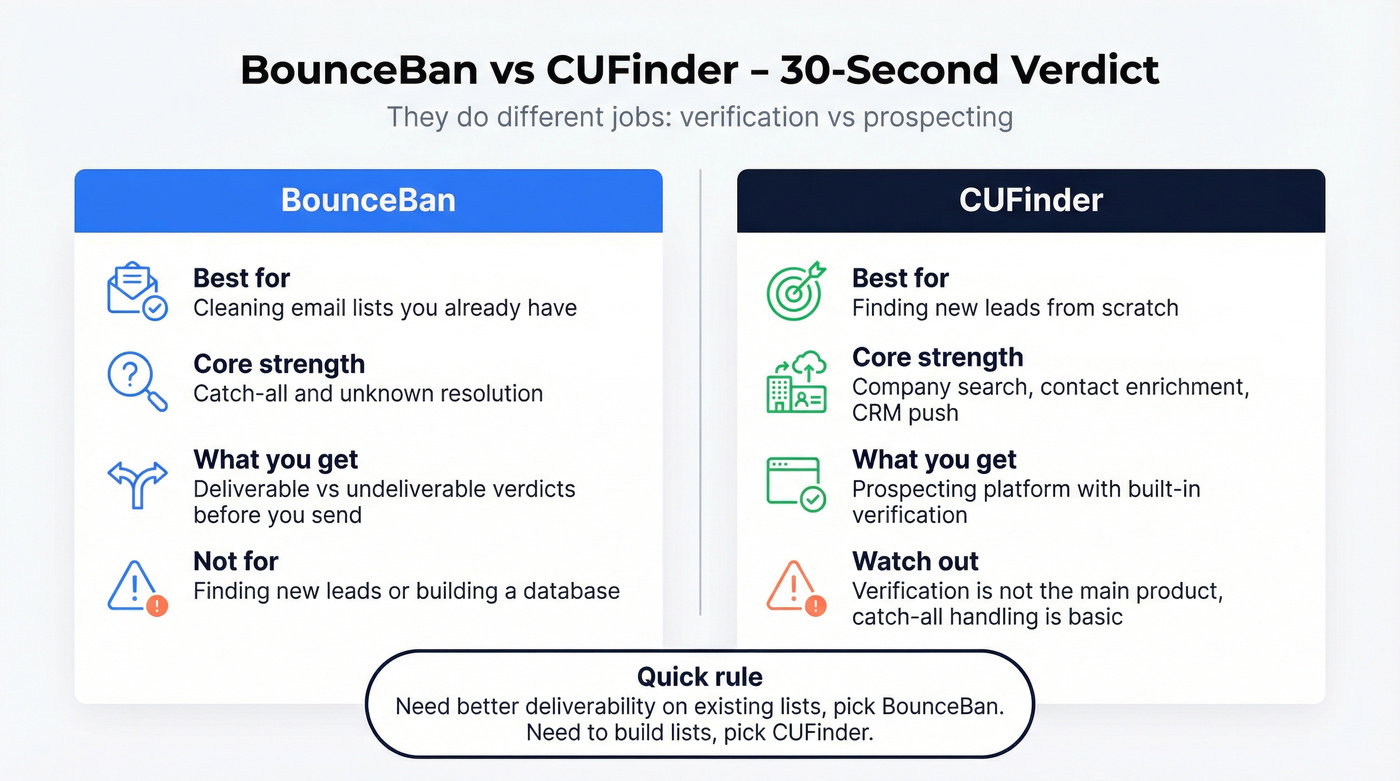
Pick CUFinder if you need to find new leads from scratch - company search, contact enrichment, CRM integrations. Prospecting is the core job.
What Each Tool Actually Does
BounceBan
BounceBan is a dedicated email verification service built around one specific problem: catch-all and SEG-protected emails that standard verifiers mark as "unknown" or "risky." Where most verifiers punt on catch-all domains, BounceBan reliably verifies true deliverability for 85-95% of those emails without sending a single message. In bulk tests, it identifies roughly 40% more deliverable/undeliverable emails while maintaining similar or better delivery rates than competitors - and users on the site report bounce rates dropping from around 8% to under 1%.
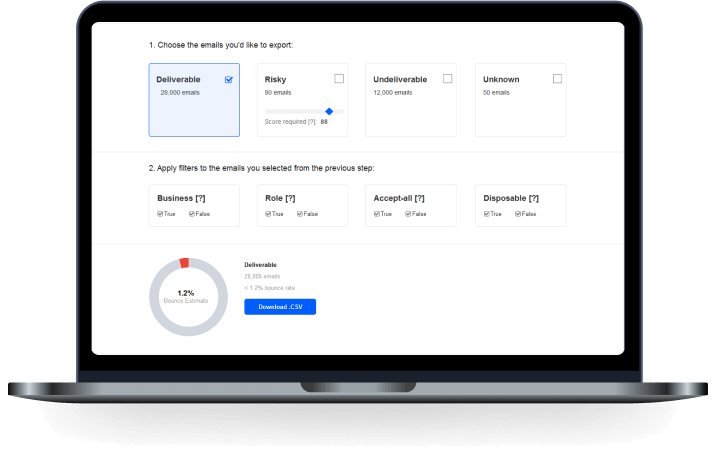
The product is lean. Single email verification is free forever. Bulk verification runs on a credit-based model where one credit equals one successful check, with packages from 10K up to 1M+ credits and custom options for larger volumes. Unused credits roll over and don't expire, which is genuinely useful for teams with irregular sending patterns.
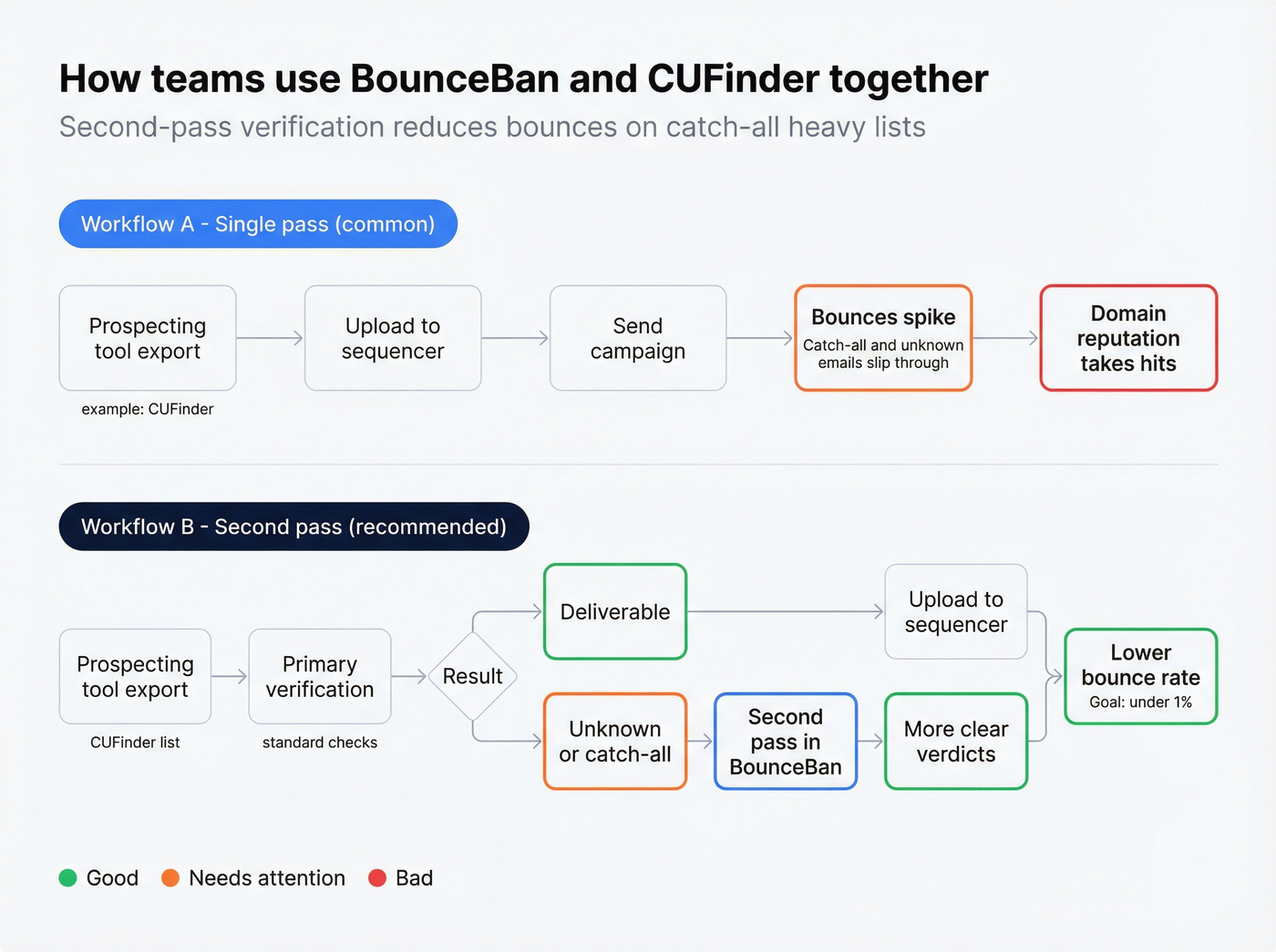
There's also a CRM Sync feature for daily automated list hygiene. On r/coldemail, practitioners recommend BounceBan as a second-pass verifier - run your primary enrichment tool first, then send the unknowns through BounceBan. We've seen this workflow consistently outperform single-pass verification, especially on enterprise-heavy lists where catch-all domains are the norm.
CUFinder
CUFinder is a lead generation and prospecting platform, not a dedicated verifier. Its database covers 262M+ companies and 419M+ contacts, with a Chrome extension, CRM integrations, and advanced search filters for building targeted lists. CUFinder markets a "98% accuracy level" for its database - but that's contact data accuracy, not the same thing as email deliverability verification. Important distinction.
It carries a 4.8/5 rating on G2 across 988 reviews, with users consistently praising data accuracy and ease of use. The recurring complaints: data can occasionally be outdated, and the interface can feel cluttered. Email verification exists as a feature inside CUFinder, but it's not the core product - think of it as a checkbox, not a specialty. For standard domains it's fine. For catch-all-heavy enterprise lists, you'll want something purpose-built.
Feature Comparison
| Feature | BounceBan | CUFinder |
|---|---|---|
| Category | Email verifier | Prospecting platform |
| Core function | Catch-all resolution | Lead gen + enrichment |
| Database | None | 419M+ contacts |
| Email verification | 97%+ catch-all accuracy | Included (not core) |
| Catch-all handling | 85-95% resolved | Basic |
| Chrome extension | No | Yes |
| CRM integrations | Daily sync | Native integrations |
| API access | Yes | Yes |
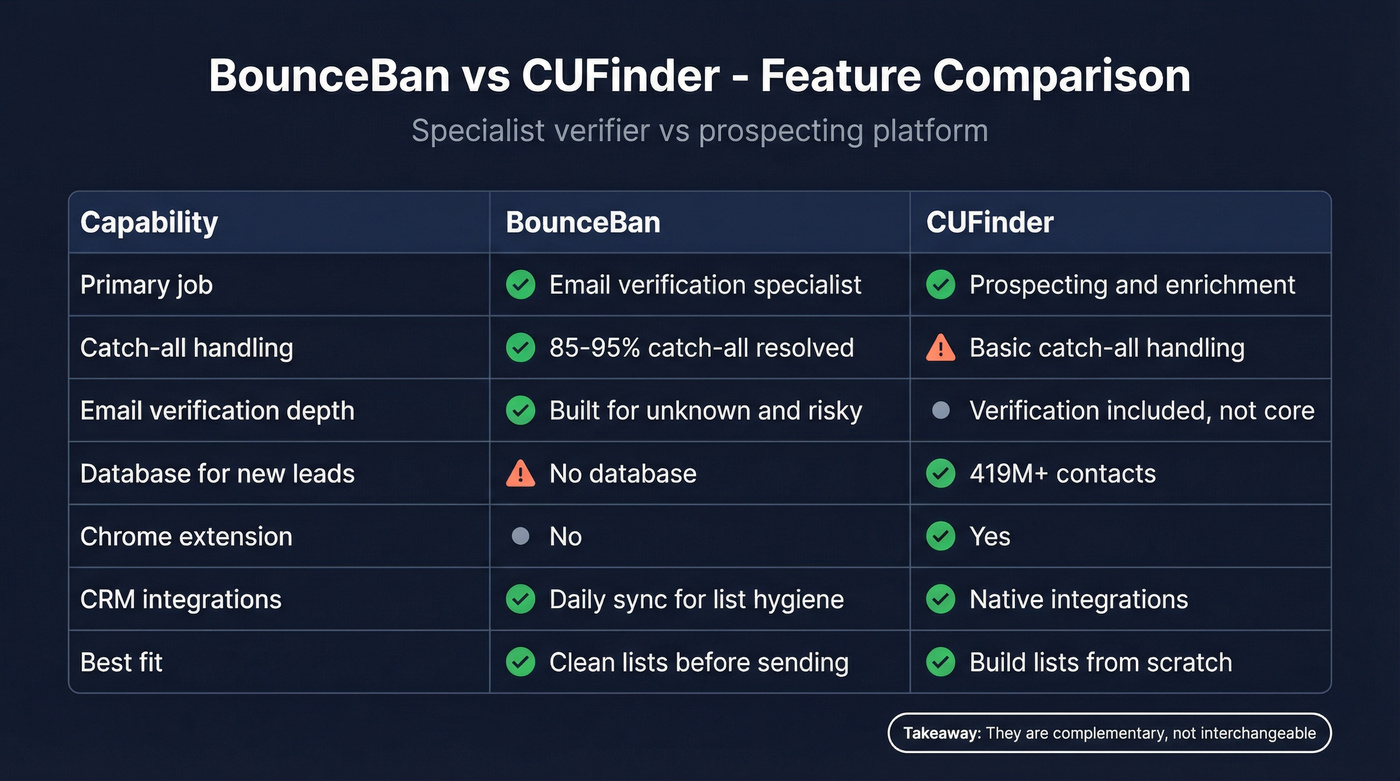
You're comparing a scalpel to a Swiss Army knife. BounceBan does one thing exceptionally well. CUFinder does many things competently. They're complementary, not interchangeable - and in our experience, the teams that treat them as either/or are the ones who end up with deliverability problems down the line.

Running BounceBan as a second pass on CUFinder exports means two tools, two costs, and a stitched-together workflow. Prospeo's proprietary 5-step verification - with catch-all handling, spam-trap removal, and honeypot filtering - is built directly into the prospecting engine. 98% email accuracy. Under 4% bounce rates. No second pass required.
One platform. Prospecting and verification. 75 free emails to prove it.
Pricing Breakdown
| Plan | CUFinder | BounceBan |
|---|---|---|
| Free | $0 (50 credits/mo) | Single checks free forever |
| Starter | $49/mo (1K credits) | Credit-based, pay-as-you-go |
| Mid-tier | $129/mo (3K credits) | Credit-based, volume packs |
| Top tier | $299/mo (10K credits) | Up to 1M+ credits |
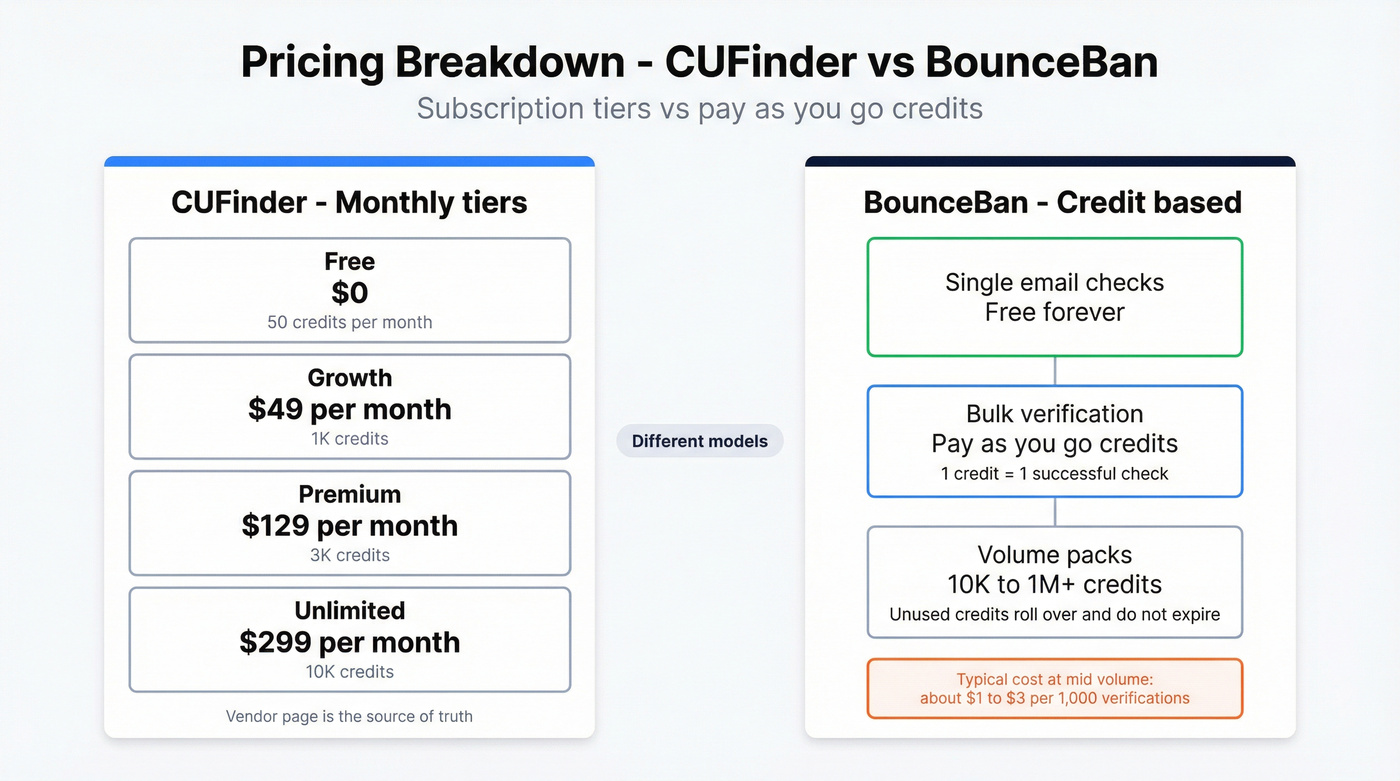
CUFinder's pricing page lists four tiers: Free, Growth ($49), Premium ($129), and Unlimited ($299). If you see different numbers on G2, that's stale data. Trust the vendor's own page.
BounceBan uses a credit-based model with pay-as-you-go or monthly subscription options (15% discount for monthly). Expect roughly $1-3 per 1,000 verifications at mid-tier volumes. Credits roll over indefinitely.
When to Pick Which
Pick BounceBan if your lists are heavy on catch-all/unknown results and you need clean, actionable deliverable vs undeliverable verdicts before you send. You've already got contacts - you just need to know which ones will actually land. Pair it with whatever outbound lead generation tools you're already using as a second-pass verification step.
Pick CUFinder if you're starting from zero and need to build prospect lists. You want company search, contact enrichment, and CRM push in one platform. Verification isn't your primary need.
Here's the thing: most teams weighing BounceBan vs CUFinder are asking the wrong question entirely. If you need both prospecting and verification - and you almost certainly do - running two separate tools creates friction, extra cost, and workflow gaps that compound over time. A single platform that handles both sides eliminates the stitching.
The Full-Stack Alternative
Most teams don't realize they need both prospecting and verification until they've already burned a domain. Don't be that team.
CUFinder gives you contacts but weak verification. BounceBan gives you verification but zero contacts. Prospeo gives you 300M+ profiles with 98% verified emails, 125M+ mobile numbers, and a 7-day data refresh cycle - all at roughly $0.01 per email. No stitching two tools together. No burned domains.
Skip the two-tool tax. Get prospecting and verification in one platform.
FAQ
Can CUFinder replace a dedicated email verifier?
For standard domains with low catch-all rates, CUFinder's built-in verification handles roughly 70-80% of typical B2B lists without issues. For catch-all-heavy enterprise lists, you'll want a dedicated verifier like BounceBan or a platform with built-in catch-all handling.
Is BounceBan worth it for small lists?
Single email verifications are free forever, so there's zero risk in trying it. It's most valuable when more than 15-20% of your list returns "unknown" from your primary verifier - that's where the ROI on a second-pass tool becomes obvious.
Do I need both a prospecting tool and a separate verifier?
Not necessarily. Platforms that combine prospecting with built-in multi-step verification eliminate the need to stitch two tools together. But if you're committed to a prospecting tool with weaker verification, adding BounceBan as a second pass is a proven workflow - the goal is getting under 1% bounce rate, and over-verifying is never the problem.