

BounceRemove vs Clodura.AI (2026): List Cleaner or GTM Platform?
BounceRemove vs Clodura.AI isn't a fair fight - you're matching a list-cleaning utility against a full GTM platform. Most comparisons of these two lean heavily toward Clodura and don't actually address BounceRemove at all, which means nobody's giving you a real side-by-side. This one does.
30-Second Verdict
Choose BounceRemove if you already have a list and just need to scrub it before sending. Upload a CSV, flag spam traps and disposables, download clean results. No prospecting, no sequences - just hygiene.
Choose Clodura.AI if you need to build a prospect list from scratch and run outreach from one platform. It bundles a 600M+ contact database, cadence tools, and intent signals on Pro/PAYG plans.
Skip both if deliverability is your top priority. BounceRemove has virtually no third-party review footprint, and Clodura's verification has produced wildly inconsistent bounce rates in real-world sends.
What Each Tool Actually Does
| BounceRemove | Clodura.AI | |
|---|---|---|
| Category | Email list verifier | All-in-one GTM platform |
| Core job | Clean existing lists | Find leads + enrich + outreach |
| Database | None (bring your own list) | 600M+ contacts |
| Outreach | No | Built-in cadences |
| Pricing | Pay-per-email credits | Per-user/month plans |
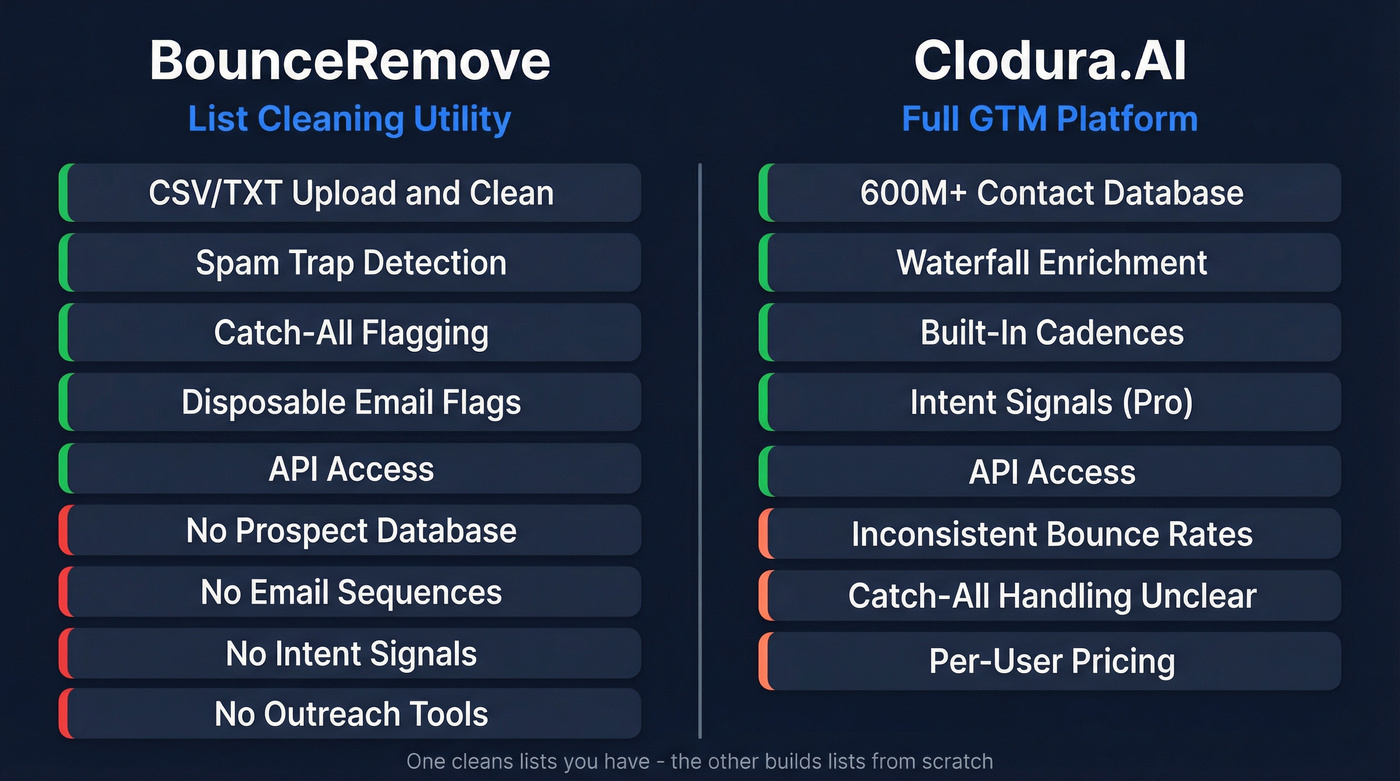
If you need a database, BounceRemove can't help. If you just need to verify a list you already have, paying for a full per-user GTM seat is overkill.
Here's the thing about BounceRemove: it doesn't show up in mainstream verifier conversations at all. We couldn't find relevant Reddit mentions, it didn't appear in any of the sampled "verifier showdown" roundups, and its only visible third-party footprint was a thin Slashdot directory page with a single rating. That's it. For a tool you're trusting with your sender reputation, that lack of social proof is a red flag.
Features Side by Side
| Feature | BounceRemove | Clodura.AI |
|---|---|---|
| Bulk verification | CSV/TXT upload | Waterfall enrichment + verification |
| Spam trap detection | Yes | Not specified |
| Catch-all detection | Yes | Not specified |
| Disposable/abuse flags | Yes (incl. suspicious, complaint) | Not specified |
| API access | Full JSON + single status | Yes |
| Prospecting database | No | 600M+ contacts |
| Email sequences | No | Yes |
| Intent signals | No | Yes (Pro/PAYG only) |
Clodura runs emails through 50+ waterfall email finders and verifiers sequentially until it lands a verified address. The real question: does the output hold up when you hit send?


Waterfall verification still left one user with 16% bounce rates and a banned domain. Prospeo's proprietary 5-step verification - with spam-trap removal, honeypot filtering, and catch-all handling - delivers 98% accuracy across 143M+ verified emails. No guesswork, no stacked third-party tools.
Run your first 75 verifications free and see the difference.
Bounce Risk in Practice
Two real-world Clodura tests tell very different stories, and the gap between them should make you nervous.
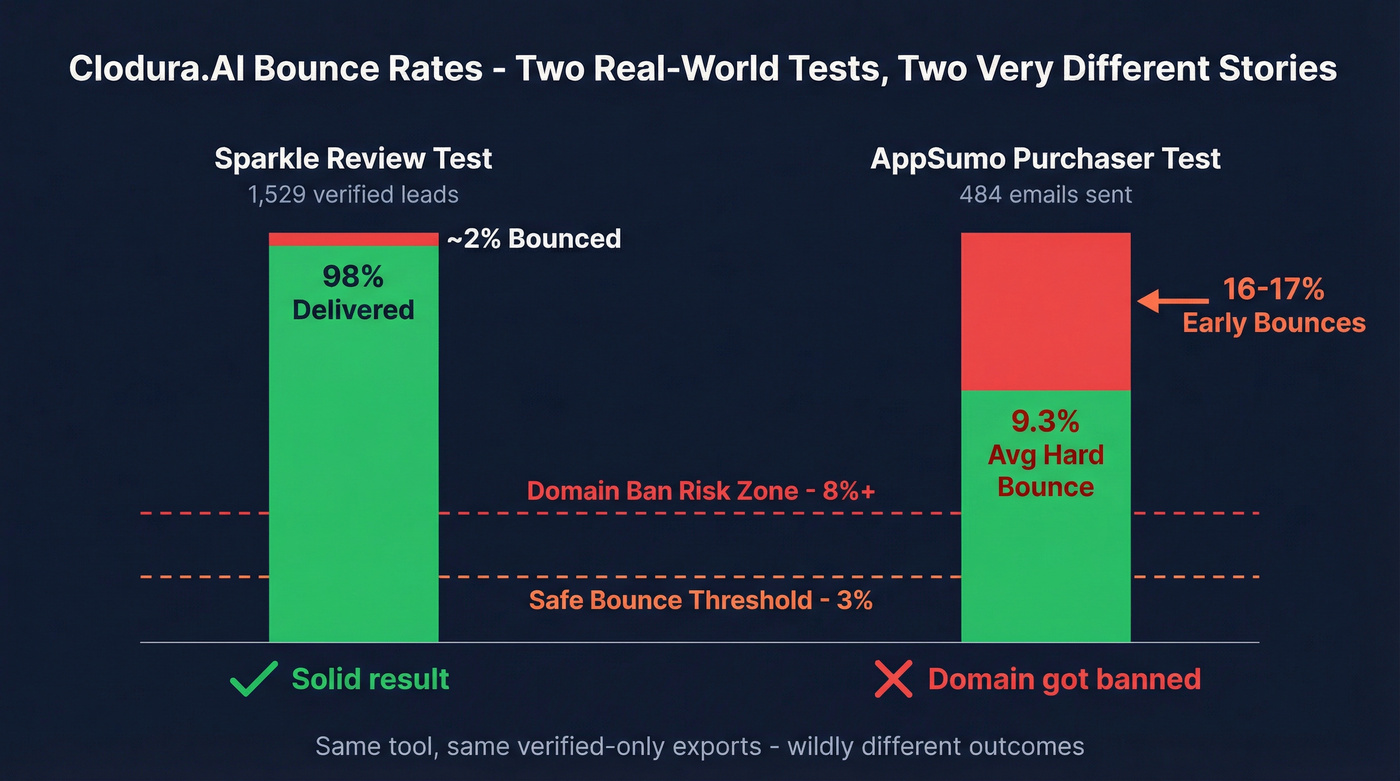
A Sparkle review tested 1,529 "verified" leads exported from Clodura. Result: 28 bounces, roughly 98% deliverability. Solid.
An AppSumo verified purchaser paints a much darker picture. Over 484 emails - also avoiding "guessed" addresses - they hit a 9.3% average hard bounce rate. Earlier in the campaign, bounces ran 16-17%. Their email provider banned their domain.
That variance is the problem. Once hard bounces creep past the low single digits, you're in reputation-damage territory. Above ~8%, you're looking at domain bans. We've seen this pattern across multiple verification tools: catch-all domains are the single biggest source of false positives, and neither BounceRemove nor Clodura handles them well enough to trust blindly.
Let's be honest - if you're running cold outbound, never trust a single tool's "verified" label as your last line of defense. Always run a second verification pass. The cost of a redundant check is trivial compared to a torched domain.
Why "Accuracy" Isn't One Number
A Hunter benchmark tested 15 email verifiers against 3,000 real business emails. The top overall accuracy? About 70%. Not 95%, not 99% - 70%.
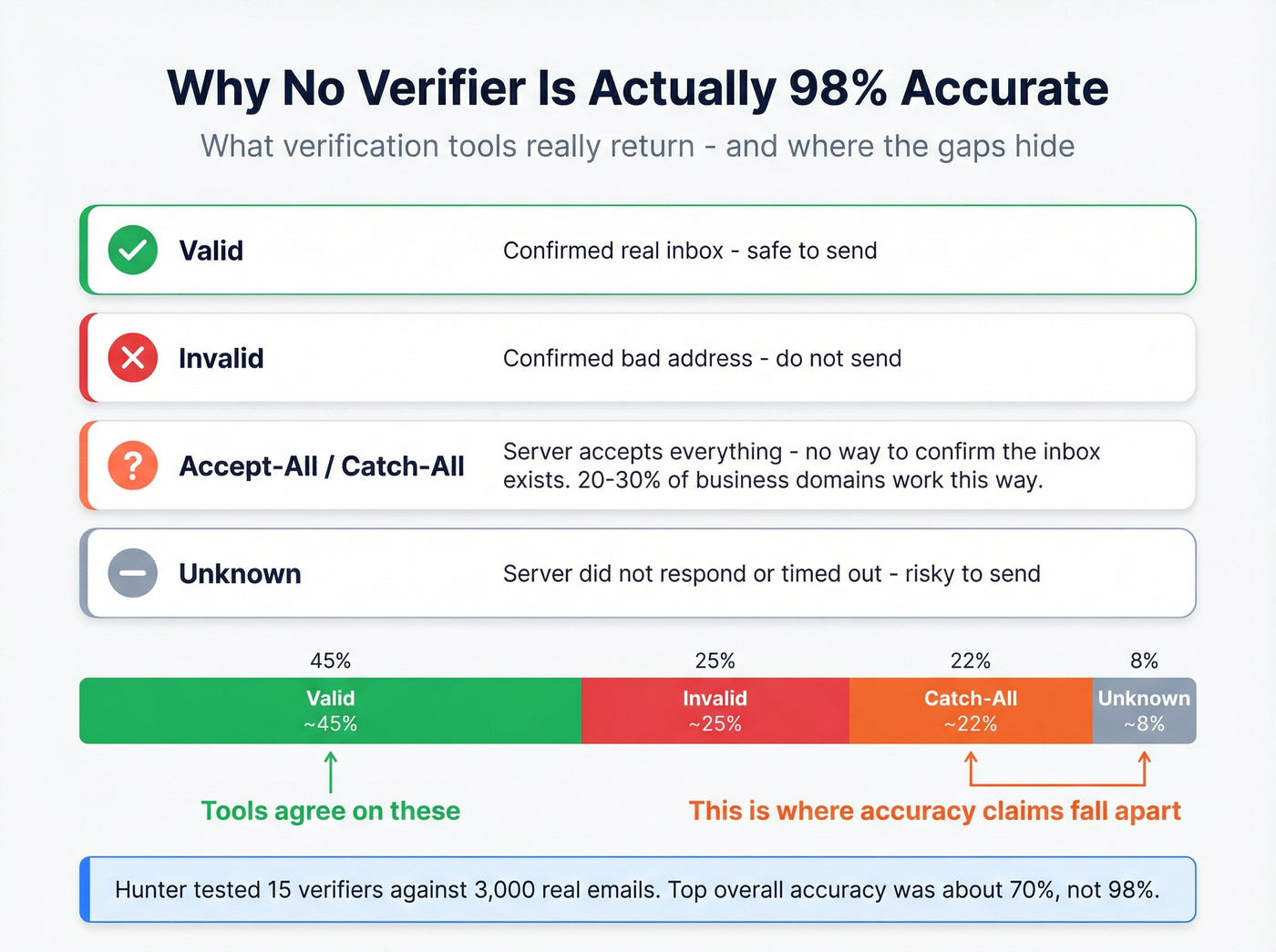
Why so low? Verification tools return Valid, Invalid, Accept-All, and Unknown categories. Every "Unknown" or "Accept-All" result drags accuracy down, and roughly 20-30% of business domains run catch-all configurations that make definitive verification impossible. A competing benchmark using 10,000 emails reported top accuracies above 95%, but that test was run by the vendor that ranked #1 and 28% of the test set was catch-all domains. Methodology determines the number.
When any tool claims 98%+ accuracy, ask: accuracy on what subset? The tools that flag catch-all domains as risky rather than marking them valid are the ones that actually protect your sender reputation.
What It Actually Costs
| BounceRemove | Clodura.AI | |
|---|---|---|
| Free tier | 100 credits | $0/mo (750 email credits) |
| Entry paid | ~$0.003/email (1k-5k) | $33/user/mo (Prospect) |
| Mid tier | ~$0.002/email (5k-100k) | $58/user/mo (Prospect Pro) |
| High volume | ~$0.0007/email (3M-5M) | Custom |
| 10k emails | ~$20-30 | Credit-based exports; verification isn't the limiter |
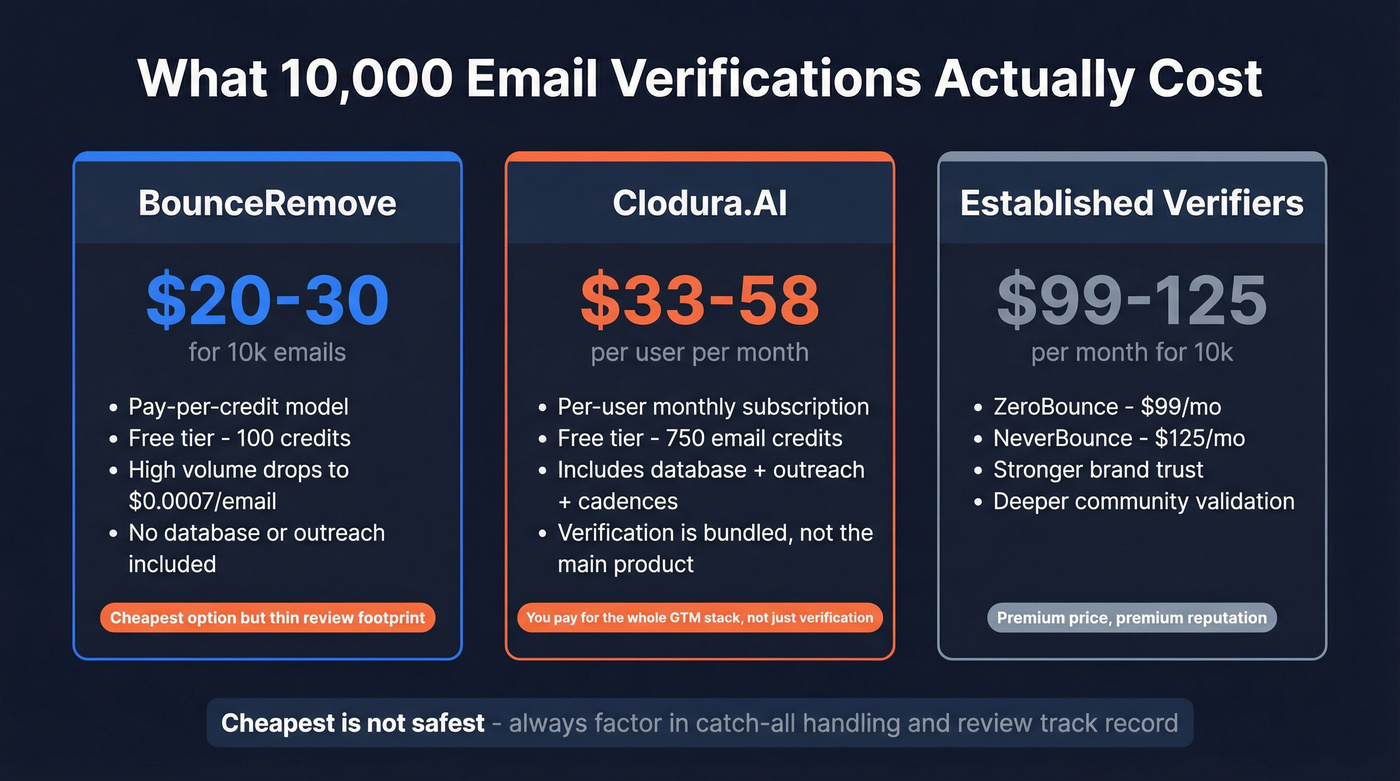
Clodura pricing is messy across the web. Some directories list it starting at $99/user/month, while other reviews list $33/user/month for Prospect and $58/user/month for Prospect Pro. Either way, Clodura's pricing makes more sense when you factor in the database and outreach tools - you're paying for the whole GTM stack, not just verification.
For context, established standalone verifiers charge more: ZeroBounce runs $99/mo and NeverBounce $125/mo for 10,000 verifications. BounceRemove is significantly cheaper, but you're trading brand trust and community validation for cost savings.
Decision Tree
You already have a list and just need it cleaned. A standalone verifier works. BounceRemove handles this, though we'd recommend pairing it with a second tool that has a stronger verification track record and better catch-all handling.
If you're comparing options, start with a shortlist of email verification tools that publish clearer methodology and have more real-world feedback.
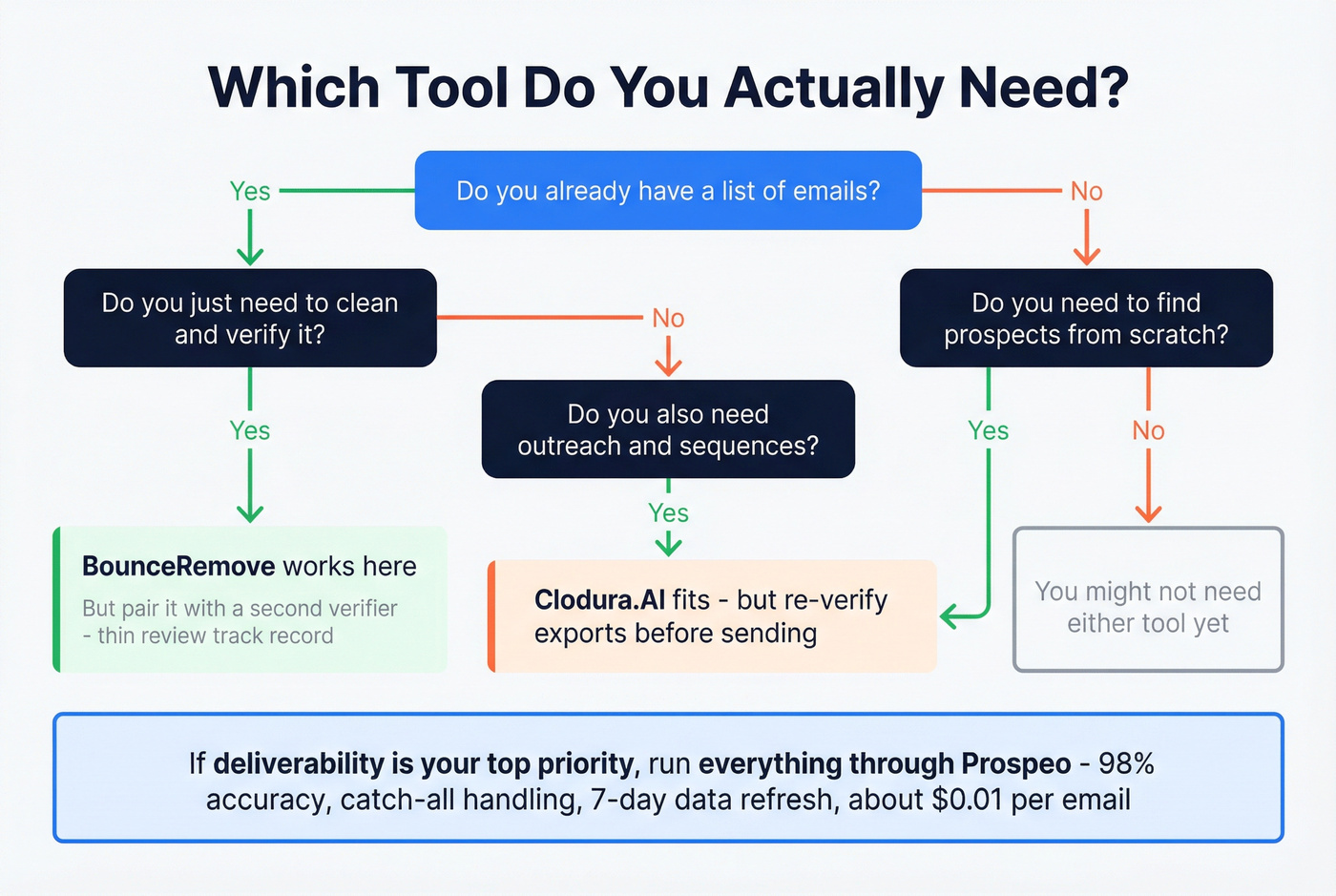
You need to find leads and run outreach from one platform. Clodura fits that use case. Just don't treat the built-in verification as your only quality gate - export verified-only contacts and run them through a second pass before sending.
If you're building lists from scratch, it helps to understand modern sales prospecting techniques and where databases fit (and don't fit) in the workflow.
You care most about not getting your domain banned. This is where both tools fall short. Segment out catch-all and unknown results. Never mail "guessed" emails cold. Prospeo's 5-step verification with catch-all handling and spam-trap removal catches what waterfall architectures miss, and its 7-day data refresh cycle means you're not mailing stale records. At 98% email accuracy across 143M+ verified addresses, it fills the gap these two tools leave open.
If deliverability is the priority, pair verification with a real email deliverability guide and ongoing sender reputation monitoring.
Neither BounceRemove nor Clodura solves the catch-all problem that causes most domain bans. Prospeo does - with dedicated catch-all detection, a 7-day data refresh cycle, and emails at ~$0.01 each. One tool instead of two, with accuracy that holds up on send.
Stop running second verification passes. Get it right the first time.
FAQ
Is BounceRemove or Clodura.AI better for reducing hard bounces?
They serve different functions. BounceRemove is a dedicated list verifier that flags spam traps, disposables, and catch-all domains on lists you already have. Clodura is a prospecting platform with built-in verification. For pure bounce reduction on an existing list, a standalone verifier gives you more granular control over risky categories - but given BounceRemove's thin review footprint, we'd want a second verification layer regardless.
Why do "verified" emails still bounce on catch-all domains?
Catch-all domains accept all incoming mail at the server level, so verification tools can't confirm whether a specific address has a real inbox behind it. Roughly 20-30% of business domains use catch-all configurations. A "verified" result on a catch-all domain just means the server didn't reject the probe - not that someone will receive your email.
What hard bounce rate risks domain reputation?
Stay under 3% to be safe. In the 3-5% range, ESPs start throttling. Above ~8%, you're in domain-ban territory, as the AppSumo reviewer learned firsthand. Reputation damage is cumulative, and recovery takes weeks - sometimes longer if you've been flagged by multiple providers.
Can I layer Prospeo on top of Clodura exports?
Yes, and you should. Export your Clodura contacts and run them through Prospeo's verification before any campaign - it catches spam traps and handles catch-all domains that Clodura's waterfall architecture misses. At ~$0.01/email with 98% accuracy and a 7-day refresh cycle, it's cheap insurance against domain bans.