

Best Bulk Email Address Verification Tools in 2026 (Tested)
You uploaded 50,000 contacts to your sequencer last quarter. By today, roughly 11,250 of those emails are dead. People changed jobs, companies folded, domains expired. Email addresses decay at about 22.5% per year - nearly 3% per month. Send to a list you haven't cleaned in six months and you're volunteering for deliverability hell.
The global inbox placement rate sits around 83.5%, which means one in six legitimate emails never reaches the inbox even under ideal conditions. Stack a dirty list on top of that and you're looking at bounce rates that torch your sender reputation in a single campaign. The fix isn't complicated: run bulk email address verification before you hit send. The hard part is picking the right tool, because pricing models, accuracy claims, and catch-all handling vary wildly across the category.
We've tested all 10 tools below. Here's what actually matters.
Our Picks (TL;DR)
- Prospeo - Best for teams that want clean data from the start. Verification is baked into a 5-step pipeline across 143M+ verified emails. 98% accuracy. ~$0.01/email. Free tier: 75 emails/month.
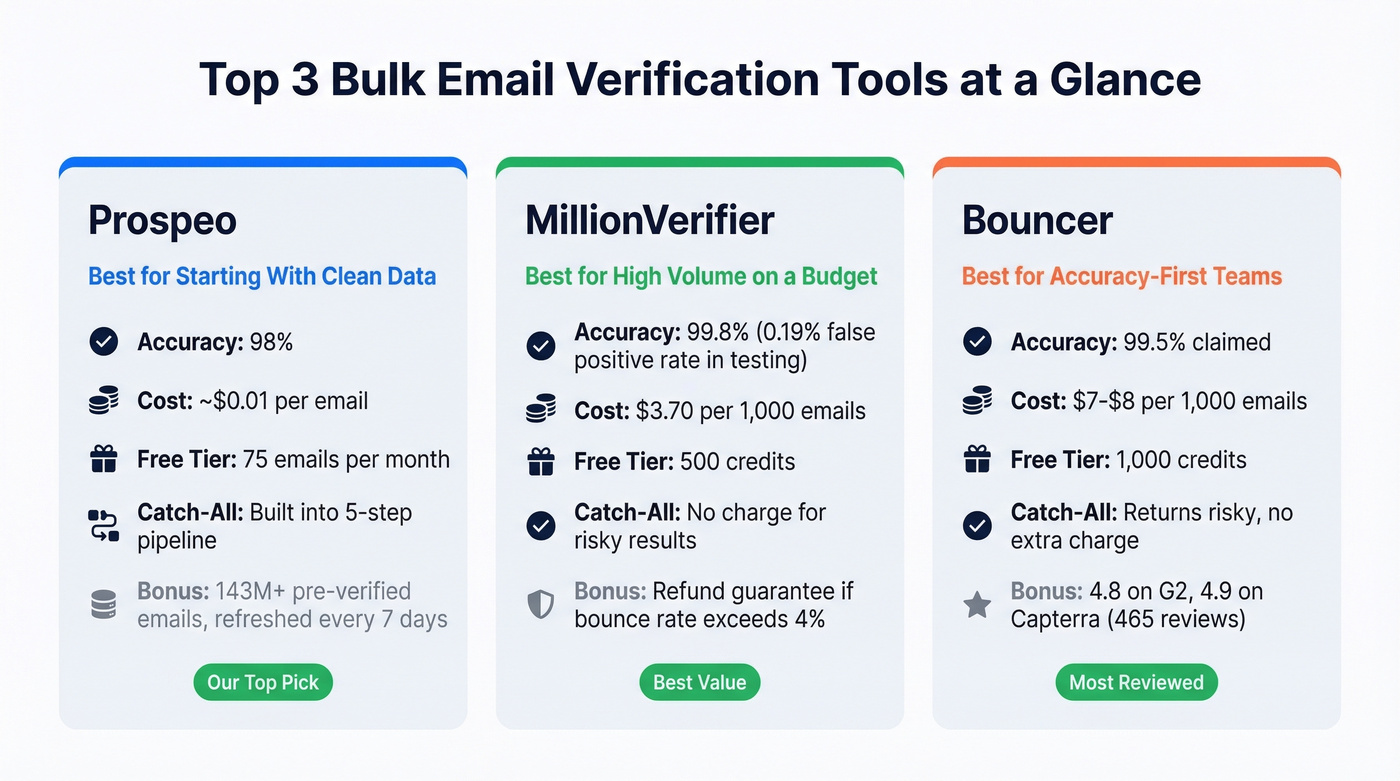
MillionVerifier - Best for high-volume list cleaning on a budget. You only pay for "good" and "bad" results, not risky ones. $3.70 per 1,000 emails.
Bouncer - Best for accuracy-first teams who want simple pricing. Strong third-party review scores: 4.8 on G2 and 4.9 on Capterra. $7-$8 per 1,000 emails.
How Batch Email Verification Works
Every tool on this list runs roughly the same pipeline under the hood. The differences come down to how aggressively they handle edge cases and what they charge you for.
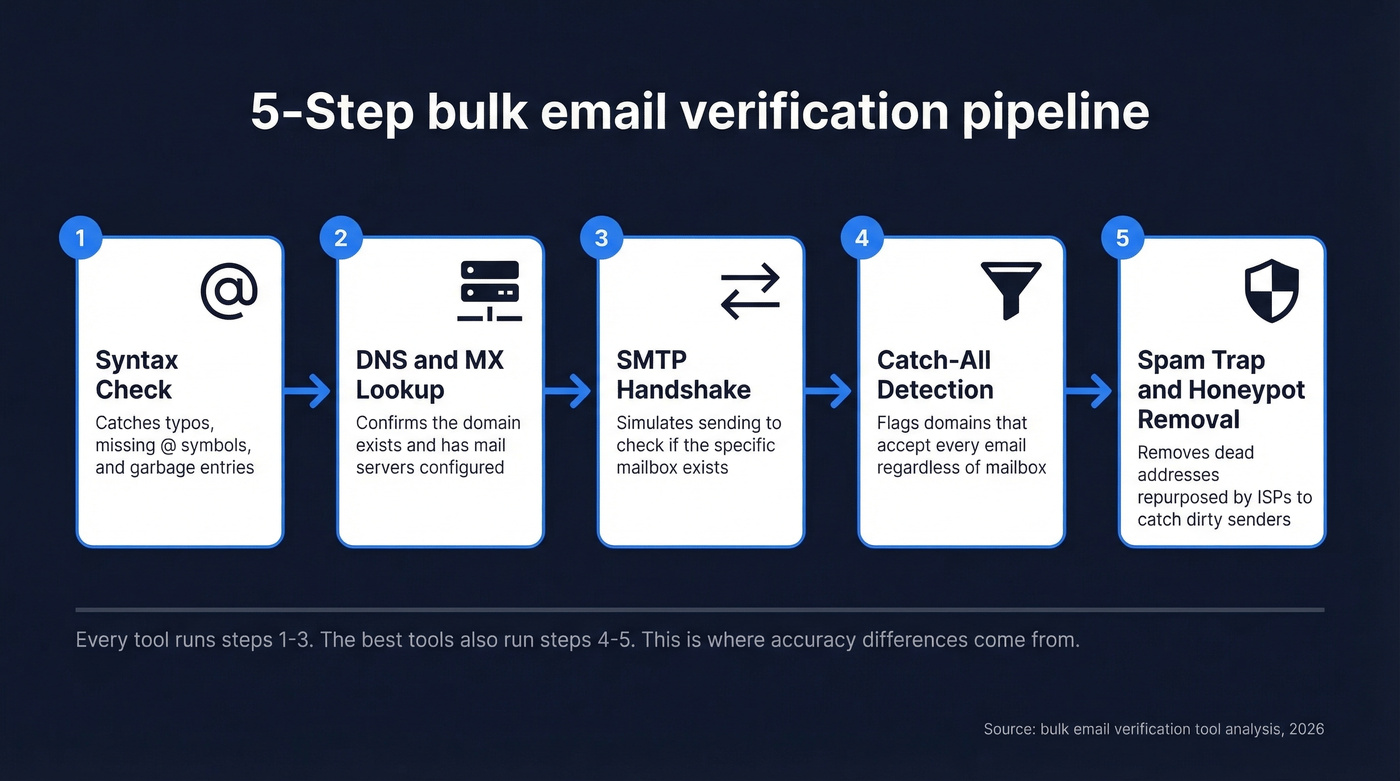
It starts with syntax checking - does the address follow a valid email format? This catches typos, missing @ symbols, and garbage entries. Every tool nails it. Next comes DNS and MX record lookup, where the tool checks whether the domain exists and has mail servers configured. No MX record means the email can't receive mail. Dead end.
The critical step is the SMTP handshake. The tool connects to the recipient's mail server and simulates sending an email without actually delivering one. The server's response reveals whether the specific mailbox exists. This is where most invalid emails get caught - and where tools start to diverge in quality.
After that, good tools run catch-all detection. Some domains accept every email sent to them regardless of whether the mailbox exists, and these domains are the biggest source of confusion in verification. The best tools then layer on disposable email detection, role-based filtering for addresses like info@ and admin@, and spam-trap removal. Spam traps are dead addresses repurposed by ISPs to catch senders with dirty lists. Hit one and your domain reputation takes a serious hit.
Pricing Comparison
Pricing in this category is all over the map. Some tools charge per email, some use credit packs, and some sneak in extra charges for catch-all results. Here's how the top 10 stack up:
| Tool | Cost per 1,000 | Free Tier | Credits Expire? | Unknown / Catch-All Policy |
|---|---|---|---|---|
| Prospeo | ~$10 (~$0.01/ea) | 75 emails/mo | No | Built into 5-step pipeline |
| MillionVerifier | $3.70 | 500 credits | No | Free - no charge for risky results |
| Bouncer | $7-$8 | 1,000 credits | No | Returns "risky," no extra charge |
| ZeroBounce | $2.75-$10 | 100/mo | No | Unknown results free; AI Scoring uses credits |
| Emailable | ~$3-$10 | 250 credits | No | Unknowns refunded |
| Clearout | ~$7 | 100 credits | No (roll over) | Returns "risky" |
| NeverBounce | $8 | 1,000 credits | - | Returns "accept-all" |
| EmailListVerify | ~$4-$8 | 100 credits | - | Returns "unknown" |
| Bulk Email Checker | ~$1 | 10/day | No | Basic detection |
| Hunter.io | Bundled | 50/mo | Yes (monthly) | Basic detection |
The standout column is catch-all policy. MillionVerifier is the only tool that doesn't charge for risky results. ZeroBounce applies AI Scoring to help with catch-alls, but that burns credits. Most others return a "risky" label and charge you anyway.
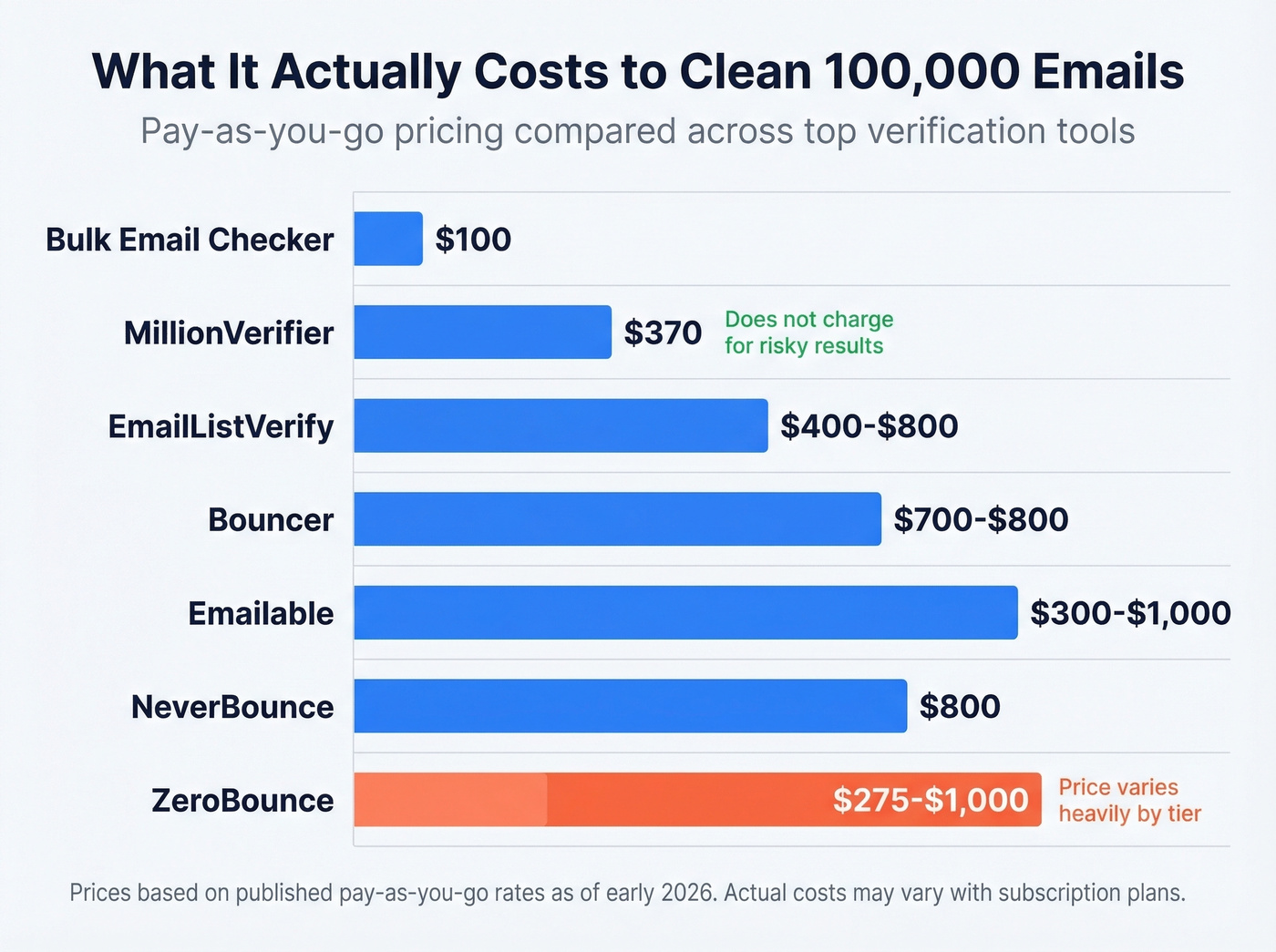
To put the cost differences in perspective: cleaning a 100,000-email list costs $37 on MillionVerifier, roughly $70-$80 on Bouncer, and about $275-$1,000 on ZeroBounce pay-as-you-go depending on your tier.

Why verify a dirty list when you can start with a clean one? Prospeo runs 5-step verification - syntax, MX, SMTP, catch-all, and spam-trap removal - on every email before it reaches your export. 143M+ verified emails, 98% accuracy, refreshed every 7 days. At ~$0.01 per email, it costs less than most standalone verifiers.
Skip the cleanup step entirely. Start with data that's already verified.
Top 10 Verification Tools Reviewed
Prospeo
Prospeo flips the typical verification workflow. Instead of finding emails first and cleaning them later, its 5-step verification - syntax, MX, SMTP handshake, catch-all handling, spam-trap and honeypot removal - runs on every email in its 143M+ database before you ever export a contact. The data refreshes every 7 days, compared to the 6-week industry average, so you're not verifying stale records.
The platform delivers 98% email accuracy. Stack Optimize, an agency running client campaigns through Prospeo, maintains under 3% bounce rates with zero domain flags across all clients. Snyk's sales team dropped bounce rates from 35-40% to under 5% after switching. Those aren't cherry-picked numbers - they're the kind of results you get when verification happens upstream instead of as an afterthought.
At ~$0.01 per email with a free tier of 75 emails/month, the pricing is competitive with dedicated verification tools - except you're also getting the data source, not just the cleaning layer. Already have a list from another provider? Prospeo's validation pipeline works on imported data too. But where it really shines is preventing bad data from entering your workflow in the first place - especially if you're building lists with sales prospecting techniques that depend on high deliverability.
MillionVerifier
A third-party test tells the story better than any feature list. When 2,000 emails were run through MillionVerifier, 80.5% came back good, 4% bad, and 3.4% risky. Only 3 emails marked "good" actually bounced - a 0.19% false-positive rate.
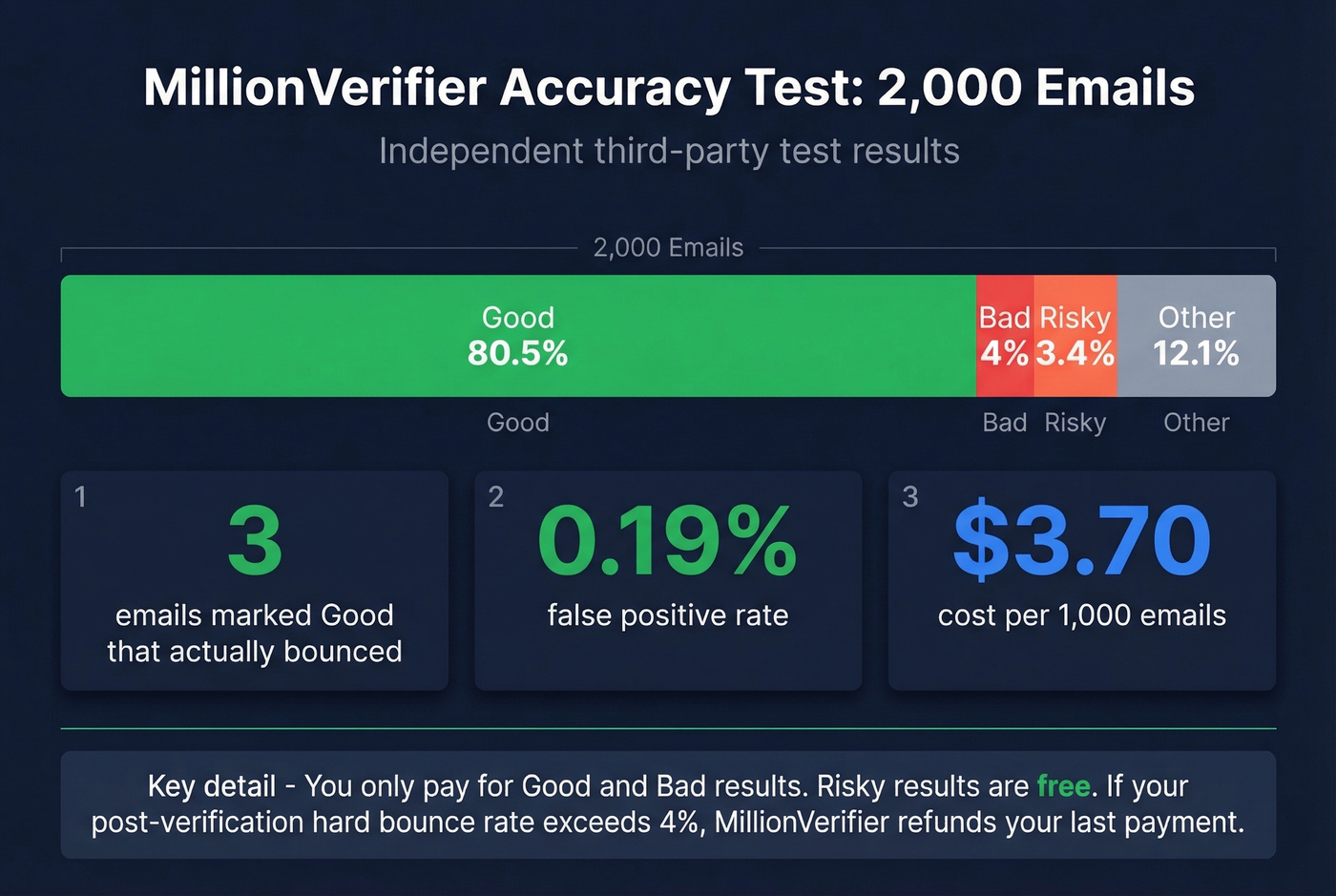
The real draw is the pricing model. At $37 for 10,000 credits ($3.70 per 1,000 emails), MillionVerifier is the cheapest credible verifier in the category - and you only pay for "good" or "bad" classifications. They back this up with a guarantee: if your post-verification hard bounce rate exceeds 4%, they refund your last payment. Every 5 million credits purchased also earns 1 million bonus credits.
Here's the thing: if you need enterprise compliance certifications like SOC 2 or ISO 27001, or advanced features like inbox placement rate testing, skip MillionVerifier. It's a pure verification play - lean and cheap.
Bouncer
4.8 on G2 (232 reviews). 4.9 on Capterra (233 reviews). That's 465 reviews combined, and Bouncer claims 99.5% accuracy.
Pricing is $7-$8 per 1,000 emails on straightforward pay-as-you-go with 1,000 free credits to start. No subscriptions to manage, no credit expiration, no hidden fees. Whether the premium over MillionVerifier is worth it depends on your volume and how much you care about edge cases. For a reliable list-cleaning tool with transparent pricing, Bouncer is hard to beat - especially if you're tracking email bounce rate as a core deliverability KPI.
ZeroBounce
ZeroBounce is the most feature-rich tool in the category and holds SOC 2 Type II and ISO 27001 certifications. It scores 4.7 on Capterra across 548 reviews.
The trade-off is pricing complexity. Pay-as-you-go ranges from $0.01 down to $0.00275 per email depending on volume, with subscription plans running $39-$199/month on annual billing. The Email Finder feature burns 20 credits per successful query. Credits don't expire, and Unknown results are free. But here's the one that catches people off guard: verification results get deleted after 30 days. Multiple Capterra reviewers have flagged this as a frustration, and we can see why - if you're running compliance audits, losing your verification receipts after a month is a real problem. ZeroBounce is the enterprise pick if you need the certifications and can navigate the pricing tiers. Otherwise, you're paying a premium for features you won't use.
Emailable
The fastest engine we tested - 10,000 emails verified in 2-3 minutes, 250,000 in roughly 10 minutes. Credits don't expire and roll over on subscriptions. Unknown results get refunded automatically. The 250 free credits are enough for a meaningful test.
The downside is a minimum purchase of 5,000 credits, and per-credit pricing typically lands around ~$0.003-$0.01 per email depending on volume. It's verification-only with no prospecting features. Best for teams that need speed above all else and verify large batches frequently.
Clearout
A solid all-rounder with ISO 27001/2013 and SOC 2 Type 2 compliance. Starter plan runs $21/month for 3,000 credits/month, with subscription discounts up to 20%. Credits roll over and don't expire. Scores 4.7 on both G2 (307 reviews) and Capterra (83 reviews). The UI feels dated compared to newer tools, and the per-credit cost at the starter tier isn't competitive with MillionVerifier. Best for mid-market teams that need compliance certifications without ZeroBounce's pricing maze.
NeverBounce, EmailListVerify, Bulk Email Checker, and Hunter.io
NeverBounce is the safe, unremarkable choice - $8 per 1,000 emails, 1,000 free credits, claims 99.9% accuracy. Nothing stands out as best-in-class, but nothing's broken either. It handles batch validation well enough for teams that just need a dependable cleaning step.
EmailListVerify positions itself as "half the price" of competitors and gives 100 free verifications when you create an account. For basic list cleaning it delivers, but don't expect advanced catch-all scoring or compliance certifications.
Bulk Email Checker is the cheapest option at about $1 per 1,000 emails with 10 free verifications per day. If cost is literally your only criterion, this is your tool. Accuracy and feature depth reflect the price point.
Hunter.io bundles 50 free verifications per month with its email-finding tool. If you already use Hunter for prospecting, the built-in verification is convenient - but treat it as a bonus feature, not a primary solution. If you're comparing prospecting stacks, see our breakdown of Hunter alternatives.
The Catch-All Problem
Catch-all domains are the single biggest headache in bulk email address verification. Some companies configure their mail servers to accept every email sent to any address at their domain - send to completely.fake.person@company.com and the server says "sure, I'll take it." The mailbox doesn't exist, but the server won't tell you that.
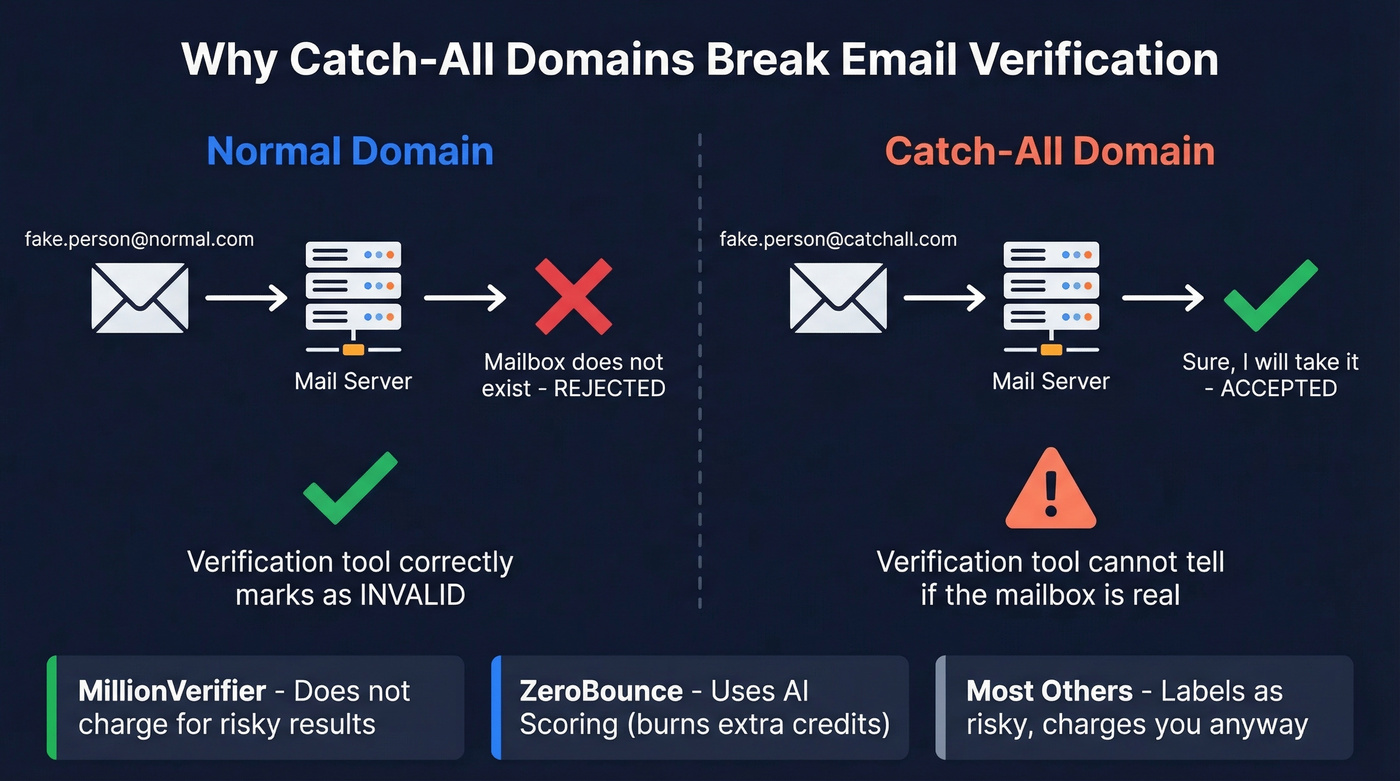
This means verification tools can't confirm whether a specific address is real on a catch-all domain. Most tools label these results as "risky" or "unknown" and charge you for them anyway. MillionVerifier is the notable exception, refunding credits for risky results entirely. ZeroBounce uses AI Scoring to help you decide what to do with catch-all-heavy segments, but that burns additional credits. No verification tool can fully solve this problem - it's a limitation of the SMTP protocol itself.
Let's be honest: if your average deal size is under $15K, you probably shouldn't be sending to catch-all addresses at all. The deliverability risk outweighs the potential upside. For higher-value accounts, send to catch-all addresses in small batches and monitor bounce rates closely. If bounces spike above 3%, stop sending to that domain's catch-all results immediately.
How to Choose the Right Tool
The "best" tool depends entirely on your use case.
For high-volume cold outreach on a budget, go with MillionVerifier. Cheapest per-email cost, no catch-all charges, 4% bounce guarantee.
Sales teams that want clean data from the source should look at Prospeo. Verification is built into the prospecting pipeline, so there's no separate cleaning step needed - especially if you're building from a sales prospecting database.
Accuracy-first teams with simple needs will like Bouncer. Strong review scores, transparent pay-as-you-go pricing, no surprises.
For enterprise compliance requirements, ZeroBounce is the pick. SOC 2 Type II plus ISO 27001, feature-rich, but budget accordingly.
If you just need to verify a one-off list, MillionVerifier or Bouncer will get the job done without locking you into a subscription. For ongoing prospecting where data quality matters from the start, a platform with built-in verification eliminates the need for a separate cleaning step entirely.
Verification Best Practices
Re-verify your lists every 3-4 months. At 3% monthly decay, a 50,000-contact list loses roughly 1,500 valid addresses every month. Wait six months and you're sending to thousands of dead emails. We've seen teams burn their sender reputation in a single campaign by skipping this step - one client we spoke with had their domain blacklisted after sending an unverified list of just 8,000 contacts.
The smarter approach is layering real-time and batch verification. Validate at the point of capture - when someone fills out a form, when a rep adds a contact - and run batch cleaning before every major campaign. This catches both new bad data and addresses that have decayed since your last clean. Think of it as two layers: a list-level checker for your existing database, and real-time validation for every new contact entering your CRM - ideally alongside a broader email deliverability guide.
Before uploading a list for verification, deduplicate it. You're paying per email on most tools, and verifying the same address three times is just burning credits. A quick sort-and-dedupe in a spreadsheet saves real money at scale.
Verification is inherently reactive - you're cleaning up problems after they exist. The upstream argument is stronger: start with better data sources and you need less cleaning in the first place. When your source data refreshes weekly instead of every six weeks, the decay problem shrinks dramatically before verification even enters the picture. The consensus on r/coldemail lines up with our experience here - the teams with the best deliverability aren't the ones running the most verification passes, they're the ones starting with fresher data. The goal isn't just to validate addresses after the fact. It's to build a workflow where bad data rarely enters your system to begin with.
Stack Optimize runs client campaigns with under 3% bounce rates and zero domain flags. Snyk dropped from 35-40% bounces to under 5%. The difference? Verification baked into the data source, not bolted on after. Prospeo's 7-day refresh cycle means you're never sending to stale emails that other tools would miss.
Bulk verification tools fix bad lists. Prospeo prevents them.
FAQ
Email Verification vs. Validation?
Validation checks format and syntax; verification confirms the mailbox exists via SMTP handshake. Every tool on this list does both, so the distinction is academic. In practice the terms are interchangeable - don't let terminology slow down your tool evaluation.
How Often Should I Re-Verify?
Cold outreach teams should re-verify monthly; marketing lists can stretch to quarterly. The non-negotiable rule: always clean your list before a major campaign, even if you verified it recently. At 3% monthly decay, a 30-day-old list already has hundreds of dead addresses.
Should I Send to Catch-All Addresses?
Proceed with caution. Catch-all domains accept all emails regardless of whether the mailbox exists, so no verifier can confirm them. Send in small batches of 50-100 and monitor bounce rates. If bounces spike above 3%, stop sending to that domain immediately.
What's the Best Free Option?
Bouncer offers 1,000 free credits - the most generous free tier among dedicated verifiers. MillionVerifier gives 500, and Prospeo provides 75 verified emails per month with its full 5-step pipeline included. Use free tiers to benchmark accuracy against a known-good list segment before committing budget.
What's a Safe Bounce Rate for Cold Email?
Stay under 3%. Above 5% and ESPs start flagging your domain. Above 10% and you risk permanent sender reputation damage. Running bulk email address verification before every campaign should keep you well under that threshold.