

Business Email Validation: How It Works in 2026
Your last campaign bounced at 6%, your ESP flagged your sending domain, and now you're scrambling to figure out which emails on your list are dead. Most teams discover business email validation after the damage is done. Let's make sure that doesn't happen again.
What Is Business Email Validation?
Business email validation confirms that a B2B email address is real, active, and safe to send to. It goes beyond checking whether someone typed "john@company.com" correctly - it confirms the mailbox behind that address actually exists and won't bounce.
There's a useful distinction worth knowing. In many teams, "validation" refers to syntax and domain checks, while "verification" refers to deeper mailbox-level checks via an SMTP handshake. In practice, most major tools bundle both steps, and the industry uses the terms interchangeably. The goal is the same: confirm the recipient is real before you hit send.
Why bother? Job changes, company closures, and domain expirations mean your database is constantly decaying. If you're not validating regularly, you're sending into a void - and paying for it with your domain reputation.
Why Validation Matters for Deliverability
According to Validity's deliverability benchmark data, global inbox placement sits around 84%. Roughly one in six emails never reaches the inbox. They land in spam, get blocked, or vanish entirely.

The ISP-level differences are stark. Gmail delivers to the inbox about 87.2% of the time. Microsoft drops to 75.6%. If your prospect list skews heavily toward Outlook domains, you're already at a disadvantage, and high bounce rates make it worse.
Here's the rule of thumb: keep total bounces below 2%, with hard bounces under 1%. Gmail flags senders whose spam complaint rate exceeds 0.3%. Once your domain reputation tanks, even your valid emails stop reaching inboxes. Recovery takes weeks - sometimes months - of careful warm-up sending, and there's no guarantee you'll get back to where you were.
How the Validation Process Works
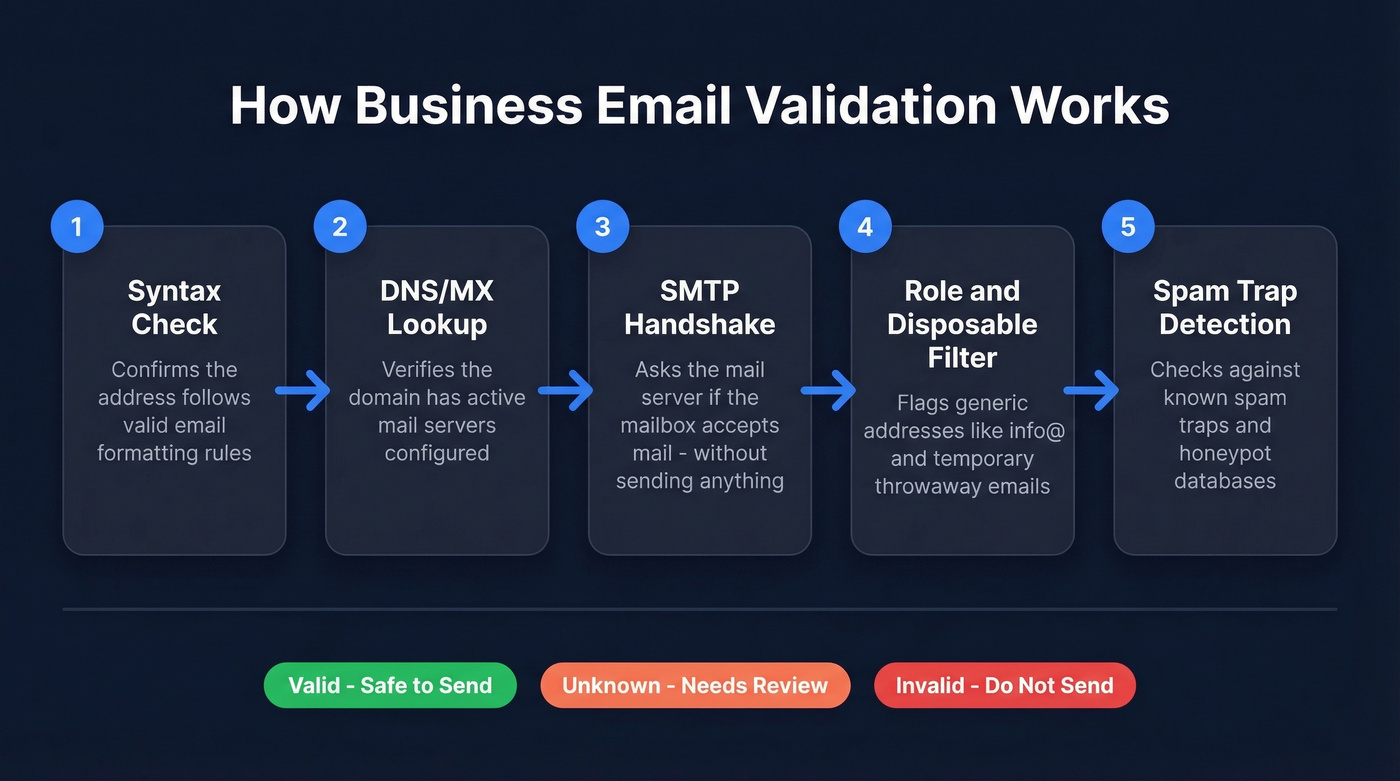
Most tools follow a similar core process. A syntax check confirms the address follows valid formatting rules. Then a DNS/MX lookup verifies the domain has mail servers configured. Next, an SMTP handshake asks the mail server whether the specific mailbox accepts mail - without actually sending a message. The tool filters out disposable addresses and generic inboxes like info@, support@, or sales@, since these role-based addresses rarely belong to a single decision-maker and hurt reply rates. Finally, it checks for known spam traps and honeypots (and if you need a deeper remediation playbook, see spam traps).
The Catch-All Problem
Catch-all domains are where mailbox verification gets tricky. These domains accept mail for any address, real or fake. When a tool probes randomgarbage@company.com, the server says "sure, I'll take it," making it impossible to confirm whether a specific mailbox exists using standard SMTP checks.
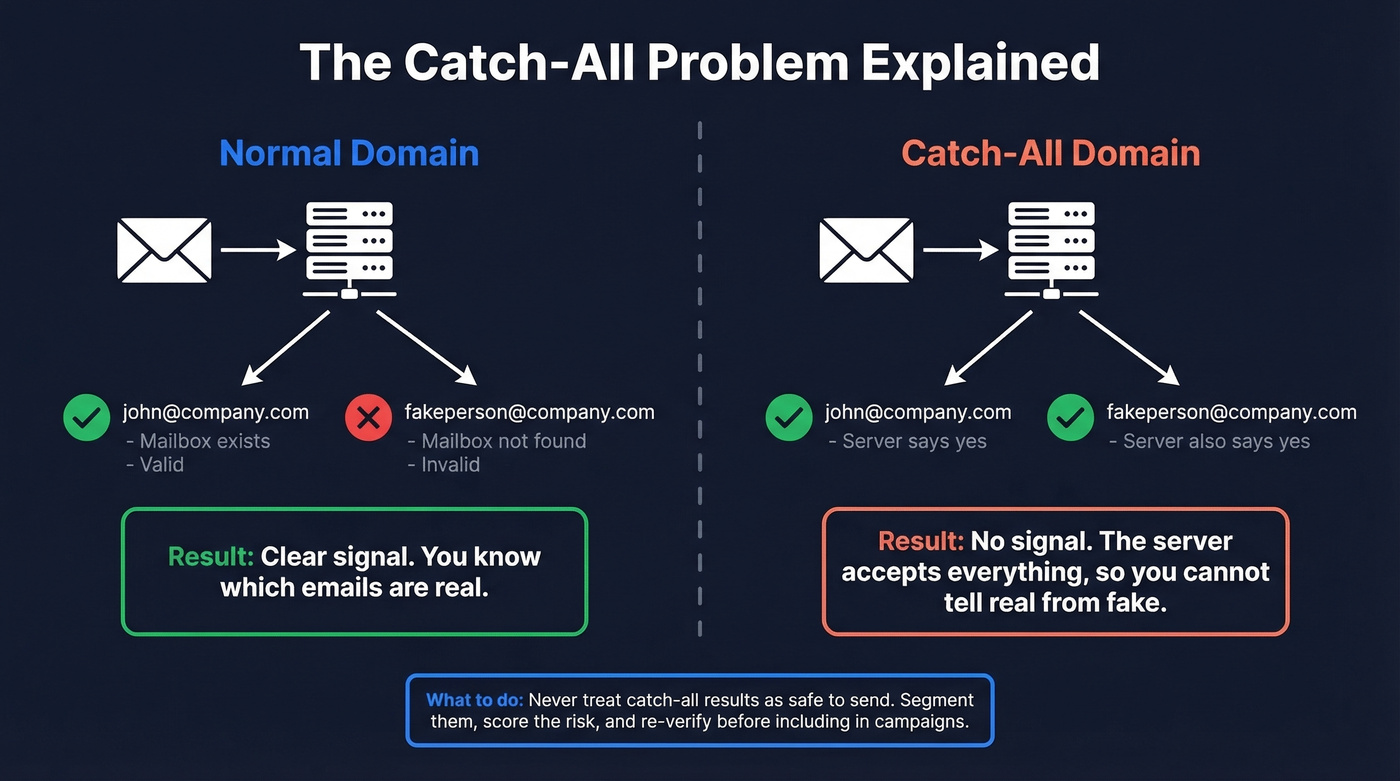
We've seen teams treat "unknown" catch-all results as safe to send. They're not.
Catch-all handling is one of the biggest gaps across verification workflows because many tools default to an "unknown" label that doesn't tell you what to do next. NeverBounce hits 94% catch-all detection accuracy using scoring algorithms - the top result in the 47,000-email benchmark we reference below.

Catch-all handling, spam-trap removal, and honeypot filtering are already built into every Prospeo email - before you export a single contact. 98% accuracy, 7-day data refresh, $0.01 per email. No separate validation tool required.
Skip the extra verification step. Start with emails that are already clean.
Email Filtering vs. Verification
A related concept that often gets confused with validation: form-level email filtering. This is the JavaScript check on your signup forms that blocks personal email domains (gmail.com, yahoo.com) and forces visitors to enter a work email. It's a simple domain-blocklist approach, and there are open-source lists with 312 common free email providers you can plug into any form.
Filtering and verification solve different problems. Filtering captures business emails at the point of entry. Verification confirms those emails are still valid when you're ready to send. You need both (and if you're building outbound systems, pair this with a solid email deliverability baseline).
Top Validation Tools Compared
Here's the thing: most teams don't have a validation problem. They have a data freshness problem. Validating a list from a database that refreshes every six weeks is treating the symptom. The real differentiators across tools are catch-all handling, data freshness, and whether verification is a separate step or built into your data source (which is why many teams start by auditing their email list providers first).
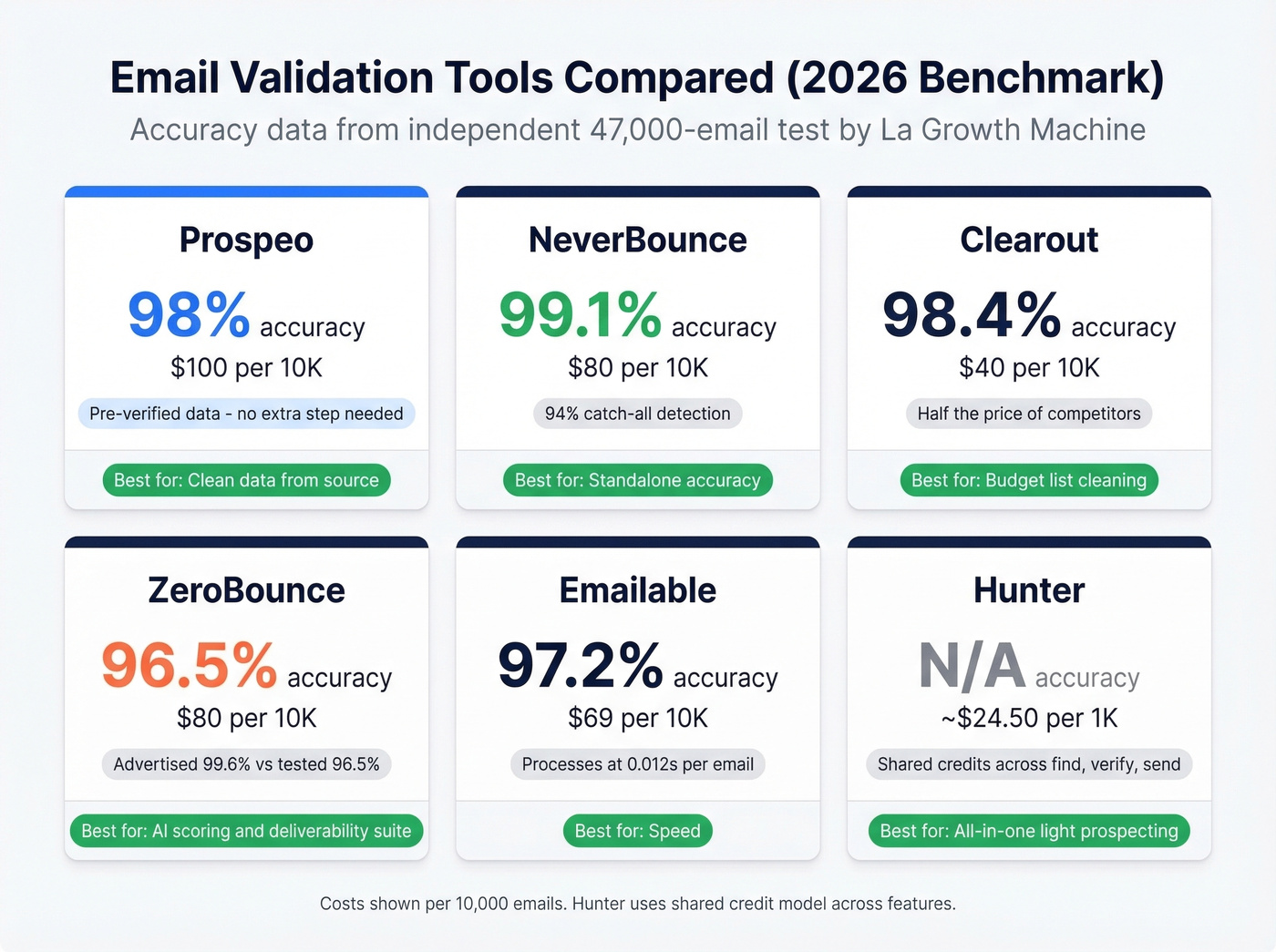
Accuracy data below comes from La Growth Machine's independent 47,000-email benchmark:
| Tool | Accuracy | Cost / 10K | Free Tier | Best For |
|---|---|---|---|---|
| Prospeo | 98% | ~$100 | 75 emails/mo | Pre-verified data, no extra validation step |
| NeverBounce | 99.1% | $80 | 10 credits | Standalone accuracy + catch-all detection |
| Clearout | 98.4% | $40 | - | Budget list cleaning |
| ZeroBounce | 96.5% | $80 | 100/mo | AI scoring + deliverability suite |
| Emailable | 97.2% | $69 | 250 credits | Speed (0.012s/email) |
| Hunter | - | ~$24.50/1K* | 50 credits/mo | All-in-one find + verify + outreach |
*Hunter uses shared credits across find/verify/outreach; verification costs 0.5 credits each.
Prospeo
Every email in Prospeo's database goes through 5-step verification before it reaches you, and the data refreshes every 7 days - not the 6-week industry average. The proprietary email-finding infrastructure doesn't rely on third-party providers, which means catch-all handling, spam-trap removal, and honeypot filtering are all baked into the pipeline. Snyk's 50-person AE team went from 35-40% bounce rates to under 5% after switching, with AE-sourced pipeline up 180%. Free tier gives you 75 verified emails per month, paid plans run about $0.01 per email, no contracts (and if you're comparing sourcing options, see sales prospecting databases).
NeverBounce
Use this if you need the highest standalone verification accuracy. NeverBounce scored 99.1% in independent testing - the top result in that 12-tool benchmark. Catch-all detection hits 94%. At $80 per 10K emails with 88 integrations, it fits most tech stacks. Skip this if you want a combined data and verification platform; NeverBounce only verifies, it doesn't source contacts.
Clearout
The budget pick. Clearout tested at 98.4% accuracy and charges $40 per 10K emails - half the price of NeverBounce. If you're running high-volume list cleaning on a tight budget, the math works. Check that your CRM or sequencer is among its 38 integrations before committing (and if you're standardizing your stack, start with contact management software).
ZeroBounce
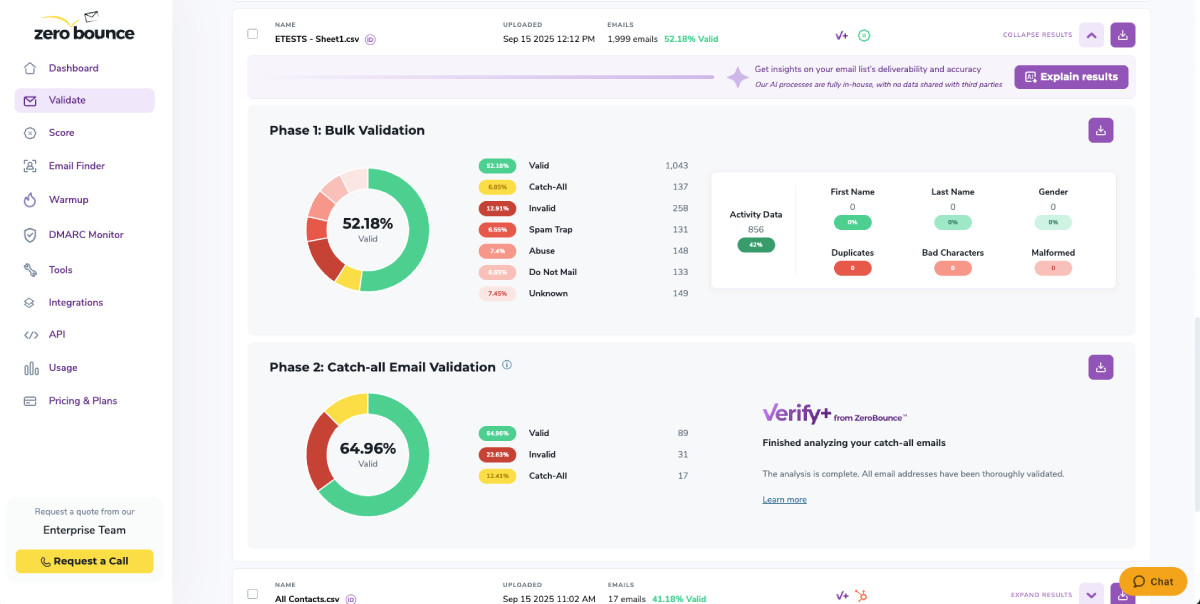
ZeroBounce advertises 99.6% accuracy; independent testing measured 96.5%, which is a meaningful gap. The platform offers useful extras: AI-based email scoring, 100 free monthly verifications, and unknown results don't consume credits. ZeroBounce ONE starts at $79/month billed annually. Solid if you want a deliverability suite, but the accuracy delta compared to NeverBounce or Clearout is worth noting (for more on reputation risk, see email reputation tools).
Emailable
The speed champion. Emailable processes emails at 0.012 seconds each - 10K emails in about 2-3 minutes. Starts with 250 free credits, unknowns get refunded, and credits never expire. 92 integrations. Mid-range at $69 per 10K.
Hunter
Hunter's value is the all-in-one workflow: find emails, verify them, and send outreach from one platform. A Starter plan ($34/month yearly) with 2,000 credits gives you 4,000 verifications. The tradeoff is that credits are shared across finding, verifying, and sending, so heavy prospecting eats into your verification budget fast. For teams that only need light prospecting alongside verification, it's efficient. For high-volume senders, the shared credit pool gets expensive quickly (if you're weighing options, compare against Hunter alternatives).
Common Mistakes to Avoid
Validating once and forgetting. With 41% average professional turnover driving list decay, a one-time validation is worthless within months. Validate at capture, before every send, and re-check your full list every 3-4 months.
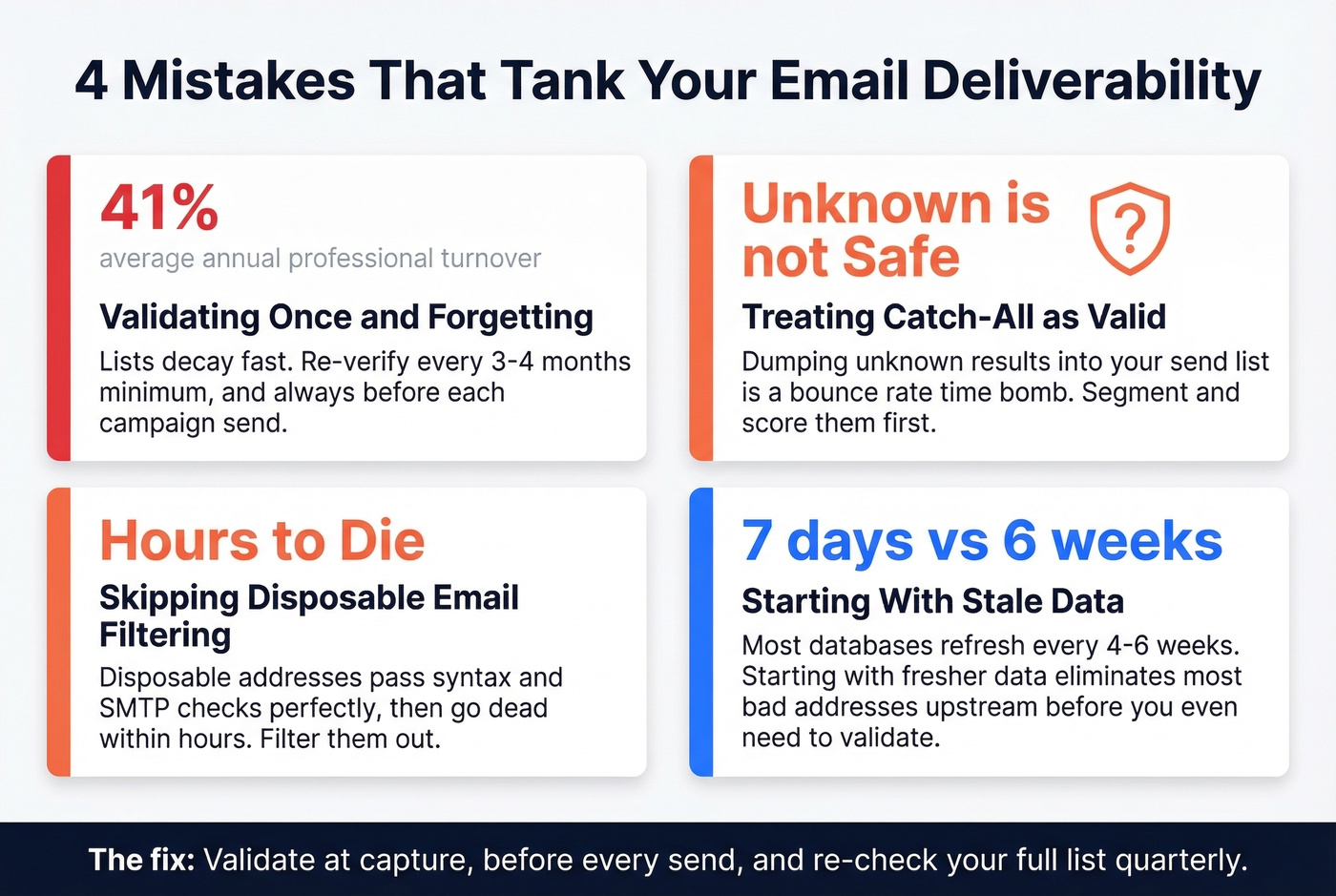
Treating catch-all results as safe. Dumping "unknown" emails into your send list is a bounce rate time bomb. Segment them, score the risk, and re-verify before including them in campaigns. We learned this the hard way running outbound for a client with a list heavy on enterprise domains - nearly all catch-all, and the bounce spike was immediate.
Skipping disposable email filtering. Disposable addresses pass syntax and SMTP checks just fine, then go dead within hours. Most verification tools flag these, but only if you're actually using the tool before sending.
Starting with stale data. In our experience, the single biggest cause of validation headaches is sourcing emails from databases that refresh every 4-6 weeks. Starting with fresher data eliminates most of the problem upstream - you're validating fewer bad addresses because fewer went bad in the first place (and if you're diagnosing the impact, start with email bounce rate benchmarks and fixes).
Snyk's 50 AEs went from 35-40% bounce rates to under 5% because the data was pre-verified at the source. Prospeo's proprietary infrastructure verifies every email in 5 steps and refreshes the entire database every 7 days - not 6 weeks.
Fix your bounce rate at the source, not after the damage is done.
FAQ
What's the difference between email validation and verification?
Validation checks format and domain structure. Verification confirms the mailbox exists via SMTP handshake. In practice, every major tool bundles both steps, and the industry uses the terms interchangeably - so the distinction rarely matters when choosing a platform.
How often should I re-verify my email list?
Re-verify every 3-4 months at minimum, since lists decay roughly 28% per year. Best practice is to validate at capture, re-verify before each campaign, and run a full quarterly audit. Teams sending weekly outreach should verify even more frequently - the consensus on r/sales is that monthly re-verification is the sweet spot for high-volume senders.
Can verification tools handle catch-all domains?
Standard SMTP checks can't confirm individual mailboxes on catch-all domains. Advanced tools like NeverBounce (94% catch-all accuracy) use scoring algorithms and behavioral signals to deliver actionable verdicts instead of unhelpful "unknown" labels. Prospeo handles catch-all detection within its 5-step pipeline, so emails are filtered before they ever reach your list.
What's a good free tool for validating business emails?
Prospeo offers 75 free verified emails per month with full 5-step verification included. Hunter provides 50 free credits monthly for combined finding and verifying. ZeroBounce gives 100 free verifications per month. For small teams running real campaigns, a pre-verified source saves the most time because you're skipping the separate validation step entirely.