

Business-to-Business: What B2B Actually Looks Like in 2026
A $36.86 trillion market, and most people still explain business-to-business with the same stale Salesforce example from 2018. The reality is messier, faster, and more digital than the textbook version suggests.
What Is Business-to-Business (B2B)?
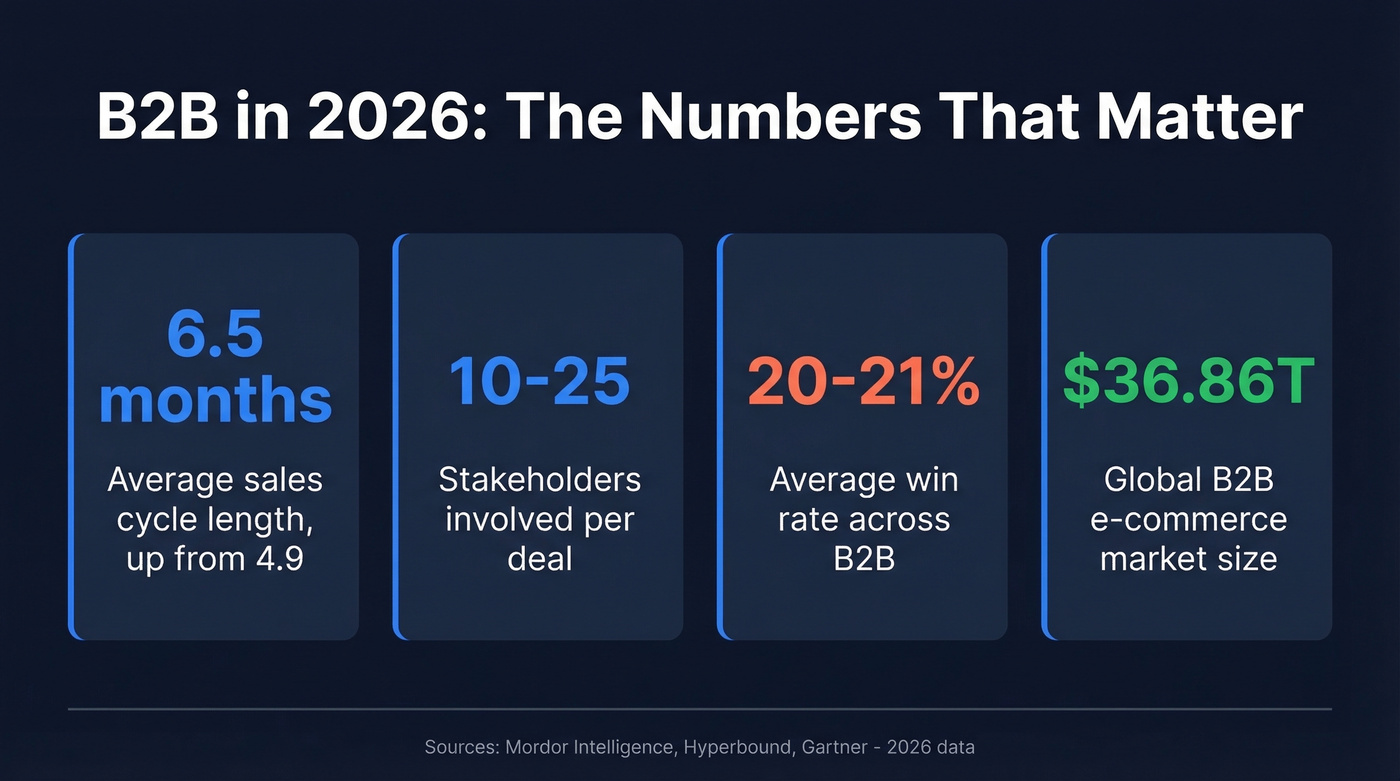
Business-to-business means one company selling products or services to another company. That's the one-sentence version. The full picture is a $36.86 trillion global B2B e-commerce market projected to hit $61.66 trillion by 2031 at a 10.84% CAGR.
You'll still see articles citing an $18.665 trillion figure from older reports. Mordor Intelligence's 2026 update nearly doubles that number. Most "B2B explainer" content is working off stale data.
B2B covers everything from a steel manufacturer selling components to an automaker, to a SaaS company selling workflow automation to a hospital system. The common thread: both sides of the transaction are businesses, not individual consumers. Sometimes called business 2 business in casual shorthand, the model underpins the majority of global commerce by dollar volume - dwarfing what most people think of when they hear "e-commerce."
Key B2B Benchmarks
- Average sales cycle: 6.5 months, up from 4.9 a few years ago
- Stakeholders per deal: 10-25, depending on deal size
- Win rates: 20-21% average; top performers hit 30%+
- Digital-first buying: 56% of B2B companies already report new-product revenue growth through digital channels, and 75% of organizations will complete their highest-revenue deals digitally by 2028
How B2B Transactions Work
The B2B sales process follows a rough five-step flow: identify the right company, contact the decision-maker, negotiate terms, implement the solution, and provide ongoing support. Simple in theory. Brutal in practice.
67% of the buyer's journey is completed before a prospect ever talks to a salesperson. Buyers research, compare, and shortlist on their own. By the time your rep gets a meeting, the buyer already has opinions - and often a preferred vendor. Reps, meanwhile, spend only 28-30% of their time actually selling. The rest goes to CRM updates, internal meetings, and admin work.
That first step - finding the right person at the right company - is where most teams bleed time. Modern B2B data platforms compress that step by letting teams search hundreds of millions of professional profiles with granular filters, verify emails in real time, and skip the manual list-building that eats entire afternoons.
One operational reality that catches first-time B2B sellers off guard: payment terms. Net 30 and Net 60 are standard, and Net 90 shows up in larger accounts. That means you can close a deal in January and not see cash until April. We've seen early-stage companies nearly run out of runway not because they lacked sales, but because their cash flow couldn't absorb the gap between invoicing and payment.
B2B Examples Across Industries
B2B isn't just enterprise software. ServiceNow sells workflow automation to large enterprises. Drata sells compliance automation to mid-market companies. DocuSign handles e-signatures for businesses of every size. Sendbird provides conversation APIs that other companies embed in their own products. Bringg manages delivery logistics for retailers. Motive runs fleet management for trucking companies.
Then there's the classic supply chain version: a component manufacturer sells parts to an OEM, who assembles a product and sells it to a retailer. Every link in that chain is a B2B transaction. As of early 2026, 701 B2B startups tracked by Seedtable have raised $27 billion in aggregate funding, spanning fintech, data governance, logistics, and commerce infrastructure.

Finding the right person at the right company is where most B2B teams bleed time. Prospeo gives you 300M+ professional profiles with 30+ filters - buyer intent, technographics, headcount growth, funding - so you skip the manual list-building. 98% email accuracy means your outreach actually lands.
Stop researching. Start reaching the 10-25 stakeholders that close your deal.
B2B vs B2C vs Other Models
| Model | Audience | Sales Cycle | Decision-Makers | Avg Deal Size |
|---|---|---|---|---|
| B2B | Businesses | Months | 10-25 | $10K-$500K+ |
| B2C | Consumers | Minutes-days | 1 | $10-$500 |
| B2B2C | Biz > biz > consumer | Weeks-months | 2-10 | Varies |
| D2C | Direct to consumer | Days | 1 | $20-$200 |
| B2G | Government | Months-years | 5-20+ | $50K-$10M+ |
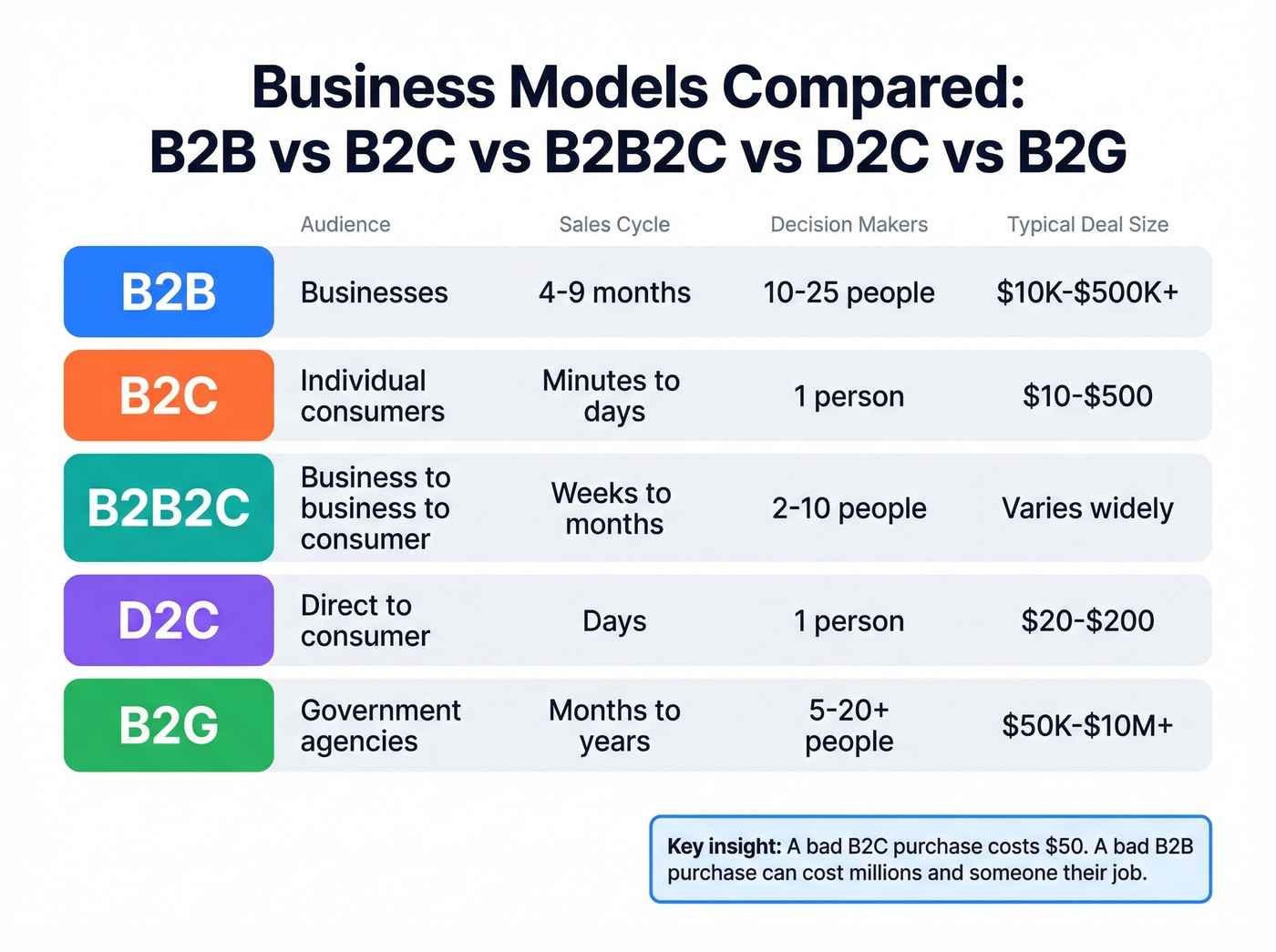
The key distinction: B2B deals involve more people, longer timelines, and higher stakes. A bad B2C purchase costs someone $50. A bad B2B purchase can cost a company millions and someone their job.
The B2B Sales Cycle in Numbers
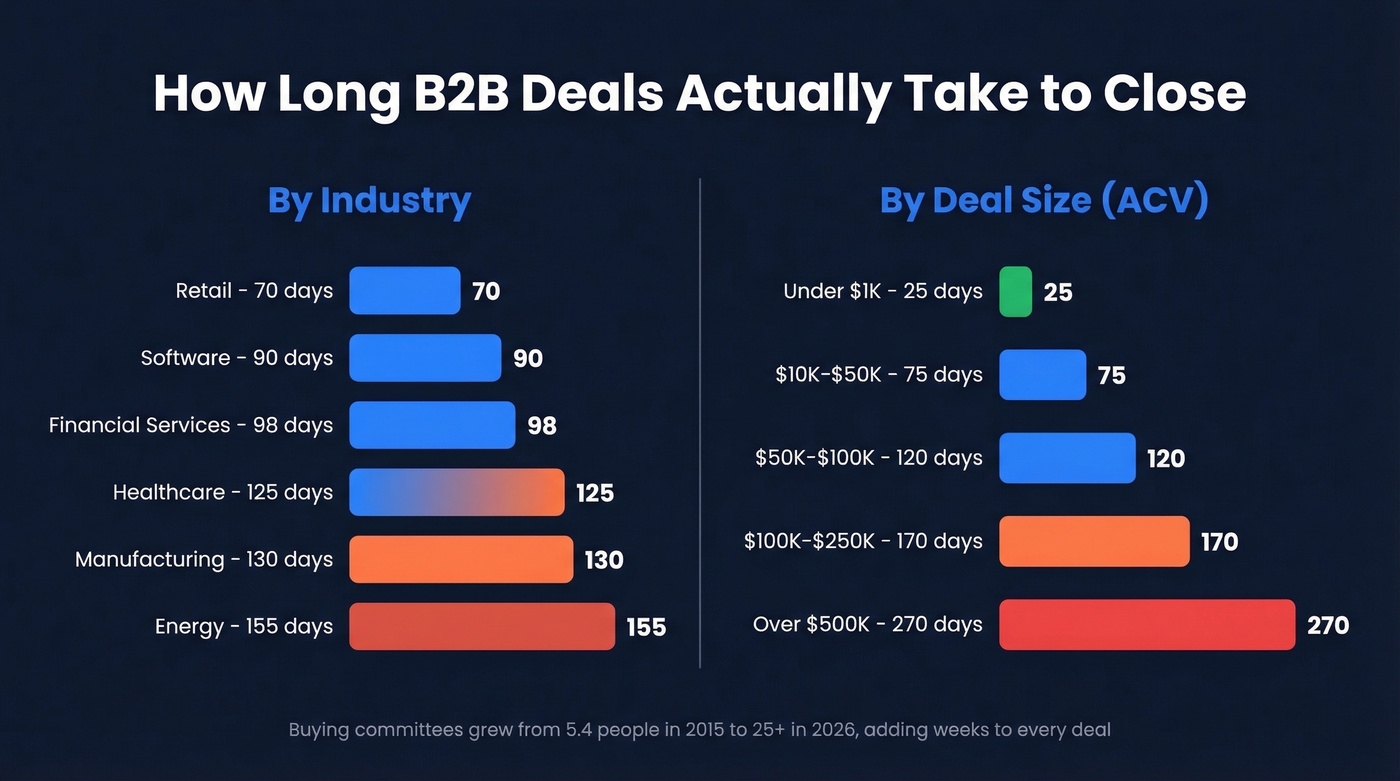
By industry (average days to close):
| Industry | Days |
|---|---|
| Retail | 70 |
| Software | 90 |
| Financial Services | 98 |
| Healthcare | 125 |
| Manufacturing | 130 |
| Energy | 155 |
By deal size:
| ACV | Days |
|---|---|
| Under $1K | 25 |
| $10K-$50K | 75 |
| $50K-$100K | 120 |
| $100K-$250K | 170 |
| Over $500K | 270 |
The buying committee trend is what makes these cycles so long. In 2015, Gartner measured 5.4 stakeholders per B2B deal. By 2018, Challenger put it at 10.2. In 2026, buying committees regularly include 25 stakeholders.
Every additional person in the buying group adds friction, meetings, and weeks. Win rates haven't kept up - the average sits at 20-21%, and only 16-28% of reps met quota in 2023 depending on the dataset. In our experience, the most actionable benchmark here is multi-threading: deals over $50K see a 130% win rate boost when reps engage multiple stakeholders simultaneously. If your team isn't multi-threading by default, that's the single highest-impact change you can make.
How B2B Commerce Is Changing in 2026
Three shifts define the market right now.
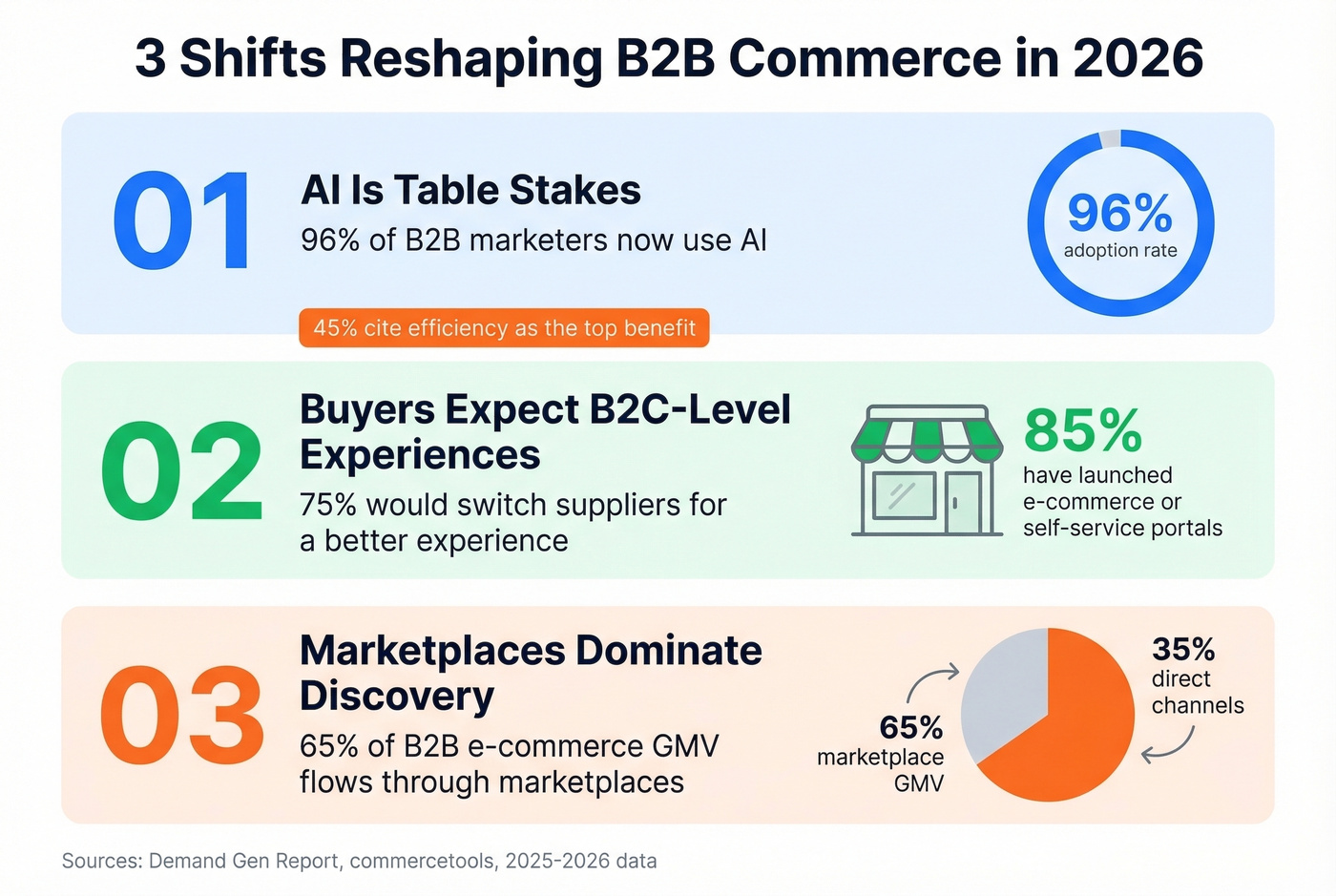
AI is table stakes. 96% of B2B marketers are using AI, with 45% citing efficiency as the top benefit. This isn't experimental anymore. Teams that aren't using AI for prospecting, content, or lead scoring are already behind.
Buyers expect B2C-level experiences. 75% of B2B buyers say they'd switch suppliers for a better experience. That's pushed 85% of B2B organizations to launch e-commerce storefronts or self-service portals. The days of "call us for a quote" as your only buying channel are numbered.
Marketplaces dominate discovery. In 2025, 65.12% of B2B e-commerce GMV flowed through marketplaces, especially in cross-border trade, which accounted for 44.32% of transactions. Direct sales channels still matter, but the discovery layer is increasingly platform-driven.
Common B2B Mistakes
Invisible marketing. Buyers are 70% through their purchasing process before engaging sellers. If your content doesn't educate at every funnel stage, you don't exist to them.
Fuzzy ICP. We've seen teams burn through six-figure ad budgets targeting "all businesses" with generic messaging. The tighter your ideal customer profile, the higher your conversion rates. Full stop.
Expecting B2C timelines. A 6.5-month average sales cycle means your pipeline needs to be built months before you need revenue. Impatience kills B2B companies faster than bad product-market fit.
Ignoring cash flow mechanics. Net 30/60/90 payment terms mean revenue on paper doesn't equal cash in the bank. Plan for the gap or it'll plan for you.
Bad data. Every bounced email, wrong number, and outdated contact erodes your domain reputation and your team's confidence. Data quality is infrastructure, not a nice-to-have. Tools like Prospeo exist specifically because this problem is so pervasive - 98% email accuracy and a 7-day data refresh cycle are the kind of specs that prevent the slow domain-reputation death spiral most outbound teams don't notice until it's too late. (If you're running outbound, an email deliverability baseline check is non-negotiable.)
Here's the thing: on r/sales and r/startups, first-time B2B founders consistently ask the same question - "What actually worked to get your first B2B customers?" The answer is almost always referrals and warm intros, not cold outreach at scale. If your average contract value is under $15K, you probably don't need a massive outbound machine. You need five happy customers who refer you to five more.
In a market where 67% of the buyer journey happens before your rep gets a meeting, stale data is a death sentence. Prospeo refreshes every 7 days - not the 6-week industry average - so you're reaching real buyers at current companies, not ghosts at old jobs. At $0.01 per email, enterprise-grade B2B data doesn't require enterprise budgets.
Your B2B competitors already upgraded their data. Catch up in 60 seconds.
FAQ
What is a B2B environment?
A B2B environment is any market where companies primarily sell to other companies rather than individual consumers. It's characterized by longer sales cycles (6.5 months on average), multi-stakeholder buying committees of 10-25 people, and higher deal values. Manufacturing, enterprise software, and professional services are classic examples.
What is the B2B market worth in 2026?
Global B2B e-commerce is valued at $36.86 trillion in 2026 - nearly double the $18.665 trillion figure still cited in older reports. The market is projected to reach $61.66 trillion by 2031 at a 10.84% CAGR.
What's an example of B2B?
ServiceNow sells workflow automation software to enterprises. A steel manufacturer sells components to an automaker. A data platform sells verified contact data to sales teams. Any transaction where both buyer and seller are businesses qualifies.
How long is a typical B2B sales cycle?
The average runs 6.5 months. Software deals close in roughly 90 days, energy sector deals average 155 days, and deals over $500K can stretch past 270 days. Multi-threading - engaging multiple stakeholders simultaneously - can boost win rates by 130%.
How is B2B different from B2C?
B2B involves longer sales cycles, multiple decision-makers (10-25 per deal), higher transaction values, and relationship-driven selling. B2C targets individual consumers with shorter, emotion-driven purchases and typically a single buyer making a decision in minutes or days.