

The B2B Marketing Strategy Guide That Actually Shows You the Math
Your CEO just asked for a B2B marketing plan with projected ROI by Friday. You open a dozen "ultimate guides" and get the same recycled advice: build buyer personas, create content, nurture leads. Not a single dollar figure. Not one conversion rate. Nothing you can put in a slide deck that a CFO would take seriously.
Here's the thing - we've built and reviewed enough B2B marketing plans to know that the gap between "strategy advice" and "something finance will approve" is enormous. This is a business to business marketing strategy built on actual math: budget benchmarks, channel ROI data, pipeline reverse-engineering. The kind of plan that turns "we should do more marketing" into a spreadsheet with numbers attached.
Five Moves (Quick Version)
- Spend 7.7% of revenue on marketing (the Gartner benchmark), split roughly 50/50 between brand building and demand generation.
- Work backward from revenue: revenue goal → pipeline needed → leads required. If you can't connect marketing activity to a dollar figure, it's not a strategy.
- Prioritize SEO (748% ROI) and email (261% ROI) for long-term compounding. Use LinkedIn paid ads (229% ROI) when you need faster results.
- Verify your data before you execute anything. A 35% bounce rate kills every channel - email, ABM, paid, all of it.
- Measure pipeline and revenue influenced, not pageviews and MQLs. Your board doesn't care about impressions.
What B2B Marketing Strategy Actually Means
A B2B marketing strategy is the plan for how your company will generate pipeline and revenue from other businesses. Not a channel list. Not a content calendar. A math-backed plan that connects marketing spend to revenue outcomes.
Why this matters more in B2B than B2C comes down to structure. You're selling to buying committees of 6-10 stakeholders per Gartner, and Forrester's research puts the real number at 13 when you count cross-departmental influencers. Sales cycles run 4-8 months. And 75% of B2B buyers now prefer a rep-free experience, meaning your marketing has to do the heavy lifting before a salesperson ever gets involved - roughly 80% of the buying journey happens without vendor contact, and buyers spend just 17% of their time meeting with potential suppliers, split across multiple vendors.
A real strategy isn't "we'll do SEO and email and LinkedIn." It's "we need $5M in new revenue, which means X pipeline, which means Y leads, and here's how we'll generate them within Z budget."
Step 1: Reverse-Engineer Pipeline Math
Let's walk through a worked example. Revenue target: $5M in new business. Average deal size: $50K. Close rate: 25%.
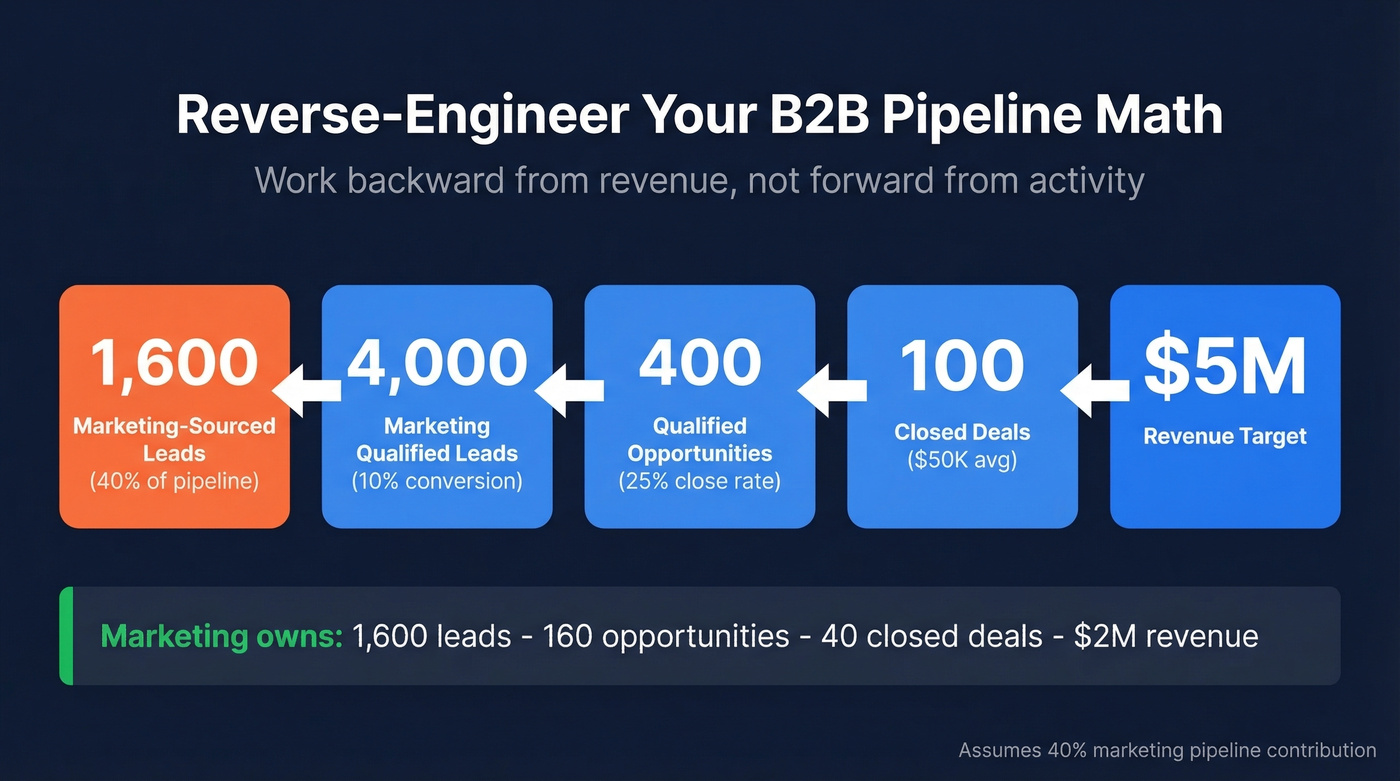
You need 100 closed deals. At a 25% close rate, that's 400 qualified opportunities. If your lead-to-opportunity conversion rate is 10%, you need 4,000 marketing-qualified leads. Marketing typically contributes 30-50% of pipeline in a mature B2B company. At 40%, marketing's target is 1,600 leads → 160 opportunities → 40 closed deals worth $2M.
The numbers shift based on your business, but the framework doesn't. Work backward from revenue, not forward from activity. This is the foundation of any effective business to business marketing strategy - the math comes first, the tactics come second.
Those 6-10 stakeholders per deal mean you're not just generating leads. You're multi-threading into accounts. A single champion isn't enough. Your strategy needs to reach the economic buyer, the technical evaluator, the end user, and the procurement gatekeeper. This is why "generate more MQLs" is a terrible goal. Pipeline math forces you to think in terms of accounts and opportunities, not individual names in a spreadsheet.
Step 2: Set Your Budget
The Gartner CMO Spend Survey puts the average B2B marketing budget at 7.7% of revenue. Half of CMOs operate at 6% or less. Big spenders exceed 10.5%. And 59% of CMOs say their budget isn't sufficient - so even the "average" is probably underfunded.
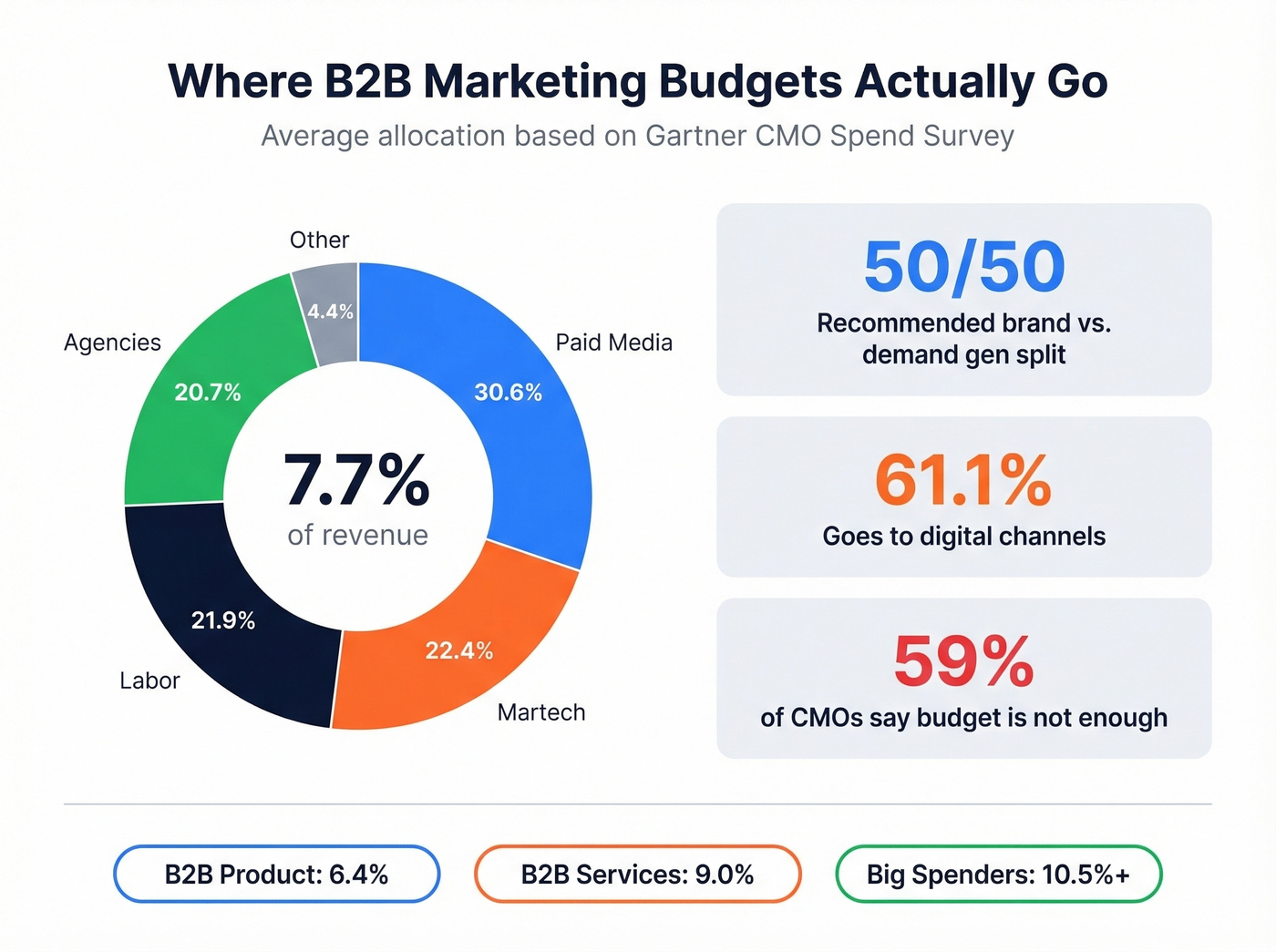
Deloitte's CMO Survey breaks it down further: B2B product companies average 6.4% of revenue, B2B services companies spend 9.0%. A $20M services company? That's $1.8M in marketing budget.
Here's where the money goes:
| Category | % of Budget |
|---|---|
| Paid media | 30.6% |
| Martech | 22.4% |
| Labor | 21.9% |
| Agencies | 20.7% |
| Digital (of total) | 61.1% |
The LinkedIn B2B Institute, drawing on Binet & Field's research, recommends a 50/50 split between brand and performance. The logic is the 95:5 rule: only 5% of your market is actively buying at any given time. If you only run demand gen, you're fighting over that 5% and ignoring the 95% who'll buy later. Brand investment ensures you're the first name they think of when they enter the market.
In 2026, AI is a dedicated line item in most marketing budgets - up from 9% of total spend in 2025. It's no longer experimental.
Hot take: If your average contract value sits below $15K, you probably don't need a $1.8M marketing budget or enterprise-grade tools. A founder with SEO skills, a verified email list, and a strong LinkedIn presence can outperform a bloated marketing team that can't connect spend to pipeline. The math matters more than the headcount.

You just saw the math: a 35% bounce rate kills every channel's ROI. Prospeo delivers 98% email accuracy with a 7-day data refresh cycle - so the pipeline numbers you reverse-engineered actually hold up when you hit send. At $0.01 per verified email, your CFO will approve this line item before lunch.
Stop bleeding budget on bounced emails. Start with data that converts.
Step 3: Pick Channels With ROI Data
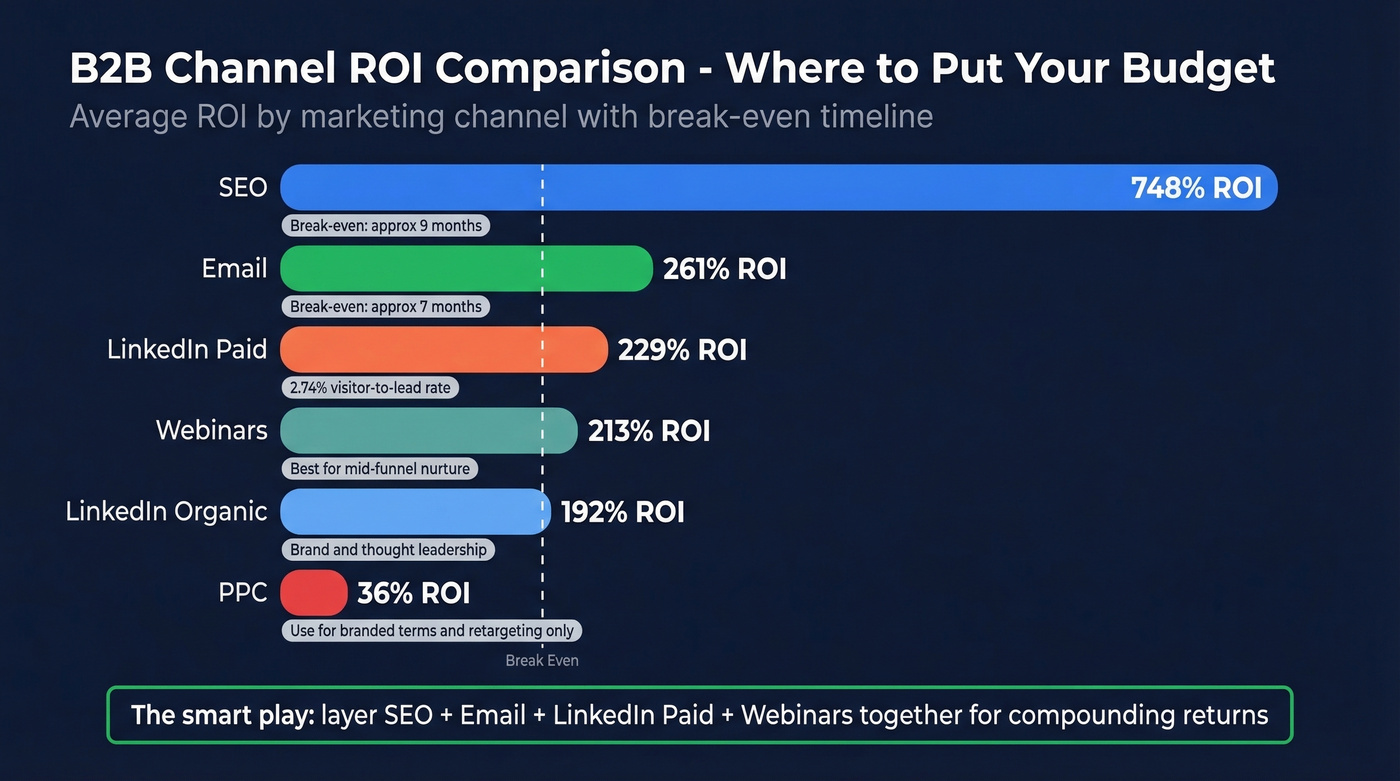
Not all channels deserve your budget equally. Here's what the ROI data shows:
| Channel | ROI | Break-Even | Best For |
|---|---|---|---|
| SEO | 748% | ~9 months | Long-term compounding |
| 261% | ~7 months | Speed + personalization | |
| LinkedIn (paid) | 229% | Varies | B2B targeting precision |
| Webinars | 213% | Varies | Mid-funnel nurture |
| LinkedIn (organic) | 192% | Varies | Brand + thought leadership |
| PPC | 36% | ~4 months | Branded terms, retargeting only |
SEO wins long-term, but it takes 9 months to break even. If your CEO wants pipeline this quarter, SEO alone won't get you there. Email breaks even faster and gives you direct control over targeting.
LinkedIn paid is the best B2B advertising channel - a 2.74% visitor-to-lead conversion rate crushes X/formerly Twitter at 0.69% and Facebook at 0.77%.
PPC is the weakest channel on this list at 36% ROI. We've seen teams pour budget into Google Ads for competitive B2B keywords and get crushed by CPCs north of $15-20 per click. Use PPC for branded terms and retargeting - not as your primary demand engine.
The smart play is layering channels: SEO for compounding organic traffic, email for targeted outbound, LinkedIn paid for account-based targeting, and webinars for mid-funnel conversion. The strongest B2B programs combine all four rather than betting on a single channel.
SEO and Content
Map content to the buyer journey: awareness for problem education, consideration for solution comparison, decision for product-specific content, and retention for customer success. If you're drowning in traffic but starving for pipeline, shift toward bottom-of-funnel comparison pages and case studies.
One trend you can't ignore: 49% of marketers report declining traditional search traffic due to AI-generated answers. Structure content for featured snippets, use clear data points, and make your content the source that AI models cite. The teams still writing 2,000-word keyword-stuffed blog posts are watching their traffic evaporate.
Email - The Sniper Approach
The era of pretty branded email templates is over. One practitioner on r/b2bmarketing put it bluntly after sending 17M+ emails: the best-performing campaigns were "sniper" emails - plain text, one CTA, hyper-relevant to 20-50 person micro-segments. Not 2,000-person blasts.
Cold email reply rates average about 5%, but personalized CTAs convert 200%+ better than generic ones. Three tailored variations sent to 50 people will outperform one generic template sent to 5,000 every time. Before you send, verify your list. A single bad campaign can tank your sender reputation for months.
Social and Video
LinkedIn is the primary social channel for most B2B teams. Seventy-eight percent of B2B marketers use video, and 55% partner with creators and subject-matter experts to produce it. Brands combining video with influencer partnerships are 2.2x more likely to be trusted and 1.8x more likely to be well known. Skip this if you don't have someone on the team who's genuinely good on camera - forced, corporate-feeling video does more harm than good.
ABM vs. Demand Gen
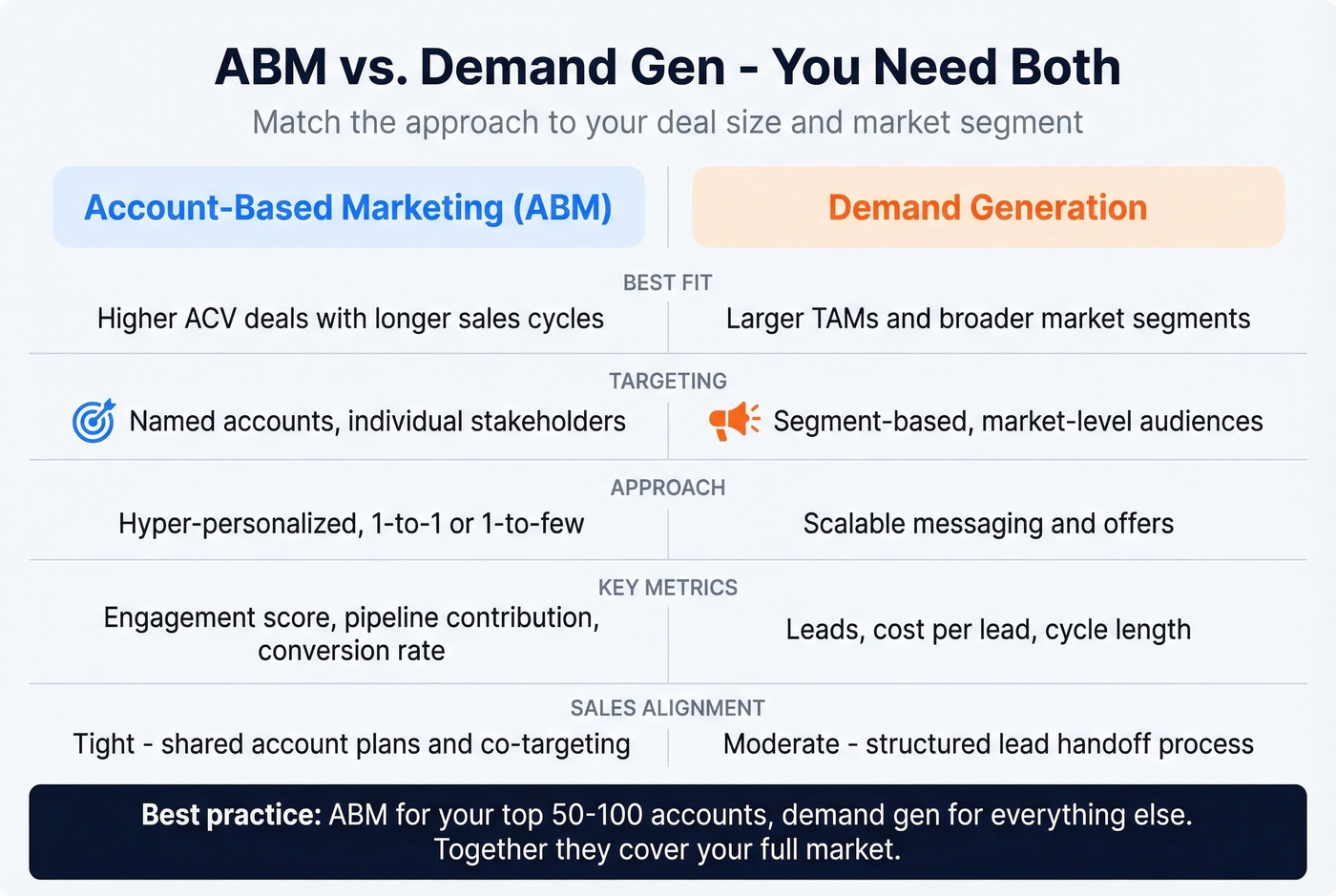
Most teams don't need to choose. They need both.
| Factor | ABM | Demand Gen |
|---|---|---|
| Best fit | Higher-ACV deals with longer cycles | Larger TAMs and broader segments |
| Targeting | Named, account-level | Segment-based, market-level |
| Approach | Hyper-personalized | Scalable messaging + offers |
| Key metrics | Engagement score, pipeline contribution, conversion rate | Leads, CPL, cycle length |
| Sales alignment | Tight, shared account plans | Moderate, lead handoff |
ABM for your highest-priority accounts, demand gen for everything else. Together, they form the backbone of scalable strategies across different deal sizes and market segments.
Emerging: AI-Powered Prospecting
A creative example from r/b2bmarketing: a B2B tech company built an AI tool that scraped 100K+ reviews from Clutch and GoodFirms, extracted lead profiles with challenges and solutions, enriched them with contact data, then invited roughly 1,000 highly qualified leads into a community for nurture. It's ABM meets community-led growth - still early, but worth testing if you've got the technical chops.
Step 4: Fix Your Data First
Here's a stat that should make every B2B marketer uncomfortable: 18% cite incomplete data as the single biggest barrier to confident decisions. And 96% of B2B marketers are now using AI - but AI on bad data just produces bad outputs faster.
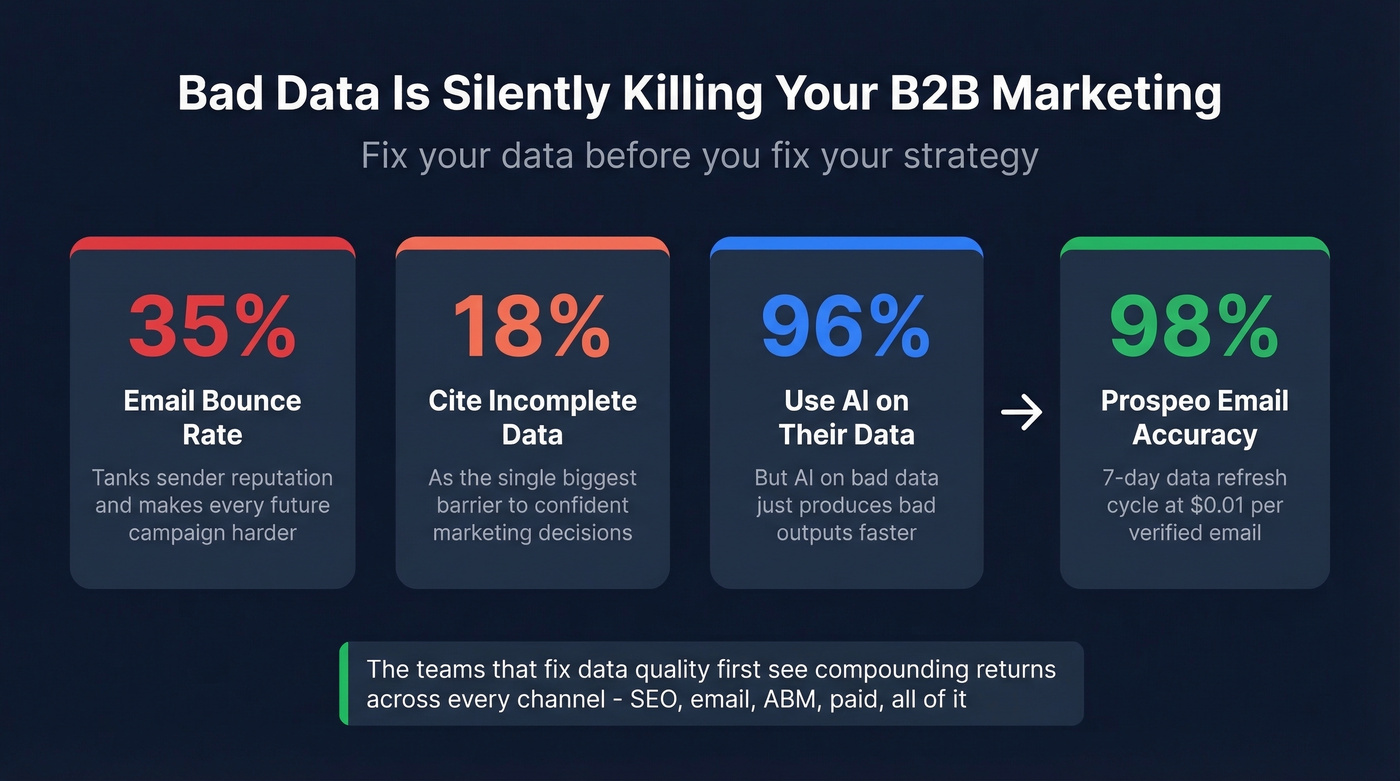
Bad data is like termites in a house. You don't notice the damage until the floor collapses. A 35% bounce rate doesn't just waste emails - it tanks your sender reputation and makes every future campaign harder. Bad data breaks ABM by targeting wrong contacts at target accounts, wastes ad spend on people who've left the company, and corrupts your CRM. No business to business marketing strategy survives contact data that's six months stale.
In our experience, the teams that fix data quality first see returns across every channel simultaneously. Prospeo's 30+ search filters let you target by intent signals, technographics, funding stage, and headcount growth:

With 300M+ professional profiles verified on a 7-day refresh cycle and 98% email accuracy, you're sending to real inboxes, not spam traps. At roughly $0.01 per verified email with a free tier of 75 emails per month, it's the cheapest insurance policy for your entire marketing stack. Meritt tripled their pipeline from $100K to $300K per week after switching, and their bounce rate dropped from 35% to under 4%.
Multi-threading into accounts with 6-10 stakeholders requires verified contact data for every buyer in the room. Prospeo gives you 300M+ profiles with 30+ filters - buyer intent, technographics, headcount growth, funding - so your ABM and email channels hit the economic buyer, the technical evaluator, and the procurement gatekeeper. Not just one champion.
Reach the entire buying committee, not just the one name you found on LinkedIn.
Five Strategy Mistakes That Waste Budget
No ICP definition. Targeting "companies with 50+ employees" isn't an ICP. Define industry, revenue range, tech stack, and buying triggers - or your pipeline math is fiction. Use an Ideal Customer Profile Template to make it concrete.
Tactic-first planning. "We need a podcast" isn't a strategy. Every channel should trace back to the pipeline funnel from Step 1.
Vanity metric addiction. Reporting pageviews to the board is how marketing budgets get cut. Report pipeline influenced and revenue generated.
Siloed teams. When marketing and sales don't share account plans, leads die in the handoff. Eighty-nine percent of B2B decisions cross multiple departments - your org structure should reflect that.
Ignoring the 95%. Spending 100% of budget on demand gen means you're fighting over the 5% actively buying and building zero brand equity with everyone else. Allocate at least half of spend to long-term brand building. This one frustrates us the most - we've watched companies burn through seven-figure ad budgets chasing bottom-funnel leads while their competitors quietly built the brand that captured the other 95% when they were ready to buy.
Step 5: Measure Revenue, Not Vanity
The basic formula: (Revenue generated - marketing investment) / marketing investment x 100. A 5:1 ratio is the commonly cited benchmark for "good" B2B marketing ROI.
The hard part is attribution. B2B sales cycles run 6-12+ months with dozens of touchpoints and data silos between marketing and sales. Server-side tracking and blended attribution models - last-click, data-driven, marketing mix modeling - are replacing the old cookie-based approach.
The biggest measurement mistake isn't using the wrong attribution model. It's tracking the wrong metrics entirely. If you need a clean KPI set, start with funnel metrics and align them to revenue.
| Stop Tracking | Start Tracking |
|---|---|
| Pageviews | Pipeline in ICP accounts |
| Impressions | Revenue influenced |
| Raw MQLs | Sales-accepted opportunities |
| Email opens | Meeting acceptance rate |
| Likes/shares | Win-rate impact |
Your board doesn't care that a blog post got 10,000 views. They care that marketing influenced $2M in pipeline last quarter. Measurement is where your strategy either proves its value or gets its budget slashed.
2026 Trends Reshaping B2B
AI: Universal Adoption, Data Bottleneck
The Demand Gen Report's 2026 survey of 300+ B2B marketers found that 96% are using AI and 47% rank it as the #1 trend they're excited about. Forty-five percent say the top benefit is efficiency - AI handles the repetitive work so marketers can focus on strategy and creative. But nearly one in five teams are feeding AI tools garbage inputs. The teams winning aren't the ones with the fanciest AI. They're the ones with the cleanest data.
Intent Data Is Evolving
Traditional third-party intent data is losing its edge. The signals are delayed, generic, and keyword-level - by the time you act on them, your competitor already has. The shift is toward real-time buyer signals, first-party data from your own properties, and AI-powered predictive insights that identify buying stage and next best action. If you're operationalizing this, identifying buying signals is the starting point.
Brand Building Isn't Optional
A LinkedIn/Ipsos study of 1,500 senior B2B marketers found that 94% say trust is the key to B2B success, and 42% prioritize brand awareness as their top goal. Remember the 95:5 rule - if your entire budget goes to demand gen, you're optimizing for the 5% who are in-market right now and building zero equity with everyone else. Brand isn't a luxury. It's compound interest. If you need a practical framework, see B2B brand positioning.
FAQ
What's the difference between B2B and B2C marketing?
B2B involves buying committees of 6-10+ stakeholders, sales cycles of 4-8 months, and decisions driven by ROI. B2C targets individual consumers with shorter, emotion-driven purchases. B2B requires multi-touch nurture across more channels and more decision-makers, which is why pipeline math and account-based thinking matter far more than they do when you're selling sneakers or subscriptions.
How much should a B2B company spend on marketing?
Gartner's benchmark is 7.7% of revenue. B2B product companies average 6.4%, services companies 9.0%. Split roughly 50/50 between brand building and demand activation per the Binet & Field framework. Below 6%, you're likely underfunding growth.
What's the highest-ROI B2B channel?
SEO delivers 748% ROI with a 9-month break-even. Email returns 261% ROI in about 7 months. LinkedIn paid ads hit 229% ROI with the best B2B targeting precision. The most effective programs layer all three rather than betting on one.
How do you keep outreach data accurate?
Use a verified data platform with frequent refresh cycles - 98%+ email accuracy and weekly refreshes are the standard to aim for. Verify before every campaign to protect sender reputation and maximize deliverability. Stale data is the silent killer of otherwise solid outbound programs.
Start with the pipeline math. Build your business to business marketing strategy from revenue targets down to channel tactics - and make sure every dollar traces back to pipeline. Everything else follows from there.