

Where to Buy B2B Leads in 2026 (Without Burning Your Domain)
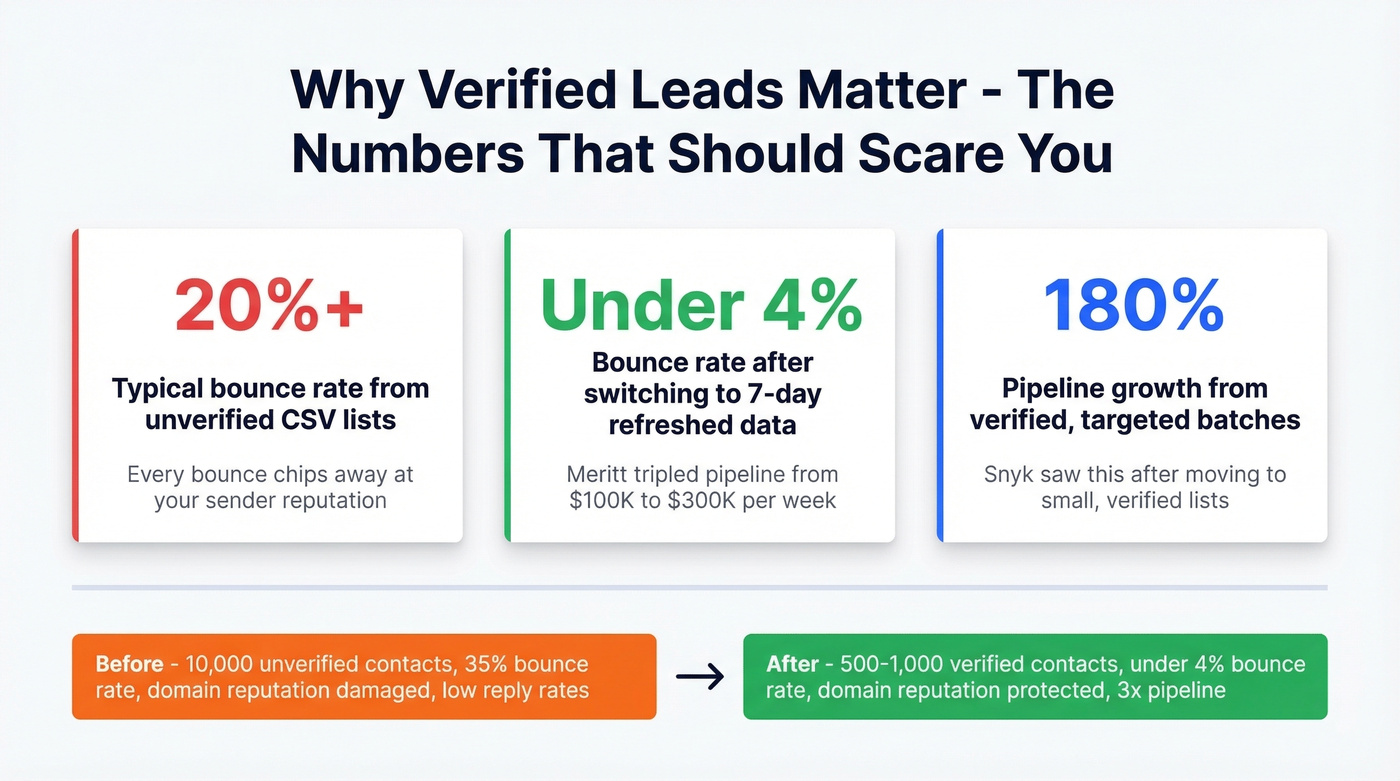
You export 5,000 contacts from a big-name database, load them into your sequencer, and hit send. By day three, bounces spike past 20%, your domain reputation craters, and the VP of Sales wants to know why reply rates are half what they were last quarter. That's what happens when you buy B2B leads without a system.
Most "buy leads" advice treats contacts like a commodity - download a CSV, blast it, repeat. But leads decay. The database you paid for last month is already rotting, and every SDR on your competitor's team is emailing the same people from the same lists. Let's talk about what actually works.
Our Picks (TL;DR)
Best overall for accuracy and freshness: Prospeo - 98% email accuracy, 7-day data refresh, $0.01/email, no contracts.
Best all-in-one GTM platform: Apollo.io - sequencing, database, and dialer in one tool. Plans from $49/mo. Convenient, but data quality is the tradeoff.
Best for EU-heavy teams: Cognism - checks against 15 DNC lists, GDPR-focused compliance, and the strongest European mobile data on the market. Typically ~$1K-$3K/mo.
Four Ways to Acquire B2B Leads
Not all lead buying is the same. Before you pick a tool, understand which motion you're actually paying for.
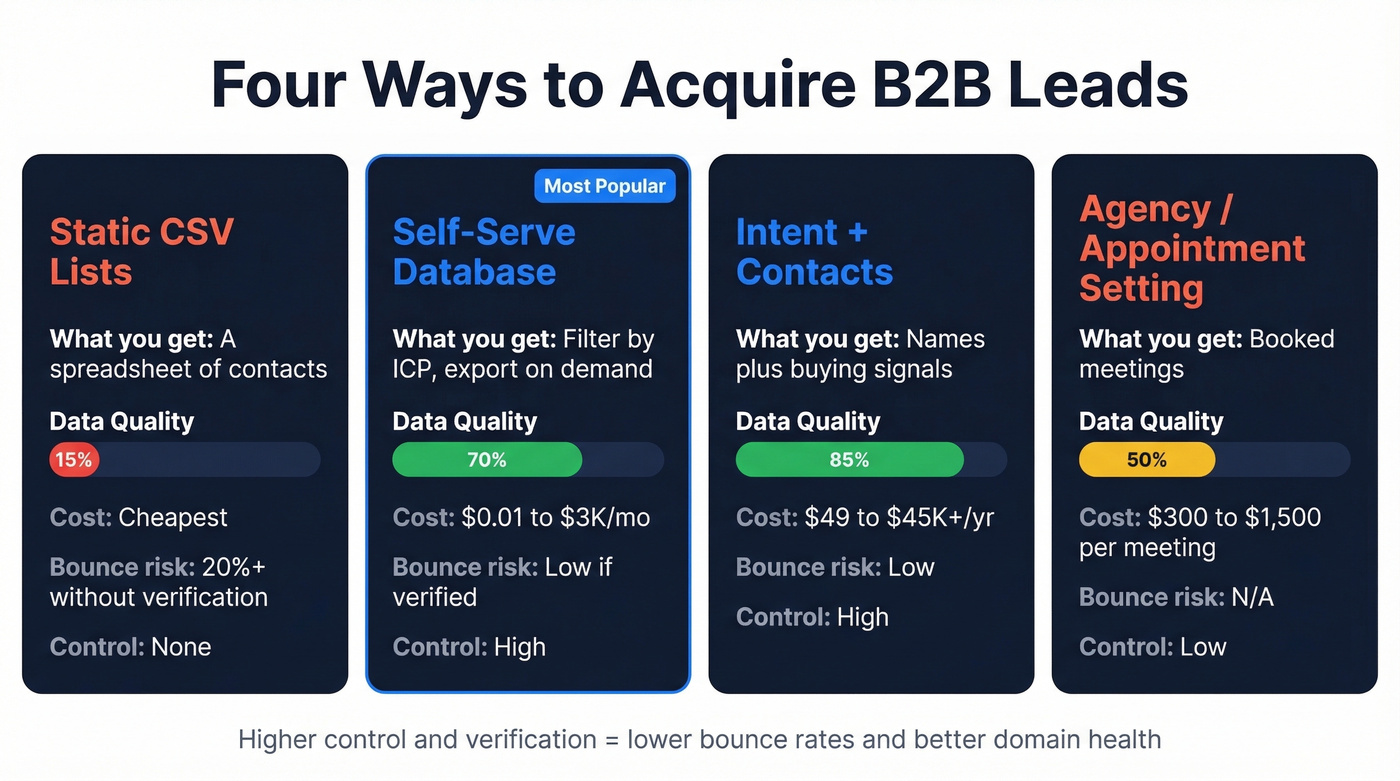
Static CSV lists. You pay a vendor for a spreadsheet of contacts. Cheapest option, worst data quality. These lists go stale fast and often carry 20%+ bounce rates if you don't verify them independently.
Self-serve database access. You log into a platform, filter by ICP criteria, and export contacts on demand. Apollo, ZoomInfo, Cognism, and most tools in this article live here. You control freshness and targeting, making this the most popular approach for teams that want to purchase B2B contacts with precision.
Intent + contacts. Same as above, but layered with buying signals - job changes, funding rounds, tech installs, content engagement. You're not just buying names; you're buying timing.
Agency / appointment-setting. You're buying meetings, not contacts. Expect to pay $300-$1,500 per meeting. Belkins is the go-to example.
The rest of this article focuses on self-serve database tools, because that's where most teams get the best balance of control, cost, and data quality.
Best Places to Buy B2B Leads
Top-Tier Comparison
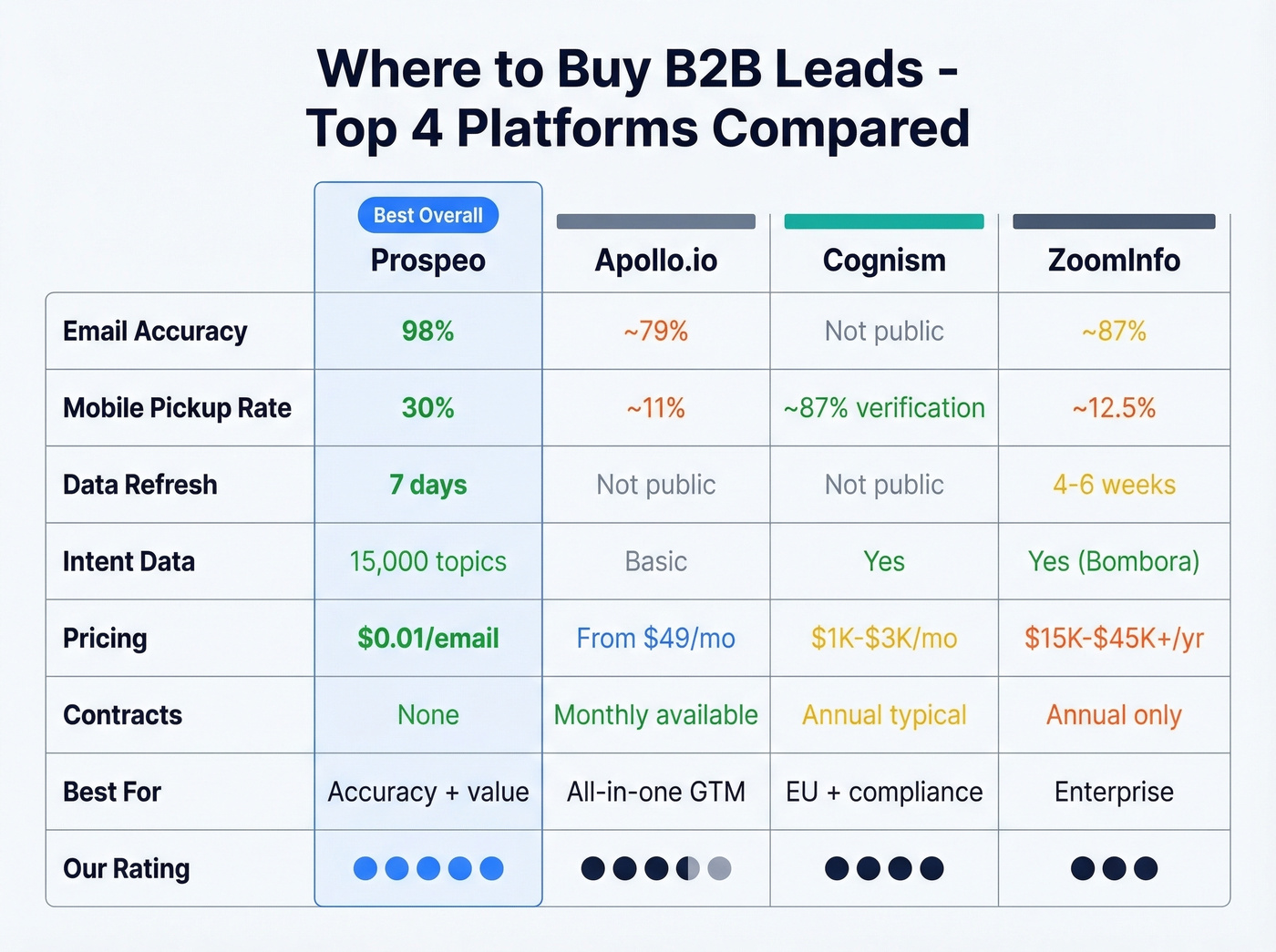
| Email accuracy | 98% | ~79% | Not public | ~87% |
| Mobile pickup rate | 30% | ~11% | ~87% verification rate | ~12.5% |
| Refresh cadence | 7 days | Not public | Not public | 4-6 weeks |
| Verified mobiles | 125M+ | Yes (credits) | Yes (DNC-checked) | Yes (credits) |
| Intent data | 15,000 topics | Basic | Yes | Yes (Bombora) |
| Pricing | $0.01/email | From $49/mo | ~$1K-$3K/mo | $15K-$45K+/yr |
| Contracts | None | Monthly avail. | Annual typical | Annual only |
| Best for | Accuracy + self-serve | All-in-one GTM | EU + compliance | Enterprise + techno. |
Also strong: Lusha (from ~$36/mo, best for SMB quick lookups) and UpLead (from $99/mo, email verification on export).
Prospeo
Use this if you care more about data that actually works than about having 47 features you'll never touch. Prospeo's database covers 300M+ professional profiles, 143M+ verified emails, and 125M+ verified mobile numbers - all refreshed on a 7-day cycle. The industry average is six weeks, which means most databases serve you contacts who've already changed jobs by the time you email them.

The filters go well beyond job title and industry. You get buyer intent across 15,000 Bombora topics, technographics, job changes, headcount growth, and funding rounds - so you're pulling people who are actively in-market, not just names that match a firmographic checkbox. Mobile pickup rates hit 30%, compared to 12.5% at ZoomInfo and 11% at Apollo, a difference that compounds across hundreds of dials per week. Meritt switched over and saw their bounce rate drop from 35% to under 4%, with pipeline tripling from $100K to $300K per week.
Pricing is dead simple: ~$0.01 per email, 10 credits per mobile. The free tier gives you 75 emails and 100 Chrome extension credits per month. No contracts, no annual lock-in. Integrations cover Salesforce, HubSpot, Smartlead, Instantly, Lemlist, and Clay.
Skip this if you need a built-in sequencer and dialer in the same platform - pair it with your outreach tool of choice instead.
Apollo.io
Apollo is the Swiss Army knife of B2B sales tools: database, sequences, and a dialer in one login. The free tier is generous, and paid plans start at $49/mo (Basic), $79/mo (Professional), and $119/mo (Organization, minimum 3 seats). You can go from search to sequence to call without switching tabs.
Here's the thing: Apollo is a jack of all trades, master of none. The database is partially populated by other users, which means accuracy is inconsistent. We've seen email accuracy run around 79% in testing - workable, but verify exports before sending. Credits expire each billing cycle and don't roll over, so unused credits are wasted money.
The practitioner consensus on Reddit is clear: don't use Apollo's open/click tracking (it tanks deliverability), and be cautious with the VoIP dialer since those Twilio numbers get flagged as spam. If your deal size is under $10K and you need one tool to do everything, Apollo is a reasonable starting point. If outbound is your primary growth channel, you'll outgrow it.
Cognism
Cognism is the tool you pick when your pipeline runs through Europe. It checks against 15 DNC lists globally - table stakes if you're cold-calling into the UK, Germany, or France. Mobile verification hits an 87% success rate, and the European data depth genuinely beats ZoomInfo in EMEA.
G2 rates Cognism 4.5/5 across 1,318 reviews. Users consistently praise ease of use and contact quality. The caveat: "Inaccurate Data" appears in 99 G2 con tags, so expect some misses. No database is perfect.
Pricing is quote-based, typically ~$1K-$3K/mo for small teams with annual contracts. You're paying less than ZoomInfo for better European coverage and compliance tooling, but significantly more than self-serve alternatives.
The verdict: Best-in-class for EMEA-heavy teams. Overkill if your market is primarily North America.
ZoomInfo
ZoomInfo is still the default enterprise platform for a reason - the North American data depth, org charts, technographics, and Bombora-powered intent data are unmatched in one package. If you're a 200-person sales org that needs everything centralized, it delivers.
But the pricing model tells you exactly who it's built for. $15K-$45K+ annual contracts with 60-day cancellation windows and 10-20% renewal uplifts. Annual-only. EMEA and APAC data is notably weaker than North America, and the credit system means you're constantly watching your export budget. Most teams don't need all-in-one enterprise - they need accurate data they can actually afford to use.
Lusha
Lusha lives and dies by its Chrome extension. G2 rates it 4.3/5 across 1,618 reviews, and the extension-first workflow is genuinely fast for one-off prospecting. Plans start at ~$36/mo with a solid free tier.
The limitations are real, though. "Data Inaccuracy" shows up in 49 G2 con tags, there's no intent layer to prioritize who's actually in-market, and bulk exports are limited. It's a lookup tool, not a prospecting platform - and that's fine if that's what you need.
UpLead, Lead411, and Others Worth Knowing
UpLead ($99/mo) verifies emails on export, so you're not paying for dead addresses. Strong for mid-market teams focused on email outreach, but it lacks mobile numbers at scale and intent data.
Lead411 ($49/mo) includes Bombora intent data on its Pro plan, plus trigger signals like funding rounds, hiring surges, and leadership changes. Worth evaluating if intent-led outbound is your primary motion and you want triggers without ZoomInfo prices.
Seamless.AI ($100-$200/mo) positions itself as an AI-powered real-time search engine for contacts. User reviews consistently flag accuracy concerns - we'd test a small batch before committing budget.
BookYourData uses a pay-per-list model at $0.20-$0.40 per contact. Good for one-time purchases when you need a targeted list for a specific campaign without ongoing costs.
Belkins is a different category entirely. They sell booked meetings, not contact data. Expect $300-$1,500 per appointment depending on ICP complexity.
Other tools worth a look: Kaspr (strong in Europe, from EUR45/mo), D&B Hoovers (firmographics and company intelligence), and LeadIQ (prospecting workflow focus).

Every bounced email from a bad lead list chips away at your domain reputation. Prospeo's 5-step verification and 7-day refresh cycle keep bounce rates under 4% - the same result Meritt saw when they switched and tripled pipeline to $300K/week.
Buy B2B leads that actually connect. Start free with 75 verified emails.
How to Buy Leads Safely in 2026
Stop buying 10,000 leads. Here's the workflow that actually protects your domain and converts.
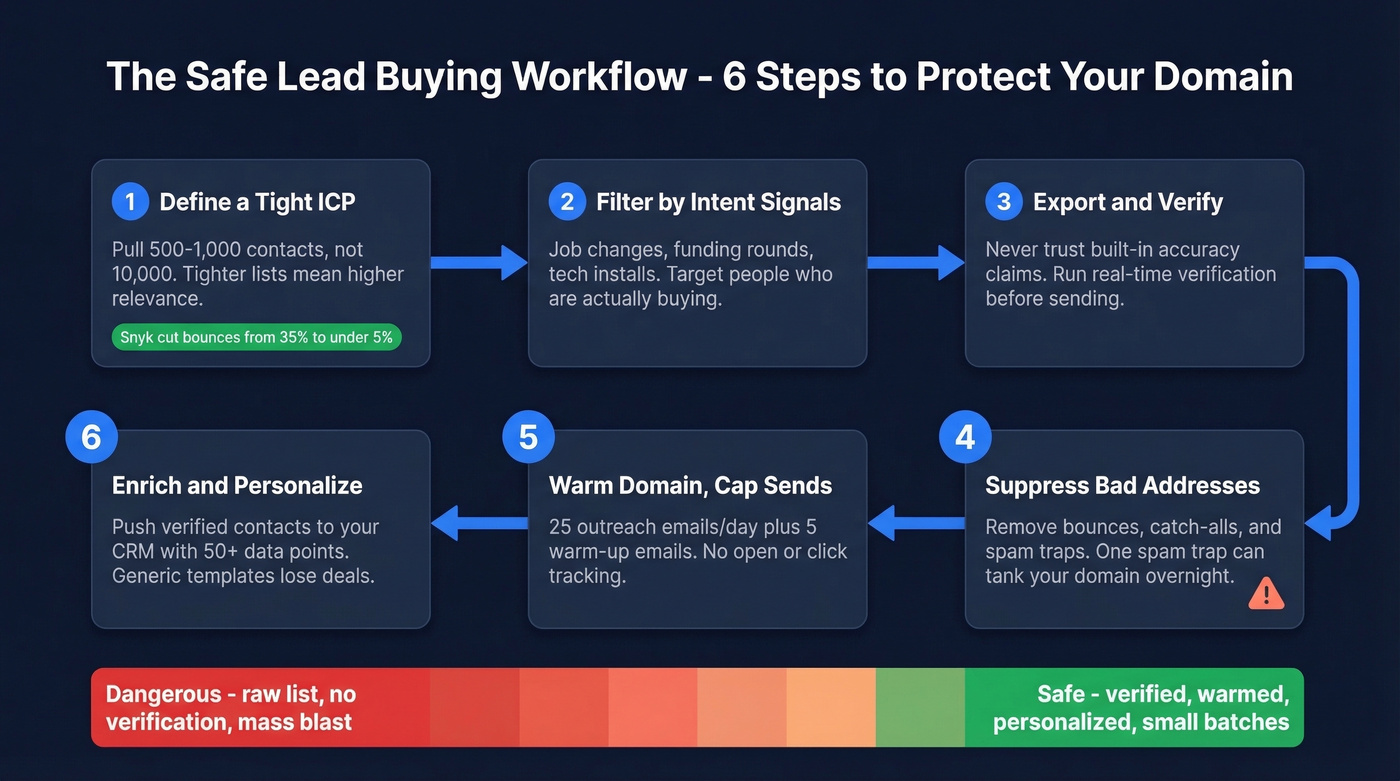
1. Define a tight ICP. Pull 500-1,000 contacts, not 10,000. Tighter lists mean higher relevance, better reply rates, and less risk to your sender reputation. Snyk's 50-person AE team cut bounce rates from 35-40% to under 5% and grew AE-sourced pipeline 180% after switching to verified data in small, targeted batches.
2. Filter by intent signals. Job changes, funding rounds, tech installs, content engagement. Contacts showing active buying signals convert at dramatically higher rates than cold lists. If your database doesn't offer intent filtering, you're guessing.
3. Export and verify. Never trust a database's built-in accuracy claims at face value. Run exports through real-time verification before they touch your sequencer.
4. Suppress bounces, catch-alls, and spam traps. Remove anything that isn't a confirmed valid mailbox. Spam traps can tank your domain overnight. Bounces and spam reports destroy your sender score, which triggers ISP-level blocking that takes weeks to recover from.
5. Warm your domain and cap sends. 25 outreach emails per day plus 5 warm-up emails is a solid starting cap until you've built reputation. Don't use open or click tracking - it kills deliverability. For a deeper breakdown of safe sending limits, see email velocity.
6. Enrich in your CRM for personalization. Push verified contacts into Salesforce or HubSpot with enrichment data (50+ data points) so reps can actually personalize outreach instead of sending generic templates. If you need vendors and workflows, start with data enrichment services.
Vendor red flags to watch for: no compliance documentation, no refund or credit policy, no data freshness disclosure, and no clear answer when you ask how often records are reverified. If a vendor can't produce these, walk away.

You just read the pricing column: $0.01/email vs $1/lead at ZoomInfo. Prospeo gives you 300M+ profiles, 30+ ICP filters, intent data across 15,000 topics, and 125M+ verified mobiles with a 30% pickup rate - no annual contract required.
Stop overpaying for stale data. Export your first leads in under two minutes.
Is It Legal to Buy B2B Leads?
The legality isn't about buying - it's about how you use the data afterward.
| Region | Law | Model | Key risk | Penalty |
|---|---|---|---|---|
| US | CAN-SPAM | Opt-out | Must honor unsubs | $46,517/violation |
| California | CCPA/CPRA | Opt-out + rights | Employment data = personal info | $100-$750/violation |
| Canada | CASL | Express consent | Purchased lists rarely qualify | Up to $10M/violation |
| EU | GDPR | Consent/legit. interest | Lists fail specificity | EUR20M or 4% revenue |
| UK | PECR + UK GDPR | Corporate exception | Named individuals need basis | Case-by-case |
In the US, CAN-SPAM regulates how you send, not where you got addresses. Include an opt-out, honor it within 10 days, and you're compliant. California adds another layer - CCPA/CPRA expanded "personal information" to include employment-related data, so purchased B2B contacts trigger consumer-style rights.
Canada is stricter. CASL requires express consent, and purchased lists almost never qualify. Hudson's Bay learned this the hard way with a $120K undertaking.
The EU is the tightest. GDPR requires consent to be specific, and "we bought your email from a vendor" doesn't meet that bar. Total GDPR fines have crossed EUR5.88B across 2,245 cases - Vodafone Italia was fined EUR12.25M and TIM EUR27.8M for data handling violations. These aren't theoretical risks.
Before buying from any vendor, demand proof of lawful basis for data collection, consent records, opt-out handling procedures, and DSAR response capability within 30 days. If they can't produce these, walk away.
What B2B Lead Procurement Costs
The B2B leads database market crossed $11B in 2025 with an 11.33% CAGR - there's no shortage of vendors competing for your budget. But costs vary wildly depending on what you're buying.
| Lead type | Typical cost | What you're getting |
|---|---|---|
| Self-serve database email | $0.01-$1.00 | Raw contact from a platform export |
| Broker/agency qualified lead | $20-$150+ | Enriched, filtered, sometimes verified |
| Sales-qualified lead | $150-$600 | Vetted against ICP, confirmed interest |
| Booked appointment | $300-$1,500 | Meeting on the calendar |
The self-serve tier is where the math gets interesting. A 1,000-verified-email list from Prospeo costs about $10. That same list from ZoomInfo - factoring in annual contract minimums and credit costs - often works out closer to ~$1 per lead, or roughly $1,000. The broker/agency range of $20-$150+ reflects the cost of human qualification layered on top.
Average B2B conversion rates sit around 2.9%, ranging from 1% for SaaS to 7.4% for legal services. Purchased leads can match or beat those numbers when you layer intent signals and verify data - but raw, unfiltered lists underperform significantly. If you want more benchmarks, see average B2B lead conversion rate.
FAQ
Is buying B2B leads illegal?
Not inherently. In the US, CAN-SPAM governs how you email, not where addresses came from - include an opt-out and honor it within 10 days. In the EU and Canada, purchased lists usually fail consent requirements under GDPR and CASL. Verify your vendor's compliance documentation and segment outreach by jurisdiction.
What bounce rate should I expect?
Unverified purchased lists typically produce 20%+ bounce rates, which can damage your sender reputation within days. With real-time verification at 98% accuracy, you can keep bounces under 4-5%, the threshold most ESPs consider safe for domain health.
How many leads should I buy to start?
Start with 500-1,000 tightly filtered contacts, not 10,000. Smaller verified batches let you test messaging, protect deliverability, and iterate on ICP targeting before scaling spend. This approach also keeps your cost under $10 on self-serve platforms.
Do purchased leads convert worse than inbound?
Average B2B conversion rates sit around 2.9%. Purchased leads match or exceed that when you layer intent signals, verify data, and personalize outreach. Raw, unfiltered lists without verification or targeting underperform significantly - data quality matters more than the source.
Where should I buy B2B leads on a budget?
Start with a self-serve database offering real-time verification and no annual contract. Prospeo's free tier lets you test 75 verified emails before committing budget, while Apollo's free plan gives you a taste of the all-in-one approach. Avoid CSV brokers until you've validated your ICP and messaging with a smaller, verified list.