

Buyer Enablement: How to Help Your Buyers Actually Buy
The call went great. Your champion was nodding, asking the right questions, even talking about next steps. Then silence. A week passes. Two weeks. You send a follow-up - "just checking in!" - and get nothing back. The deal didn't die in a dramatic loss. It just faded out, momentum quietly disappearing like air from a slow leak.
You enabled your sellers with playbooks, battlecards, and talk tracks. But you forgot about buyer enablement - giving your buyers what they need to close the deal without you in the room.
The Three Things to Implement This Week
Buyer enablement isn't a content library. It's an operating system for how your buyers navigate a purchase internally. Here's where to start:
A mutual action plan for every deal with 3+ stakeholders. This is the single highest-leverage move. It creates shared accountability and makes deal drift visible before it kills the deal.
Stage-mapped content that addresses each stakeholder's specific concern. Finance needs ROI models. Legal needs security docs. Your champion needs ammunition, not brochures.
Clean contact data so your enablement content actually reaches the buying committee. If you can't email the CFO directly, your ROI calculator sits in your champion's inbox forever.
What Is Buyer Enablement?
Buyer enablement is the practice of equipping your buyers - not your sellers - with the tools, content, and structure they need to complete a purchase internally. It helps buyers make informed decisions, build consensus across stakeholders, and justify the purchase to budget holders. It can extend into onboarding and advocacy, but the biggest ROI sits in the pre-purchase phase.
The distinction from sales enablement matters. Sales enablement is internal - training reps, building playbooks, optimizing CRM workflows. Buyer enablement is external - giving buyers what they need to sell the deal on your behalf when you're not in the room. Instead of arming your team, you're arming theirs.
Only 20% of content is created with buyers in mind. The other 80% is built for lead capture, nurturing, or internal rep use. That gap is where deals go to die. And buyers who receive high-quality information from sellers are 3x less likely to regret a large purchase - proof that the right content at the right time changes outcomes.
| Sales Enablement | Buyer Enablement | |
|---|---|---|
| Focus | Internal (your team) | External (their team) |
| Who benefits | Reps and managers | Buyers and champions |
| Content examples | Battlecards, playbooks | ROI calculators, security docs |
| Goal | Rep performance | Purchase completion |
Why It Matters in 2026
A Gartner survey of 646 B2B buyers found that 67% prefer a rep-free buying experience - up from 61% just a year earlier. That's not a blip. It's acceleration.
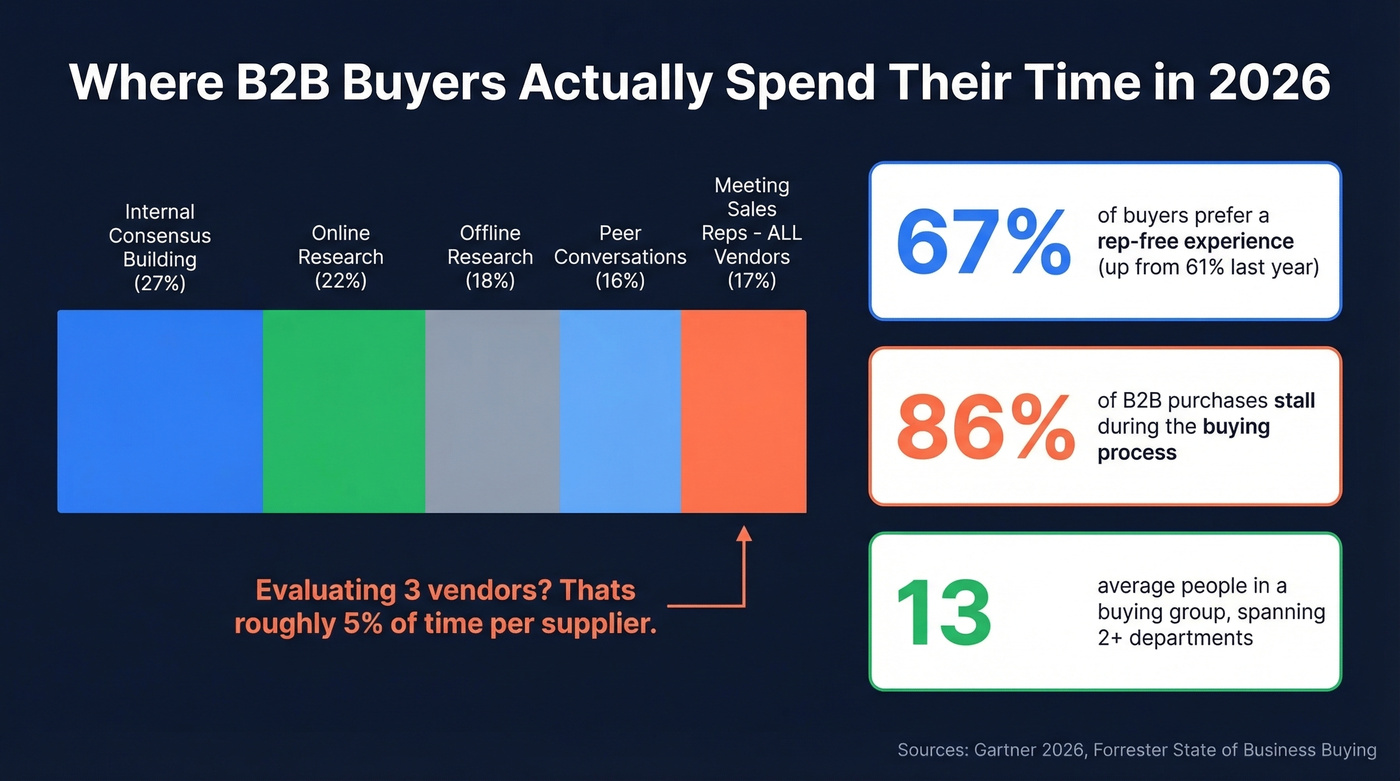
Forrester's State of Business Buying report paints an even grimmer picture: 86% of B2B purchases stall during the buying process, and 81% of buyers end up dissatisfied with the provider they choose. Buying groups now average 13 people - 89% of purchases span two or more departments. That's 13 people who all need to say yes, and any one of them can say "let's wait."
Here's the thing: buyers spend only 17% of their total buying time with sales teams - across all suppliers. Evaluating three vendors? That's roughly 5% of your time per supplier. The remaining 83% splits across online research, internal consensus-building, offline research, and external peer conversations.
Your reps aren't losing deals because they're bad at selling. They're losing deals because they're absent for 95% of the buying process and haven't given buyers anything useful to work with during that time.
Forrester also found that 45% of buyers already used AI during a recent purchase, and nearly 95% anticipate using genAI in their buying process within the next year. Static PDFs won't cut it when your buyer's AI assistant is summarizing your competitor's interactive ROI calculator.
Two more stats that should keep you up at night: 69% of buyers report inconsistencies between supplier websites and what sellers tell them, and 73% actively avoid suppliers who send irrelevant outreach. If your enablement materials contradict your website - or your outreach misses the mark - you're done before the second call.
The Buying Journey Is Not a Funnel
The buying journey breaks into six jobs that every B2B purchase moves through: problem identification, solution exploration, requirements building, supplier selection, validation, and consensus creation. The critical insight isn't the jobs themselves - it's that buyers loop through them repeatedly, circling back, revisiting assumptions, and restarting conversations as new stakeholders get involved.
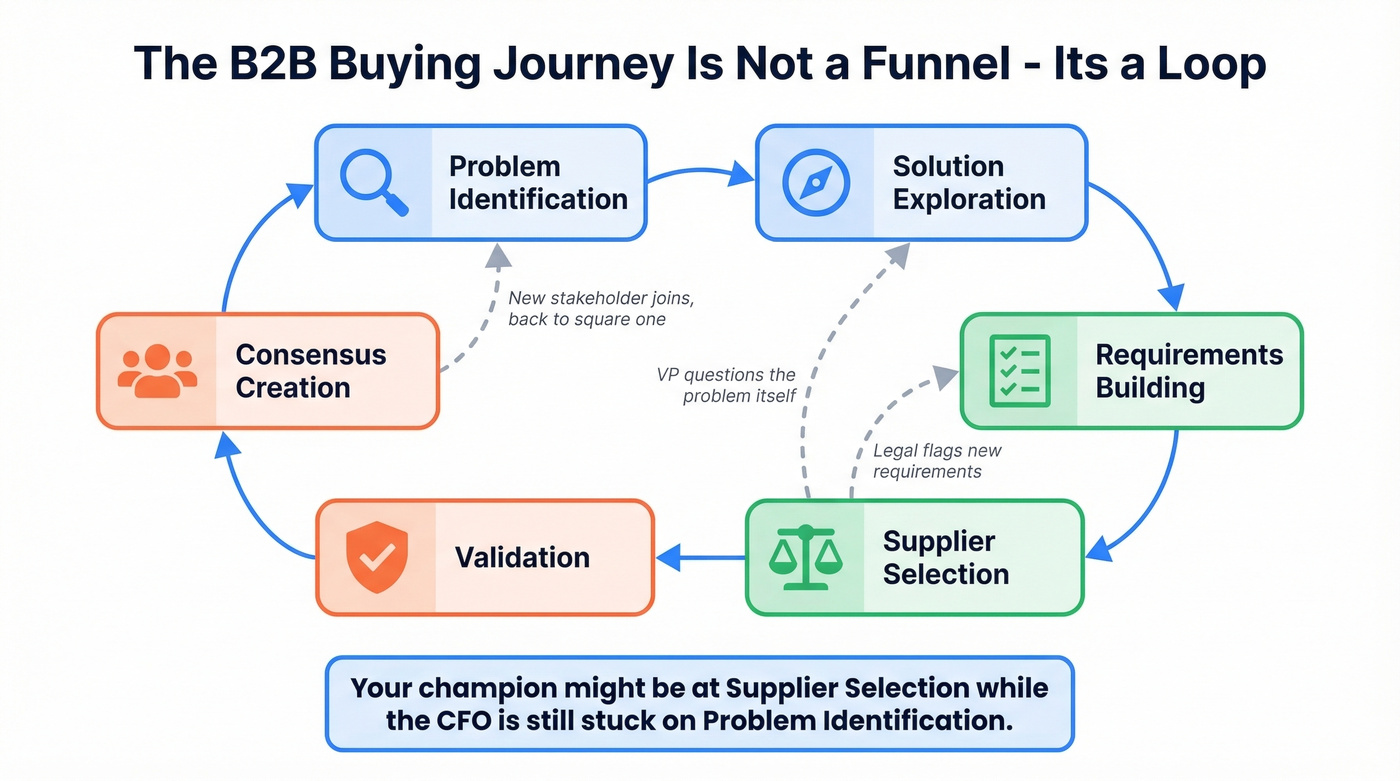
This looping behavior is why deals stall. Your champion might be at supplier selection while the VP of Finance is still stuck on problem identification, wondering whether the problem is even worth solving. Effective enablement means meeting each stakeholder where they actually are - not where your pipeline stage says they should be.
When buyers use supplier-provided digital tools in partnership with a sales rep, they're 1.8x more likely to complete a high-quality deal. Confident buyers are twice as likely to report a high-quality deal. Your job isn't to replace the rep - it's to make every rep interaction more impactful by giving buyers the resources to stay confident between calls.
A word of caution: If your average deal is under $15K and your buying committee is two people, you don't need a dedicated platform. A shared Google Doc with next steps and links to your key resources will outperform most tools. Buyer enablement is a strategy, not a software category. The tools matter when deals involve 5+ stakeholders and six-figure contracts.

You just read that 86% of deals stall because buying committees can't build consensus. The fix starts with reaching every stakeholder directly - not routing everything through your champion. Prospeo gives you verified emails for the CFO, the VP, and the legal lead across 300M+ profiles at 98% accuracy.
Stop letting your ROI calculator die in your champion's inbox.
Content Mapped to Each Buying Stage
The biggest mistake teams make is creating content for "buyers" as a monolith. Different stages need different assets, and different stakeholders within the same deal need different versions.
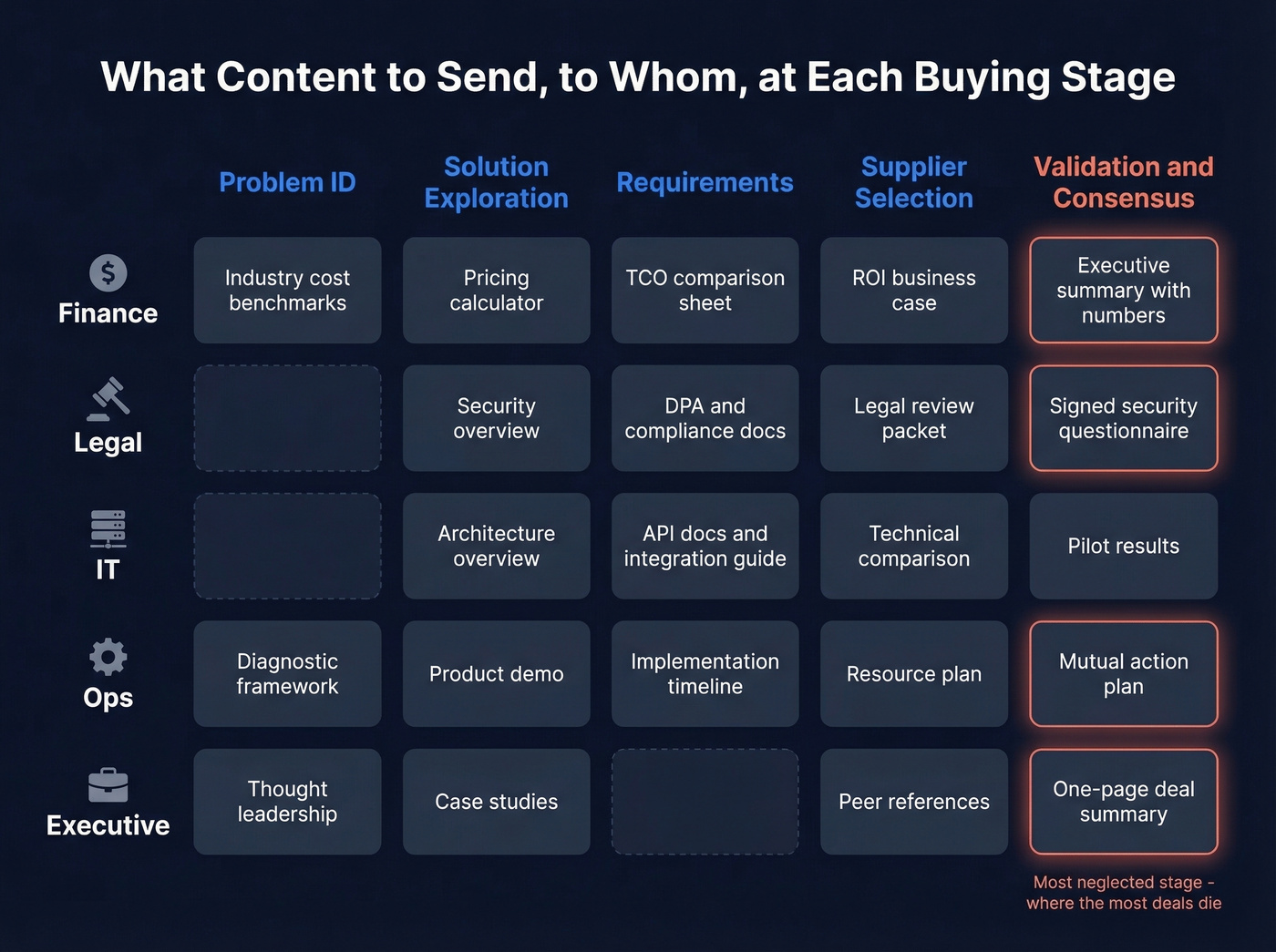
Problem identification. Industry benchmarks, diagnostic frameworks, and thought leadership that helps buyers articulate the problem internally. Linear's Change Management Toolkit gives buyers a framework before they've even decided to buy.
Solution exploration. Product overviews, short demos, case studies, and pricing calculators. Most teams over-invest here, but the content is too seller-focused. 1Password's buyer's checklist works because it's structured around the buyer's evaluation criteria, not the product's feature list.
Requirements building. Evaluation checklists, RFP templates, spec sheets, and implementation guides. DocuSign's eSignature Legality Guide is a masterclass - it answers the exact legal questions that stall procurement.
Supplier selection. Competitive comparisons, business case templates, testimonials, and security/compliance documentation. Intercom does this well with ready-made business case frameworks.
Validation and consensus. Mutual action plans, executive summaries, Q&A documents, pilot summaries, and reference scheduling. This is the stage most teams neglect entirely - and it's where the most deals die.
One dimension most guides miss: tailoring content to buyer personality types. An analytical CFO wants data density and methodology. A driver-type VP wants the bottom line in three bullets. We've seen teams cut a full week off their consensus-building timeline just by creating two versions of their business case - a detailed spreadsheet for the analyst, a one-page summary for the executive.
| Stakeholder | Primary Concern | Content They Need |
|---|---|---|
| Finance | ROI and TCO | ROI calculator, TCO comparison |
| Legal | Security, compliance | Security whitepaper, DPA |
| IT | Integrations, architecture | API docs, integration guide |
| Ops | Implementation effort | Timeline, resource plan |
| Executive | Peer validation | Case studies, references |
Mistakes That Kill Deals
Scattered PDFs and broken links. Your champion is trying to sell this deal internally at 9 PM. They're looking for the ROI calculator you sent three weeks ago. It's buried in an email thread, the link is expired, and the version is outdated. Build one organized space - a digital sales room - where everything lives and stays current.
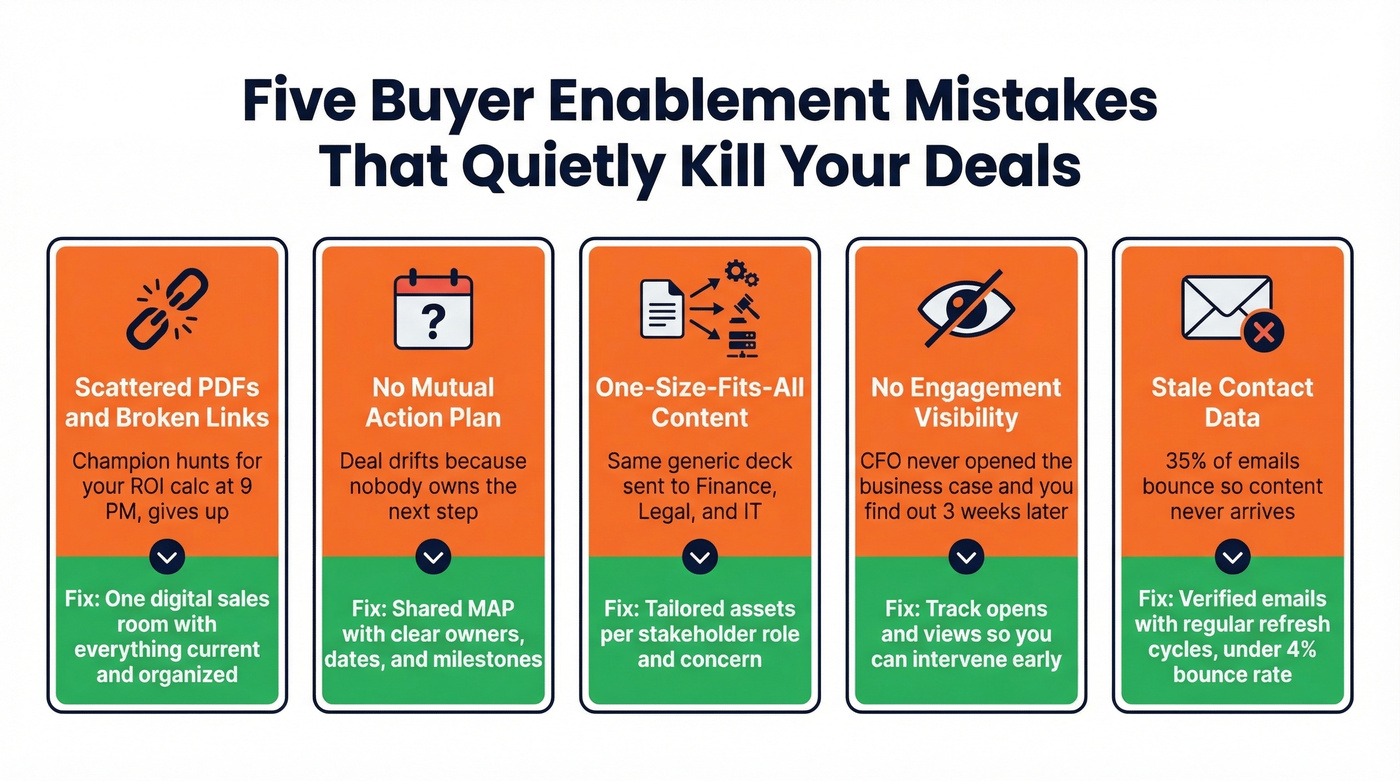
No mutual action plan. Without a shared timeline and clear next steps, deals drift. The consensus on r/salestechniques is clear: tools that support mutual action plans and provide engagement signals are the ones that actually keep deals moving. If you don't have a MAP, you're relying on your champion's memory and motivation. That's a losing bet.
One-size-fits-all content. Finance asked a question your champion couldn't answer. Legal needs a security review your champion didn't know existed. When you send the same generic deck to every stakeholder, you're asking your champion to do translation work they're not equipped for.
No engagement visibility. If you can't see who opened what, you can't detect stalls until it's too late. You need to know that the CFO hasn't opened the business case - not find out three weeks later when the deal goes dark.
Stale contact data. This is the most underrated deal-killer in buyer enablement, and it drives us crazy. If a big chunk of your emails bounce, your ROI calculator never reaches the CFO. Your security whitepaper never gets to Legal. In our experience, teams using Prospeo's 98%-accurate email verification and 7-day refresh cycle see bounce rates drop from 35%+ to under 4% - the difference between enablement content that exists and enablement content that arrives.
Buying groups average 13 people across multiple departments. Your stage-mapped content only works if it lands in the right inbox at the right time. Prospeo's 30+ filters - including department, seniority, and buyer intent signals - let you map and reach entire committees for $0.01 per verified email.
Arm every stakeholder, not just the one who took your first call.
Building a Buyer Engagement Blueprint
The tools and content above are components. What ties them together is a buyer engagement blueprint - a documented plan that maps each stakeholder role to the content, channels, and timing they need at every stage of the deal.
A strong blueprint answers three questions for every deal: Who are the stakeholders and what do they care about? What content does each person need, and when? How will you deliver it and track whether it landed? Document this once, templatize it, and iterate as you learn which assets actually move deals forward. Without one, enablement efforts stay ad hoc and inconsistent across your team.
If you want a tighter way to define stakeholders up front, start with an ideal customer profile and map roles from there.
Tools and Pricing for 2026
Digital Sales Rooms
Aligned is the practitioner favorite for a reason. It combines mutual action plans with real engagement signals - you can see exactly who viewed what and when. Reddit users consistently praise it for keeping deal content and next steps in one place. The tradeoff: it can feel like overkill for small, transactional deals. Free tier available; paid plans from $29/seat/month.
Skip these if your deals are simple. Dock ($49/user/month) is lightweight, but engagement tracking is basic. Trumpet (~$30-60/user/month) has a clean buyer-facing interface but limited MAP support. GetAccept (from $25/user/month) adds e-signatures to the mix. DealHub (~$50-100/user/month) tracks buyer engagement well but can feel heavier and less intuitive.
If you're building a full stack, it helps to align your enablement workflow with your sales process optimization work so reps don't fight the system.
Interactive Demos and Proposals
Storylane and Consensus take opposite approaches. Storylane offers a free tier for basic demos, scaling to $500/month on its Growth plan - ideal for self-serve exploration. Consensus (from ~$600/month) automates demo delivery and tracks which features each stakeholder cares about, making it the better choice for multi-stakeholder deals where you need to know who watched what.
For proposals, PandaDoc (from $19/user/month) handles automation with built-in e-signatures, while Qwilr (from $35/user/month) creates interactive, web-based proposals that track engagement.
Pricing at a Glance
| Tool | Category | Starting Price |
|---|---|---|
| Prospeo | Data foundation | Free (75 emails/mo); ~$0.01/email |
| PandaDoc | Proposal automation | $19/user/mo |
| GetAccept | Digital sales room | $25/user/mo |
| Aligned | Digital sales room | Free; $29/seat/mo paid |
| Chili Piper | Scheduling | $30/user/mo + $150-$1K platform fee |
| Trumpet | Digital sales room | ~$30-60/user/mo |
| Qwilr | Proposals / content | $35/user/mo |
| Storylane | Interactive demos | Free; $40/mo starter |
| Dock | Digital sales room | $49/user/mo |
| DealHub | Deal management | ~$50-100/user/mo |
| Consensus | Demo automation | ~$600/mo |
Measuring What Works
The north star metric is deal quality. Buyers using supplier digital tools with rep partnership are 1.8x more likely to complete a high-quality deal - that's your benchmark.
Win rate is the most direct measure of whether enablement is working. Teams report 20-35% improvements. Sales cycle length typically drops 25-40% as buyers self-serve through information gaps. Stall/no-decision rate is where the biggest gains hide - in our experience, it's the first metric to move, often within a single quarter. Average deal size tends to climb too; better-enabled buyers buy more confidently, driving 23% larger deals on average.
Content engagement and stakeholder breadth are your leading indicators. If the CFO never opened the business case, that's a red flag you can act on today - not a surprise you discover when the deal goes dark.
Let's be honest about the internal pitch: when you're selling buyer enablement to your own leadership, lead with your stall-rate data. Executives respond to "42% of our pipeline died from no-decision last quarter" far more than "we need better content for buyers." The ROI case writes itself once you quantify the deals you're losing to inaction rather than competitors.
To make this measurable, treat enablement like pipeline health: define leading indicators, set baselines, and review them weekly.
FAQ
What's the difference between buyer enablement and sales enablement?
Sales enablement equips reps with internal tools and playbooks. Buyer enablement equips buyers with external resources - ROI calculators, comparison guides, security docs - so they can sell the deal internally. Only 20% of content targets buyers, which is why most deals stall during consensus.
What tools do I need to get started?
Start with a digital sales room that supports mutual action plans - Aligned is the strongest option right now. Add interactive demos through Storylane for self-serve exploration and verified contact data so content reaches every stakeholder. You don't need every category on day one.
How long before results show up?
Stall rate and cycle length improve within one quarter. Win rate gains compound over 2-3 quarters as buying committee engagement deepens. Measure no-decision rates first - that's where the biggest gains hide.
How does bad contact data hurt deal velocity?
Bounced emails mean your business case, security docs, and ROI models never reach key stakeholders. Teams using verified data report bounce rates dropping from 35%+ to under 4%, which means the difference between a deal that moves and a deal that stalls because Legal never saw the security whitepaper.