

Buyer Intent Questions That Actually Reveal Who's Ready to Buy
Your rep just wrapped a 40-minute discovery call. Great rapport, lots of nodding, a promising "let's circle back next week." Then the prospect ghosts. Businesses lose 67% of sales because reps don't qualify properly - they mistake a pleasant conversation for real buying intent. The fix isn't more calls. It's asking the right buyer intent questions, the kind that separate real buyers from browsers in the first five minutes.
If You Only Ask Five Questions
Make it these:
- "What made you take this meeting today?" - Tire-kickers can't answer this specifically.
- "What problem are you trying to solve right now?" - No named problem, no deal.
- "What happens if nothing changes in 6-12 months?" - Tests urgency without being pushy.
- "Who else needs to weigh in on this decision?" - Reveals whether you're talking to the decision-maker.
- "Are you actively looking for a new provider or just researching?" - Most prospects will tell you the truth if you ask plainly.
Here's the 10-second intent check: ask questions 2 and 3 back-to-back. If the prospect can't name a specific problem and can't articulate consequences of inaction, you're talking to a browser. Move on.
Questions Mapped by Funnel Stage
Top of Funnel: Problem and Need
These go first because without a real problem, nothing else matters. Top-of-funnel sales questions surface whether a prospect has genuine pain or is simply browsing - and the distinction matters more than most reps realize.
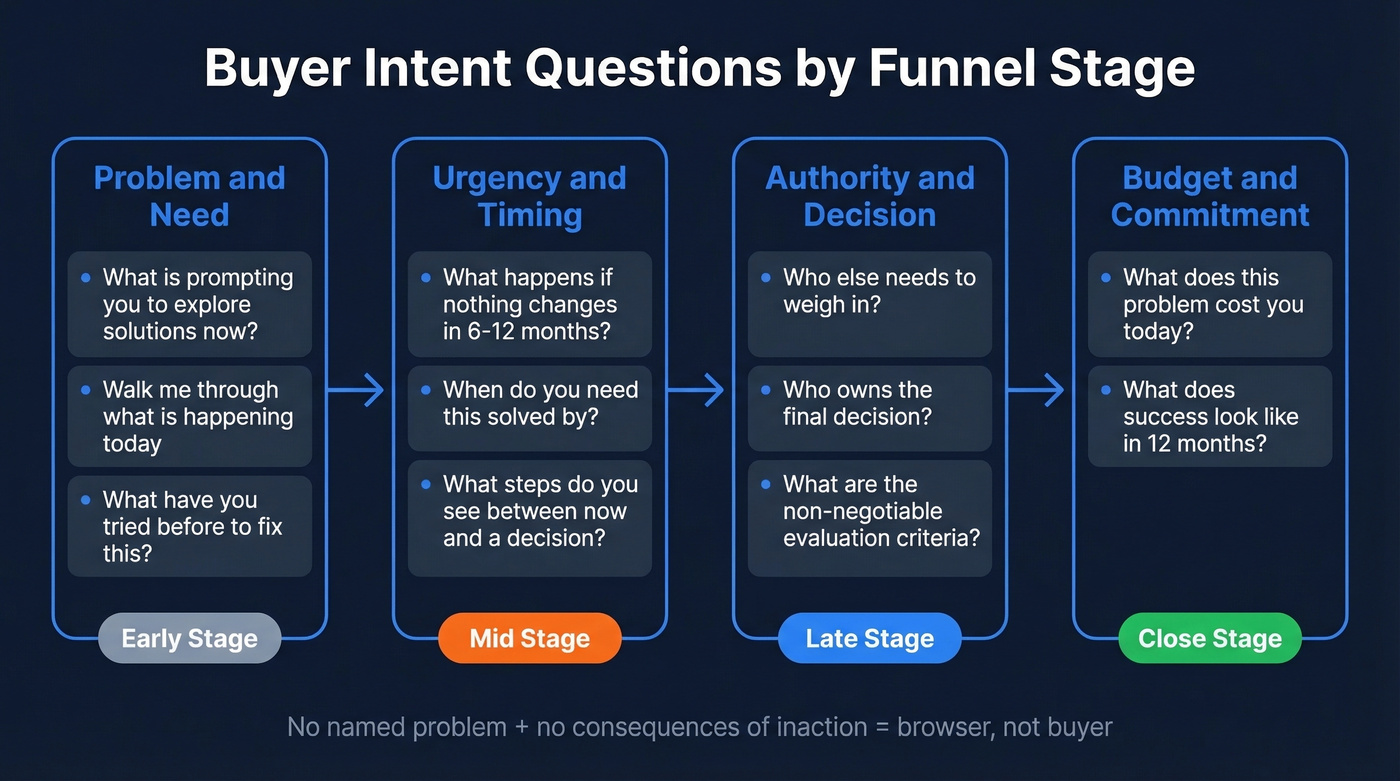
Start with "What's prompting you to explore solutions like ours now?" and listen for a specific trigger event: new leadership, a lost deal, a broken process. If you hear "just keeping up with the market," your alarm bells should fire. Follow up with "Can you walk me through what's happening now that you'd like to change?" You want operational detail, not vague dissatisfaction. A prospect who can't describe their current state hasn't felt enough pain to buy.
The question that reveals the most: "What have you tried in the past to fix this?" Someone who's tried two competitors and failed is far more motivated than someone exploring for the first time. Past attempts are one of the strongest signals that a prospect is serious about making a change.
Urgency and Timing
Urgency separates Q1 pipeline from "maybe next year."
One of the best urgency questions in sales is "What happens if nothing changes in the next 6-12 months?" Listen for consequences tied to revenue, headcount, or competitive positioning. If the answer is "honestly, we'd be fine," you have your answer too. Follow that with "When do you need this solved by?" Direct and effective - no timeline means no urgency.
Then ask "What steps do you envision between now and a decision?" This maps the buying process from their side. Red flag: they have no idea what the internal process looks like, which means nobody has asked them to run one.
Authority and Decision
You can have perfect need and urgency, but if you're pitching to someone who can't sign, you're wasting cycles.
"Who else needs to weigh in on this decision?" Listen for names and titles, not "I'll need to check." If they rattle off three VPs and a CFO, you're early in a multi-threaded deal. "Who owns the decision? Who's the economic buyer?" Blunt, but necessary. The biggest competitor in B2B isn't another vendor - it's "no decision." And "Beyond budget, what are the key non-negotiables your team uses to evaluate solutions?" reveals the decision framework and tells you exactly what to address in your proposal.
Budget and Commitment
"If you had to quantify the cost of this problem today, what would it be?" anchors the conversation in ROI. If the problem costs $500K/year and your solution is $50K, the math sells itself.
Then shift to vision: "What would a successful relationship look like to you 12 months from now?" This is a commitment question disguised as a vision question. Prospects who can describe success are mentally past the buying decision. Those who stumble here are still window-shopping.

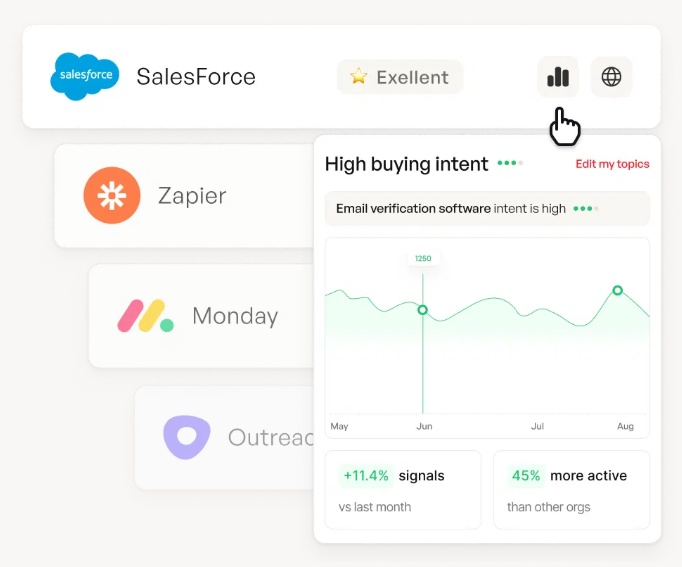
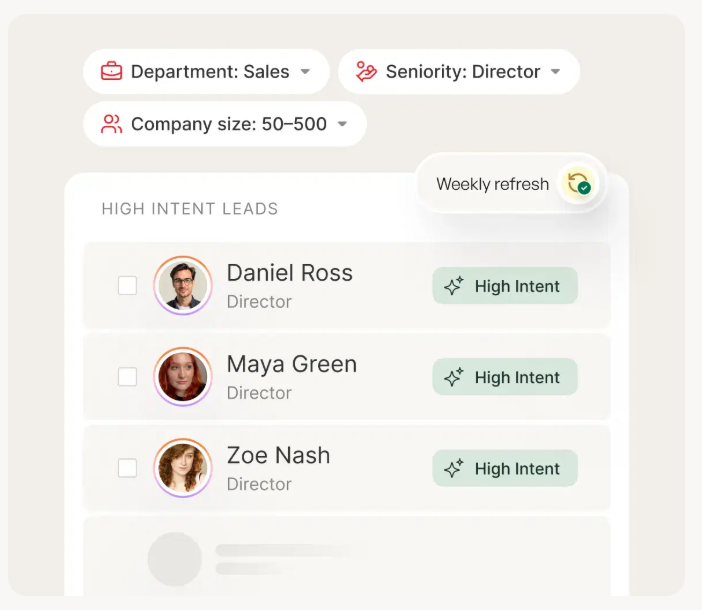
Buyer intent questions work best when you already know where accounts sit on the buying spectrum. Prospeo tracks 15,000 intent topics via Bombora - so your reps walk into every discovery call knowing who's browsing pricing pages, reading competitor comparisons, and looping in decision-makers.
Ask better questions because you already know the answers that matter.
Choosing a Qualification Framework
| Framework | Best For | Focus Areas | Weakness |
|---|---|---|---|
| BANT | Inbound triage | Budget, Authority, Need, Time | Too rigid for complex deals |
| CHAMP | Mid-market | Challenges, Authority, Money, Priority | Less structured than MEDDIC |
| MEDDIC | Enterprise ($50K+) | 6 criteria: Metrics through Champion | Overkill for transactional sales |
| SPIN | Consultative sales | Situation through Need-payoff | Slow; not great for fast cycles |
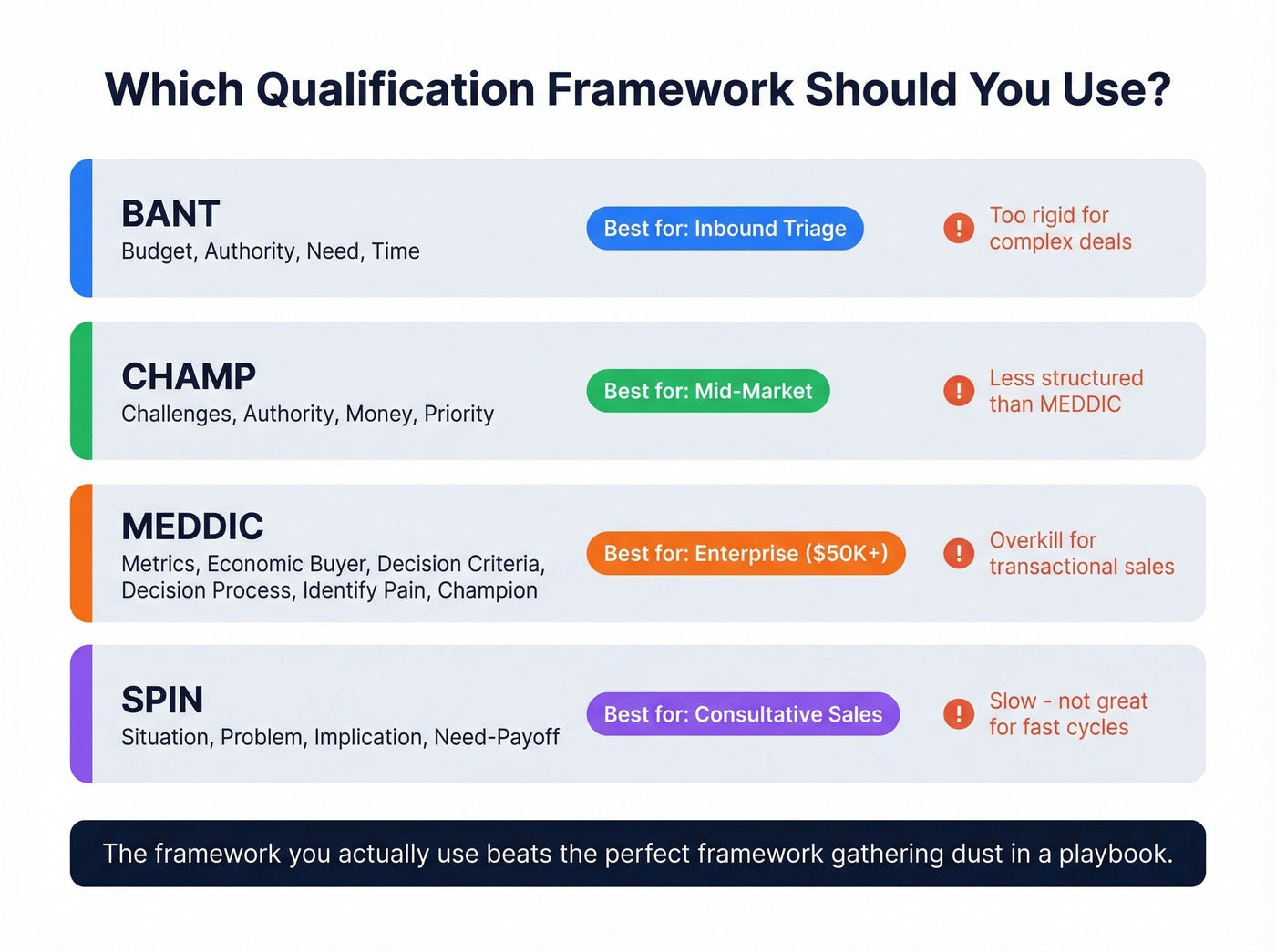
Let's be honest: BANT works fine for qualifying inbound leads quickly. MEDDIC is the gold standard for enterprise deals where six stakeholders need to agree. CHAMP splits the difference for mid-market teams. Don't overthink this - pick one, train your team on it, and iterate. We've watched teams spend months debating frameworks when the real problem was that reps weren't asking any qualifying questions consistently. The framework you actually use beats the perfect framework gathering dust in a sales playbook.
Intent Signals That Shape Your Questions
The best discovery calls don't start cold. They start with data.
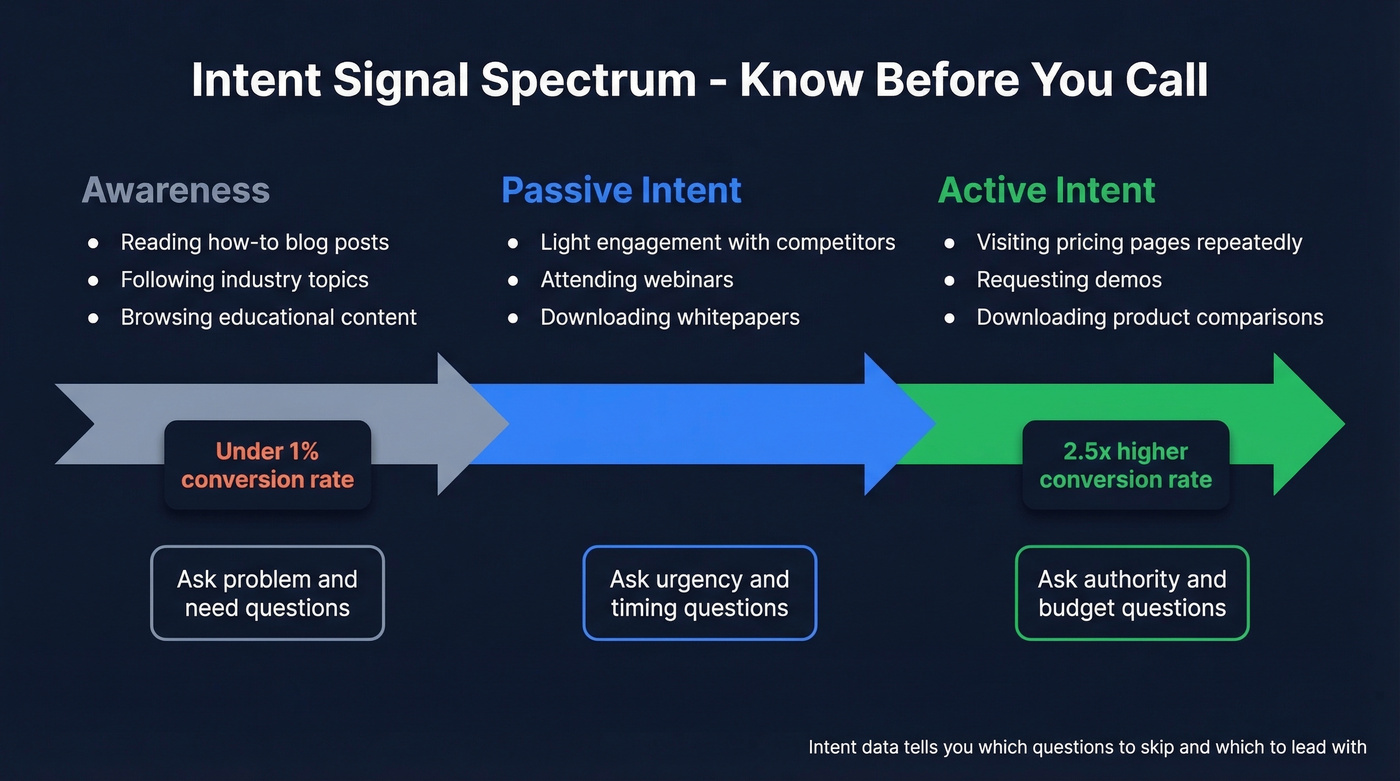
Demandbase's intent taxonomy breaks signals into three stages: awareness (reading how-to content), passive (light engagement with competitors), and active (visiting pricing pages, requesting demos, downloading detailed product comparisons). Top-of-funnel content converts under 1% of visitors, but accounts showing active intent signals convert at dramatically higher rates.
When you know where an account sits on that spectrum, you skip the generic openers and go straight to the questions that matter. IT is reading competitor comparisons, the CFO downloaded a pricing guide, and the CTO reviewed technical documentation - that's a buying committee in motion. Businesses using intent data see a 2.5x increase in conversion rates, not because the data replaces judgment, but because reps stop wasting time on accounts that aren't ready.
Mistakes That Kill Intent Discovery
Talking too much. NetSuite highlights talking over the prospect as one of the most common sales conversation mistakes. If you're dominating the call, you're pitching, not discovering.
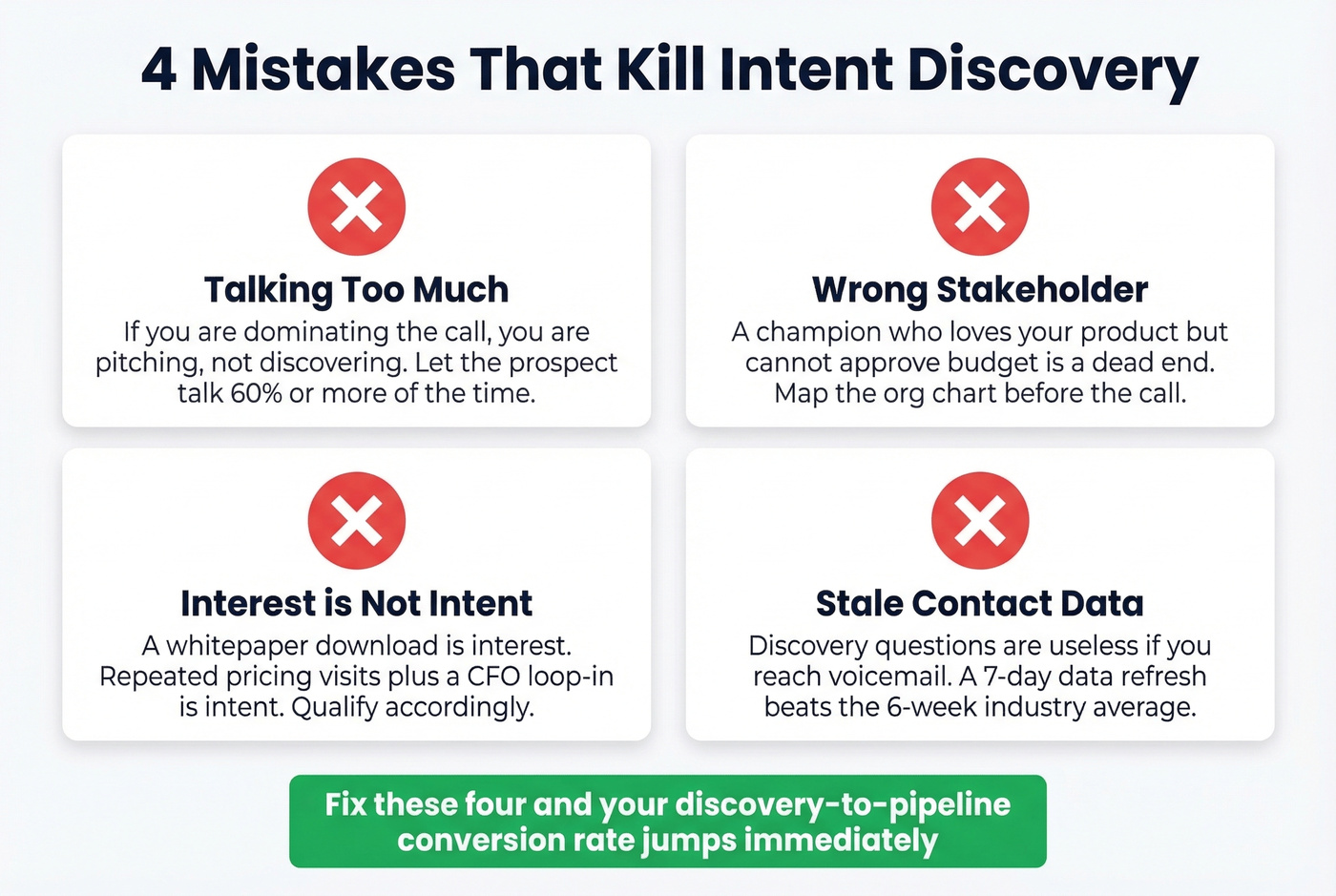
Pitching to the wrong stakeholder. A champion who loves your product but can't approve budget is a dead end. Map the org chart before the call, not after.
Treating interest as intent. Someone who downloaded your whitepaper is interested. Someone who shows repeated pricing page visits, asks about implementation timelines, and loops in their CFO has intent. These are different things - qualify accordingly.
Calling dead numbers. None of your discovery questions matter if you can't reach the prospect. A 7-day data refresh cycle - compared to the 6-week industry average - means you're not calling numbers that went stale weeks ago. That's the difference between a connected conversation and a voicemail graveyard. If you're rebuilding your outbound motion, start with a repeatable cold calling system and tighten your sales prospecting techniques.
Skip the 20-question discovery framework if your average deal size is under $15K. Ask the five questions from the top of this article, trust your gut on the answers, and move fast. Overqualification kills more small deals than underqualification ever will.
You just mapped the org chart, confirmed urgency, and identified the economic buyer. Now you need verified contact data to reach them. Prospeo delivers 98% accurate emails and 125M+ verified mobile numbers with a 30% pickup rate - so your multi-threaded outreach actually connects.
Turn qualified intent into booked meetings at $0.01 per verified email.
FAQ
What's the difference between buyer intent and buying intent?
Buyer intent is interest inferred from online behavior - content consumption, site visits, webinar attendance. Buying intent is near-term readiness to purchase, signaled by actions like requesting demos or asking about contracts. Buying intent is a subset of buyer intent, further down the funnel.
How many discovery questions should I ask per call?
Five to seven well-chosen questions reveal more than a 30-minute interrogation. Pick questions that match the prospect's funnel stage and adapt based on their answers, not your script.
How do I get intent data on my target accounts?
Prospeo tracks 15,000 intent topics via Bombora and pairs that with verified contact data - so you know which accounts are researching your category and can reach the right person immediately. Enterprise platforms like 6sense and Demandbase offer similar signals at $30-100K+/year.
Which buyer intent questions work best for enterprise deals?
Focus on authority and process: "Who owns the final sign-off?" and "What does your evaluation timeline look like?" In enterprise cycles with 6+ stakeholders, mapping the decision committee early prevents deals from stalling at procurement. Pair these with MEDDIC to track champion strength and economic buyer access.