

Buyer Motivation: What Actually Drives People to Buy (And How to Diagnose It)
A SaaS seller on r/sales described losing a massive deal because they got "feature happy" - overcomplicating the pitch with technical details while completely ignoring the emotional buying motives of each stakeholder. Their fix? "Nail the emotional motivation first" before touching a single feature. That gap between knowing buyer motivation matters and actually uncovering it is where most sales teams live. It's where most deals die, too.
What Is Buyer Motivation?
Buyer motivation is the underlying reason a person commits to a purchase. Not the feature they clicked on, not the discount that caught their eye - the deeper force that made them open their wallet. It can be rational (cost savings, compliance), emotional (fear, status, belonging), or some blend of both.
The distinction matters because sellers who pitch features are answering a question nobody asked. Buyers don't buy drills. They buy holes. And often, they don't even buy holes - they buy the feeling of a finished kitchen renovation. Everything below - the science, the diagnostic tools, the measurement methods - is built around that idea.
The Core Motivation Types
You don't need to memorize eleven categories. Seven cover the territory, and the real skill is recognizing which one's driving a specific buyer in a specific moment.
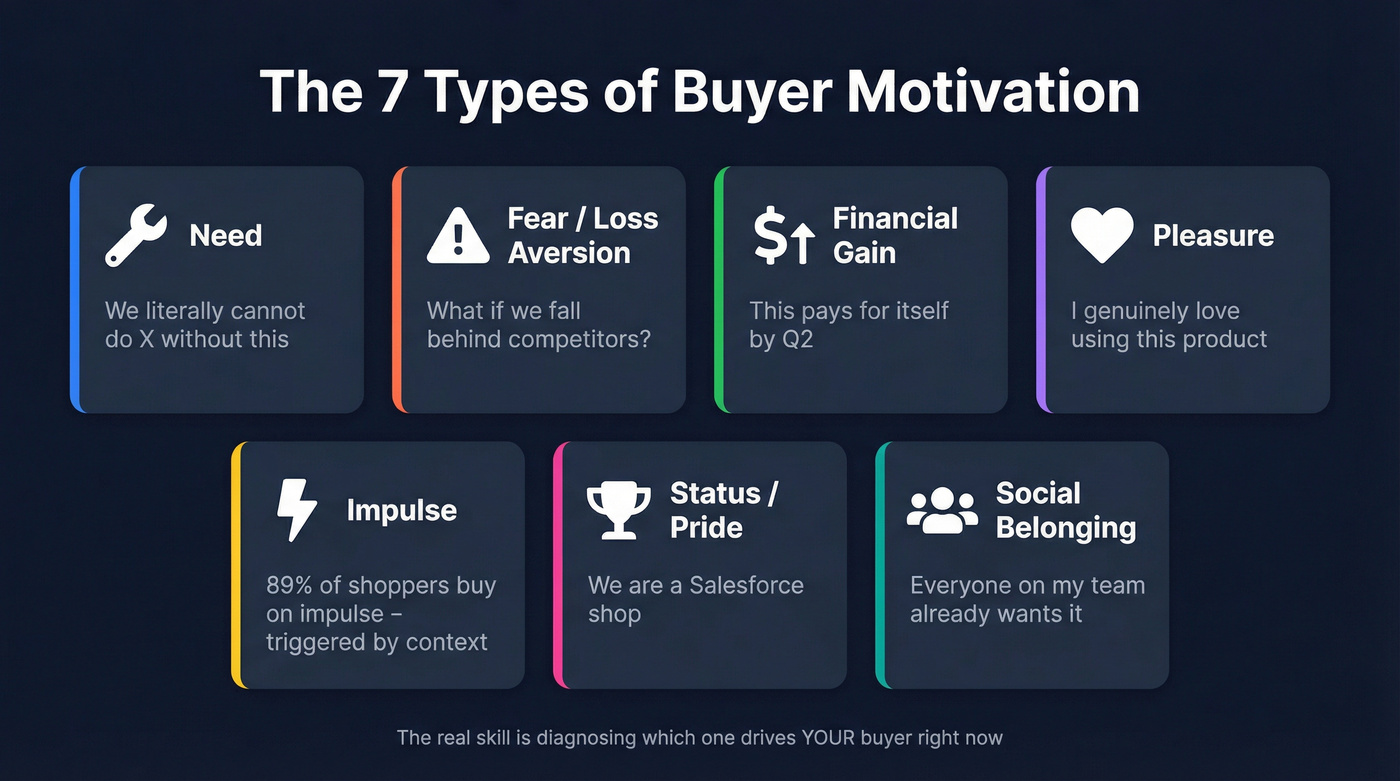
| Type | What It Sounds Like | Example Trigger |
|---|---|---|
| Need | "We literally can't do X" | Broken process, compliance gap |
| Fear / Loss Aversion | "What if we fall behind?" | Competitor move, contract expiry |
| Financial Gain | "This pays for itself in Q2" | ROI case, cost reduction proof |
| Pleasure | "I just love using this" | UX delight, aesthetic appeal |
| Impulse | "Add to cart" | Discount, limited offer, browsing |
| Status / Pride | "We're a Salesforce shop" | Brand prestige, peer perception |
| Social Belonging | "Everyone on my team wants it" | Peer adoption, community buzz |
A note on impulse: 89% of shoppers have some history of impulse buying, spending an average of $282/month on unplanned purchases, and 72% of online shoppers have bought impulsively because of an advertised discount. A meta-analysis of 75 studies covering 139,545 respondents found that situational stimuli are the strongest driver of online impulse buying (effect size 0.477), followed by marketing stimuli (0.433). Impulse isn't random. It's triggered by context, and pricing, discounts, and scarcity cues are reliable triggers.
The Psychology Behind It
Prospect Theory and Loss Aversion
Kahneman and Tversky's prospect theory (1979) remains the most reliable explanation for why buyers don't behave rationally. People evaluate outcomes relative to a reference point, not in absolute terms. Losing $100 feels roughly twice as bad as gaining $100 feels good. That asymmetry drives everything from free trial conversions to contract renewals.
A 2020 replication study across 19 countries, published in Nature Human Behaviour with 4,098 respondents, achieved roughly 90% replication of prospect theory's key contrasts. People overweight small probabilities, shift between risk-seeking and risk-averse depending on framing, and consistently anchor to reference points. For sellers, this means how you frame the status quo matters more than how you pitch the upside. "You're losing $14,000/month to bad data" hits harder than "You could save $14,000/month."
Self-Determination Theory
Self-Determination Theory identifies three core psychological needs driving motivation: autonomy (choosing freely), competence (feeling effective), and relatedness (belonging and connection). Thousands of published studies back this framework, and the APA's summary is a solid starting point.
The brand applications are intuitive. IKEA supports autonomy through planning tools and personalization - you built it, you own it. Dyson supports competence by making complex engineering feel accessible. Amazon supports relatedness through frictionless returns and 24/7 support.
But here's the caution: Too much choice causes overload, leading to dissatisfaction and inaction. Three well-framed options beat fifteen every time.

Loss aversion is the strongest buying trigger - but only if your message reaches the right person. Prospeo gives you 98% verified emails and 125M+ direct dials so your carefully framed pitch actually lands with decision-makers, not dead inboxes.
Stop diagnosing motivation for contacts that bounce.
How to Diagnose What Motivates Buyers
Lists of motivation types are the easy part. The real skill is diagnosis - figuring out which forces are actually at work in a specific deal.
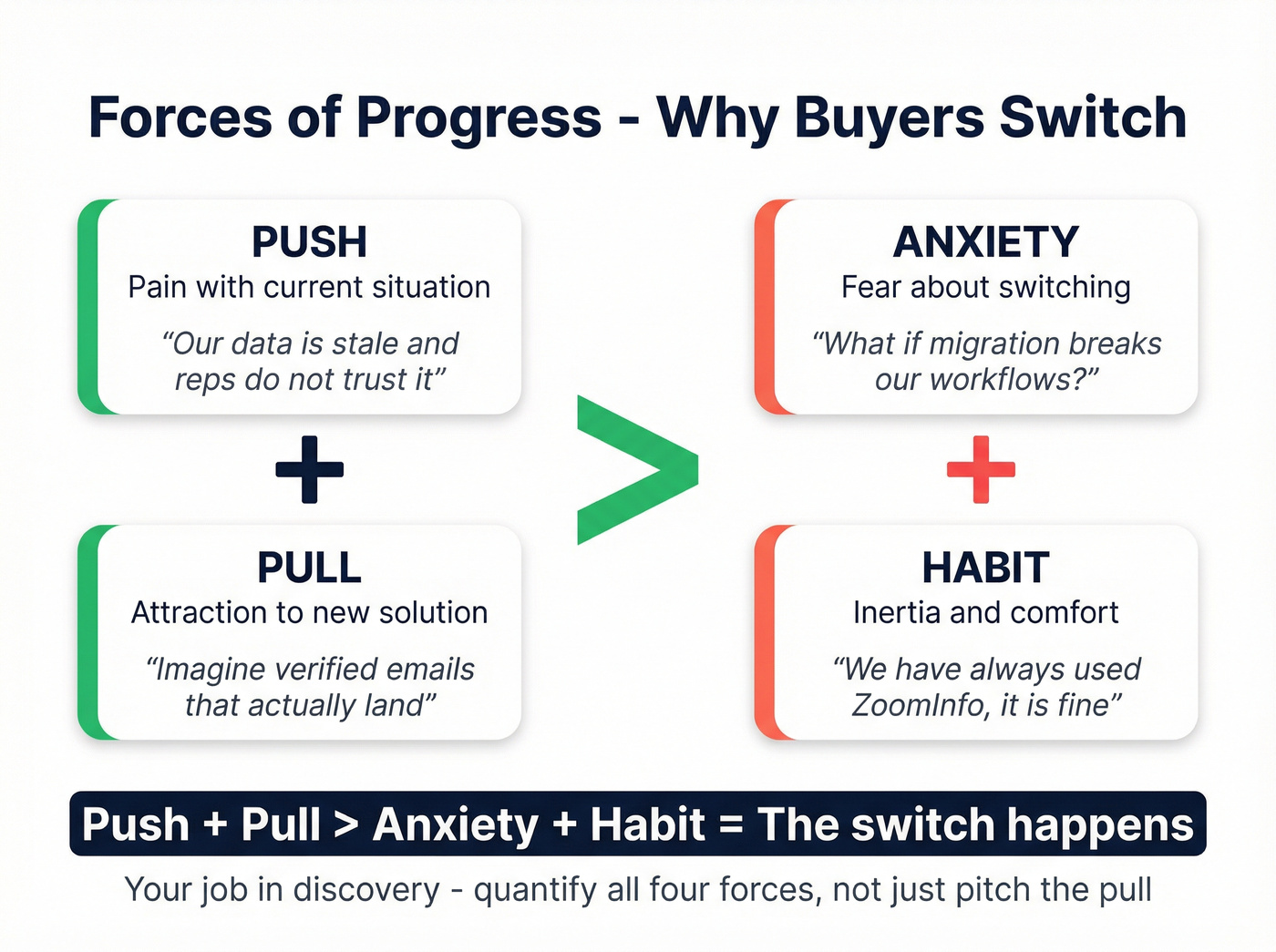
The best framework we've found for this is the Forces of Progress model from Bob Moesta and Clayton Christensen's Jobs-to-Be-Done tradition. I'm specifically referencing the "Jobs as Progress" school here, which is far more useful for motivation work than Tony Ulwick's "Jobs as Activities" approach.
Think of Christensen's famous milkshake example: McDonald's couldn't sell more milkshakes until they stopped asking "how do we improve the milkshake?" and started asking "what job is the milkshake being hired to do?" The answer - a boring commute companion - had nothing to do with flavor or thickness. Motivation diagnosis works the same way.
The formula: Push + Pull > Anxiety + Habit = switch happens.
- Push: pain with the current situation ("Our data is stale and reps don't trust it")
- Pull: attraction to the new solution ("Imagine verified emails that actually land")
- Anxiety: fear about switching ("What if migration breaks our workflows?")
- Habit: inertia ("We've always used ZoomInfo, it's fine")
A deal moves when push and pull together outweigh anxiety and habit together. Your job in discovery is to quantify all four forces, not just pitch the pull.
Use the Job Story template to structure what you learn: "When [situation], I want to [motivation], so I can [outcome]." Then map discovery questions to specific motivation types:
- Fear/loss aversion: "What happens if you don't solve this by Q3?"
- Financial gain: "What's this costing you per month right now?"
- Status: "How does your leadership team evaluate vendor choices?"
- Autonomy: "What does your ideal buying process look like - do you want a demo or prefer to self-serve?"
Buyer Motivation in B2B
Here's the thing most people get wrong: they treat emotional motivation as a B2C phenomenon. The data says the opposite.
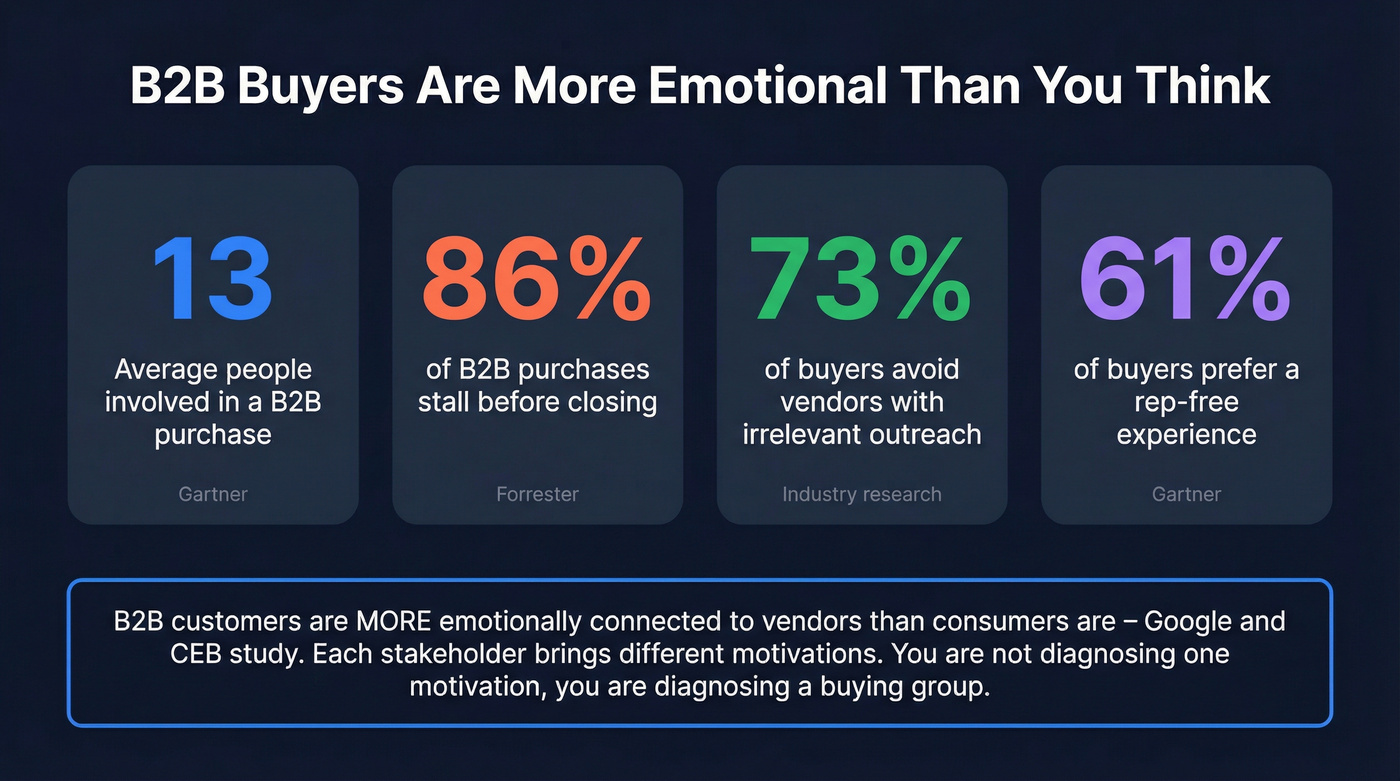
A Google and CEB Marketing Leadership Council study found that B2B customers are more emotionally connected to their vendors than consumers are. B2B purchases carry career risk, long contract commitments, and organizational consequences that make the emotional stakes enormous. The CFO who signs off on a $200K platform deal isn't just evaluating ROI - they're thinking about what happens to their reputation if the implementation tanks.
The buying environment amplifies this. Gartner research shows around 13 people are involved in a typical B2B purchase, 61% of buyers prefer a rep-free experience, and 86% of purchases stall according to Forrester. Meanwhile, 73% of buyers actively avoid vendors with irrelevant outreach. Each stakeholder brings different motivations: the CFO cares about cost justification, the end user cares about ease, and the VP cares about career risk. You're not diagnosing one motivation - you're diagnosing a buying group. And if you don't understand what drives each of them, you're the irrelevant outreach they're avoiding.
This is also where B2B buyer anxiety shows up most. Stakeholders worry about implementation risk, political fallout, and being the person who "picked the wrong vendor," even when the ROI math is solid.
Skip the stakeholder mapping if your deal size is under $15k. You probably don't need to chart all fifteen people. But you absolutely need to nail the top two - the champion and the budget holder. Get their motivations right and the deal moves. Get them wrong and no amount of follow-up emails will save you.
Once you understand what motivates each stakeholder, you need to reach them with the right message at the right moment. This is where intent data becomes critical. Prospeo tracks 15,000 topics via Bombora, so you can identify buyers actively researching solutions and pair that signal with 30+ search filters - firmographic, job changes, headcount growth - to reach current decision-makers, not stale contacts from six weeks ago.
How to Measure Motivation
Let's be honest: Likert scales are useless for motivation research. Everyone rates everything "very important," and you end up with a flat dataset that tells you nothing about priorities. The consensus on r/SampleSize and r/AskSocialScience echoes this - post-purchase surveys return "everything was important" while the actual buying decision hinged on one or two factors.
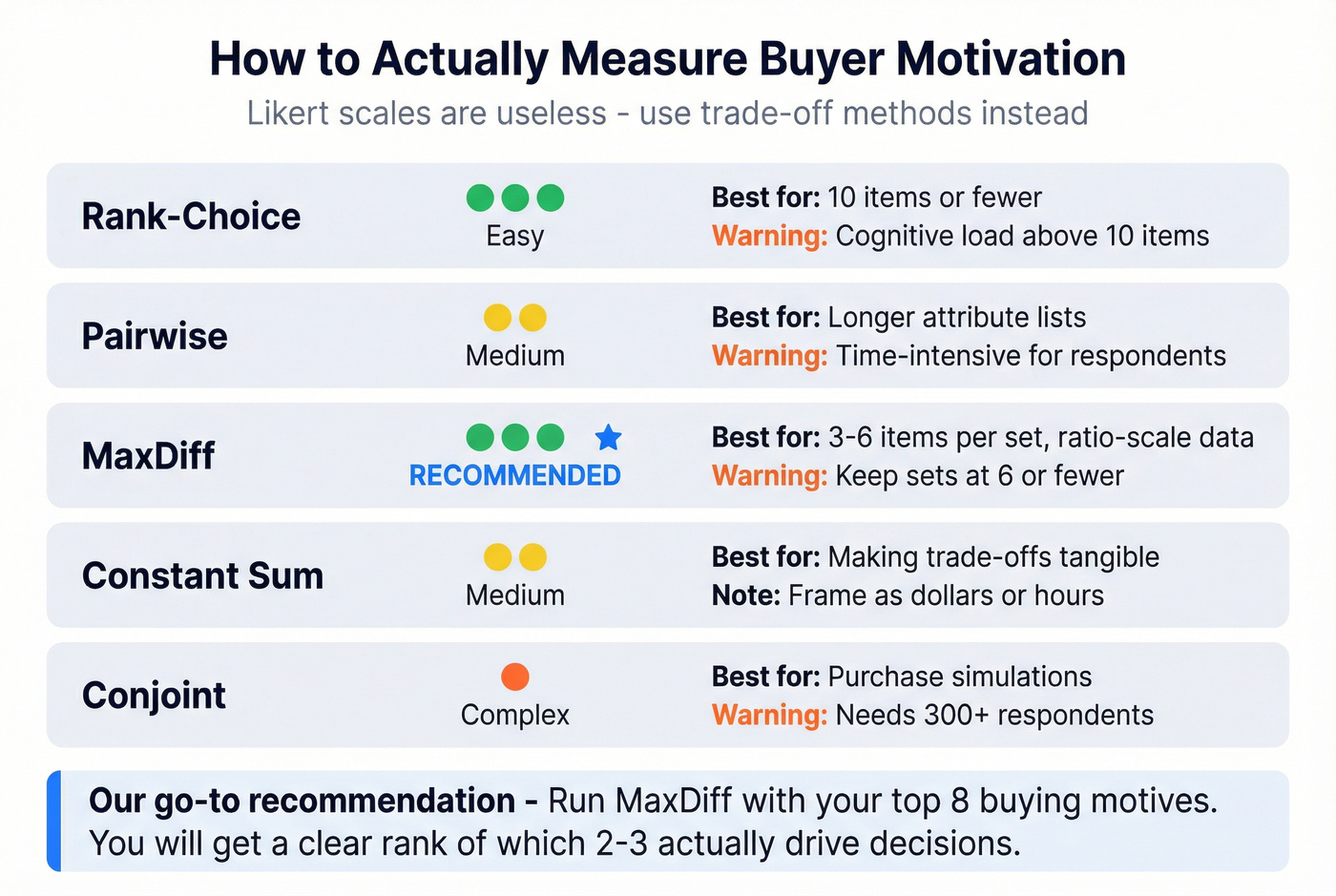
Trade-off methods force real choices. Here's what works:
| Method | Best For | Watch Out For |
|---|---|---|
| Rank-choice | 10 items or fewer, quick surveys | Cognitive load above 10 |
| Pairwise | Longer attribute lists | Time-intensive for respondents |
| MaxDiff | 3-6 items per set | Keep sets at 6 or fewer or quality drops |
| Constant sum | Making trade-offs tangible | Frame as dollars or hours |
| Conjoint | Purchase simulations | Needs 300+ respondents |
MaxDiff is our go-to recommendation for prioritization research. It's simple for respondents, produces ratio-scale data, and scales to longer attribute lists by splitting them into small sets. Run a MaxDiff study with your top 8 buying motives and you'll get a clear rank order showing which 2-3 actually drive decisions - not the flat "everything matters" result a Likert scale would give you.
Conjoint is powerful for simulating purchase decisions, but watch for interaction effects between attributes and the tendency for respondents to treat price as a quality proxy rather than a cost. Both methods rank importance. They won't explain why, so pair them with qualitative discovery interviews.
Ethics: Persuasion vs. Manipulation
Understanding what drives buyers comes with responsibility:
- Use scarcity only when it's real - actual stock limits, actual deadlines
- Never fabricate countdown timers or fake "only 3 left" alerts
- Avoid health or financial guarantees you can't substantiate
- Transparency builds long-term trust; short-term manipulation destroys it
- Respect autonomy: give buyers real choices, not manufactured urgency
If your persuasion tactics undermine a buyer's sense of autonomy, you're not motivating - you're manipulating. And manipulated buyers don't renew. (If you want a deeper framework, see ethics in sales.)
FAQ
What are the main types of buyer motivation? Seven types cover nearly every purchase decision: need, fear/loss aversion, financial gain, pleasure, impulse, status/pride, and social belonging. Most real purchases involve two or three of these working together - rarely does a single motive drive a decision alone.
How is buyer motivation different in B2B vs. B2C? B2B buyers are actually more emotionally driven than consumers because purchases carry career risk and organizational consequences. The key difference is that B2B involves multiple stakeholders - often 13+ people - each with their own motivation, so you're diagnosing a group, not an individual.
How do you uncover what motivates a specific buyer? Use the Forces of Progress framework: map the push (current pain), pull (new solution appeal), anxiety (switching fear), and habit (inertia) for each stakeholder. Discovery questions like "What happens if you don't solve this by Q3?" surface real motivations faster than feature demos ever will.
What's the best survey method for measuring buyer motivation? MaxDiff. It forces trade-offs between options, produces ratio-scale data, and avoids the "everything is important" problem that plagues Likert scales. For purchase simulations, conjoint analysis works well but needs 300+ respondents to produce reliable results.
You mapped the push, pull, anxiety, and habit. Now you need to reach all 13 stakeholders in the deal. Prospeo's 30+ filters - including buyer intent data across 15,000 topics - let you find every person in the buying committee and hit their specific motivation.
Reach the full buying committee with data refreshed every 7 days.