

Buyer Persona vs Target Audience: The Difference That Changes Your Marketing
You're staring at a strategy doc with "target audience" and "buyer persona" sections that look suspiciously similar. A thread on r/DigitalMarketing nails the confusion: "Isn't the buyer persona just a fictional grouping of the target audience?" The buyer persona vs target audience distinction is genuinely simple to define. Where teams actually fail is turning these concepts into something operational - and that's where the real damage happens.
The Quick Version
- Target audience = the broad group you market to, defined by demographics, firmographics, and behavioral patterns.
- Buyer persona = a research-based profile of one person within that group, covering goals, challenges, and decision criteria.
- ICP (Ideal Customer Profile) = the company-level filter that helps you focus on the right accounts before you zoom in on people.
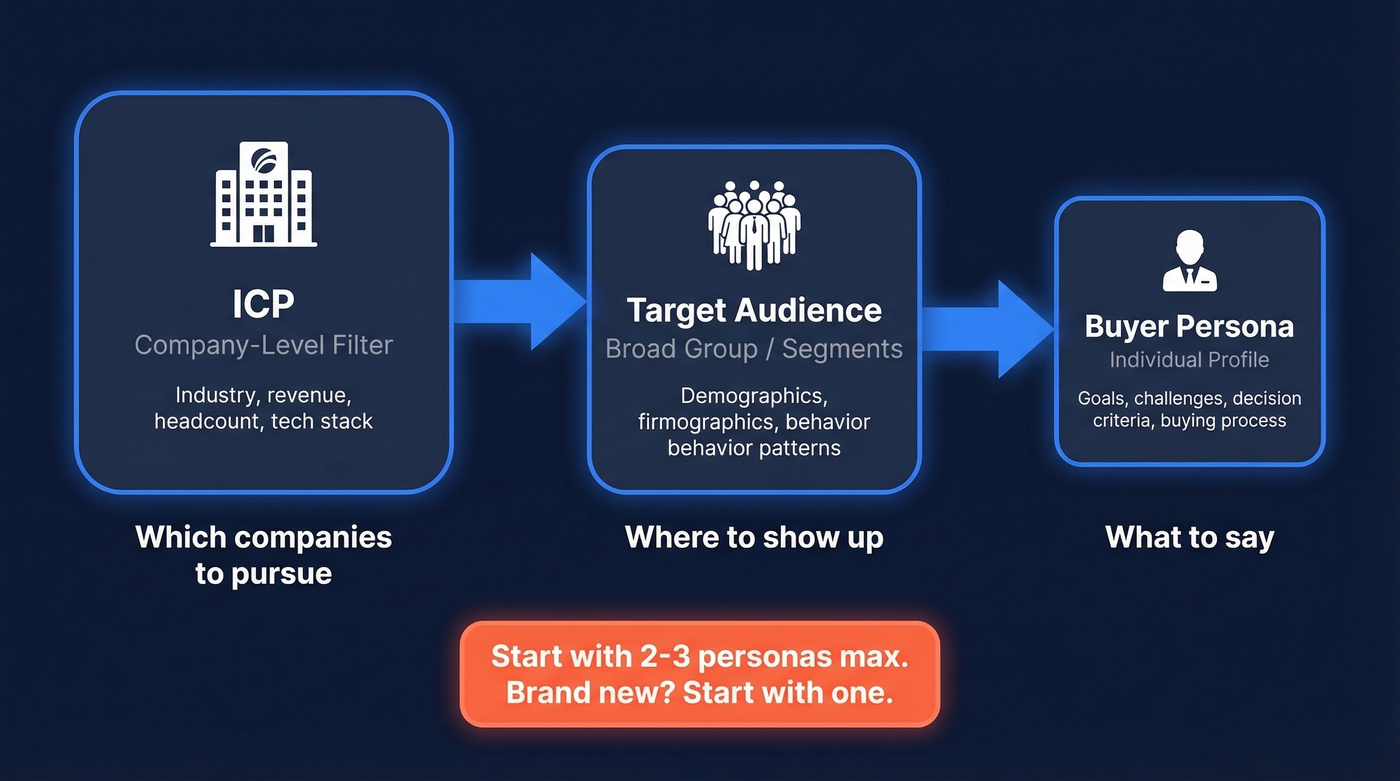
A practical flow is ICP -> target audience/segments -> personas. Start with 2-3 personas max. Brand new to this? Start with one.
Definitions: Persona, Audience, and ICP
What Is a Target Audience?
A target audience is the broadest layer - the group of people or companies your marketing is aimed at. In B2B, that might look like "SaaS companies with 50-200 employees in North America that spend on marketing automation." It tells you what your audience does and where they cluster. Segments explain patterns, not motivations.
What Is a Buyer Persona?
A buyer persona is a research-based profile of an individual within your target audience. It goes beyond demographics into goals, challenges, decision criteria, buying process, and communication preferences.
Where a target audience tells you what, a persona explains why - why someone cares about your product, why they'd choose you over a competitor, why they stall mid-funnel. Good personas also include a negative persona: the profile of someone you don't want, like the price-shopper who'll churn in 60 days.
Here's what a useful B2B persona actually looks like:
"Ops-Oriented Olivia" - VP of Operations at a 150-person SaaS company. Evaluates tools based on integration depth and time-to-value. Reports to a CFO who cares about cost-per-seat. Frustrated by tools that require IT involvement to configure. Discovers new software through peer communities and G2 reviews, not cold emails.
That level of specificity separates a real persona from a demographic summary with a stock photo attached.
Where Does ICP Fit?
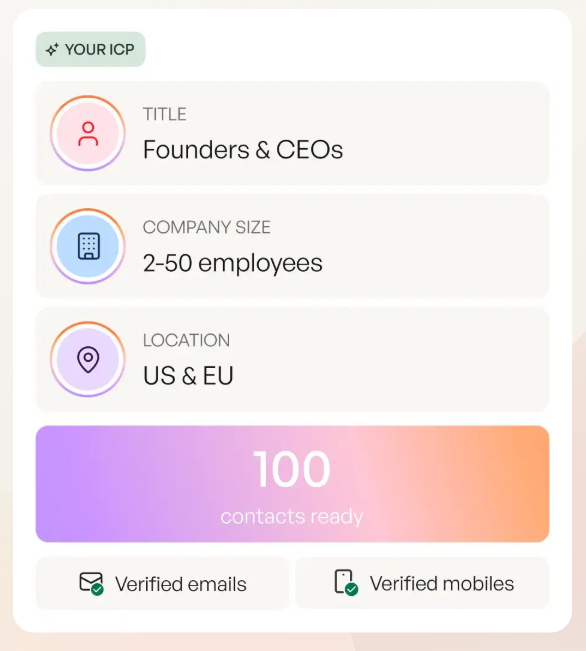
ICP (Ideal Customer Profile) is a company-level framework covering firmographics like industry, revenue, headcount, and tech stack. It sets the segment boundaries you care about, and then personas zoom in on the individuals inside those companies. ICP defines which companies to pursue; personas define which people to reach and how to talk to them.
Side-by-Side Comparison
| Dimension | Target Audience | Buyer Persona | ICP |
|---|---|---|---|
| Scope | Broad group | Individual profile | Company-level |
| Detail | General | Deep | High-level |
| Data Points | Demographics, needs | Goals, triggers, process | Revenue, industry, size |
| Best For | Channel strategy | Messaging & content | Account selection |
| Wins for | Knowing where to advertise | Sales scripts + content | Account prioritization |
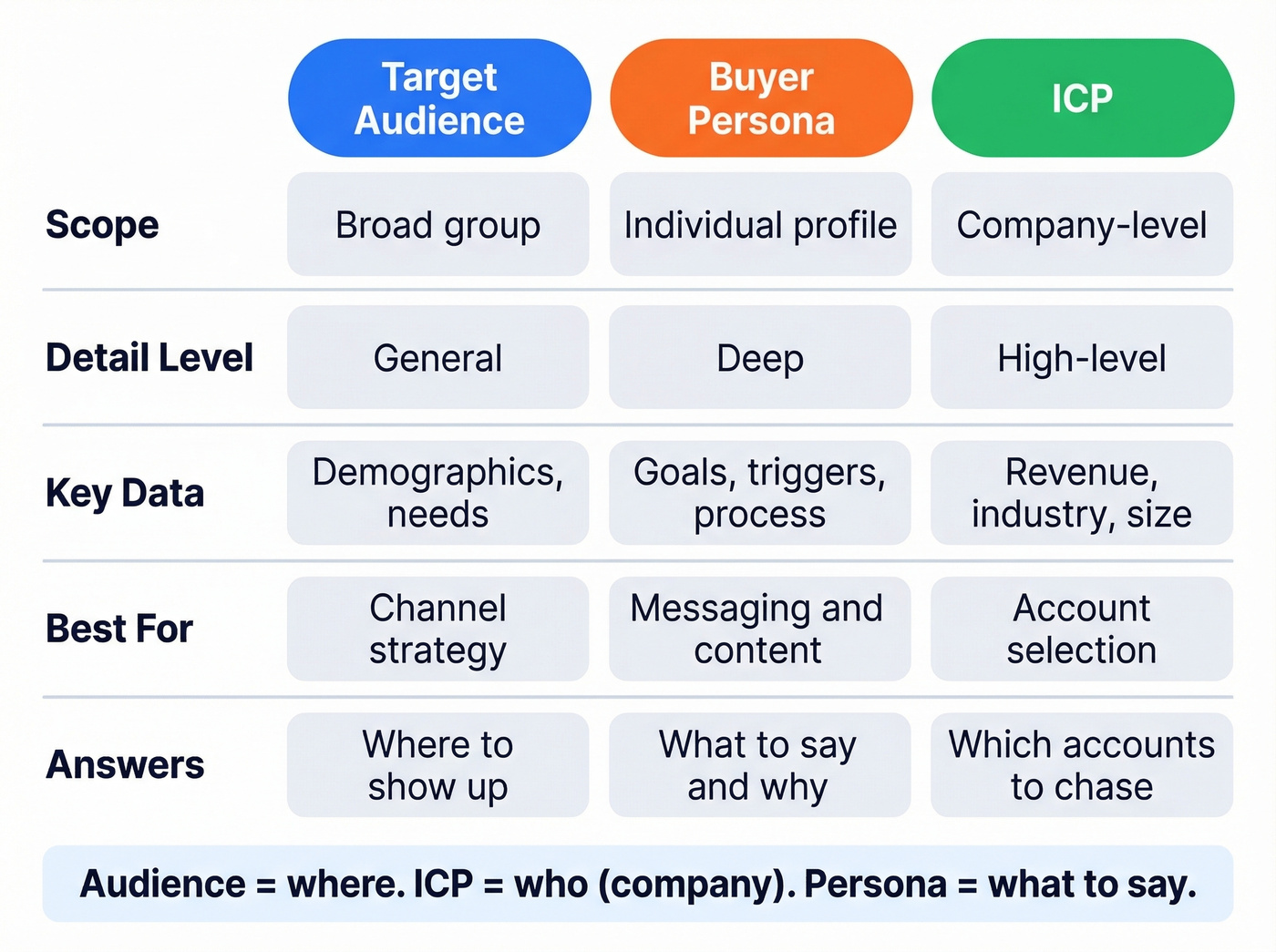
The target audience tells you where to show up. The ICP tells you which accounts to prioritize. The persona tells you what to say when you get there.

Personas only drive revenue when you can actually reach the people they describe. Prospeo's 30+ search filters - including job title, department headcount, buyer intent, and technographics - let you turn persona criteria into targeted prospect lists with 98% verified emails.
Stop letting personas collect dust in slide decks.
Why the Distinction Matters
71% of companies that exceed revenue targets have documented buyer personas. Those companies report 24% more leads and 36% shorter sales cycles. Persona-driven emails see open rates 2x higher and click-through rates 5x higher than generic sends. MarketingSherpa data, cited in Salesgenie's persona stats roundup, shows persona-based websites saw a 100% increase in pages visited.
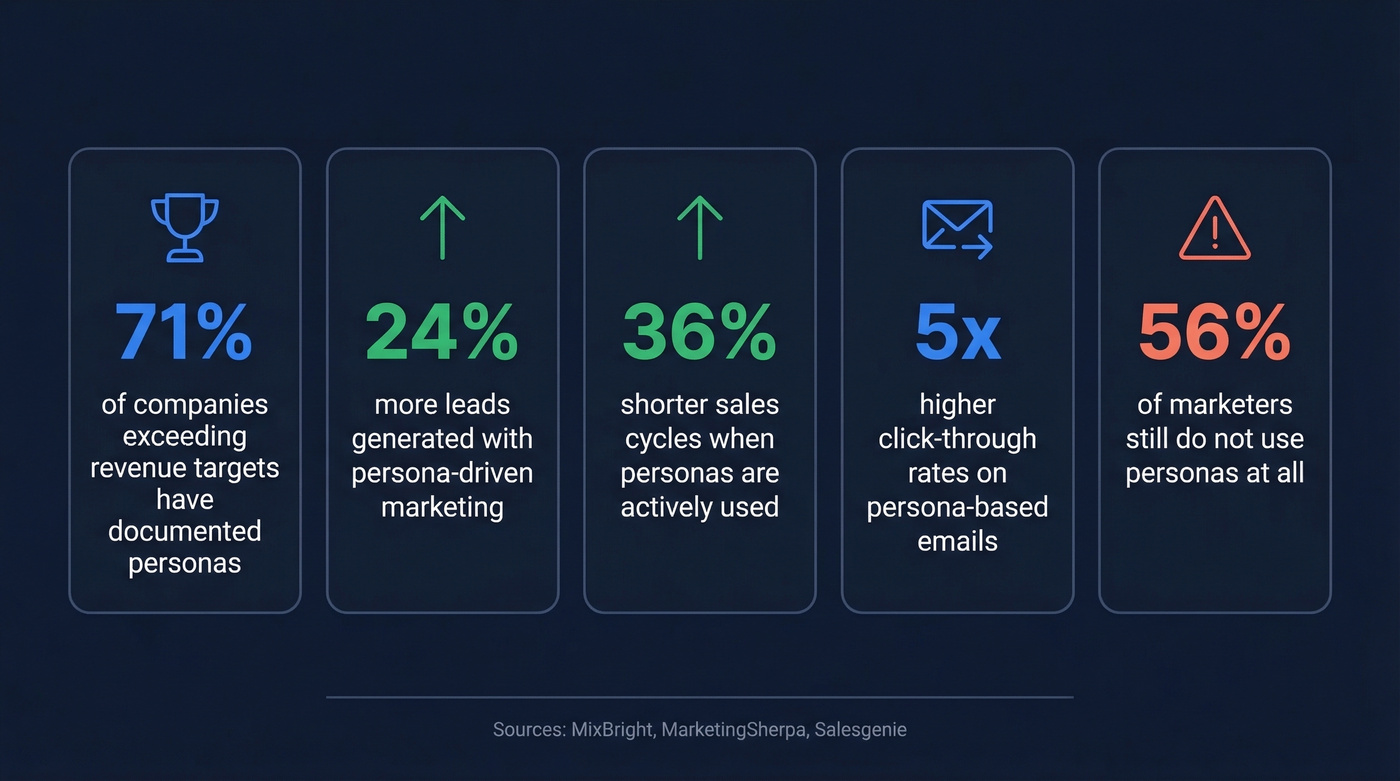
Yet only 44% of marketers actually use personas. That means more than half are defining the right audience but writing generic copy that doesn't speak to any specific person's priorities. The audience is right. The message is wrong.
Here's my hot take: most teams don't have a persona problem - they have an operationalization problem. They build the persona, put it in a slide deck, and never connect it to a single campaign, sales script, or prospecting filter. A persona you don't use is worse than no persona at all, because it gives you the illusion of customer understanding.
Persona Mistakes That Waste Time
1. Fairytale personas. Built in a workshop by marketers who've never talked to a customer. Real personas come from interviews, CRM data, and win/loss analysis - not brainstorming sessions with sticky notes.
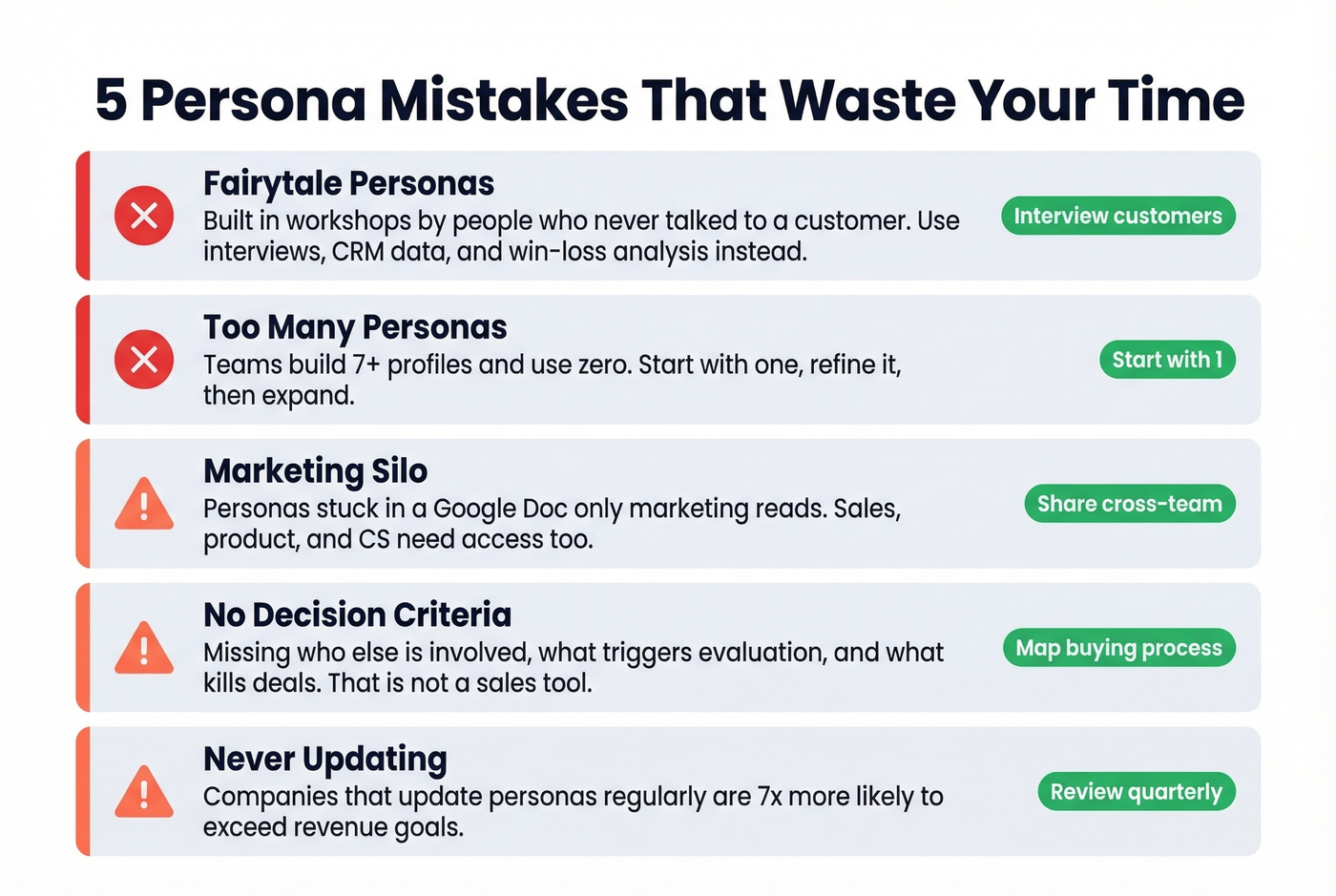
2. Too many personas. We've seen teams build 7+ targeting profiles in a single offsite and use exactly zero of them. Start with one, refine it, then expand.
3. Marketing silo. A persona that lives in a Google Doc only marketing reads is a wasted asset. Sales, product, and CS all need access and input - otherwise you're building a character sheet for a game nobody else is playing. If you're trying to make this cross-functional, marketing enablement is the missing layer most teams skip.
4. No decision criteria. A B2B persona without buying process details - who else is involved, what triggers evaluation, what kills deals - is a character sketch, not a sales tool. This is also where MEDDIC sales qualification can help you pressure-test what “real” criteria look like.
5. Never updating. B2B personas should be revisited after major market shifts or when win/loss patterns change. Companies that update personas regularly are 7x more likely to exceed revenue goals. One guardrail worth noting: 32% of consumers find personalized messages invasive. Sharpen your relevance without crossing the creepy line.
B2B vs B2C Persona Building
B2B personas represent company interests, not just individual preferences. The user, the champion, and the economic buyer are often three different people - and you need a persona for each role in the buying committee. Clayton Christensen's milkshake framework applies here: customers "hire" products to solve a specific job, and the real motivation is rarely what demographics suggest.
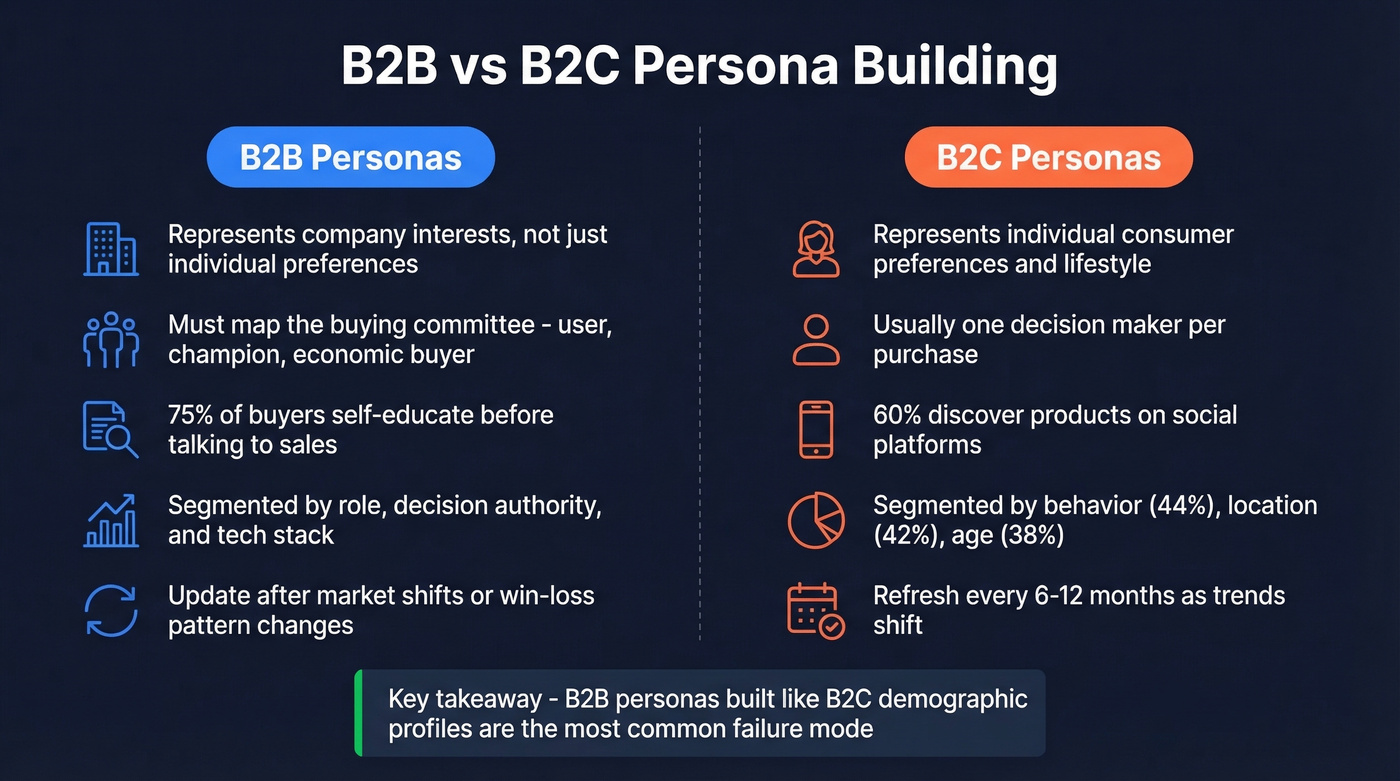
Here's the stat that makes this concrete: 75% of B2B buyers prefer to gather information on their own before talking to sales, and buyers discover new software on social platforms roughly 60% of the time versus marketing emails at 41%. If your persona doesn't account for how someone self-educates before ever entering your funnel, you're mapping the wrong journey.
In our experience, the B2B teams that get personas right always start with buying committee mapping before writing a single persona document. Segmentation research shows B2C's most common segmentation methods are behavior at 44%, location at 42%, and age at 38% - all individual-level signals that matter far less in B2B. Let's be honest: B2B personas built like B2C demographic profiles are the single most common failure mode we see, and the consensus on r/b2bmarketing backs that up.
From Persona to Prospecting
Every persona guide ends the same way: "Congratulations, you have a persona!" And then nothing happens.
The step everyone skips is turning that persona into a list of real people who match it. Your persona attributes - job title, industry, company size, tech stack, intent signals - map directly to prospecting filters. Once you've aligned your personas and audience segments, a platform like Prospeo lets you plug those criteria into 30+ search filters (including buyer intent across 15,000 topics, technographics and job change signals) and export a verified prospect list. The free tier gives you 75 emails a month to test the workflow before committing budget.
If you want more ways to turn “persona” into pipeline, start with these sales prospecting techniques and then build a repeatable lead generation workflow.
Skip this step if your personas are still hypothetical. Validate them with real customer interviews first, then use the filters. Feeding guesswork into a database just gives you a very precise list of the wrong people.

Your ICP defines the company. Your persona defines the person. Prospeo connects both - filter 300M+ profiles by firmographics and role, then get verified emails and direct dials for every member of the buying committee. At $0.01 per email, persona-driven outreach finally scales.
Reach the user, the champion, and the economic buyer in one search.
FAQ
What's the difference between a buyer persona and a target audience?
A target audience is the broad group your marketing addresses, defined by demographics and behavioral data. A buyer persona is a detailed, research-based profile of one individual within that audience - covering goals, pain points, decision process, and communication preferences. The audience tells you who to reach; the persona tells you what to say.
How many buyer personas should I create?
Start with 2-3. If you're new to persona work, begin with one and refine it before expanding. Companies that try to build 7+ personas in a single workshop end up using none of them. Depth beats breadth every time.
How often should I update my personas?
Refresh B2C personas every 6-12 months. B2B personas should be updated after major market shifts, product changes, or when win/loss patterns shift noticeably. Companies that update personas regularly are 7x more likely to exceed revenue goals.
What should a B2B buyer persona include?
At minimum: job title, goals, key challenges, buying committee role, decision criteria, preferred information sources, and deal-killers. If your persona doesn't answer "what would make this person say no?" it's incomplete.
How do I turn a persona into an actual prospect list?
Map your persona's attributes - title, industry, company size, tech stack - to filters in a B2B data platform. Layer in intent signals to find people who are actively researching solutions right now, then export verified contacts. The free plan on most platforms is enough to validate the workflow before scaling.