

Buying Databases for Marketing: 2026 Honest Guide
You just approved budget for a marketing database and you're staring at vendor websites that won't show pricing. A marketer on r/b2bmarketing shared his experience spending $15,000 on lead databases last year and getting "mediocre results" - generic emails, outdated contacts, and the same leads every competitor was already hitting. That's the norm when you buy blind.
Three things burn buyers: opaque pricing, data that tanks your domain reputation, and annual contracts you can't escape. If you're short on time, here's the short version - you need verified data, transparent pricing, and no annual lock-in. Test before you commit.
What You're Actually Buying
"Marketing database" means three different things depending on who's shopping.
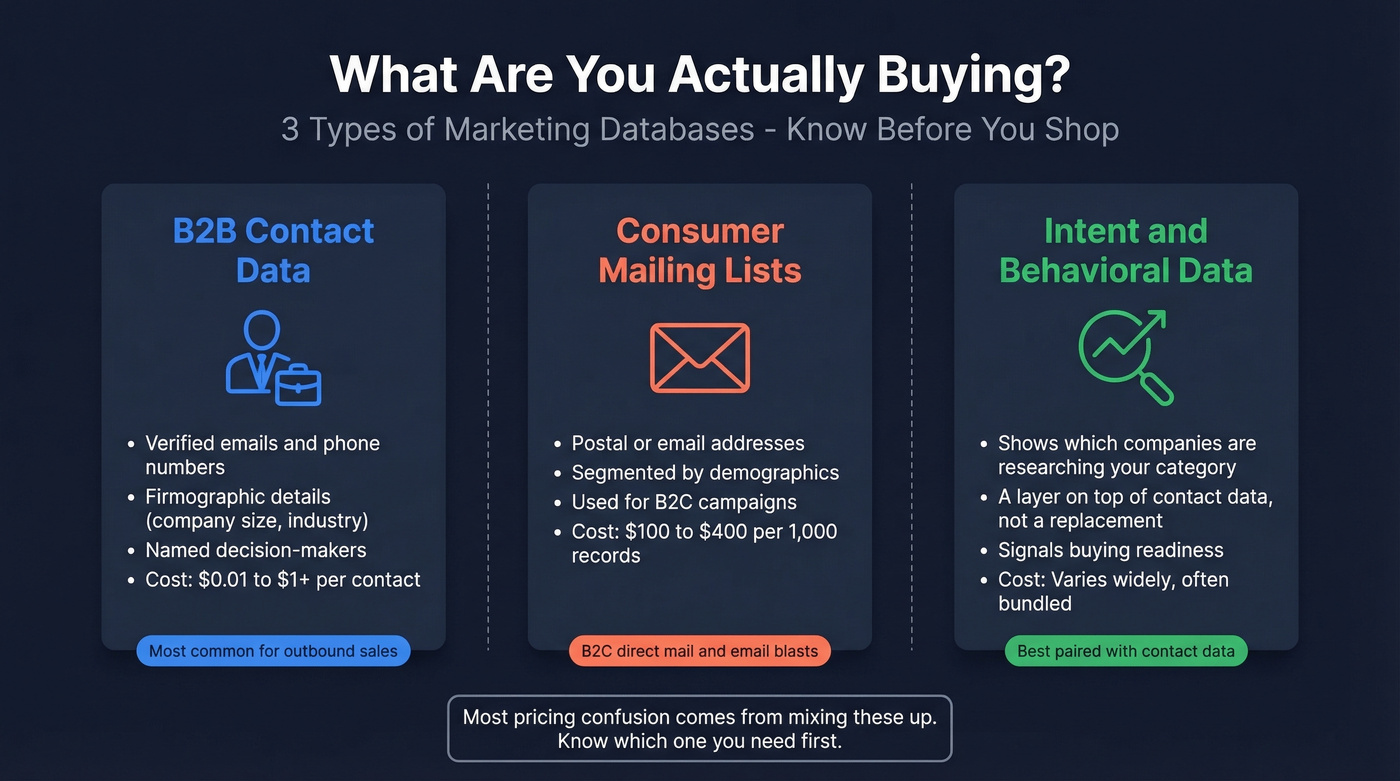
B2B contact data is verified emails, phone numbers, and firmographic details for named decision-makers - what most readers here want. Consumer mailing lists are postal or email addresses for B2C campaigns segmented by demographics. Intent and behavioral data shows which companies are actively researching your product category, a layer on top of contact data rather than a replacement for it.
Most pricing confusion comes from conflating these categories. A consumer email list at $100-$400 per thousand records is a completely different product than a B2B database charging $1+ per verified contact. Knowing which of these three you actually need is the first step toward not wasting money.
What Marketing Databases Cost in 2026
Every guide tells you to buy a database like it's ordering from Amazon. It's not. B2B lists run $300 to $1,000+ per thousand contacts, and the range is enormous depending on verification quality, phone number inclusion, and contract structure. Traditional brokers like LeadsPlease charge $0.60/record for small orders of 500, dropping to roughly $0.25/record at 50,000 - but their email accuracy guarantee tops out at 80%.
| Provider | Starting Price | Cost/Contact | Contract | Accuracy |
|---|---|---|---|---|
| Prospeo | Free (75/mo) | ~$0.01/email | None | 98% |
| Apollo | Free / $49/mo per user | Varies (credits) | Monthly | Not stated |
| UpLead | $99/mo | ~$0.50-$0.58 per credit | Monthly | 95% |
| Lusha | Free (40/mo) | Credit-based (1 credit email, 5 credits phone) | Annual billing on paid plans | Not stated |
| BookYourData | $99 (250 credits) | $0.10-$0.40 | Pay-as-you-go | 97% |
| Salesgenie | $99/mo | Varies | Monthly | Not stated |
| ZoomInfo | ~$15,000/yr | ~$1+ | Annual only | Not stated |
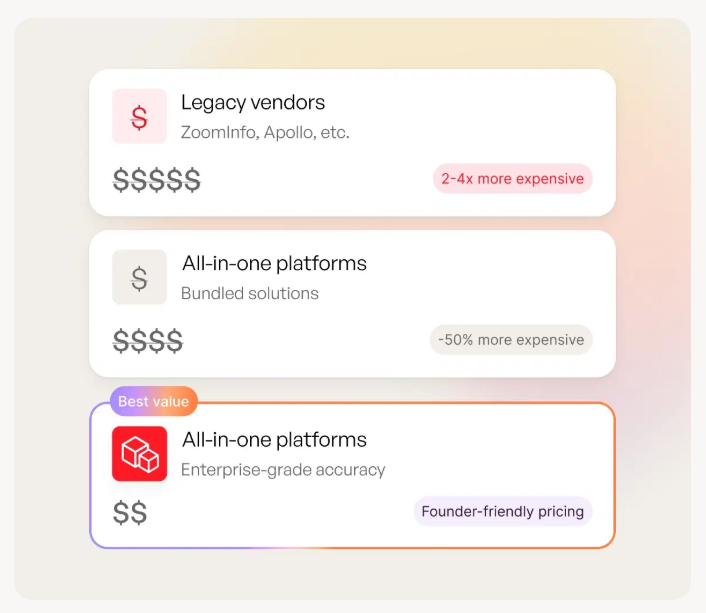
The spread is staggering. ZoomInfo makes zero sense unless you have a multi-rep outbound team running campaigns daily. For everyone else, it's overkill.
Here's the thing: most teams buying a marketing database don't need a $15k platform. They need 500-2,000 verified contacts per month with accurate emails. That's a $50-$200/month problem, not a five-figure one.
Hidden Costs Nobody Mentions
The sticker price is just the start.
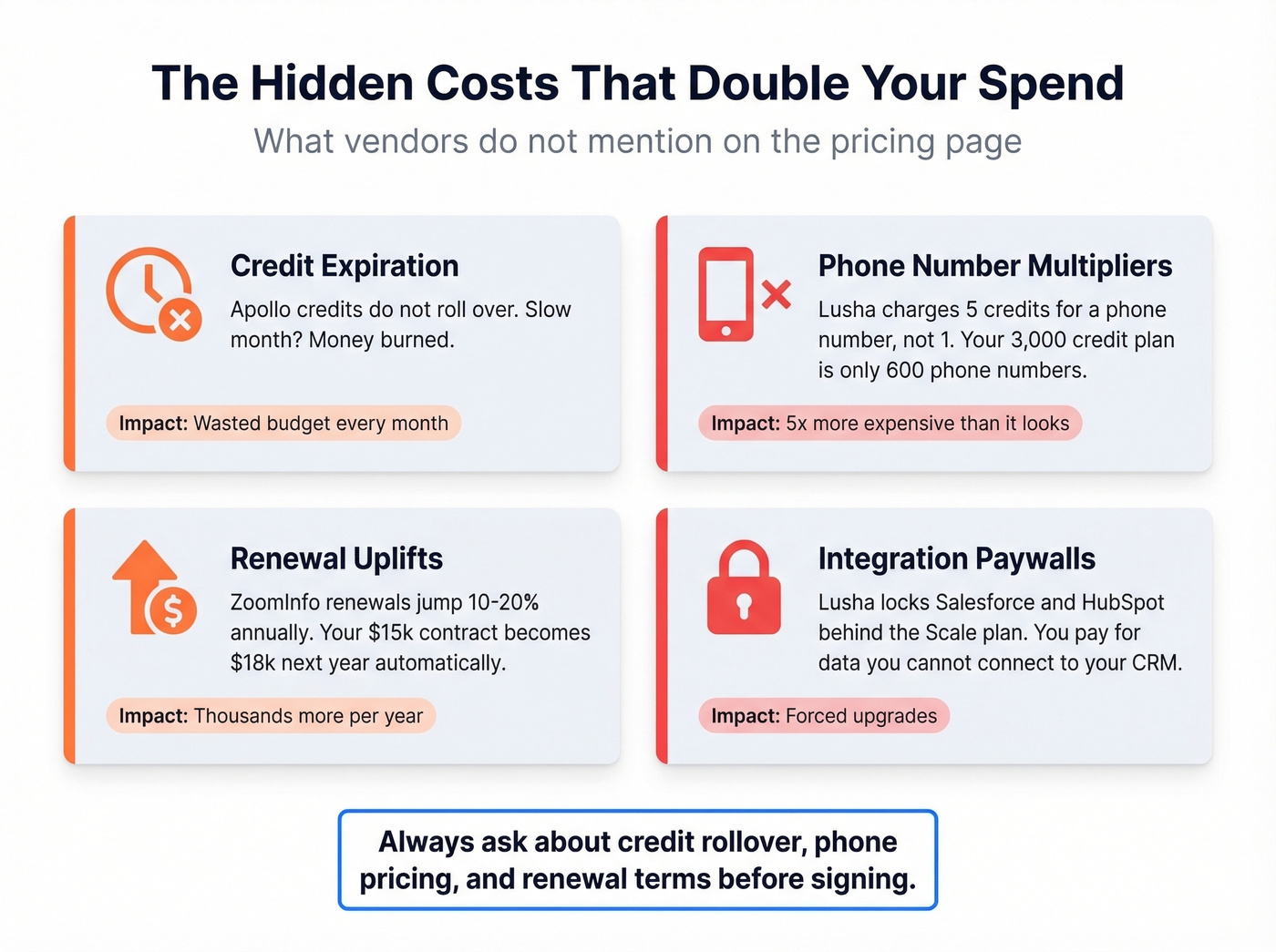
Credit expiration. Apollo credits don't roll over. Buy a plan in a slow month and you've burned money. Phone number multipliers. Lusha charges 1 credit for an email but 5 credits for a phone number. That 3,000-credit annual plan is 600 phone numbers, not 3,000 contacts. Renewal uplifts. ZoomInfo renewals commonly jump 10-20% annually, so your $15k contract becomes $18k next year without adding a single seat. Integration paywalls. Lusha locks Salesforce and HubSpot CRM integrations behind the Scale plan, meaning you're paying for data you can't connect to your CRM without upgrading.
Always ask about credit rollover, phone-number pricing, and renewal terms before signing. These hidden costs can double your effective spend.

You just saw the cost breakdown - ZoomInfo at $1+/contact, UpLead at $0.50, brokers at $0.25 with 80% accuracy. Prospeo delivers 98% verified emails at ~$0.01 each with no annual contract, no credit expiration, and a 7-day data refresh that keeps your lists clean.
Stop burning budget on data that bounces. Test 75 emails free.
Risks of Purchased Data
Bounce rates are the first warning sign. A good bounce rate sits below 2%. Purchased or outdated lists often push you past 5% - enough to put your sender reputation at risk with Gmail and Microsoft. Once your sending domain is flagged, even legitimate emails land in spam.
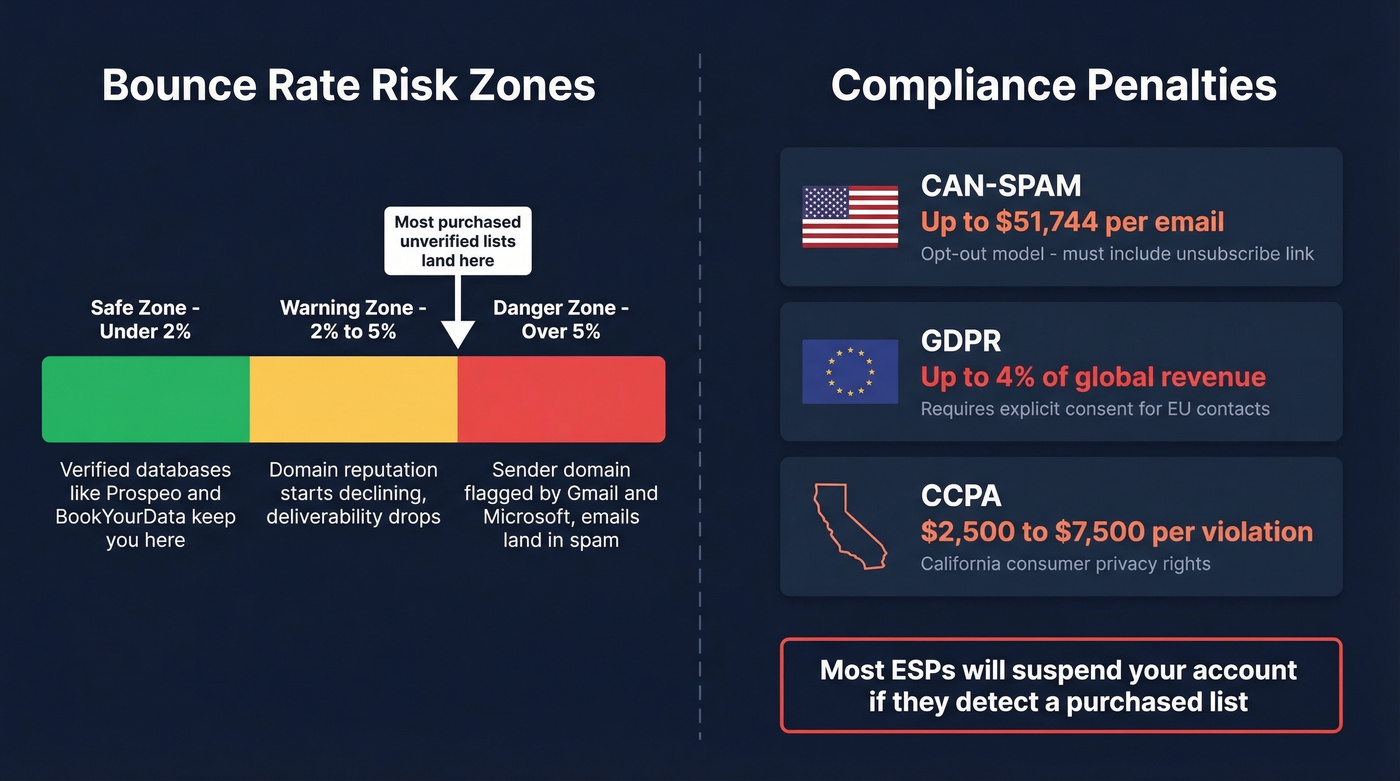
Legal compliance doesn't protect your domain reputation, either. Most email platforms prohibit purchased lists and will suspend your account if they detect one. CAN-SPAM fines run up to $51,744 per email. CAN-SPAM is opt-out, but GDPR requires explicit consent for EU contacts, and the risk multiplies fast when you acquire a database without verifying its origin or consent status.
How to Buy Business Data Without Wasting Money
Define your ICP before you shop. Industry, company size, job titles, geography. If you can't describe your ideal buyer in one sentence, you aren't ready to buy a list.
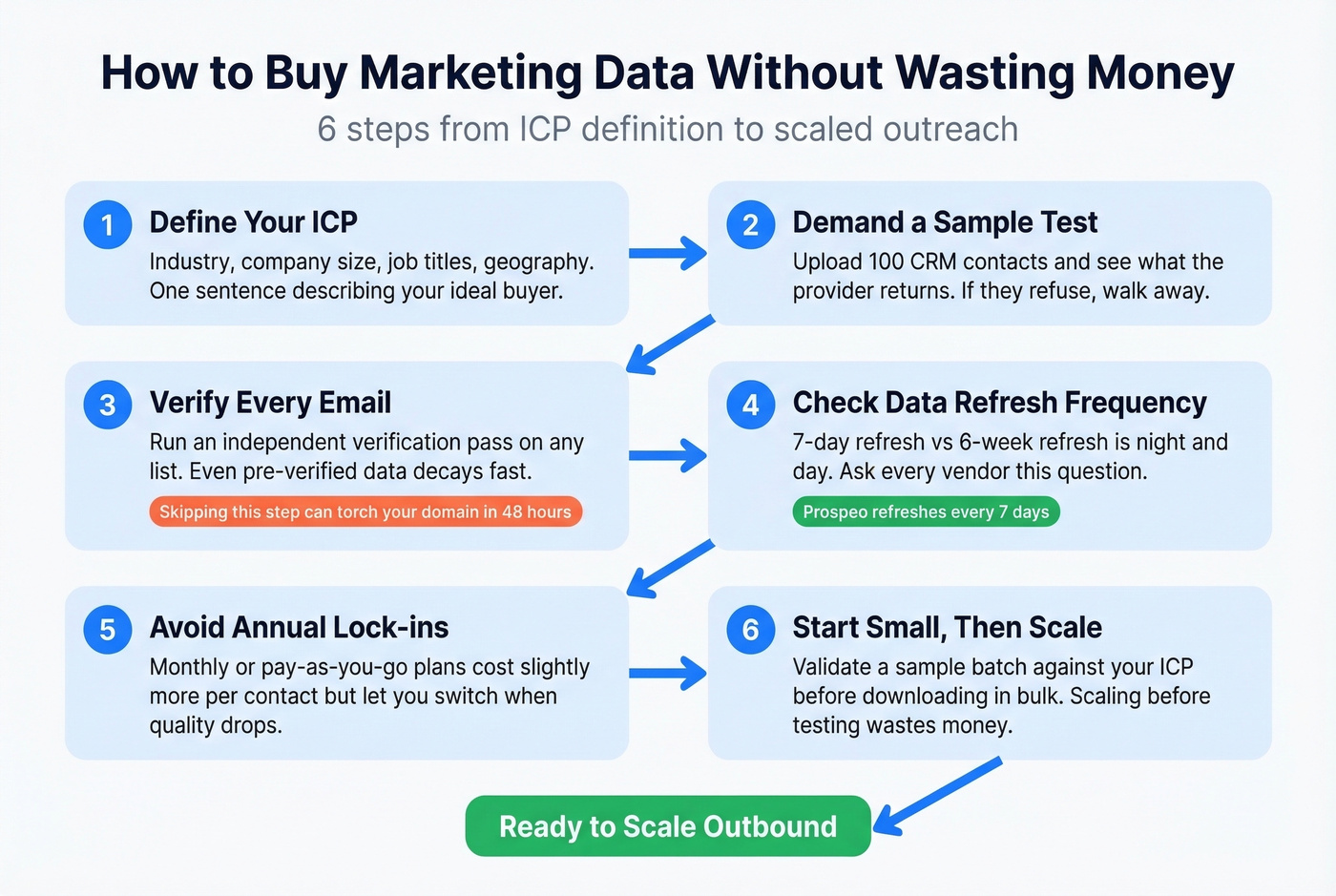
Demand a sample or match test. Upload 100 contacts from your CRM and see what the provider returns. If they won't let you test, walk away. No exceptions.
Verify every email before sending. Even "verified" databases decay. Run a verification pass on any list regardless of source. I've seen teams skip this step and torch a domain in a single campaign - one client went from 94% deliverability to getting flagged by Google within 48 hours because they trusted a vendor's "pre-verified" claim. (If you need a checklist, use an email verifier workflow.)
Check data refresh frequency. We've run side-by-side comparisons on data freshness, and the difference between a 7-day and 6-week refresh cycle is night and day. Most providers update every 4-6 weeks; Prospeo refreshes every 7 days. Ask every vendor this question.
Avoid annual lock-ins unless your team runs consistent outbound volume. Monthly or pay-as-you-go plans cost slightly more per contact but give you the flexibility to switch when data quality drops. If you're comparing flexible options, start with pay-as-you-go providers.
Start small, then scale. Download records in bulk only after you've validated a sample batch against your ICP. Scaling before testing is how teams end up with 10,000 useless rows in a spreadsheet. (A simple prospecting list template helps keep this clean.)

One alternative worth knowing about: a practitioner on Reddit reported building targeted lists using WHOIS data and getting 8-12% response rates versus 2-3% from purchased databases. It doesn't scale, but for small, high-value campaigns it's a legitimate approach that costs nothing. Skip this if you need more than a few dozen contacts per week.
When to Skip Buying a Database Entirely
Let's be honest - not every team needs to purchase data. If you're running inbound-heavy campaigns with strong organic traffic, your CRM already has the contacts you need. Buying a database on top of that just creates duplicate records and messy segmentation.
For teams doing fewer than 200 outbound touches per month, manual prospecting with a Chrome extension and email finder is faster, cheaper, and produces better-targeted lists than any bulk purchase. The consensus on r/sales leans the same way: build your own lists when volume is low, buy when you're scaling past what one person can research. If you're building from scratch, follow a B2B prospecting process instead of buying bulk.
Every hidden cost in this article - credit expiration, phone number multipliers, renewal uplifts, integration paywalls - doesn't exist at Prospeo. Transparent credit-based pricing, 125M+ verified mobiles at 10 credits each, native HubSpot and Salesforce integrations on every plan, and cancel anytime.
Buy marketing data the way it should work: pay for what you use, keep what you find.
FAQ
Is buying a marketing database legal?
In the US, yes. CAN-SPAM is opt-out, so you can email purchased contacts if you include an unsubscribe link and physical address. GDPR requires explicit consent for EU contacts. Most ESPs will still suspend your account if they detect a purchased list, so use a dedicated outbound tool like Smartlead or Instantly instead of your marketing automation platform.
What bounce rate should I expect from purchased lists?
Unverified lists routinely bounce above 5%, which risks your sender domain. Verified databases from providers like Prospeo or BookYourData keep rates under 2%. Always run an independent verification pass before sending - even on "pre-verified" data.
Can I use purchased lists in HubSpot or Salesforce?
Most marketing automation platforms prohibit purchased lists and will suspend accounts that upload them. Use a dedicated cold outbound tool - Smartlead, Instantly, or Lemlist - to send campaigns, then sync engaged leads back to your CRM.
How much should I budget for a B2B marketing database?
For most small-to-midsize teams needing 500-2,000 contacts per month, expect $50-$200/month with a self-serve provider. Enterprise platforms like ZoomInfo start around $15,000/year and only make sense for large outbound operations with multiple reps running daily sequences.