


Bytemine vs Lusha: Which B2B Data Tool Is Worth Your Budget?
You're either an SDR watching Lusha credits evaporate mid-quarter, or you're evaluating Bytemine's API for a Clay enrichment workflow and wondering if it's legit. There isn't much real head-to-head analysis comparing these two tools online. We've dug into the pricing, accuracy claims, and actual user feedback so you don't have to piece it together yourself.
30-Second Verdict
Bytemine wins if you need API-first enrichment at flat per-contact pricing with unlimited users.
Lusha wins if you want a polished Chrome extension workflow and don't need high-volume phone reveals.
Skip both if your real problem is bounce rates and stale data - a tool with weekly data refresh and 98% email accuracy will outperform either one.
Feature Comparison at a Glance
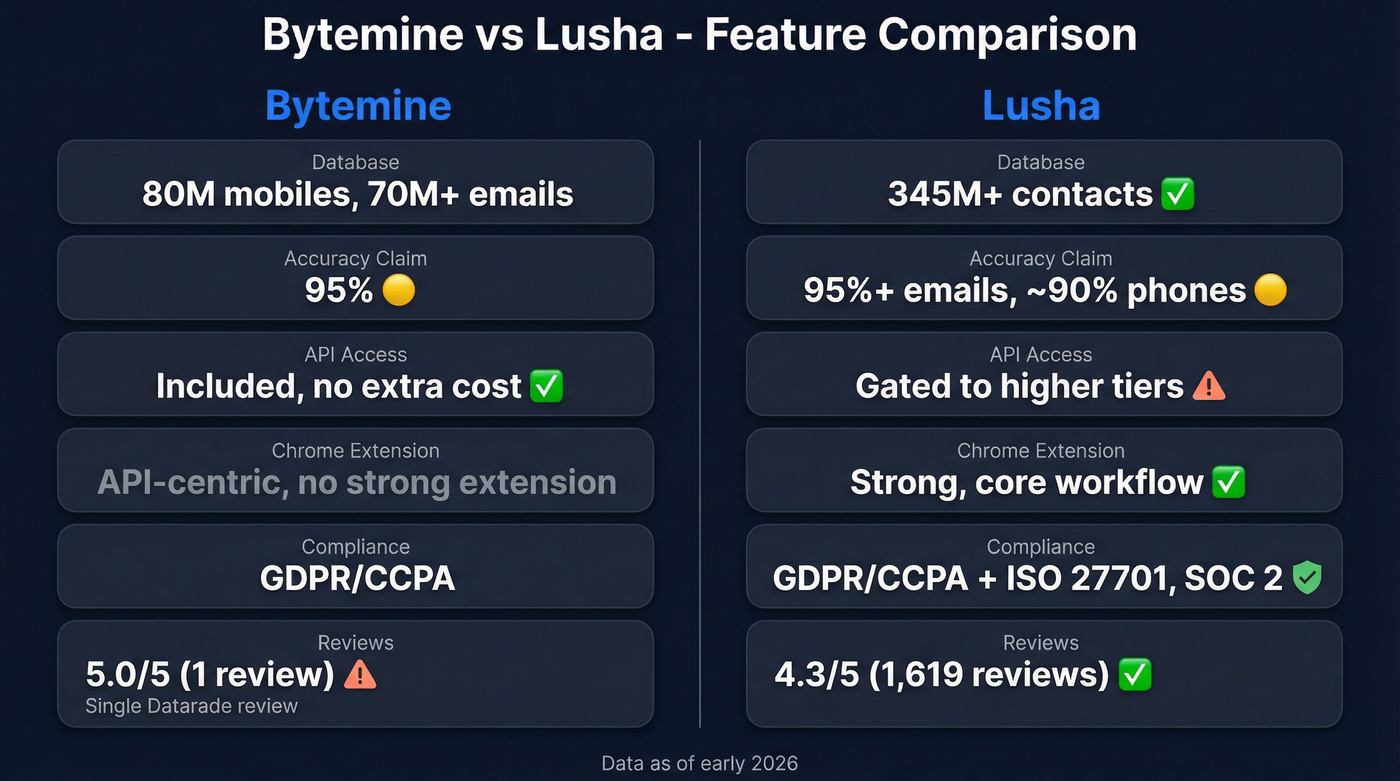
Bytemine is API-first and built for teams running enrichment workflows. Lusha is extension-first and built for reps doing one-off lookups. Lusha added 170M contacts in 2025 alone and serves 280,000+ revenue teams - a sign of serious investment in its database. Bytemine is far earlier-stage, and that shows in the numbers.
| Feature | Bytemine | Lusha |
|---|---|---|
| Database | 80M mobile numbers, 70M+ work emails | 345M+ contacts |
| Accuracy claim | 95% | 95%+ emails, ~90% phones |
| API access | Included, no extra cost | Gated to higher tiers |
| Chrome extension | API-centric | Strong, core workflow |
| Compliance | GDPR/CCPA | GDPR/CCPA + ISO 27701, SOC 2 |
| Integrations | Clay, Apollo, HighLevel | 40+ integrations |
| Reviews | 5.0/5 (1 Datarade review) | 4.3/5 (1,619 reviews) |
One note on that review score: Bytemine's perfect 5.0 comes from a single Datarade review. Lusha's 4.3 reflects 1,600+ users across G2 and other platforms. Also, Trustpilot reviews for "Bytemine" refer to a separate trading-signals product (bytemine.io) - not the B2B data platform.
Pricing Breakdown
Lusha's credit math is where most buyers get surprised.
| Plan | Monthly cost | Credits/year | Phone reveals/year |
|---|---|---|---|
| Free | $0 | Up to 70/mo (no annual pool) | 7/mo |
| Pro (annual) | $22.45/user/mo | 3,000 | 300 |
| Premium (annual) | $52.45/user/mo | 7,200 | 720 |
| Scale (25 seats) | ~$37,482/year list | Custom | Custom |
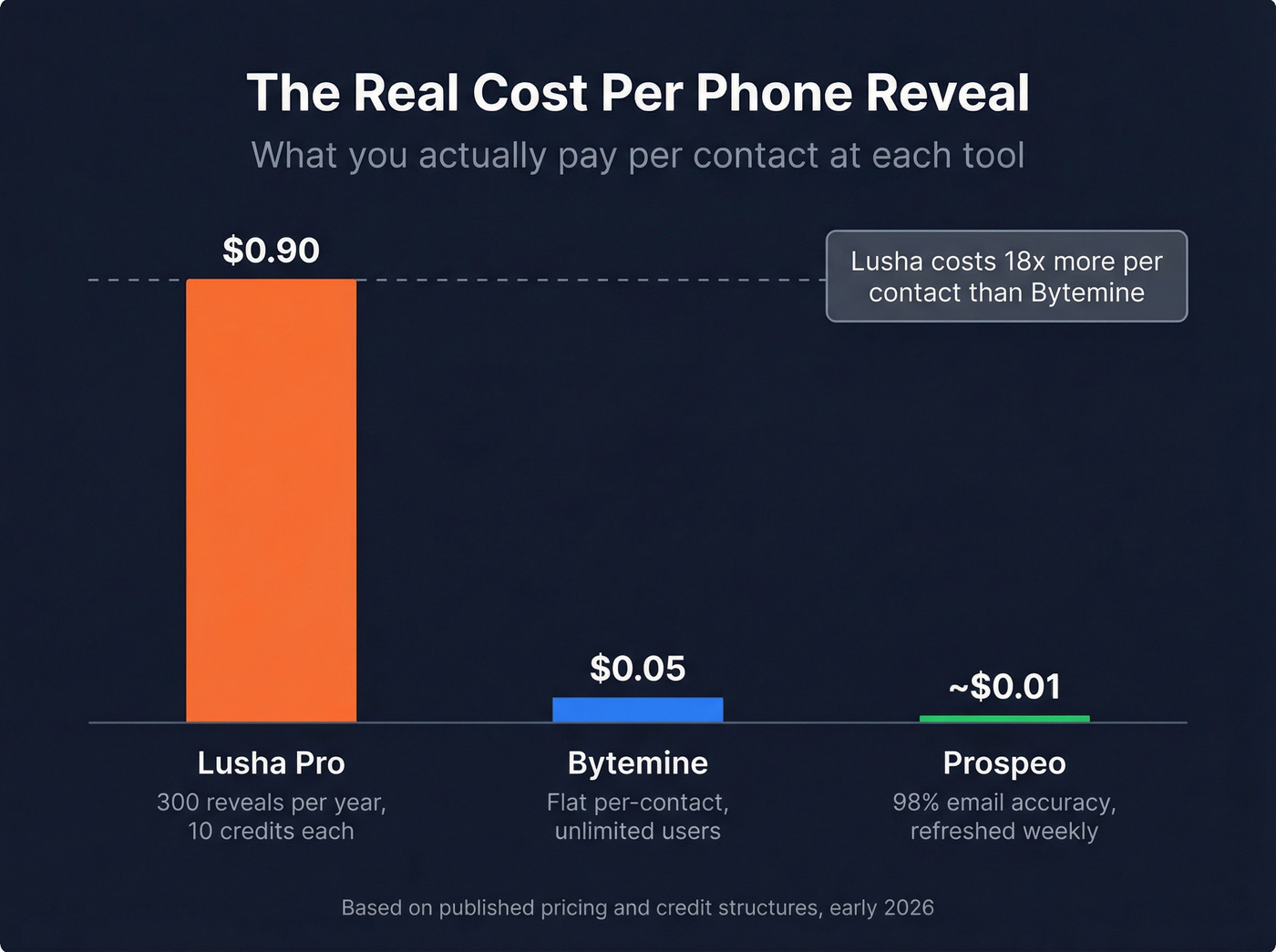
Phone reveals cost 10 credits each. On Lusha Pro, your 3,000 annual credits buy exactly 300 phone numbers - about 25 per month. If your team dials 50+ prospects a day, you'll burn through a quarter's allocation in weeks. On monthly plans, unused credits roll over up to 2x your limit. Annual plans reset - use them or lose them. Renewal increases of 8-15% are common, too, which catches teams off guard at contract time.
Bytemine starts at $50/month for 1,000 credits, with per-contact costs from $0.05. Unlimited users, full API access included. No seat-based multiplier.
Here's the math that actually matters: a Lusha Pro phone reveal runs about $0.90 each ($269.40/year divided by 300 reveals). Bytemine charges $0.05/contact flat. For teams doing heavy enrichment, Bytemine's economics are dramatically better. For reps doing 10 lookups a day from a browser, Lusha's workflow is faster and the cost difference barely registers.
Let's be honest - in 2026, hiding pricing behind a "talk to sales" wall is a red flag. Lusha's pricing page explains the credit system clearly, but the actual price-per-credit at paid tiers often has to be pieced together from third-party breakdowns. Bytemine at least puts the starting number on the page.

Lusha charges $0.90 per phone reveal. Bytemine charges $0.05 per contact. Prospeo gives you 125M+ verified mobiles with a 30% pickup rate at roughly $0.01 per email - with data refreshed every 7 days, not whenever the provider gets around to it.
Stop debating credits. Start connecting with real buyers.
Data Accuracy in Practice
Both tools claim ~95% accuracy. Neither proves it convincingly.
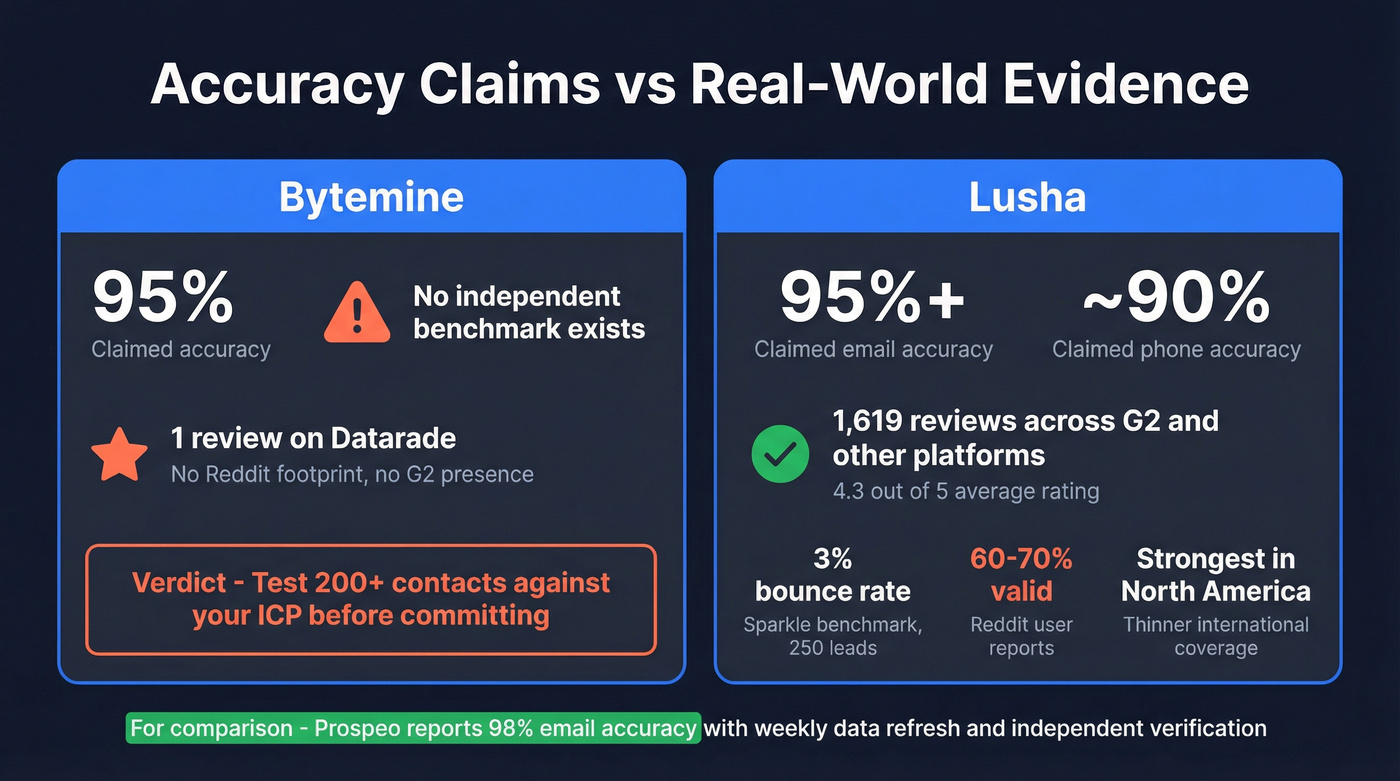
A Sparkle benchmark tested 250 leads through Lusha and reported a 3% bounce rate, compared to 2.65% for Apollo in the same write-up. G2 reviews surface "outdated contacts" and "inaccurate data" as recurring complaints, alongside frustration that credits are too restrictive for high-volume prospecting. Over on r/EmailProspecting, one thread described Lusha at 60-70% valid emails, with phone numbers called a "coin flip."
Competitor comparisons frequently position Lusha as strongest in North America, with thinner coverage internationally.
Bytemine's 95% accuracy metric? No independent benchmark exists. No community data points, no meaningful Reddit footprint. You're taking their word for it based on a single review. That's not necessarily a dealbreaker, but we'd want to test at least 200 contacts against our own ICP before committing budget.

Who Should Pick Which
Choose Bytemine if you're building API-driven enrichment workflows in Clay, want flat per-contact pricing, and don't need a browser extension. It fits small technical teams that want unlimited seats without per-user costs. Just know you're betting on an early-stage product with a thin review footprint and limited integrations.
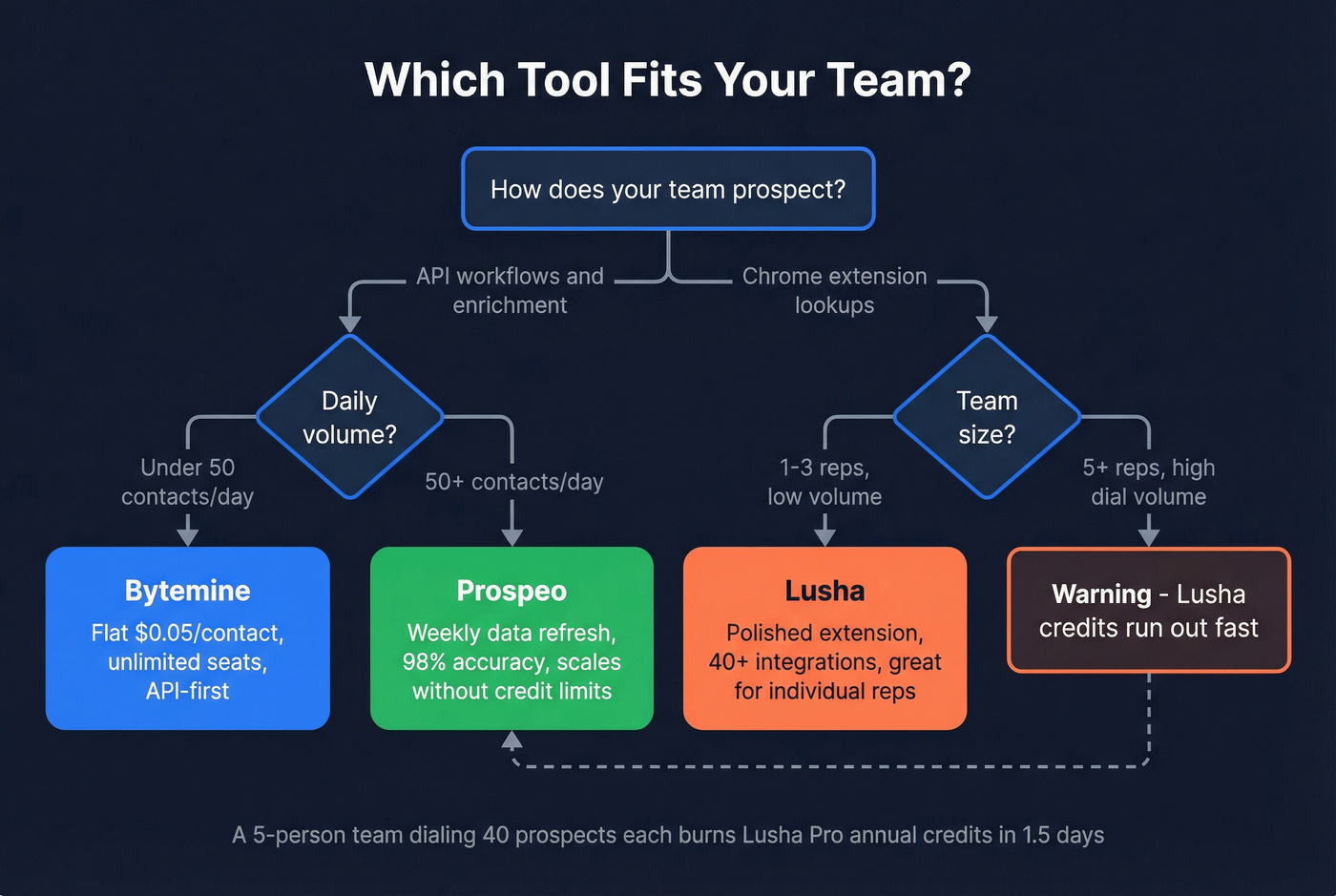
Choose Lusha if you need a polished Chrome extension for quick lookups, value an established integrations ecosystem with Salesforce, HubSpot, and Outreach, and you're an individual contributor or small team that won't blow through credit limits.
Skip Lusha if you're doing high-volume enrichment. The credit economics simply don't scale.
Here's how this plays out in practice: a 5-person SDR team dialing 40 prospects each per day needs 200 phone reveals daily. On Lusha Pro, that's their entire annual allocation gone in a day and a half. On Bytemine, that's $10/day - manageable. The "which tool is better" question almost always comes down to volume. Low-volume reps love Lusha's extension. High-volume teams can't afford it.
For teams where deals average under $10K ACV, you probably don't need either tool's full platform. A dedicated email finder with high accuracy and a Chrome extension will get you 80% of the value at a fraction of the cost.
Consider a Third Option
If what's actually killing your outbound is bounce rates and stale data, neither Bytemine nor Lusha fully solves the problem.
Real results back this up. Meritt switched to Prospeo and saw their bounce rate drop from 35% to under 4%, with pipeline tripling from $100K to $300K per week. That's the difference fresh, verified data makes when your reps are dialing and emailing at scale.
The free tier gives you 75 verified emails and 100 Chrome extension credits per month - enough to run a real test against your own prospect list. No credit card, no contract, no sales call.
Your 5-person SDR team burns through Lusha's annual phone credits in a day and a half. With Prospeo, 300M+ profiles, 98% email accuracy, and 30+ search filters mean your reps spend time selling - not rationing credits or chasing bounced emails.
Free tier. No credit card. Test it against your own ICP today.
FAQ
Is Bytemine a good Lusha alternative?
For API-first teams wanting flat per-contact pricing and unlimited users, yes. But limited reviews and a small integration ecosystem mean you should verify data quality against your ICP before committing. Test at least 200 contacts before signing an annual deal.
How many phone numbers can you reveal on Lusha Pro?
Lusha Pro includes 3,000 credits per year. Phone reveals cost 10 credits each - that's 300 numbers annually, roughly 25 per month. High-dial teams exhaust this in weeks, making it impractical for outbound-heavy orgs.