

Bytemine vs QuickEnrich: Honest Comparison (2026)
Picking between Bytemine and QuickEnrich means evaluating two newer B2B data enrichment tools with almost no public social proof. We couldn't find credible G2 or Capterra review pages for either product, and named-customer case studies don't seem to exist - so you're working with vendor claims and not much else.
That's a red flag worth sitting with before you hand over your credit card.
30-Second Verdict
QuickEnrich if you're solo and want the cheapest per-lookup cost. Bytemine if you need unlimited seats for a team and predictable pricing matters more than volume. Skip both if you want a platform with a real track record - Prospeo covers 143M+ verified emails at 98% accuracy and is used by 15,000+ companies.
Feature Comparison
| Bytemine | QuickEnrich | |
|---|---|---|
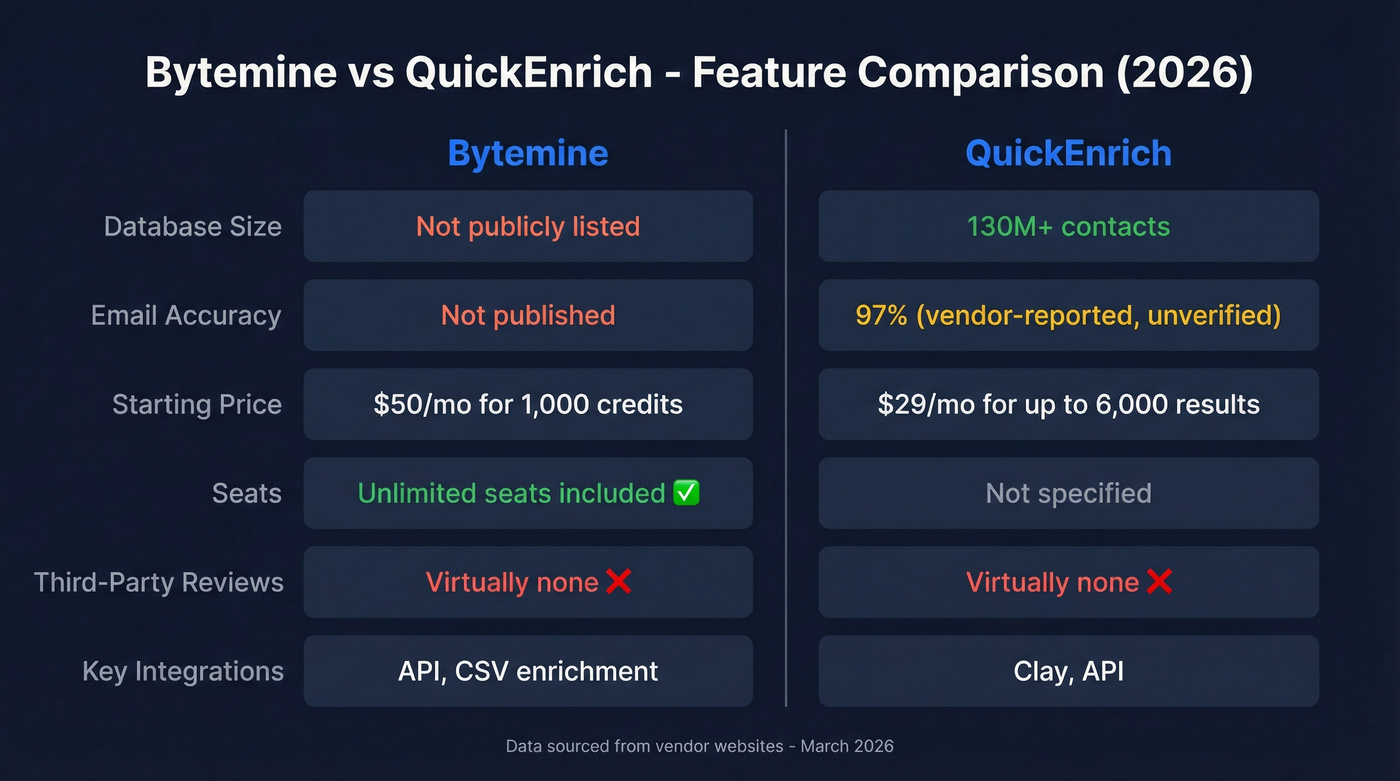
| Database size | Not publicly listed | 130M+ contacts |
| Email accuracy | Not published | 97% (vendor-reported) |
| Mobile numbers | Phone data + validation available | ~25% of enrichments include mobile numbers |
| Starting price | $50/mo (1,000 credits) | $29/mo (up to 6,000 found emails/phones) |
| Third-party reviews | Virtually none | Virtually none |
| Data refresh | Not published | Not published |
| Key integrations | API + CSV enrichment | Clay, API |
| Free plan | Yes | Free trial |
We searched Reddit threads, review sites, and common SaaS directories for real user feedback on these tools. Didn't find much that was clearly about either product, which tells you something about real-world adoption so far.
Pricing Breakdown
QuickEnrich's Starter plan runs $29/mo for up to 6,000 found emails or phone numbers - though their pricing page also shows 3,000 in a conflicting spot. Growth is $99/mo for 25,000 found results, with an alternate 11,000 figure displayed elsewhere on the same page. Annual billing drops those to $24/mo and $83/mo respectively, but the lookup numbers conflict there too, with both 72,000 and 36,000 shown for the annual Starter tier. Per-result costs land around $0.004-$0.005 on monthly plans.
If you're comparing more vendors in this category, start with our roundup of data enrichment services.
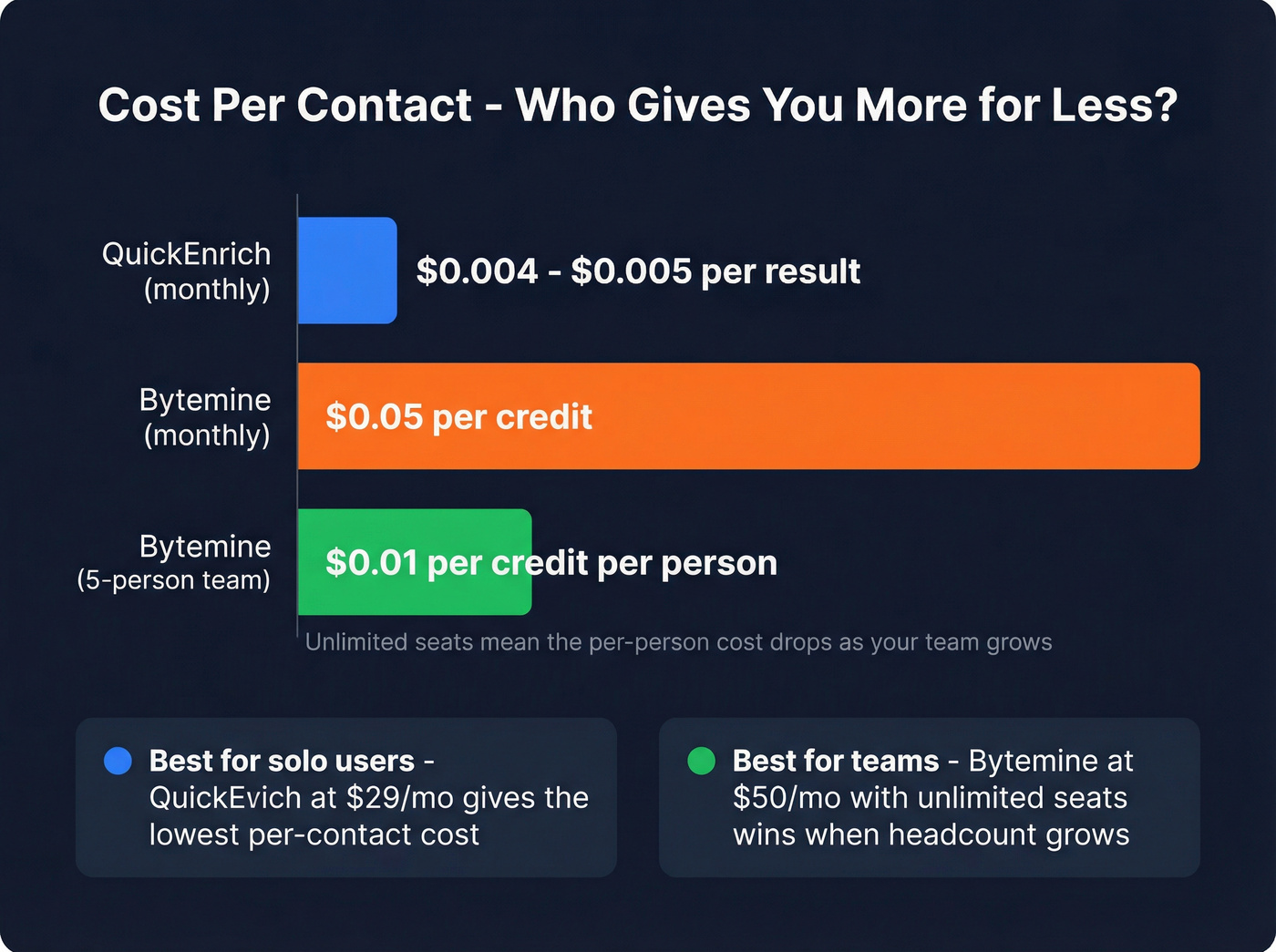
Bytemine starts at $50/mo for 1,000 credits with unlimited seats - that's $0.05 per credit, roughly 10-12x QuickEnrich's per-result unit cost. The unlimited seats are the real play here: a five-person SDR team pays the same as a solo user, which changes the math fast when you're scaling headcount.
Use QuickEnrich for solo volume at the lowest per-contact cost. Use Bytemine for teams that want predictable costs without per-seat multiplication. If you're building a full outbound stack, it helps to benchmark against other SDR tools.

Conflicting pricing pages and unverified accuracy claims are a rough foundation for your outbound stack. Prospeo gives you 143M+ verified emails at 98% accuracy, refreshed every 7 days - with 15,000+ companies already proving the data works.
Stop testing unproven tools with your domain reputation.
Data Quality Reality Check
Here's the thing about QuickEnrich's 97% accuracy claim: it sounds great until you look at independent benchmarks.
If you're seeing bounces climb, use these email reputation tools to diagnose the damage early.
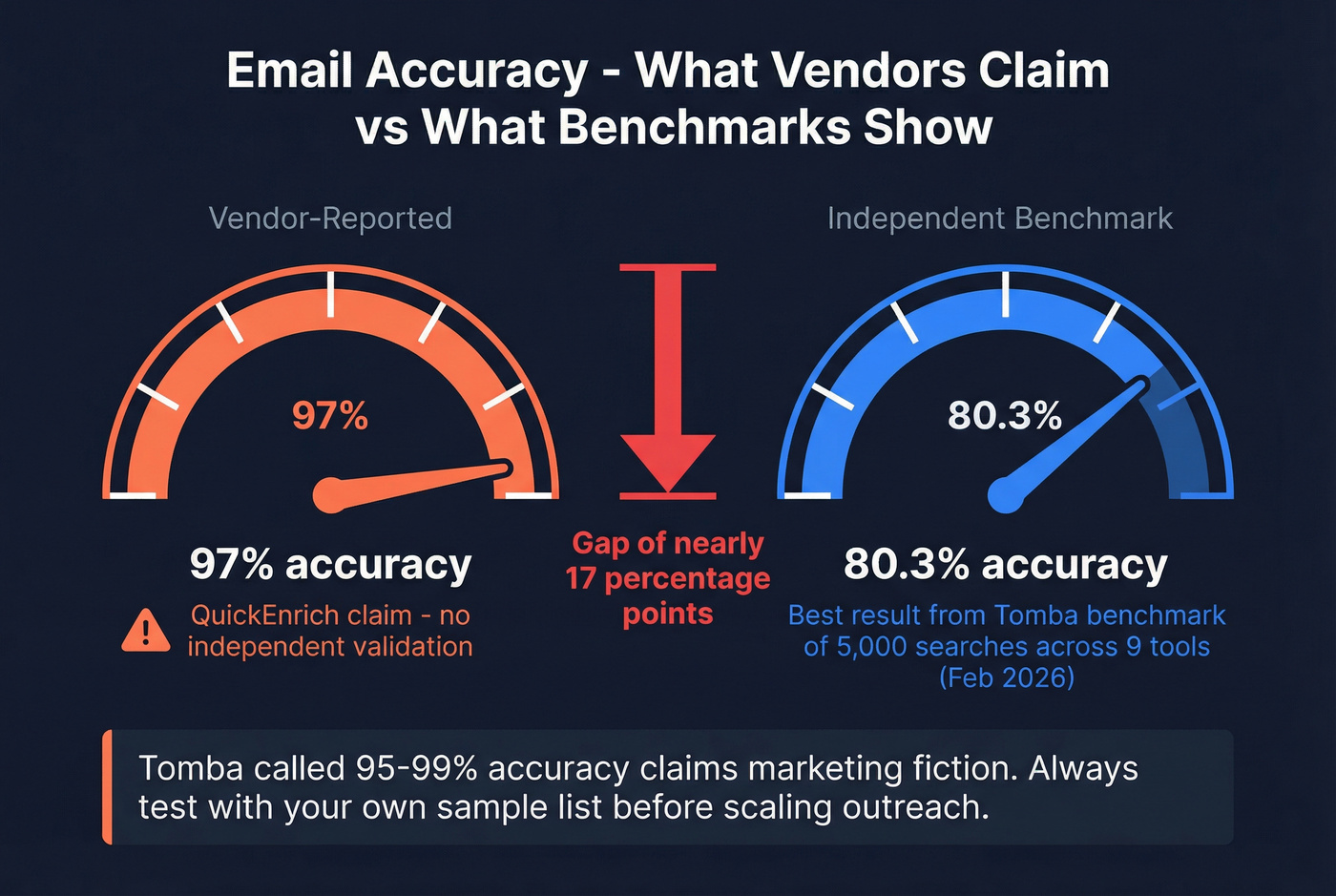
Tomba's February 2026 benchmark tested 5,000 searches across nine email-finding tools, and the best result in that test was 80.3% accuracy. Tomba called 95-99% accuracy claims "marketing fiction." QuickEnrich wasn't included in that benchmark, but the gap between 80% real-world results and 97% vendor claims should give you pause. We've seen this pattern across dozens of tools - the advertised number and the number you actually get in production are rarely the same.
QuickEnrich does emphasize double-verified emails using SMTP verification plus catch-all verification, and it provides a verification date on each email. That's genuinely useful because data decay is one of the fastest ways "good" data turns into bounces and torched sender reputation.
Bytemine doesn't list a headline accuracy percentage anywhere we looked. Neither tool comes with independent validation you can point to publicly, so treat accuracy as something you need to test yourself with a sample list before you scale. If you need a deeper workflow, see our guide to lead enrichment.
Why Most Teams Outgrow Both
Let's be honest: if your outbound motion generates more than $5K/month in pipeline, you've already outgrown tools with limited social proof and no easy-to-cite independent accuracy data.

The detail that matters most when comparing these tools to more established platforms is data freshness. Prospeo runs a 7-day data refresh cycle - the industry average is six weeks, meaning most enrichment databases are serving you contacts who changed jobs a month ago. That 5-step verification process with catch-all handling and spam-trap removal delivers a 92% API match rate in practice. Meritt tripled their pipeline from $100K to $300K/week after switching, with bounce rates dropping from 35% to under 4%.
If you're sending cold outreach at scale, pair better data with a tighter email deliverability guide.
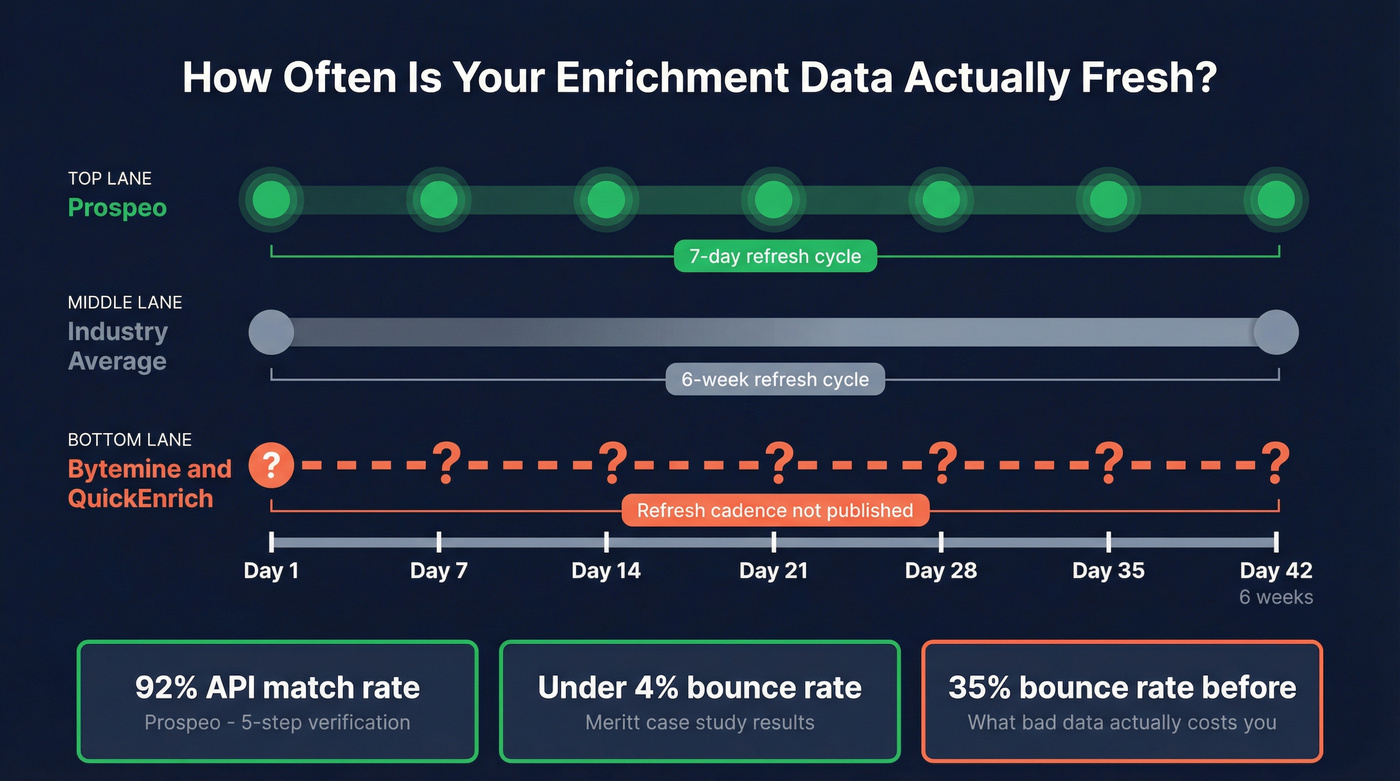
Neither Bytemine nor QuickEnrich publishes a data refresh cadence, which usually means it isn't a selling point.
Meritt dropped their bounce rate from 35% to under 4% and tripled pipeline to $300K/week. That's what happens when your enrichment data is verified in 5 steps and refreshed weekly - not whenever the vendor gets around to it.
Get 75 free emails monthly - no credit card, no contracts.
Final Verdict
Solo users on a budget: QuickEnrich at $29/mo gets you the most lookups per dollar. Just don't trust the 97% accuracy number without running your own test.
Teams needing unlimited seats: Bytemine at $50/mo with no per-seat charges works if your team is growing and you want cost predictability over raw volume.
If you're still shopping, compare options in our best sales prospecting databases guide.
FAQ
Is QuickEnrich's 97% accuracy claim realistic?
Independent benchmarks show top email finders maxing out around 80% accuracy in real-world tests of 5,000+ searches. QuickEnrich's 97% is a vendor-reported figure without third-party validation. Always run your own verification pass on a sample list before launching sequences at scale - your domain reputation isn't worth the gamble.
Does Bytemine offer a free plan?
Yes. Bytemine has a free plan with real data and no credit card required. Paid plans start at $50/mo for 1,000 credits with unlimited user seats. QuickEnrich offers a free trial with paid plans from $29/mo.