How to Check If an Email Exists Online - And Why Most Free Checkers Lie
You export 2,000 contacts from your CRM, load them into a sequence, and hit send. By morning, 500 have bounced. Your sender reputation just took a hit that'll take months to repair.
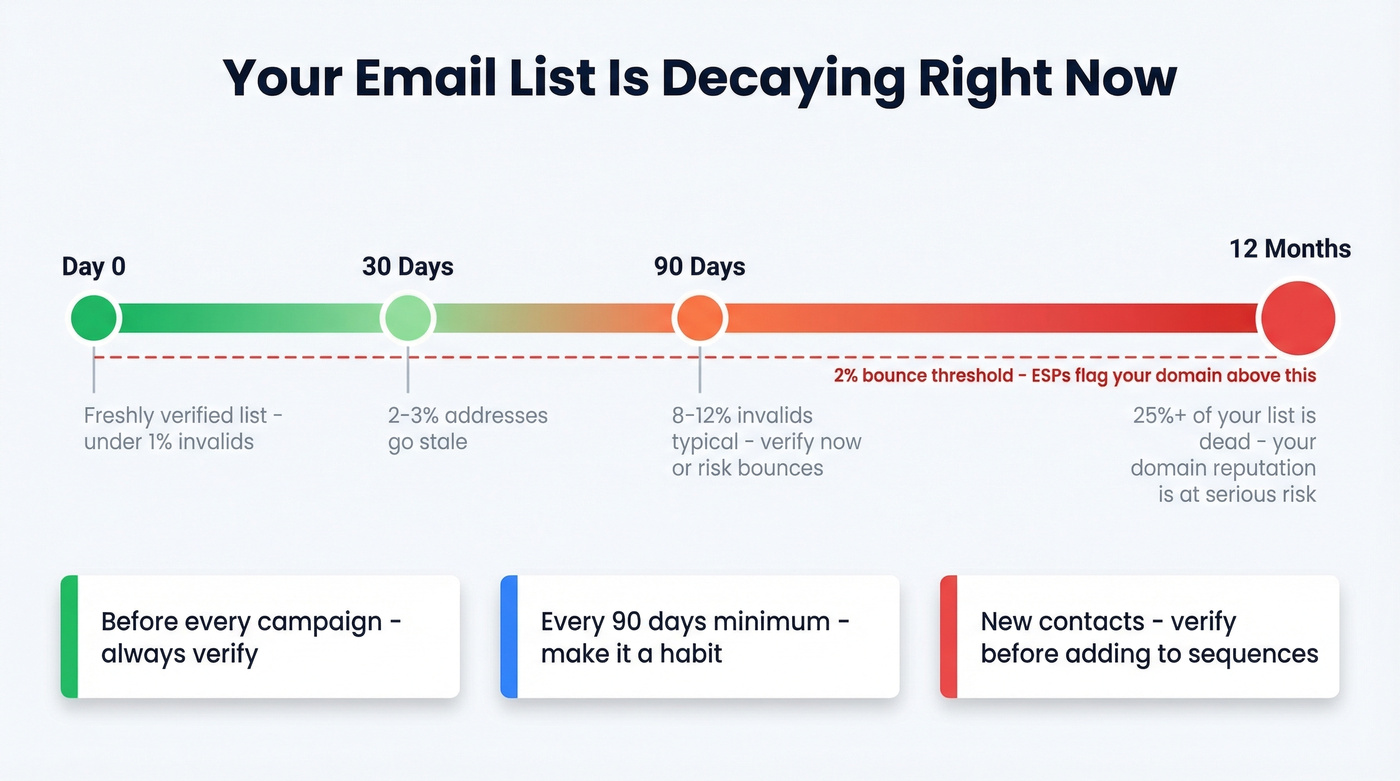
Before you send anything, you need to verify those addresses actually exist. Lists decay at 25%+ per year, and most ESPs flag your domain once bounces cross the 2% threshold. That's not a lot of room for error.
What You Need (Quick Version)
- Quick single-email check - Hunter (free for single checks, no signup) or Mailmeteor (free, no signup)
- Budget bulk cleaning - NeverBounce ($8/1K) or Bouncer ($7/1K)
How Email Verification Actually Works
Every tool follows the same basic pipeline, though depth varies wildly.
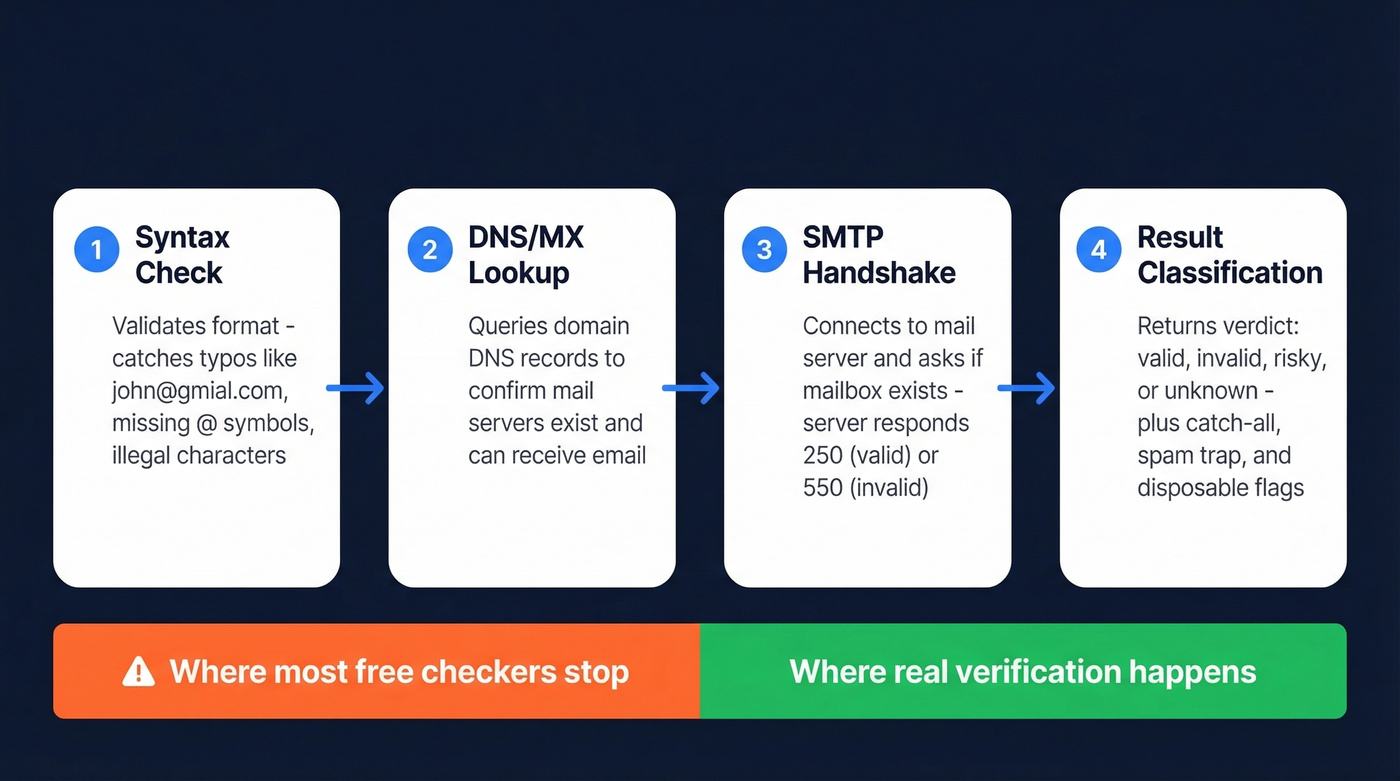
Step 1: Syntax check. Confirms valid format - no missing @, no illegal characters. Catches typos like john@gmial.com but nothing else.
Step 2: DNS/MX lookup. Queries the domain's DNS records to confirm mail servers exist. No MX record means the domain can't receive email at all.
Step 3: SMTP handshake. The tool opens a connection to the mail server and asks "Does this mailbox exist?" without sending a message. The server responds with a code: 250 means accepted, 550 means invalid.
Step 4: Result classification. The tool returns a verdict - valid, invalid, risky, or unknown - plus catch-all detection, spam traps identification, and disposable domain flagging on better platforms.
Here's the thing: many free checkers stop at steps 1 and 2. They confirm the domain exists and the format looks right, then call it "verified." That's like checking a building has a front door and assuming someone's home.

Most free checkers stop at step 2 and call it "verified." Prospeo's 5-step pipeline handles catch-all domains, strips spam traps, and filters honeypots - delivering 98% email accuracy on a 7-day refresh cycle. 75 free verifications/month, no credit card required.
Check if those emails actually exist before your domain pays the price.
Why Free Checkers Fail
Most free verification tools are lead-gen forms disguised as products. They give you just enough to capture your email address, then gate everything useful.
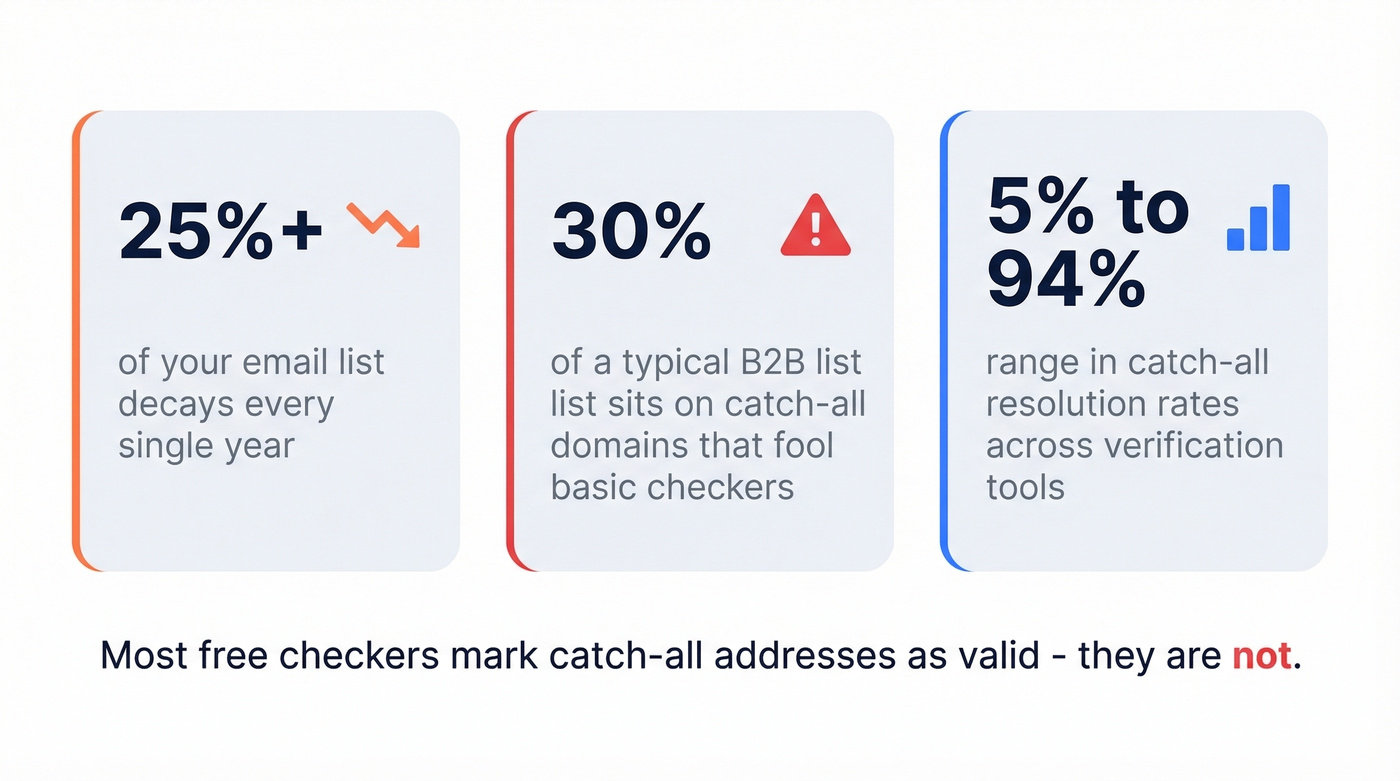
Vendor accuracy claims of "99%" are marketing. Real-world benchmarks show accuracy between 65% and 99.5%, depending on how unknowns and catch-all results get counted. Catch-all domains are the biggest blind spot - these domains accept mail for any address, whether the specific mailbox exists or not, so the SMTP handshake always returns a 250 code. Roughly 30% of a typical B2B list sits on catch-all domains. Basic checkers mark them all "valid." They're not.
A LeadMagic benchmark of 10,000 real B2B emails found catch-all resolution rates ranging from 5% to 94% across tools - though the top performer was LeadMagic itself, so take the exact rankings with a grain of salt. Threads in r/b2bmarketing echo this frustration: tools that "claimed to verify" but only ran format checks.
If your bounce rate's under 2% and you're sending to a few hundred contacts a month, you probably don't need a paid verification tool. But the moment you're doing outbound at any real scale, free checkers will cost you more in burned domains than a paid tool ever would.
Best Tools to Verify an Email Address Online
We've tested most of these on the same lists. In our experience, catch-all resolution is the single biggest differentiator - everything else is table stakes.
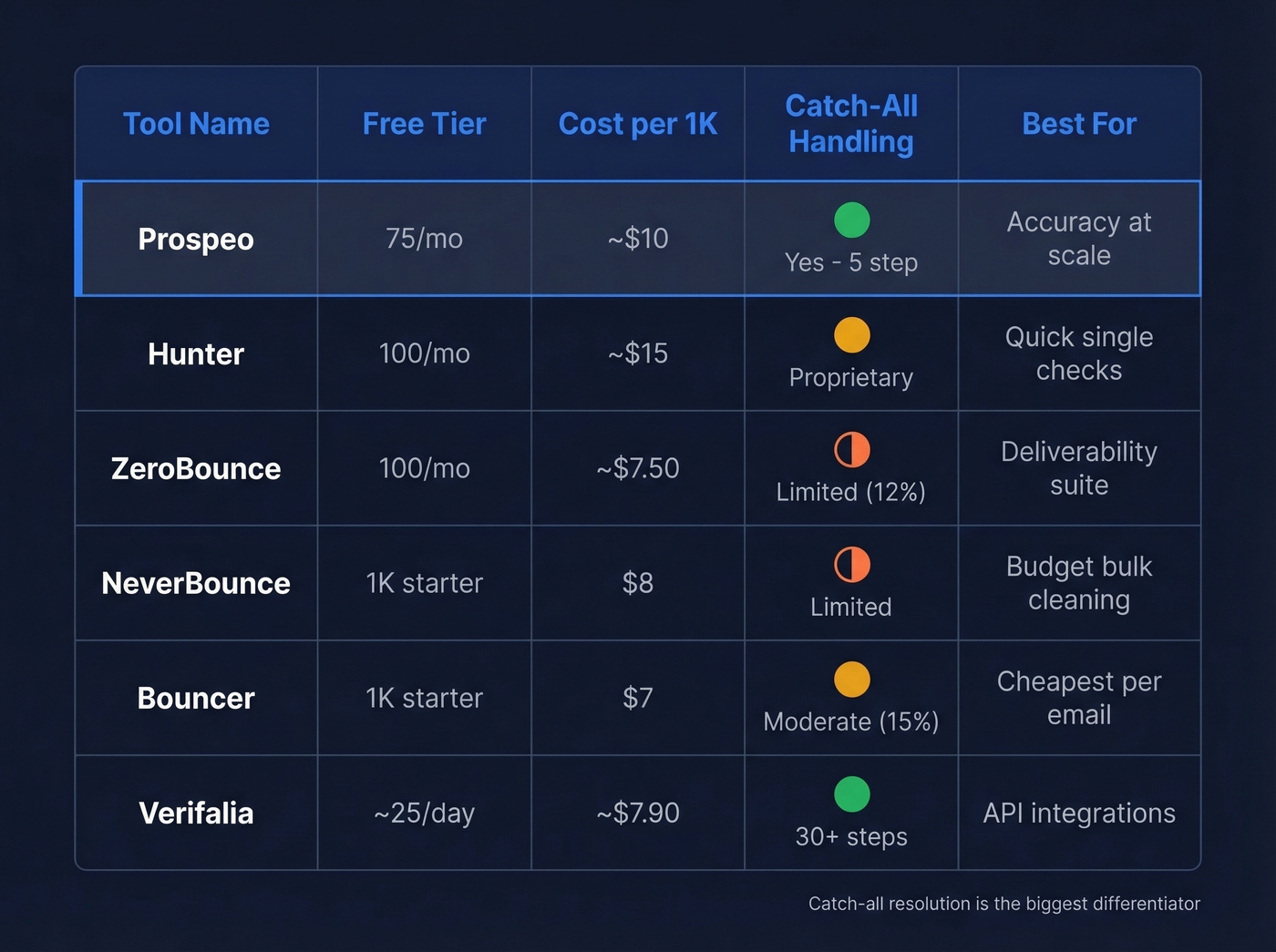
| Tool | Free Tier | Cost/1K | Catch-All Handling | Best For |
|---|---|---|---|---|
| Prospeo | 75/mo | ~$10 | Yes (5-step) | Accuracy at scale |
| Hunter | 100/mo | ~$15 | Proprietary | Quick single checks |
| ZeroBounce | 100/mo | ~$7.50 | Limited | Deliverability suite |
| NeverBounce | 1K starter | $8 | Limited | Budget bulk cleaning |
| Bouncer | 1K starter | $7 | Moderate | Cheapest per-email |
| Verifalia | ~25/day | ~$7.90 | 30+ step process | API integrations |
Prospeo
Prospeo runs a 5-step verification process across its 143M+ verified email database - syntax, DNS, SMTP, catch-all resolution, and spam-trap/honeypot filtering. That last step matters more than most people realize: spam traps don't just bounce, they actively damage your sender reputation with ISPs.
The result is 98% email accuracy on a 7-day data refresh cycle, compared to the 6-week industry average. The free tier gives you 75 verifications per month with no contract. For teams that have been burned by basic SMTP checks failing on catch-all domains, this pipeline solves exactly that problem. Stack Optimize, one of their customers, reports deliverability above 94% and bounce rates under 3% across all client campaigns.
Catch-all domains fool basic SMTP checks into marking every address as valid. Prospeo resolves them with proprietary verification across 143M+ emails - at ~$0.01 per email. Stack Optimize runs bounce rates under 3% across every client campaign using this exact pipeline.
Stop guessing on catch-all domains. Verify with 98% accuracy for a penny each.
Hunter
Hunter's the default for quick, one-off checks. It has 6+ million users and a 4.4 on G2. It runs syntax, MX, server response, and a database lookup against its own B2B index, plus proprietary catch-all handling for major providers. The free plan includes up to 100 verifications per month, and paid plans start around $49/month. For single-email spot checks where you just need a fast answer, it's reliable enough.
If you're comparing options beyond Hunter, see our breakdown of Hunter alternatives.
ZeroBounce
Scored 97.8% accuracy in the LeadMagic benchmark, but catch-all resolution was only around 12%. You get 100 free verifications per month and a deliverability toolkit - inbox placement testing, blacklist monitoring - bundled in. At ~$7.50/1K on paid plans, it's a solid mid-range pick if you need more than just verification. Skip it if catch-all domains are your main headache.
NeverBounce
Budget bulk cleaning at $8/1K with pay-as-you-go pricing. Benchmark accuracy of 96.9%. Includes typo correction that catches gmai.com → gmail.com, which is a nice touch. Credits expire after 12 months.
If you're trying to keep bounces down long-term, it helps to understand email bounce rate benchmarks and what they mean.
Bouncer
Cheapest per-email at $7/1K, with 1,000 free starter credits. Benchmark accuracy of 96.5% and a 15% catch-all resolution rate - better than NeverBounce on catch-alls, slightly lower on overall accuracy. Good for teams watching every dollar.
If Bouncer is on your shortlist, you can also compare Bouncer alternatives.
Verifalia
Developer-friendly with 30+ verification steps and 40+ result classifications. Connects to 6,000+ apps via Zapier. Free tier is tight at roughly 25 checks per day, but the $9.90/month subscription works well for API-driven workflows that need granular status codes rather than simple pass/fail verdicts.
Is Email Verification Legal?
Under GDPR, an email address is personal data, and verification counts as processing. But GDPR's Article 5(1)(d) actually requires that personal data be accurate and kept up to date - which is exactly what verification does. Article 5(1)(c) adds data minimization: you should be removing invalid addresses, not hoarding them.
Your verification provider acts as a data processor. Pick one with clear DPAs, defined retention periods, and EU-adequate hosting. CCPA imposes similar expectations in the US. The real legal risk isn't verifying emails you have a legitimate basis to contact - it's not verifying and sending to dead addresses that tank your deliverability.
If you're building lists (not just cleaning them), read our guide on how to generate an email list and what to verify before sending.
FAQ
How do I search if an email address exists?
Paste the address into a verification tool that runs a full SMTP handshake - it connects to the mail server, asks whether the mailbox exists, and returns a status (valid, invalid, risky, or unknown) within seconds. No email is ever sent. For bulk lists, upload a CSV and the tool flags bad addresses before they damage your sender reputation.
Can you verify an email without sending a message?
Yes. Every reputable email checker uses an SMTP handshake - it connects to the recipient's mail server, queries the mailbox, then disconnects before any message is transmitted. The server's response code (250 for accepted, 550 for invalid) provides the answer. No inbox is touched.
What does "catch-all" mean in verification results?
A catch-all domain accepts mail for every address, whether the specific mailbox exists or not - so SMTP checks always return "valid." Treat catch-all results as risky. Sending blindly to them is how bounce rates creep past 2%. Tools with dedicated catch-all resolution steps separate real inboxes from phantom ones, which is why we weight that feature so heavily in our comparisons.
How often should I verify my email list?
With 25%+ annual decay, verify before every major campaign or at minimum quarterly. Lists that looked clean three months ago routinely come back with 8-12% invalids after a single quarter. Any list older than 90 days deserves a fresh pass - make it a habit to verify every new contact before adding them to active sequences.
If you're sending cold outreach, pair verification with a broader email deliverability guide so you don't burn domains.
If you're scaling outbound, also watch your email velocity to stay under provider limits.
And if you're actively repairing a damaged domain, use a step-by-step plan to improve sender reputation.