

How to Check if an Email Address Is Valid - And Why Most Tools Get It Wrong
You uploaded 500 prospects into your sequencer, hit send, and 40 bounced before lunch. That's an 8% bounce rate - well above the 2% threshold that signals list quality problems and starts hurting deliverability. You paid for those contacts, and now you're paying again in sender reputation damage that takes weeks to undo.
Here's the thing: if you're checking email addresses after you've already bought a list, you're paying twice for the same problem. The smarter play is sourcing pre-verified data so you never need a cleaning step. But if you already have a list sitting in a spreadsheet, here's how to verify formatting, deliverability, and risk - and which tools are actually worth your money.
How Email Verification Works
Most verification tools follow the same four-stage pipeline.
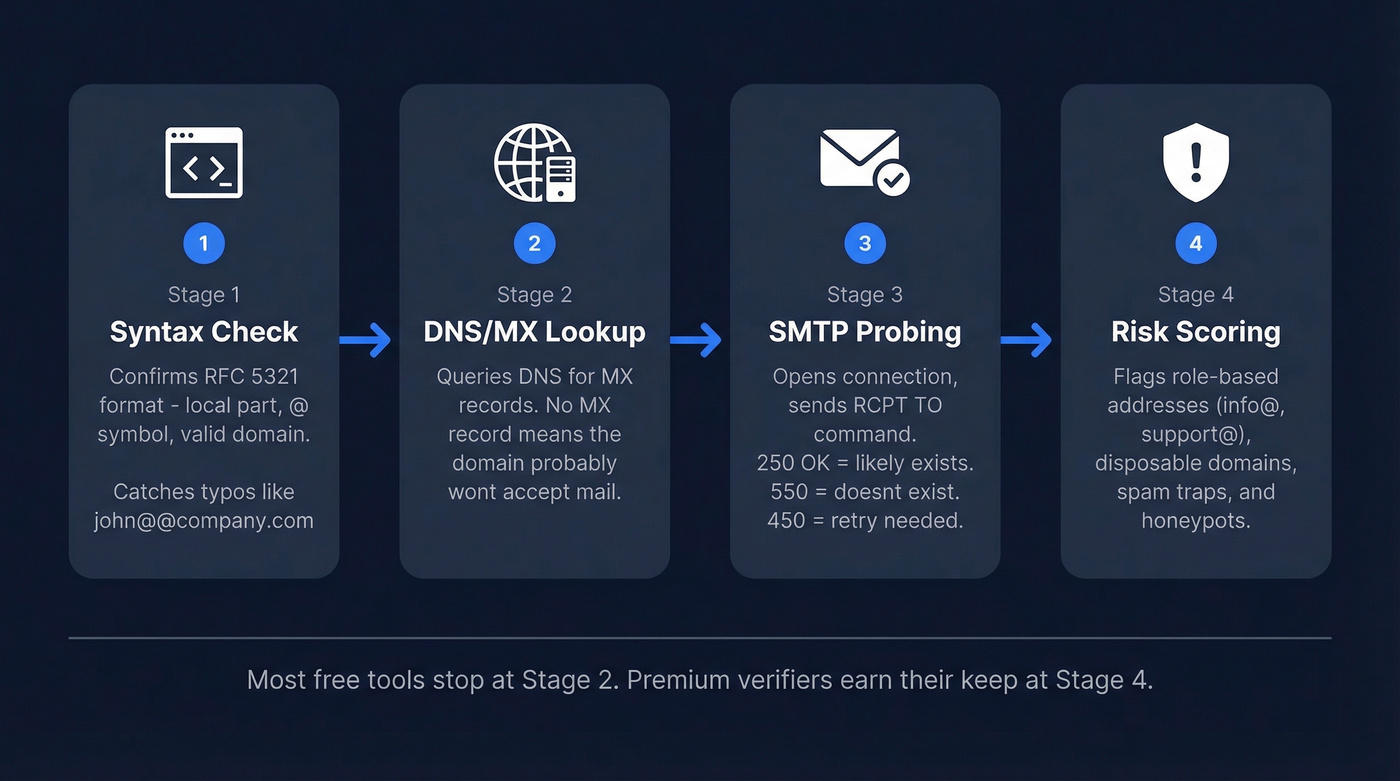
Stage 1: Syntax check. The tool confirms the address follows RFC 5321 formatting - a local part, an @ symbol, a valid domain. Catches typos like john@@company.com. Every tool nails this.
Stage 2: DNS/MX lookup. The verifier queries DNS for the domain's MX records. No MX record usually means the domain won't accept mail.
Stage 3: SMTP probing. The tool opens a connection to the mail server and issues a RCPT TO command. A 250 OK means the mailbox likely exists; a 550 means it doesn't. A 450 temporary failure might mean greylisting or rate limiting - good verifiers retry with exponential backoff, while cheap ones don't bother. The older VRFY command is essentially dead because most servers disable it to prevent address enumeration.
Stage 4: Risk scoring. The tool classifies results beyond binary valid/invalid, flagging role-based addresses like info@ and support@, disposable domains, spam traps, and honeypots. This is where premium verifiers earn their keep.
What Verification Can't Do
SMTP verification is probabilistic. A 250 OK doesn't guarantee delivery - catch-all domains return 250 OK for every address, real or fabricated. In LeadMagic's 10,000-email B2B benchmark, catch-all domains made up 28% of the list, making them the single biggest accuracy challenge.
Hunter published their own benchmark across roughly 3,000 business emails segmented by company size, showing 70% overall accuracy - lower than many other comparisons, largely because mid-market and enterprise mail servers suppress mailbox existence signals. The only true proof of ownership is a confirmation email with an activation link. Everything else is inference.

You just read how catch-all domains tank verification accuracy. Prospeo's 5-step verification handles catch-all resolution, spam-trap removal, and honeypot filtering before an email ever reaches your list. 98% accuracy. 7-day refresh. No post-purchase cleaning step required.
Stop verifying bad data. Start with data that's already verified.
Accuracy Benchmarks Worth Knowing
Vendor marketing pages tell one story. Independent benchmarks tell another.
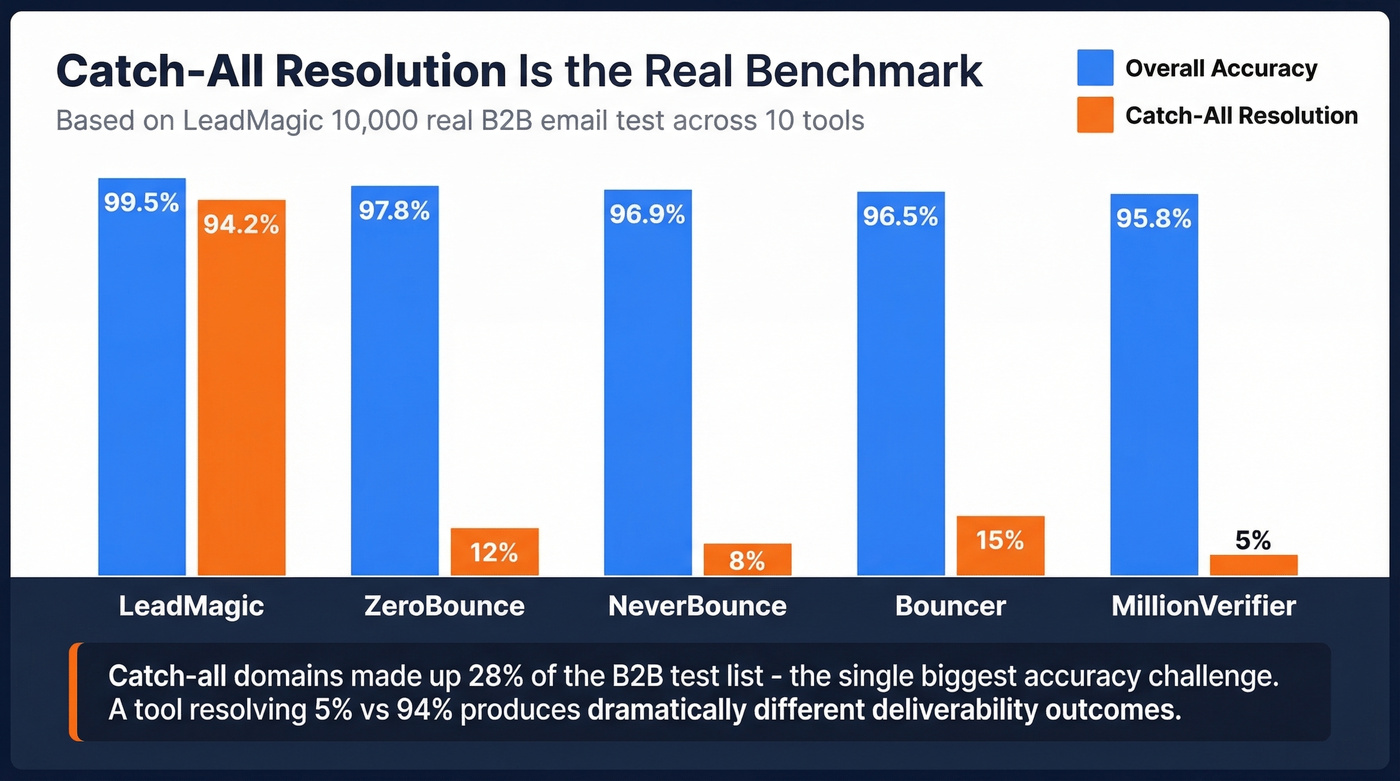
LeadMagic's 10,000 real B2B email test ran addresses through 10 tools within 48 hours:
| Tool | Accuracy | Catch-All Resolved | Cost/10K |
|---|---|---|---|
| LeadMagic | 99.5% | 94.2% | ~$80 |
| ZeroBounce | 97.8% | 12% | ~$65 |
| NeverBounce | 96.9% | 8% | ~$50 |
| Bouncer | 96.5% | 15% | ~$55 |
| MillionVerifier | 95.8% | 5% | ~$6 |
The catch-all column matters most for B2B outbound. A tool resolving 5% of catch-all addresses versus 94% produces dramatically different deliverability outcomes, and Clay's catch-all benchmark confirms the spread, with data quality scores ranging from 76% to 95% across providers.
Most "free email checkers" gloss over this: when a tool marks a catch-all address as "unknown," it's often the only honest answer. But "unknown" still leaves you with a sending decision and no clear path forward.
Best Tools to Verify Email Addresses
| Tool | Best For | Price |
|---|---|---|
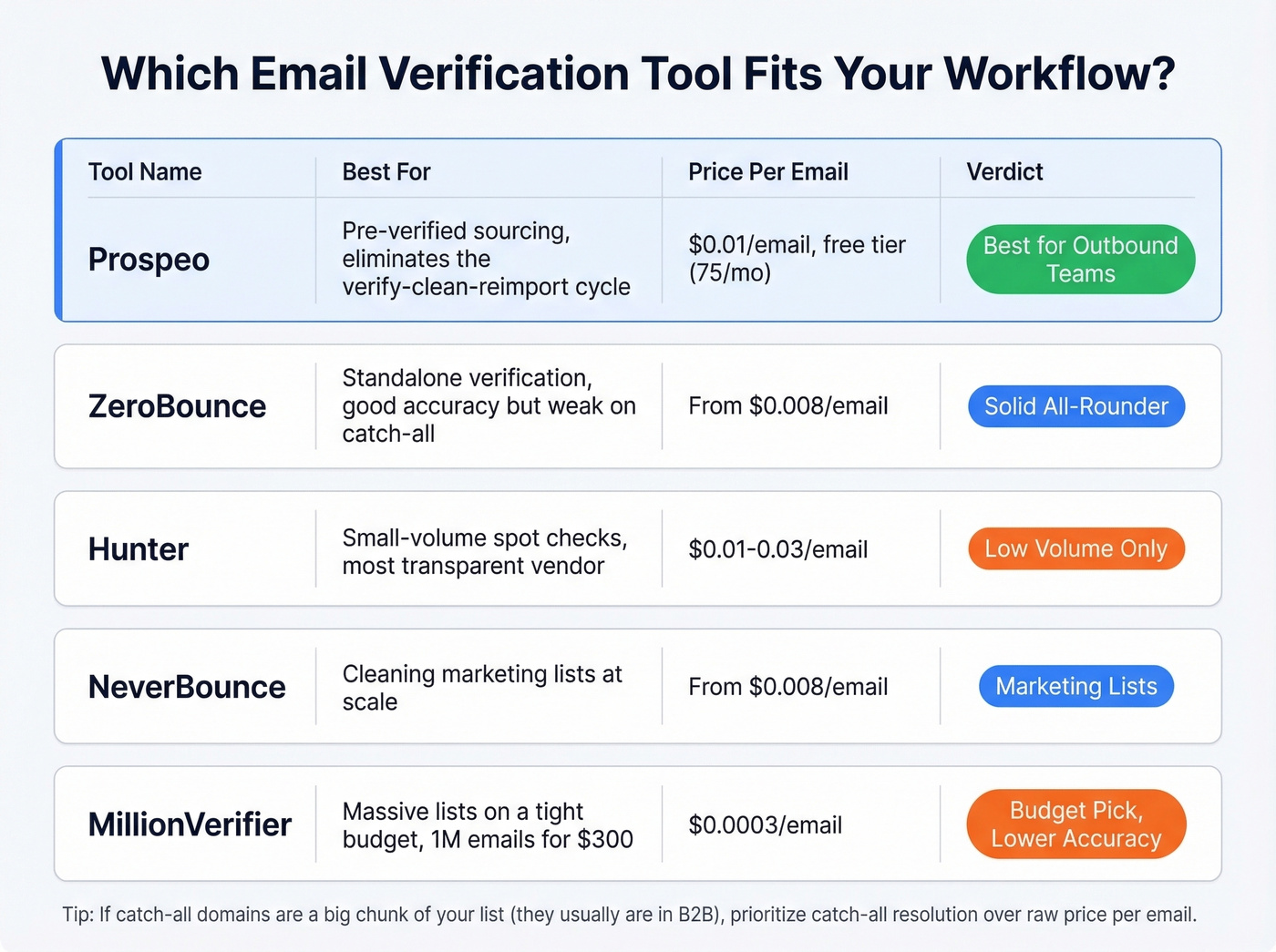
| Prospeo | Pre-verified sourcing | ~$0.01/email, free tier |
| ZeroBounce | Standalone verification | From $0.008/email |
| Hunter | Small-volume spot checks | ~$0.01-0.03/email |
| NeverBounce | Cleaning marketing lists at scale | From $0.008/email |
| MillionVerifier | Massive lists on a tight budget | $0.0003/email |
Prospeo
Verification is a band-aid for bad data sourcing. Prospeo's database covers 300M+ professional profiles with 143M+ verified emails, each run through a 5-step verification process including catch-all handling, spam-trap removal, and honeypot filtering. The 98% email accuracy rate means you're working with contacts that already passed the gauntlet before they ever reach your CRM.
Every record refreshes on a 7-day cycle versus the 6-week industry average. Stack Optimize built to $1M ARR using Prospeo data, maintaining 94%+ client deliverability with bounce rates under 3% and zero domain flags. Pricing starts at roughly $0.01 per email with a free tier of 75 emails/month, no contracts. For outbound teams, this eliminates the "source, export, upload to verifier, re-import" workflow entirely.
ZeroBounce
ZeroBounce hit 97.8% accuracy in the 10K-email benchmark - respectable - but only resolved 12% of catch-all addresses. For lists heavy on enterprise domains, that gap will hurt. The free tier gives you 100 verifications/month when you sign up with a business domain, and pay-as-you-go starts at $0.008/email with monthly plans from $15/mo for 2,000 emails. Skip this if catch-all domains are a significant chunk of your list. In B2B, they usually are.
Hunter
Hunter is the most transparent vendor in this space. They published a benchmark showing their own 70% accuracy ceiling - that honesty is rare, but transparency about bad accuracy doesn't fix it. Catch-all coverage runs 30-44% in Clay's benchmark. Good for small-volume spot checks when you need to verify a single address quickly. You get 100 free verifications/month with an account, and paid plans start around $34/month.
NeverBounce
Reliable mid-range option: 96.9% accuracy, poor catch-all resolution at 8%. Pay-as-you-go from $0.008/email. We've seen teams use NeverBounce successfully for cleaning marketing lists where catch-all isn't a major concern, but for cold outbound to enterprise targets, the catch-all gap is a dealbreaker.
MillionVerifier
The math is hard to argue with: verify a million addresses for $300. But accuracy at 95.8% and catch-all resolution at 5% are the lowest in the benchmark. Skip MillionVerifier if your list is under 100K contacts - the accuracy tradeoff isn't worth it at smaller volumes where every bounce damages your sender score disproportionately.
How Often to Re-Verify
B2B email lists decay at roughly 2-3% per month. Average professional turnover hit 41% in 2023, which means a large share of your contacts can change roles within a year. In our experience, re-verifying every 30-60 days catches most decay before it damages your sender score.
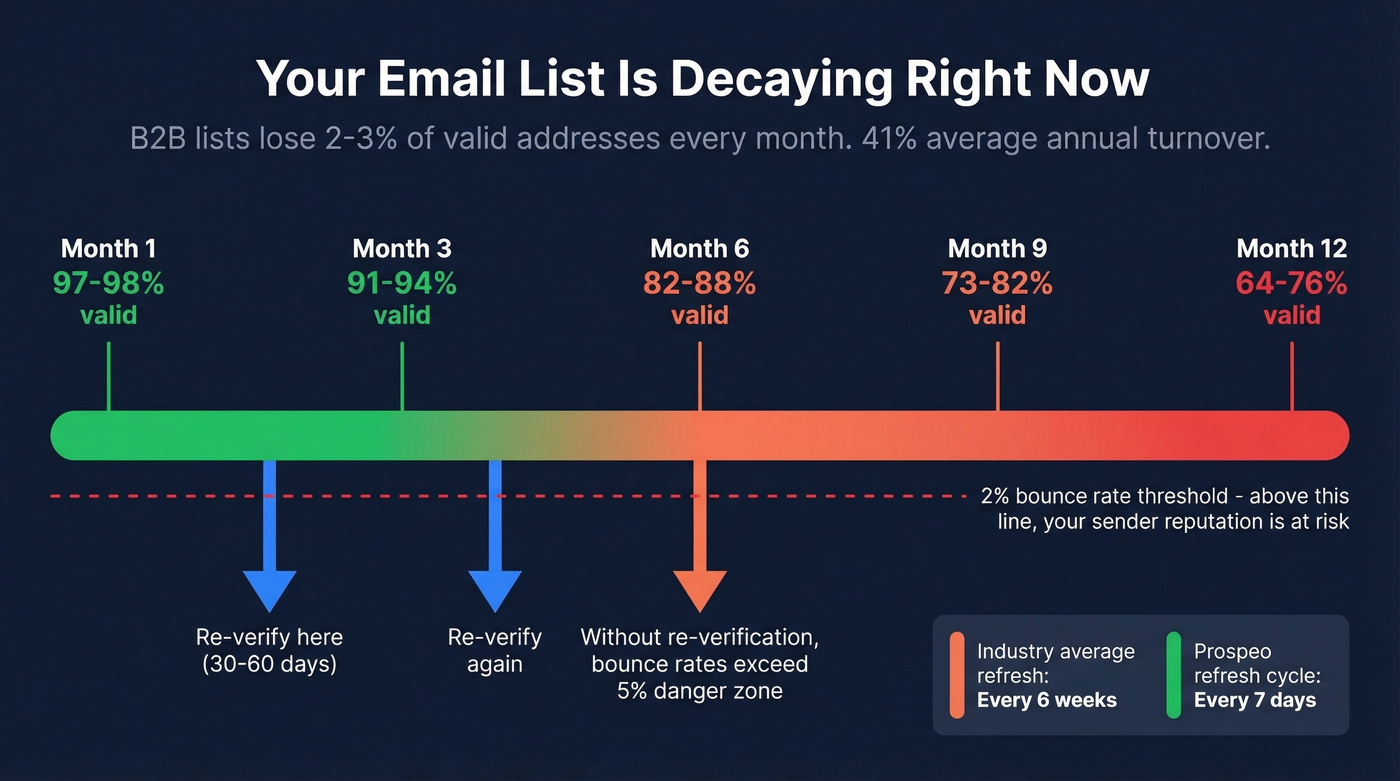
Always re-verify before major campaigns and immediately after importing old contacts. Let's be honest - if you're not routinely confirming each address is still deliverable, you're gambling with your domain reputation. And that's a bet that gets more expensive every time you lose. If you’re seeing repeated bounces, start by diagnosing your email bounce rate and then work on sender reputation before scaling volume.
Re-verifying every 30-60 days costs time and money you shouldn't be spending. Prospeo refreshes all 300M+ profiles every 7 days - not the 6-week industry average. Stack Optimize maintained under 3% bounce rates and zero domain flags building to $1M ARR on Prospeo data alone.
Eliminate the verify-clean-reimport cycle for $0.01 per email.
FAQ
What's a catch-all domain?
A catch-all domain accepts email sent to any address at that domain, whether the mailbox exists or not. In LeadMagic's B2B benchmark, catch-all domains made up 28% of the list - the single biggest accuracy challenge for verifiers. Standard SMTP probing returns false positives on these domains every time.
What bounce rate is too high?
Below 2% is healthy. Between 2-5% signals list quality problems. Above 5% risks sender reputation damage that can take months to repair - ESPs like Google and Microsoft throttle or block senders who consistently exceed that threshold.
Can I check valid email addresses for free?
Yes, with limits. Most tools offer 50-100 free checks per month. For bulk verification, expect $0.0003-$0.008 per email depending on the tool and accuracy level you need.
How do I validate formatting before sending?
Start with a regex or syntax check to catch obvious typos, then run the address through DNS and SMTP verification. The most reliable approach combines all four stages - syntax, DNS, SMTP probing, and risk scoring - to confirm the mailbox actually exists and is safe to send to.