

Clay Email Finder: How to Get Verified Emails in 2026
You hit "Find Email" on 5,000 leads in Clay, wait for the credits to burn, and a big chunk comes back empty. That's not you doing it wrong - it's the normal ceiling of any single email finder.
Clay is a brilliant orchestration layer. It's a mediocre data source.
The native "Find email" action pulls from Clay's provider ecosystem, but single-provider coverage ceilings sit at 40-70% for most B2B segments. For every 1,000 leads you run, 300-600 come back empty. And after Apollo's widely discussed 60% credit cut across paid plans, more teams started leaning on Clay for enrichment volume - which makes the coverage gap feel even more painful unless you build a proper waterfall.
Clay doesn't magically solve the data gap. It gives you a place to stack providers. The gap stays unless you build a real waterfall.
The Short Version
- Clay's built-in email action works, but coverage tops out around 40-70%. You need a waterfall.
- Start your waterfall with an accuracy-first provider, add one or two coverage fallbacks, then validate everything.
- If you're under 5,000 emails/month, skip Clay's credit complexity and use a standalone email finder.
How Email Finding Works in Clay
Clay's "Find email" action takes a contact - a professional profile URL, or a name plus company - and returns an email address. It's available on all plans, using either Clay credits or your own connected accounts via API keys.
Here's what matters about the mechanics:
- Inputs: Name + company, or a profile URL
- Outputs: Contact profile URL + email address
- Credit cost: Around 1-3 credits for a basic email-finding step, scaling with the number of steps you run
- Failed lookups still cost credits - this is the detail that burns people
- Bringing your own API key for a provider like Hunter or Findymail shifts the cost to that provider, but you're now managing two billing systems
The real power isn't the single action. It's chaining multiple providers in sequence so when one misses, the next one catches it.
What Clay Actually Costs
Clay's pricing is credit-based, and the credit math gets complicated fast.
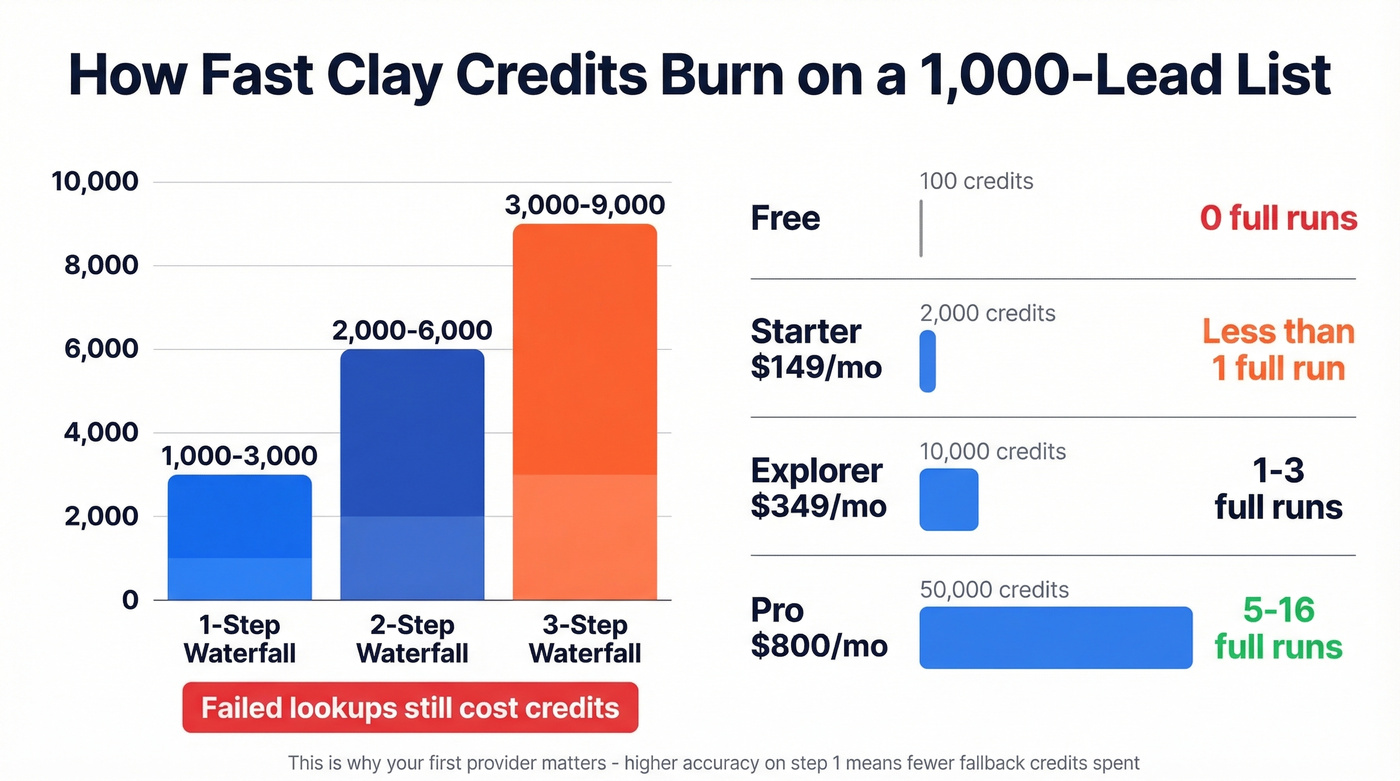
| Plan | Monthly Price | Annual Price | Credits/Month |
|---|---|---|---|
| Free | $0 | $0 | 100 |
| Starter | $149 | $134 | 2,000 |
| Explorer | $349 | $314 | 10,000 |
| Pro | $800 | $720 | 50,000 |
| Enterprise | Custom | Custom | Custom |
The sticker prices look reasonable until you realize how quickly credits evaporate. A three-step email waterfall on 1,000 leads can consume 3,000-9,000 credits. That's your entire Starter plan on a single list.
The top complaint on Reddit about Clay's pricing is action credits. Every workflow step - HTTP requests, integrations, enrichment - eats into your limit. We've seen users migrating pieces of their workflows to n8n and Latenode just to get more predictable billing.

Clay credits burn fast when failed lookups still cost you. Prospeo delivers 98% email accuracy at ~$0.01/email with a native Clay integration - no separate API key, no surprise billing. Put it first in your waterfall and watch your coverage gap shrink.
Stop paying credits for empty results. Get verified emails first.
Best Email Finders to Use Inside Clay
Most Clay tutorials tell you to stack seven providers. That's overkill. You need two or three good ones in the right order.
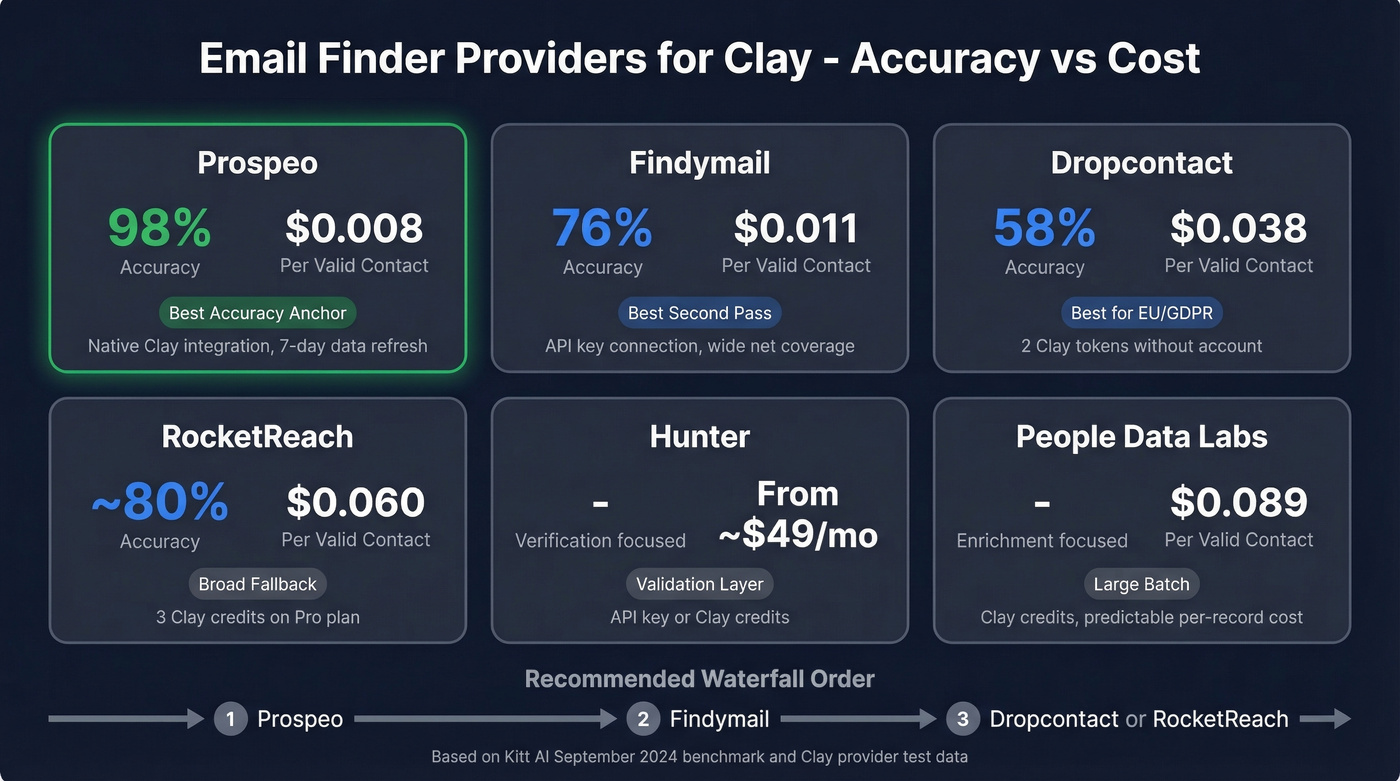
| Provider | Benchmark Accuracy | Cost per Valid Contact | How to Run in Clay | Best For |
|---|---|---|---|---|
| Prospeo | 98% verified | $0.008 | Native integration | Accuracy anchor |
| Dropcontact | 58% | $0.038 | Clay credits or API key | EU/GDPR coverage |
| Findymail | 76% | $0.011 | API key | Coverage fallback |
| RocketReach | ~80% | $0.060 | Clay credits | Broad fallback |
| Hunter | - | From ~$49/mo | API key or Clay credits | Verification layer |
| People Data Labs | - | $0.089 per valid email | Clay credits | Large-batch enrichment |
Benchmark numbers come from the Kitt AI September 2024 benchmark (Financial Services CEOs) and Clay's own provider test write-up where noted.
Prospeo
Put this first in any waterfall.
In the Kitt AI benchmark - run inside Clay and validated with Bounceban - Prospeo delivered 81.6% accuracy at $0.008 per valid contact, the highest accuracy among the non-Kitt tools in that table at the lowest cost per valid contact. That performance comes from proprietary email-finding infrastructure that doesn't recycle the same stale data everyone else has.
The platform runs a 7-day data refresh cycle compared to the 6-week industry average. It integrates natively with Clay, so there's no separate API key to manage. The free tier gives you 75 emails/month - enough to validate data quality before committing. Paid plans start at ~$39/mo with no contracts.
Dropcontact
If your ICP skews European, Dropcontact belongs in your waterfall.
In their own 20,000-contact benchmark, they hit 54.9% real enrichment with 0.9% hard bounces - strong numbers for a GDPR-compliant-by-design provider. The Kitt AI benchmark separately measured their accuracy at 58%. Without a Dropcontact account, each email found/validated/verified costs 2 Clay tokens. Less useful for US-heavy lists where other providers have deeper coverage.
Findymail
Findymail is the best "second pass" tool we've tested. The Kitt AI benchmark showed 76% accuracy with a 49.6% find rate - a wider net than most providers cast, which means it picks up contacts others miss.
Pricing starts around ~$49/mo. Connect via API key in Clay. We've seen teams pair it with an accuracy-first provider to get high precision on the first pass and broader coverage on the second.
The Fallback Tier
RocketReach fills gaps as a broad database. In Clay's own test write-up, it came out to $0.060 per valid email (3 Clay credits on the $800/month plan). Use it as a third-tier fallback, not a primary.
Hunter is better at verification than finding. It connects to Clay via API key or Clay credits and includes Find Work Email, Find Emails by Company, and Validate Email. Paid plans start around ~$49/mo. Put it at the end of your waterfall as a validation layer. If you're comparing options, see Hunter alternatives.
People Data Labs works well for large-batch enrichment, coming in at $0.089 per valid email on the Clay Pro plan. It's useful when you're processing big lists and want predictable per-record economics inside Clay.
What the Benchmarks Actually Show
Let's be honest about benchmark data: a lot of benchmarks in this space are vendor-funded.
The Dropcontact benchmark tested 20,000 contacts across 15 tools using live email delivery - genuinely strong methodology. But Dropcontact funded it and came out on top. The Kitt AI benchmark ran Financial Services CEOs through Clay with Bounceban validation. Kitt AI funded it, and their table also shows Kitt AI as the highest-accuracy tool in that specific test.

The useful signal is the pattern: even in a strong, live-sending benchmark, the top real enrichment rate was 54.9%. No single provider gets you "complete coverage" on its own.
There's also a public dataset of 45,000 searches across 9 tools on Reddit - and the punchline is damning. Some tools marketing "99% accuracy" found 25 valid emails out of 2,500 in one test. The takeaway isn't which benchmark to trust. It's that waterfalls aren't optional.
Building a Clay Email Waterfall
The architecture that consistently hits 95%+ coverage with under 2% bounces follows one principle: put your most accurate provider first. Every valid email caught in step one is a credit you don't spend in steps two and three.
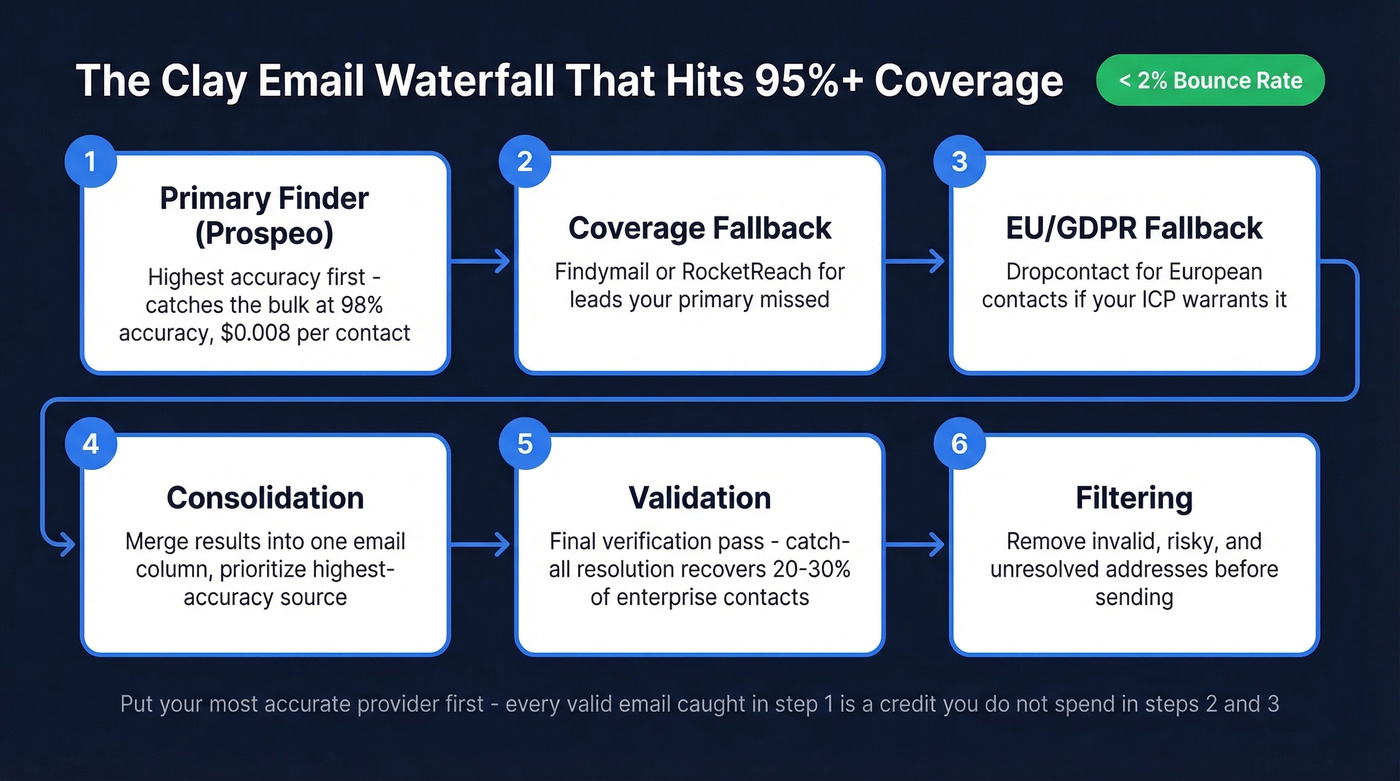
- Primary finder - Your highest-accuracy provider goes first to minimize wasted fallback credits.
- Coverage fallback - Add Findymail or RocketReach for leads your primary missed.
- EU/GDPR fallback - Dropcontact for European contacts that slipped through, if your ICP warrants it.
- Consolidation - Merge results into a single email column, prioritizing the highest-accuracy source.
- Validation - Run a final verification pass. Catch-all resolution alone can recover 20-30% of enterprise contacts that standard validation marks as unverifiable. (If you want a deeper verification stack, see Bouncer alternatives.)
- Filtering - Remove invalid, risky, and catch-all-unresolved addresses before they hit your sequencer. This is also where email deliverability starts or dies.
Here's the thing most people get wrong: they overthink the waterfall and underthink the first provider. If your step-one finder catches a big chunk of emails at high accuracy, your fallback only processes what's left - cutting total spend fast. A mediocre first provider with five fallbacks will always cost more and deliver worse results than a great first provider with one fallback.
If you're still getting lots of blanks, it's usually a process issue, not a tool issue - see Email Not Found?.
The benchmarks are clear: no single provider covers your entire list. But starting your waterfall with Prospeo's 98% accuracy and 7-day data refresh means fewer fallback steps, fewer wasted credits, and cleaner deliverability. 75 free emails/month - no contract required.
Anchor your Clay waterfall with the most accurate email finder available.
When to Skip Clay Entirely
Use Clay if you're running complex, multi-step enrichment workflows on 5,000+ contacts/month and need orchestration across multiple data sources, CRM pushes, and AI research steps. If you're building lists in Clay specifically, read Clay list building.
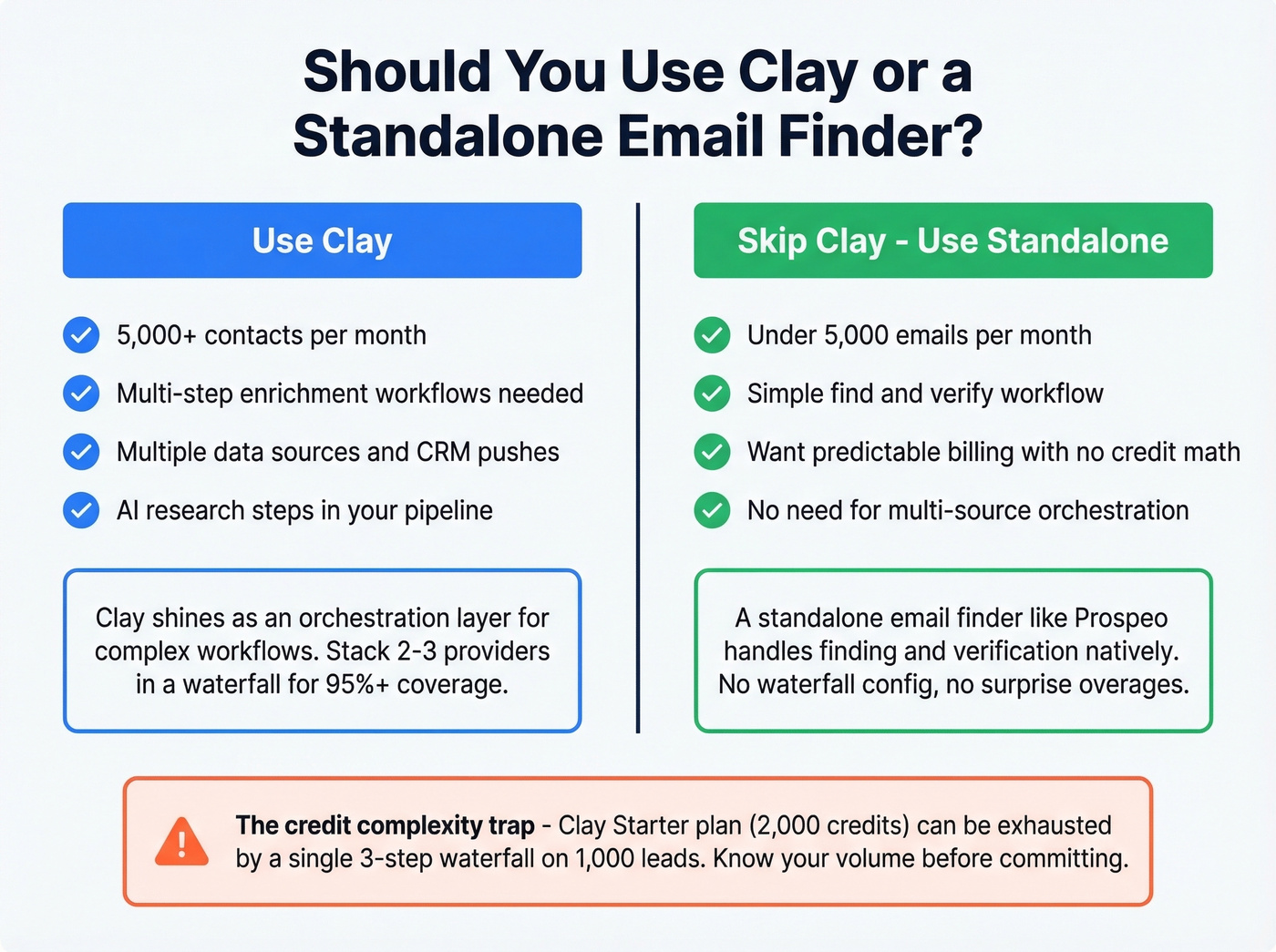
Skip Clay if you're under 5,000 emails/month. The credit complexity isn't worth it. Standalone tools handle finding and verification natively - no credit math, no waterfall configuration, no surprise overages. If you're evaluating the broader category, start with email search tools or email ID finder.
One user in r/gtmengineering described Clay People Search as consistently missing leads and returning inaccurate data, which tracks with what our team hears from teams who switched to dedicated finders. For teams whose volume doesn't justify the orchestration overhead, a standalone email finder is the smarter play.
FAQ
Does Clay find emails for free?
Yes. The Free plan includes 100 credits/month. One lookup costs roughly 1-3 credits, so expect 30-100 free lookups before you need to upgrade.
How many credits does a Clay email lookup use?
Typically 1-3 credits per lookup for a basic email-finding step. A three-step waterfall on 1,000 leads can consume 3,000-9,000 credits - enough to exhaust a Starter plan on a single list. Failed lookups still cost credits.
What's the most accurate email finder for Clay?
Prospeo leads with 98% verified email accuracy and $0.008 per valid contact in the Kitt AI benchmark. It integrates natively with Clay, runs a 7-day data refresh cycle, and offers a free tier of 75 emails/month - making it the strongest accuracy anchor for any waterfall.
Can I use Clay without building a waterfall?
You can, but expect 40-70% coverage at best. Single-provider lookups leave 300-600 leads per thousand without emails. For teams sending under 5,000 emails/month, a standalone finder with built-in verification often delivers better results with less setup.