


Clay Pros and Cons: Is It Worth the Complexity?
You just watched a RevOps engineer build a waterfall enrichment workflow in Clay that pulls from twelve data providers, scores leads by ICP fit, and pushes verified contacts straight into Smartlead - all in a spreadsheet interface. Then you look at the credit meter and realize the demo burned $47 in enrichment credits on 60 leads.
That's Clay in a nutshell. It's the most powerful GTM enrichment platform on the market - and also the most expensive way to learn you needed something simpler. If you've got a dedicated RevOps engineer running complex multi-tool outbound, Clay is worth it. If you're a small sales team or solo founder, the credit burn and learning curve will cost more than the enrichment saves.
What Is Clay?
Clay is a GTM orchestration platform that brings 150+ data providers into a spreadsheet-like interface with 300+ attributes for filtering. You build workflows that pull contact data, company signals, and intent from dozens of sources, then push results into your CRM or sequencer.
Over 50,000 teams use it, and it holds a 4.7/5 on G2 from 189 reviews. Impressive ratings - but they mask a sharp divide between power users and everyone else.
Where Clay Excels
Waterfall enrichment nearly doubles coverage. B2B contact data decays at roughly 22.5% per year, which makes multi-source enrichment less of a luxury and more of a maintenance requirement. Instead of relying on one provider and accepting a 40% email find rate, Clay chains multiple providers together, and independent testing shows this waterfall approach lifts find rates from 40% to 78%.
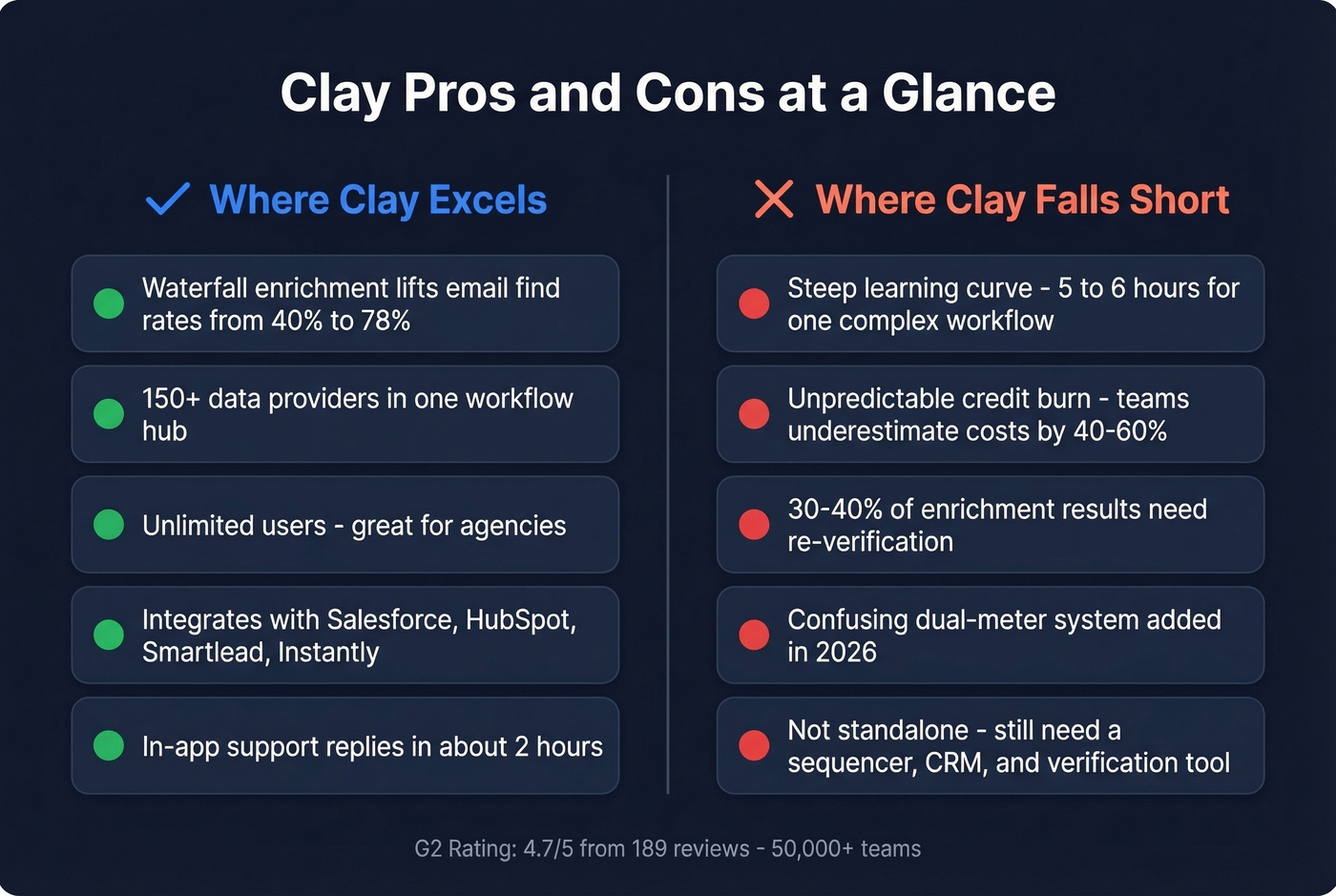
150+ data providers, one workflow hub. Clay routes many providers through its credit system, which cuts down on separate tool contracts. You're still choosing providers and steps, but you're doing it in one place instead of juggling a dozen logins.
G2 reviewers cite ease of use 18 times as a top positive - though that's specifically for basic workflows. A simple enrichment table can be running in 30 minutes. Complex waterfalls are a different story entirely.
Clay integrates with Salesforce, HubSpot, Smartlead, Instantly, Make, and more, so enriched data flows wherever your stack already lives. Plans include unlimited users, and pricing is credit-based rather than per-seat - a real cost advantage for agencies managing multiple client campaigns. Support is solid on weekdays too, with in-app chat replies averaging around 2 hours and Loom walkthroughs in under 4.
Where Clay Falls Short
Here's the thing: the #1 complaint on G2 - with 16 separate mentions - is the learning curve. One reviewer spent 5-6 hours in their first week building a single complex waterfall. Sales managers without ops support burn credits trying to figure out how the platform works before they ever enrich a real lead.
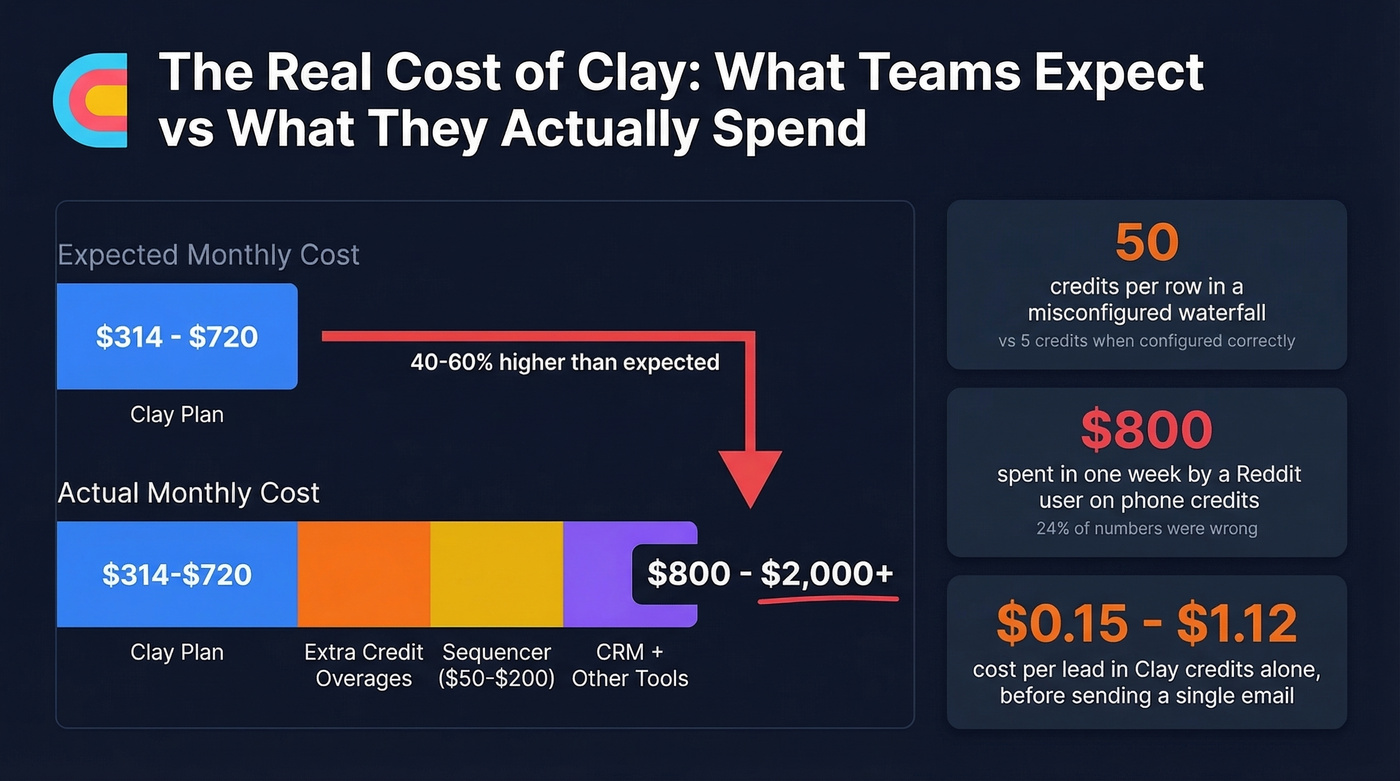
That credit burn is the second problem. One Reddit user spent $800 in a single week on phone credits, with roughly 24% of the numbers being wrong. We've seen teams underestimate total stack cost by 40-60% because a poorly configured waterfall can consume 50 credits per row when you only needed 5. The gap between "expected cost" and "actual cost" is wider here than with any other tool in this category.
Data quality doesn't match the coverage hype. Clay aggregates data from 150+ sources, but aggregation isn't verification. Customer reports indicate 30-40% of enrichment results need re-verification. If you need emails that won't bounce, you'll want a dedicated verification layer on top of Clay's output - see our breakdown of data enrichment vs. verification.
The 2026 pricing-model shift added confusion. In March 2026, users documented Clay splitting its single credit system into two meters: Data Credits for enrichment and Actions for orchestration. Data costs dropped 50-90% on some enrichments, but CRM pushes, Claygent calls, and API execution started consuming Actions separately. Managing two meters is confusing, and API access moved to the $495/mo Growth plan.
Some users have already moved orchestration workflows to Make or Latenode to avoid the new Actions meter. That tells you something.
Not a standalone tool. Clay is prep, not execution. You still need a sequencer, a CRM, and sometimes additional premium data providers. It finds and enriches contacts; it doesn't send emails or manage deals.
If your workflow is mostly outbound, it’s worth comparing your stack against other SDR tools before committing to a complex orchestration layer.

If 30-40% of Clay's enrichment results need re-verification, you're paying twice - once for credits, once to clean the data. Prospeo's 5-step verification delivers 98% email accuracy out of the box. No waterfall configuration. No second tool. At $0.01 per email, your total cost per lead stays predictable.
Skip the re-verification layer. Get emails that are accurate the first time.
Clay Pricing in 2026
Clay's current public pricing on annual billing:
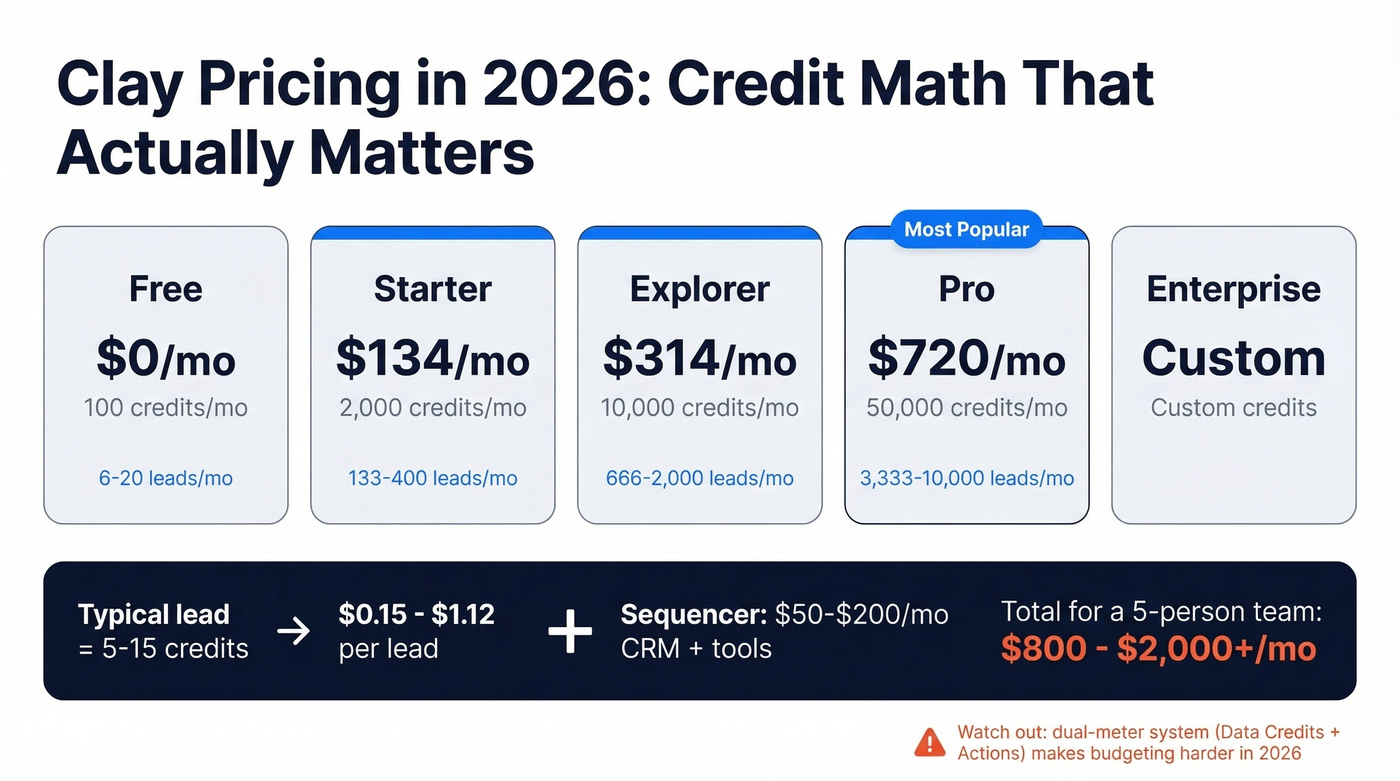
| Plan | Price/mo | Credits |
|---|---|---|
| Free | $0 | 100 credits/mo |
| Starter | $134 | 2,000 credits/mo |
| Explorer | $314 | 10,000 credits/mo |
| Pro | $720 | 50,000 credits/mo |
| Enterprise | Custom | Custom |
A typical lead consumes 5-15 credits across enrichment steps. At $0.03-$0.075 per credit, that's $0.15-$1.12 per lead before you've sent a single email.
Factor in the rest of the stack - sequencer at $50-$200/mo, CRM, and any other outbound tools - and a 5-person team is looking at $800-$2,000+ per month in total costs.
Let's be honest: Clay isn't expensive for what it does. It's expensive for what most teams actually need. If your outbound motion is "find emails, verify them, send sequences," you're paying for an orchestration engine to do a data provider's job.
If you’re evaluating vendors, it helps to benchmark against other data enrichment services and sales prospecting databases to see what you’re actually paying for.
The Verdict
In our testing, the credit burn was the biggest surprise - not the dollar amount, but how fast it compounds when you're iterating on workflows. One afternoon of experimentation cost more than a month of a simpler tool.
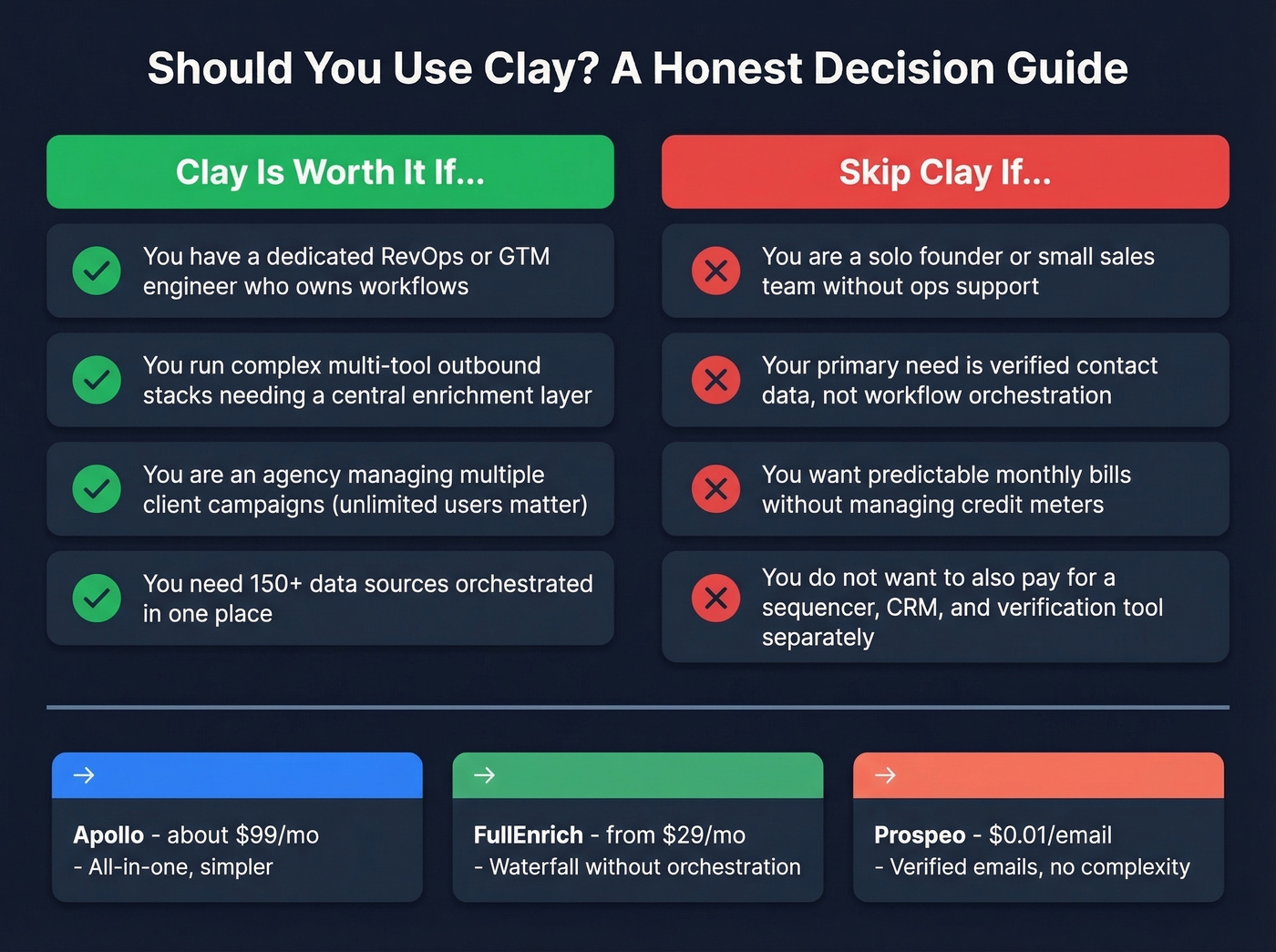
The teams that get ROI from Clay share three traits: they have a dedicated RevOps or GTM engineer who owns the workflows, they run complex multi-tool outbound stacks that need a central enrichment layer, and they're often agencies managing multiple client campaigns where unlimited users matter.
Skip Clay if you're a solo founder or small sales team without ops support. Skip it if your primary need is verified contact data rather than workflow orchestration. And definitely skip it if you don't want to manage multiple meters, a separate sequencer, and unpredictable monthly bills.
Cognism positions Clay as built for Ops engineers. If that's not your team, Apollo at ~$99/mo gives you an all-in-one platform that's far simpler to operate. Weighing these Clay pros and cons honestly, the platform is best-in-class for orchestration - but orchestration isn't what most outbound teams are bottlenecked on. Most teams are bottlenecked on data quality.
If you’re building an outbound motion from scratch, start with proven sales prospecting techniques and then choose tooling that matches your team’s ops capacity.
Alternatives Worth Considering
Apollo (~$99/mo) - All-in-one prospecting with a built-in sequencer. Less powerful enrichment, but you won't need five other tools to run outbound.
FullEnrich (from $29/mo) - Waterfall enrichment without the orchestration layer. Good middle ground.
Airscale (from $49/mo) - The consensus on r/sales is that the cost is "peanuts" compared to Clay for similar multi-source enrichment.
Databar (from $39/mo) - Similar multi-source enrichment at a lower entry point.
For orchestration without Clay's credit system, some teams use Make or Latenode to run enrichment APIs directly. If your main pain is bounce risk, compare dedicated verifiers in our guide to Bouncer alternatives.
FAQ
Is Clay worth it for small sales teams?
For most teams under 5 reps without dedicated RevOps support, no. The learning curve averages 5-6 hours for a single complex workflow, and misconfigured waterfalls can burn 10x the credits you planned. Apollo at ~$99/mo or Prospeo at $0.01/email deliver verified contacts without the orchestration overhead.
How much does Clay actually cost per lead?
Expect $0.15-$1.12 per lead in Clay credits alone, depending on enrichment steps. Add your sequencer at $50-$200/mo and CRM, and a 5-person team typically spends $800-$2,000+ per month total. Teams routinely underestimate actual costs by 40-60%.
What's the biggest downside of using Clay?
Unpredictable credit consumption. A poorly configured waterfall can use 50 credits per row when 5 would suffice. Combined with the dual-meter system introduced in March 2026, budgeting becomes genuinely difficult without ops expertise.
Can Clay replace my data provider?
Clay aggregates data from 150+ sources but doesn't verify it to deliverability standards. Customer reports show 30-40% of results need re-verification. For clean, send-ready emails, you still need a dedicated verification tool layered on top or used independently.
Most outbound teams aren't bottlenecked on orchestration - they're bottlenecked on data quality. Prospeo gives you 300M+ profiles with 30+ search filters, 125M+ verified mobiles, and a 7-day data refresh cycle. No credit meters to manage, no $800 surprise bills, no RevOps engineer required.
Enterprise-grade data without the enterprise complexity. Start free today.