

Client Engagement: What It Actually Takes in 2026
A CSM at an early-stage startup posted on r/CustomerSuccess with a problem that'll sound familiar: customers were logging in regularly but wouldn't respond to a single email or pick up a call. HubSpot marketing emails showed rock-bottom engagement. The product was being used. The relationship was dying anyway.
That gap between product usage and relationship health is where most client engagement strategies fall apart. Teams confuse activity with connection, check-ins with value, and CRM data with actual understanding.
What Client Engagement Actually Means
Client engagement is an ongoing, strategic relationship in which both parties succeed. Three elements show up across every credible definition: ongoing two-way communication, a dynamic relationship that builds loyalty over time, and measurable progress against stated goals.
That last part is what separates engagement from vague relationship-building. If you can't measure it, you're just being friendly. Friendly doesn't prevent churn.
Some teams - especially those coming from a sales enablement background - define engagement narrowly as "how prospects interact with content." That framing misses the point entirely. Real engagement spans every post-sale interaction: strategic reviews, support conversations, product adoption, executive alignment, and expansion discussions. It also rests on what Harvard Business School calls the trust triangle: authenticity, logic, and empathy. If your clients don't trust your motives, your competence, or your ability to understand their world, no engagement tactic will save you. Transparency in sales and post-sale interactions is the fastest way to build that trust, because hiding bad news or sugarcoating metrics erodes credibility faster than any competitor can.
Here's something worth calling out: disengagement doesn't always look like silence. A thread on r/projectmanagement captured it perfectly - sometimes disengagement is a critical stakeholder who takes three weeks to approve a one-paragraph scope change. Decision latency is disengagement in disguise.
The terminology in this space gets muddy fast. Here's how the concepts actually differ:
| Concept | Focus | Timeframe | Who Owns It |
|---|---|---|---|
| Client Engagement | Relationship depth | Ongoing | AM / CSM / Exec |
| Customer Experience | Interaction quality | Per touchpoint | CX / Product |
| Customer Satisfaction | Happiness snapshot | Point-in-time | Support / CS |
| Customer Success | Outcome achievement | Lifecycle | CS team |
Engagement is the foundation. Without it, satisfaction surveys return empty, success metrics stall, and experience improvements go unnoticed because nobody's paying attention.
Why Engagement Drives Revenue
The business case isn't theoretical. Gallup's research shows fully engaged customers deliver +23% in share of wallet, profitability, and revenue growth. Actively disengaged customers? A -13% drag across those same metrics. That's a 36-point swing based entirely on relationship quality.
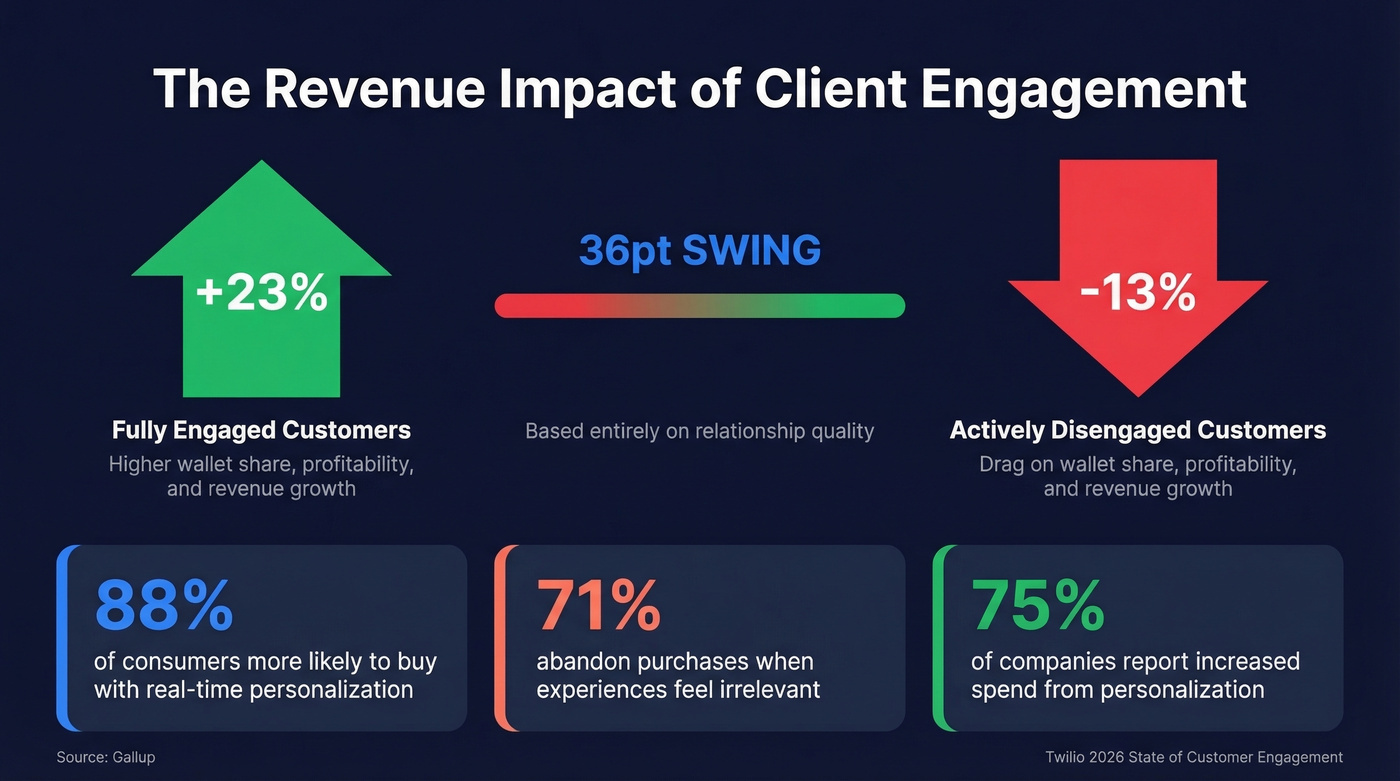
Twilio's 2026 State of Customer Engagement report - surveying 7,640 consumers and 637 business leaders across 18 countries - found that 88% of consumers are more likely to buy when engagement is personalized in real time. On the flip side, 71% abandon purchases when experiences feel irrelevant. And 75% of companies report increased customer spend directly from personalization efforts.

SAP's Engagement Index 2026 paints a bleaker picture: only 38% of consumers believe brands know who they are and what they need when contacted. That's a trust gap most teams haven't closed.
The loyalty management market reflects this urgency, growing from $15.19B in 2025 to a projected $41.21B by 2032 at a 15.3% CAGR. The classic retention stat still holds: a 5% increase in retention drives 25-95% higher profits. Companies aren't spending billions on loyalty infrastructure because it's trendy - they're doing it because disengagement is expensive.
Engagement Health Check
Before building strategies, diagnose where you actually stand. Run through these five questions honestly:
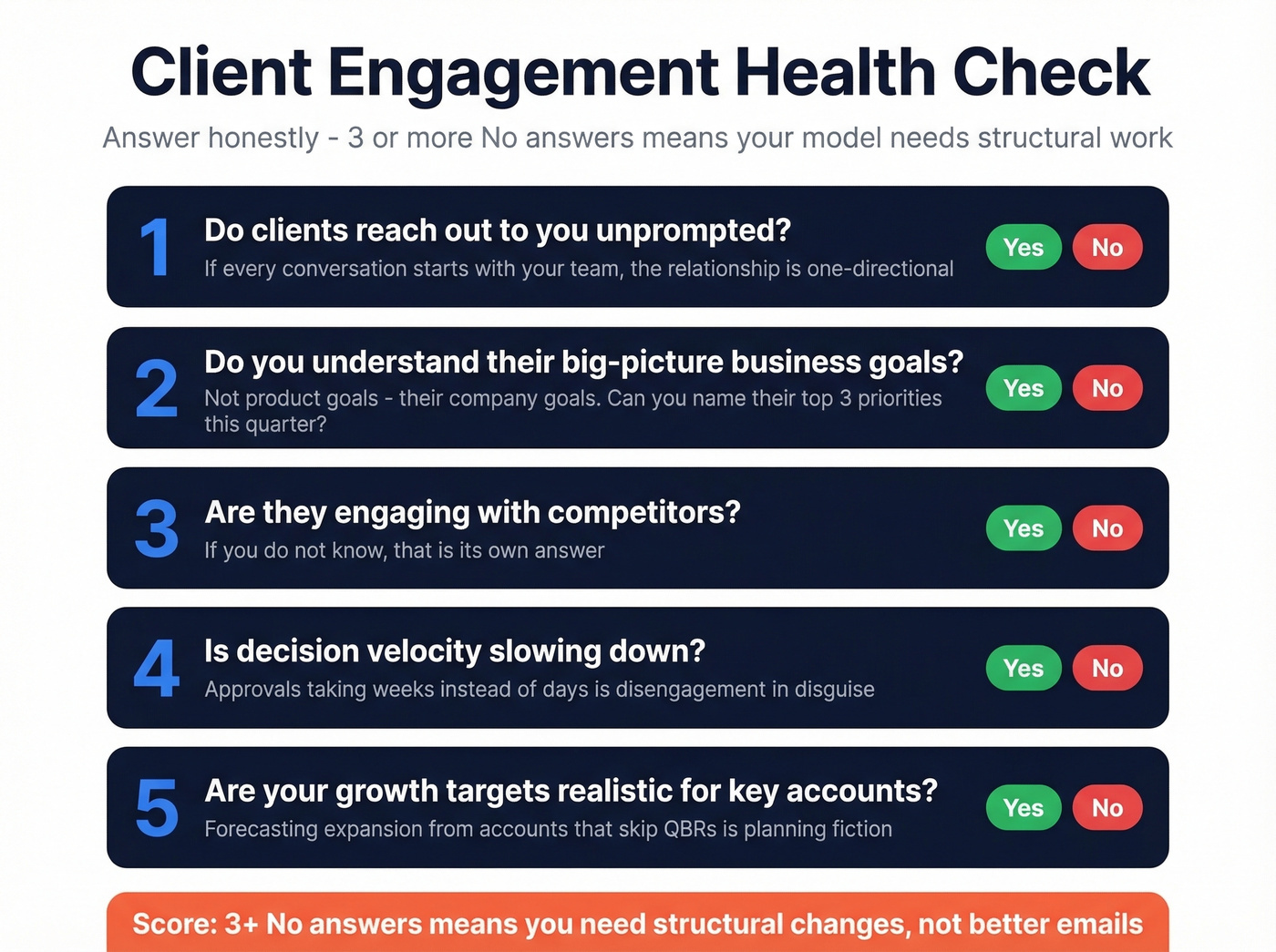
Do clients reach out to you unprompted? If every conversation starts with your team, the relationship is one-directional. That's a warning sign.
Do you understand their big-picture business goals? Not their product goals - their company goals. If you can't name their top three priorities this quarter, you're operating blind.
Are they engaging with competitors? If you don't know, that's its own answer. Engaged clients tell you about alternatives because they trust you to respond.
Is decision velocity slowing down? Approvals that used to take a day now take two weeks. Scope changes stall. This is disengagement wearing a business-process disguise, and it's more dangerous than silence because it doesn't trigger any alert in your CRM.
Are your growth targets realistic for key accounts? If you're forecasting expansion from accounts that haven't attended a QBR in two quarters, you're planning fiction.
Three or more "no" answers means your engagement model needs structural work, not just better emails.
B2B Engagement Models
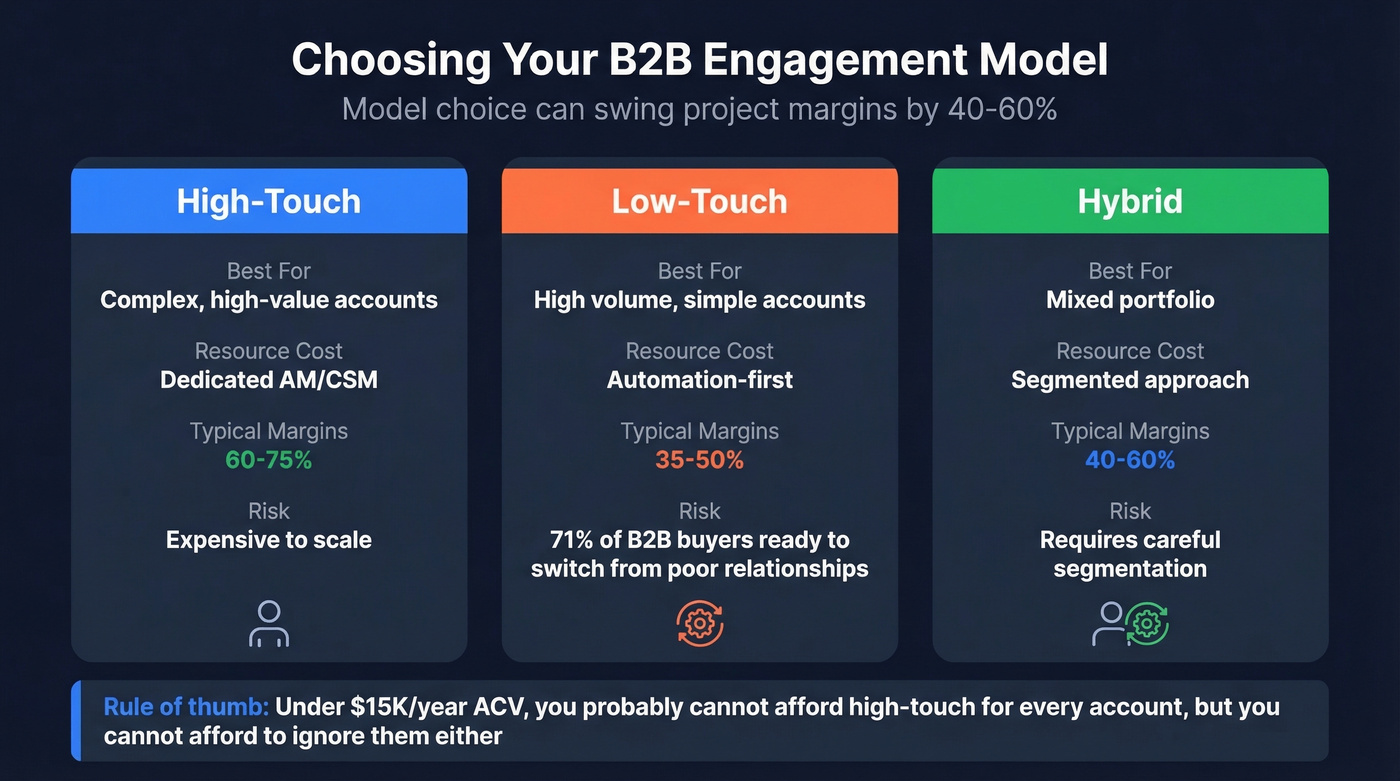
Not every client deserves the same engagement investment. The model you choose has direct margin implications - Rework's research shows engagement model choice can swing project margins by 40-60%.
| Model | Best For | Resource Cost | Typical Margins |
|---|---|---|---|
| High-touch | Complex, high-value | Dedicated AM/CSM | 60-75% |
| Low-touch | High volume, simple | Automation-first | 35-50% |
| Hybrid | Mixed portfolio | Segmented approach | 40-60% |
High-touch works when you have complex accounts where relationship depth drives expansion. A dedicated CSM who knows the client's org chart, politics, and goals is worth the cost when deal sizes justify it. Advisory engagements in this model can hit 65-80% margins.
Low-touch makes sense for transactional accounts where automation handles most interactions. The risk: 71% of B2B customers are ready to switch providers due to poor relationship management. Automation without any human warmth creates exactly the kind of disengagement that drives churn.
Most B2B teams land on the hybrid model. A SaaS company with 500 mid-market accounts might run high-touch for the top 50, hybrid for the next 200, and low-touch automation for the rest. Here's the thing - acquiring new customers costs up to 20x more than retaining existing ones, so even your "low-touch" segment deserves intentional design.
If your average contract value is under $15K/year, you probably can't afford high-touch engagement for every account. But you also can't afford to ignore those accounts. The hybrid model isn't a compromise - it's the only model that scales without hemorrhaging either margin or relationships.

Disengaged clients don't respond to generic emails - they respond when you reach the right person, at the right number. Prospeo gives you 125M+ verified mobiles with a 30% pickup rate and 98% accurate emails, so your re-engagement outreach actually lands.
Stop losing accounts to bad contact data. Start conversations that stick.
10 Strategies That Actually Work
Segment by Use Case, Not Industry
A CSM on r/CustomerSuccess described being asked to build an engagement plan in three days for a platform spanning food & beverage, manufacturing, and banking. The instinct is to segment by vertical. The better move: segment by how they use your product. Two manufacturing companies using your platform for completely different workflows need different engagement approaches regardless of sharing an industry code.
Nail Onboarding
Onboarding sets the engagement ceiling. Build it as a prescribed set of plays - objectives, team responsibilities, reference materials, and step-by-step instructions - not a vague "get them started" handoff. Every stalled onboarding becomes a disengaged account if you let it linger.
Run QBRs Religiously
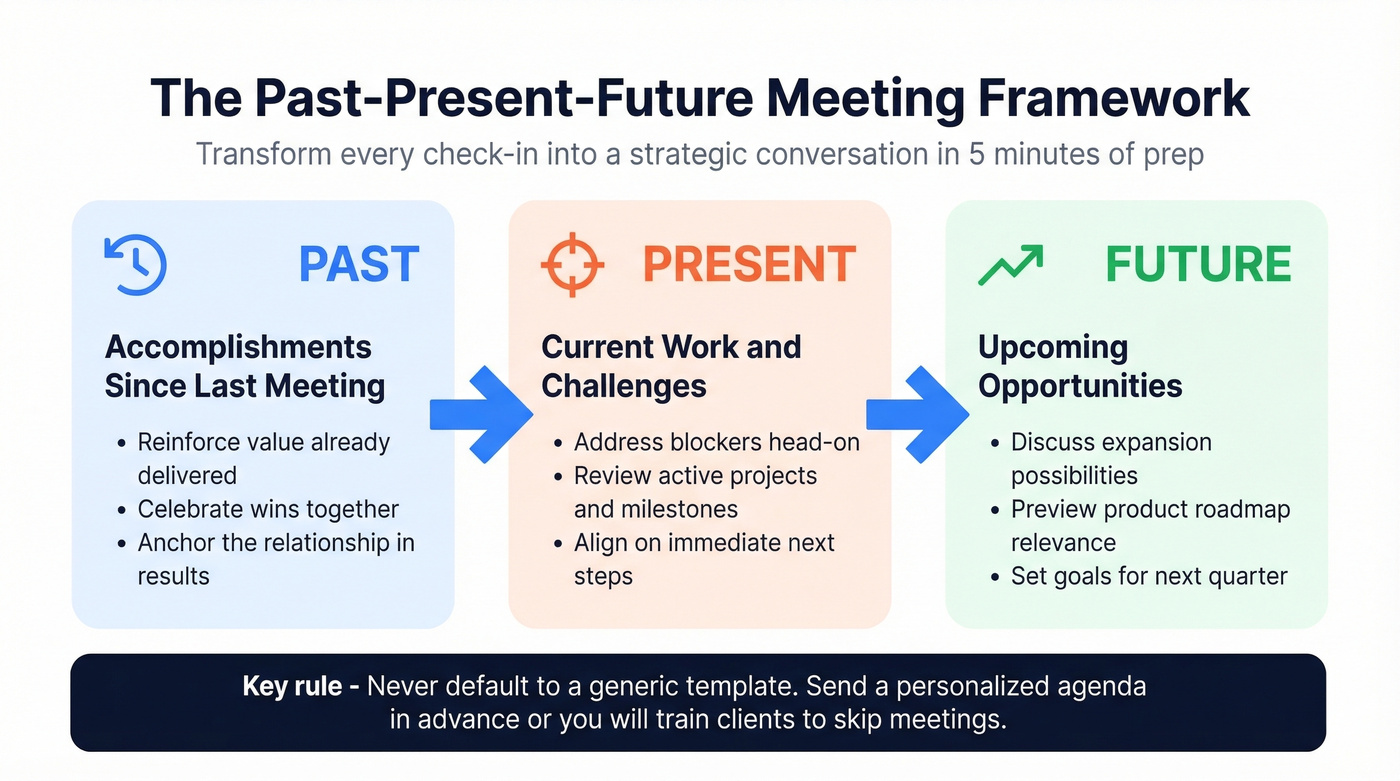
There's a direct correlation between QBR frequency per rep and expansion pipeline identified. Upkeep's SVP of CS calls QBRs a "money activity" - and the data backs it up. Run them quarterly for strategic accounts, especially those approaching renewal. The key: send a personalized agenda in advance. Never default to a generic template or you'll train clients to skip them.
Use the Past-Present-Future Framework
Every client meeting should follow this structure from Consulting Success: Past - accomplishments since last meeting, reinforcing value delivered. Present - current work, challenges, immediate next steps. Future - upcoming opportunities and expansion. It takes five minutes to prep and transforms a check-in into a strategic conversation.
Personalize With Real-Time Data
Twilio's data is unambiguous: 88% more likely to buy with real-time personalization, 71% abandon when it's irrelevant. Yet 84% of brands don't excel at differentiating with personalization. That 84% gap is your opening - most competitors know personalization matters but haven't operationalized it.
AI has become table stakes here. Twilio reports that 96% of companies say AI is improving customer-facing operations. The practical applications for engagement teams: AI-powered health scoring that flags at-risk accounts before a human would notice, predictive churn models that weight behavioral signals automatically, and personalized content recommendations based on product usage patterns. If you're still manually reviewing dashboards to spot disengagement, you're already behind.
Build Re-Engagement Sequences Early
Reactive re-engagement is always worse than having a playbook ready. Build your sequence now - channel escalation paths, trigger conditions, message templates - so when an account goes dark, your team executes instead of improvises. The full playbook is in the next section.
Map Multiple Stakeholders
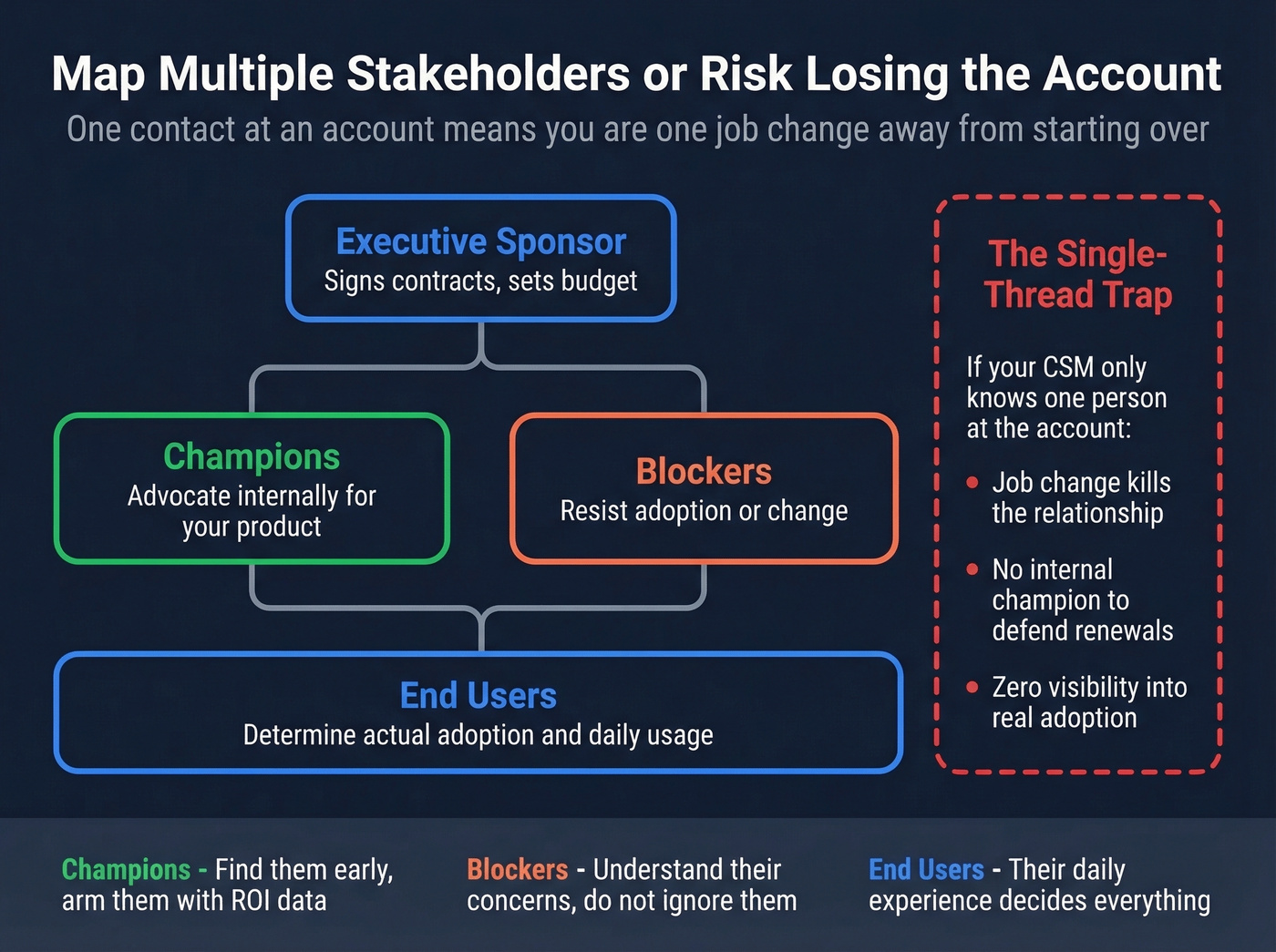
One of the most common engagement mistakes from Collective54's research is only talking to executives. Executives sign contracts; frontline users determine adoption. If your CSM only has one contact at an account, you're one job change away from starting over. Map champions, blockers, and end users across every strategic account.
Make Every Touch Count
Wynne Brown, former CS leader at GitHub and DocuSign, put it perfectly: "If you're writing 'just want to touch base,' don't send it." Every interaction should deliver value - a relevant insight, a product tip, a benchmark comparison, an introduction. Touches without substance erode trust faster than no touch at all.
Create Self-Service Resources
A knowledge base, a Loom video library, a community forum - these aren't engagement replacements, they're engagement multipliers. Clients who can solve problems independently engage more deeply on strategic conversations because they're not wasting meeting time on support questions.
Start With Clean Contact Data
This is the unsexy strategy nobody talks about. Your engagement outreach fails silently when contact data is stale. Emails bounce, phone numbers are disconnected, and the CSM thinks the client is disengaged when the message never arrived. We've seen teams discover that 20-30% of their "disengaged" contacts simply had outdated email addresses. Running your top accounts through an email verification tool before the next QBR cycle catches these dead addresses before they poison your engagement metrics.
How to Re-Engage Silent Clients
Let's be honest: "silent client" usually means the account that logs into your product regularly but won't respond to emails, won't get on calls, and shows low engagement with every marketing touchpoint. The Reddit CSM who posted about this wasn't dealing with a churning customer - they were dealing with a communication breakdown.
Here's the playbook.
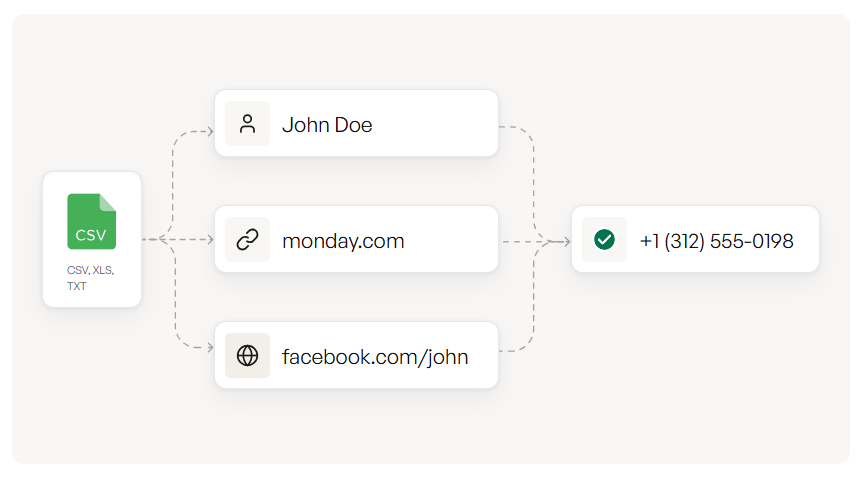
Step 1: Verify your contact data first. Before assuming a client is ignoring you, check whether your emails are actually arriving. Run your contact list through an email verification tool. Bounced emails don't generate "disengaged" alerts in most CRMs. They just disappear.
Step 2: Try a different channel. If email isn't working, send a 60-second Loom video. Reference something specific they've done in your product recently. The novelty of video cuts through inbox noise in a way that another templated email never will.
Step 3: Use behavior-triggered outreach. If they're logging in, you know when they're active. Reach out right after a login event. The timing alone signals that you're paying attention - not just running a sequence.
Step 4: Reframe the conversation. Don't ask for a "check-in." Ask: "I want to understand your priorities for this quarter so we can make sure you're getting the right value." Goal-capture framing gives them a reason to show up.
Step 5: Escalate internally. Loop in their executive sponsor or a different stakeholder. Sometimes the silence is with one person, not the whole account. Multi-threading solves this.
Step 6: Show new value. A cross-sell motion framed as "here's something that solves a problem you mentioned six months ago" can restart a stalled relationship faster than any check-in cadence.
10 Engagement Mistakes That Kill Deals
The first three mistakes here are the ones we see destroy the most revenue. The rest are common but more fixable.
Leading with the deck, not dialogue. You walk into a QBR, share your screen, and start clicking through slides. The client checks out by slide three. Start every meeting with discovery questions. Let the client talk for the first ten minutes. The deck is a reference document, not a script.
Solving symptoms, not systems. A client complains about slow onboarding. You throw more resources at onboarding. Three months later, the same complaint surfaces because the root cause was unclear success criteria, not staffing. Ask "why" three times before proposing solutions.
Only talking to executives. A project manager on r/projectmanagement described a project that stalled for weeks because the only client contact was a VP who was too busy to respond. The frontline team had answers and urgency - nobody was talking to them. Map frontline users and mid-level champions. They determine adoption.
Measuring too much - or nothing. Pick 3-5 KPIs. Track them consistently. Everything else is noise. In our experience, teams that track fewer than 3 engagement signals end up tracking none consistently.
Confusing activity with progress. Count outcomes like expansion, retention, and NPS movement - not meetings held.
The remaining five mistakes are equally dangerous but more straightforward to fix: undefined scope and unclear expectations at kickoff, making assumptions instead of asking the client directly, failing to plan handoff so your champion can run without you, ignoring internal politics and influence networks, and overcustomizing or overtemplating your approach. Use frameworks, but adapt them with discipline. Cookie-cutter engagement feels lazy; fully custom engagement doesn't scale.
How to Measure Engagement
SAP's Engagement Index 2026 found that only 21% of brands have reached high engagement maturity. A full 63% are still at "developing" stage. The difference usually comes down to measurement discipline.
| Metric | What It Tells You | Strong Target |
|---|---|---|
| NPS | Loyalty + advocacy | 20-40 solid, 50+ excellent |
| CSAT | Satisfaction snapshot | 80-90% |
| CES | Effort to get value | Lower is better |
| CLV | Long-term revenue | Trending up QoQ |
| Retention Rate | Relationship durability | Above segment avg |
| Churn Rate | Relationship failure | Below segment avg |
| Upsell/Cross-sell Freq | Expansion health | Increasing QoQ |
Beyond surveys, track behavioral signals: email response rates, meeting attendance, QBR participation, support ticket sentiment, and expansion conversations. CustomerGauge's research shows a 10-point NPS increase correlates with 3.1% higher revenue - meaningful at scale.
The simplest engagement scoring model weights five signals: login frequency, support ticket sentiment, QBR attendance, NPS response rate, and expansion conversation frequency. Assign each a 1-5 score, weight by importance to your business, and you've got a composite health score that's more actionable than any single metric. AI-powered CS platforms like Gainsight and ChurnZero now automate this scoring with predictive models that flag accounts trending toward churn weeks before a human would catch it. Track monthly. Flag accounts that drop two or more points.
Your Engagement Tech Stack
You don't need fifteen tools. You need three layers working together.
Layer 1: CRM. Salesforce or HubSpot, depending on your scale and budget. HubSpot's free tier works for early-stage teams; Salesforce runs roughly $25-300/user/month depending on edition. This is your system of record for every client interaction.
Layer 2: Contact data accuracy. Clean data is the unsexy foundation that makes every other engagement tool work. Prospeo's CRM enrichment returns 50+ data points per contact at an 83% enrichment match rate - job titles, mobile numbers, company data - so your outreach reaches the right person with the right context. At roughly $0.01 per email with no annual contracts, it's a fraction of what enterprise data tools charge.
Layer 3: Communication and intelligence. Loom for async video (free tier available), Slack Connect for real-time collaboration at $8-15/user/month, and your CS platform of choice. For larger teams, Gainsight or ChurnZero run $2,000-15,000+/month but add AI-driven health scoring, playbook automation, and renewal management that justify the cost at scale. Look for platforms that offer predictive engagement signals - the ability to flag a disengaging account before the CSM notices is worth the premium alone.
Your hybrid engagement model is only as good as the data behind it. Prospeo enriches your CRM with 50+ data points per contact - job changes, department headcount, buyer intent across 15,000 topics - so you know which accounts need high-touch before they go silent.
Spot disengagement signals before they become churn. Enrich your accounts today.
FAQ
What's the difference between client engagement and customer success?
Client engagement measures relationship strength and two-way interaction quality. Customer success focuses on ensuring clients achieve desired outcomes. Engagement is the how; success is the result. They're distinct disciplines with different metrics and ownership, though they feed each other constantly.
How often should you run QBRs?
Quarterly for strategic accounts, especially near renewal or showing churn risk. Skip them for truly transactional accounts where the contract value doesn't justify the prep time. Every QBR needs a personalized agenda sent in advance - generic decks train clients to decline.
What's the fastest way to re-engage a silent client?
Send a 60-second Loom video referencing something specific they've done in your product. Reframe around their goals, not your check-in cadence. If emails are bouncing, verify your contact data first - teams routinely find 20-30% of "disengaged" contacts simply have stale addresses.
How do you measure client engagement effectively?
Track 3-5 weighted signals: NPS, QBR attendance, email response rates, product usage, and expansion conversations. Combine them into a composite health score. A 10-point NPS increase correlates with 3.1% higher revenue, so even small measurement improvements compound.
How does data quality affect engagement outcomes?
Stale contact data means emails bounce and calls reach disconnected numbers - your outreach never arrives. Verifying emails at 98% accuracy and refreshing data on a weekly cycle ensures engagement efforts reach the right people at current addresses, eliminating false disengagement signals.